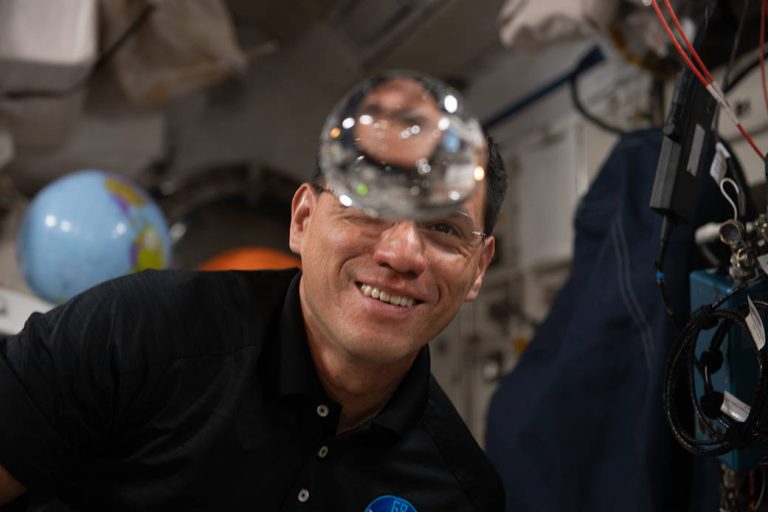
NASA astronaut and Expedition 68 Flight Engineer Frank Rubio is all smiles as he observes the behavior of a free-flying water bubble inside the International Space Station’s (ISS) Kibo laboratory module on Oct. 10, 2022.
Fluid physics is the study of liquid and gas motion and the effects of forces on liquids and gases. The International Space Station’s low-gravity environment offers a unique place to study fluid physics. Nearly weightless conditions allow researchers to observe and control fluid phenomena in ways not possible on Earth. Learn more about fluid physics research on the ISS.
Media are invited to a news conference with NASA Administrator Bill Nelson and other agency leadership at 10 a.m. EST on Wednesday, Jan. 18, at NASA Headquarters in Washington. Leadership will discuss the next step forward with the agency’s Sustainable Flight Demonstrator project.
NASA aims to develop technology and designs for a new generation of lower-emission single-aisle airliners. Through this project, NASA will fund the design, construction, and ground and flight testing for a large-scale demonstrator with an advanced airframe configuration.
The event will air live on NASA Television, the NASA app, and the agency’s website.
The agency’s Sustainable Flight Demonstrator project also will include the development of related green technologies, with the goal of validating them to inform industry decisions about the next generation of single-aisle aircraft entering the market by the 2030s.
Other agency participants in the news conference include:
Deputy Administrator Pam Melroy
Bob Pearce, associate administrator, Aeronautics Research Mission Directorate
Brent Cobleigh, project manager
Media interested in attending in-person or virtually must RSVP up to two hours before the start of the event, to Roxana Bardan at: [email protected]. The event will take place in the Webb Auditorium at the Mary W. Jackson NASA Headquarters building, located at 300 E. Street SW, Washington, D.C.
Learn more about NASA’s Sustainable Aviation efforts at:
NASA has selected Banner Quality Management Inc., of Friendswood, Texas, to provide safety and mission assurance, engineering, and technical services to the agency in various locations across the country.
The Safety and Mission Assurance (SMA) Engineering and Technical Services (SETS) contract is a cost-plus-fixed-fee contract with an indefinite-delivery/indefinite-quantity contract line item and has an expected potential value of approximately $39.7 million.
The three-year performance period begins March 1 and is followed by two, one-year options, which would end no later than Feb. 28, 2028.
SETS will provide safety and mission assurance services to the NASA Safety Center in Cleveland and NASA Headquarters in Washington. These services include administrative support, communication, as well as professional development, information technology, and technical knowledge.
For information about NASA and other agency programs, visit: https://www.nasa.gov
Cheryl Warner Headquarters, Washington 202-358-1600 [email protected]
Jacqueline Minerd Glenn Research Center, Cleveland 216-433-6036 [email protected]
NASA selected 60 winning teams for the second TechRise Student Challenge, a nationwide contest designed to engage students in technology, science, and space exploration. These teams will work together to build science and technology experiments in preparation for a suborbital flight test.
The challenge was open to students in grades six through 12 at American public, private, or charter schools, including those in U.S. territories. This year, winning teams include about 500 students representing 38 states and territories.
“NASA’s missions of tomorrow are sparked by the accomplishments of the Artemis Generation today in classrooms across America,” said NASA Administrator Bill Nelson. “Through opportunities like the TechRise Student Challenge, young people are deepening their passion in science and technology, preparing to be the future innovators and pioneers who help humanity soar to new heights and unlock more secrets of the universe.”
A full list of winning teams is available on the TechRise website.
Students from a winning team for the 2021-2022 TechRise challenge work together at Sewanhaka High School in Floral Park, New York, to wire the electronics of their experiment payload for their upcoming suborbital test flight. Credits: Sewanhaka High School, Jack Chen
Each team will receive $1,500 to build their experiments and an assigned spot to test it on one of two NASA-sponsored high-altitude balloon flights scheduled for this summer.
Winning proposals address a wide variety of science and technology challenges, including evaluating the effects of climate change; protecting humans, electronics, and various materials against radiation; testing machine learning and computing techniques for space technology; and supporting human health on long-duration space missions.
Led by NASA’s Flight Opportunities program and administered by Future Engineers, TechRise offers students both hands-on experience with the payload build and flight test process, as well as the chance to contribute to NASA’s mission of exploring space and studying our planet. The Flight Opportunities program, part of NASA’s Space Technology Mission Directorate (STMD), rapidly demonstrates technologies for space exploration, discovery, and the expansion of space commerce. Winning teams will design, build, and prepare their payloads for flight, receiving close mentorship and support along the way. The challenge is designed to inspire a deeper understanding of Earth’s atmosphere, surface features, and climate, as well as space exploration, coding, electronics, and the value of test data.
Student experiments will be tested via a high-altitude balloon flight from one of two commercial providers: Aerostar of Sioux Falls, South Dakota or World View based in Tucson, Arizona. On flight day, the payloads will gather data as the balloons launch and ascend to an altitude of approximately 70,000 feet, where they will float for at least four hours. During flight, they will be exposed to the unique thermal and atmospheric environment of the stratosphere, providing conditions for student experiments that cannot be replicated in ground-based tests. The high-altitude balloons will simultaneously allow payloads to observe the surface below them and collect data on land features such as vegetation, crops, urban centers, and bodies of water.
World View launch team fills a stratospheric balloon ahead of a launch at Page, Arizona. Credits: World View
“I am extremely proud of these students. They worked hard and spent every second of free time they had in class researching and perfecting the design they turned in,” said Cheyenne Moses, a teacher at Hartselle Jr. High School in Hartselle, Alabama. “Seeing my students’ hard work come to life and the excitement I know they will have is what excites me the most. They are absolutely fascinated by the idea of a balloon flying that high!”
A group of approximately 275 volunteer judges with expertise in engineering, space, and Earth science reviewed entries and selected winners from across the nation. Proposal evaluation criteria included the originality of their experiment idea, its impact on education and/or society, feasibility to build the experiment in the allotted timeframe and budget, as well as the quality of the build plan. Judging was designed to encourage equitable student participation and geographic representation, and scoring included additional points for Title I eligible schools.
TechRise is one of many NASA prizes and challenges that offer opportunities to participate in America’s space program. The latest NASA TechRise Student Challenge news and updates on the student teams’ progress will be available on the TechRise website. The NASA Tournament Lab, part of STMD’s Prizes, Challenges, and Crowdsourcing program, supports TechRise.
NASA’s Flight Opportunities is based at the agency’s Armstrong Flight Research Center in Edwards, California. To learn more about Flight Opportunities, visit:
2022 effectively tied for Earth’s 5th warmest year since 1880, and the last 9 consecutive years have been the warmest 9 on record. NASA looks back at how heat was expressed in different ways around the world in 2022. Credits: NASA’s Goddard Space Flight Center/Kathleen Gaeta
Earth’s average surface temperature in 2022 tied with 2015 as the fifth warmest on record, according to an analysis by NASA. Continuing the planet’s long-term warming trend, global temperatures in 2022 were 1.6 degrees Fahrenheit (0.89 degrees Celsius) above the average for NASA’s baseline period (1951-1980), scientists from NASA’s Goddard Institute for Space Studies (GISS) in New York reported.
“This warming trend is alarming,” said NASA Administrator Bill Nelson. “Our warming climate is already making a mark: Forest fires are intensifying; hurricanes are getting stronger; droughts are wreaking havoc and sea levels are rising. NASA is deepening our commitment to do our part in addressing climate change. Our Earth System Observatory will provide state-of-the-art data to support our climate modeling, analysis and predictions to help humanity confront our planet’s changing climate.”
The past nine years have been the warmest years since modern recordkeeping began in 1880. This means Earth in 2022 was about 2 degrees Fahrenheit (or about 1.11 degrees Celsius) warmer than the late 19th century average.
“The reason for the warming trend is that human activities continue to pump enormous amounts of greenhouse gases into the atmosphere, and the long-term planetary impacts will also continue,” said Gavin Schmidt, director of GISS, NASA’s leading center for climate modeling.
Human-driven greenhouse gas emissions have rebounded following a short-lived dip in 2020 due to the COVID-19 pandemic. Recently, NASA scientists, as well as international scientists, determined carbon dioxide emissions were the highest on record in 2022. NASA also identified some super-emitters of methane – another powerful greenhouse gas – using the Earth Surface Mineral Dust Source Investigation instrument that launched to the International Space Station last year.
The Arctic region continues to experience the strongest warming trends – close to four times the global average – according to GISS research presented at the 2022 annual meeting of the American Geophysical Union, as well as a separate study.
Communities around the world are experiencing impacts scientists see as connected to the warming atmosphere and ocean. Climate change has intensified rainfall and tropical storms, deepened the severity of droughts, and increased the impact of storm surges. Last year brought torrential monsoon rains that devastated Pakistan and a persistent megadrought in the U.S. Southwest. In September, Hurricane Ian became one of the strongest and costliest hurricanes to strike the continental U.S.
Tracking Our Changing Planet
NASA’s global temperature analysis is drawn from data collected by weather stations and Antarctic research stations, as well as instruments mounted on ships and ocean buoys. NASA scientists analyze these measurements to account for uncertainties in the data and to maintain consistent methods for calculating global average surface temperature differences for every year. These ground-based measurements of surface temperature are consistent with satellite data collected since 2002 by the Atmospheric Infrared Sounder on NASA’s Aqua satellite and with other estimates.
NASA uses the period from 1951-1980 as a baseline to understand how global temperatures change over time. That baseline includes climate patterns such as La Niña and El Niño, as well as unusually hot or cold years due to other factors, ensuring it encompasses natural variations in Earth’s temperature.
Many factors can affect the average temperature in any given year. For example, 2022 was one of the warmest on record despite a third consecutive year of La Niña conditions in the tropical Pacific Ocean. NASA scientists estimate that La Niña’s cooling influence may have lowered global temperatures slightly (about 0.11 degrees Fahrenheit or 0.06 degrees Celsius) from what the average would have been under more typical ocean conditions.
A separate, independent analysis by the National Oceanic and Atmospheric Administration (NOAA) concluded that the global surface temperature for 2022 was the sixth highest since 1880. NOAA scientists use much of the same raw temperature data in their analysis and have a different baseline period (1901-2000) and methodology. Although rankings for specific years can differ slightly between the records, they are in broad agreement and both reflect ongoing long-term warming.
NASA’s full dataset of global surface temperatures through 2022, as well as full details with code of how NASA scientists conducted the analysis, are publicly available from GISS.
GISS is a NASA laboratory managed by the Earth Sciences Division of the agency’s Goddard Space Flight Center in Greenbelt, Maryland. The laboratory is affiliated with Columbia University’s Earth Institute and School of Engineering and Applied Science in New York.
For more information about NASA’s Earth science programs, visit:
2023 is set to be another busy year. Here are five of the most exciting missions to watch out for.
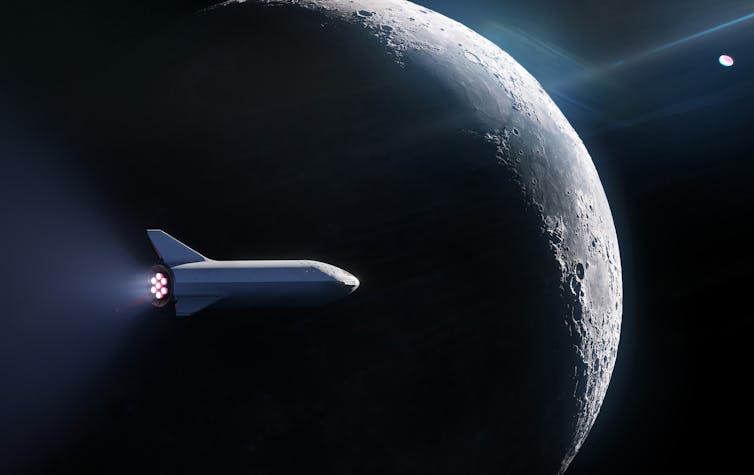
Artist’s impression of Starship cruising past the Moon. Space Exploration Technologies Corp./SpaceX Flickr, CC BY-SA
1. Jupiter Icy Moons Explorer
In April, the European Space Agency (ESA) is set to launch the Jupiter Icy Moons Explorer (Juice), in what will be Europe’s first dedicated robotic mission to Jupiter. Juice is due to reach the planet in July 2031 after performing an incredible flight path through the Solar System. The mission will enter into orbit around Jupiter and perform numerous flybys of its large icy moons: Europa, Ganymede and Callisto.
After four years of moon flybys, Juice will then enter into orbit around Ganymede, the largest moon in the Solar System – becoming the first spacecraft ever to reach orbit around the moon of another planet. The icy moons of Jupiter are interesting as they are all believed to host oceans of liquid water beneath their frozen surfaces. Europa, in particular, is regarded as one of the most likely abodes in the Solar System for extra-terrestrial life.
Juice will be equipped with ten scientific instruments including ice-penetrating radar to study the internal oceans. This use of radar is a practical first step in mapping the sub-surface oceans, paving the way for more exotic future missions involving submersible vehicles – some of which have already been put forward. The launch window runs from April 5 to April 25.
2. SpaceX Starship
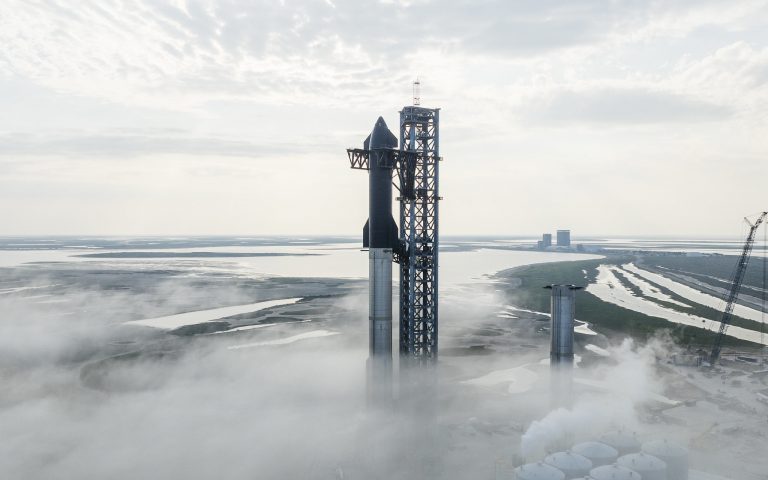
Although no date has been announced by aerospace company SpaceX at the time of writing, the first orbital test flight of the super-heavy Starship spacecraft is highly anticipated to occur in early 2023. Starship will be the largest spacecraft capable of carrying humans from Earth to destinations in space (the International Space Station is larger, but it was assembled in space). It will be the most powerful launch vehicle ever to fly, capable of lifting 100 tonnes of cargo to low Earth orbit.
Starship is the collective name for a two-component system consisting of the Starship spacecraft (which carries the crew and cargo) and the Super Heavy rocket. The rocket component will lift Starship to some 65km altitude before separating and returning to Earth in a controlled landing. The upper Starship component will then use its own engines to push itself the rest of the way to orbit.
Several short test flights of the Starship portion of the system have been made with varying degrees of success. But the upcoming flight will be the first time the whole system will be used to reach space as one. This first orbital flight was originally scheduled to launch in September 2022, but has been delayed several times.
3. dearMoon
The long-awaited dearMoon project, which will take members of the public on a six-day trip around the Moon and back, is due for launch on Starship and was originally planned for 2023. The exact date will depend on the successful test of Starship, but has been on the books since 2018. It will be the first true deep space tourism launch.
Financed by business entrepreneur Yusaku Maezawa, a competition was set up to select eight members of the public (and an unknown number of crew) to join Maezawa on the trip – all completely paid for. The winners and criteria used have not been disclosed, although it is suspected the guests may be established or aspiring artists.
This mission will mark a big change in the way we think about space, as previously only astronauts picked using incredibly stringent criteria have been able to go into deep space (note: we are not counting brief 10-minute jaunts up to 100 km). A full trip of several days poses extreme risks, both in terms of health and engineering.
The success or failure of the dearMoon mission could affect whether deep space tourism becomes the next big thing, or it is relegated back to being a pipe-dream.
4. Asteroid explorer returns to Earth
The Origins Spectral Interpretation Resource Identification Security – Regolith Explorer, mercifully more commonly known as OSIRIS-REx, is a Nasa mission to near-Earth asteroid Bennu. A key goal of this robotic mission was to acquire samples of Bennu and return them to Earth for analysis.
OSIRIS-REx is now fast returning to Earth with up to a kilogram of precious asteroid samples stored aboard. If all goes well, the capsule will detach from the spacecraft, enter the Earth’s atmosphere and parachute to a soft landing in the deserts of Utah on September 24. Asteroid sample return has only been achieved once before, by the Japanese Space Agency’s Hayabusa 2 mission in 2020.
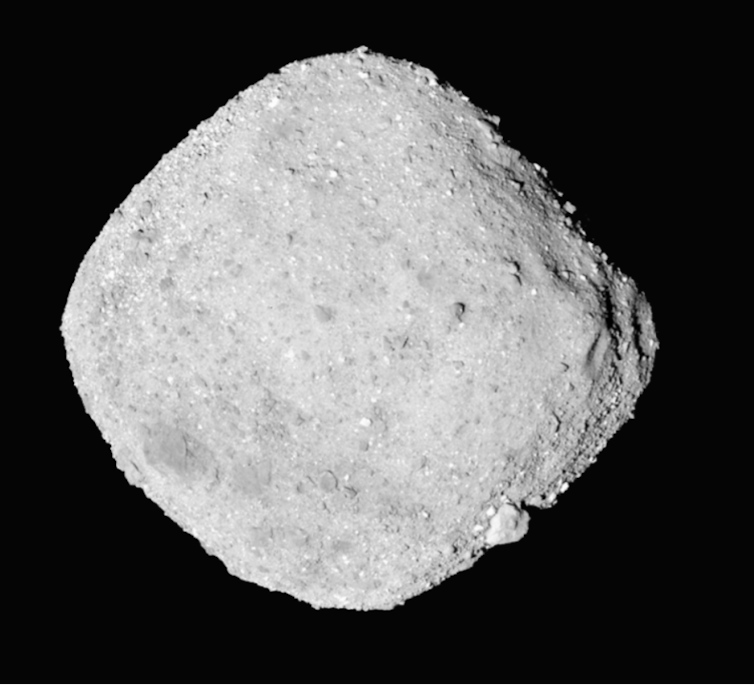
Bennu the golden space rock. NASA/Goddard/University of Arizona
Bennu is an approximately diamond-shaped world just half a kilometre in size, but has many interesting characteristics. It is believed to have broken off from a much larger asteroid in the first 10 million years of the Solar System. Some of the minerals detected within it have been altered by water, implying that Bennu’s ancient parent body possessed liquid water.
It also has an abundance of precious metals, including gold and platinum. Finally, Bennu is classed as a potentially hazardous object with a (very) small possibility of Earth impact in the next century.
5. India’s private space launch
While SpaceX is the most prominent private space launch company, there are many others developing their own series of launchers around the world. Skyroot Aerospace, which successfully launched its Vikram-S rocket in November 2022, is soon to become the first private Indian company to launch a satellite.
The rocket itself reached 90km in altitude, a distance that would need to be improved upon to get a constellation of satellites into orbit. Skyroot’s first satellite launch is planned for 2023, with a goal of undercutting the cost of private space launch rivals by producing its 3D-printed rockets in a matter of days. If successful, this could also provide a route for cheaper launches of scientific missions, enabling a faster rate of research.
Clearly, interest in the space sector remains high. With many bold advances and launches due in 2023, we are entering a new phase akin to the “Golden era” of space launches in the 1960s and ’70s.
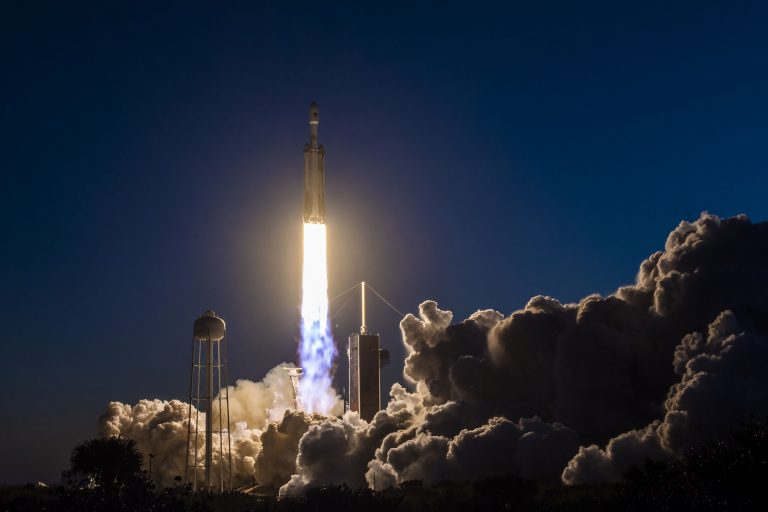
SpaceX’s Falcon Heavy rocket successfully completed another mission on January 15, 2023 at 5:56 PM Eastern Time from Launch Complex 39A at the Kennedy Space Center in Florida, USA. The rocket is carrying a classified mission for the US Space Force USSF-67 to Earth orbit.
The USSF-67 is the Space Force’s first national security mission of 2023. This is also the Falcon Heavy’s fifth mission since it started in 2018.
The Falcon Heavy’s first stage is made up of three Falcon 9 rockets strapped together, with 27 engines powering the first stage and one engine in the second stage. About two and a half minutes after liftoff, both side boosters separated. The second stage separated from the core stage just over four minutes after liftoff.
Both side boosters landed back at SpaceX’s Landing Zones 1 and 2 at Cape Canaveral Space Force Station in Florida, about eight and a half minutes after liftoff. These landings marked SpaceX’s 163rd and 164th successful booster recoveries. They will be refurbished for future national security space missions.
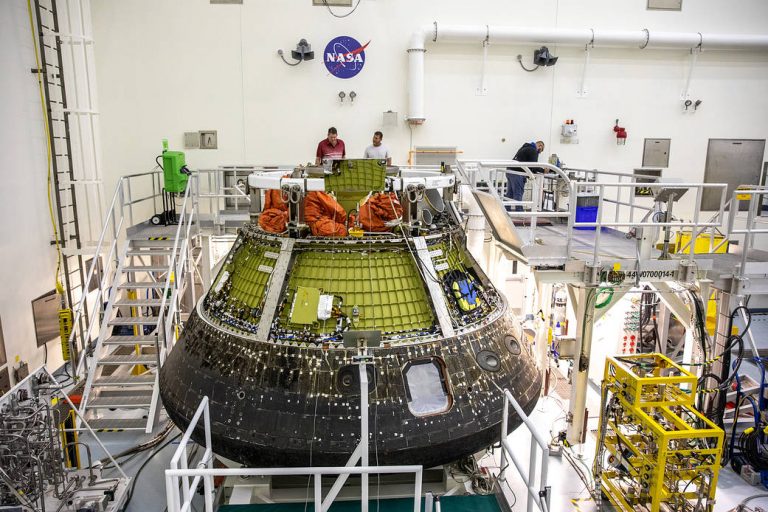
The Artemis I Orion capsule is secured on a platform inside the Multi-Payload Processing Facility (MPPF) at Kennedy Space Center in Florida in this image from Jan. 6, 2023. Orion splashed down on Dec. 11, 2022 and was transported back to Kennedy for de-servicing inside the MPPF.
During Orion’s 25.5-day trip beyond the Moon and back, it flew farther than any designed to carry humans to deep space and safely return them to Earth, paving the way for human deep space exploration and demonstrating NASA’s commitment and capability to extend human presence to the Moon and beyond.
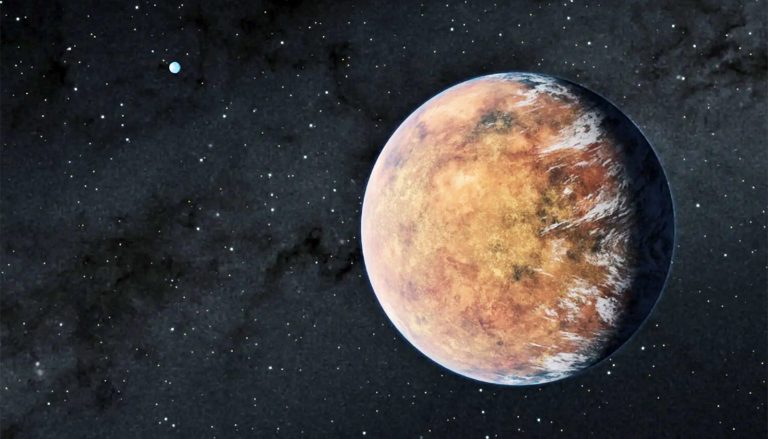
Newly discovered Earth-sized planet TOI-700 e orbits within the habitable zone of its star in this illustration. Its Earth-sized sibling, TOI-700 d, can be seen in the distance. (Credit: NASA/JPL-Caltech/Robert Hurt)
Researchers have discovered an Earth-sized exoplanet—a planet outside of our solar system.
The planet, named TOI-700 e, falls within its star’s habitable zone, meaning it could be capable of supporting life as we know it.
Astronomers believe that many such planets exist in our galaxy and across the universe. The discovery of TOI-700 e, along with the earlier confirmation of its host system, could provide unique opportunities to better explore exoplanets going forward.
“Even with more than 5,000 exoplanets discovered to date, TOI-700 e is a key example that we have a lot more to learn,” says Joey Rodriguez, an assistant professor in the physics and astronomy department at Michigan State University, who helped make the discovery.
Rodriguez was one of the senior researchers on the project, led by Emily Gilbert, a postdoctoral fellow at NASA’s Jet Propulsion Laboratory in Southern California. The duo is also part of the original team that confirmed the TOI-700 system in 2020, finding it had at least three planets (named TOI-700 b, TOI-700 c, and TOI-700 d).
With the new discovery, the team showed that the TOI-700 system has two Earth-sized planets within its habitable zone.
“This is one of only a few systems with multiple, small, habitable-zone planets that we know of,” says Gilbert. “That makes the TOI-700 system an exciting prospect for additional follow-up.”
Gilbert, Rodriguez, and Andrew Vanderburg, an assistant professor of physics at Massachusetts Institute of Technology, spearheaded the current project, which includes researchers from dozens of institutions. The research team announced the finding at the American Astronomical Society meeting in Seattle.
Here, Rodriguez, an exoplanet expert, explains the discovery and the research behind it:
Q
What makes this discovery special?
A
The discovery of TOI-700 e provides a valuable opportunity for detailed follow-up studies, as it is one of the only systems known with two small planets in the star’s habitable zone. The host star, TOI-700, is well-suited for these characterization efforts.
This system is very accessible in comparison to other candidates or TESS Objects of Interest, TOIs. Some of those other systems are farther away and their stars are fainter. TOI-700 is really close to us—about 100 light years away.
Having a close and bright host star allows us to achieve the sensitivity needed to measure key aspects like the mass of the planets and the composition of a planet’s atmosphere.
Q
How does one go about discovering an exoplanet?
A
With TESS, we are observing more than 100 million stars across the night sky. When we look at one of those stars, we can also see if a planet moves between the star and the satellite, blocking out just a little bit of the star’s light. We use the analogy of a fly moving in front of a spotlight.
Q
You were also part of the team that originally confirmed the TOI-700 system in 2020. Can you share a little bit of the background there?
A
In 2020, there was a series of three papers that came out at the same time that confirmed the TOI-700 system. Emily Gilbert, who led this current effort, led one of those studies. That one looked at the star, its three planets known at the time—b, c, and d—and the dynamics of the system.
I led another paper, which also used data from the Spitzer Space Telescope to confirm the system had a habitable-zone, Earth-sized planet. That was planet d.
At the time, we had some hints that there might be another planet, planet e, but on the outside of the system—like way, way outside. After we got in another year of observation with TESS, though, we discovered that planet e was actually inside the habitable zone, in between the orbits of planets b and c.
Q
So TOI-700’s planets aren’t in alphabetical order?
A
No, and there’s a little bit of an Easter egg in our new paper where we say, “Sorry, they are not in order.” But this demonstrates the power of something like TESS and the reason to continue observing systems with already discovered exoplanets. It shows that we have a lot more to learn and there may be surprises as we keep observing.
Q
Can you talk about the names: planet b, c, d, and e? Are those final or will you get to pick different ones?
A
I get this question all the time. People will ask if I can name an exoplanet “Joey-1 b” or if I could name one after my wife. I tell them I could call them that, but nobody else would.
There’s actually a convention and I don’t want to get too far in the weeds, but it is a combination of the discovery instrument or telescope and a catalog number. In the case of TOI-700, before they were confirmed, the candidate planets were designated TOI-700.01, TOI-700.02, and TOI-700.03. As we confirmed them, they became TOI-700 b, TOI-700 c, and so on. The “a” gets reserved for the star, even though we just call it TOI-700.
Q
What’s next for you and your research?
A
I was asked this question in 2020 and at the time I said, “TESS will observe the system again and we’ll see what happens.” I can say the same thing again this time since TESS is going to re-observe TOI-700.
We can also use other instruments to study the system. For example, we’re working to use another telescope, the JWST, to characterize the biggest planet in the system along with a large effort to measure the mass of all four planets through spectroscopic measurements. But I also have my hands in a bunch of different projects for TESS. For example, I do a lot of work with Jupiter-sized exoplanets that are very close to their stars.
We are doing exoplanet studies with our on-campus observatory to help confirm new planets from TESS, not systems like TOI-700, but planets more similar in size to Saturn and Jupiter.
Q
We started off talking about habitable zones. What will it take to go from saying an exoplanet like TOI-700 e is capable of supporting life to showing that it does?
A
That’s a question that’s going to be debated for decades. The reason is that one of the ways we think we’ll be able to do this is by identifying biological signatures in the planet’s atmosphere. Those are really hard measurements to make.
I expect over the next decade or so we may have the first detections of possible biological signatures in a planet’s atmosphere, but since many can also be explained by nonbiological sources, there will be a lot of debate.
So, we’ll need to measure multiple observables and decide which of them—or which combinations of them—are actually indicative of life. All of that will be complicated and, I think, will be hotly debated.
That being said, I would argue that, even if we do find something, we are trying to force our understanding of life into a box. What I mean by that is we have one data point for how we think about life and that’s Earth: It’s us and what we see around us. Who’s to say that’s what all life looks like?
New research suggests that chemistry in late-stage planet development is fueled by ultraviolet rays, rather than cosmic rays or X-rays.
The chemistry of planet formation has fascinated researchers for decades because the chemical reservoir in protoplanetary discs—the dust and gas from which planets form—directly affects planet composition and potential for life.
The new finding provides a chemical signature that helps researchers trace exoplanets back to their cosmic nurseries in the planet-forming disks.
Jenny Calahan, a doctoral student in astronomy at the University of Michigan and first author of the paper in Nature Astronomy, says the discovery was part happy accident, part building on previous work.
“It has been shown that there are bright, complex organic molecules present in the coldest and densest parts of planet-forming disks,” Calahan says. “This bright emission has been puzzling because we expect these molecules to be frozen out at these temperatures, not in the gas where we can observe them.”
These molecules are emitting from regions that are minus-400 degrees Fahrenheit, and at these temperatures they’re thought to be frozen onto tiny solids that astronomers label as dust grains, or for the later millimeter-to-centimeter-sized solids as pebbles. These molecules should add to an icy coating on the grains, so they cannot be observed in the gas.
The planet-forming disk has three main components, a pebble-rich dusty midplane, a gas atmosphere, and a small dust population coupled to the gas. As the planet-forming disk evolves over time, the changing environment affects the chemistry within. To account for the observed brightness, Calahan adjusted her model to decrease the mass of the small dust population—which typically blocks UV photons—to allow more UV photons to penetrate deep into these coldest regions of the disc. This reproduced the observed brightness.
“If we have a carbon-rich environment paired with a UV-rich environment due to the evolution of the small solids in planet forming regions, we can produce complex organics in the gas and reproduce these observations,” she says.
This represents the evolution of small dust over time.
About 20 years ago, researchers realized that the chemistry of the gaseous disk is governed by chemistry operating on shorter timescales and powered by sources such as cosmic rays and X-rays, says principal investigator Edwin Bergin, professor and chair of astronomy.
“Our new work suggests that what really matters is the ultraviolet radiation field generated by the star accreting matter from the disk,” he says. “The initial steps in making planets, forming larger and larger solids, shifts the chemistry from cosmic rays and X-ray-driven early, to UV-driven during the phase where giant planets are thought to be born.
“Jenny’s work tells us for terrestrial worlds, if you wonder how they get things like water, the key part of the evolution is the early phases before this shift occurs. That is when the volatile molecules that comprise life—carbon, hydrogen, nitrogen—are implanted in solids that make Earth-like worlds. These planets are not born in this phase but rather the composition of solids becomes fixed. The later stages of this model tells us how to determine the composition of material that makes giant planets.”