
Home Blog Page 95

Sixth GPS III Satellite Built By Lockheed Martin Launches As Part Of Constellation Modernization

0

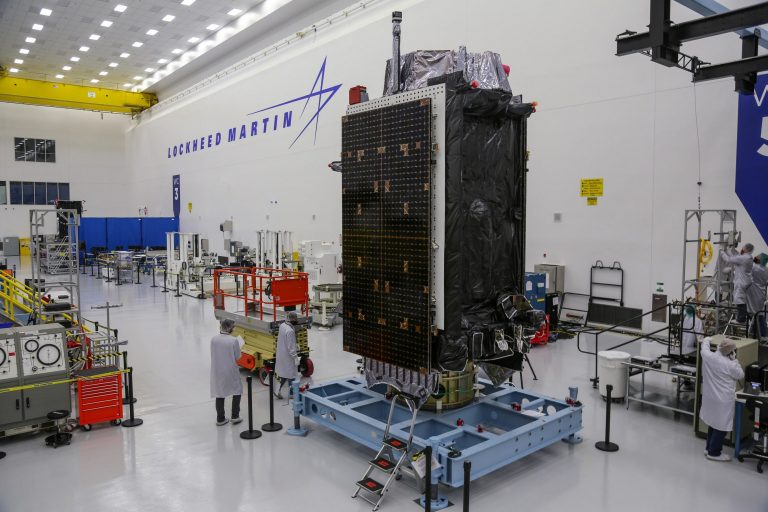
The sixth Global Positioning System III (GPS III) satellite designed and built by Lockheed Martin (NYSE: LMT) has been launched and is propelling to its operational orbit approximately 12,550 miles above Earth, where it will contribute to the ongoing modernization of the U.S. Space Force’s GPS constellation.

GPS III Space Vehicle 06 (GPS III SV06) launched from Cape Canaveral Space Force Station, Florida, aboard a SpaceX Falcon 9 rocket at 7:24 a.m. EST today. About 83 minutes after liftoff, U.S. Space Force and Lockheed Martin engineers at the company’s Denver Launch & Checkout Operations Center confirmed signal acquisition of GPS III SV06 and now have the space vehicle “flying” under their control.

GPS III SV06 is the 25th Military-Code satellite introduced to the constellation. The satellite will provide advanced technology to aide Space Force operators in their mission by providing positioning, navigation and timing (PNT) data to military and civil users worldwide.

“Lockheed Martin is incredibly proud to support the Space Force’s GPS team as it continues to add world-class capabilities that underpin U.S. national security with enhanced performance and accuracy,” said Andre Trotter, Lockheed Martin vice president for Navigation Systems. “With the last GPS III satellite complete and ready to launch, production of the first GPS IIIF vehicle is underway.”

GPS is a satellite-based radio navigation system that delivers the gold standard in PNT services to America’s military, U.S. allies and civil users. The satellites serve as a crucial technological foundation for internet, financial, transportation and agricultural operations, with more than 4 billion users depending on the PNT signals.

GPS III vehicles provide three times greater accuracy and eight times greater anti-jamming capability over existing satellites in the constellation. To better address mission needs and emerging threats, Lockheed Martin intentionally created GPS III with a modular design, allowing new technology and capabilities to be added in the future.

Lockheed Martin has completed production on its original GPS III SV1-10 contract, with the Space Force declaring SV10 Available for Launch on Dec. 8, 2022. GPS III SV06 will soon join SV01-05 in orbit. GPS III SV07-10 are completed and in storage at the company’s facility waiting for the U.S. Space Force to call them up for launch.

Lockheed Martin is also designing and building the GPS III Follow On (GPS IIIF) for the Space Force, which will feature even more innovative capabilities than its predecessors. GPS IIIF satellites will feature an accuracy-enhancing laser retroreflector array, a new search and rescue payload, a fully digital navigation payload and more next-generation technology. In November 2022, Space Systems Command announced it exercised the third production option valued at approximately $744 million for the procurement of three additional GPS IIIF satellites from Lockheed Martin, meaning the company is now contracted to build SV11-20.

For additional GPS information, photos and video visit: www.lockheedmartin.com/gps.

About Lockheed Martin

Headquartered in Bethesda, Maryland, Lockheed Martin Corporation is a global security and aerospace company that employs approximately 114,000 people worldwide and is principally engaged in the research, design, development, manufacture, integration and sustainment of advanced technology systems, products and services.

Please follow @LMNews on Twitter for the latest announcements and news across the corporation, and @LMSpace to learn more about the latest technologies, missions and people driving the future of space.

SOURCE Lockheed Martin
A Near-Pristine Star Found To Be Binary

0
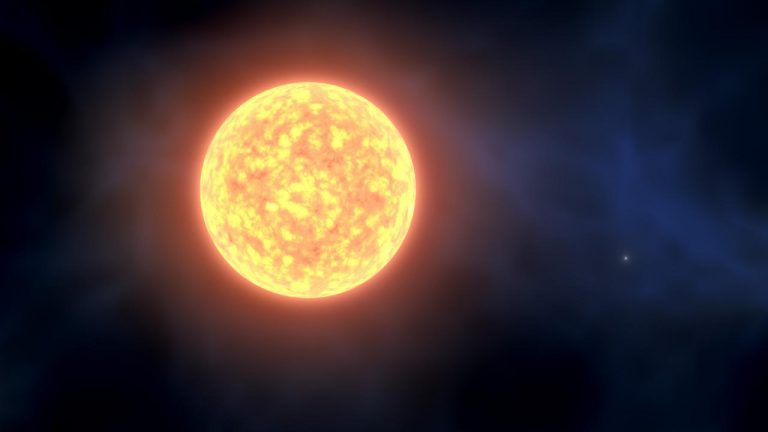
Artist’s impression of the binary star SMSS1605-1443. Credit: Gabriel Pérez Díaz (IAC).

The nearly primordial origin of an ancient star of the Milky Way confirmed by an international team of researchers thanks to the ESPRESSO spectrograph.

Stars with very low content of chemical elements are considered to be the older stars in the Milky Way. Formed a few hundred million years after the Big Bang, a very small time compared to the age of the Universe, these stars are real fossils which encode the first phases of the chemical evolution of the Universe in their atmosphere.

The star SMSS1605-1443, discovered in 2018, was identified as one of the earliest stars in the galaxy, but its true nature was  unknown. Now, thanks to the joint effort of several European research groups and the use of the ESPRESSO spectrograph, capable of operating with any of the four VLT telescopes in Chile, it has been possible to understand the almost primordial origin of this archaeological stellar jewel. David Aguado, currently Ramón y Cajal Advanced postdoctoral fellow at the Instituto de Astrofísica de Canarias (IAC) and former researcher at the University of Florence-NEFERTITI group, first author of this work published in the January 2023 issue of the journal Astronomy & Astrophysics, explains:

It was a real surprise to discover that this star was actually a long period binary star, which was not foreseen and which requires a revision of the theory of formation of the first stars”. Fundamental was the use of the ESPRESSO spectrograph which, thanks to its high precision,  has made possible to follow the small variations in the speed of this star due to its orbital motion around its companion, which remains nevertheless unknown.”

These stars have a low iron content but a high carbon content, and are called  CEMP-no  in the astronomical jargon. They are thought to have formed  from material processed from the interior of the first massive stars and ejected in the explosion of supernovae in the early stages of the formation of the Milky Way. “All the oldest stars we know belong to the CEMP-no class and I like to remember that with Piercarlo Bonifacio we discovered the prototype of this class of stars back in 1997“, underlines Paolo Molaro, astronomer of INAF-Trieste, co-author of this work and principal investigator of the research programme.

The high resolution of the instrument allowed a detailed analysis of the relative composition of the carbon isotopes which provided new information on the origin of the  elements observed in the atmosphere of the star. Elisabetta Caffau, an Italian astronomer who works at  Paris Observatory, explains: “The key was provided to us by the relationship between Carbon-12 and Carbon-13. The relative quantity of these two isotopes demonstrates that the internal processes of the star have not altered the composition of the atmosphere which therefore remains absolutely original. It is like having an intact sample of the environment in which this star formed, about thirteen billion years ago“.

This discovery is also extremely important from a theoretical point of view: it clarifies the characteristics of the first supernovae that polluted the  environment out of which  this star formed, ruling out several theoretical models and putting an end to a long debate.“, says  Jonay González Hernández, astronomer of the IAC, Tenerife, and co-author of this work.

The team is multidisciplinary and is made up of researchers from Spain, Italy, France, Portugal and Switzerland who built the ESPRESSO spectrograph, which is proving to be one of the best and most modern tools for studying the formation of the first stars. ESPRESSO (Echelle SPectrograph for Rocky Exoplanets and Stable Spectroscopic Observations) is a VLT ultra-stable high-resolution spectrograph developed by research institutions in Switzerland, Italy, Spain and Portugal, and ESO (European Southern Observatory), installed and in operations at the VLT telescope in Paranal Observatory (ESO, Chile) since October 2018.

Scientific article: D. S. Aguado et al: “The pristine nature of SMSS1605−1443 revealed by Espresso”, Astronomy & Astrophysics, 2022. DOI: https://doi.org/10.1051/0004-6361/202245392


Source Instituto de Astrofísica de Canarias

NASA And DOD Seek Universities To Develop CubeSats

0
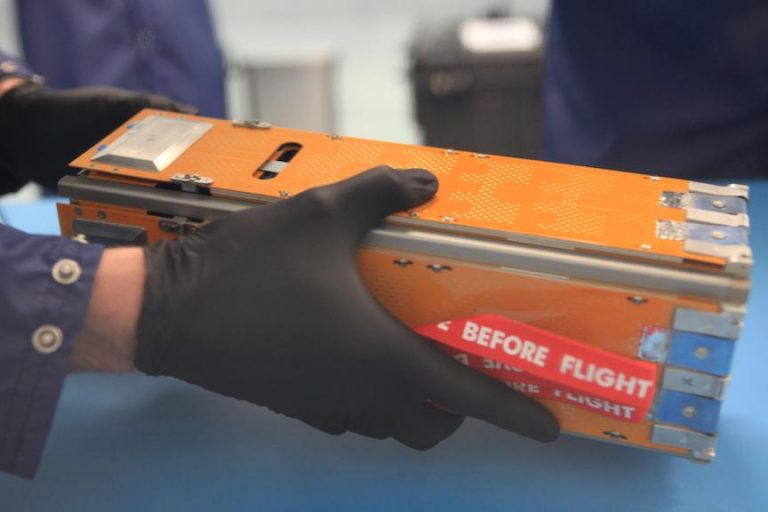
The Advanced Electrical Bus (ALBus) mission is a technology demonstration of resettable Shape Memory Alloy (SMA) mechanisms for deployable solar arrays and a pathfinder for high power density CubeSats. The mission has two primary objectives. The first is to demonstrate the functionality of the novel SMA activated solar array mechanisms in the on-orbit environment. The second objective is to assess the system level ability to charge a high capacity battery, distribute 100 W of electrical power and thermally control the 3-U CubeSat system. Performance from the mission will be used to mature the SMA mechanism designs for CubeSat applications and plan for future high power density CubeSat missions. Credits: NASA/Cory Huston

NASA’s CubeSat Launch Initiative (CSLI) is collaborating with the U.S. Air Force and U.S. Space Force to solicit applicants for a set of hands-on learning engagements that will help higher education institutions, faculty, and students elevate efforts to build small satellites and enhance the potential to be selected for flight opportunities.

Teams selected for the University Nanosatellite Program (UNP) Mission Concept-1: 2023 Summer Series, will receive systems engineering training that prepares students for the industrial workforce while developing small satellite expertise at U.S. universities. The program, which runs from May through August 2023, also enhances students’ potential to be selected for flights to space as part of NASA’s CSLI in November 2023 and the full U.S. Air Force UNP in 2024.

The program allows faculty and students to form teams without draining university resources, and includes travel funding for kickoff, final event, and any in-person reviews, among other benefits.

All U.S colleges and universities are eligible, teams at minority-serving institutions and historically Black colleges and universities are strongly encouraged to apply for the Mission Concepts-1: 2023 Summer Series in accordance with the criteria in the Request for Proposal. The deadline to apply is Feb. 3, 2023.

NASA’s collaboration with the U.S Air Force and U.S. Space Force helps broaden access to space and strengthen the capabilities and knowledge of higher education institutions, faculty, and students.

By Keith Cowing
Source SpaceRef

Webb Space Telescope Observes Galaxy NGC 346

0
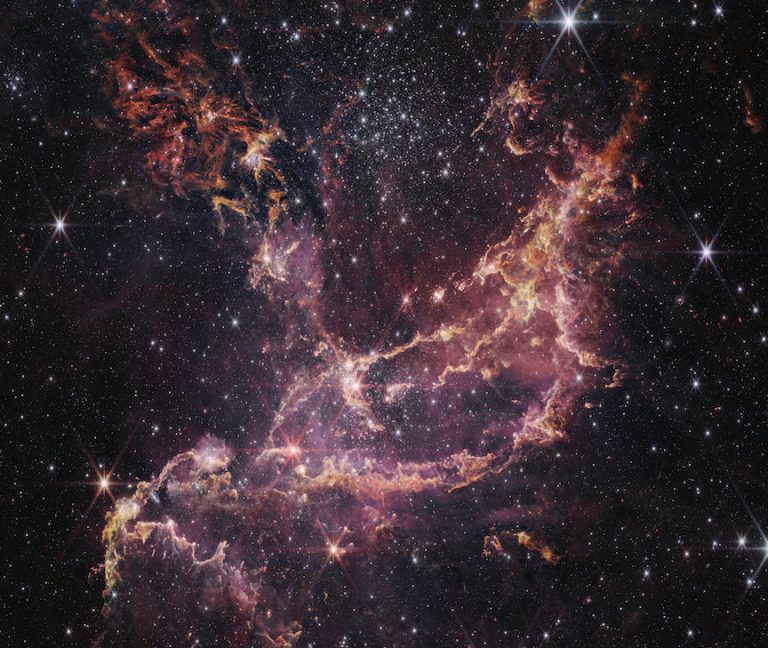
NGC 346, one of the most dynamic star-forming regions in nearby galaxies, is full of mystery. Now, though, it is less mysterious thanks to new findings from the NASA/ESA/CSA James Webb Space Telescope.

NCG 346 is located in the Small Magellanic Cloud (SMC), a dwarf galaxy close to our Milky Way. The SMC contains lower concentrations of elements heavier than hydrogen or helium, which astronomers call metals, than seen in the Milky Way. Since dust grains in space are composed mostly of metals, scientists expected that there would only be small amounts of dust, and that it would be hard to detect. But new data from Webb reveals just the opposite.

Astronomers probed this region because the conditions and amount of metals within the SMC resemble those seen in galaxies billions of years ago, during an era in the Universe’s history known as ‘cosmic noon,’ when star formation was at its peak. Some 2 to 3 billion years after the Big Bang, galaxies were forming stars at a furious rate. The fireworks of star formation happening then still shape the galaxies we see around us today.

“A galaxy during cosmic noon wouldn’t have one NGC 346, as the Small Magellanic Cloud does; it would have thousands”, said Margaret Meixner, an astronomer at the Universities Space Research Association and principal investigator of the research team. “But even if NGC 346 is now the one and only massive cluster furiously forming stars in its galaxy, it offers us a great opportunity to probe the conditions that were in place at cosmic noon.”

By observing protostars still in the process of forming, researchers can learn if the star formation process in the SMC is different from what we observe in our own Milky Way. Previous infrared studies of NGC 346 have focused on protostars heavier than about five to eight times the mass of our Sun. “With Webb, we can probe down to lighter-weight protostars, as small as one tenth of our Sun, to see if their formation process is affected by the lower metal content,” said Olivia Jones of the United Kingdom Astronomy Technology Centre, at the Royal Observatory Edinburgh, a co-investigator on the program.

As stars form, they gather gas and dust, which can look like ribbons in Webb imagery, from the surrounding molecular cloud. The material collects into an accretion disc that feeds the central protostar. Astronomers have detected gas around protostars within NGC 346, but Webb’s near-infrared observations mark the first time they have also detected dust in these discs.

“We’re seeing the building blocks, not only of stars, but also potentially of planets,” said Guido De Marchi of the European Space Agency, a co-investigator on the research team. “And since the Small Magellanic Cloud has a similar environment to that of galaxies during cosmic noon, it’s possible that rocky planets could have formed earlier in the history of the Universe than we might have thought.”

The team also has spectroscopic observations from Webb’s NIRSpec instrument that they are continuing to analyse. These data are expected to provide new insights into the material accreting onto individual protostars, as well as the environment immediately surrounding the protostars.

Credits: NASA, ESA, CSA, STScI, A. Pagan (STScI); CC BY 4.0
Larger image

By Keith Cowing
Source SpaceRef

A Dusty Debris Disk Observed Around Red Dwarf Star AU Mic

0
The NASA/ESA/CSA James Webb Space Telescope has imaged the inner workings of a dusty disk surrounding a nearby red dwarf star. These observations represent the first time the previously known disk has been imaged at these infrared wavelengths of light. They also provide clues to the composition of the disk. These two images are of the dusty debris disk around AU Mic, a red dwarf star located 32 light-years away in the southern constellation Microscopium. Scientists used Webbís Near-Infrared Camera (NIRCam) to study AU Mic. NIRCamís coronagraph, which blocked the intense light of the central star, allowed the team to study the region very close to the star. The location of the star, which is masked out, is marked by a white, graphical representation at the center of each image. The region blocked by the coronagraph is shown by a dashed circle. Webb provided images at 3.56 microns (top, blue) and 4.44 microns (bottom, red). The team found that the disk was brighter at the shorter or ìbluerî wavelength, likely meaning that it contains a lot of fine dust that is more efficient at scattering shorter wavelengths of light. The NIRCam images allowed the researchers to trace the disk, which spans a diameter of 60 astronomical units (9 billion kilometers), as close to the star as 5 astronomical units (740 million kilometers) ñ the equivalent of Jupiterís orbit in our solar system. The images were more detailed and brighter than the team expected, and scientists were able to image the disk closer to the star than expected. While detecting the disk is significant, the teamís ultimate goal is to search for giant planets in wide orbits, similar to Jupiter, Saturn, or the ice giants of our solar system. Such worlds are very difficult to detect around distant stars using either the transit or radial velocity methods. These results are being presented in a press conference at the 241st meeting of the American Astronomical Society. The observations were obtained as part

The NASA/ESA/CSA James Webb Space Telescope has imaged the inner workings of a dusty disk surrounding a nearby red dwarf star.

These observations represent the first time the previously known disk has been imaged at these infrared wavelengths of light. They also provide clues to the composition of the disk.

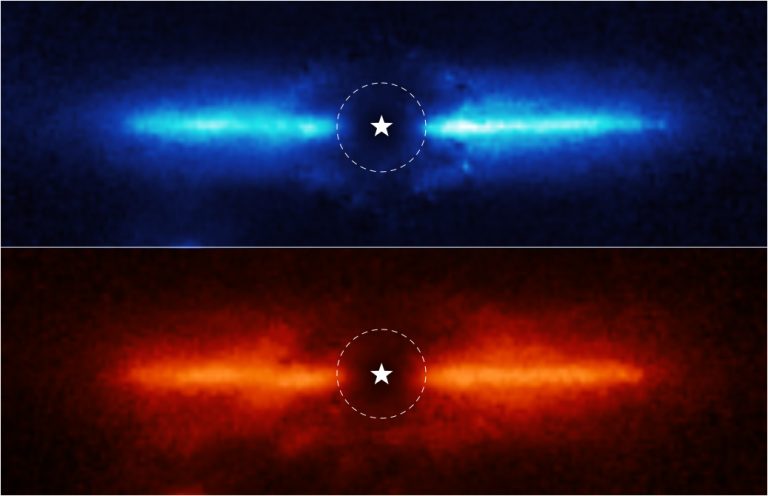
These two images are of the dusty debris disk around AU Mic, a red dwarf star located 32 light-years away in the southern constellation Microscopium. Scientists used Webb’s Near-Infrared Camera (NIRCam) to study AU Mic. NIRCam’s coronagraph, which blocked the intense light of the central star, allowed the team to study the region very close to the star. The location of the star, which is masked out, is marked by a white, graphical representation at the center of each image. The region blocked by the coronagraph is shown by a dashed circle.

Webb provided images at 3.56 microns (top, blue) and 4.44 microns (bottom, red). The team found that the disk was brighter at the shorter or “bluer” wavelength, likely meaning that it contains a lot of fine dust that is more efficient at scattering shorter wavelengths of light.

The NIRCam images allowed the researchers to trace the disk, which spans a diameter of 60 astronomical units (9 billion kilometers), as close to the star as 5 astronomical units (740 million kilometers) – the equivalent of Jupiter’s orbit in our solar system. The images were more detailed and brighter than the team expected, and scientists were able to image the disk closer to the star than expected.

While detecting the disk is significant, the team’s ultimate goal is to search for giant planets in wide orbits, similar to Jupiter, Saturn, or the ice giants of our solar system. Such worlds are very difficult to detect around distant stars using either the transit or radial velocity methods.

These results are being presented in a press conference at the 241st meeting of the American Astronomical Society. The observations were obtained as part of Webb’s Guaranteed Time program 1184.

[Image Description: The visual shows two bright lines, representing the dusty debris disc around the red dwarf star AU Mic. The glowing line on top is blue, representing 3.56 microns and appears brighter, and the glowing line on bottom is red, representing 4.44 microns.]

Credits: NASA, ESA, CSA, and K. Lawson (Goddard Space Flight Center), A. Pagan (STScI); CC BY 4.0

By Keith Cowing
Source SpaceRef

Formation Of Massive Star Caught In The Act With Magnetic Field Mapping

0
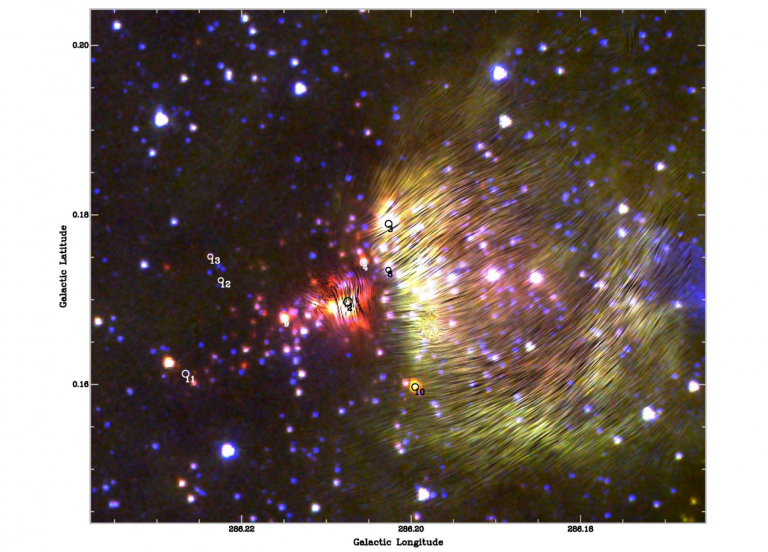
The magnetic field orientations of BYF 73, as derived from SOFIA data, are overlain on a composite image of the region taken by the Spitzer Space Telescope and Anglo-Australian Telescope. The circled areas are locations of protostars in the region identified by ALMA and the Gemini Observatory. These studies help astronomers uncover the relationship between magnetism and gravity in star formation. Credit: NASA/Spitzer/SOFIA/ALMA/Gemini/AAT/Barnes et al.

Catching a massive star in the early stages of formation is a rare event in astronomy, making it an exciting moment to study.

A group of researchers took advantage of the discovery of one youthful star and used the Stratospheric Observatory for Infrared Astronomy (SOFIA) to reveal the magnetic processes that allow such a massive star to form.

The stellar nursery where the action is taking place, called BYF 73, is not your typical star-forming cloud. It’s relatively small, but at its central core is a young star that holds the record for the highest known rate of protostellar mass accretion, the process by which a growing star accumulates mass from its surrounding material.

Using SOFIA and another observatory – the Atacama Large Millimeter/submillimeter Array (ALMA) in Chile – Peter Barnes, a research scientist at the Space Science Institute in Boulder, Colorado, and his team examined the magnetic fields within this cloud amid ongoing star formation. Studying the orientation of magnetic fields can shed light on their role in massive-star formation, a long-standing question. Massive stars form through a different process from their more average counterparts, relying on an ongoing exchange of material with their environment, rather than accreting mass from a surrounding disk of matter.

Birth of a “Masquerading Monster”

Previous ALMA research had shown that within the core of BYF 73 lies a “masquerading monster:” a single protostar, MIR 2, which is about 1,300 times the Sun’s mass and responsible for about half of the region’s power output. These ALMA values place MIR 2 in the very early stages of massive star formation, with an age of around 40,000 years — on human timescales, it began forming sometime after the arrival of humans to Australia.

“It’s exciting because MIR 2 seems to be so young, and massive stars evolve very quickly by astronomical standards and are very rare, making their early stages easy to miss,” said Barnes.

Data from SOFIA and ALMA both offer high resolution and sensitivity in their respective wavelength ranges, allowing Barnes and his team to map the polarization of dust grains in BYF 73. This helped the researchers determine the relationship between the cloud’s magnetic field and gas density – and what that might mean for the formation of MIR 2.

When Gravity Takes Over

The researchers found that both the strength of the magnetic field and density of the gas are on the higher end of the range typical for star-forming clouds, but the relationship between the two scales is as expected. This means what’s happening in BYF 73 isn’t necessarily something unique — it just happens to be massive, and its monstrous density compared to its small size may help astronomers uncover a threshold necessary for gravity to take over and allow stars to form.

Gravity is the sole force responsible for forming stars, but the unusually strong magnetic field in BYF 73 could be acting in opposition, preventing lower-mass stars from forming until gravity becomes strong enough to form a monster.

“The original discovery of the massive inflow of material [onto MIR 2] was very exciting, since so few examples were known for higher-mass protostars. From that point on, BYF has been the gift that keeps on giving,” Barnes said.

MIR 2 is still in the very early stages of forming a massive star, and the synergies between SOFIA and ALMA’s magnetic field studies have helped clarify the factors at play in the process.

“Without their discoveries, BYF 73, and MIR 2 within it, would still be real head-scratchers,” said Barnes.

SOFIA was a joint project of NASA and the German Space Agency at DLR. DLR provided the telescope, scheduled aircraft maintenance, and other support for the mission. NASA’s Ames Research Center in California’s Silicon Valley managed the SOFIA program, science, and mission operations in cooperation with the Universities Space Research Association, headquartered in Columbia, Maryland, and the German SOFIA Institute at the University of Stuttgart. The aircraft was maintained and operated by NASA’s Armstrong Flight Research Center Building 703, in Palmdale, California. SOFIA achieved full operational capability in 2014 and concluded its final science flight on Sept. 29, 2022.

By Keith Cowing
Source SpaceRef

NASA’s Lunar Flashlight Team Assessing Spacecraft’s Propulsion System

0
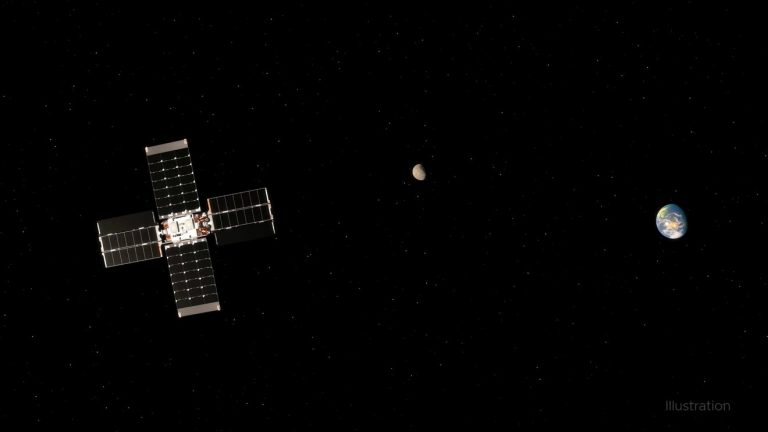
This illustration shows NASA’s Lunar Flashlight carrying out a trajectory correction maneuver with the Moon and Earth in the background. Powered by the small satellite’s four thrusters, the maneuver is needed to reach lunar orbit. Credit: NASA/JPL-Caltech

The mission is characterizing its new “green” propulsion system and developing a modified plan for the briefcase-size satellite’s journey to the Moon.

NASA’s Lunar Flashlight mission successfully launched on Dec. 11, 2022, to begin its four-month journey to the Moon, where the small satellite, or SmallSat, will test several new technologies with a goal of looking for hidden surface ice at the lunar South Pole. While the SmallSat is largely healthy and communicating with NASA’s Deep Space Network, the mission operations team has discovered that three of its four thrusters are underperforming.

The mission team, which first observed the reduced thrust three days after launch, is working to analyze the issue and provide possible solutions. During its cruise, Lunar Flashlight’s propulsion system has operated for short-duration pulses of up to a couple seconds at a time. Based on ground testing, the team thinks that the underperformance might be caused by obstructions in the fuel lines that may be limiting the propellant flow to the thrusters.

The team plans to soon operate the thrusters for much longer durations, hoping to clear out any potential thruster fuel line obstructions while carrying out trajectory correction maneuvers that will keep the SmallSat on course to reach its planned orbit around the Moon. In case the propulsion system can’t be restored to full performance, the mission team is drawing up alternative plans to accomplish those maneuvers using the propulsion system with its current reduced-thrust capability. Lunar Flashlight will need to perform daily trajectory correction maneuvers starting in early February to reach lunar orbit about four months from now.

Swooping low over the Moon’s surface, the briefcase-size SmallSat will use a new laser reflectometer built with four near-infrared lasers to shine a light into the permanently shadowed craters at the lunar South Pole to detect surface ice. To achieve this goal with the limited amount of propellent it’s built to carry, Lunar Flashlight will employ an energy-efficient near-rectilinear halo orbit, taking it within 9 miles (15 kilometers) of the lunar South Pole and 43,000 miles (70,000 kilometers) away at its farthest point.

Only one other spacecraft has employed this type of orbit: NASA’s Cislunar Autonomous Positioning System Technology Operations and Navigation Experiment (CAPSTONE) mission, which launched in June 2022 to a different near-rectilinear halo orbit, the same one that is planned for Gateway. CAPSTONE also experienced difficulties during its journey to the Moon, and some of the NASA teams who helped the SmallSat reach its planned orbit are lending their expertise to help resolve Lunar Flashlight’s thruster issues.

Managed by NASA’s Jet Propulsion Laboratory in Southern California, Lunar Flashlight is the first interplanetary spacecraft to use a new kind of “green” propellant, called Advanced Spacecraft Energetic Non-Toxic (ASCENT), that is safer to transport and store than the commonly used propellants such as hydrazine. One of the mission’s primary goals is to demonstrate this technology for future use. The propellant was successfully tested with a previous NASA technology demonstration mission in Earth orbit.

Other systems on Lunar Flashlight are performing well, including the never-before-flown Sphinx flight computer, developed by JPL as a low-power, radiation-tolerant option for SmallSats. Also performing as designed, Lunar Flashlight’s upgraded Iris radio – which is used to communicate with the Deep Space Network – features a new precision navigation capability that future small spacecraft will use to rendezvous and land on other solar system bodies. Additional new and groundbreaking systems, such as the mission’s laser reflectometer, will be tested in the coming weeks before the mission enters lunar orbit.

Further updates on the status of the mission will be posted to NASA’s Small Satellite Missions blog.

More About the Mission

Lunar Flashlight is managed for NASA by JPL, a division of Caltech in Pasadena, California. The SmallSat is operated by Georgia Tech, including graduate and undergraduate students. The Lunar Flashlight science team is led by NASA Goddard Space Flight Center in Greenbelt, Maryland, and includes team members from multiple institutions, including the University of California, Los Angeles; Johns Hopkins University Applied Physics Laboratory; and the University of Colorado.

The SmallSat’s propulsion system was developed by NASA’s Marshall Space Flight Center in Huntsville, Alabama, with development and integration support from Georgia Tech. NASA’s Small Business Innovation Research program funded component development from small businesses including Plasma Processes Inc. (Rubicon) for thruster development, Flight Works for pump development, and Beehive Industries (formerly Volunteer Aerospace) for specific 3D-printed components. The Air Force Research Laboratory also contributed financially to the development of Lunar Flashlight’s propulsion system. Lunar Flashlight is funded by the Small Spacecraft Technology program within NASA’s Space Technology Mission Directorate.

Read more about the Lunar Flashlight mission here:

https://www.jpl.nasa.gov/missions/lunar-flashlight

News Media Contact

Ian J. O’Neill
Jet Propulsion Laboratory, Pasadena, Calif.
818-354-2649
[email protected]

Sarah Frazier
NASA Headquarters, Washington
202-358-1600
[email protected]

Hubble Finds Hungry Black Hole Twisting Captured Star Into Donut Shape

0

SUMMARY

A DEEP GRAVITATIONAL SINKHOLE SWALLOWS UNLUCKY BYPASSING STAR

Black holes have such a voracious gravitational pull that they even swallow light. This makes them hungry monsters lurking in the eternal darkness. There’s no escape if you happen to stumble across one in the inky blackness of space. That’s no worry for astronauts who have yet to travel farther than the Moon. But entire stars can face that peril if they wind up in the wrong place at the wrong time.

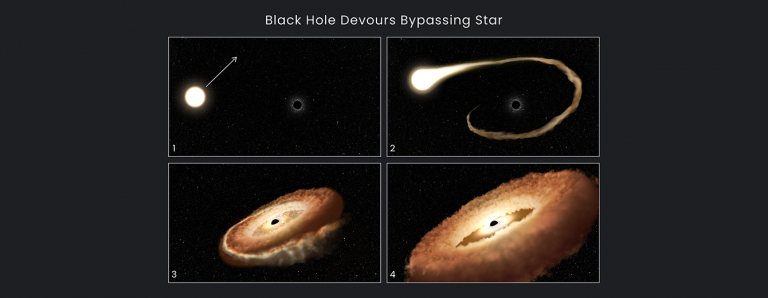
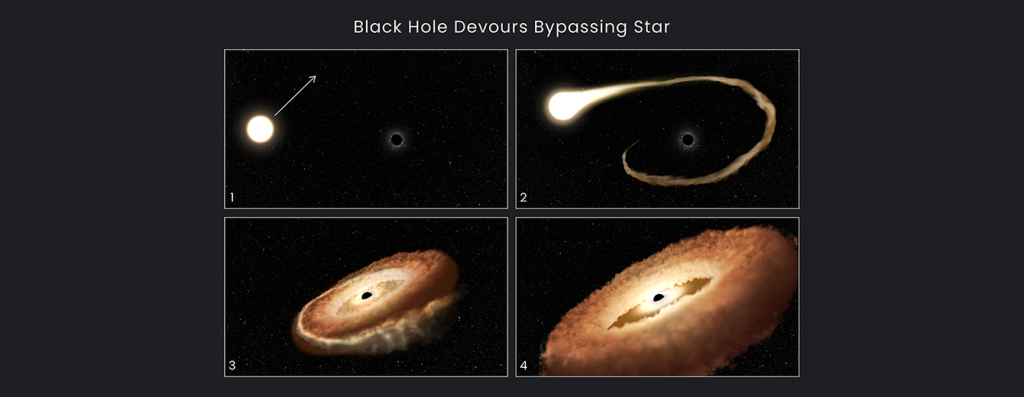
Hubble astronomers got a front row seat to such an interstellar demolition derby when they were alerted to a flash of high-energy radiation from the core of a galaxy 300 million light-years away. Like a police officer arriving quickly at the scene of an accident, Hubble vision was trained on the mayhem before the collision was over. Hubble is too far away to see the doomed star getting sucked in. Instead, Hubble astronomers took the fingerprints of starlight coming from the mishap. These spectra tell a forensic story of a star falling into a cosmic blender. It was shredded, and pulled toward the black hole like a piece of stretched taffy. This process formed a donut-shaped ring of gas around the black hole with superheated gas bleeding out in every direction. About 100 insatiable black holes have been observed to date.

FULL ARTICLE

Black holes are gatherers, not hunters. They lie in wait until a hapless star wanders by. When the star gets close enough, the black hole’s gravitational grasp violently rips it apart and sloppily devours its gasses while belching out intense radiation.

Astronomers using NASA’s Hubble Space Telescope have recorded a star’s final moments in detail as it gets gobbled up by a black hole.

These are termed “tidal disruption events.” But the wording belies the complex, raw violence of a black hole encounter. There is a balance between the black hole’s gravity pulling in star stuff, and radiation blowing material out. In other words, black holes are messy eaters. Astronomers are using Hubble to find out the details of what happens when a wayward star plunges into the gravitational abyss.

Hubble can’t photograph the AT2022dsb tidal event’s mayhem up close, since the munched-up star is nearly 300 million light-years away at the core of the galaxy ESO 583-G004. But astronomers used Hubble’s powerful ultraviolet sensitivity to study the light from the shredded star, which include hydrogen, carbon, and more. The spectroscopy provides forensic clues to the black hole homicide.

About 100 tidal disruption events around black holes have been detected by astronomers using various telescopes. NASA recently reported that several of its high-energy space observatories spotted another black hole tidal disruption event on March 1, 2021, and it happened in another galaxy. Unlike Hubble observations, data was collected in X-ray light from an extremely hot corona around the black hole that formed after the star was already torn apart.

“However, there are still very few tidal events that are observed in ultraviolet light given the observing time. This is really unfortunate because there’s a lot of information that you can get from the ultraviolet spectra,” said Emily Engelthaler of the Center for Astrophysics | Harvard & Smithsonian (CfA) in Cambridge, Massachusetts. “We’re excited because we can get these details about what the debris is doing. The tidal event can tell us a lot about a black hole.” Changes in the doomed star’s condition are taking place on the order of days or months.

For any given galaxy with a quiescent supermassive black hole at the center, it’s estimated that the stellar shredding happens only a few times in every 100,000 years.

This AT2022dsb stellar snacking event was first caught on March 1, 2022 by the All-Sky Automated Survey for Supernovae (ASAS-SN or “Assassin”), a network of ground-based telescopes that surveys the extragalactic sky roughly once a week for violent, variable, and transient events that are shaping our universe. This energetic collision was close enough to Earth and bright enough for the Hubble astronomers to do ultraviolet spectroscopy over a longer than normal period of time.

“Typically, these events are hard to observe. You get maybe a few observations at the beginning of the disruption when it’s really bright. Our program is different in that it is designed to look at a few tidal events over a year to see what happens,” said Peter Maksym of the CfA. “We saw this early enough that we could observe it at these very intense black hole accretion stages. We saw the accretion rate drop as it turned to a trickle over time.”

The Hubble spectroscopic data are interpreted as coming from a very bright, hot, donut-shaped area of gas that was once the star. This area, known as a torus, is the size of the solar system and is swirling around a black hole in the middle.

“We’re looking somewhere on the edge of that donut. We’re seeing a stellar wind from the black hole sweeping over the surface that’s being projected towards us at speeds of 20 million miles per hour (three percent the speed of light),” said Maksym. “We really are still getting our heads around the event. You shred the star and then it’s got this material that’s making its way into the black hole. And so you’ve got models where you think you know what is going on, and then you’ve got what you actually see. This is an exciting place for scientists to be: right at the interface of the known and the unknown.”

The results were reported during a press conference on Jan. 12 at the 241st meeting of the American Astronomical Society in Seattle, Washington. 

The Hubble Space Telescope is a project of international cooperation between NASA and ESA. NASA’s Goddard Space Flight Center in Greenbelt, Maryland, manages the telescope. The Space Telescope Science Institute (STScI) in Baltimore, Maryland, conducts Hubble and Webb science operations. STScI is operated for NASA by the Association of Universities for Research in Astronomy, in Washington, D.C.

MEDIA CONTACT:

Ann Jenkins
Space Telescope Science Institute, Baltimore, Maryland

Ray Villard
Space Telescope Science Institute, Baltimore, Maryland

SCIENCE CONTACT:

Emily Engelthaler
Center for Astrophysics | Harvard & Smithsonian, Cambridge, Massachusetts

W. Peter Maksym
Center for Astrophysics | Harvard & Smithsonian, Cambridge, Massachusetts

Atlanta Shines At Night

0

Martin Luther King, Jr.’s birthplace, Atlanta, Georgia, is seen on January 20, 2013, in this image from the International Space Station as it flew approximately 240 miles above the city.

NASA honors Dr. King’s life and legacy by expanding mission equity, engaging in public service, and sharing knowledge for the benefit of all humanity.

Image Credit: NASA

By Monika Luabeya
Source NASA

NASA To Provide Coverage Of US Spacewalk, Preview News Conference

0
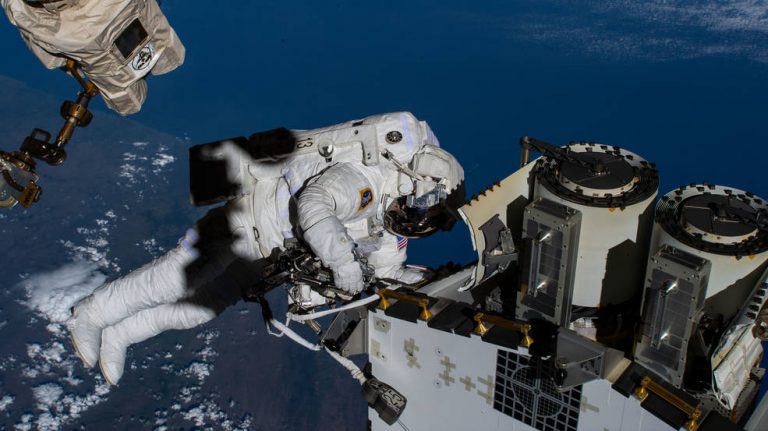
A photo of Expedition 68 Flight Engineer and NASA spacewalker Josh Cassada on Dec. 22, 2022, preparing a roll-out solar array for its deployment on the International Space Station’s Port-4 truss segment as the orbiting lab flew 264 miles above the Indian Ocean off the coast of South Africa. Credits: NASA

Two astronauts on the International Space Station will conduct a spacewalk Friday, Jan. 20, to install hardware for future power system upgrades. Experts will preview the work during a Tuesday, Jan. 17, news conference at NASA’s Johnson Space Center in Houston.

NASA will preview the spacewalk and provide live coverage of the power system upgrades on NASA Television, the NASA app, and the agency’s website.

The news conference will take place at 2 p.m. EST (1 p.m. CST) Jan. 17, with the following participants:

  • Dina Contella, operations integration manager, International Space Station Program
  • Chloe Mehring, spacewalk flight director
  • Keith Johnson, lead spacewalk officer

U.S. media wishing to participate in-person must request news conference credentials from the Johnson newsroom no later than 5 p.m. EST Monday, Jan. 16, at 281-483-5111 or [email protected]. Media interested in participating by phone must contact the Johnson newsroom no later than one hour before the start of the briefing.

On Jan. 20, NASA astronaut Nicole Mann and Japan Aerospace Exploration Agency (JAXA) astronaut Koichi Wakata will exit the station’s Quest airlock to complete the installation of two mounting platforms as part of planned solar array augmentation on the starboard side of the International Space Station’s truss.

The duo will complete the installation of a mounting platform on the 1B power channel that was started during a previous spacewalk and begin installing a mounting platform on the 1A power channel.

NASA will provide live coverage beginning at 7 a.m. EST. The spacewalk is scheduled to begin at 8:15 a.m., and last about six and a half hours.

The installation is part of a series of spacewalks to augment the International Space Station’s power channels with new International Space Station Roll-Out Solar Arrays (iROSAs). Four iROSAs have been installed so far, and two more will be mounted to the platforms installed during this spacewalk in the future.

Mann will serve as extravehicular crew member 2 (EV 2) and will wear an unmarked suit. Wakata will serve as extravehicular crew member 1 (EV 1) and will wear a suit with red stripes. The spacewalk will be the first for both Mann and Wakata.

Get breaking news, images and features from the space station on the station blogInstagramFacebook, and Twitter.

Learn more about International Space Station research and operations at:

https://www.nasa.gov/station

-end-

Lora Bleacher
Headquarters, Washington
202-358-1100
[email protected]

Gary Jordan
Johnson Space Center, Houston
281-483-5111
[email protected]

By Gerelle Dodson
Source NASA