To get computer models to look similar to the Universe around us, cosmologists have assumed that around 96 per cent of matter and energy are in forms that we cannot directly detect. You might think that this would make cosmologists wary of relying on such hypothetical substances. Yet for the majority working today, dark matter and dark energy are every bit as real as the stars and galaxies that we can see.
Such corporate belief might work for business, but it has no place in science. Back in 1620, Francis Bacon published his Novum Organum (The New Method). In his description of how to investigate nature, he cautioned would-be scientists about four ‘idols of the mind’. Namely:
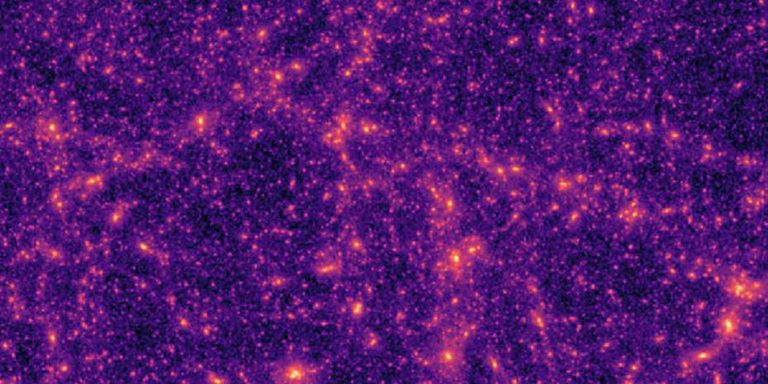
NASA ESA
Idola tribus (idols of the tribe) – which occur when people try to feed new facts into their preconceived ideas. ‘The human understanding is like a false mirror,’ Bacon wrote, ‘which, receiving rays irregularly, distorts and discolours the nature of things by mingling its own nature with it.’
Idola specus (idols of the cave): ‘Everyone… has a cave or den of his own, which refracts and discolours the light of nature,’ writes Bacon. These individual likes and dislikes cloud judgment.
Idola fori (idols of the marketplace): in the exchange of ideas, Bacon writes, ‘the ill and unfit choice of words wonderfully obstructs the understanding’.
Idola theatri (idols of the theatre): the final idol comes about by blindly following academic dogma and not asking enough real questions about the world. Why theatre? ‘In my judgment,’ writes Bacon, ‘all the received systems are but so many stage plays, representing worlds of their own creation after an unreal and scenic fashion.’
Cosmology could well be falling foul of these idols. In the case of dark matter, the unquestioning belief is puzzling because the direct searches for these particles are coming up effectively empty‑handed. Yet observations are routinely interpreted as being the result of dark matter. No other avenues of approach are taken by the vast majority of researchers.
In reality, there are other possible solutions that at least warrant examination and comparison. In certain circumstances they fit the observations better than dark matter can. They usually involve a different approach, which is to alter how the force of gravity works or to relax an assumption about the way we think the Universe works, rather than add new constituents to the Universe.
An alternative to dark matter was offered in 1981, by the physicist Mordehai Milgrom of the Weizmann Institute of Science in Israel. He postulated that gravity pulls a little more strongly than Newton’s laws predict at extremely weak levels.
A different approach to dark energy, which is thought to power an acceleration of the Universe, is to dismiss the assumption that matter is distributed evenly throughout space. Then the Universe will naturally change the rate at which it expands.
Yet these ideas are generally sidelined in favour of the status quo. Why?
Cosmology has become too conservative, too unwilling to step outside of the mainstream in the search for answers. While some might see this piece as an attack, it is simply the adoption of a position that I believe is truly scientific. One in which skepticism rules, and prevailing ideas are questioned.
The true gold standard for science is constant self-questioning, constant re‑evaluation, and constant open-mindedness in the search for better explanations. Theories are never ‘true’, even if they fit all known facts. They are merely hypotheses that have been shown to be useful. And they could fall at any moment if new observations come to light that do not fit.
The sobering fact is that either 96 per cent of the Universe is unknown to us or we are completely wrong about the way we think the Universe works. Either way, cosmology is far from finished: we have a lot to work out.
This article was originally published at Aeon and has been republished under Creative Commons.
NASA has signed agreements with three U.S. companies to develop designs of space stations and other commercial destinations in space. The agreements are part of the agency’s efforts to enable a robust, American-led commercial economy in low-Earth orbit.
The total estimated award amount for all three funded Space Act Agreements is $415.6 million. The companies that received awards are:
Blue Origin of Kent, Washington, for $130 million
Nanoracks LLC, of Houston for $160 million
Northrop Grumman Systems Corporation of Dulles, Virginia, for $125.6 million
NASA seeks to maintain an uninterrupted U.S. presence in low-Earth orbit by transitioning from the International Space Station to other platforms. These awards will stimulate U.S. private sector development of commercial, independent space stations that will be available to both government and private-sector customers.
“Building on our successful initiatives to partner with private industry to deliver cargo, and now our NASA astronauts, to the International Space Station, NASA is once again leading the way to commercialize space activities,” said NASA Administrator Bill Nelson. “With commercial companies now providing transportation to low-Earth orbit in place, we are partnering with U.S. companies to develop the space destinations where people can visit, live, and work, enabling NASA to continue forging a path in space for the benefit of humanity while fostering commercial activity in space.”
Representatives from NASA and the selected companies will host a teleconference today, Dec. 2, at 5 p.m. EST. Media wishing to participate in the call must RSVP to Josh Finch via email at: [email protected] by 4:30 p.m. EST.
Phil McAlister, director, commercial spaceflight, NASA Headquarters in Washington
Angela Hart, manager, of NASA’s commercial low-Earth orbit development program at NASA’s Johnson Space Center in Houston
Brent Sherwood, senior vice president of advanced development programs, Blue Origin, and Dr. Janet Kavandi, former NASA astronaut and Sierra Space president
Jeffrey Manber, president of international and space stations for Voyager Space and chairman of the board at Nanoracks
Rick Mastracchio, director of business development for human exploration, Northrop Grumman
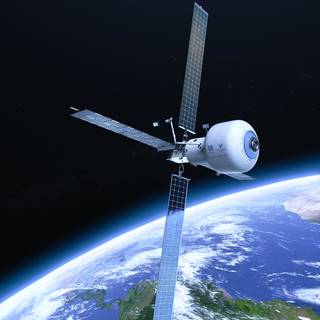
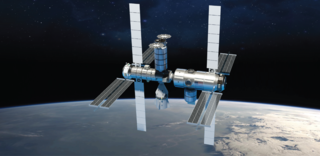
The Blue Origin and Sierra Space Orbital Reef baseline configuration (second half of the 2020s): Core Module, Energy Mast, LIFE, Node, and Science Module. Payload operations commence with the second launch.
Credits: Orbital Reef
The awards are the first in a two-phase approach to ensure a seamless transition of activity from the International Space Station to commercial destinations. During this first phase, private industry, in coordination with NASA, will formulate and design commercial low-Earth orbit destination capabilities suitable for potential government and private sector needs. The first phase is expected to continue through 2025.
Blue Origin and Sierra Space have partnered to develop Orbital Reef, a commercially owned and operated space station to be built in low-Earth orbit, which will start operating in the second half of this decade. Orbital Reef teammates include Boeing, Redwire Space, Genesis Engineering, and Arizona State University. Orbital Reef’s human-centered space architecture is designed to be a “mixed-use space business park” that provides essential infrastructure needed to support all types of human spaceflight activity in low-Earth orbit and can be scaled to serve new markets.
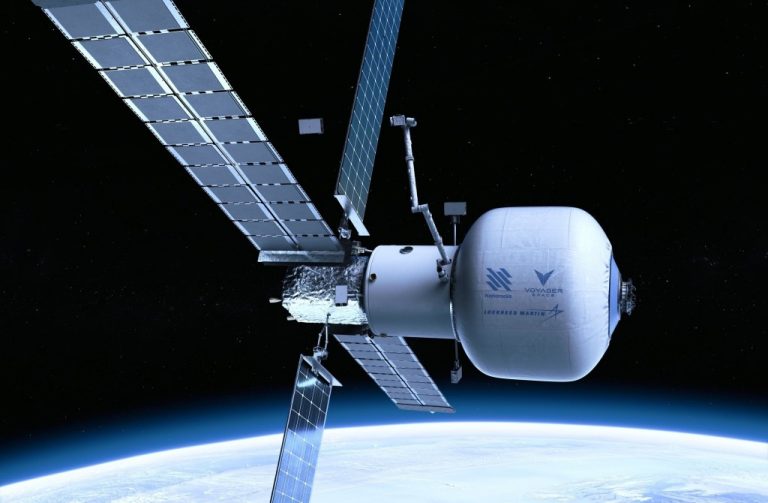
Starlab, from Nanoracks, Voyager Space, and Lockheed Martin, is a continuously crewed, free-flying, commercial space station dedicated to conducting advanced research, fostering commercial industrial activity, and ensuring continued U.S. presence and leadership in low-Earth Orbit.
Credits: Nanoracks/Lockheed Martin/Voyager Space
The station’s shared infrastructure will support the proprietary needs of diverse U.S. and international users, tenants, and visitors, including those representing research, industry, government, and the commercial sector. Features such as reusable space transportation and advanced automation can minimize cost and complexity to enable the widest range of users. Accommodations, vehicle docking ports, and utilities can all be scaled with growth in market demand.
Nanoracks’ commercial low-Earth orbit destination, in collaboration with Voyager Space and Lockheed Martin, is called “Starlab.” Starlab is targeted for launch in 2027 on a single flight as a continuously crewed, commercial space station dedicated to conducting advanced research, fostering commercial industrial activity, and ensuring continued U.S. presence and leadership in low-Earth orbit. Starlab is designed for four astronauts and will have power, volume, and a payload capability equivalent to the International Space Station.
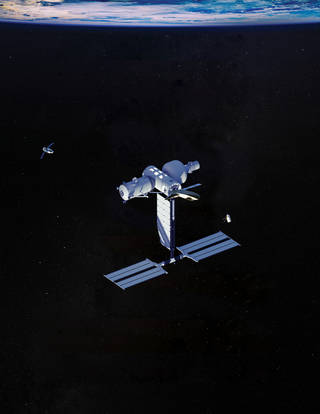
Northrop Grumman’s free flyer commercial destination design leverages flight proven elements to provide the base module for extended capabilities including science, tourism, industrial experimentation, and building of infrastructure beyond initial design.
Credits: Northrop Grumman
Starlab will host the George Washington Carver Science Park featuring four main operational departments – a biology lab, plant habitation lab, physical science and materials research lab, and an open workbench area – to meet the needs of researchers and commercial customers for commercial space activities. The station will be built with flexible growth in mind, featuring interfaces both internal and external to the spacecraft to allow Nanoracks to expand the architecture as new demand sources are identified, and new markets emerge.
Northrop Grumman’s design for a modular, commercial destination in low-Earth orbit is built on decades of experience supporting NASA, defense, and commercial programs. The design leverages flight-proven elements, such as the Cygnus spacecraft that provides cargo delivery to the International Space Station, to provide a base module for extended capabilities including science, tourism, industrial experimentation, and the building of infrastructure beyond initial design.
Multiple docking ports will allow future expansion to support crew analog habitats, laboratories, crew airlocks, and facilities capable of artificial gravity, in support of multiple customers. This Space Act Agreement will enable Northrop Grumman to provide a detailed commercialization, operations, and capabilities plan, as well as space station requirements, mission success criteria, risk assessments, key technical and market analysis requirements, and preliminary design activities. Northrop Grumman’s team includes Dynetics, with other partners to be announced.
For the second phase of NASA’s approach to a transition toward commercial low-Earth orbit destinations, the agency intends to certify for NASA crew member use commercial low-Earth orbit destinations from these and potential other entrants, and ultimately, purchase services from destination providers for crew to use when available. This strategy will provide services the government needs at a lower cost, enabling NASA to focus on its Artemis missions to the Moon and on to Mars while continuing to use low-Earth orbit as a training and proving ground.
NASA estimates the agency’s future needs in low-Earth orbit will require continuous accommodations and training for at least two crew members, as well as the ability to support a national orbiting laboratory and the performance of approximately 200 investigations annually to support human research, technology demonstrations, biological and physical science.
Developing commercial destinations in low-Earth orbit is part of NASA’s broader efforts to build a robust low-Earth orbit economy, including supporting commercial activity and enabling the first private astronaut mission to the space station. In addition to these new awards NASA selected Axiom Space in January 2020 to design and develop commercial modules to attach to the station. NASA and Axiom recently completed the preliminary design review of two modules as well as the critical design review of the module’s primary structure.
By transitioning to a model where commercial industry owns and operates the assets in low-Earth orbit and where NASA is one of many customers, the agency can save on costs to live and work in low-Earth orbit and focus on pushing innovation and exploration of the Moon and Mars through NASA’s Artemis missions.
Find more information about NASA’s efforts to bolster a low-Earth orbit economy at: