
Home Blog Page 94

NASA, DARPA Will Test Nuclear Engine For Future Mars Missions

0
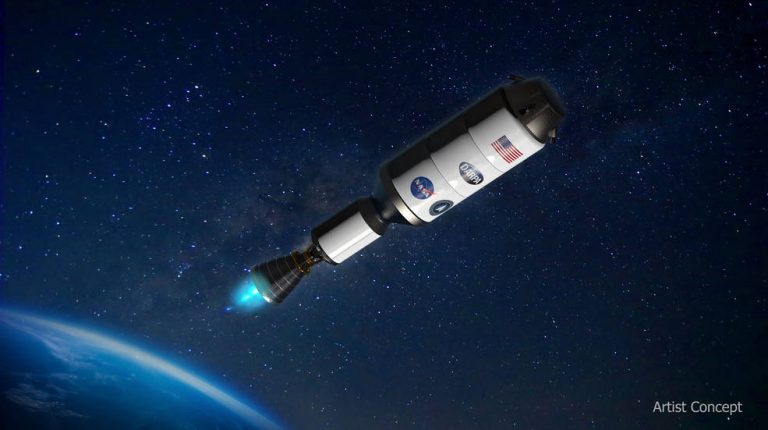
Artist concept of Demonstration for Rocket to Agile Cislunar Operations (DRACO) spacecraft, which will demonstrate a nuclear thermal rocket engine. Nuclear thermal propulsion technology could be used for future NASA crewed missions to Mars. Credits: DARPA

NASA and the Defense Advanced Research Projects Agency (DARPA) announced Tuesday a collaboration to demonstrate a nuclear thermal rocket engine in space, an enabling capability for NASA crewed missions to Mars.

NASA and DARPA will partner on the Demonstration Rocket for Agile Cislunar Operations, or DRACO, program. The non-reimbursable agreement designed to benefit both agencies, outlines roles, responsibilities, and processes aimed at speeding up development efforts. 

“NASA will work with our long-term partner, DARPA, to develop and demonstrate advanced nuclear thermal propulsion technology as soon as 2027. With the help of this new technology, astronauts could journey to and from deep space faster than ever – a major capability to prepare for crewed missions to Mars,” said NASA Administrator Bill Nelson. “Congratulations to both NASA and DARPA on this exciting investment, as we ignite the future, together.”

Using a nuclear thermal rocket allows for faster transit time, reducing risk for astronauts. Reducing transit time is a key component for human missions to Mars, as longer trips require more supplies and more robust systems. Maturing faster, more efficient transportation technology will help NASA meet its Moon to Mars Objectives.

Other benefits to space travel include increased science payload capacity and higher power for instrumentation and communication. In a nuclear thermal rocket engine, a fission reactor is used to generate extremely high temperatures. The engine transfers the heat produced by the reactor to a liquid propellant, which is expanded and exhausted through a nozzle to propel the spacecraft. Nuclear thermal rockets can be three or more times more efficient than conventional chemical propulsion.

“NASA has a long history of collaborating with DARPA on projects that enable our respective missions, such as in-space servicing,” said NASA Deputy Administrator Pam Melroy. “Expanding our partnership to nuclear propulsion will help drive forward NASA’s goal to send humans to Mars.”

Under the agreement, NASA’s Space Technology Mission Directorate (STMD) will lead technical development of the nuclear thermal engine to be integrated with DARPA’s experimental spacecraft. DARPA is acting as the contracting authority for the development of the entire stage and the engine, which includes the reactor. DARPA will lead the overall program including rocket systems integration and procurement, approvals, scheduling, and security, cover safety and liability, and ensure overall assembly and integration of the engine with the spacecraft. Over the course of the development, NASA and DARPA will collaborate on assembly of the engine before the in-space demonstration as early as 2027. 

“DARPA and NASA have a long history of fruitful collaboration in advancing technologies for our respective goals, from the Saturn V rocket that took humans to the Moon for the first time to robotic servicing and refueling of satellites,” said Dr. Stefanie Tompkins, director, DARPA. “The space domain is critical to modern commerce, scientific discovery, and national security. The ability to accomplish leap-ahead advances in space technology through the DRACO nuclear thermal rocket program will be essential for more efficiently and quickly transporting material to the Moon and eventually, people to Mars.”

The last nuclear thermal rocket engine tests conducted by the United States occurred more than 50 years ago under NASA’s Nuclear Engine for Rocket Vehicle Application and Rover projects.

“With this collaboration, we will leverage our expertise gained from many previous space nuclear power and propulsion projects,” said Jim Reuter, associate administrator for STMD. “Recent aerospace materials and engineering advancements are enabling a new era for space nuclear technology, and this flight demonstration will be a major achievement toward establishing a space transportation capability for an Earth-Moon economy.”

NASA, the Department of Energy (DOE), and industry are also developing advanced space nuclear technologies for multiple initiatives to harness power for space exploration. Through NASA’s Fission Surface Power project, DOE awarded three commercial design efforts to develop nuclear power plant concepts that could be used on the surface of the Moon and, later, Mars.

NASA and DOE are working another commercial design effort to advance higher temperature fission fuels and reactor designs as part of a nuclear thermal propulsion engine. These design efforts are still under development to support a longer-range goal for increased engine performance and will not be used for the DRACO engine. 

To learn more about STMD, please visit: https://www.nasa.gov/spacetech

Sarah Frazier
Headquarters, Washington
202-853-7191
[email protected]

Tabatha Thompson
DARPA
703-526-2085
[email protected]

By Roxana Bardan
Source NASA
NASA To Launch New Mars Sample Receiving Project Office At Johnson

0
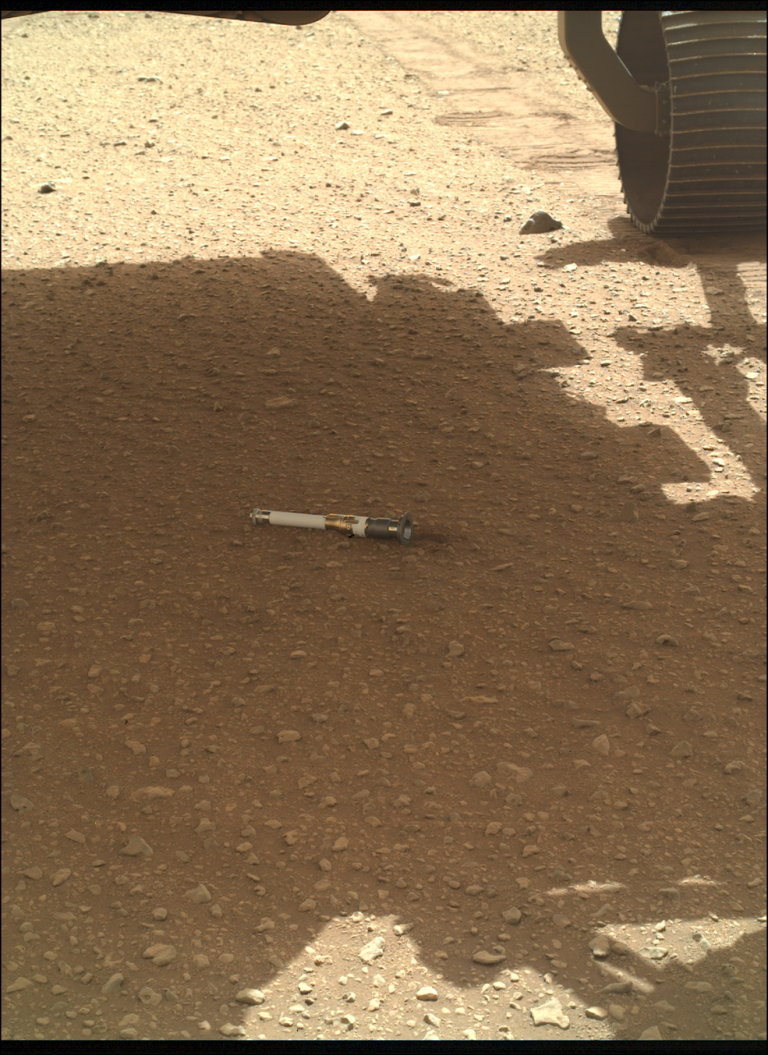
NASA’s Perseverance rover deposited the first of several samples onto the Martian surface on Dec. 21, 2022, the 653rd Martian day, or sol, of the mission. Credits: NASA/JPL-Caltech/MSSS

NASA announced Thursday its new Mars Sample Receiving Project office, responsible for receiving and curating the first samples returned from the Red Planet, will be located at the agency’s Johnson Space Center in Houston. The safe and rapid release of Mars samples after they return to Earth to laboratories worldwide for science investigations will be a priority.

The office will reside within Johnson’s Astromaterials Research and Exploration Science division, NASA’s organization with expertise in processing and curating extraterrestrial samples.

“NASA Johnson houses the largest and most diverse collection of astromaterials in the world, beginning with samples returned from the Apollo Program,” said Johnson Center Director Vanessa Wyche. “With our expertise, we look forward to managing the project that will receive scientifically compelling Mars samples gathered by the NASA Perseverance rover.”

Johnson will work with the agency’s Mars Exploration Program to develop and design plans for sample recovery and subsequent transition to science investigations. The project team will recover, contain, transfer, assess safety, curate, and coordinate scientific investigation of the samples collected by NASA’s Mars 2020 Perseverance rover, which are expected to arrive on Earth in 2033.

Samples returned to Earth will enhance humanity’s understanding of Mars through detailed chemical and physical analyses in laboratories around the world that are beyond the capabilities of instruments delivered to Mars. Perseverance is gathering samples in and around Jezero Crater, where billions of years ago, a river once flowed into a lake and deposited rocks and sediments in a fan shaped delta formation. Deltas are one of the best places on Mars to search for potential signs of ancient microbial life.

“Age-old samples, like those being collected on Mars, are critical in our quest to better understand our universe,” said Rep. Brian Babin of Texas. “I’m proud Johnson will lead NASA’s effort in curating these samples and play a key role in propelling our scientific discoveries forward.”

A key objective for Perseverance’s mission on Mars is astrobiology, including caching samples that may contain signs of ancient microbial life. The rover is currently characterizing the planet’s geology and past climate, paving the way for human exploration of the Red Planet, and is the first mission to collect and cache Martian rock and regolith.

“The Mars Sample Return Program is essential for the human exploration of Mars,” said Rep. Sheila Jackson Lee of Texas. “Establishing this Sample Receiving Project office is a large step forward in helping us gain knowledge and make progress in our efforts to go to Mars.”

“Johnson will work with the agency’s Mars Exploration Program and ESA to complete studies and develop plans for sample recovery and transportation, facility development and operation, and science investigations,” said Gerhard Kminek, ESA’s MSR lead scientist.

More Campaign Information

Returning samples to Earth from Mars is expected to be the most complex robotic space flight campaign ever attempted. The NASA-European Space Agency (ESA) Mars Sample Return Campaign promises to revolutionize humanity’s understanding of Mars by bringing scientifically selected samples to Earth for study using the most sophisticated instruments around the world. The campaign would fulfill a solar system exploration goal, a high priority since the 1970s and in the last three National Academy of Sciences Planetary Decadal Surveys.

This strategic NASA and ESA partnership would be the first mission to return scientifically selected samples from another planet and the first launch from the surface of another planet. The samples collected by NASA’s Perseverance Mars rover during its exploration of an ancient lakebed are thought to present the best opportunity to reveal clues about the early evolution of Mars, including the potential for past life. By better understanding the history of Mars, we would improve our understanding of all rocky planets in the solar system, including Earth.

For more information about the Mars Sample Return campaign, visit: https://mars.nasa.gov/msr

Karen Fox / Alana Johnson
Headquarters, Washington
202-358-1600
[email protected] / [email protected]

Nilufar Ramji
Johnson Space Center, Houston
281-483-5111
[email protected]

By Roxana Bardan
Source NASA

Webb Unveils Dark Side

0

An international team of astronomers using NASA’s James Webb Space Telescope has obtained an in-depth inventory of the deepest, coldest ices measured to date in a molecular cloud. In addition to simple ices like water, the team was able to identify frozen forms of a wide range of molecules, from carbonyl sulfide, ammonia, and methane, to the simplest complex organic molecule, methanol. This is the most comprehensive census to date of the icy ingredients available to make future generations of stars and planets, before they are heated during the formation of young stars.

This image from the telescope’s Near-Infrared Camera (NIRCam) features the central region of the Chamaeleon I dark molecular cloud, which resides 630 light-years away. The cold, wispy cloud material (blue, center) is illuminated in the infrared by the glow of the young, outflowing protostar Ced 110 IRS 4 (orange, upper left). The light from numerous background stars, seen as orange dots behind the cloud, can be used to detect ices in the cloud, which absorb the starlight passing through them.

This research forms part of the Ice Age project, one of Webb’s 13 Early Release Science programs. These observations are designed to showcase Webb’s observing capabilities and to allow the astronomical community to learn how to get the best from its instruments. The Ice Age team has already planned further observations, and hopes to trace out the journey of ices from their formation through to the assemblage of icy comets.

Image credit: NASA, ESA, CSA, and M. Zamani (ESA)

By Dacia Massengill
Source NASA

Montana Students To Hear From NASA Astronaut On Space Station

0
NASA Expedition 68 Flight Engineer Nicole Mann helps NASA spacewalkers Josh Cassada, left, and Frank Rubio, suit up for a spacewalk to install a roll-out solar array on the International Space Station. The crew successfully completed the spacewalk on Dec. 22 after a 24-hour delay to avoid a close approach by a piece of space junk. Credits: NASA

Students from the Boys & Girls Club of the Flathead Reservation and Lake County in Ronan, Montana, will have an opportunity this week to hear from a NASA astronaut aboard the International Space Station. The space-to-Earth call will air live at 12 p.m. EST on Thursday, Jan. 26, on NASA Television, the NASA app, and the agency’s website.

NASA astronaut Nicole Mann will answer prerecorded questions from student participants of the Boys & Girls Club of the Flathead Reservation and Lake County out-of-school programing. Mann is the first Native American woman to fly in space.

The program provides opportunities for reservation youth that inspire students to be the best version of themselves and uses science, technology, engineering, and mathematics (STEM) to foster collaboration and problem solving. The downlink connects to their experiences as part of the Students to Launch program and their study of STEM.

Students to Launch was born out of a partnership agreement between NASA’s Office of STEM Engagement (OSTEM) and the American Institute of Aeronautics and Astronautics. The program works through OSTEM’s Community Anchors and its informal education institutions called “S2L Hubs” – museums, science centers, youth-serving institutions, libraries, and other places across the country where students congregate outside of school.

Media interested in covering the event should contact Aric Cooksley at [email protected] or 406-493-2312.

For more than 22 years, astronauts have continuously lived and worked aboard the space station, testing technologies, performing science, and developing the skills needed to explore farther from Earth. Astronauts living in space aboard the orbiting laboratory communicate with NASA’s Mission Control Center in Houston 24 hours a day through the Near Space Network Tracking and Data Relay Satellites (TDRS).

As part of Artemis, NASA will send astronauts to the Moon to prepare for future human exploration of Mars. Inspiring the next generation of explorers – the Artemis Generation – ensures America will continue to lead in space exploration and discovery.

See videos and lesson plans highlighting research on the International Space Station at: https://www.nasa.gov/stemonstation

Katherine Brown
Headquarters, Washington
202-358-1288
[email protected]

Sandra Jones 
Johnson Space Center, Houston
281-483-5111
[email protected]

By Roxana Bardan
Source NASA
Suiting Up For Their First Spacewalk

0

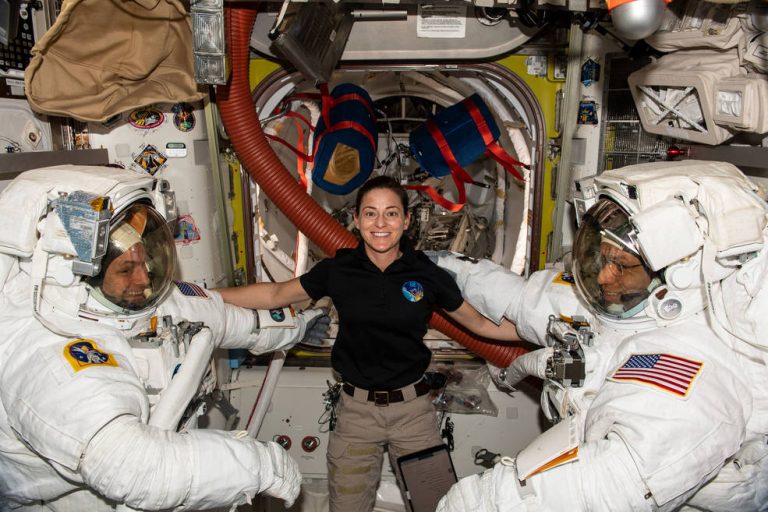
Expedition 68 Flight Engineers Nicole Mann of NASA and Koichi Wakata of the Japan Aerospace Exploration Agency are pictured on Jan. 12, 2023, during a fit check of their spacesuits inside the Quest airlock ahead of a planned spacewalk to upgrade the International Space Station’s power generation system.

The spacewalk began on Jan. 20, 2023, at approximately 8:15 a.m. EST and was expected to last six and a half hours.

Image Credit: NASA

By Monika Luabeya
Source NASA

NASA Issues Award For Greener, More Fuel-Efficient Airliner Of Future

0
NASA Administrator Bill Nelson holds a model of an aircraft with a Transonic Truss-Braced Wing during a news conference on NASA’s Sustainable Flight Demonstrator project, Wednesday, Jan. 18, 2023, at the Mary W. Jackson NASA Headquarters building in Washington, DC. Through a Funded Space Act Agreement, The Boeing company and its industry team will collaborate with NASA to develop and flight-test a full-scale Transonic Truss-Braced Wing demonstrator aircraft. Credits: NASA/Joel Kowsky

NASA announced Wednesday it has issued an award to The Boeing Company for the agency’s Sustainable Flight Demonstrator project, which seeks to inform a potential new generation of green single-aisle airliners.

Under a Funded Space Act Agreement, Boeing will work with NASA to build, test, and fly a full-scale demonstrator aircraft and validate technologies aimed at lowering emissions.

Over seven years, NASA will invest $425 million, while the company and its partners will contribute the remainder of the agreement funding, estimated at about $725 million. As part of the agreement, the agency also will contribute technical expertise and facilities.

“Since the beginning, NASA has been with you when you fly. NASA has dared to go farther, faster, higher. And in doing so, NASA has made aviation more sustainable and dependable. It is in our DNA,” said NASA Administrator Bill Nelson. “It’s our goal that NASA’s partnership with Boeing to produce and test a full-scale demonstrator will help lead to future commercial airliners that are more fuel efficient, with benefits to the environment, the commercial aviation industry, and to passengers worldwide. If we are successful, we may see these technologies in planes that the public takes to the skies in the 2030s.”

Single-aisle aircraft are the workhorse of many airline fleets, and due to their heavy usage, account for nearly half of worldwide aviation emissions. NASA plans to complete testing for the project by the late 2020s, so that technologies and designs demonstrated by the project can inform industry decisions about the next generation of single-aisle aircraft that could enter into service in the 2030s.

Through the Sustainable Flight Demonstrator project, Boeing and its industry team will partner with NASA to develop and flight-test a full-scale Transonic Truss-Braced Wing demonstrator aircraft.

The Transonic Truss-Braced Wing concept involves an aircraft with extra-long, thin wings stabilized by diagonal struts. This design results in an aircraft that is much more fuel efficient than a traditional airliner due to a shape that would create less drag – resulting in its burning less fuel.

“NASA is working toward an ambitious goal of developing game-changing technologies to reduce aviation energy use and emissions over the coming decades toward an aviation community goal of net-zero carbon emissions by 2050,” said Bob Pearce, NASA associate administrator for the Aeronautics Research Mission Directorate. “The Transonic Truss-Braced Wing is the kind of transformative concept and investment we will need to meet those challenges and, critically, the technologies demonstrated in this project have a clear and viable path to informing the next generation of single-aisle aircraft, benefiting everyone that uses the air transportation system.”

NASA’s goal is that the technology flown on the demonstrator aircraft, when combined with other advancements in propulsion systems, materials, and systems architecture, would result in fuel consumption and emissions reductions of up to 30% relative to today’s most efficient single-aisle aircraft, depending on the mission.

Through separate efforts, NASA has worked with Boeing and other industry partners on advanced sustainable aviation concepts, including the Transonic Truss-Braced Wing concept.

Artist concept of commercial aircraft families with a Transonic Truss-Braced Wing configuration from the Sustainable Flight Demonstrator project.
Credits: Boeing

“We’re honored to continue our partnership with NASA and to demonstrate technology that significantly improves aerodynamic efficiency resulting in substantially lower fuel burn and emissions,” said Todd Citron, Boeing chief technology officer. “Boeing has been advancing a multipronged sustainability strategy, including fleet renewal, operational efficiency, renewable energy, and advanced technologies to support the U.S. Aviation Climate Action Plan and meet the industry objective of net zero carbon emissions by 2050. The Sustainable Flight Demonstrator builds on more than a decade of NASA, Boeing, and our industry partners’ investments to help achieve these objectives.”

The new Funded Space Act agreement allows NASA to capitalize on private industry knowledge and experience, with Boeing and its partners laying out a proposed technical plan. NASA will provide access to its aeronautics facilities and expertise. NASA will not procure an aircraft or any other hardware for its missions. The agency will obtain access to certain ground and flight data that can be used to validate the airframe configuration and associated technologies.

The Sustainable Flight Demonstrator will help the United States achieve net-zero carbon emissions from aviation by 2050 – one of the environmental goals articulated in the White House’s U.S. Aviation Climate Action Plan. The International Civil Aviation Organization also has set a goal of net-zero carbon emissions by 2050.

The project is an activity under NASA’s Integrated Aviation Systems Program and a key element of the Sustainable Flight National Partnership, which focuses on developing new sustainable aviation technologies.

Learn more about NASA’s Sustainable Aviation efforts at: https://go.nasa.gov/3GzcDMP

Rob Margetta
Headquarters, Washington
202-763-5012
[email protected]

By Roxana Bardan
Source NASA

Northrop Grumman, AT&T and Fujitsu Demonstrate New 5G-powered Open Architecture Capabilities to Support Joint Force

0

Northrop Grumman Corporation (NYSE: NOC), AT&T* and Fujitsu recently demonstrated 5G-enabled intelligence, surveillance and reconnaissance (ISR) capabilities in Northrop Grumman’s new 5G lab. The demonstration integrated radios with Northrop Grumman’s tactical data links, AT&T’s private 5G network and Fujitsu’s Open Radio Access Network (O-RAN) to transmit ISR data and video, proving our strength in connecting the battlespace. This is a critical step in building the digital battle network to support multi-domain operations.

Northrop-Grumman-image-3
Credit: Northrop Grumman

“This critical capability will bring together the high speeds, low latency and cybersecurity protections of private 5G networks with the flexibility and scalability of commercial 5G capabilities,” said Ben Davies, vice president and general manager networked information solutions division, Northrop Grumman. “Enabling 5G connectivity for our warfighters across domains will help realize a connected battlespace for the joint force.” 

Last spring, Northrop Grumman and AT&T established a joint research and development agreement to build a digital battle network powered by AT&T’s commercial 5G network and Northrop Grumman’s robust portfolio of capabilities that are at the forefront of military technological advancement to enable the joint force.

“This demonstration showcased the benefits of commercially available 5G for the Department of Defense and the open, standards-based technologies that we’re exploring and developing as leaders in the O-RAN Alliance,” said Lance Spencer, client executive vice president, defense, public sector, AT&T.

“Open RAN is accelerating 5G innovations to deliver high-speed, low-latency requirements for mission-critical applications,” said Greg Manganello, senior vice president and vice head of the 5G mobile systems business unit at Fujitsu. “Our collaboration with Northrop Grumman and AT&T highlights the benefits of the ecosystem underpinning of Open RAN, enabling new configurations of mission-critical communications networks.”

The collaboration between Northrop Grumman, AT&T and Fujitsu is designed to drive innovation at speed to deliver a cost-effective, scalable, open architecture solution for the DoD. This approach can enable rapid deployment of new capabilities and shorten the decision-making timeline in a multi-domain, contested environment – a key component in laying the foundation for Joint All-Domain Command and Control. 


About Northrop Grumman

Northrop Grumman is a technology company, focused on global security and human discovery. Our pioneering solutions equip our customers with the capabilities they need to connect, advance and protect the U.S. and its allies. Driven by a shared purpose to solve our customers’ most challenging problems, our 90,000 employees define possible every day.

*About AT&T

We help more than 100 million U.S. families, friends and neighbors connect in meaningful ways every day. From the first phone call 140+ years ago to our 5G wireless and multi-gig internet offerings today, we @ATT innovate to improve lives. For more information about AT&T Inc. (NYSE:T), please visit us at about.att.com. Investors can learn more at investors.att.com.

About Fujitsu Network Communications Inc.

Fujitsu Network Communications, Inc. is a leading provider of digital transformation solutions for network operators, service providers and content providers worldwide. We combine best-in-class hardware, software and services with multi-vendor expertise to enable cost savings, faster services delivery and improved network performance. Working closely with our customers and ecosystem partners, we design, build, operate and maintain better networks for the connected world. For more information, please visit our website or connect with us on LinkedIn.


Star on a dangerous path provides regular meals for supermassive black hole

0

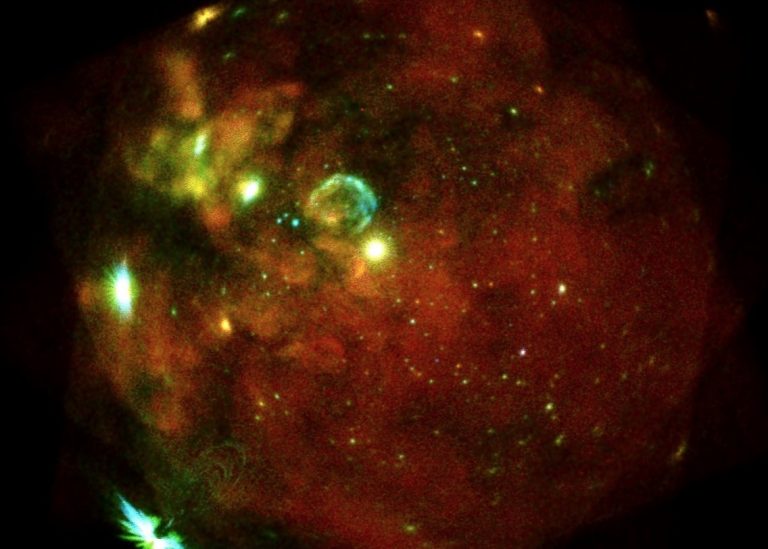
In the eROSITA all-sky survey, scientists at the Max Planck Institute for Extraterrestrial Physics (MPE) have found an interesting repeating event. In an otherwise quiescent galaxy, an X-ray flare repeats every 220 days, indicating that a star orbiting the central black hole “feeds” the gravity monster on subsequent orbits. Such events could be effective tools to explore the accretion process and the gravity field around supermassive black holes in other galaxies.

Most galaxies harbour a supermassive black hole at their centre, and observations suggest a symbiotic growth of the central black hole and the host galaxy. These studies mainly concentrate on ‘active’ galaxies, i.e., those where the central black hole persistently accretes large amounts of matter, which heats up and shines very brightly. However, these active galaxies (or active galactic nuclei, AGN) are vastly outnumbered by quiescent galaxies, in which it is much harder to infer the presence of the nuclear supermassive black hole.

Occasionally, a star might wander too close to the central black hole in a galaxy and be disrupted by its strong tidal forces, in a so called „tidal disruption event“. These events result in the star losing its material to the black hole, temporarily increasing the fuelling rate of the gravity monster, and producing an X-ray flare as the stellar matter is consumed. Occurring roughly once every 10000 years per galaxy, tidal disruption events are rare, and most observed candidates to-date are one-off events that show only a single flare due to the destruction of the star. Recently, a few transients have been reported that show periodic or repeating flares. These could be due to stars that are fortunate to survive their first encounter. Instead of being disrupted completely, the remnant orbits the supermassive black hole, losing parts of its outer layers and fuelling the black hole with each passage.

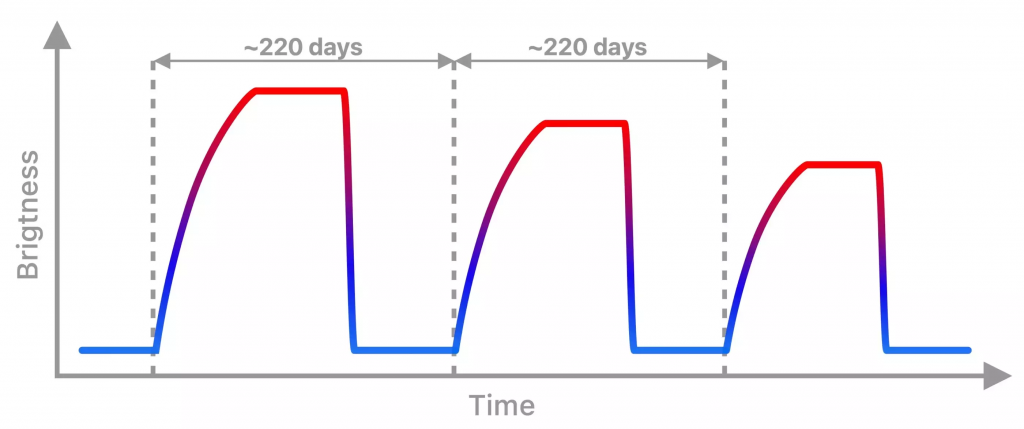
The light-curve of the new source, J0456-20, shows four distinctive phases: The X-ray flux plateau phase lasts about two months and then drops rapidly (by a factor of 100) within one week. A faint X-ray stage follows this for about 2-3 months before it starts the X-ray rising phase again. The whole cycle lasts about 220 days.

© MPE
The light-curve of the new source, J0456-20, shows four distinctive phases: The X-ray flux plateau phase lasts about two months and then drops rapidly (by a factor of 100) within one week. A faint X-ray stage follows this for about 2-3 months before it starts the X-ray rising phase again. The whole cycle lasts about 220 days. © MPE

“Such repeating partial disruption events could be effective tools to explore the accretion process around supermassive black holes”, points out Zhu Liu, the lead author of the study at MPE. “With eROSITA we found a very intriguing repeating nuclear transient in an otherwise quiescent galaxy.”

During its all-sky survey, the eROSITA X-ray telescope observed every position on the sky multiple times, thereby uncovering high-energy transients in galaxies that showed no signatures of prior activity at their centres. The new source, J0456-20, discovered in February 2021, is located in a quiescent galaxy about 1 billion light-years away. It is one of the most variable X-ray sources seen by eROSITA, with the X-ray flux dropping by a factor of 100 within a week. In total, the astronomers observed three complete cycles of repeating X-ray flares from the source, with a recurrence time of around 220 days. Follow-up optical observations showed a typical quiescent galaxy, while the repeating X-ray flares strongly suggest a repeating partial tidal disruption event.

“We estimate that the star orbiting the black hole lost the equivalent of 5%, 1.5% and 0.5% of the mass of our Sun in its first, second, and third visit, respectively”, explains Adam Malyali, a postdoc at MPE. “These losses are small enough that the star could survive several partial disruption episodes.”

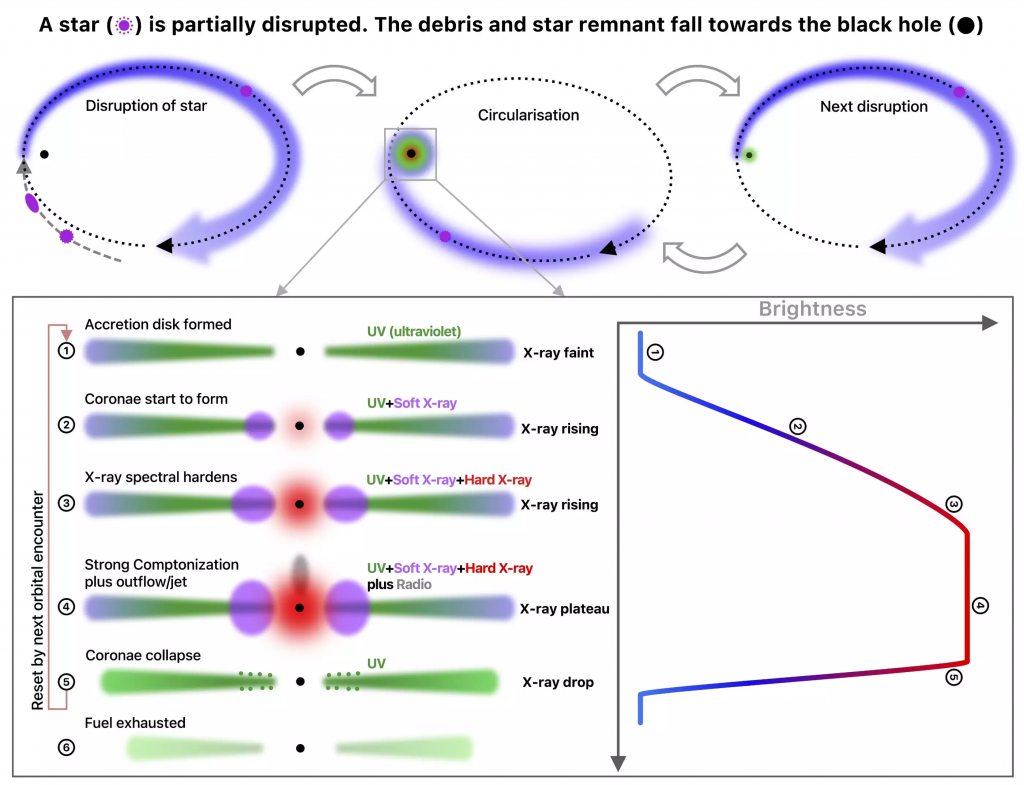
This sketch shows the sequence of events that could explain the evolution of the light curve in J0456-20: A star is partially disrupted when coming close to a supermassive black hole (top). The stellar debris forms an accretion disk (blue), with the accretion proceeding in various stages (1-5) with changing emission signatures. Eventually, the fuel is completely exhausted (6) and no more X-ray flares will be detected.

© MPE
This sketch shows the sequence of events that could explain the evolution of the light curve in J0456-20: A star is partially disrupted when coming close to a supermassive black hole (top). The stellar debris forms an accretion disk (blue), with the accretion proceeding in various stages (1-5) with changing emission signatures. Eventually, the fuel is completely exhausted (6) and no more X-ray flares will be detected. © MPE

Through a collaboration with the Australian ATCA facility, the scientists also discovered transient radio emission from J0456-20, indicating the launch of an outflow of gas or a jet. Together with the characteristic X-ray evolution, there is compelling evidence for changes in the structure of the accretion disk around the supermassive black hole.

“More follow-up observations are needed to pin down the exact details of the physical processes,” says Andrea Merloni, eROSITA principal investigator. “Nevertheless, the discovery of this repeating X-ray event already provides solid evidence that there are stars in tightly bound orbits around supermassive black holes beyond our own Milky Way galaxy. These offer ideal laboratories to test General Relativity in the strong field regime.”

eROSITA has already found other repeating X-ray sources, e.g. two quasi-periodic eruptions in AGN. In the future, the scientists expect to discover more events with eROSITA, and the upcoming Einstein Probe mission.

Source: MPE

Flashes On The Sun Could Help Scientists Predict Solar Flares

0
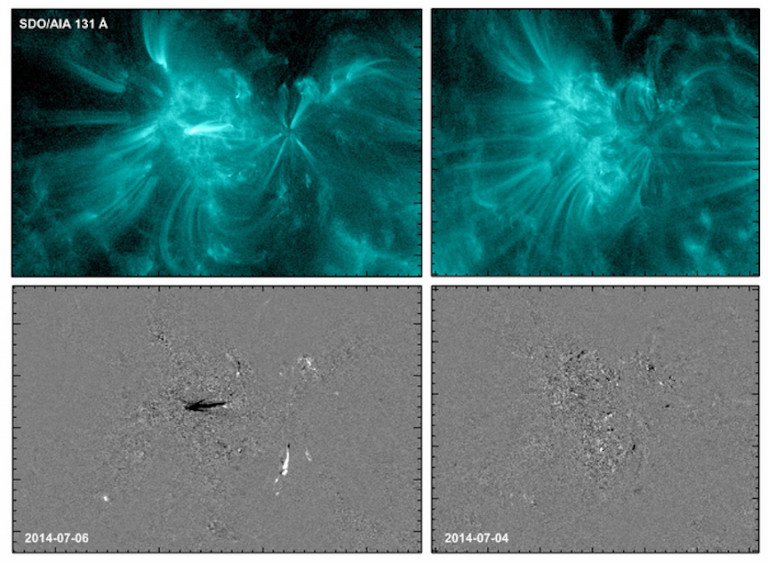
Two images of a solar active region (NOAA AR 2109) taken by SDO/AIA show extreme-ultraviolet light produced by million-degree-hot coronal gas (top images) on the day before the region flared (left) and the day before it stayed quiet and did not flare (right). The changes in brightness (bottom images) at these two times show different patterns, with patches of intense variation (black & white areas) before the flare (bottom left) and mostly gray (indicating low variability) before the quiet period (bottom right). CREDIT NASA/SDO/AIA/Dissauer et al. 2022

In the blazing upper atmosphere of the Sun, a team of scientists have found new clues that could help predict when and where the Sun’s next flare might explode.

Using data from NASA’s Solar Dynamics Observatory, or SDO, researchers from NorthWest Research Associates, or NWRA, identified small signals in the upper layers of the solar atmosphere, the corona, that can help identify which regions on the Sun are more likely to produce solar flares – energetic bursts of light and particles released from the Sun.

They found that above the regions about to flare, the corona produced small-scale flashes – like small sparklers before the big fireworks.

This information could eventually help improve predictions of flares and space weather storms – the disrupted conditions in space caused by the Sun’s activity. Space weather can affect Earth in many ways: producing auroras, endangering astronauts, disrupting radio communications, and even causing large electrical blackouts.

Scientists have previously studied how activity in lower layers of the Sun’s atmosphere – such as the photosphere and chromosphere – can indicate impending flare activity in active regions, which are often marked by groups of sunspots, or strong magnetic regions on the surface of the Sun that are darker and cooler compared to their surroundings. The new findings, published in The Astrophysical Journal, add to that picture.

“We can get some very different information in the corona than we get from the photosphere, or ‘surface’ of the Sun,” said KD Leka, lead author on the new study who is also a designated foreign professor at Nagoya University in Japan. “Our results may give us a new marker to distinguish which active regions are likely to flare soon and which will stay quiet over an upcoming period of time.”

For their research, the scientists used a newly created image database of the Sun’s active regions captured by SDO. The publicly available resource, described in a companion paper also in The Astrophysical Journal, combines over eight years of images taken of active regions in ultraviolet and extreme-ultraviolet light. Led by Karin Dissauer and engineered by Eric L. Wagner, the NWRA team’s new database makes it easier for scientists to use data from the Atmospheric Imaging Assembly (AIA) on SDO for large statistical studies.

“It’s the first time a database like this is readily available for the scientific community, and it will be very useful for studying many topics, not just flare-ready active regions,” Dissauer said.

The NWRA team studied a large sample of active regions from the database, using statistical methods developed by team member Graham Barnes. The analysis revealed small flashes in the corona preceded each flare. These and other new insights will give researchers a better understanding of the physics taking place in these magnetically active regions, with the goal of developing new tools to predict solar flares.

“With this research, we are really starting to dig deeper,” Dissauer said. “Down the road, combining all this information from the surface up through the corona should allow forecasters to make better predictions about when and where solar flares will happen.”

Properties of Flare-imminent versus Flare-quiet Active Regions from the Chromosphere through the Corona. II. Nonparametric Discriminant Analysis Results from the NWRA Classification Infrastructure (NCI), Astrophysical Journal

By Keith Cowing
Source SpaceRef

Scientists Offer A New Explanation For A Mystery Surrounding Jupiter’s Two Massive Asteroid Swarms

0
NASA/JPL-Caltech

An international team of scientists including NYUAD researcher Nikolaos Georgakarakos and others from the US, Japan, and China led by Jian Li from Nanjing University, has developed new insights that may explain the numerical asymmetry of the L4 and L5 Jupiter Trojan swarms, two clusters containing more than 10,000 asteroids that move along Jupiter’s orbital path around the sun.

For decades, scientists have known that there are significantly more asteroids in the L4 swarm than the L5 swarm, but have not fully understood the reason for this asymmetry. In the current configuration of the Solar System, the two swarms show almost identical dynamical stability and survivability properties, which has led scientists to believe that the differences came about during earlier times of our Solar System’s life. Determining the cause of these differences could uncover new details about the formation and evolution of the Solar System. 

In the paper, Asymmetry in the number of L4 and L5 Jupiter Trojans driven by jumping Jupiter, published in the journal Astronomy & Astrophysics, the researchers present a mechanism that can explain the observed number asymmetry. “We propose that an outward, in terms of distance to the Sun, fast migration of Jupiter can distort the configuration of the Trojan swarms, resulting in more stable orbits in the L4 swarm than in the L5 one,” said Li. “This mechanism, which temporarily induced different evolution paths for the two asteroid groups that share the orbit of Jupiter, provides a new and natural explanation for the unbiased observation, that the L4 asteroids are about 1.6 times more than the asteroids in the L5 swarm.” 

The model simulates the orbital evolution of Jupiter, caused by a planetary orbital instability in the early Solar System. This led to the outward migration of Jupiter at a very high speed; a migration that the researchers hypothesize was the possible cause of the changes in the stability of the nearby asteroid swarms. Future models could expand on this work by including additional aspects of the evolution of the Solar System, which could depict it with improved accuracy. This could include simulating the fast migrations of Jupiter at different speeds, and the effects of nearby planets.

“The characteristics of the current Solar System hold as-yet unsolved mysteries into its formation and early evolution. The ability to successfully simulate an event from an early stage of the Solar System’s development and apply those results to modern day questions can also be a key tool as astrophysicists and other researchers work to learn more about the dawn of our world.”NYUAD researcher Nikolaos Georgakarakos

By External Relations Staff, NYUAD
Source NYUAD