
Home Blog Page 93

Data From SLS Flight Prepares NASA For Future Artemis Missions

0

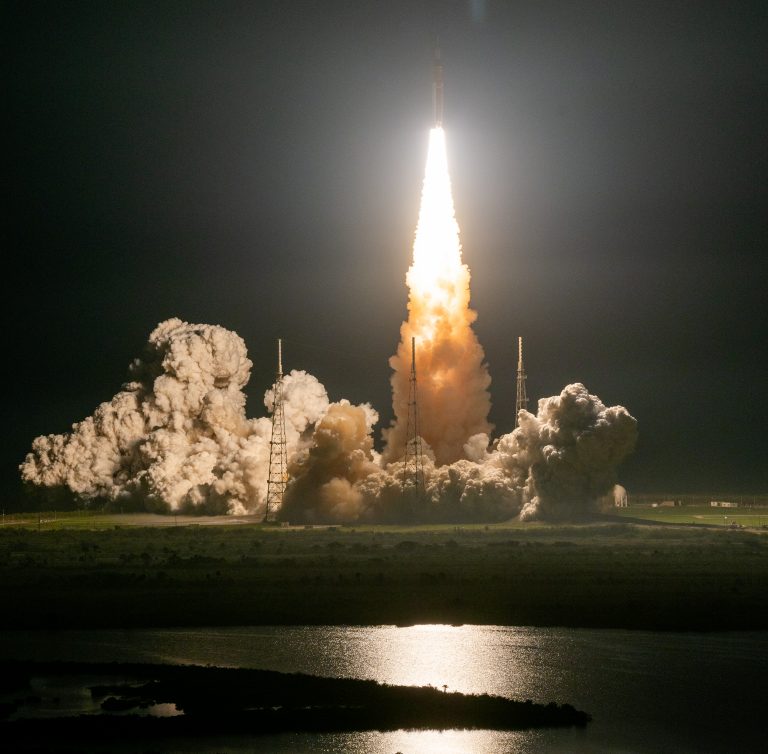
NASA continues to evaluate data and learn more about the Space Launch System (SLS) rocket’s debut performance during the agency’s Nov. 16 Artemis I launch. Following an initial data assessment and review that determined the SLS rocket met or exceeded all performance expectations, SLS engineers are now taking a closer look at the Moon rocket’s performance to prepare for the first crewed Artemis missions.

Building off the assessment conducted shortly after launch, the preliminary post-flight data indicates that all SLS systems performed exceptionally and that the designs are ready to support a crewed flight on Artemis II. The post-flight analysis team will continue reviewing data and conducting final reporting’s.

The core stage of NASA’s Space Launch System (SLS) rocket has more than 1,000 sensors and 45 miles of cabling. The SLS core stage’s base heat shield is roughly 1.3 inches thick and was specially designed to protect the 212-foot-tall stage and its two liquid propellant tanks from launch pad temperatures greater than 3,200 degrees Fahrenheit. Data indicates the structure was not affected by temperatures that can turn sand to glass.
Credits: NASA/Chris Coleman and Kevin Dav

“NASA’s Space Launch System rocket has laid the foundation for the Artemis Generation and the future of spaceflight in deep space,” said John Honeycutt, SLS Program manager. “The correlation between actual flight performance and predicted performance for Artemis I was excellent. There is engineering and an art to successfully building and launching a rocket, and the analysis on the SLS rocket’s inaugural flight puts NASA and its partners in a good position to power missions for Artemis II and beyond.”

Ahead of launch, teams established benchmarks for the rocket’s performance through a series of pre-flight simulations and test campaigns. As the rocket launched and ascended to space, it experienced dynamic phases, like extreme forces and temperatures, that influenced its operations. The Artemis I flight test was the only way to gather real data on how the rocket performed during events like booster separation.

Engineers in the SLS Engineering and Support Center at NASA’s Marshall Space Flight Center in Huntsville, Alabama, collected more than four terabytes of data and on-board imagery from SLS during pre-launch and launch phases. In addition, a total of roughly 31 terabytes of imagery data alone was collected from ground cameras, cameras on the rocket, and aerial cameras that were focused on SLS. By comparison the Library of Congress’ printed material is roughly 20 terabytes.

“The data we got back from Artemis I is critical in building confidence in this rocket to send humanity back to the Moon,” said John Blevins, SLS chief engineer. “The SLS team will use what we learn from this flight test to improve future flights of the rocket, and we are already taking what we’ve learned about operations and assembly and applying it to streamline future missions.”

Cameras and sensors also allowed teams to monitor how the rocket performed during its in-space maneuvers. Seeing launch from the SLS rocket’s “view” involved strategically positioning cameras, sensors, and other measurement tools all along the rocket, the mobile launcher, and the launch pad.

Four RS-25 engines and two five-segment solid rocket boosters provide more than 8.8 million pounds of thrust for SLS during liftoff and flight. Thanks in part to development of a new RS-25 engine controller that checks engine health 50 times per second, engineers were able to collect more than 100 measurements on pressures, temperatures, flows, speeds, and vibrations on the four RS-25 engines that helped power Artemis I.
Credits: NASA/Joel Kowsky

“The numerous views of the Artemis I rocket, including the solid rocket booster separation and interim cryogenic propulsion stage (ICPS) separation, provided imagery data that helped us assess how SLS performed from liftoff through the ascent and separation events,” said Beth St. Peter, SLS imagery integration lead.

Engineers also monitored the extreme temperatures and sounds the rocket experienced just after liftoff. SLS post-flight data have shown the RS-25 engines’ thrust and mixture ratio control valves were within 0.5% of predicted values. The mixture ratio is the ratio of fuel to oxidizer that determines the temperature and thrust coming from the engines throughout their eight minutes of flight time. Other key engine internal pressures and temperatures were within 2% of pre-flight predicted values.

NASA’s Space Launch System (SLS) rocket delivers propulsion in stages with the interim cryogenic propulsion stage (ICPS) providing the in-space “push” the Orion spacecraft needs to get to the Moon. During Artemis I, the ICPS performed two successful burns to send Orion to the Moon, including the longest RL10 engine burn in the design’s 50-year-plus history and hundreds of missions.
Credits: NASA

In flight, the SLS core stage successfully executed all of its functions and inserted the ICPS and Orion spacecraft into an initial Earth orbit of 972.1 miles by 16 miles. The insert was just 2.9 miles shy of the perfect bullseye target of 975 miles by 16 miles and well within acceptable parameters. Following a near-perfect trans-lunar injection burn, the ICPS and Orion spacecraft successfully separated – allowing Orion to complete a 25.5-day mission.

Through Artemis, NASA will land the first woman and the first person of color on the surface of the Moon, paving the way for a long-term lunar presence and serving as a steppingstone for astronauts on the way to Mars.

For more information on SLS, please visit the SLS Reference Guide: https://www.nasa.gov/exploration/systems/sls/reference_guide.html

Corinne Edmiston
Marshall Space Flight Center, Huntsville, Ala.
256.544.0034
[email protected]

By Lee Mohon
Source NASA
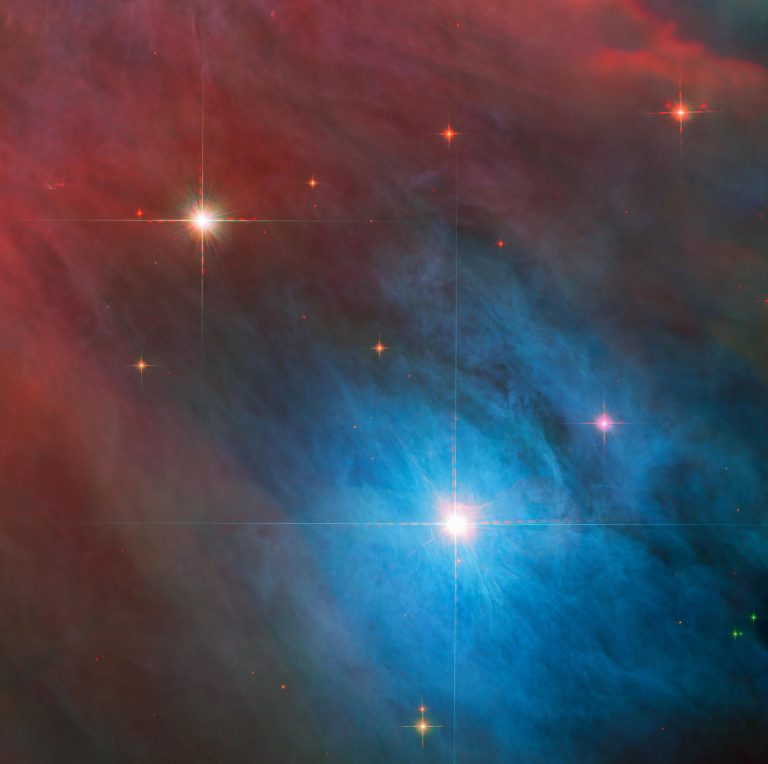
Hubble Views A Stellar Duo In Orion Nebula

0

The bright variable star V 372 Orionis takes center stage in this image from the NASA/ESA Hubble Space Telescope, which has also captured a smaller companion star in the upper left of this image. Both stars lie in the Orion Nebula, a colossal region of star formation roughly 1,450 light-years from Earth.

V 372 Orionis is a particular type of variable star known as an Orion Variable. These young stars experience some tempestuous moods and growing pains, which are visible to astronomers as irregular variations in luminosity. Orion Variables are often associated with diffuse nebulae, and V 372 Orionis is no exception; the patchy gas and dust of the Orion Nebula pervade this scene.

This image overlays data from two of Hubble’s instruments. Data from the Advanced Camera for Surveys and Wide Field Camera 3 at infrared and visible wavelengths were layered to reveal rich details of this corner of the Orion Nebula. Hubble also left its own subtle signature on this astronomical portrait in the form of diffraction spikes that surround the bright stars. The four spikes around the brightest stars in this image form when an intense point source of light, such as starlight, interacts with the four vanes inside Hubble that support the telescope’s secondary mirror. The diffraction spikes of the NASA/ESA/CSA James Webb Space Telescope, on the other hand, are six-pointed due to Webb’s hexagonal mirror segments and 3-legged support structure for the secondary mirror.  

Text credit: European Space Agency (ESA)
Image credit: ESA/Hubble & NASA, J. Bally, M. Robberto

Media Contact:

Claire Andreoli
NASA’s Goddard Space Flight CenterGreenbelt, MD
301-286-1940

By: Andrea Gianopoulos
Source: NASA

Oklahoma Students To Hear From NASA Astronaut Aboard Space Station

0

Students from Choctaw Nation Head Start, Jones Academy Elementary, and seven area public schools in Durant, Oklahoma, will have an opportunity this week to hear from a NASA astronaut aboard the International Space Station.

The space-to-Earth call will air live at 10:20 a.m. EST on Tuesday, Jan. 31, on NASA Television, the NASA app, and the agency’s website.

NASA astronaut Nicole Mann will answer prerecorded questions from pre-K through 8th grade student participants. The event, hosted by the Choctaw Nation of Oklahoma, is an opportunity for students and tribal members to get a firsthand look at living and working in space, inspiring the next generation to pursue STEM. The downlink aligns to students’ current science, technology, engineering, and math curriculum, which uses NASA lessons. The event also includes the opportunity for tribal students to connect and be inspired by Mann, who is the first Native American woman to fly in space.

Media interested in covering the event should contact Randy Sachs at [email protected] or 580-380-2597 no later than 10 a.m. Tuesday, Jan. 31.

For more than 22 years, astronauts have continuously lived and worked aboard the space station, testing technologies, performing science, and developing the skills needed to explore farther from Earth. Astronauts living in space aboard the orbiting laboratory communicate with NASA’s Mission Control Center in Houston 24 hours a day through the Near Space Network Tracking and Data Relay Satellites.

As part of Artemis, NASA will send astronauts to the Moon to prepare for future human exploration of Mars. Inspiring the next generation of explorers – the Artemis Generation – ensures America will continue to lead in space exploration and discovery.

See videos and lesson plans highlighting research on the International Space Station at: https://www.nasa.gov/stemonstation

Katherine Brown
Headquarters, Washington
202-358-1288
[email protected]

Sandra Jones 
Johnson Space Center, Houston
281-483-5111
[email protected]

By: Roxana Bardan
Source: NASA

Day Of Remembrance

0

NASA Administrator Bill Nelson lays a wreath at the Space Shuttle Challenger Memorial during NASA’s Day of Remembrance, Thursday, Jan. 26, 2023, at Arlington National Cemetery in Arlington, Va. Wreaths were laid in memory of those men and women who lost their lives in the quest for space exploration. 

Credit: NASA/Aubrey Gemignani

By: Dacia Massengill
Source: NASA

Montana Students To Hear From NASA Astronaut On Space Station

0

Students from the Boys & Girls Club of the Flathead Reservation and Lake County in Ronan, Montana, will have an opportunity this week to hear from a NASA astronaut aboard the International Space Station. The space-to-Earth call will air live at 12 p.m. EST on Thursday, Jan. 26, on NASA Television, the NASA app, and the agency’s website.

NASA astronaut Nicole Mann will answer prerecorded questions from student participants of the Boys & Girls Club of the Flathead Reservation and Lake County out-of-school programing. Mann is the first Native American woman to fly in space.

The program provides opportunities for reservation youth that inspire students to be the best version of themselves and uses science, technology, engineering, and mathematics (STEM) to foster collaboration and problem solving. The downlink connects to their experiences as part of the Students to Launch program and their study of STEM.

Students to Launch was born out of a partnership agreement between NASA’s Office of STEM Engagement (OSTEM) and the American Institute of Aeronautics and Astronautics. The program works through OSTEM’s Community Anchors and its informal education institutions called “S2L Hubs” – museums, science centers, youth-serving institutions, libraries, and other places across the country where students congregate outside of school.

Media interested in covering the event should contact Aric Cooksley at [email protected] or 406-493-2312.

For more than 22 years, astronauts have continuously lived and worked aboard the space station, testing technologies, performing science, and developing the skills needed to explore farther from Earth. Astronauts living in space aboard the orbiting laboratory communicate with NASA’s Mission Control Center in Houston 24 hours a day through the Near Space Network Tracking and Data Relay Satellites (TDRS).

As part of Artemis, NASA will send astronauts to the Moon to prepare for future human exploration of Mars. Inspiring the next generation of explorers – the Artemis Generation – ensures America will continue to lead in space exploration and discovery.

See videos and lesson plans highlighting research on the International Space Station at:

https://www.nasa.gov/stemonstation

Katherine Brown
Headquarters, Washington
202-358-1288
[email protected]

Sandra Jones 
Johnson Space Center, Houston
281-483-5111
[email protected]

By: Roxana Bardan
Source: NASA

Were More Galaxies Born Earlier Than We Thought?

0

Astronomers suggest more galaxies formed in the early universe than previously thought.

In their new study, the researchers discovered 87 galaxies that could be the earliest known galaxies in the universe.

“…WE MIGHT NEED TO REVISE OUR PREVIOUS UNDERSTANDING OF GALAXY FORMATION.”

The finding gets the astronomers one step closer to finding out when galaxies first appeared in the universe—about 200-400 million years after the Big Bang, says Haojing Yan, associate professor of physics and astronomy at the University of Missouri and lead author of the study.

The researchers used data from NASA’s James Webb Space Telescope (JWST) Early Release Observations.

“Finding such a large number of galaxies in the early parts of the universe suggests that we might need to revise our previous understanding of galaxy formation,” Yan says. “Our finding gives us the first indication that a lot of galaxies could have been formed in the universe much earlier than previously thought.”

In the study, the astronomers searched for potential galaxies at “very high redshifts.” Yan says the concept of redshifts in astronomy allows astronomers to measure how far away distant objects are in the universe—like galaxies—by looking at how the colors change in the waves of light that they emit.

“If a light-emitting source is moving toward us, the light is being ‘squeezed,’ and that shorter wavelength is represented by blue light, or blueshift,” Yan says. “But if that source [of light] is moving away from us, the light it produces is being ‘stretched,’ and changes to a longer wavelength that is represented by red light, or redshift.”

Yan says Edwin Hubble’s discovery in the late 1920s that our universe is ever-expanding is key to understanding how redshifts are used in astronomy.

“Hubble confirmed that galaxies external to our Milky Way galaxy are moving away from us, and the more distant they are, the faster they are moving away,” Yan says. “This relates to redshifts through the notion of distances—the higher the redshift an object is at, such as a galaxy, the further away it is from us.”

Therefore, Yan says the search for galaxies at very high redshifts gives astronomers a way to construct the early history of the universe.

“The speed of light is finite, so it takes time for light to travel over a distance to reach us,” Yan says. “For example, when we look at the sun, we aren’t looking at it what it looks like in the present, but rather what it looked like some eight minutes ago. That’s because that’s how long it takes for the sun’s radiation to reach us. So, when we are looking at galaxies which are very far away, we are looking at their images from a long time ago.”

Using this concept, Yan’s team analyzed the infrared light captured by the JWST to identify the galaxies.

“The higher the redshift a galaxy is at, the longer it takes for the light to reach us, so a higher redshift corresponds to an earlier view of the universe,” Yan says. “Therefore, by looking at galaxies at higher redshifts, we are getting earlier snapshots of what the universe looked like a long time ago.”

The JWST was critical to this discovery because objects in space like galaxies that are located at high redshifts—11 and above—can only be detected by infrared light, according to Yan. This is beyond what NASA’s Hubble Space Telescope can detect because the Hubble telescope only sees from ultraviolet to near-infrared light.

“JWST, the most powerful infrared telescope, has the sensitivity and resolution for the job,” Yan says. “Up until these first JWST data sets were released [in mid-July 2022], most astronomers believed that the universe should have very few galaxies beyond redshift 11. At the very least, our results challenge this view. I believe this discovery is just the tip of the iceberg because the data we used only focused on a very small area of the universe. After this, I anticipate that other teams of astronomers will find similar results elsewhere in the vast reaches of space as JWST continues to provide us with a new view of the deepest parts of our universe.”

The research appears in The Astrophysical Journal Letters. Additional coauthors are from the University of Missouri, University of Massachusetts-Amherst, and the Chinese Academy of Sciences South America Center for Astronomy and National Astronomical Observatories of China.

Source: University of Missouri

Original Study DOI: 10.3847/2041-8213/aca80c

By Eric Stann-Missouri
Source Futurity

Billions Of Celestial Objects Revealed In A Gargantuan Survey Of The Milky Way

0
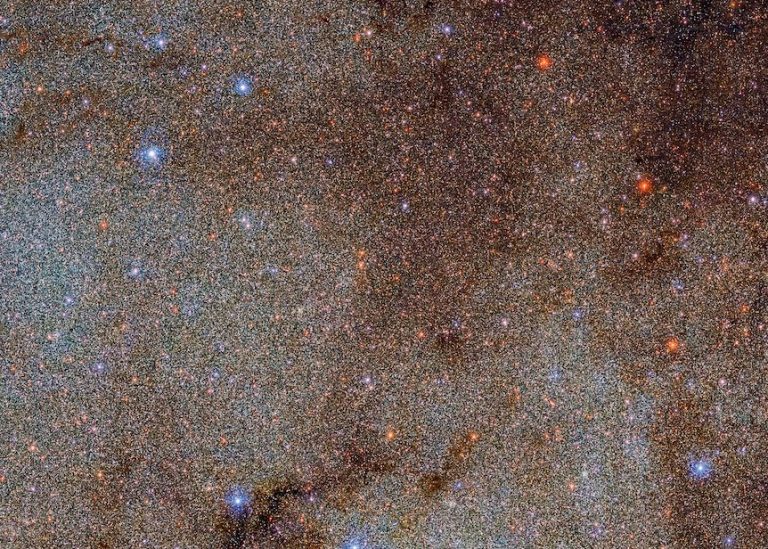
This image, which is brimming with stars and dark dust clouds, is a small extract — a mere pinprick — of the full Dark Energy Camera Plane Survey (DECaPS2) of the Milky Way. The new dataset contains a staggering 3.32 billion celestial objects — arguably the largest such catalog so far. The data for this unprecedented survey were taken with the US Department of Energy-fabricated Dark Energy Camera at the NSF’s Cerro Tololo Inter-American Observatory in Chile, a Program of NOIRLab. Credit: DECaPS2/DOE/FNAL/DECam/CTIO/NOIRLab/NSF/AURA (Much) MUCH Larger imagery

Astronomers have released a gargantuan survey of the galactic plane of the Milky Way. The new dataset contains a staggering 3.32 billion celestial objects — arguably the largest such catalog so far.

Astronomers have released a gargantuan survey of the galactic plane of the Milky Way. The new dataset contains a staggering 3.32 billion celestial objects — arguably the largest such catalog so far. The data for this unprecedented survey were taken with the Dark Energy Camera, built by the US Department of Energy, at the NSF’s Cerro Tololo Inter-American Observatory in Chile, a Program of NOIRLab.

The Milky Way Galaxy contains hundreds of billions of stars, glimmering star-forming regions, and towering dark clouds of dust and gas. Imaging and cataloging these objects for study is a herculean task, but a newly released astronomical dataset known as the second data release of the Dark Energy Camera Plane Survey (DECaPS2) reveals a staggering number of these objects in unprecedented detail. The DECaPS2 survey, which took two years to complete and produced more than 10 terabytes of data from 21,400 individual exposures, identified approximately 3.32 billion objects — arguably the largest such catalog compiled to date. Astronomers and the public can explore the dataset here.

This unprecedented collection was captured by the Dark Energy Camera (c) instrument on the Víctor M. Blanco 4-meter Telescope at Cerro Tololo Inter-American Observatory (CTIO), a Program of NSF’s NOIRLab. CTIO is a constellation of international astronomical telescopes perched atop Cerro Tololo in Chile at an altitude of 2200 meters (7200 feet). CTIO’s lofty vantage point gives astronomers an unrivaled view of the southern celestial hemisphere, which allowed DECam to capture the southern Galactic plane in such detail.

DECaPS2 is a survey of the plane of the Milky Way as seen from the southern sky taken at optical and near-infrared wavelengths. The first trove of data from DECaPS was released in 2017, and with the addition of the new data release, the survey now covers 6.5% of the night sky and spans a staggering 130 degrees in length. While it might sound modest, this equates to 13,000 times the angular area of the full Moon.

The DECaPS2 dataset is available to the entire scientific community and is hosted by NOIRLab’s Astro Data Lab, which is part of the Community Science and Data Center. Interactive access to the imaging with panning/zooming inside of a web-browser is available from the Legacy Survey Viewer, the World Wide Telescope and Aladin.

Most of the stars and dust in the Milky Way are located in its disk — the bright band stretching across this image — in which the spiral arms lie. While this profusion of stars and dust makes for beautiful images, it also makes the Galactic plane challenging to observe. The dark tendrils of dust seen threading through this image absorb starlight and blot out fainter stars entirely, and the light from diffuse nebulae interferes with any attempts to measure the brightness of individual objects. Another challenge arises from the sheer number of stars, which can overlap in the image and make it difficult to disentangle individual stars from their neighbors.

Despite the challenges, astronomers delved into the Galactic plane to gain a better understanding of our Milky Way. By observing at near-infrared wavelengths, they were able to peer past much of the light-absorbing dust. The researchers also used an innovative data-processing approach, which allowed them to better predict the background behind each star. This helped to mitigate the effects of nebulae and crowded star fields on such large astronomical images, ensuring that the final catalog of processed data is more accurate.

“One of the main reasons for the success of DECaPS2 is that we simply pointed at a region with an extraordinarily high density of stars and were careful about identifying sources that appear nearly on top of each other,” said Andrew Saydjari, a graduate student at Harvard University, researcher at the Center for Astrophysics | Harvard & Smithsonian and lead author of the paper. “Doing so allowed us to produce the largest such catalog ever from a single camera, in terms of the number of objects observed.”

“When combined with images from Pan-STARRS 1, DECaPS2 completes a 360-degree panoramic view of the Milky Way’s disk and additionally reaches much fainter stars,” said Edward Schlafly, a researcher at the AURA-managed Space Telescope Science Institute and a co-author of the paper describing DECaPS2 published in theAstrophysical Journal Supplement. “With this new survey, we can map the three-dimensional structure of the Milky Way’s stars and dust in unprecedented detail.”

“Since my work on the Sloan Digital Sky Survey two decades ago, I have been looking for a way to make better measurements on top of complex backgrounds,” said Douglas Finkbeiner, a professor at the Center for Astrophysics, co-author of the paper, and principal investigator behind the project. “This work has achieved that and more!”

“This is quite a technical feat. Imagine a group photo of over three billion people and every single individual is recognizable!” says Debra Fischer, division director of Astronomical Sciences at NSF. “Astronomers will be poring over this detailed portrait of more than three billion stars in the Milky Way for decades to come. This is a fantastic example of what partnerships across federal agencies can achieve.”

DECam was originally built to carry out the Dark Energy Survey, which was conducted by the Department of Energy and the US National Science Foundation between 2013 and 2019.

More information

This dataset was presented in the paper “The Dark Energy Camera Plane Survey 2 (DECaPS2): More Sky, Less Bias, and Better Uncertainties” to appear in the Astrophysical Journal Supplement. https://doi.org/10.3847/1538-4365/aca594

The DECaPS2 team is composed of A. K. Saydjari (Harvard University and the Center for Astrophysics | Harvard & Smithsonian), E. F. Schlafly (Space Telescope Science Institute), D. Lang (Perimeter Institute for Theoretical Physics and University of Waterloo), A. M. Meisner (NSF’s NOIRLab), G. M. Green (Max Planck Institute for Astronomy), C. Zucker (Space Telescope Science Institute and the Center for Astrophysics | Harvard & Smithsonian), I. Zelko (Canadian Institute of Theoretical Astrophysics — University of Toronto), J. S. Speagle (University of Toronto), T. Daylan (Princeton University), A. Lee (Bill & Melinda Gates Foundation), F. Valdes (NSF’s NOIRLab), D. Schlegel (Lawrence Berkeley National Laboratory), and D. P. Finkbeiner (Harvard University and the Center for Astrophysics | Harvard & Smithsonian).

NSF’s NOIRLab (National Optical-Infrared Astronomy Research Laboratory), the US center for ground-based optical-infrared astronomy, operates the international Gemini Observatory (a facility of NSF, NRC–Canada, ANID–Chile, MCTIC–Brazil, MINCyT–Argentina, and KASI–Republic of Korea), Kitt Peak National Observatory (KPNO), Cerro Tololo Inter-American Observatory (CTIO), the Community Science and Data Center (CSDC), and Vera C. Rubin Observatory (in cooperation with DOE’s SLAC National Accelerator Laboratory). It is managed by the Association of Universities for Research in Astronomy (AURA) under a cooperative agreement with NSF and is headquartered in Tucson, Arizona. The astronomical community is honored to have the opportunity to conduct astronomical research on Iolkam Du’ag (Kitt Peak) in Arizona, on Maunakea in Hawai‘i, and on Cerro Tololo and Cerro Pachón in Chile. We recognize and acknowledge the very significant cultural role and reverence that these sites have to the Tohono O’odham Nation, to the Native Hawaiian community, and to the local communities in Chile, respectively.

The Dark Energy Camera Plane Survey 2 (DECaPS2): More Sky, Less Bias, and Better Uncertainties, The Astrophysical Journal

By Keith Cowing
Source SpaceRef

Airbus Finalises JUICE Ready For Its Mission To Jupiter

0

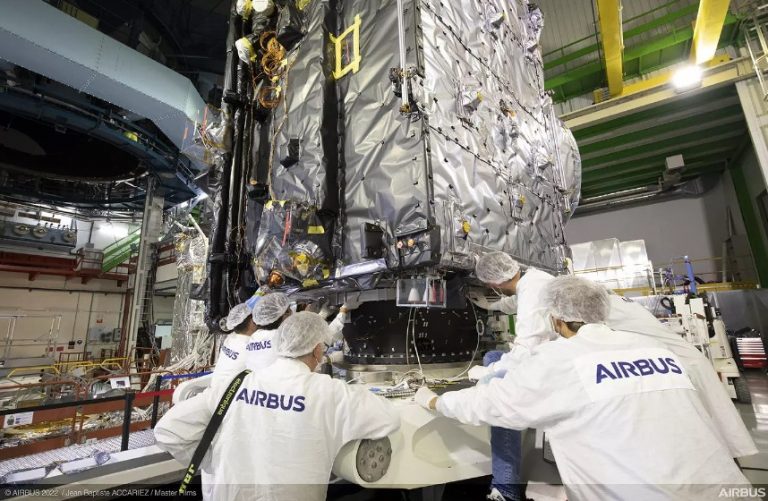
The Airbus-built JUICE (JUpiter ICy moons Explorer mission) spacecraft will shortly leave Toulouse, France, for Kourou, French Guiana, for lift-off on an Ariane 5 in April 2023. Shipment is expected in early February.

The spacecraft has been at Airbus in Toulouse since August 2021 for final assembly and test. This included integration of the final instrument units and the largest solar arrays ever to fly on a planetary exploration mission, needed to power the mission at 740 million kilometres from the Sun.

“With JUICE’s departure for the launch site fast approaching, we look back at its long Earthly journey through various Airbus sites in Europe towards final integration and involving close to 500 Airbus employees who prepared the spacecraft for its eight-year cruise,” said Cyril Cavel, JUICE Project Manager at Airbus Defence and Space.

“It has been an incredible adventure, along with more than 80 companies across Europe, to bring ESA’s vision to life and ultimately study Jupiter and its icy moons in fine detail.”

Today a commemorative plaque was unveiled during a press event in Toulouse as a tribute to Italian astronomer Galileo Galilei. The plaque has been mounted on the spacecraft to honour Galileo who was the first to view Jupiter and its largest moons through a telescope in 1610.

On its more than 2 billion-kilometre long journey, the 6.2 ton JUICE spacecraft will collect data on the icy moons to try to understand whether there is any possibility that these moons could host microbial life. Carrying 10 state-of-the-art scientific instruments, including cameras, spectrometers, an ice-penetrating radar, an altimeter, a radio-science experiment, and sensors, the JUICE spacecraft will complete a unique tour of the Jupiter system that will include in-depth studies of three potentially ocean-bearing moons: Ganymede, Europa and Callisto.

During its four year-long mission, JUICE will spend nine months orbiting the icy moon Ganymede analysing its nature and evolution, characterising its subsurface ocean, and investigating its potential habitability.

After being selected by ESA as prime contractor in 2015 Airbus has led a pan European industrial consortium to design and build this unique spacecraft.

@ESA @ESAScience @ESA_JUICE @AirbusSpace #NextSpace #JUICE #ExploreFarther #Jupiter #SpaceMatters

For more information about JUICE, please visit our dedicated pages: https://www.airbus.com/en/products-services/space/exploration/solar-system/juice

Galaxy Pair VV 191 – Webb And Hubble Composite Image

0

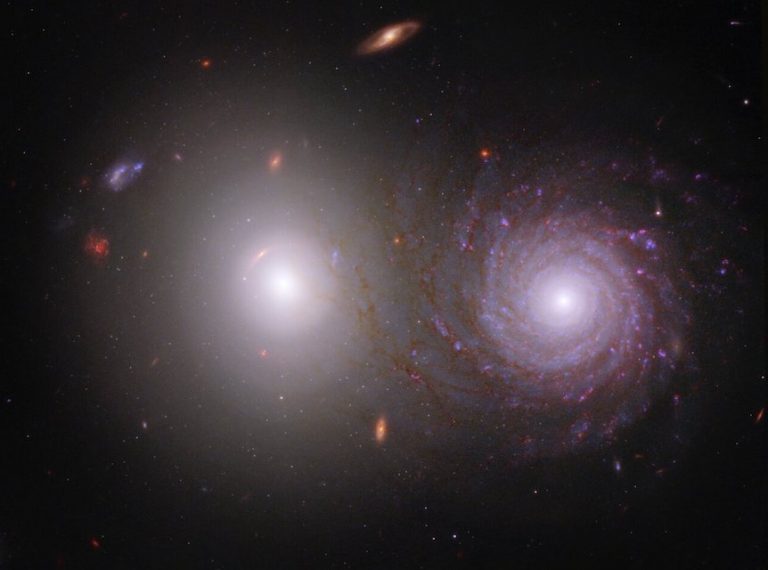
By combining data from the NASA/ESA/CSA James Webb Space Telescope and the NASA/ESA Hubble Space Telescope, researchers were able to trace light that was emitted by the large white elliptical galaxy at left through the spiral galaxy at right and identify the effects of interstellar dust in the spiral galaxy. This image of galaxy pair VV 191 includes near-infrared light from Webb, and ultraviolet and visible light from Hubble. Webb’s near-infrared data also show us the galaxy’s longer, extremely dusty spiral arms in far more detail, giving them an appearance of overlapping with the central bulge of the bright white elliptical galaxy on the left. Although the two foreground galaxies are relatively close astronomically speaking, they are not actively interacting. Don’t overlook the background scenery! Like many Webb images, this image of VV 191 shows many galaxies that lie great distances away. For example, two patchy spirals to the upper left of the elliptical galaxy have similar apparent sizes, but show up in very different colors. One is likely very dusty and the other very far away, but researchers need to obtain data known as spectra to determine which is which. Note: This image highlights Webb’s science in progress, which has not yet been through the peer-review process. Links Video

By combining data from the NASA/ESA/CSA James Webb Space Telescope and the NASA/ESA Hubble Space Telescope, researchers were able to trace light that was emitted by the large white elliptical galaxy at left through the spiral galaxy at right and identify the effects of interstellar dust in the spiral galaxy.

This image of galaxy pair VV 191 includes near-infrared light from Webb, and ultraviolet and visible light from Hubble.

Webb’s near-infrared data also show us the galaxy’s longer, extremely dusty spiral arms in far more detail, giving them an appearance of overlapping with the central bulge of the bright white elliptical galaxy on the left. Although the two foreground galaxies are relatively close astronomically speaking, they are not actively interacting.

Don’t overlook the background scenery! Like many Webb images, this image of VV 191 shows many galaxies that lie great distances away. For example, two patchy spirals to the upper left of the elliptical galaxy have similar apparent sizes, but show up in very different colors. One is likely very dusty and the other very far away, but researchers need to obtain data known as spectra to determine which is which.

Note: This image highlights Webb’s science in progress, which has not yet been through the peer-review process.

Larger Image


By Keith Cowing
Source Spaceref

Astronaut Nicole Mann Makes Her First Spacewalk

0

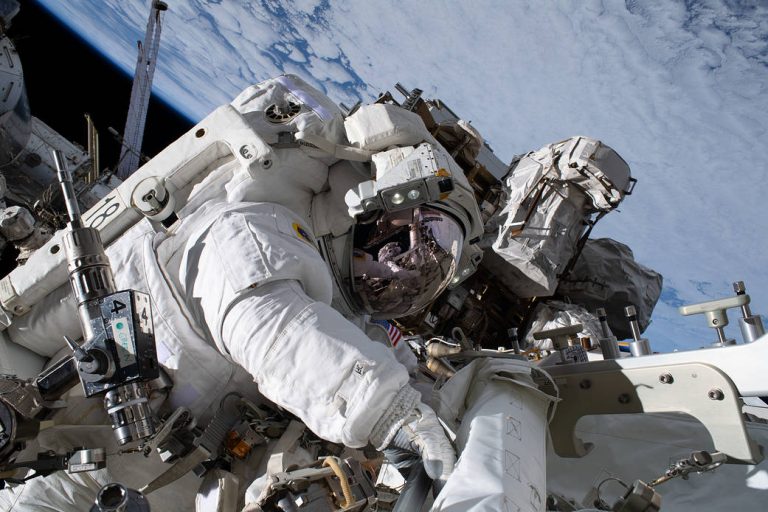
iss068e041215 (Jan. 20, 2023) — NASA astronaut and Expedition 68 Flight Engineer Nicole Mann is pictured in her Extravehicular Mobility Unit, or spacesuit, during her first spacewalk. She and fellow spacewalker Koichi Wakata (out of frame) of the Japan Aerospace Exploration Agency installed a modification kit on the International Space Station’s starboard truss structure that will enable the future installation of the orbiting lab’s next roll-out solar array.

By Mark Garcia
Source NASA