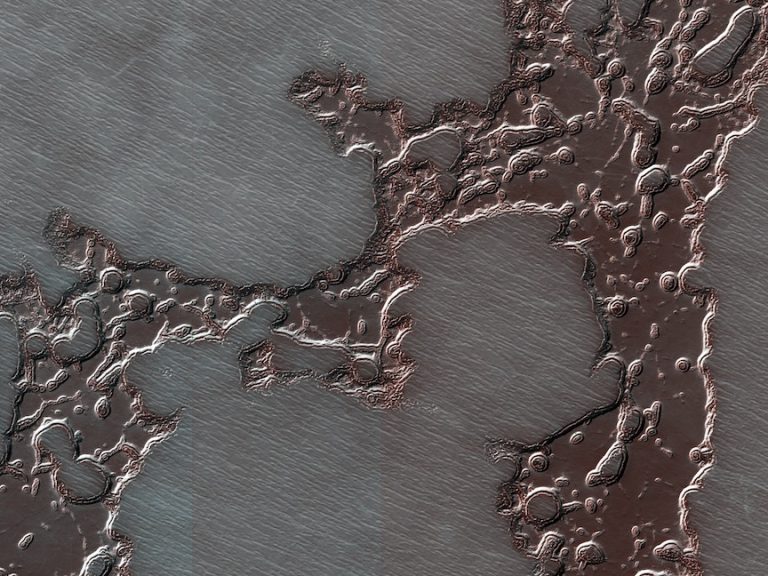
Exotically pitted “Swiss-cheese” terrain made of carbon dioxide (dry ice) overlies the topmost layer of water ice in Mars’ South Polar Massive Carbon Dioxide Ice Deposit. Image is about 1 kilometer across. Credit: NASA/JPL-Caltech/UArizona.
Mars’ south polar layered deposits of H2O and CO2 ice record its climate history. A new study links the long-term global movement of Mars’ water from midlatitude to pole to a function of the planet’s orbital configuration with H2O ice deposition decreasing as a factor of obliquity, or spin-axis tilt.
“No deposit yet analyzed provides a global water cycle record that can be tied to a specific orbital history. Here, I fill this gap by analyzing H2O ice layer formation in Mars’ south polar massive C02 ice deposit, a 510,000-year climate record,” said Peter B. Buhler, a Research Scientist at the Planetary Science Institute and lead author of the paper “A 510,000-year Record of Mars’ Climate” that appears in Geophysical Research Letters.
“Previously, only deposition rates averaged over millions of years – which is about ten times longer than Mars’ orbit cycles – had been derived,” he said.
“Mars experiences 100,000-year cycles in which its poles vary from tilting more toward or away from the Sun. These variations cause the amount of sunlight shining on each latitude band, and thus the temperature of each band, to cycle, too. Water ice moves from warmer to colder regions during these cycles, driving Mars’ basic long-term global water cycle,” Buhler said. “Up until now, the quantitative rate at which water moves through this cycle has been highly uncertain. This study addresses this open question by deciphering the layered ice record in Mars’ south polar cap.
“This layering is important because it is a direct record of how water and carbon dioxide have moved around on Mars. The water layer thicknesses tell us how much water vapor has been in Mars’ atmosphere and how that water vapor has moved around the globe. The carbon dioxide layers tell us the history of how much of the atmosphere froze onto the ground, and thus how thick or thin Mars’ atmosphere was in the past,” Buhler said.
“The history of Mars’ atmospheric pressure and availability of water are critical information for understanding the basic workings of Mars’ climate and near-surface geologic, chemical, and perhaps even biologic history. Specifically, the results of this work provide a major step forward for deciphering the basic workings of Mars’ water cycle and, by extension, the long-term availability of near-surface water ice or even liquid brines. The availability of near surface water sources is critical for enabling near-surface life as we know it.”
Buhler’s work was funded by a grant to PSI from NASA’s Mars Data Analysis Program.
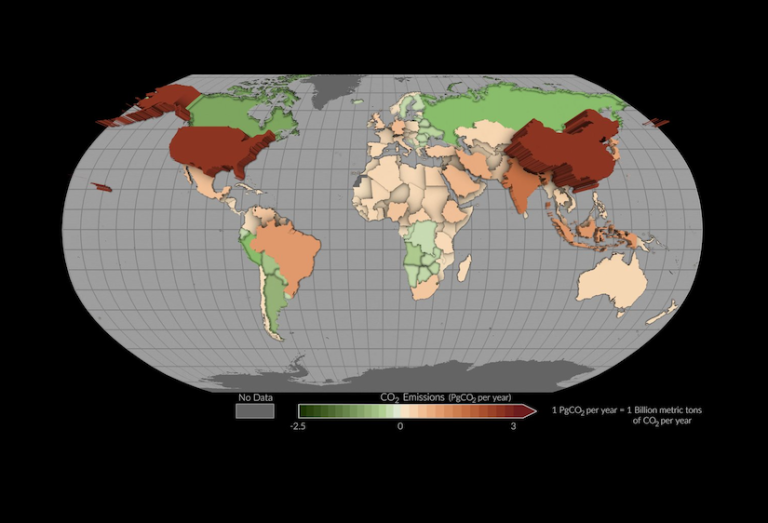
This map shows mean net emissions and removals of carbon dioxide from 2015 to 2020 using estimates informed by NASA’s OCO-2 satellite measurements. Countries where more carbon dioxide was removed than emitted appear as green depressions, while countries with higher emissions are tan or red and appear to pop off the page. Credit: NASA’s Scientific Visualization Studio
A NASA Earth-observing satellite has helped researchers track carbon dioxide emissions for more than 100 countries around the world.
The pilot project offers a powerful new look at the carbon dioxide being emitted in these countries and how much of it is removed from the atmosphere by forests and other carbon-absorbing “sinks” within their borders. The findings demonstrate how space-based tools can support insights on Earth as nations work to achieve climate goals.
The international study, conducted by more than 60 researchers, used measurements made by NASA’s Orbiting Carbon Observatory-2 (OCO-2) mission, as well as a network of surface-based observations, to quantify increases and decreases in atmospheric carbon dioxide concentrations from 2015 to 2020. Using this measurement-based (or “top-down”) approach, the researchers were then able to infer the balance of how much carbon dioxide was emitted and removed.
Although the OCO-2 mission was not specifically designed to estimate emissions from individual nations, the findings from the 100-plus countries come at an opportune time. The first Global Stocktake – a process to assess the world’s collective progress toward limiting global warming, as specified in the 2015 Paris Agreement – takes place in 2023.
“NASA is focused on delivering Earth science data that addresses real world climate challenges – like helping governments around the world measure the impact of their carbon mitigation efforts,” said Karen St. Germain, director of NASA’s Earth Science Division at NASA Headquarters in Washington. “This is one example of how NASA is developing and enhancing efforts to measure carbon emissions in a way that meets user needs.”
Traditional activity-based (or “bottom-up”) approaches to carbon measurement rely on tallying and estimating how much carbon dioxide is being emitted across all sectors of an economy, such as transportation and agriculture. Bottom-up carbon inventories are critical for assessing progress toward emission-reduction efforts, but compiling them requires considerable resources, expertise, and knowledge of the extent of the relevant activities.
This is why developing a database of emissions and removals via a top-down approach could be especially helpful for nations that lack traditional resources for inventory development, the study authors assert. In fact, the scientists’ findings include data for more than 50 countries that have not reported emissions for at least the past 10 years.
The study provides a new perspective by tracking both fossil fuel emissions and the total carbon “stock” changes in ecosystems, including trees, shrubs, and soils. The data is particularly useful for tracking carbon dioxide fluctuations related to land cover change. Emissions from deforestation alone make up a disproportionate amount of total carbon output in the Global South, which encompasses regions of Latin America, Asia, Africa, and Oceania. In other parts of the world, the findings indicate some reductions in atmospheric carbon concentrations via improved land stewardship and reforestation.
The authors said that bottom-up methods for estimating carbon dioxide emissions and removals from ecosystems are essential. However, those methods are vulnerable to uncertainty when data is lacking or the net effects of specific activities, such as logging, aren’t fully known.
“Our top-down estimates provide an independent estimate of these emissions and removals, so although they cannot replace the detailed process understanding of traditional bottom-up methods, we can check both approaches for consistency,” said Philippe Ciais, a study author and research director at the Laboratoire des Sciences du Climat et de l’Environnement in France.
Tracking Carbon
The study offers a complex picture of carbon moving through Earth’s land, ocean, and atmosphere.
In addition to direct human impacts accounted for by national inventories, unmanaged ecosystems like some tropical and boreal forests – where humans have a minimal footprint – can sequester carbon from the atmosphere, thus reducing potential global warming.
“National inventories are intended to track how management policies impact emissions and removals of CO2,” said study author Noel Cressie, a professor at the University of Wollongong in Australia. “However, the atmosphere doesn’t care whether CO2 is being emitted from deforestation in the Amazon or wildfires in the Canadian Arctic. Both processes will increase the concentration of atmospheric CO2 and drive climate change. Therefore, it is critical to monitor the carbon balance of unmanaged ecosystems and identify any changes in carbon uptake.”
Looking forward, the researchers said their pilot project can be further refined to understand how emissions from individual nations are changing.
“Sustained, high-quality observations are critical for these top-down estimates,” said lead author Brendan Byrne, a scientist at NASA’s Jet Propulsion Laboratory in Southern California. “Continued observations from OCO-2 and surface sites will allow us to track how these emissions and removals change as the Paris Agreement is implemented. Future international missions that provide expanded mapping of CO2 concentrations across the globe will allow us to refine these top-down estimates and give more precise estimates of countries’ emissions and removals.”
Launched in 2014, the OCO-2 satellite maps natural and human-made carbon dioxide concentrations with the help of three camera-like spectrometers. These devices are tuned to detect the unique spectra, or light signature, of carbon dioxide. They measure the gas indirectly by how much reflected sunlight it absorbs in a given column of air.
The OCO-2 project is managed by JPL. Caltech manages JPL for NASA. To read more about the mission, go to: https://ocov2.jpl.nasa.gov
The UK Space Agency is investing in projects that could revolutionise our ability to journey deeper into space – and even travel to Mars – safely and efficiently, using remote technologies and supplies found in space to sustain astronauts and spacecraft.
One project is creating remote equipment that scientists can use to run experiments on biological models in deep space from Earth, enabling them to better understand the impact of space on human health and begin designing medical treatments for astronauts.
Other innovations, in different stages of development across the country, include testing improved systems for recycling breathing gases while in space, enhanced methods for extracting valuable resources, such as oxygen and metals, from Moon rock (known as in-situ resource utilisation) and new nuclear power processes for propulsion.
Minister of State with responsibility for Space at the new Department of Science, Innovation and Technology, George Freeman, said:
Space is the ultimate frontier, laboratory and technology testbed.
The UK’s long history of leadership in deep space science and exploration is key to both understanding our solar system and origins of life, and creating opportunities for our high growth SpaceTech sector.
Today’s funding is part of the government’s strategy to use our £5 billion investment in space science and technology to grow our £16.5 billion commercial space sector to create the businesses, jobs and opportunities of tomorrow, and the space clusters from Cornwall to Scotland.
The agency has announced £1.6 million funding for the eight projects through its Enabling Space Exploration fund on Mars Day, led by STEM Learning to celebrate innovations in space exploration and promote career opportunities in the sector.
Investment in skills and expertise is a key pillar of the National Space Strategy to grow the UK as a global space superpower, and part of our goal to enable sustainable exploration of the Moon and, eventually, Mars.
Supporting innovative technologies enables UK organisations to take part in major exploration missions with international partners.
The government pledged £1.84 billion for important space programmes at the European Space Agency Council of Ministers meeting in November, which includes a commitment to the UK-built Rosalind Franklin Mars Rover, set to launch to Mars in 2028.
Dr Paul Bate, CEO of the UK Space Agency, said:
The concept of exploring deeper into space – whether that means retuning to the lunar surface through the Artemis programme, or working out how we could travel to, and survive on, Mars and beyond – is a global ambition that has been growing since humanity’s first forays into space in the 1950s.
Supporting technologies that make that ambition a reality will help raise the international profile of UK space skills and expertise. Not only does this naturally unlock business opportunities all along the supply chain, but it helps inspire young people to consider the possibility of a career in space without having to leave the UK.
This is an incredibly exciting time for the space exploration sector, and I look forward to seeing how far the results of these projects will reach.
The latest report on the size and health of the UK space sector showed that at least 47,000 people are employed in space-related jobs across almost 1,300 UK-based space organisations. It also reported a 19% increase in space-related research and development investment up to 2021.
Projects receiving a share of the £1.6 million Enabling Space Exploration funding
Fluorescent deep space petri-pod (FDSPP) flight readiness programme
Lead: University of Exeter, Devon
Funding: £363,000
This project aims to support future planetary exploration by addressing the harmful impact of the space environment on human health. It will establish innovative, miniaturised equipment that will enable scientists to perform biology experiments in deep space, remotely. Designed to give important readouts of health in model systems (cells, microbes, microscopic animals), this equipment will help understand the biological effects of space and the effectiveness of different therapies, to help develop medical treatments for astronauts.
All-in-one Mars in-situ resource utilisation system using non-thermal plasma
Lead: University of Southampton, Hampshire
Funding: £200,000
This project will develop an all-in-one in-situ resource utilisation system for future crewed Mars exploration missions and explore the feasibility of using non-thermal plasmas for removing biological and chemical contaminants in extracted water from Mars and generating oxygen and rocket fuel from the Martian atmosphere.
Novel infrared technology for exploring Mars and advance reconnaissance
Lead: Open University, Buckinghamshire
Funding: £200,000
Infrared observations are a key measurement in space exploration, and high-performance infrared detectors are a crucial element in spaceflight instrumentation. This project will build on previous work developing a new technology for use of IR detectors in space, by exposing a new form of detector to radiation levels that would be encountered in a typical Mars mission and assessing the effect on performance.
Microwave heating and oxygen extraction experiment
Lead: Open University, Buckinghamshire
Funding: £200,000
This project extends the development of the microwave heating demonstrator payload that investigated the potential of microwave heating for lunar construction and resource extraction, such as oxygen and water from lunar soil, to support sustainable surface exploration on the Moon.
Reactors for off-planet life support systems and Martian in-situ resource utilisation
Lead: MAC SciTech, South Shields
Funding: £68,000
This project will optimise the design and function of the various components of reactor systems designed to recycle breathing gases (carbon dioxide and hydrogen) in off-planet environments such as low Earth orbit, lunar or on Mars. The technology offers efficient, catalyst-free, low maintenance gas processing designed to improve upon and replace existing gas processing systems.
Nuclear thermal fuel system and thermal-based characterisation
Lead: Bangor University, Wales
Funding: £200,000
Without stable nuclear fuel systems, deep space missions would not be successful. Additive manufacturing presents a state-of-the-art demonstration technique for nuclear-based fuels for space propulsion. The process allows the development and manufacture of various fuel configurations and designs that cannot be easily realised by conventional manufacturing methods. This project will demonstrate the additive manufacturing of metallic and ceramic zirconium-containing nuclear fuels and assess their performance.
In-situ resource utilisation production DISRUPT-2
Lead: Thales Alenia Space, Oxfordshire
Funding: £169,000
This project will allow more efficient selection of Moon rock for oxygen extraction as well as extraction of other resources such as metal. It will improve a technique for use on the Moon’s surface called X-Ray Diffraction/X-Ray Fluorescence where the Moon rock is illuminated with X-rays and the rock type is identified by the way that the X-rays are diffracted or by the way the X-rays cause the rock to fluoresce.
Integrated fission-based power systems for electric propulsion
Lead: University of Southampton, Hampshire
Funding: £195,000
This project will develop a coherent design concept of a nuclear fission power system to drive space exploration to be integrated with a high-power electric propulsion technology. Substantial high power electric propulsion systems are needed to make large-scale activity near and further from the Earth feasible and nuclear fission reactors are required to power them.
Sierra Space, a leading pureplay commercial space company building the first end-to-end business and technology platform in space, announced today the signing of a Memorandum of Understanding (MOU) with University of Notre Dame to explore future space-based research and development in low-Earth orbit (LEO), including flying R&D payloads and conducting scientific investigations on board new commercial outposts.
The five-year agreement empowers university researchers and Sierra Space’s top aerospace engineers and scientists to collaborate on all Sierra Space platforms, including the company’s Dream Chaser® spaceplane, LIFE™ habitat and Orbital Reef, a commercial space station co-developed by Sierra Space and Blue Origin, enabling future R&D opportunities for the storied academic institution.
“The next great breakthroughs in human health, computing and telecommunications will be enabled in space and our company’s mission is to unlock that great potential for the benefit of all humanity,” said Sierra Space CEO Tom Vice. “This alignment with Notre Dame’s globally renowned faculty and students will seek to utilize the university’s vast expertise in space and microgravity research to further accelerate our collective effort to establish a platform in space to benefit life on Earth.”
Through the MOU, Sierra Space and Notre Dame’s subject matter experts will identify potential opportunities to send research and development payloads to space on Sierra Space’s commercial platforms, conduct microgravity experiments, design and develop hardware to support experimental objectives, and support the commercialization from research findings.
Notre Dame will draw from its Life Science, Physical & Material Science, Earth and Planetary Science and Aerospace Technology Development fields to create research and development payloads that will use microgravity for findings that could bring benefits to a future where living and working in low-Earth orbit is more common.
“The University is committed to scientific breakthroughs that can help all of humanity,” said David Go, Notre Dame Vice President and Associate Provost for Academic Strategy and Viola D. Hank Professor. “This agreement gives our students and faculty the opportunity to take part in cutting-edge research that will benefit generations to come. Our researchers are always looking for new environments in which to conduct their scientific investigations and access to a unique platform in microgravity will lead us into a whole new era of innovation.” Go is also the chair of Notre Dame’s Department of Aerospace and Mechanical Engineering.
Sierra Space may also work with Notre Dame’s start-up companies whose interests include commercialization of technology and products that could benefit space and/or microgravity research and manufacturing. Additional collaboration could include developing proposals and teaming to conduct microgravity research.
##
About Sierra Space
Sierra Space (www.sierraspace.com) is a leading pureplay commercial space company at the forefront of innovation and the commercialization of space in the Orbital Age™, building platforms in space to benefit life on Earth. With more than 30 years and 500 missions of space flight heritage, the company is enabling the future of space transportation with Dream Chaser®, the world’s only winged commercial spaceplane. Under construction at its Colorado headquarters and expected to launch in 2023 on the first of a series of NASA missions to the International Space Station, Dream Chaser can safely carry cargo – and eventually crew – to on-orbit destinations, returning to land on compatible commercial airport runways worldwide. Sierra Space is also building an array of in-space destinations for low-Earth orbit (LEO) commercialization including the LIFE™ habitat (Large Integrated Flexible Environment), a three-story commercial habitation and science platform designed for LEO. Both Dream Chaser and LIFE are central components to Orbital Reef, a mixed-use business park in LEO being developed by principal partners Sierra Space and Blue Origin, which is expected to be operational by the end of the decade.
About Notre Dame Research
University of Notre Dame is a private research and teaching university inspired by its Catholic mission. Located in South Bend, Indiana, its researchers are advancing human understanding through research, scholarship, education, and creative endeavor in order to be a repository for knowledge and a powerful means for doing good in the world. For more information, please see research.nd.edu or @UNDResearch.
Longueuil, Quebec, — On March 14 at 8:30 p.m. ET, a new batch of CubeSats designed and built by Canadian students will launch to the International Space Station:
AuroraSat from Aurora Research Institute of Aurora College
The teams finalized preparations of their miniature satellites in November 2022 at the Canadian Space Agency (CSA). This is the second launch of CubeSats under the Canadian CubeSat Project (CCP). Live coverage of the launch will air on NASA Live.
Through the CCP, 15 teams of students from each province and territory designed and built their own CubeSat with the guidance of CSA experts and representatives from the Canadian space industry.
Media interested in talking to a CSA expert or to representatives of the student teams and universities may contact:
Expert
Contact
Tony Pellerin, Canadian Space Agency Manager, Space Science and Technology
Media Relations Office Canadian Space Agency 450-926-4370 [email protected]
Taren Ginter, Operations Lead Matt Innes-Leroux, Media Relations McMaster University
Company Commercializes Horizon™ and Compass™ Command and Control and Mission Planning Software Designed to Support Constellations of Any Size
WASHINGTON, D.C., March 14, 2023 – To help future developers of commercial satellite constellations plan missions and operate their systems, Lockheed Martin (NYSE: LMT) is now offering commercial licenses to its proven Horizon™ Command & Control (C2) and Compass™ Mission Planning software.
Lockheed Martin’s Compass™ mission planning software uses adaptable automation to optimize available satellite time overhead with space vehicle finite propulsion resources; this helps enable commercial satellite constellation customers to maximize operationss
Horizon and Compass leverage an integrated and scalable modular architecture designed to meet specific customer needs. They provide mission critical capability for small, medium or large constellations, which includes orbit management, autonomous operations and formation flying.
Lockheed Martin has used versions of the Horizon and Compass software in more than 50 spacecraft, performing government, research and commercial space missions.
“As more commercial companies start exploring services and capabilities from orbit, Lockheed Martin’s mission planning and command and control expertise is helpful to the developing space economy,” said Paul Koether, program director at Lockheed Martin Space. “Compass and Horizon offer the flexibility to meet a variety of constellation requirements, benefitting user companies in such a way that they can focus on providing services to their customer versus managing the complexities of flying their satellites.”
Horizon: Flexible Mission Management
Horizon is an extensible, cloud-enabled C2 jump-start kit built on industry and telemetry standards. It has been designed for customer flexibility, as its capabilities are extendable to any satellite bus and adaptable to any mission planner. It also includes a semi to full autonomous operations mode to enable “lights out” operations for periods where direct human engagement is not necessary.
Key Horizon features include commanding, telemetry processing, storage and analytics, scheduled execution and intuitive user displays.
Compass: Making the Most of On-Orbit Time
Compass is a modularized, microservice-based software tool suite that enables customers to efficiently develop and deploy satellite bus, payload and communications mission planning. Its out-of-the-box, cloud-native, mission-adaptable, data-driven configuration uses mission-tailored automation to plan the most efficient missions. This helps customers maximize use of their space vehicles to make best use of satellite available time overhead and minimize on-orbit fuel usage.
Key Compass features include dashboard visualization, orbit management, feasibility assessment, downlink scheduling, altitude control, payload scheduling, rules-based planning and contact planning.
For additional information about commercial licenses for Lockheed Martin’s Compass and Horizon software, contact: [email protected] or visit our website.
Headquartered in Bethesda, Maryland, Lockheed Martin Corporation is a global security and aerospace company that employs approximately 116,000 people worldwide and is principally engaged in the research, design, development, manufacture, integration and sustainment of advanced technology systems, products and services.
Please follow @LMNews on Twitter for the latest announcements and news across the corporation, @LMSpace to learn more about the latest technologies, missions and people driving the future of space.
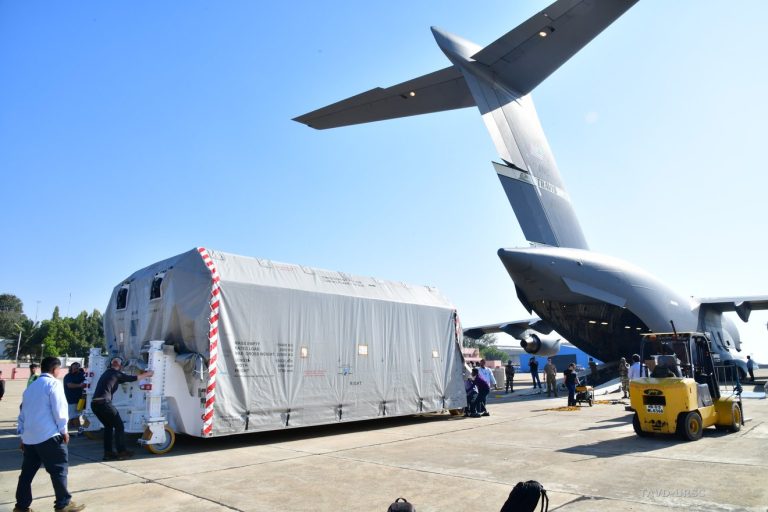
The NASA-ISRO Synthetic Aperture Radar (NISAR) science instrument payload is unloaded from a cargo plane shortly after arriving in Bengaluru, India, on March 6. At ISRO’s U R Rao Satellite Centre, it will be combined with the NISAR satellite body in preparation for launch in 2024. Credit: ISRO
NISAR will feature the most advanced radar system ever launched on a NASA science mission and will help us study natural hazards, melting sea ice, groundwater supply, and more.
The NISAR Earth science mission has moved a step closer to its 2024 launch. Its science payload of two radar systems, one built by NASA and the other by the Indian Space Research Organisation (ISRO), recently completed the journey from NASA’s Jet Propulsion Laboratory in Southern California to ISRO’s U R Rao Satellite Centre in Bengaluru, India. Soon, teams at the facility will combine the radar systems with the satellite’s body, or bus, and run it through tests in advance of its three-year mission.
Short for NASA-ISRO Synthetic Aperture Radar, NISAR will observe nearly all of Earth’s land and ice surfaces twice every 12 days, measuring movements in extremely fine detail. It will also survey forests and agricultural regions to help scientists understand carbon exchange between plants and the atmosphere.
NISAR’s payload will be the most advanced radar system ever launched as part of a NASA science mission, and it will feature the largest-ever radar antenna of its kind: a drum-shaped, wire mesh reflector nearly 40 feet (12 meters) in diameter that will extend from a 30-foot (9-meter) boom.
NISAR Mechanical Integration Lead Scott Nowak explains how his team of engineers worked to prepare the NISAR science payload for its trip from a JPL clean room to India, where it will be combined with the satellite body. Credit: NASA/JPL-Caltech
The mission’s science instruments consist of L- and S-band radar, so named to indicate the wavelengths of their signals. ISRO built the S-band radar, which it shipped to JPL in March 2021. Engineers spent much of the last two years integrating the instrument with the JPL-built L-band system, then conducting tests to verify they work well together.


In late February 2023, technicians and engineers working in a JPL clean room put the science payload into a specially designed shipping container before hoisting it onto a flatbed truck for the drive to March Air Reserve Base in California’s Riverside County. A U.S. Air Force C-17 cargo plane carried it from there to Bengaluru, touching down on March 6.
The NASA-ISRO Synthetic Aperture Radar (NISAR) science instrument payload sits in a specially designed container in a JPL clean room in late February. The payload was shipped on March 3 to India, where it will be combined with the satellite body. Credit: NASA/JPL-Caltech
The NASA-ISRO Synthetic Aperture Radar (NISAR) science payload sits in a specially designed shipping container outside a JPL airlock. The payload was shipped on March 3 to India, where it will be combined with the satellite body. Credit: NASA/JPL-Caltech
The next time the satellite is airborne will be aboard ISRO’s Geosynchronous Satellite Launch Vehicle Mark II rocket, which is set to lift off in 2024 from Satish Dhawan Space Centre on India’s southeastern coast and deliver NISAR into a near-polar Earth orbit.
Once in operation, NISAR will be able to collect measurements day and night, in all weather conditions, and its trove of data will help researchers better understand a broad range of Earth science topics, including landslides, groundwater loss, and the carbon cycle.
More About the Mission
NISAR is the first-ever collaboration between NASA and ISRO on an Earth-observing mission. JPL, which is managed for NASA by Caltech in Pasadena, leads the U.S. component of the project and is providing the mission’s L-band SAR. NASA is also providing the radar reflector antenna, the deployable boom, a high-rate communication subsystem for science data, GPS receivers, a solid-state recorder, and payload data subsystem. ISRO is providing the spacecraft bus, the S-band SAR, the launch vehicle, and associated launch services and satellite mission operations.
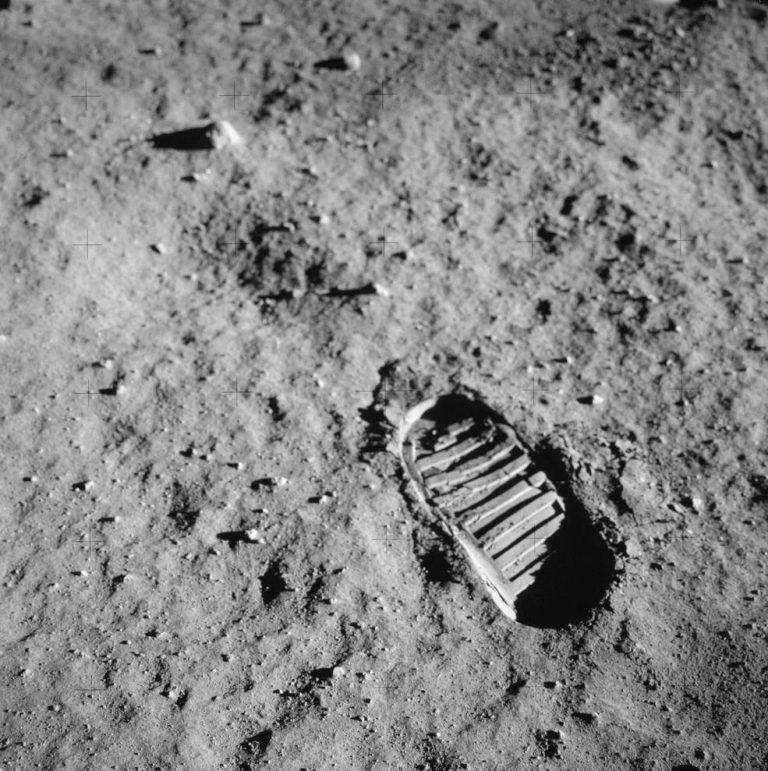
A close-up view of an astronaut’s bootprint in the lunar soil, photographed with a 70mm lunar surface camera during the Apollo 11 extravehicular activity (EVA) on the moon. While astronauts Neil A. Armstrong, commander, and Edwin E. Aldrin Jr., lunar module pilot, descended in the Lunar Module (LM) “Eagle” to explore the Sea of Tranquility region of the moon, astronaut Michael Collins, command module pilot, remained with the Command and Service Modules (CSM) “Columbia” in lunar orbit. Credits: NASA
A spacesuit prototype of what NASA astronauts, including the first woman, plan to wear on the surface of the Moon during the agency’s Artemis III mission, is set for reveal during a televised event hosted by Axiom Space beginning at 10:30 a.m. EDT (9:30 a.m. CDT) Wednesday, March 15, from Space Center Houston in Texas.
The event will air live on NASA Television, the NASA app, and the agency’s website.
NASA selected Axiom Space to deliver a moonwalking system to land the first astronauts near the lunar South Pole. Planned during the reveal activities are remarks from NASA and Axiom Space experts, a suit demonstration, as well as question-and-answer sessions with media and students.
Participants will include:
Bob Cabana, associate administrator, NASA
Vanessa Wyche, center director, NASA Johnson Space Center
Lara Kearney, manager, Extravehicular Activity and Human Surface Mobility Program, NASA Johnson
Kate Rubins, NASA astronaut
Michael Suffredini, president and CEO, Axiom Space
Mark Greeley, program manager for Extravehicular Activity, Axiom Space
Russell Ralston, deputy program manager for Extravehicular Activity, Axiom Space
Peggy Whitson, Axiom-2 commander, Axiom Space
John Shoffner, Axiom-2 pilot, Axiom Space
The full event schedule is as follows (all times CDT):
9 a.m.: In-person media one-on-one interviews with NASA and Axiom Space officials
9:30 a.m.: Remarks and suit demonstration on NASA TV
10:15 a.m.: Student question-and-answer session
10:40 a.m.: Media question-and-answer session
11:00 a.m.: Event concludes
U.S. media interested in participating in person or by phone, or obtaining a media kit, must contact Axiom Space no later than 12 p.m. CDT, Tuesday, March 14, by emailing [email protected].
In this new approach to working with commercial partners, NASA is enabling a growing space economy that leverages industry capabilities and NASA’s expertise to provide spacewalk and moonwalk services as safely, effectively, and efficiently as possible.
New spacesuits that allow humans to explore the lunar surface advance our capability for human exploration in space. Under Artemis, new exploration spacesuits and other human surface mobility systems, the Space Launch System rocket, the Orion Spacecraft, ground systems, Gateway, and human landing systems, will enable NASA to return humans to the Moon and establish a long-term presence there for scientific discovery. This experience prepares us for the next giant leap: sending astronauts to Mars.
The Moon is seen passing in front of the Sun during a solar eclipse from Ross Lake, Northern Cascades National Park, Washington on Aug. 21, 2017. A total solar eclipse swept across a narrow portion of the contiguous United States from Lincoln Beach, Oregon to Charleston, South Carolina. A partial solar eclipse was visible across the entire North American continent along with parts of South America, Africa, and Europe.
This was the first total eclipse to span the U.S. since 1918, and with scientific advancements, presented a perfect opportunity to shed light on phenomena such as solar flares and coronal mass ejections.
In honor of the mathematical constant pi – and its many uses in space exploration – the annual NASA Pi Day Challenge offers four math problems involving real NASA missions and science. Credits: NASA/JPL-Caltech
The agency’s Jet Propulsion Laboratory celebrates the mathematical marvel with a set of problems involving real space missions.
Pi Day is the annual tribute to the mathematical constant pi, whose infinite number of decimals is usually rounded to 3.14. So what better day to celebrate than March 14? To find pi, aka the Greek letter π, you simply divide any circle’s circumference by its diameter. It’s a ratio that’s indispensable to NASA missions studying Earth, Mars, and beyond.
This Pi Day marks the 10th year that the Education Office at NASA’s Jet Propulsion Laboratory has celebrated this wondrously useful number with the agency’s Pi Day Challenge. Students can put their math mettle to the test to solve real problems faced by NASA scientists and engineers.
approximate the density of Psyche – the metal-rich asteroid that will be visited by a NASA mission by the same name – and speculate about what it’s made of; and
determine how much of the Sun’s disk will be eclipsed by the Moon and whether to expect a total or annular solar eclipse this October.
Answers to all four challenge questions will be available on March 15.
The NASA Pi Day Challenge is accompanied by other pi-related resources for educators, K-12 students, and parents, including lessons and teachable moments, articles, downloadable posters, and illustrated web/mobile backgrounds. More than 30 puzzlers from previous challenges are also available.