
Home Blog Page 37

Apple introduces the advanced new Apple Watch Series 9

0

12 September 2023

PRESS RELEASE

Apple introduces the advanced new Apple Watch Series 9

Featuring breakthrough capabilities for the world’s most popular watch and Apple’s first carbon neutral products

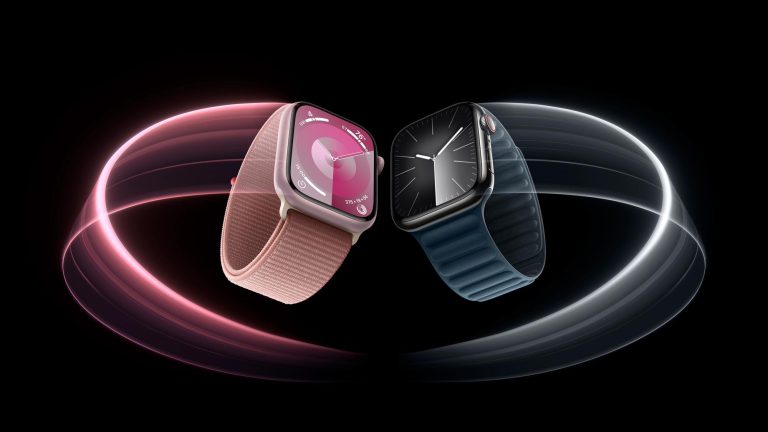
CUPERTINO, CALIFORNIA Apple today introduced Apple Watch Series 9, bringing new features to the world’s best-selling watch and achieving a significant environmental milestone. Apple Watch Series 9 is more powerful than ever with the new S9 SiP, which increases performance and capabilities; a magical new double tap gesture; a brighter display; faster on-device Siri, now with the ability to access and log health data; Precision Finding for iPhone; and more. Apple Watch Series 9 runs watchOS 10, which delivers redesigned apps, the new Smart Stack, new watch faces, new cycling and hiking features, and tools to support mental health.

For the first time, customers can choose a carbon neutral option of any Apple Watch, representing a significant milestone toward Apple 2030: Apple’s plan to be carbon neutral across its entire business, manufacturing supply chain, and product life cycle by 2030.

The new Apple Watch lineup can be ordered today, with availability beginning Friday, September 22.

Apple Watch Series 9 is a more indispensable companion than ever, offering powerful new capabilities to help users with their health, fitness, communications, and safety.

“Apple Watch is an indispensable companion that helps millions of people with their health, fitness, communications, and safety,” said Jeff Williams, Apple’s chief operating officer. “We’re introducing our best Apple Watch lineup, with incredible new capabilities and technological advancements, including a new double tap gesture, brighter display, on-device Siri, as well as our first-ever carbon neutral products. Whether users are upgrading from earlier models or buying their first, there’s never been a more compelling time to experience Apple Watch.”

“At Apple, we are committed to making products customers love and protecting the planet at the same time, and this year, we hit a key milestone toward our Apple 2030 goal,” said Lisa Jackson, Apple’s vice president of Environment, Policy, and Social Initiatives. “Our first carbon neutral products were made in a uniquely Apple way, steeply reducing carbon emissions from materials, electricity, and transportation through innovation and design.”

Select case and band combinations of Apple Watch Series 9 are Apple’s first-ever carbon neutral products.

Powerful New S9 SiP

Apple Watch Series 9 is powered by custom Apple silicon in the all-new S9 SiP. Apple’s most powerful watch chip yet delivers systemwide improvements and brand-new features, including a new double tap gesture and on-device Siri with the ability to access and log health data privately and securely. Apple Watch Series 9 also has a new 4-core Neural Engine that can process machine learning tasks up to twice as fast, when compared with Apple Watch Series 8. The power efficiency of the S9 SiP allows Apple Watch Series 9 to maintain all-day 18-hour battery life.1

Apple Watch Series 9 features the S9 SiP, Apple’s most powerful watch chip yet, along with a new 4-core Neural Engine that can process machine learning tasks up to two times faster.

Double Tap Gesture

Innovations such as the Digital Crown and Taptic Engine — along with gestures like tap, swipe, wrist raise, and cover to mute — make Apple Watch simple and intuitive to use. With a new double tap gesture, users can easily control Apple Watch Series 9 using just one hand and without touching the display. Users can tap the index finger and thumb of their watch hand together twice to quickly and conveniently perform many of the most common actions on Apple Watch Series 9.

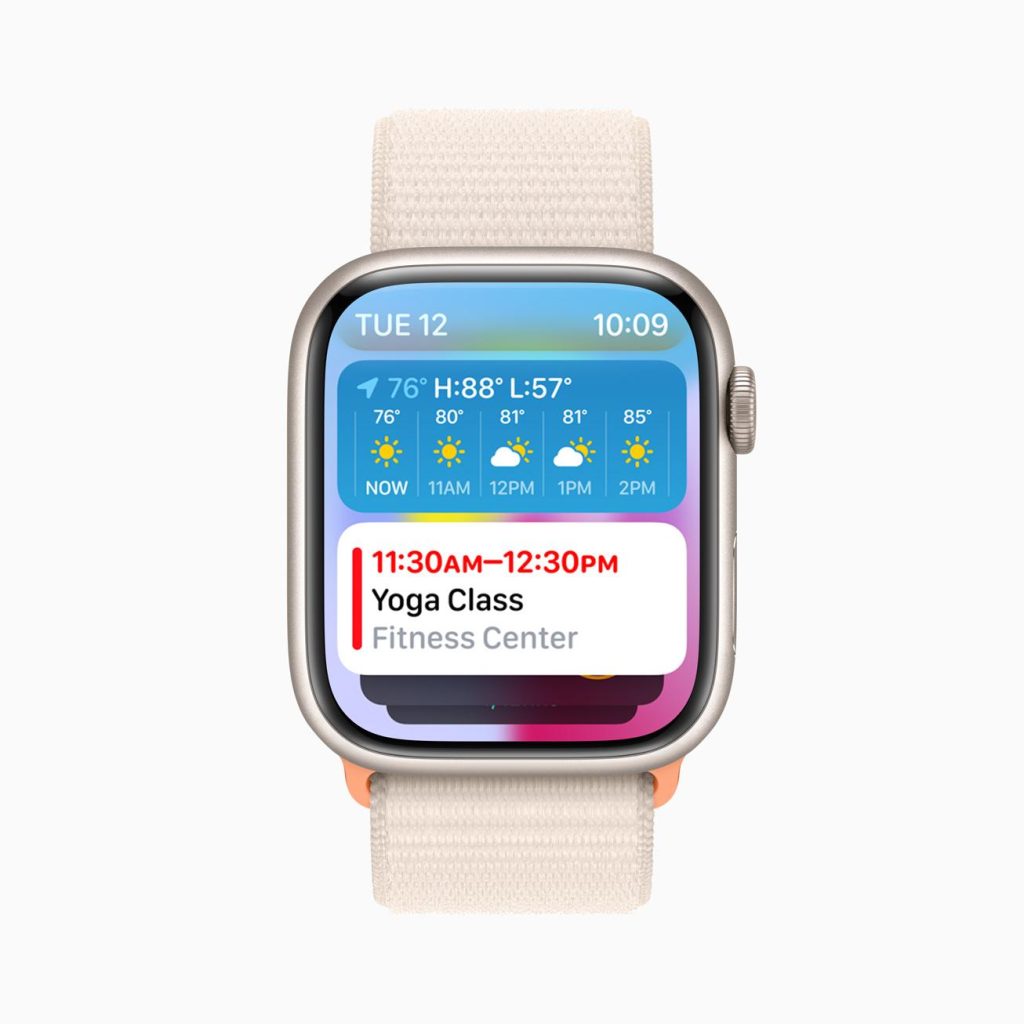
Double tap controls the primary button in an app so it can be used to stop a timer, play and pause music, or snooze an alarm. The gesture can be used to answer and end a phone call, and even to take a photo with the Camera Remote on Apple Watch. Double tap will also open the Smart Stack from the watch face, and another double tap will scroll through widgets in the stack.

This new double tap gesture is enabled by the faster Neural Engine in Apple Watch Series 9, which processes data from the accelerometer, gyroscope, and optical heart sensor with a new machine learning algorithm. The algorithm detects the unique signature of tiny wrist movements and changes in blood flow when the index finger and thumb perform a double tap. The double tap gesture will be available in a software update next month.

With a new double tap gesture, users can easily control Apple Watch Series 9 using just one hand and without touching the display. Double tap controls the primary button in an app so it can be used to answer a phone call, stop a timer, play and pause music, or snooze an alarm.

Brighter Display

The power-efficient S9 SiP and advanced display architecture increase the maximum brightness of the Apple Watch Series 9 display up to 2000 nits — double that of Series 8 — making it even easier to read text in bright sunlight. For dark rooms or early mornings, the display can also lower to just one nit so as not to disturb people close by.

Apple Watch Series 9 features a maximum brightness of up to 2000 nits — double that of Series 8.

On-Device Siri with Ability to Access and Log Health Data

For the first time on Apple Watch, Siri requests can be processed on device. For requests that do not require information from the internet, such as starting a workout or setting a timer, Siri does not rely on Wi-Fi or cellular networks, resulting in quicker and more reliable responses. The powerful Neural Engine also makes dictation up to 25 percent more accurate than Apple Watch Series 8.

On-device processing is private and secure, and now Siri can be used to access data from the Health app for health- and fitness-related queries. For example, a user can ask how many hours of sleep they had the previous night, for progress on closing their Activity rings, or about their blood glucose level if they have a connected monitor. Users can also make Siri requests on Apple Watch Series 9 to log health data such as their weight, period, or medications taken.2

Precision Finding and HomePod Integration

The ability to use Apple Watch to find iPhone is a favourite user feature. Now, the S9 SiP includes a second-generation Ultra Wideband (UWB) chip to enable Precision Finding for the iPhone 15 family, which has the same chip. Precision Finding provides distance and direction, as well as visual, haptic, and audio guidance to a misplaced iPhone, even if it is in a different room.

The S9 SiP chip features second-generation Ultra Wideband to enable Precision Finding, providing distance and direction, as well as visual, haptic, and audio guidance to a misplaced iPhone, even if it is in a different room.

UWB also brings deeper integration between Apple Watch and HomePod. When an Apple Watch user gets within 4 meters of a HomePod playing audio, Apple Watch Series 9 will launch Now Playing to control the media. Or if nothing is playing on HomePod, media suggestions will appear at the top of the Smart Stack.

The new second-generation Ultra Wideband chip also brings deeper integration between Apple Watch and HomePod.

Featuring watchOS 10

Apple Watch Series 9 runs watchOS 10, a milestone update that includes:

  • A fresh approach to quickly view information with redesigned apps and a new Smart Stack to show relevant widgets right when they’re needed.
  • Delightful new watch faces: Snoopy, Palette, and Solar Analog. A new Nike watch face, Nike Globe, lights up the lines on the globe with each passing second.
  • Bluetooth connectivity for power meters, speed sensors, and cadence sensors arrives for cyclists, unlocking new metrics and Workout Views, and cycling workouts.
  • A cycling workout can automatically show up as a Live Activity on iPhone and utilise the full screen when tapped.
  • New Compass Waypoints and Maps capabilities to further help during outdoor adventures.
  • Additional tools to support mental health with state of mind logging in the Mindfulness app.
  • The ability to measure time spent in daylight using the ambient light sensor to help reduce the risk of myopia and provide additional benefits to physical and mental health for all ages.

Carbon Neutral Models

Select case and band combinations of Apple Watch Series 9, Apple Watch Ultra 2, and Apple Watch SE are Apple’s first-ever carbon neutral products. As part of Apple 2030, the carbon footprint of Apple Watch has been significantly decreased. Emissions were reduced from the three biggest sources of greenhouse gases — materials, electricity, and transportation. The small amount of emissions remaining are offset with high-quality carbon credits from nature-based projects. Apple Watch packaging has been redesigned to be 100 percent fibre-based, and a new logo on the packaging indicates models that are carbon neutral.

Apple Watch SE

Apple Watch SE continues to deliver the core Apple Watch experience at a more affordable price point, and is a great way for users to start their Apple Watch journey, use with Family Setup, or gift to their loved ones. Additionally, Apple Watch SE offers Activity tracking, high and low heart rate notifications, Fall Detection, Emergency SOS, Crash Detection, and watchOS 10.

The new Apple Watch SE delivers the core Apple Watch experience at a more affordable price point, offering everything from Activity tracking to Emergency SOS.

Lineup

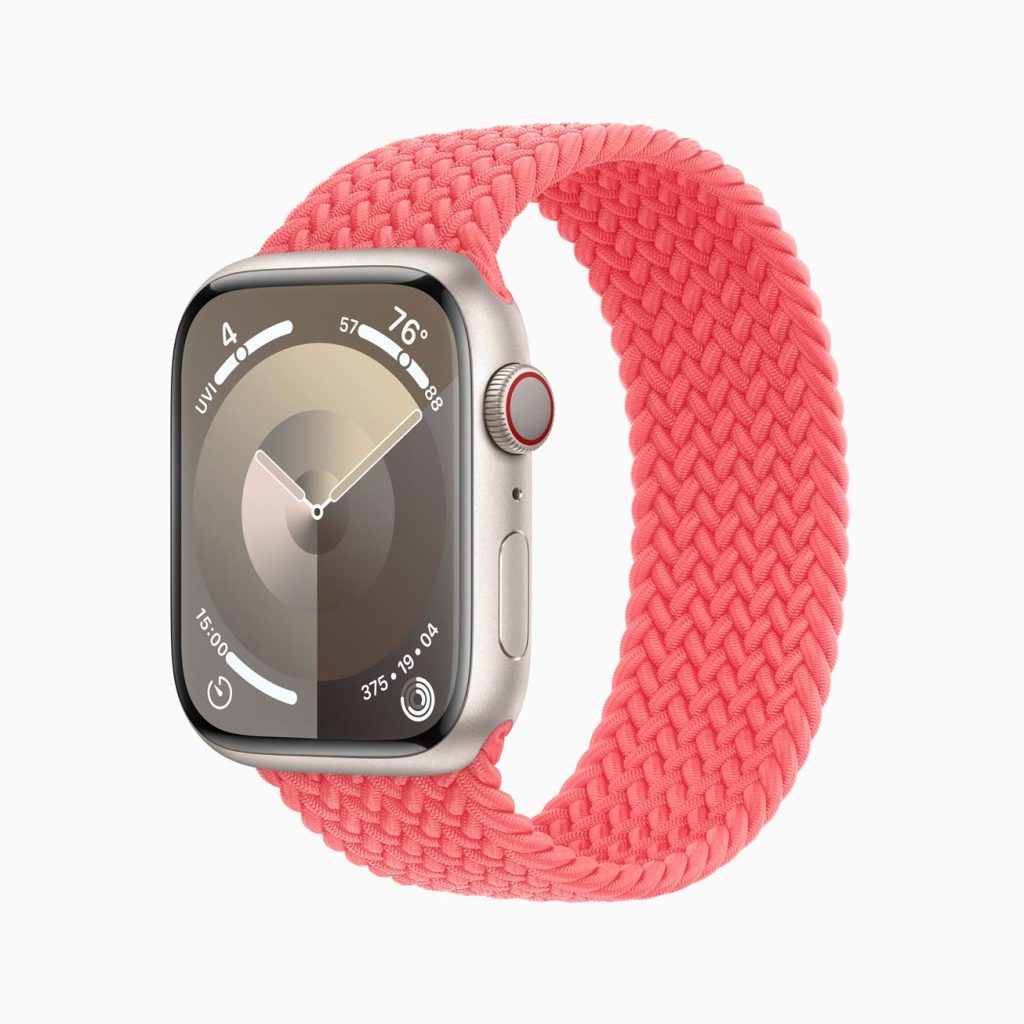
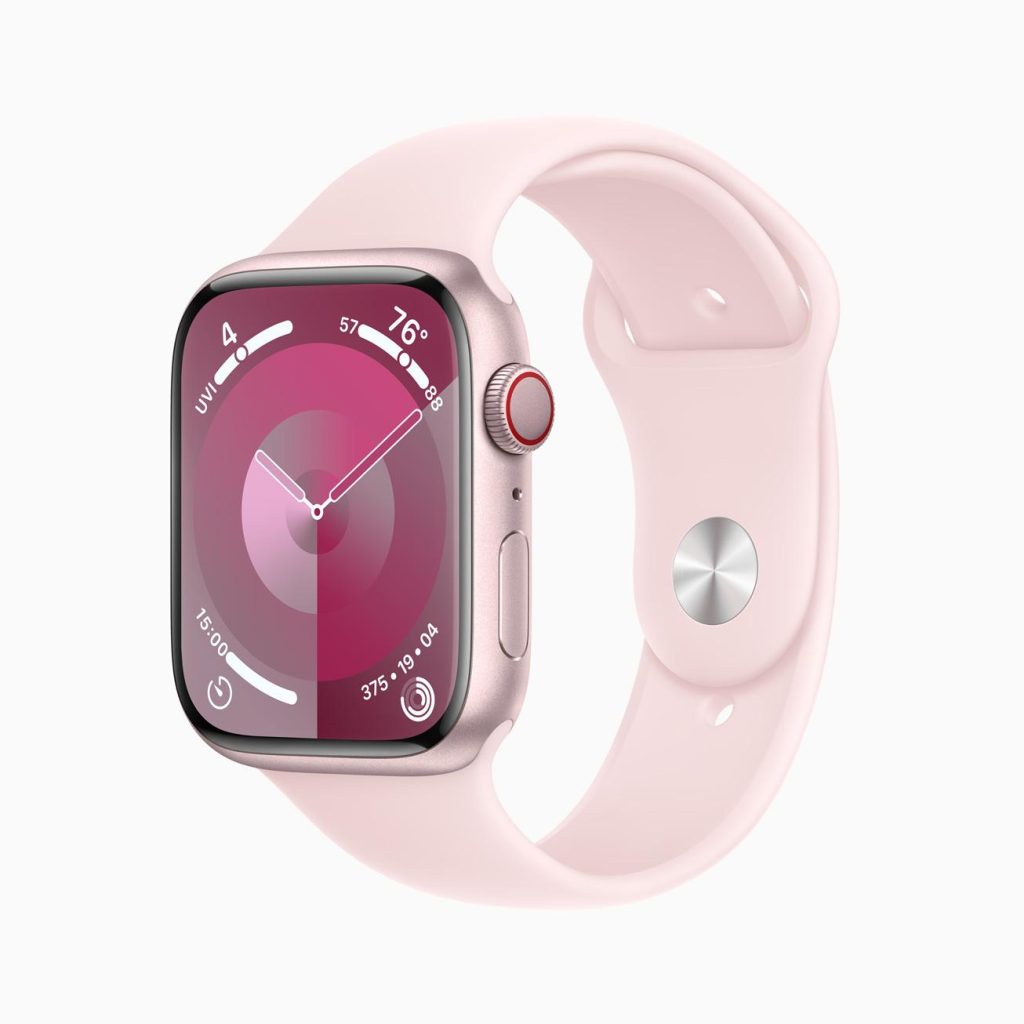
  • Apple Watch Series 9 is available in 41mm and 45mm sizes in starlight, midnight, silver, (PRODUCT)RED, and a new pink aluminium case, as well as stainless steel in gold, silver, and graphite cases.
  • Any aluminium Apple Watch Series 9 with a new Sport Loop band is carbon neutral.
  • Apple Watch SE is available in 40mm and 44mm aluminium cases, and is carbon neutral when paired with a new Sport Loop band.
  • Apple Watch Hermès is available in stainless steel in silver and space black.
Bands

Apple is introducing FineWoven, a luxurious and durable microtwill made of 68 percent post-consumer recycled content that has significantly lower carbon emissions compared to leather. FineWoven has a suedelike feel, and is available with the Magnetic Link and Modern Buckle bands. Starting today, Apple will no longer use leather in any new Apple product, including watch bands.

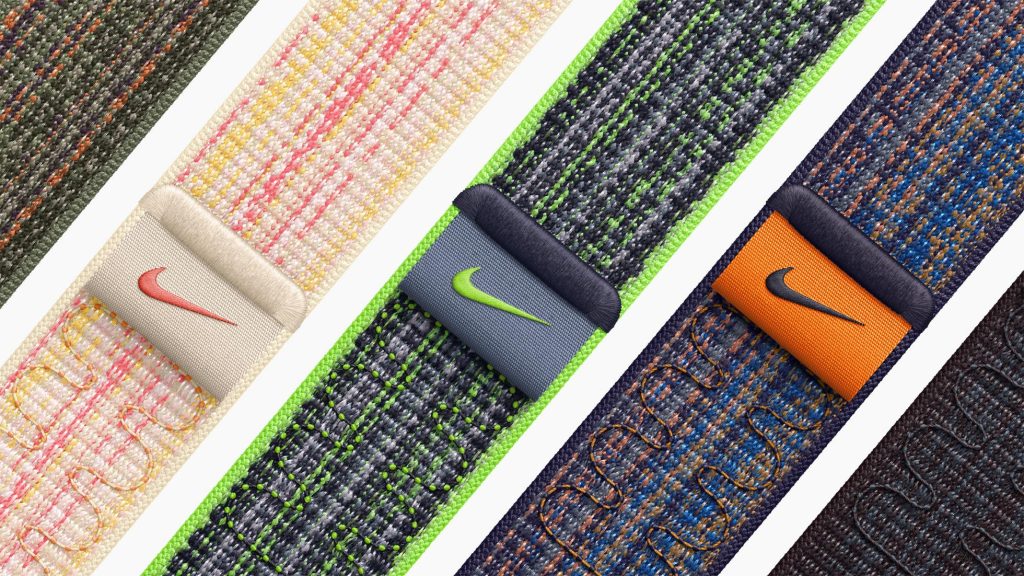
The popular Sport Loop band has been redesigned to include 82 percent recycled yarn. All new Apple Watch Sport Loops are carbon neutral.
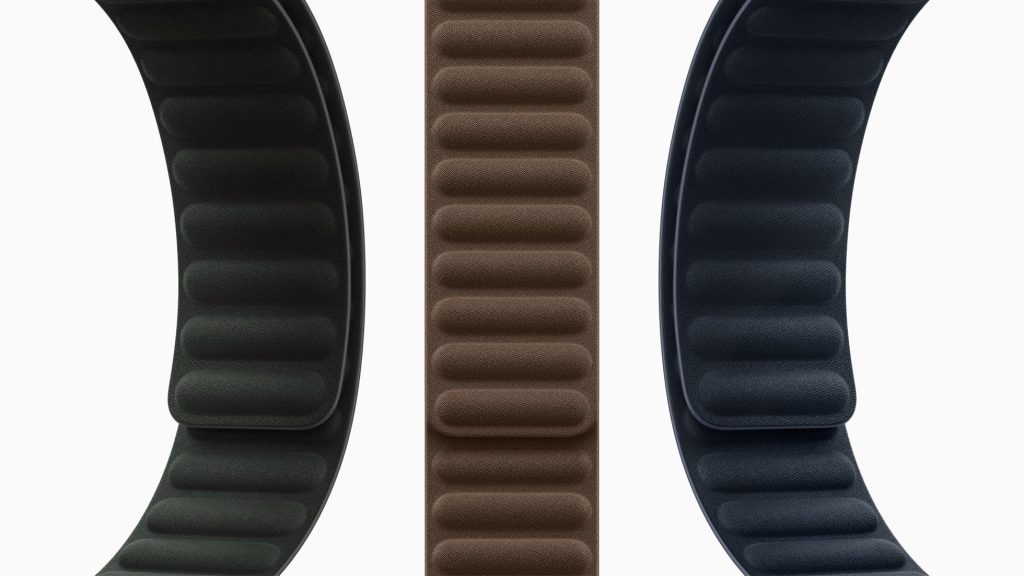
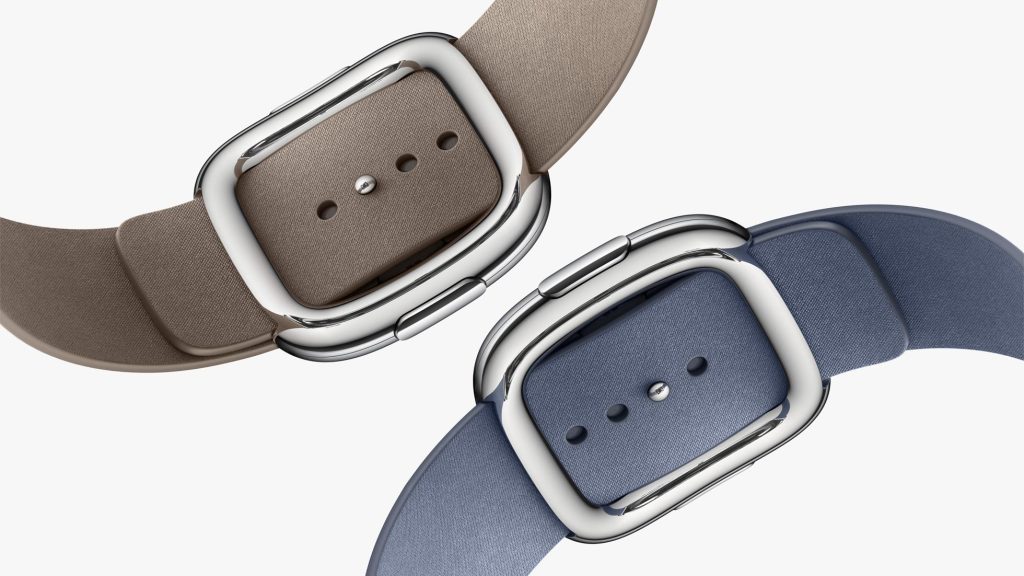
Apple worked with Nike and Hermès on more environmentally friendly band collections. The Nike Sport Band now contains 32 percent or more recycled fluoroelastomer, including colourful flakes made from excess bands that create a randomised pattern, making each band unique, while the Nike Sport Loop with a space-dye pattern repurposes yarn from previous seasons.
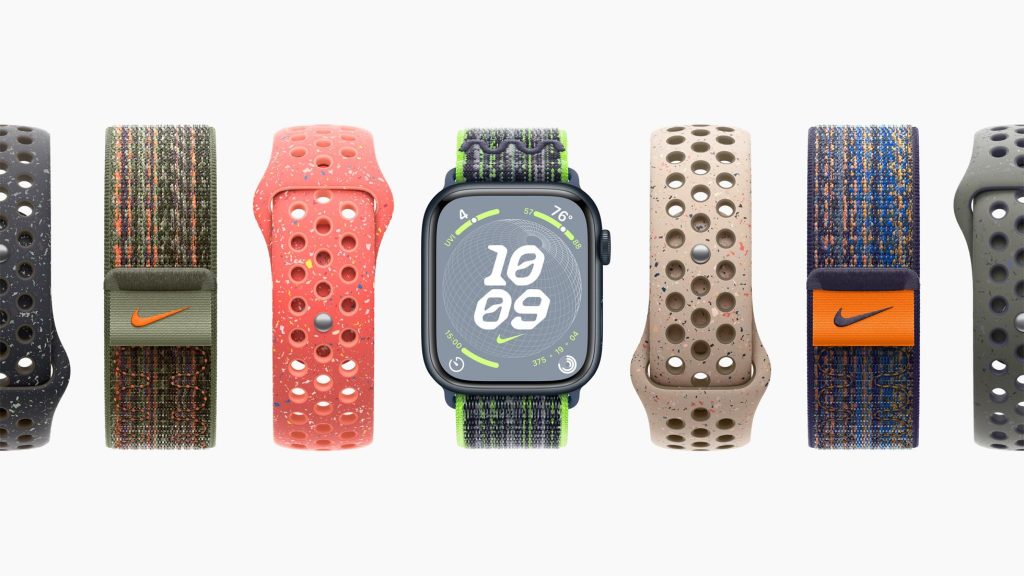
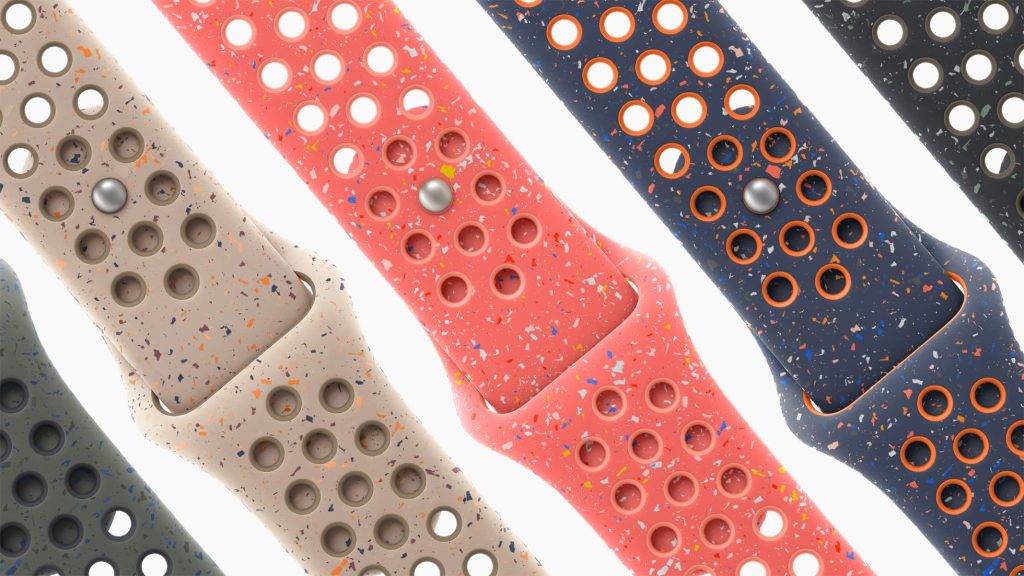
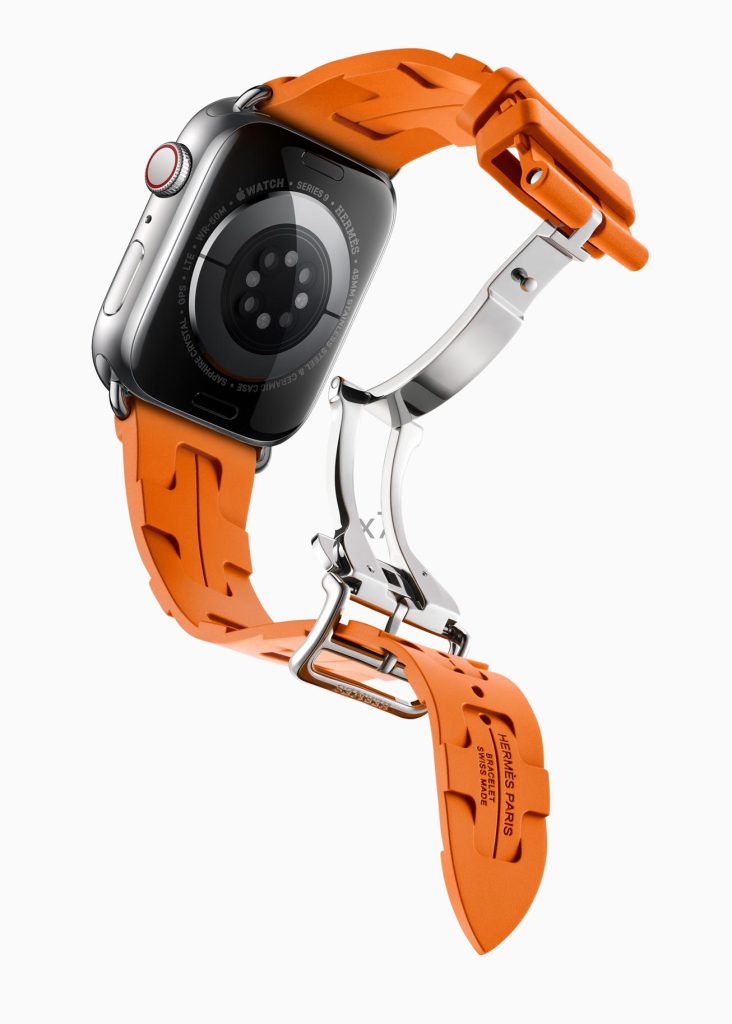
A new collection of Hermès bands draws on the house’s rich history in textiles and craftsmanship. Two new woven bands are introduced: Toile H is an interpretation of the brand’s signature checked canvas, and Twill Jump is a rich solid colour with contrasting details. The first-ever knitted band for Apple Watch, Bridon, is hand-braided with a bold chevron pattern, while Kilim is made of sporty, waterproof molded rubber and has a deployment buckle. A classic new watch face, Hermès Radial, complements these four new band styles.3

Pricing and Availability

  • Customers in Australia, Canada, France, Germany, India, Japan, the UAE, the U.K., the U.S., and more than 40 other countries and regions can order Apple Watch Series 9 and Apple Watch SE today, with availability in stores beginning Friday, September 22.
  • Apple Watch Series 9 starts at £399, and Apple Watch SE starts at £219 .
  • Apple Watch bands, Apple Watch Nike bands, and Apple Watch Hermès bands will be available to order today from apple.com/uk/store and in the Apple Store app, with availability in stores beginning Friday, September 22.
  • watchOS 10 will be available for Apple Watch Series 4 and later on Monday, September 18, and requires iPhone XS or later running iOS 17. Not all features are available on all devices and in all regions.
  • Three months of Apple Fitness+ are included for customers who purchase Apple Watch Series 9, Apple Watch SE, Apple Watch Ultra 2, or a new Apple Watch Series 4 or later.
  • For more information on Apple 2030, visit apple.com/uk/2030.

About Apple Apple revolutionised personal technology with the introduction of the Macintosh in 1984. Today, Apple leads the world in innovation with iPhone, iPad, Mac, Apple Watch, and Apple TV. Apple’s five software platforms — iOS, iPadOS, macOS, watchOS, and tvOS — provide seamless experiences across all Apple devices and empower people with breakthrough services including the App Store, Apple Music, Apple Pay, and iCloud. Apple’s more than 100,000 employees are dedicated to making the best products on earth, and to leaving the world better than we found it.

  1. Battery life varies by use.
  2. These capabilities will be available in a software update later this year, starting in English and Mandarin. They require the download of speech models.
  3. The Hermès Radial watch face is available with Apple Watch Hermès models only.

Press Contacts

Aileen Tappin

Apple

[email protected]

020 3284 6333
Apple Media Helpline

[email protected]

020 3284 6333

Apple debuts iPhone 15 and iPhone 15 Plus

0

12 September 2023

PRESS RELEASE

Apple debuts iPhone 15 and iPhone 15 Plus

A huge leap forward for iPhone with a gorgeous new design featuring a durable, colour-infused back glass and new contoured edge; the Dynamic Island; a 48MP Main camera with 2x Telephoto; and USB‑C

CUPERTINO, CALIFORNIA Apple today announced iPhone 15 and iPhone 15 Plus, featuring an industry-first colour-infused back glass with a stunning, textured matte finish, and a new contoured edge on the aluminium enclosure. Both models feature the Dynamic Island, and an advanced camera system designed to help users take fantastic photos of everyday moments in their lives. A powerful 48MP Main camera enables super-high-resolution photos and a new 2x Telephoto option to give users a total of three optical zoom levels — like having a third camera. The iPhone 15 lineup also introduces the next generation of portraits, making it easier to capture portraits with great detail and low-light performance. Building on Apple’s innovative satellite infrastructure, Roadside Assistance via satellite can connect users to AAA if they have car trouble while off the grid. With A16 Bionic for powerful, proven performance; a USB‑C connector; Precision Finding for Find My friends; and industry-leading durability features, iPhone 15 and iPhone 15 Plus represent a huge leap forward. 

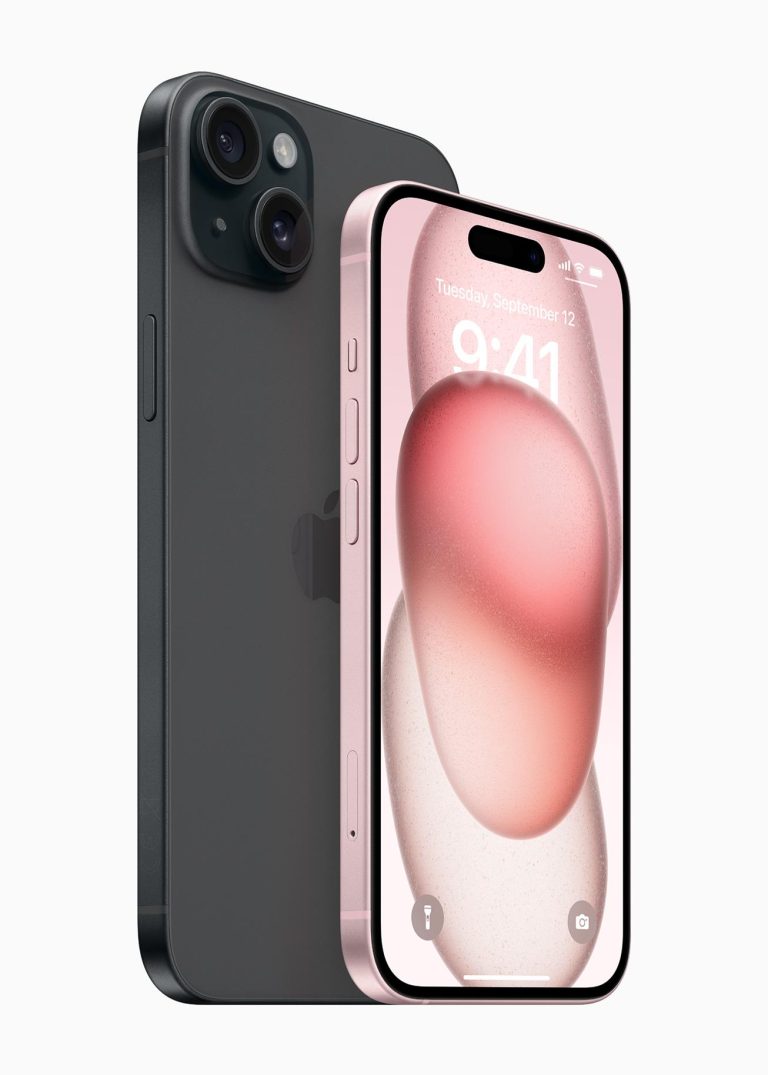
iPhone 15 and iPhone 15 Plus will be available in five stunning new colours: pink, yellow, green, blue, and black. Pre-orders begin Friday, September 15, with availability beginning Friday, September 22. 

“iPhone 15 and iPhone 15 Plus represent a huge leap forward with exciting camera innovations that inspire creativity, the intuitive Dynamic Island, and the A16 Bionic chip for proven powerful performance,” said Kaiann Drance, Apple’s vice president of Worldwide iPhone Product Marketing. “We’re also pushing the power of computational photography to new levels this year with a 48MP Main camera featuring a new 24MP default for super-high-resolution photos, a new 2x Telephoto option, and next-generation portraits.”

iPhone 15 and iPhone 15 Plus will be available in five stunning new colours: black, blue, green, yellow, and pink.

A Beautiful and Durable Design with an Advanced Display

Available in 6.1-inch and 6.7-inch display sizes,1 iPhone 15 and iPhone 15 Plus feature the Dynamic Island, an innovative way to interact with important alerts and Live Activities. The elegant experience fluidly expands and adapts so users can see the next direction in Maps; easily control music; and, with third-party app integrations, get real-time updates on food delivery, ride sharing, sports scores, travel plans, and more. The Super Retina XDR display is great for watching content, streaming Apple Fitness+ workouts, and playing games. Peak HDR brightness now reaches up to 1600 nits so HDR photos and videos look better than ever. And when it is sunny, peak outdoorbrightness reaches up to 2000 nits — twice as bright as the previous generation.

Both models feature the Dynamic Island, which fluidly expands and adapts to a user’s alerts and Live Activities, creating an intuitive experience that feels magical.

Both models feature a sophisticated new look that’s built to last. For the first time in a smartphone, colour is infused throughout the back glass, creating five beautiful colours. The back glass is strengthened with an optimised dual-ion exchange process before being polished with nanocrystalline particles and etched to create a luxurious, textured matte finish. A new contoured edge on the aerospace-grade aluminium enclosure feels even nicer in users’ hands, and the Ceramic Shield front cover continues to be tougher than any other smartphone glass. With a water- and dust-resistant design2 and industry-leading durability features, iPhone lasts and holds its value longer than any other smartphone. Plus, the internal design provides powerful sustained performance, while improving ease and affordability of repairs.

iPhone 15 and iPhone 15 Plus introduce a new contoured edge and durable, colour-infused back glass.

A Powerful Camera to Capture Every Moment in Super-High Resolution

The advanced camera system on iPhone 15 and iPhone 15 Plus helps users capture everyday moments and cherished memories. A 48MP Main camera shoots sharp photos and videos while capturing fine details, with a quad-pixel sensor and 100 percent Focus Pixels for fast autofocus. Using the power of computational photography, the Main camera gives users a new 24MP super-high-resolution default, offering incredible image quality at a practical file size ideal for storing and sharing. By intelligently integrating hardware and software, an additional 2x Telephoto option gives users three optical-quality zoom levels — 0.5x, 1x, 2x — for the first time on an iPhone dual-camera system.

Next-generation portraits on iPhone 15 and iPhone 15 Plus feature sharper detail, more vivid colours, and improved low-light performance. For the first time, users can take portraits without having to switch to Portrait mode. When there’s a person, dog, or cat in the frame, or when a user taps to focus, iPhone automatically captures depth information, so users can turn photos into stunning portraits later in the Photos app on iPhone, iPad, or Mac. For greater creative control, users can also adjust the focus point after the photo has been taken. Shooting at night gets better with improvements to Night mode, including sharper details and more vivid colours. When lighting is bright or uneven, new Smart HDR captures subjects and the background with more true-to-life renderings of skin tones, while ensuring photos have brighter highlights, richer midtones, and deeper shadows when viewed in the Photos app. This advanced HDR rendering is also available to third-party apps, so images can look even better when shared online. These improvements benefit the 48MP Main camera, Ultra Wide camera, and TrueDepth front camera.

iPhone 15 detects when there’s a person in the frame and captures rich depth information automatically — so users can turn it into a stunning portrait right away or later on in the Photos app.

A16 Bionic: Proven, Powerful Performance

The fast and efficient A16 Bionic chip brings proven performance to iPhone 15 and iPhone 15 Plus, powering the Dynamic Island, computational photography capabilities, and more. With two high-performance cores that use 20 percent less power and four high-efficiency cores, the 6-core CPU is faster than the previous generation and easily handles intensive tasks while delivering extraordinary battery life. The 5-core GPU has 50 percent more memory bandwidth for smooth graphics when streaming videos and playing games. A new 16-core Neural Engine is capable of nearly 17 trillion operations per second, enabling even faster machine learning computations for features like Live Voicemail transcriptions in iOS 17 and third-party app experiences — all while protecting critical privacy and security features using the Secure Enclave. 

A16 Bionic, with a 5-core GPU, enables smoother graphics when streaming videos and playing games — all while powering incredible computational photography capabilities and the Dynamic Island, with privacy built in.

Expanded Safety Capabilities for Peace of Mind

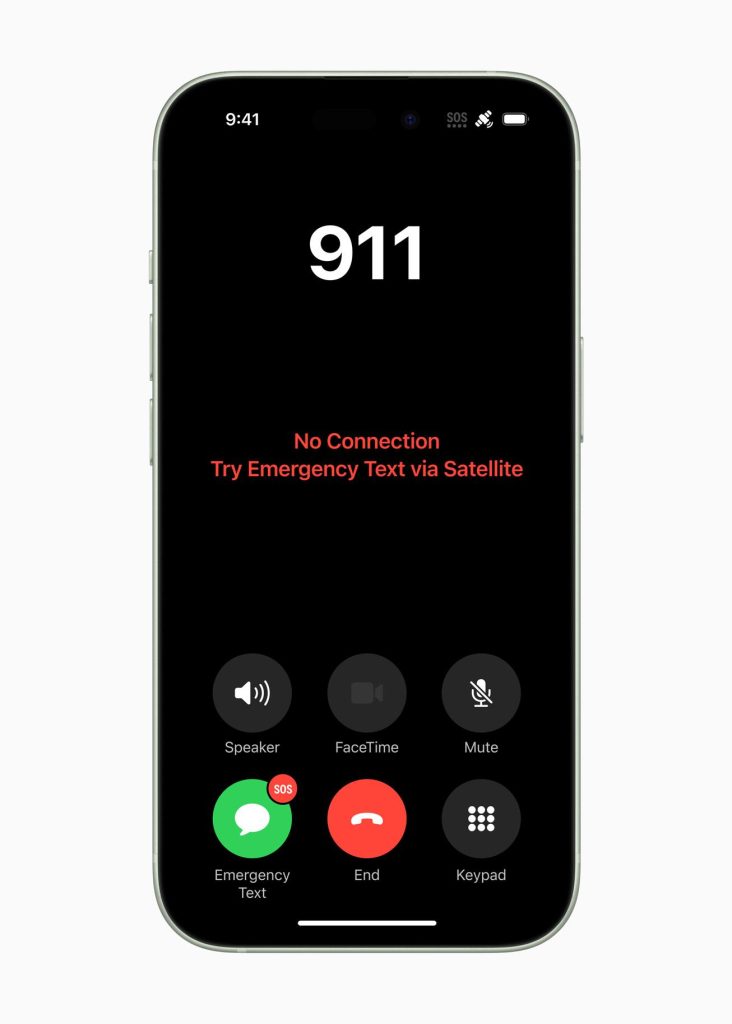
The iPhone 15 lineup offers critical safety capabilities to provide assistance when it matters most, including Crash Detection3 and Emergency SOS via satellite.4 Currently available in 14 countries and regions on three continents, Emergency SOS via satellite has made a significant impact in users’ lives. This groundbreaking safety service will come to Spain and Switzerland later this month.

Powerful Connection Capabilities

The iPhone 15 lineup offers convenient new ways to charge, find friends in busy places, and stay connected while traveling. Both models use a USB‑C connector, a universally accepted standard for charging and transferring data, allowing the same cable to charge iPhone, Mac, iPad, and the updated AirPods Pro (2nd generation). Users can also charge AirPods or Apple Watch directly from iPhone with the USB‑C connector.7 Both models support MagSafe and future Qi2 chargers for wireless charging.

iPhone 15 users can charge the updated AirPods Pro (2nd generation) or Apple Watch right from their iPhone with the new USB-C connector.

Both models feature the second-generation Ultra Wideband chip, enabling two iPhone devices with this chip to connect at three times the range as before. This opens up a new way to use Precision Finding for Find My friends, so iPhone 15 users can share their location and find each other, even in crowds. Precision Finding is built with the same privacy protections that users have come to trust in Find My.8

With Precision Finding for Find My friends, iPhone 15 users can share their location and find each other, even in a crowded place.

iPhone 15 models continue to deliver a high-quality, superfast 5G experience9 and improved audio quality on phone calls, including those made on FaceTime or third-party apps. Sound quality gets even better when users select Voice Isolation to come through loud and clear, even if they are somewhere noisy. 

iPhone 15 and iPhone 15 Plus have eSIM, a more convenient and secure alternative to a physical SIM card, with support from more than 295 carriers. When traveling the world, users can stay connected through affordable international roaming plans from their existing carrier, or purchase prepaid eSIM plans in over 50 countries and regions, including Australia, Italy, Thailand, and more.

Featuring iOS 17

iPhone 15 and iPhone 15 Plus feature iOS 17,10 making iPhone even more personal and intuitive with new capabilities:

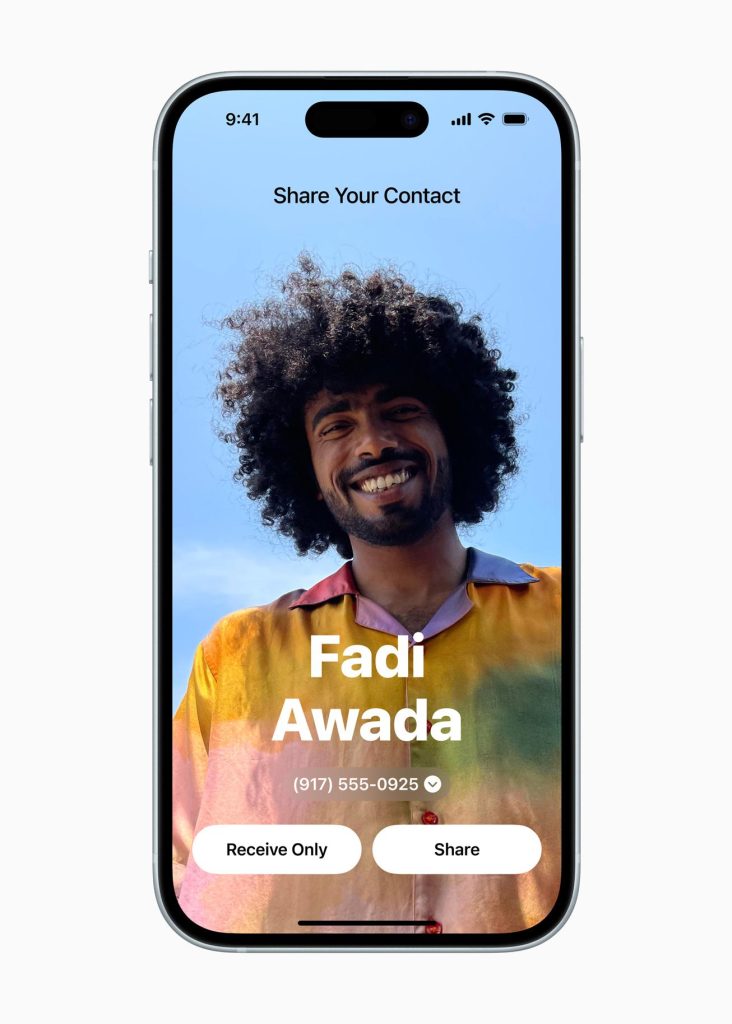
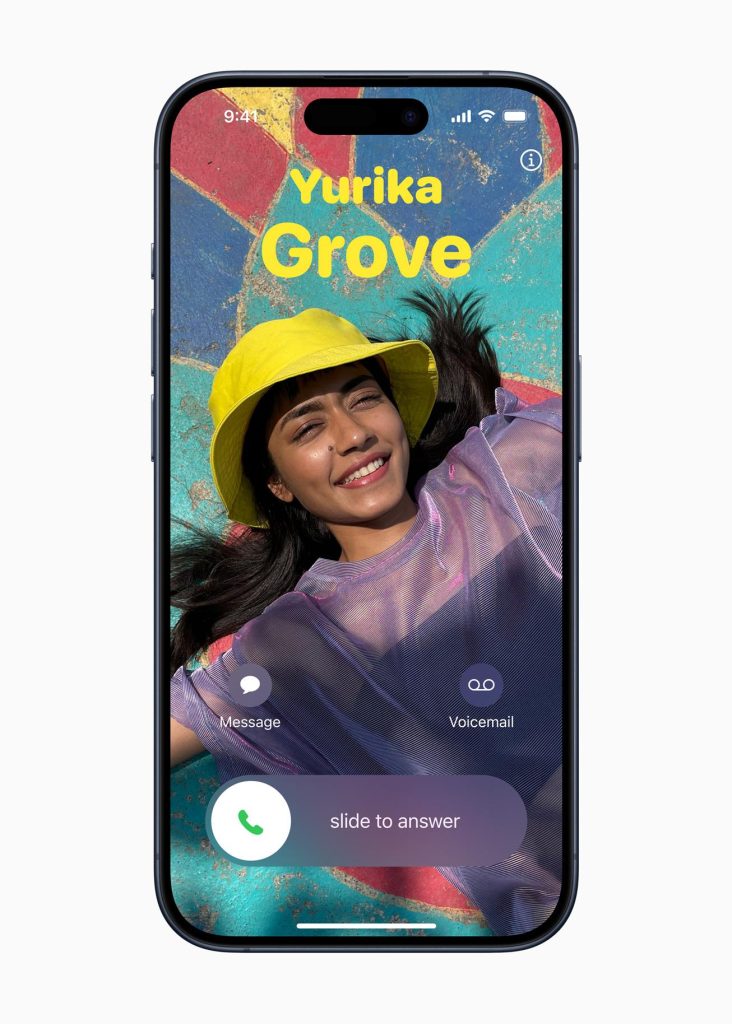
  • The Phone app gets major updates with Contact Posters, which allows users to customise how they appear to their contacts, and Live Voicemail, which leverages the power of A16 Bionic to see real-time on-device transcription as someone leaves a voicemail. Users can even pick up the call while the caller is leaving their message.
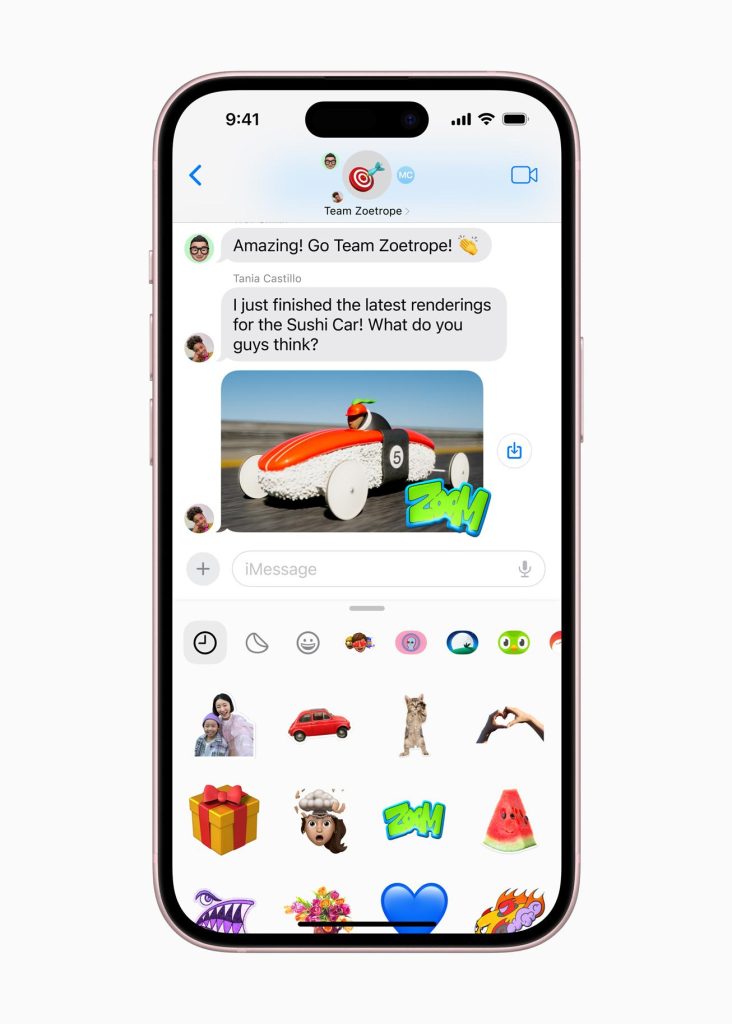
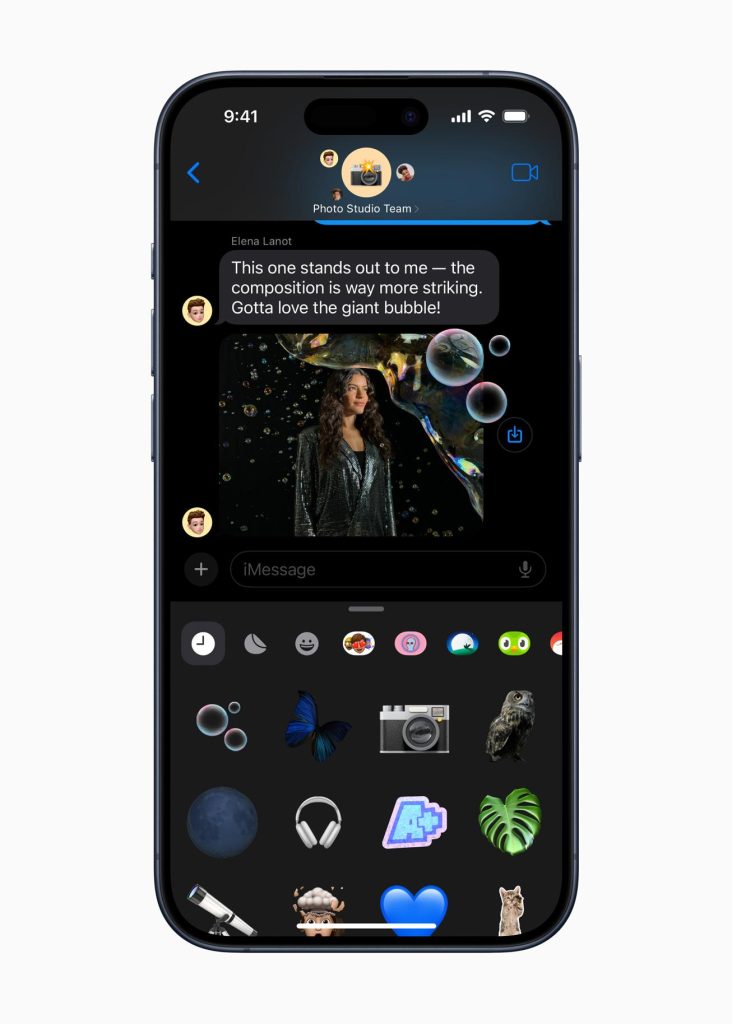
  • Messages gets a new stickers experience, more powerful search, transcription of audio messages, and Check In, which allows users to automatically notify friends and family when they have made it to their destination safely.
  • NameDrop gives users a new way to use AirDrop to more easily share contact information by simply bringing two iPhone devices together. The same gesture can be used to AirDrop content and more.
  • StandBy gives users a customisable full-screen experience with glanceable information designed to be viewed from a distance when iPhone is on its side and charging. With support for Live Activities, Siri, incoming calls, and larger notifications, StandBy is perfect for a nightstand, kitchen counter, or desk.

iOS 17 delivers many more updates, including Journal,11 a new app that helps iPhone users reflect and practice gratitude through journaling; improvements to autocorrect and Dictation; greater protection for Private Browsing in Safari; password and passkey sharing with iCloud Keychain; pet recognition in Photos; and much more. 

Better for the Environment

iPhone 15 and iPhone 15 Plus are designed with the environment in mind. As Apple continues to work toward its 2030 goal of making every product carbon neutral — from design to manufacturing to customer use — the company is prioritising clean electricity across the entire supply chain and designing products with recycled and other low-carbon materials. iPhone 15 and iPhone 15 Plus now use even more recycled content, with 100 percent recycled cobalt in the battery and 100 percent recycled copper in the main logic board, copper wire in the Taptic Engine, and copper foil in the inductive charger in MagSafe — all firsts for iPhone. Both models also include 75 percent recycled aluminium in the enclosure, 100 percent recycled rare earth elements in all magnets, and 100 percent recycled gold in the USB‑C connector as well as the gold plating and tin soldering in multiple printed circuit boards. The iPhone 15 lineup meets Apple’s high standards for energy efficiency and is free of mercury, PVC, and beryllium. Over 99 percent of the packaging is fibre-based, bringing Apple closer to its goal of completely removing plastic from its packaging by 2025.

To further reduce impact on the planet, Apple will no longer use leather in any new Apple products, including iPhone accessories. Apple is introducing a new FineWoven Case with MagSafe and FineWoven Wallet with MagSafe, made from a durable and elegant microtwill with a soft, suedelike feel. The material is made from 68 percent post-consumer recycled content and has significantly lower carbon emissions compared to leather.

New FineWoven accessories for iPhone are made from a luxurious and durable microtwill. This FineWoven material is made of 68 percent post-consumer recycled content and has significantly lower emissions compared to leather.

Pricing and Availability

  • iPhone 15 and iPhone 15 Plus will be available in pink, yellow, green, blue, and black in 128GB, 256GB, and 512GB storage capacities, starting at £799 or £33.29 per month, and £899 or £37.45 per month, respectively.12
  • Apple offers great ways to save and upgrade to the latest iPhone.
  • Customers in more than 40 countries and regions, including Australia, Canada, China, France, Germany, India, Japan, Mexico, the UAE, the U.K., and the U.S., will be able to pre-order iPhone 15 and iPhone 15 Plus beginning at 5 a.m. PDT this Friday, September 15, with availability beginning Friday, September 22.
  • iPhone 15 and iPhone 15 Plus will be available in Macao, Malaysia, Türkiye, Vietnam, and 17 other countries and regions beginning Friday, September 29.
  • FineWoven Wallet with MagSafe and FineWoven Case with MagSafe will both be available for £59 in five new colours for the iPhone 15 lineup: black, taupe, mulberry, pacific blue, and evergreen. In addition to an iPhone 15 and iPhone 15 Plus Clear Case, available for £49, a Silicone Case with MagSafe will be available for £49 in black, storm blue, clay, light pink, guava, orange sorbet, cypress, and winter blue.
  • iOS 17 will be available as a free software update on Monday, September 18.
  • Available starting on September 18, iCloud+ will offer two new plans: 6TB for £26.99 per month and 12TB for £54.99 per month, providing additional storage to keep files, photos, videos, and more safe, accessible, and easy to share. The new plans are great for users with large photo and video libraries or those using Family Sharing, and will provide access to premium features, including Private Relay, Hide My Email, Custom Email Domains, and HomeKit Secure Video support.
  • Customers who purchase iPhone 15 and iPhone 15 Plus will receive three free months of Apple Arcade and Apple Fitness+ with a new subscription.

About Apple Apple revolutionised personal technology with the introduction of the Macintosh in 1984. Today, Apple leads the world in innovation with iPhone, iPad, Mac, Apple Watch, and Apple TV. Apple’s five software platforms — iOS, iPadOS, macOS, watchOS, and tvOS — provide seamless experiences across all Apple devices and empower people with breakthrough services including the App Store, Apple Music, Apple Pay, and iCloud. Apple’s more than 100,000 employees are dedicated to making the best products on earth, and to leaving the world better than we found it.

  1. The display has rounded corners that follow a beautiful curved design, and these corners are within a standard rectangle. When measured as a standard rectangular shape, the screen is 6.06 inches (iPhone 15) or 6.68 inches (iPhone 15 Plus) diagonally. The actual viewable area is smaller.
  2. iPhone 15 and iPhone 15 Plus are splash-, water-, and dust-resistant. They were tested under controlled laboratory conditions, and have a rating of IP68 under IEC standard 60529 (maximum depth of 6 meters for up to 30 minutes). Splash, water, and dust resistance are not permanent conditions. Resistance might decrease as a result of normal wear. Do not attempt to charge a wet iPhone; refer to the user guide for cleaning and drying instructions. Liquid damage is not covered under warranty.
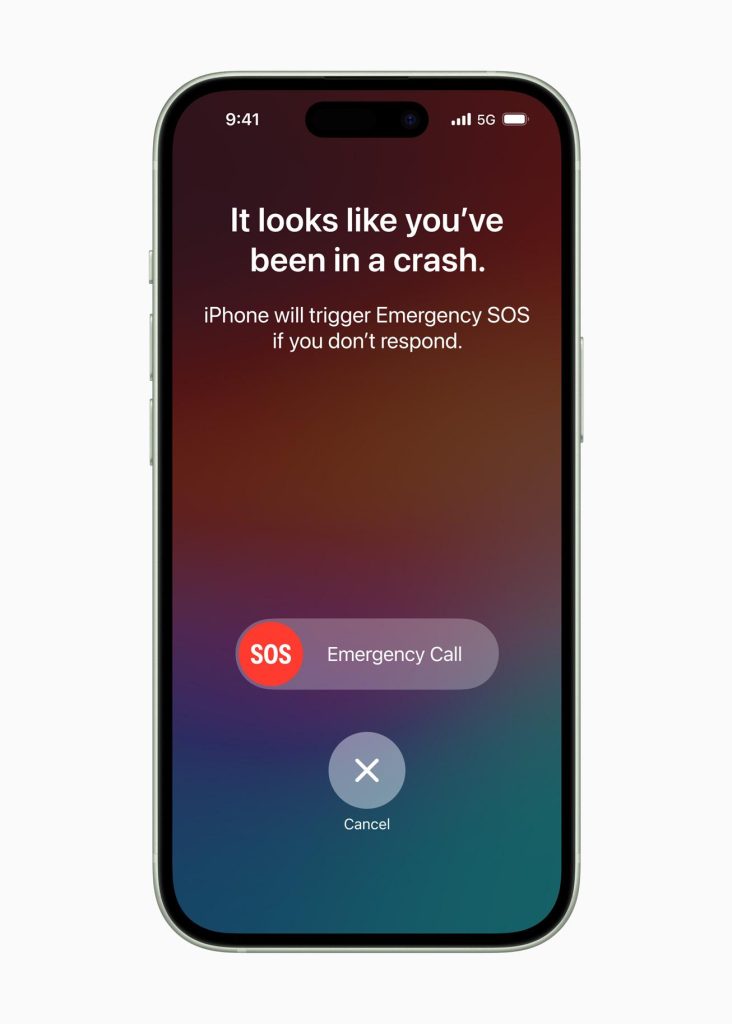
  3. Crash Detection is designed for four-wheel passenger vehicle crashes with certain mass, G-force, and speed profiles consistent with severe, life-threatening crashes. It was designed for severe, life-threatening, high-impact front and rear collisions, sideswipe, T-bone, and rollover crashes. Crash Detection is available worldwide on iPhone 15, iPhone 15 Plus, iPhone 15 Pro, iPhone 15 Pro Max, iPhone 14, iPhone 14 Plus, iPhone 14 Pro, iPhone 14 Pro Max, Apple Watch Series 9, Apple Watch Ultra 2, Apple Watch Series 8, Apple Watch Ultra, and Apple Watch SE (2nd generation).
  4. Emergency SOS via satellite and Find My via satellite are currently available in 14 countries and regions, including Australia, Austria, Belgium, Canada, France, Germany, Ireland, Italy, Luxembourg, the Netherlands, New Zealand, Portugal, the U.K., and the U.S., and will be available in Spain and Switzerland later this month.
  5. Emergency SOS via satellite and Roadside Assistance via satellite were designed for use in open spaces with a clear line of sight to the sky. Performance may be impacted by obstructions such as trees or surrounding buildings.
  6. Roadside Assistance via satellite is launching in the U.S. with AAA and is included for free for two years starting at the time of activation of a new iPhone 15, iPhone 15 Plus, iPhone 15 Pro, iPhone 15 Pro Max, iPhone 14, iPhone 14 Plus, iPhone 14 Pro, or iPhone 14 Pro Max. This satellite service requires iOS 17. AAA may charge for roadside assistance services. iPhone 15 and iPhone 14 users who are not AAA members can take advantage of Roadside Assistance via satellite on a pay-per-use basis for AAA’s roadside assistance services.
  7. iPhone 15 supports 4K at 60 fps HDR video output using a USB‑C Digital AV Multiport Adapter to allow users to connect to an HDMI display, while also connecting a standard USB device and a USB‑C charging cable.
  8. Precision Finding for Find My friends requires Ultra Wideband and isn’t available in all countries or regions. With iOS 17, Precision Finding will be available to Apple Watch Series 9 and Apple Watch Ultra 2 users to help them locate their iPhone 15, iPhone 15 Plus, iPhone 15 Pro, or iPhone 15 Pro Max. Later this fall, iPhone 15 users will be able to use Precision Finding for Find My friends to locate friends and family wearing Apple Watch Series 9 and Apple Watch Ultra 2.
  9. A data plan is required. 5G, Gigabit LTE, VoLTE, and Wi-Fi calling are available in select markets and through select carriers. Speeds are based on theoretical throughput and vary based on site conditions and carrier. For details on 5G and LTE support, customers can contact their carrier or visit apple.com/uk/iphone/cellular.
  10. Some features may not be available for all countries or all areas. View a complete list at apple.com/uk/ios/feature-availability.
  11. Journal is coming in a software update later this year.

Press Contacts

Laura Bonney

Apple

[email protected]

020 3284 6290

Fumilayo Brown-Olateju

Apple

[email protected]

Apple Media Helpline

[email protected]

020 3284 6333
Apple unveils iPhone 15 Pro and iPhone 15 Pro Max

0

12 September 2023

PRESS RELEASE

Apple unveils iPhone 15 Pro and iPhone 15 Pro Max

Featuring a strong and lightweight titanium design with new contoured edges, a new Action button, powerful camera upgrades, and A17 Pro for next-level performance and mobile gaming

CUPERTINO, CALIFORNIA Apple today debuted iPhone 15 Pro and iPhone 15 Pro Max, designed with aerospace-grade titanium that’s strong yet lightweight to deliver Apple’s lightest Pro models ever. The new design also features contoured edges and a customisable Action button, allowing users to personalise their iPhone experience. Powerful camera upgrades enable the equivalent of seven pro lenses with incredible image quality, including a more advanced 48MP Main camera system that now supports the new super-high-resolution 24MP default, the next generation of portraits with Focus and Depth Control, improvements to Night mode and Smart HDR, and an all-new 5x Telephoto camera exclusively on iPhone 15 Pro Max. A17 Pro unlocks next-level gaming experiences and pro performance. The new USB‑C connector is supercharged with USB 3 speeds — up to 20x faster than USB 2 — and together with new video formats, enables powerful pro workflows that were not possible before.1 And with the addition of Roadside Assistance via satellite, the iPhone 15 Pro lineup builds on Apple’s innovative satellite infrastructure to connect users to help if they have car trouble while off the grid.

iPhone 15 Pro and iPhone 15 Pro Max will be available in four stunning new finishes, including black titanium, white titanium, blue titanium, and natural titanium. Pre-orders begin Friday, September 15, with availability beginning Friday, September 22.

“This is the most pro lineup we have ever created, with a state-of-the-art titanium design, the best iPhone camera system yet that enables game-changing new workflows, and the A17 Pro chip, which ushers in a new chapter of performance and games never before seen on iPhone,” said Greg Joswiak, Apple’s senior vice president of Worldwide Marketing. “iPhone 15 Pro and iPhone 15 Pro Max represent the best of Apple design and industry-first innovations to help enrich the everyday experiences of our users, while enabling them to unleash their creativity.”

iPhone 15 Pro and iPhone 15 Pro Max will be available in four stunning new finishes: black titanium, white titanium, blue titanium, and natural titanium.

A Stunning, Lightweight, and Durable Design

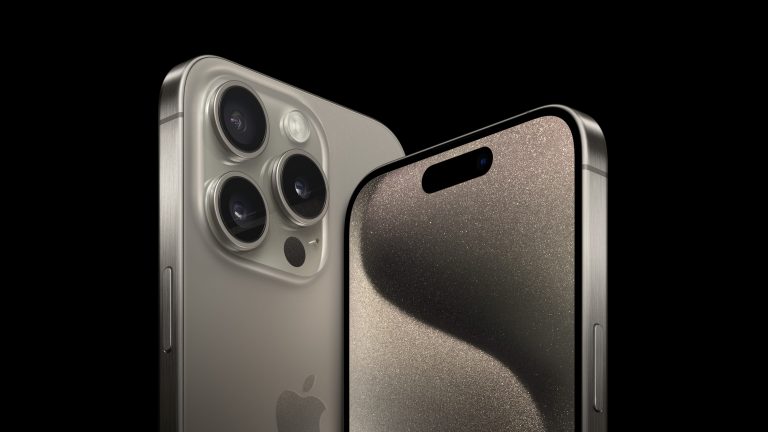
Available in 6.1-inch and 6.7-inch display sizes,2 iPhone 15 Pro and iPhone 15 Pro Max feature a strong and lightweight titanium design — a first for iPhone. This premium alloy — the same used in spacecraft — has one of the highest strength-to-weight ratios of any metal, making this Apple’s lightest Pro lineup ever. Both models feature a new refined brush texture, contoured edges, and the thinnest borders on iPhone. The Pro lineup is built to last, combining the strength of titanium with the toughest back glass in a smartphone and the industry-leading Ceramic Shield on the front. Using an industry-first thermo-mechanical process, the titanium bands encase a new substructure made from 100 percent recycled aluminium, bonding these two metals with incredible strength through solid-state diffusion. The aluminium frame helps with thermal dissipation and allows the back glass to be easily replaced. This new design highlights the Super Retina XDR display with Always-On and ProMotion technologies for an exceptional viewing experience.

The premium titanium used on iPhone 15 Pro and iPhone 15 Pro Max has one of the highest strength-to-weight ratios of any metal, making them Apple’s lightest Pro lineup ever.

The all-new Action button replaces the single-function switch used to toggle between ring and silent, offering additional options so users can choose between quickly accessing the camera or flashlight; activating Voice Memos, Focus modes, Translate,3 and accessibility features like Magnifier; or using Shortcuts for more options. A press-and-hold gesture with fine-tuned haptic feedback and visual cues in the Dynamic Island ensure the new button launches the intended action.

By default, the new Action button can switch between ring and silent, but users can choose from a set of actions for even more convenience and versatility.

A17 Pro: A New Generation of Apple Silicon for iPhone

Bringing pro performance and capabilities, iPhone 15 Pro and iPhone 15 Pro Max are powered by A17 Pro, the industry’s first 3-nanometer chip. Continuing Apple’s leadership in smartphone silicon, A17 Pro brings improvements to the entire chip, including the biggest GPU redesign in Apple’s history. The new CPU is up to 10 percent faster with microarchitectural and design improvements, and the Neural Engine is now up to 2x faster, powering features like autocorrect and Personal Voice in iOS 17. The pro-class GPU is up to 20 percent faster and unlocks entirely new experiences, featuring a new 6-core design that increases peak performance and energy efficiency. Now with hardware-accelerated ray tracing — which is 4x faster than software-based ray tracing — iPhone 15 Pro offers smoother graphics, as well as more immersive AR applications and gaming experiences. iPhone 15 Pro brings true-to-life gaming to the palm of users’ hands with console titles never before seen on a smartphone, like Resident Evil Village, Resident Evil 4, Death Stranding, and Assassin’s Creed Mirage.4

A17 Pro includes a dedicated AV1 decoder, enabling more efficient, high-quality video experiences for streaming services. Additionally, a new USB controller enables USB 3 speeds on iPhone for the first time, now supporting much higher transfer speeds and video output up to 4K at 60 fps HDR.

The new 6-core GPU in A17 Pro expands what’s possible on iPhone, enabling next-level mobile gaming with fast, efficient performance and hardware-accelerated ray tracing.

A Powerful Pro Camera System for More Creative Control

Through a deep integration of hardware and software, the advanced camera systems on iPhone 15 Pro and iPhone 15 Pro Max both pack the equivalent of seven pro lenses — all enabled by A17 Pro. With the power of computational photography, the 48MP Main camera, built exclusively for the Pro lineup, gives users even more flexibility with a new 24MP super-high-resolution default, offering incredible image quality at a practical file size ideal for storing and sharing. The Main camera allows users to switch between three popular focal lengths — 24 mm, 28 mm, and 35 mm — and even choose one as a new default. In addition to 48MP ProRAW, the Main camera also supports 48MP HEIF images with 4x more resolution. iPhone 15 Pro features an expansive 3x Telephoto camera, and iPhone 15 Pro Max provides the longest optical zoom ever on iPhone: 5x at 120 mm. Great for close-ups, wildlife photos, and catching the action from further distances, the new Telephoto camera on iPhone 15 Pro Max has an innovative tetraprism design with a combined optical image stabilisation and autofocus 3D sensor-shift module, Apple’s most advanced stabilisation system yet.

With Apple’s most pro camera systems ever, users will get powerful new features and the equivalent of seven camera lenses in their pocket, including 5x at 120 mm on iPhone 15 Pro Max.

Next-generation portraits on iPhone 15 Pro and iPhone 15 Pro Max feature sharper detail, more vivid colours, and better low-light performance. For the first time, users can take portraits without having to switch to Portrait mode. When there’s a person, dog, or cat in the frame, or when a user taps to focus, iPhone automatically captures depth information, so users can turn photos into stunning portraits later in the Photos app on iPhone, iPad, or Mac. For greater creative control, users can also adjust the focus point after the photo has been taken.

Additional features that benefit all cameras on iPhone 15 Pro and iPhone 15 Pro Max include:

  • Night mode gets better with sharper details and more vivid colours, now powered by the Photonic Engine, including Night mode portraits, enabled by the LiDAR scanner.
  • New Smart HDR captures subjects and the background with more true-to-life renderings of skin tones, while ensuring photos have brighter highlights, richer midtones, and deeper shadows when viewed in the Photos app. This advanced HDR rendering is also available to third-party apps, so images can look even better when shared online.
  • The best quality video in a smartphone is upgraded thanks to A17 Pro, with improvements in low-light video and Action mode.

The preferred smartphone for creative pros and filmmakers gets even better with new pro workflows. Users can now get up to 20x faster transfer speeds with an optional USB 3 cable. iPhone and third-party solutions like Capture One also help photographers create a pro studio, allowing them to shoot and instantly transfer 48MP ProRAW images from iPhone to Mac. ProRes video can be recorded directly to external storage, enabling higher recording options up to 4K at 60 fps, and greater flexibility on set when using iPhone as the main camera. iPhone 15 Pro also introduces a new option for Log encoding and is the first smartphone in the world to support ACES, the Academy Color Encoding System, a global standard for colour workflows.

Coming later this year, iPhone 15 Pro will add a new dimension to video capture with the ability to record spatial video for Apple Vision Pro. Users will be able to capture precious moments in three dimensions and relive those memories with incredible depth on Apple Vision Pro when it is available early next year in the U.S.

Next-Level Wireless Performance and Connectivity

The iPhone 15 Pro lineup offers convenient new ways to charge, find friends in busy places, and stay connected while traveling. Both models use the USB‑C connector, a universally accepted standard for charging and transferring data, allowing the same cable to charge iPhone, Mac, iPad, and the updated AirPods Pro (2nd generation). Users can also charge AirPods or Apple Watch directly from iPhone with the USB‑C connector. iPhone 15 Pro and iPhone 15 Pro Max support USB 3 for data transfer speeds up to 10 gigabits per second, up to 20x faster than before.

Using a USB 3 cable with iPhone 15 Pro and iPhone 15 Pro Max enables incredibly fast transfer speeds.

Both models feature the second-generation Ultra Wideband chip, enabling two iPhone devices with this chip to connect at three times the range as before. This opens up a new way to use Precision Finding for Find My friends, so iPhone 15 users can share their location and find each other, even in crowds. Precision Finding is built with the same privacy protections that users have come to trust in Find My.5

iPhone 15 Pro and iPhone 15 Pro Max now support Wi-Fi 6E for greater wireless performance, including up to 2x faster speeds, and introduces the first Thread-enabled smartphones, opening up future opportunities for Home app integrations.

iPhone 15 Pro and iPhone 15 Pro Max come equipped with super-fast 5G,6 and include:

  • Support for MagSafe and future Qi2 wireless charging.
  • Improved audio quality on phone calls, including those made on FaceTime or third-party apps. Sound quality gets even better when users select Voice Isolation, so conversations come through loud and clear, even if they are somewhere noisy.
  • eSIM with support from more than 295 carriers. When traveling the world, users can stay connected through affordable international roaming plans from their existing carrier, or purchase prepaid eSIM plans in over 50 countries and regions, including Australia, Italy, Thailand, and more.

Expanded Safety Capabilities for Peace of Mind

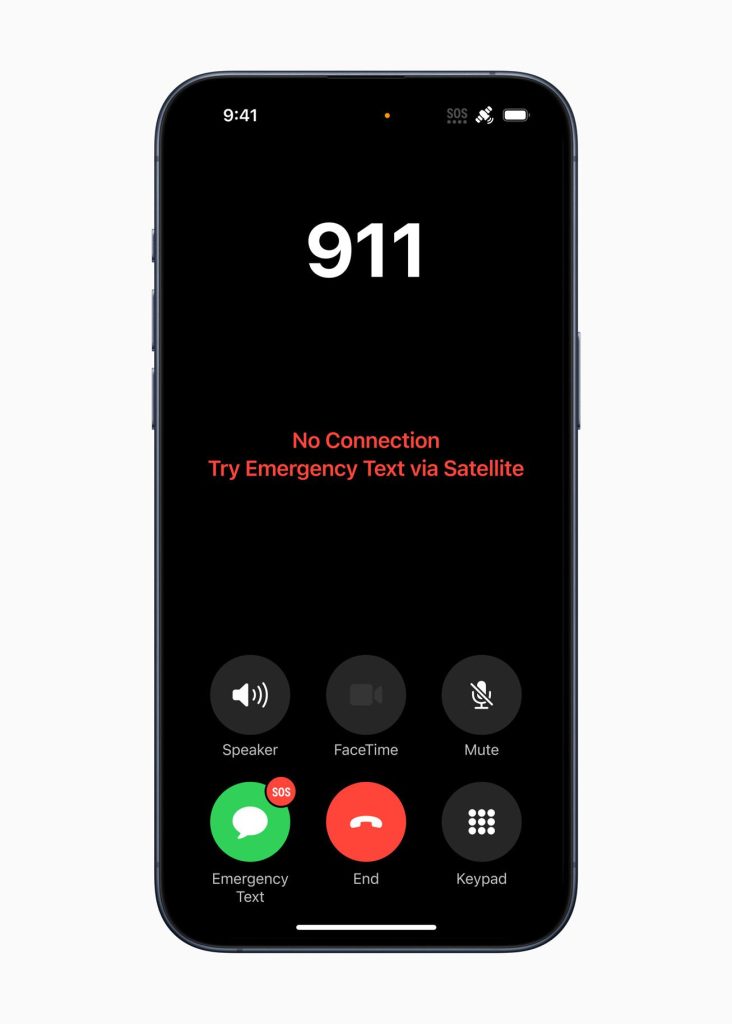
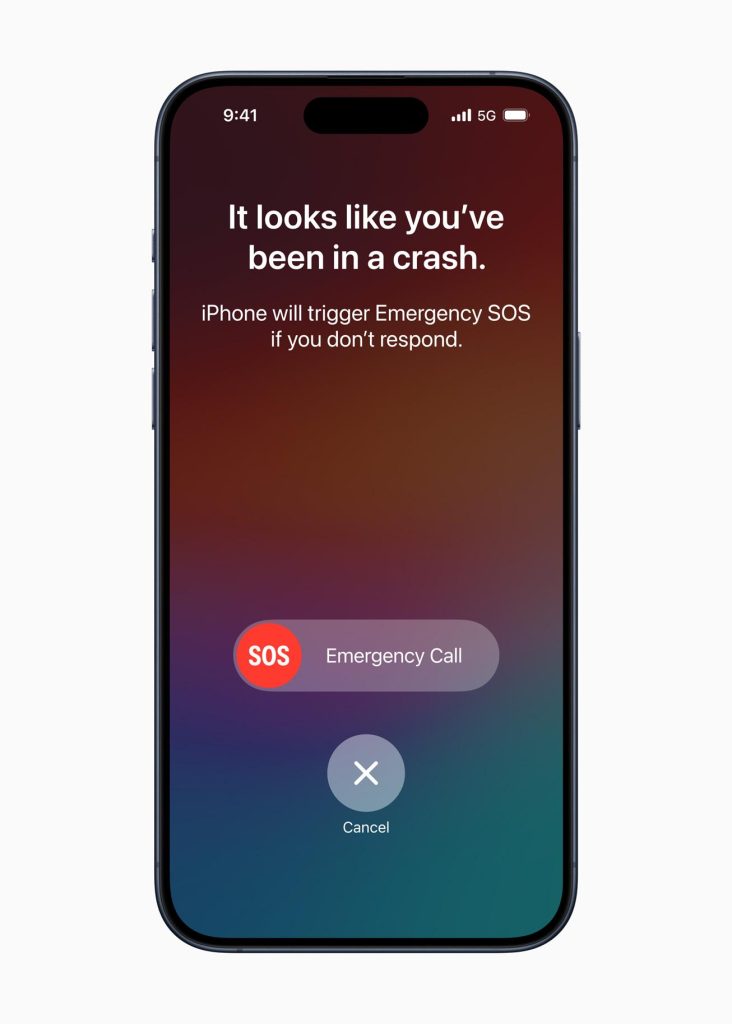
The iPhone 15 lineup offers critical safety capabilities to provide assistance when it matters most, including Crash Detection7 and Emergency SOS via satellite.8 Currently available in 14 countries and regions on three continents, Emergency SOS via satellite has made a significant impact in users’ lives. This groundbreaking service will come to Spain and Switzerland later this month.

Featuring iOS 17

iPhone 15 Pro and iPhone 15 Pro Max feature iOS 17,11 making iPhone even more personal and intuitive with new features:

  • The Phone app gets major updates, with Contact Posters that allow users to customise how they appear to their contacts, and Live Voicemail, which leverages the power of A17 Pro to see real-time on-device transcription as someone leaves a voicemail. Users can even pick up the call while the caller is leaving their message.
  • Messages gets a new stickers experience, more powerful search, transcription of audio messages, and Check In, which allows users to automatically notify friends and family when they have made it to their destination safely.
  • NameDrop gives users a new way to use AirDrop to more easily share contact information by simply bringing two iPhone devices together. The same gesture can be used to AirDrop content and more, and now users can step away from each other and finish sending large files over the internet.12
  • StandBy gives users a customisable full-screen experience with glanceable information designed to be viewed from a distance when iPhone is on its side and charging. With the Always-On display of iPhone 15 Pro and iPhone 15 Pro Max, StandBy stays on to show useful information — perfect on a desk, nightstand, or kitchen counter.
  • Interactive widgets on the Home Screen, Lock Screen, and in StandBy allow users to take action with just a tap, making it easy to complete a to-do, or play or pause a song right from the widget.
  • Safari adds greater protection for Private Browsing and introduces profiles, helping users separate their browsing for topics like work and personal.

iOS 17 delivers many more updates, including Journal,13 a new app that helps iPhone users reflect and practice gratitude through journaling, improvements to autocorrect and Dictation that make entering text faster and easier than ever before, password and passkey sharing with iCloud Keychain, and much more.

Better for the Environment

iPhone 15 Pro and iPhone 15 Pro Max are designed with the environment in mind. As Apple continues to work toward its 2030 goal of making every product carbon neutral — from design to manufacturing to customer use — the company is prioritising clean electricity across the entire supply chain and designing products with recycled and other low-carbon materials. iPhone 15 Pro and iPhone 15 Pro Max now use more recycled content, with a 100 percent recycled aluminium substructure and 100 percent recycled cobalt in the battery — both firsts for Apple. iPhone 15 Pro and iPhone 15 Pro Max also include 100 percent recycled rare earth elements in all magnets and 100 percent recycled gold in the USB‑C connector as well as the gold plating and tin soldering in multiple printed circuit boards. Both models meet Apple’s high standards for energy efficiency and are free of mercury, PVC, and beryllium. Over 99 percent of the packaging is fibre-based, bringing Apple closer to its goal of completely removing plastic from its packaging by 2025.

To further reduce impact on the planet, Apple will no longer use leather in any new Apple products, including iPhone accessories. Apple is introducing a new FineWoven Case with MagSafe and FineWoven Wallet with MagSafe, made from a durable and elegant microtwill with a soft, suedelike feel. The material is made from 68 percent post-consumer recycled content and has significantly lower carbon emissions compared to leather.

New FineWoven accessories for iPhone are made from a luxurious and durable microtwill. This FineWoven material is made of 68 percent post-consumer recycled content and has significantly lower emissions compared to leather.

Pricing and Availability

  • iPhone 15 Pro and iPhone 15 Pro Max will be available in black titanium, white titanium, blue titanium, and natural titanium finishes. iPhone 15 Pro remains at the same starting price of £999 or £41.62 per month, available in 128GB, 256GB, 512GB, and 1TB storage capacities. iPhone 15 Pro Max starts at £1,199 or £49.95 per month, available in 256GB, 512GB, and 1TB storage capacities.
  • Apple offers great ways to save and upgrade to the latest iPhone.
  • Customers in more than 40 countries and regions, including Australia, Canada, China, France, Germany, India, Japan, Mexico, the UAE, the U.K., and the U.S., will be able to pre-order iPhone 15 Pro and iPhone 15 Pro Max beginning at 5 a.m. PDT this Friday, September 15, with availability beginning Friday, September 22.
  • iPhone 15 Pro and iPhone 15 Pro Max will be available in Macao, Malaysia, Türkiye, Vietnam, and 17 other countries and regions beginning Friday, September 29.
  • FineWoven Wallet with MagSafe and FineWoven Case with MagSafe will both be available for £59 in five new colours for the iPhone 15 lineup: black, taupe, mulberry, pacific blue, and evergreen. In addition to the iPhone 15 Pro and iPhone 15 Pro Max Clear Case, available for £49, a Silicone Case with MagSafe will be available for £49 in black, storm blue, clay, light pink, guava, orange sorbet, cypress, and winter blue.
  • iOS 17 will be available as a free software update on Monday, September 18.
  • Beginning September 18, iCloud+ will offer two new plans: 6TB for £26.99 per month and 12TB for £54.99 per month, providing additional storage to keep files, photos, videos, and more safe, accessible, and easy to share. The new plans are great for users with large photo and video libraries or those using Family Sharing, and will provide access to premium features, including Private Relay, Hide My Email, Custom Email Domains, and HomeKit Secure Video support.
  • Customers who purchase iPhone 15 Pro and iPhone 15 Pro Max will receive three free months of Apple Arcade and Apple Fitness+ with a new subscription.

About Apple Apple revolutionised personal technology with the introduction of the Macintosh in 1984. Today, Apple leads the world in innovation with iPhone, iPad, Mac, Apple Watch, and Apple TV. Apple’s five software platforms — iOS, iPadOS, macOS, watchOS, and tvOS — provide seamless experiences across all Apple devices and empower people with breakthrough services including the App Store, Apple Music, Apple Pay, and iCloud. Apple’s more than 100,000 employees are dedicated to making the best products on earth, and to leaving the world better than we found it.

  1. Requires a USB 3 cable with 10Gb/s speeds.
  2. The display has rounded corners that follow a beautiful curved design, and these corners are within a standard rectangle. When measured as a standard rectangular shape, the screen is 6.06 inches (iPhone 15 Pro), or 6.68 inches (iPhone 15 Pro Max) diagonally. The actual viewable area is smaller.
  3. Translate is coming to the Action button later this year.
  4. Resident Evil Village, Resident Evil 4, and Death Stranding are coming to iPhone 15 Pro and iPhone 15 Pro Max later this year. Assassin’s Creed Mirage will be available in the first half of 2024.
  5. Precision Finding for Find My friends requires Ultra Wideband and isn’t available in all countries or regions. With iOS 17, Precision Finding will be available to Apple Watch Series 9 and Apple Watch Ultra 2 users later this fall, to help them locate their iPhone 15, iPhone 15 Plus, iPhone 15 Pro, or iPhone 15 Pro Max. Later this fall, iPhone 15 users will be able to use Precision Finding for Find My friends to locate friends and family wearing Apple Watch Series 9 and Apple Watch Ultra 2.
  6. A data plan is required. 5G, Gigabit LTE, VoLTE, and Wi-Fi calling are available in select markets and through select carriers. Speeds are based on theoretical throughput, and vary based on site conditions and carrier. For details on 5G and LTE support, customers can contact their carrier or visit apple.com/uk/iphone/cellular.
  7. Crash Detection is designed for four-wheel passenger vehicle crashes with certain mass, G-force, and speed profiles consistent with severe, life-threatening crashes. It was designed for severe, life-threatening, high-impact front and rear collisions, side-swipe, T-bone, and rollover crashes. Crash Detection is available worldwide on iPhone 15, iPhone 15 Plus, iPhone 15 Pro, iPhone 15 Pro Max, iPhone 14, iPhone 14 Plus, iPhone 14 Pro, iPhone 14 Pro Max, Apple Watch Series 9, Apple Watch Ultra 2, Apple Watch Series 8, Apple Watch Ultra, and Apple Watch SE (2nd generation).
  8. Emergency SOS via satellite and Find My via satellite are currently available in 14 countries and regions, including Australia, Austria, Belgium, Canada, France, Germany, Ireland, Italy, Luxembourg, the Netherlands, New Zealand, Portugal, the U.K., and the U.S., and will be available in Spain and Switzerland later this month.
  9. Emergency SOS via satellite and Roadside Assistance via satellite were designed for use in open spaces with a clear line of sight to the sky. Performance may be impacted by obstructions such as trees or surrounding buildings.
  10. Roadside Assistance via satellite is launching in the U.S. with AAA and is included free for two years starting at the time of activation of a new iPhone 15, iPhone 15 Plus, iPhone 15 Pro, iPhone 15 Pro Max, iPhone 14, iPhone 14 Plus, iPhone 14 Pro, or iPhone 14 Pro Max. This satellite service requires iOS 17. AAA may charge for roadside assistance services. iPhone 15 and iPhone 14 users who are not AAA members can take advantage of Roadside Assistance via satellite on a pay-per-use basis for AAA’s roadside assistance services.
  11. Some features may not be available for all countries or all areas. View a complete list at apple.com/uk/ios/feature-availability.
  12. The ability to continue AirDrop transfers over the internet is coming in a software update later this year.
  13. Journal is coming in a software update later this year.

Press Contacts

Laura Bonney

Apple

[email protected]

020 3284 6290

Fumilayo Brown-Olateju

Apple

[email protected]

Apple Media Helpline

[email protected]

020 3284 6333
Hubble Sees Glittering Globular Cluster Embedded Inside Our Milky Way

0

This colorful image of the globular star cluster Terzan 12 is a spectacular example of how dust in space affects starlight coming from background objects.

A globular star cluster is a conglomeration of stars, arranged in a spheroidal shape. Stars in globular clusters are bound together by gravity, with a higher concentration of stars towards the center. The Milky Way has about 150 ancient globular clusters at its outskirts. These clusters orbit around the galactic center, but far above and below the pancake-flat plane of our galaxy, like bees buzzing around a hive.

The location of this globular cluster, deep in the Milky Way in the constellation Sagittarius, means that it is shrouded in gas and dust which absorb and alter the starlight emanating from Terzan 12. The cluster is about 15,000 light-years from Earth. This location leaves a lot of room for intervening interstellar dust particles between us and the cluster to scatter blue light, causing only the redder wavelengths to come through to Earth. The interstellar dust clouds are mottled so that different parts of the cluster look redder than other parts along our line of sight.

The brightest red stars in the photo are bloated, aging giants, many times larger than our Sun. They lie between Earth and the cluster. Only a few may actually be members of the cluster. The very brightest hot, blue stars are also along the line of sight and not inside the cluster, which only contains aging stars.

Terzan 12 is one of 11 globular clusters discovered by the Turkish-Armenian astronomer Agop Terzan approximately a half-century ago. With its sharp vision, Hubble has revolutionized the study of globular clusters ever since its launch in 1990. Hubble observations have shed light on the relation between age and composition in the Milky Way galaxy’s innermost globular clusters.

The Hubble Space Telescope is a project of international cooperation between NASA and ESA. NASA’s Goddard Space Flight Center in Greenbelt, Maryland, manages the telescope. The Space Telescope Science Institute (STScI) in Baltimore, Maryland, conducts Hubble science operations. STScI is operated for NASA by the Association of Universities for Research in Astronomy, in Washington, D.C.  

Image Credit: NASA, ESA, ESA/Hubble, Roger Cohen (RU)

Media Contacts:

Claire Andreoli
NASA’s Goddard Space Flight CenterGreenbelt, MD
[email protected]

Ray Villard
Space Telescope Science Institute, Baltimore, MD

Bethany Downer
ESA/ESAHubble.org

By: Andrea Gianopoulos
Originally published at NASA

Now Home On Earth, NASA’s SpaceX Crew-6 To Discuss Space, Science

0

The crew of NASA’s SpaceX Crew-6 mission will discuss their six-month science mission aboard the International Space Station during a news conference at 2:15 p.m. EDT Tuesday, Sept. 12, at the agency’s Johnson Space Center in Houston.

The crew of NASA’s SpaceX Crew-6 mission is seen inside the SpaceX Dragon spacecraft, named Endeavour, after splashing down off the coast of Jacksonville, Florida, on Monday, Sept. 4, 2023. Roscosmos cosmonaut Andrey Fedyaev, left, NASA astronaut Woody Hoburg, second from left, NASA astronaut Stephen Bowen, second from right, and UAE (United Arab Emirates) astronaut Sultan Alneyadi, right, returned to Earth after nearly six-months in space as part of Expedition 69 aboard the International Space Station. Credits: NASA/Joel Kowsky

The event will air live on NASA Television, the NASA app, and the agency’s website. Watch online at:

https://www.nasa.gov/live

NASA astronauts Stephen Bowen and Woody Hoburg and UAE (United Arab Emirates) astronaut Sultan Alneyadi will speak about their mission for the first time following their return to Earth. Fellow crew member Roscosmos cosmonaut Andrey Fedyaev is unable to participate in the news conference due to travel.

To participate virtually, media must contact the newsroom at NASA Johnson no later than two hours before the start of the event by calling 281-483-5111 or emailing: [email protected]. To ask questions, reporters must dial into the news conference by 2:05 p.m. the day of the event. Questions also may be submitted on social media using #AskNASA.

Crew-6 returned to Earth aboard SpaceX’s Dragon spacecraft splashing down at 12:17 a.m., Sept. 4, off the coast of Jacksonville, Florida, and flew back to Houston shortly afterward.

The four crewmates traveled 78,875,292 statute miles during 2,976 orbits around the Earth and approximately 186 days in orbit. It was the first spaceflight for Hoburg, Alneyadi, and Fedyaev, and the fourth for Bowen.

During the mission, Bowen and Hoburg completed two spacewalks, and Alneyadi became the first UAE astronaut to conduct a spacewalk. With 10 spacewalks throughout his missions, Bowen ties the record for most excursions by a U.S. astronaut, also held by four others. He ranks third on the all-time list for cumulative hours of spacewalking.

While aboard the station, Crew-6 contributed to hundreds of experiments and technology demonstrations, including conducting a student robotic challenge, studying plant genetic adaptations to space, and monitoring human health in microgravity to prepare for exploration beyond low Earth orbit and to benefit life on Earth. The crew released Saskatchewan’s first satellite, which tests a new radiation detection and protection system derived from Melanin that’s found in many organisms including humans.

Crew-6 spent about a week with the newly arrived crew of NASA’s SpaceX Crew-7 mission that docked to the station Aug. 27, handing over ongoing tasks, and introducing two first-time explorers to the orbital outpost. Both missions are part of NASA’s Commercial Crew Program.

Get the latest NASA space station news, images and features on Instagram, Facebook, and X.

Learn more about NASA’s Commercial Crew Program:

https://www.nasa.gov/commercialcrew

-end-

Josh Finch / Lora Bleacher
Headquarters, Washington
202-358-1100
[email protected] / [email protected]

Courtney Beasley
Johnson Space Center, Houston
281-483-5111
[email protected]

Resources to Take Your Charts From Bland to Beautiful

0

There are a lot of considerations when you want to visualize data. It starts with what you want to say, that is what your objectives are, what the chart or graphics conveys. These are only some of the things you need to think about. But one of the objectives is to create both meaningful and beautiful charts. Here are some of the resources you should bookmark.

01. Visual Vocabulary

Credits: Visual Vocabulary

In this reference you will be able to choose an appropriate way to visualize your data by selecting from a category. An example use or use case and chart type will be shown. 

https://ft-interactive.github.io/visual-vocabulary/

02. Data Viz Project.com

Credits: Data Viz Project

This time a list of chart types is laid out in the home page. If you select a specific chart type, you’d be brought to a page with a detailed description on what this chart is used for, along with examples at the bottom. The neat thing about this, is that at the right side, you’d see the list of Function this chart type is for, and at the bottom are examples.

https://datavizproject.com

03. Dataviz Inspiration

Credits: Dataviz Inspiration

From the main page, a list of proejcts with charts are shown. Then these charts come together with actual data that can be filtered by function. From these examples you can take inspiration on what you want to try and convey with your chart or visualisation.

Another cool thing about this is that you can select the Programming language or tool that was used to generate these charts. From R, Python, tableau, d3.js, react, excel and others. These also have links to the actual project including the source code used.

https://www.dataviz-inspiration.com

04. Xenographics

Credits: Xenographics

Similar to the previous references, this time you could search for specific chart types using the search bar. Each chart or diagram gives some insights and sometimes weird remarks on some of these charts. Just take a look at “Scatter Pies” and see the comment they made on it. As what they say “Weird but (sometimes) useful charts”

https://xeno.graphics

05. Visalization Cheat Sheets

Credits: Visalization Cheat Sheets

A literal cheat sheet for visualisation. The charts can be filtered by Type and Visualisazation. This one offers detailed description on how to use specific charts. It also explains what these chart conveys, given specific patterns. 

https://visualizationcheatsheets.github.io

06. Chart.js

Credits: Chart.js

For the programmers, software engineer or those that just want their data to be visualised in a website. This is not really a cheat sheet or reference to decide which chart or visualisation to use, but a software library. It offers a wide array of available charts and step-by-step guide when building your own charts. It does require knowledge in programming.

https://www.chartjs.org

Thank you ZedOptima for sponsoring this article

3 Questions: A Bigger, Better Space-Ripple Detector

0

The MIT-led Cosmic Explorer project aims to detect gravitational waves from the earliest universe.

Jennifer Chu | MIT News

Artist’s impression of a Cosmic Explorer observatory. Credits:Image: Angela Nguyen, Virginia Kitchen, Eddie Anaya, California State University Fullerton; and courtesy of Cosmicexplorer.org

The search for space-shaking ripples in the universe just got a big boost. An MIT-led effort to build a bigger, better gravitational-wave detector will receive $9 million dollars over the next three years from the National Science Foundation. The funding infusion will support the design phase for Cosmic Explorer — a next-generation gravitational-wave observatory that is expected to pick up ripples in space-time from as far back as the early universe. To do so, the observatory’s detectors are planned to span the length of a small city.

The observatory’s conceptual design takes after the detectors of LIGO — the Laser Interferometer Gravitational-wave Observatory that is operated by MIT and Caltech. LIGO “listens” for gravitational waves by measuring the timing of two lasers that travel from the same point, down two separate tunnels, and back again. Any difference in their arrival times can be a signal that a gravitational wave passed through the L-shaped detector. LIGO includes two twin detectors, sited in different locations in the United States. A similar set of detectors, Virgo, operates in Italy, along with a third, KAGRA, in Japan.

Together, this existing network of detectors picks up ripples from gravitational-wave sources, such as merging black holes and neutron stars, every few days. Cosmic Explorer, scientists believe, should bump that rate up to a signal every few minutes. The science coming out of these detections could provide answers to some of the biggest questions in cosmology.

MIT News checked in with Cosmic Explorer’s executive director, Matthew Evans, who is a professor of physics at MIT, and co-principal investigator Salvatore Vitale, associate professor of physics at MIT, about what they hope to hear from the earliest universe.

Q: Walk us through the general idea for Cosmic Explorer — what will make it a “next-generation” detector of gravitational waves?

Evans: Cosmic Explorer is in some sense a giant LIGO. The LIGO detectors are four kilometers long for each arm, and Cosmic Explorer will be 40 kilometers on a side, so 10 times larger. And the signal that we get from a gravitational wave is essentially proportional to the size of our detector, and that’s why these things are so big.

Bigger is better, up to a point. At some point, you’ve matched the length of the detector to the wavelength of the incoming gravitational waves. And then, if you continue making it bigger, there’s really diminishing returns in terms of scientific output. It’s also hard to find sites to build that large of a detector. When you get too big, the curvature of the Earth starts to become an issue because the detector’s laser beam has to travel in a straight line, and that’s less possible when a detector is so large that it has to curve with the Earth.

In terms of looking for possible sites, fortunately now, as opposed to in the 1980s when sites were being looked at for LIGO, there’s a lot of public data that’s available digitally. So we have already first versions of algorithmic searches that can search the U.S. for potential candidate sites. We’re looking for places which are kind of flat but also a little bowl-shaped in terms of altitude because that would avoid some excavation. And we’re looking for places that are not in the middle of cities or lakes, or in the mountains, and that aren’t too far from populated regions so that we could imagine getting scientists in and out. Our first go-around shows there are some potential candidates, especially in the western half of the U.S.

We see Cosmic Explorer as “next-generation” in the sense that it will replace existing observatories. If we were to build two Cosmic Explorer observatories in the U.S., which is our reference concept, then we would presumably shut down the two LIGO observatories. That’s probably mid-2030s, depending on how funding goes. So, it’s still a ways in the future. But we believe it would change the name of the game in terms of the science we can do.

Q: And what might that science be? What new things could you see, and what big questions could it answer?

Vitale: It will allow us to see sources that are farther away. And by sources, I mean things that we are seeing today, such as black holes and neutron stars colliding. Now, with the sensitivity of LIGO, we can see sources in our backyard, cosmologically speaking — about one-and-a-half billion years ago. That seems far away, but compared to the size of the universe, which is about 13 to 14 billion years old, that’s pretty nearby. That means we are missing important steps of the history of the universe, one of which is “Cosmic Noon,” where most of the stars in the universe were formed. That’s when the universe was around 3 billion years old. It would be great to access sources which were formed around that time, because it would teach us a lot about how black holes and neutron stars come from stars.

Going beyond that, when the universe was about a billion years old, during the Epoch of Reionization — that’s when atoms were ionized and galaxies started to form — this is still too far for us to see. Cosmic Explorer would be sensitive to the mergers of black holes and neutron stars up to those distances, and even farther than that.

We’ll also be able to see sources in a much clearer and louder way. Today, LIGO might detect something with a signal-to-noise ratio of 30, where it’s pretty loud but hard to characterize. That same signal, coming through Cosmic Explorer, would have a signal-to-noise of 3,000. So, anything that requires really sensitive measurements, like testing if Einstein’s relativity is correct, which now we can do but with large uncertainties — that would be a more precise test with Cosmic Explorer.

Finally, many measurements get better the more sources you have. We think Cosmic Explorer could detect hundreds of thousands of black hole binaries and up to a million neutron star mergers per year.

Evans: Being able to detect more sources lets you detect objects that are in the corners of parameter space, which you wouldn’t otherwise detect — like very large spins of the black hole, or very high mass ratios. If you have hundreds of thousands of sources, you can detect these oddballs.

Q: What’s next for the project going forward?

Evans: Over the next three years, we’ll be doing a full, top-down design, where we pick all the parameters of the instrument and include the infrastructure that goes around it, like the vacuum system, and we end up doing architectural designs for the buildings. And all of this needs to lead to a cost estimate which is fairly sound, both for the construction and the preliminary design. By the end of the next design phase we will have to have identified sites and have solid architectural and infrastructural designs done, and the design of the instrument will be at the nuts-and-bolts level.

The environment in which we’re doing this is one that includes other next-gen detectors in development, such as the space mission, LISA, being run by the European Space Agency, and expected to launch mid-2030s. There is also the Einstein Telescope in Europe. All these groups are colleagues rather than competitors, who we anticipate working with. In this field, you get farther by working together. It’s kind of a global effort to build these next-generation gravitational wave detectors, and it’s global science.

Reprinted with permission of MIT News

Series Of Events Will Highlight Generative AI Use Cases Powered By Open Source Software

0

London, UK. 6 September 2023. Canonical, the publisher of Ubuntu, is launching its first AI roadshow. The series of events and presentations will highlight how enterprises can make better use of their own data and make artificial intelligence (AI) use cases a reality.

Canonical AI Roadshow 2023

AI is at the forefront of a revolution across industries and in the way we work. The widespread availability and free-to-use models of generative AI tools has accelerated the adoption of the new technology and challenged enterprises to rethink their strategies in order to stay competitive in the market. AI has proven invaluable in removing the burden of performing repetitive tasks and reducing time spent on gathering information. In fact, the spectrum of use cases for generative AI in enterprises is extremely broad. 

AI use cases gaining traction

McKinsey reports (https://www.mckinsey.com/capabilities/mckinsey-digital/our-insights/the-economic-potential-of-generative-ai-the-next-productivity-frontier#key-insights) that the technology’s impact on productivity is estimated to be up to $4.4 trillion. Industries like  financial services, technology and life sciences have started reaping the benefits. AI is predicted to make a lasting difference in these sectors, with research and development in areas like DNA sequencing, real-time payments, and transaction monitoring. More popular applications, such as content generation, chatbots, and sentiment analysis, have also long been attractive to organisations.

While the use cases of generative AI are all the hype at the moment, predictive analytics are in a more advanced state of adoption. Countless applications have been rolled out and are in production. The area of sales operations, for example, has benefited from use cases related to customer targeting, churn prevention, and sales forecasting.

Challenges with enterprise AI adoption 

Even though the impact of AI technology is evident, many businesses face a range of challenges with making the promise of AI a business reality. Notably, security and compliance concerns remain unaddressed and pose specific challenges to each enterprise.  Organisations also need to be vigilant from an ethical perspective and avoid bias in their solutions. And finally, there is a significant skills gap in the market, with very few professionals that possess deep knowledge of generative AI, large language models (LLMs), or advanced machine learning (ML).

As with any innovation, there can be a steep slope towards seeing a return on investment – even after overcoming these initial challenges. Canonical has been investing in tools dedicated to AI for over four years. The company has been focusing on the biggest challenges that companies face, from difficulties with setting up a working environment to determining the best path to scaling a project.

Canonical’s expanding big data and AI portfolio

Canonical is continuously growing its big data and AI tooling portfolio to provide customers with the latest tools and expertise. The company’s Charmed MLFlow solution, for example, enables professionals to perform experiment tracking during the development phase of the ML lifecycle. Charmed MLFlow is easy to set up and comes with integrations for tools like Jupyter Notebooks and MLOps platforms, such as Canonical’s Charmed Kubeflow. Canonical’s newly launched Charmed Spark is an open source solution that enables professionals to process streaming data at scale on any conformant Kubernetes environment, in the data centre or the cloud.

A global AI roadshow

The upcoming Canonical AI Roadshow, which kicks off on 19 September 2023, will showcase how Canonical technology can speed up companies’ AI journeys. A lineup of presentations, talks, interviews and case studies will focus on the latest trends in generative AI and the critical role of open source in driving innovation in this space. Canonical’s MLOps and Data Fabric solutions will be in the spotlight. The roadshow will also feature demos from industries like financial services and oil and gas.

Read more about the Canonical AI Roadshow (https://ubuntu.com/ai/roadshow) for a full lineup or book a meeting (https://calendly.com/andreea-munteanu-1/canonical-ai-roadshow?month=2023-08) with the team.

ESO Telescopes Help Unravel Pulsar Puzzle

0

With a remarkable observational campaign that involved 12 telescopes both on the ground and in space, including three European Southern Observatory (ESO) facilities, astronomers have uncovered the strange behaviour of a pulsar, a super-fast-spinning dead star. This mysterious object is known to switch between two brightness modes almost constantly, something that until now has been an enigma. But astronomers have now found that sudden ejections of matter from the pulsar over very short periods are responsible for the peculiar switches.

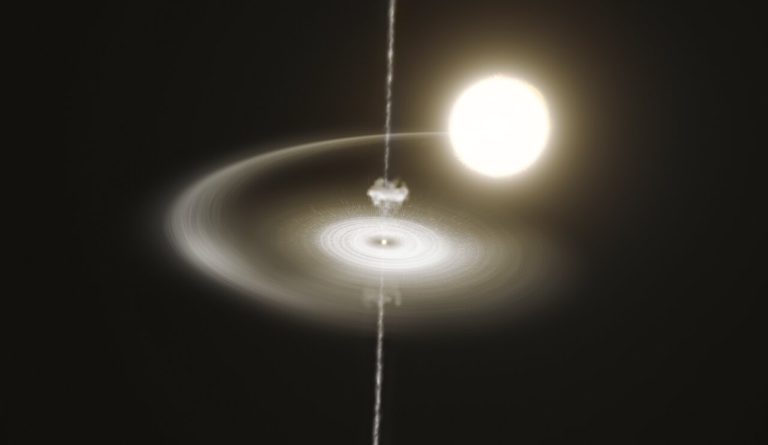
This artist’s impression shows the pulsar PSR J1023+0038 stealing gas from its companion star. This gas accumulates in a disc around the pulsar, slowly falls towards it, and is eventually expelled in a narrow jet. In addition, there is a wind of particles blowing away from the pulsar, represented here by a cloud of very small dots. This wind clashes with the infalling gas, heating it up and making the system glow brightly in X-rays and ultraviolet and visible light. Eventually, blobs of this hot gas are expelled along the jet, and the pulsar returns to the initial, fainter state, repeating the cycle. This pulsar has been observed to switch incessantly between these two states every few seconds or minutes.

“We have witnessed extraordinary cosmic events where enormous amounts of matter, similar to cosmic cannonballs, are launched into space within a very brief time span of tens of seconds from a small, dense celestial object rotating at incredibly high speeds,” says Maria Cristina Baglio, researcher at New York University Abu Dhabi, affiliated with the Italian National Institute for Astrophysics (INAF), and the lead author of the paper published today in Astronomy & Astrophysics

A pulsar is a fast-rotating, magnetic, dead star that emits a beam of electromagnetic radiation into space. As it rotates, this beam sweeps across the cosmos — much like a lighthouse beam scanning its surroundings — and is detected by astronomers as it intersects the line of sight to Earth. This makes the star appear to pulse in brightness as seen from our planet.

PSR J1023+0038, or J1023 for short, is a special type of pulsar with a bizarre behaviour. Located about 4500 light-years away in the Sextans constellation, it closely orbits another star. Over the past decade, the pulsar has been actively pulling matter off this companion, which accumulates in a disc around the pulsar and slowly falls towards it. 

Since this process of accumulating matter began, the sweeping beam virtually vanished and the pulsar started incessantly switching between two modes. In the ‘high’ mode, the pulsar gives off bright X-rays, ultraviolet and visible light, while in the ‘low’ mode it’s dimmer at these frequencies and emits more radio waves. The pulsar can stay in each mode for several seconds or minutes, and then switch to the other mode in just a few seconds. This switching has thus far puzzled astronomers.  

“Our unprecedented observing campaign to understand this pulsar’s behaviour involved a dozen cutting-edge ground-based and space-borne telescopes,” says Francesco Coti Zelati, a researcher at the Institute of Space Sciences, Barcelona, Spain, and co-lead author of the paper. The campaign included ESO’s Very Large Telescope (VLT) and ESO’s New Technology Telescope (NTT), which detected visible and near-infrared light, as well as the Atacama Large Millimeter/submillimeter Array (ALMA), in which ESO is a partner. Over two nights in June 2021, they observed the system make over 280 switches between its high and low modes. 

“We have discovered that the mode switching stems from an intricate interplay between the pulsar wind, a flow of high-energy particles blowing away from the pulsar, and matter flowing towards the pulsar,” says Coti Zelati, who is also affiliated with INAF.

In the low mode, matter flowing towards the pulsar is expelled in a narrow jet perpendicular to the disc. Gradually, this matter accumulates closer and closer to the pulsar and, as this happens, it is hit by the wind blowing from the pulsating star, causing the matter to heat up. The system is now in a high mode, glowing brightly in the X-ray, ultraviolet and visible light. Eventually, blobs of this hot matter are removed by the pulsar via the jet. With less hot matter in the disc, the system glows less brightly, switching back into the low mode.

While this discovery has unlocked the mystery of J1023’s strange behaviour, astronomers still have much to learn from studying this unique system and ESO’s telescopes will continue to help astronomers observe this peculiar pulsar. In particular, ESO’s Extremely Large Telescope (ELT), currently under construction in Chile, will offer an unprecedented view of J1023’s switching mechanisms. “The ELT will allow us to gain key insights into how the abundance, distribution, dynamics, and energetics of the inflowing matter around the pulsar are affected by the mode switching behavior,” concludes Sergio Campana, Research Director at the INAF Brera Observatory and coauthor of the study.

More information

This research was presented in a paper to appear in Astronomy & Astrophysics (doi:10.1051/0004-6361/202346418)

The team is composed of M. C. Baglio (Center for Astro, Particle, and Planetary Physics, New York University Abu Dhabi, UAE [NYU Abu Dhabi]; INAF – Osservatorio Astronomico di Brera, Merate, Italy [INAF Brera]), F. Coti Zelati (Institute of Space Sciences, Campus UAB, Barcelona, Spain [ICE–CSIC]; Institut d’Estudis Espacials de Catalunya (IEEC), Barcelona, Spain [IEEC]; INAF Brera), S. Campana (INAF Brera), G. Busquet (Departament de Física Quànticai Astrofísica, Universitat de Barcelona, Spain; Institut de Ciències del Cosmos, Universitat de Barcelona, Spain; IEEC), P. D’Avanzo (INAF Brera), S. Giarratana (INAF – Istituto di Radioastronomia, Bologna, Italy [INAF Bologna]; Department of Physics and Astronomy, University of Bologna, Italy [Bologna]), M. Giroletti (INAF Bologna; Bologna), F. Ambrosino (INAF – Osservatorio Astronomico di Roma, Rome, Italy [INAF Roma]); INAF – Istituto Astrofisica Planetologia Spaziali, Rome, Italy; Sapienza Università di Roma, Rome, Italy), S.Crespi (NYU Abu Dhabi), A. Miraval Zanon (Agenzia Spaziale Italiana, Rome, Italy; INAF Roma), X. Hou (Yunnan Observatories, Chinese Academy of Sciences, Kunming, China; Key Laboratory for the Structure and Evolution of Celestial Objects, Chinese Academy of Sciences, Kunming, China), D. Li (National Astronomical Observatories, Chinese Academy of Sciences, Beijing, China; University of Chinese Academy of Sciences, Beijing, China; Research Center for Intelligent Computing Platforms, Zhejiang Laboratory, Hangzhou, China), J. Li (CAS Key Laboratory for Research in Galaxies and Cosmology, Department of Astronomy, University of Science and Technology of China, Hefei, China; School of Astronomy and Space Science, University of Science and Technology of China, Hefei, China), P. Wang (Institute for Frontiers in Astronomy and Astrophysics, Beijing Normal University, Beijing, China), D. M. Russell (NYU Abu Dhabi), D. F. Torres (INAF Brera; IEEC; Institució Catalana de Recercai Estudis Avançats, Barcelona, Spain), K. Alabarta (NYU Abu Dhabi), P. Casella (INAF Roma), S. Covino (INAF Brera), D. M. Bramich (NYU Abu Dhabi; Division of Engineering, New York University Abu Dhabi, UAE), D. de Martino (INAF − Osservatorio Astronomico di Capodimonte, Napoli, Italy), M. Méndez (Kapteyn Astronomical Institute, University of Groningen, Groningen, The Netherlands), S. E. Motta (INAF Brera), A. Papitto (INAF Roma), P. Saikia (NYU Abu Dhabi), and F. Vincentelli (Instituto de Astrofísica de Canarias, Tenerife, Spain; Departamento de Astrofísica, Universidad de La Laguna, Tenerife, Spain).

The European Southern Observatory (ESO) enables scientists worldwide to discover the secrets of the Universe for the benefit of all. We design, build and operate world-class observatories on the ground — which astronomers use to tackle exciting questions and spread the fascination of astronomy — and promote international collaboration for astronomy. Established as an intergovernmental organisation in 1962, today ESO is supported by 16 Member States (Austria, Belgium, the Czech Republic, Denmark, France, Finland, Germany, Ireland, Italy, the Netherlands, Poland, Portugal, Spain, Sweden, Switzerland and the United Kingdom), along with the host state of Chile and with Australia as a Strategic Partner. ESO’s headquarters and its visitor centre and planetarium, the ESO Supernova, are located close to Munich in Germany, while the Chilean Atacama Desert, a marvellous place with unique conditions to observe the sky, hosts our telescopes. ESO operates three observing sites: La Silla, Paranal and Chajnantor. At Paranal, ESO operates the Very Large Telescope and its Very Large Telescope Interferometer, as well as survey telescopes such as VISTA. Also at Paranal ESO will host and operate the Cherenkov Telescope Array South, the world’s largest and most sensitive gamma-ray observatory. Together with international partners, ESO operates ALMA on Chajnantor, a facility that observes the skies in the millimetre and submillimetre range. At Cerro Armazones, near Paranal, we are building “the world’s biggest eye on the sky” — ESO’s Extremely Large Telescope. From our offices in Santiago, Chile we support our operations in the country and engage with Chilean partners and society.

The Atacama Large Millimeter/submillimeter Array (ALMA), an international astronomy facility, is a partnership of ESO, the U.S. National Science Foundation (NSF) and the National Institutes of Natural Sciences (NINS) of Japan in cooperation with the Republic of Chile. ALMA is funded by ESO on behalf of its Member States, by NSF in cooperation with the National Research Council of Canada (NRC) and the National Science and Technology Council (NSTC) in Taiwan and by NINS in cooperation with the Academia Sinica (AS) in Taiwan and the Korea Astronomy and Space Science Institute (KASI). ALMA construction and operations are led by ESO on behalf of its Member States; by the National Radio Astronomy Observatory (NRAO), managed by Associated Universities, Inc. (AUI), on behalf of North America; and by the National Astronomical Observatory of Japan (NAOJ) on behalf of East Asia. The Joint ALMA Observatory (JAO) provides the unified leadership and management of the construction, commissioning and operation of ALMA.

Links

Contacts

Maria Cristina Baglio
New York University Abu Dhabi and Italian National Institute for Astrophysics (INAF)
Abu Dhabi, United Arab Emirates
Tel: +97126287089
Email: [email protected] ; [email protected]

Francesco Coti Zelati
Institute of Space Sciences
Barcelona, Spain
Tel: (+34) 937379788 430416
Email: [email protected]

Sergio Campana
INAF Brera Observatory
Merate, Italy
Tel: +39 02 72320418
Email: [email protected]

Bárbara Ferreira
ESO Media Manager
Garching bei München, Germany
Tel: +49 89 3200 6670
Cell: +49 151 241 664 00
Email: [email protected]

Originally published at European Southern Observatory

Settle Into 10 Of The Most Beautiful Libraries On Earth

0

Designers, it seems, have figured out one way to get people to read more: Make libraries more beautiful.

PEOPLE LOVE THEIR libraries. And when their governments put money toward them, they even love to visit them. A 2012 report by the Institute of Museum and Library Services found that when investment in libraries drops, as it has in the US since 2009, usage typically falls with it. But the inverse was also true; the more public funds libraries receive, the more people tend to use them.

Perhaps that’s because a good library is more than a repository for books—it’s a community resource. It may also explain the recent spate of high-design libraries (and bookstores) popping up around the globe. Many of them function not just as singular temples to the written word, but community centers, auditoria, concert halls, and public gardens. All of them are works of art in themselves. Here are ten of note.

Dokk1 Library, Schmidt Hammer Lassen

ADAM MØRK

The Dokk1 library recently won the prize for best public library of 2016, and it’s easy to see why. The 323,000 square-foot library, the largest in Scandinavia, is situated next to the river in Aarhus, Denmark. The building is made from a stack of polygons, giving it a hard, geometric facade. While inside, the space is airy, with windows that overlook the city’s harbor. An unexpected, artistic bonus: The bell that hangs above the central staircase is connected to the local hospital—it rings every time a child is born.

Lawrence Public Library, by Gould Evans

MIKE SINCLAIR

Lawrence’s new library has the bones of its old. Originally built in 1972, architects at Gould Evans recently gutted the library and renovated it to be more modern and tech-forward. While observing visitors, the architects realized people naturally gathered in the locations with the most natural lighting. This led to them to create reading room with floor-to-ceiling windows.

Yangzhou Zhongshuge, by X+Living

SHAO FENG ARCHITECTURAL PHOTOGRAPHY

Walking into the Yangzhou Zhangshuge bookstore in Zhen Yuan, China is like walking through a river filled with books. The architects say that’s intentional; the building is supposed to evoke the feeling of water, a nod to its riverside location. Hard and paperback tomes line the curved, backlit shelves, which reflect onto the dark mirrored floor, creating a tunnel effect. It’s just the right amount of trippy.

Beyazit Library, by Tabanlioglu Architects

TABANLIOGLU ARCHITECTS

The Beyazit State Library in Istanbul isn’t a new building. In fact, it was originally built in 1506, and served as a soup kitchen and inn before it became the state library in the late 19th century. Turkish architecture studio Tabanlioglu Architects recently renovated the space, preserving its bones while adding minimalist modern touches, like tinted glass boxes that hold rare manuscripts. It’s a stunning mix of old and new.

Vennesla Library, by Helen & Hard Architects

EMILE ASHLEY

Norway’s Vennesla library looks like a portal to outer space. A series of 27 arching ribs hugs the ceiling, creating a skeleton for the building. Each rib has an integrated light that lends the cream interior and ethereal glow, while the base of the beam flows into a reading nook. Each rib contains sound absorbing materials to ensure the space is extra quiet.

Bodø Library, by DRDH

DAVID GRANDORGE

The new Bodø Public Library in Norway is also a cultural center, featuring a three-auditorium concert hall in addition to its 68,000-square feet of dedicated reading space. The white concrete building sits on the plot of a former bus station, and a row of floor-to-ceiling windows look out onto the city’s harbor.

Chicago Public Library, by SOM

HEDRICH BLESSING PHOTOGRAPHERS

Chicago’s new Chinatown library branch has no sharp edges. The pebble-shaped building is wrapped in glass and marked by solar-shading fins that are meant to reduce heat and glare. The library’s curvy, three-sided shape is built around feng shui principles and designed to align with the avenues outside the building. Inside, the two-story structure is centered around a light-filled atrium.

Birmingham Library, by Mecanoo

MECANOO

From the outside, the Birmingham library in England looks like a brutalist structure wrapped in metal lace. But the building’s vast interior—it’s 312,000 square feet—is filled with bright primary colors and clean lines. The building is home to more than 400,000 books housed on multiple floors, each of which features a cantilevered balcony overlooking a “book rotunda.”

Halifax Library, by Schmidt Hammer Lassen

ADAM MØRK

Halifax’s flagship library (there are 13 others) is 156,000-square feet of imposingly piled glass. Situated in the city’s downtown, the building’s four glass boxes stack, twist, and cantilever to create a stunning building block effect.__ On top of the building is a rooftop garden for enjoying warm Nova Scotia summers. __Inside, the library’s reading room converts to a concert hall.

Conarte Library, by Anagrama

CAROGA

Mexican design studio Anagrama designed a cozy reading nook inside this Monterrey bookstore to encourage visitors to linger and read. The sea foam blue walls shine through a latticed wood bookshelf that turns the space into a brightly colored cocoon. Stairs cut through the middle of the dome, while padded seats on either side afford comfortable reading spots. It’s visually striking, and clever, use of space.

By: LIZ STINSON
Originally published at Wired