
Home Blog Page 31

New Models And Developer Products Announced At DevDay

0

GPT-4 Turbo with 128K context and lower prices, the new Assistants API, GPT-4 Turbo with Vision, DALL·E 3 API, and more.
Today, we shared dozens of new additions and improvements, and reduced pricing across many parts of our platform. These include:

  • New GPT-4 Turbo model that is more capable, cheaper and supports a 128K context window
  • New Assistants API that makes it easier for developers to build their own assistive AI apps that have goals and can call models and tools
  • New multimodal capabilities in the platform, including vision, image creation (DALL·E 3), and text-to-speech (TTS)

We’ll begin rolling out new features to OpenAI customers starting at 1pm PT today.


Learn more about OpenAI DevDay announcements for ChatGPT. (https://openai.com/blog/introducing-gpts
)

GPT-4 Turbo with 128K context

We released the first version of GPT-4 in March and made GPT-4 generally available to all developers in July. Today we’re launching a preview of the next generation of this model, GPT-4 Turbo. 

GPT-4 Turbo is more capable and has knowledge of world events up to April 2023. It has a 128k context window so it can fit the equivalent of more than 300 pages of text in a single prompt. We also optimized its performance so we are able to offer GPT-4 Turbo at a 3x cheaper price for input tokens and a 2x cheaper price for output tokens compared to GPT-4.

GPT-4 Turbo is available for all paying developers to try by passing gpt-4-1106-preview in the API and we plan to release the stable production-ready model in the coming weeks.

Function calling updates

Function calling lets you describe functions of your app or external APIs to models, and have the model intelligently choose to output a JSON object containing arguments to call those functions. We’re releasing several improvements today, including the ability to call multiple functions in a single message: users can send one message requesting multiple actions, such as “open the car window and turn off the A/C”, which would previously require multiple roundtrips with the model (learn more). We are also improving function calling accuracy: GPT-4 Turbo is more likely to return the right function parameters.

Improved instruction following and JSON mode

GPT-4 Turbo performs better than our previous models on tasks that require the careful following of instructions, such as generating specific formats (e.g., “always respond in XML”). It also supports our new JSON mode, which ensures the model will respond with valid JSON. The new API parameter response_format enables the model to constrain its output to generate a syntactically correct JSON object. JSON mode is useful for developers generating JSON in the Chat Completions API outside of function calling.

Reproducible outputs and log probabilities

The new seed parameter enables reproducible outputs by making the model return consistent completions most of the time. This beta feature is useful for use cases such as replaying requests for debugging, writing more comprehensive unit tests, and generally having a higher degree of control over the model behavior. We at OpenAI have been using this feature internally for our own unit tests and have found it invaluable. We’re excited to see how developers will use it. Learn more (https://platform.openai.com/docs/guides/text-generation/reproducible-outputs).

We’re also launching a feature to return the log probabilities for the most likely output tokens generated by GPT-4 Turbo and GPT-3.5 Turbo in the next few weeks, which will be useful for building features such as autocomplete in a search experience.

Updated GPT-3.5 Turbo

In addition to GPT-4 Turbo, we are also releasing a new version of GPT-3.5 Turbo that supports a 16K context window by default. The new 3.5 Turbo supports improved instruction following, JSON mode, and parallel function calling. For instance, our internal evals show a 38% improvement on format following tasks such as generating JSON, XML and YAML. Developers can access this new model by calling gpt-3.5-turbo-1106 in the API. Applications using the gpt-3.5-turbo name will automatically be upgraded to the new model on December 11. Older models will continue to be accessible by passing gpt-3.5-turbo-0613 in the API until June 13, 2024. Learn more (https://platform.openai.com/docs/models/gpt-3-5).

Assistants API, Retrieval, and Code Interpreter

Today, we’re releasing the Assistants API, our first step towards helping developers build agent-like experiences within their own applications. An assistant is a purpose-built AI that has specific instructions, leverages extra knowledge, and can call models and tools to perform tasks. The new Assistants API provides new capabilities such as Code Interpreter and Retrieval as well as function calling to handle a lot of the heavy lifting that you previously had to do yourself and enable you to build high-quality AI apps.

This API is designed for flexibility; use cases range from a natural language-based data analysis app, a coding assistant, an AI-powered vacation planner, a voice-controlled DJ, a smart visual canvas—the list goes on. The Assistants API is built on the same capabilities that enable our new GPTs product: custom instructions and tools such as Code interpreter, Retrieval, and function calling.

A key change introduced by this API is persistent and infinitely long threads, which allow developers to hand off thread state management to OpenAI and work around context window constraints. With the Assistants API, you simply add each new message to an existing thread.

Assistants also have access to call new tools as needed, including:

  • Code Interpreter: writes and runs Python code in a sandboxed execution environment, and can generate graphs and charts, and process files with diverse data and formatting. It allows your assistants to run code iteratively to solve challenging code and math problems, and more.
  • Retrieval: augments the assistant with knowledge from outside our models, such as proprietary domain data, product information or documents provided by your users. This means you don’t need to compute and store embeddings for your documents, or implement chunking and search algorithms. The Assistants API optimizes what retrieval technique to use based on our experience building knowledge retrieval in ChatGPT.
  • Function calling: enables assistants to invoke functions you define and incorporate the function response in their messages.

As with the rest of the platform, data and files passed to the OpenAI API are never used to train our models and developers can delete the data when they see fit.

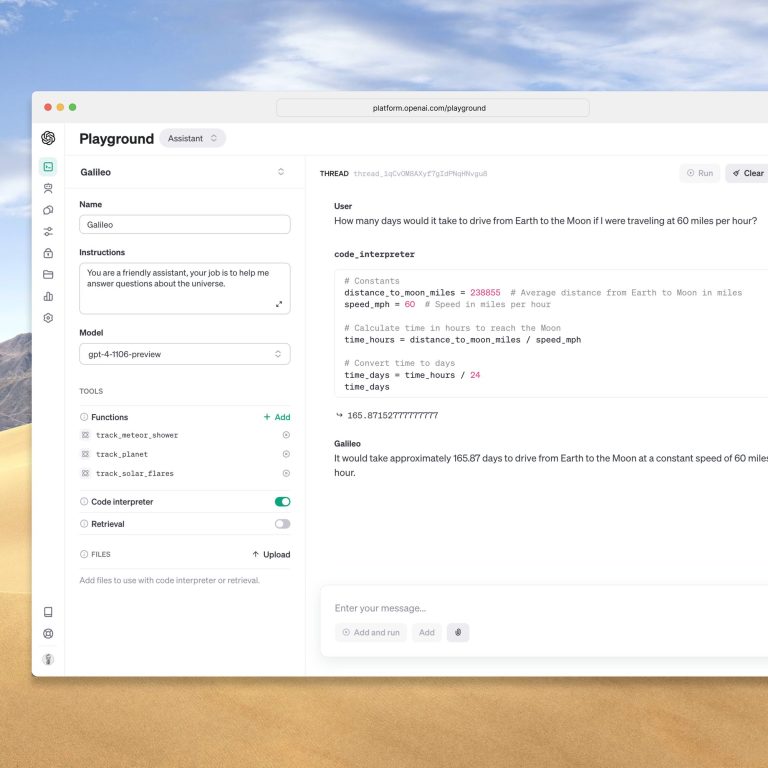
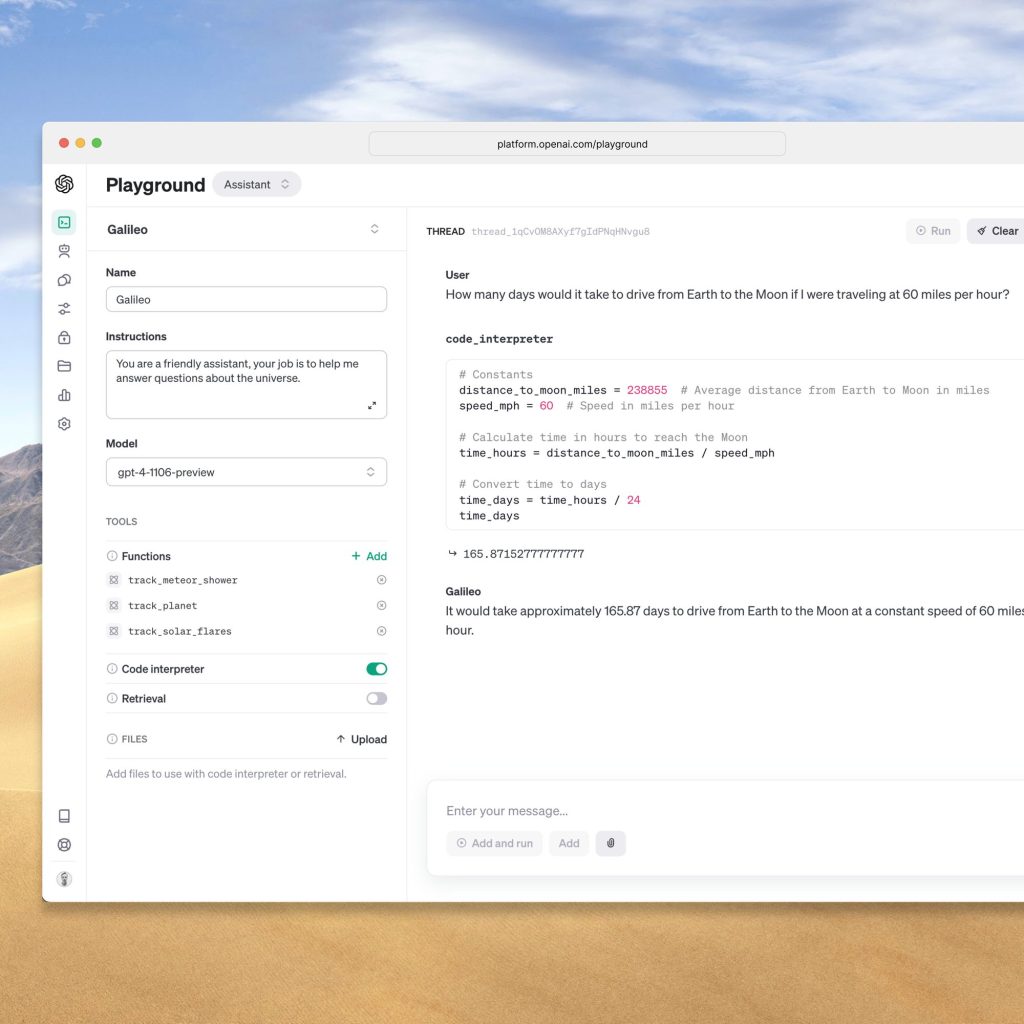
You can try the Assistants API beta without writing any code by heading to the Assistants playground.

Use the Assistants playground to create high quality assistants without code.

The Assistants API is in beta and available to all developers starting today. Please share what you build with us (@OpenAI) along with your feedback which we will incorporate as we continue building over the coming weeks. Pricing for the Assistants APIs and its tools is available on our pricing page.

New modalities in the API

GPT-4 Turbo with vision

GPT-4 Turbo can accept images as inputs in the Chat Completions API, enabling use cases such as generating captions, analyzing real world images in detail, and reading documents with figures. For example, BeMyEyes uses this technology to help people who are blind or have low vision with daily tasks like identifying a product or navigating a store. Developers can access this feature by using gpt-4-vision-preview in the API. We plan to roll out vision support to the main GPT-4 Turbo model as part of its stable release. Pricing depends on the input image size. For instance, passing an image with 1080×1080 pixels to GPT-4 Turbo costs $0.00765. Check out our vision guide.

DALL·E 3

Developers can integrate DALL·E 3, which we recently launched to ChatGPT Plus and Enterprise users, directly into their apps and products through our Images API by specifying dall-e-3 as the model. Companies like Snap, Coca-Cola, and Shutterstock have used DALL·E 3 to programmatically generate images and designs for their customers and campaigns. Similar to the previous version of DALL·E, the API incorporates built-in moderation to help developers protect their applications against misuse. We offer different format and quality options, with prices starting at $0.04 per image generated. Check out our guide to getting started with DALL·E 3 in the API.

Text-to-speech (TTS)

Developers can now generate human-quality speech from text via the text-to-speech API. Our new TTS model offers six preset voices to choose from and two model variants, tts-1 and tts-1-hdtts is optimized for real-time use cases and tts-1-hd is optimized for quality. Pricing starts at $0.015 per input 1,000 characters. Check out our TTS guide to get started.

Listen to voice samples

Select textScenicDirectionsTechnicalRecipe

As the golden sun dips below the horizon, casting long shadows across the tranquil meadow, the world seems to hush, and a sense of calmness envelops the Earth, promising a peaceful night’s rest for all living beings.

Model customization

GPT-4 fine tuning experimental access

We’re creating an experimental access program for GPT-4 fine-tuning. Preliminary results indicate that GPT-4 fine-tuning requires more work to achieve meaningful improvements over the base model compared to the substantial gains realized with GPT-3.5 fine-tuning. As quality and safety for GPT-4 fine-tuning improves, developers actively using GPT-3.5 fine-tuning will be presented with an option to apply to the GPT-4 program within their fine-tuning console.

Custom models

For organizations that need even more customization than fine-tuning can provide (particularly applicable to domains with extremely large proprietary datasets—billions of tokens at minimum), we’re also launching a Custom Models program, giving selected organizations an opportunity to work with a dedicated group of OpenAI researchers to train custom GPT-4 to their specific domain. This includes modifying every step of the model training process, from doing additional domain specific pre-training, to running a custom RL post-training process tailored for the specific domain. Organizations will have exclusive access to their custom models. In keeping with our existing enterprise privacy policies, custom models will not be served to or shared with other customers or used to train other models. Also, proprietary data provided to OpenAI to train custom models will not be reused in any other context. This will be a very limited (and expensive) program to start—interested orgs can apply here (https://openai.com/form/custom-models).

Lower prices and higher rate limits

Lower prices

We’re decreasing several prices across the platform to pass on savings to developers (all prices below are expressed per 1,000 tokens):

  • GPT-4 Turbo input tokens are 3x cheaper than GPT-4 at $0.01 and output tokens are 2x cheaper at $0.03.
  • GPT-3.5 Turbo input tokens are 3x cheaper than the previous 16K model at $0.001 and output tokens are 2x cheaper at $0.002. Developers previously using GPT-3.5 Turbo 4K benefit from a 33% reduction on input tokens at $0.001. Those lower prices only apply to the new GPT-3.5 Turbo introduced today.
  • Fine-tuned GPT-3.5 Turbo 4K model input tokens are reduced by 4x at $0.003 and output tokens are 2.7x cheaper at $0.006. Fine-tuning also supports 16K context at the same price as 4K with the new GPT-3.5 Turbo model. These new prices also apply to fine-tuned gpt-3.5-turbo-0613 models.
Older modelsNew models
GPT-4 TurboGPT-4 8K Input: $0.03 Output: $0.06 GPT-4 32K Input: $0.06 Output: $0.12GPT-4 Turbo 128K Input: $0.01 Output: $0.03
GPT-3.5 TurboGPT-3.5 Turbo 4K Input: $0.0015 Output: $0.002 GPT-3.5 Turbo 16K Input: $0.003 Output: $0.004GPT-3.5 Turbo 16K Input: $0.001 Output: $0.002
GPT-3.5 Turbo fine-tuningGPT-3.5 Turbo 4K fine-tuning Training: $0.008 Input: $0.012 Output: $0.016GPT-3.5 Turbo 4K and 16K fine-tuning Training: $0.008 Input: $0.003 Output: $0.006

Higher rate limits

To help you scale your applications, we’re doubling the tokens per minute limit for all our paying GPT-4 customers. You can view your new rate limits in your rate limit page. We’ve also published our usage tiers that determine automatic rate limits increases, so you know what to expect in how your usage limits will automatically scale. You can now request increases to usage limits from your account settings.

Copyright Shield

OpenAI is committed to protecting our customers with built-in copyright safeguards in our systems. Today, we’re going one step further and introducing Copyright Shield—we will now step in and defend our customers, and pay the costs incurred, if you face legal claims around copyright infringement. This applies to generally available features of ChatGPT Enterprise and our developer platform.

Whisper v3 and Consistency Decoder

We are releasing Whisper large-v3, the next version of our open source automatic speech recognition model (ASR) which features improved performance across languages. We also plan to support Whisper v3 in our API in the near future.

We are also open sourcing the Consistency Decoder, a drop in replacement for the Stable Diffusion VAE decoder. This decoder improves all images compatible with the by Stable Diffusion 1.0+ VAE, with significant improvements in text, faces and straight lines.

Learn more about our OpenAI DevDay announcements for ChatGPT.

Originally published at: OpenAI

Source: cyberpogo.com
Introducing GPTs

0

You can now create custom versions of ChatGPT that combine instructions, extra knowledge, and any combination of skills.

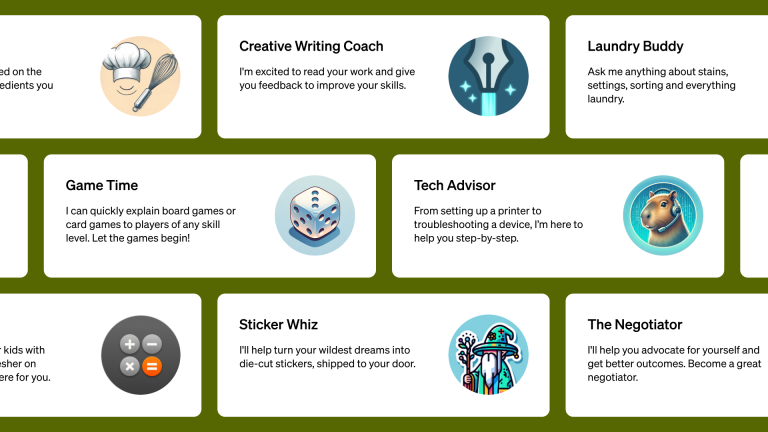
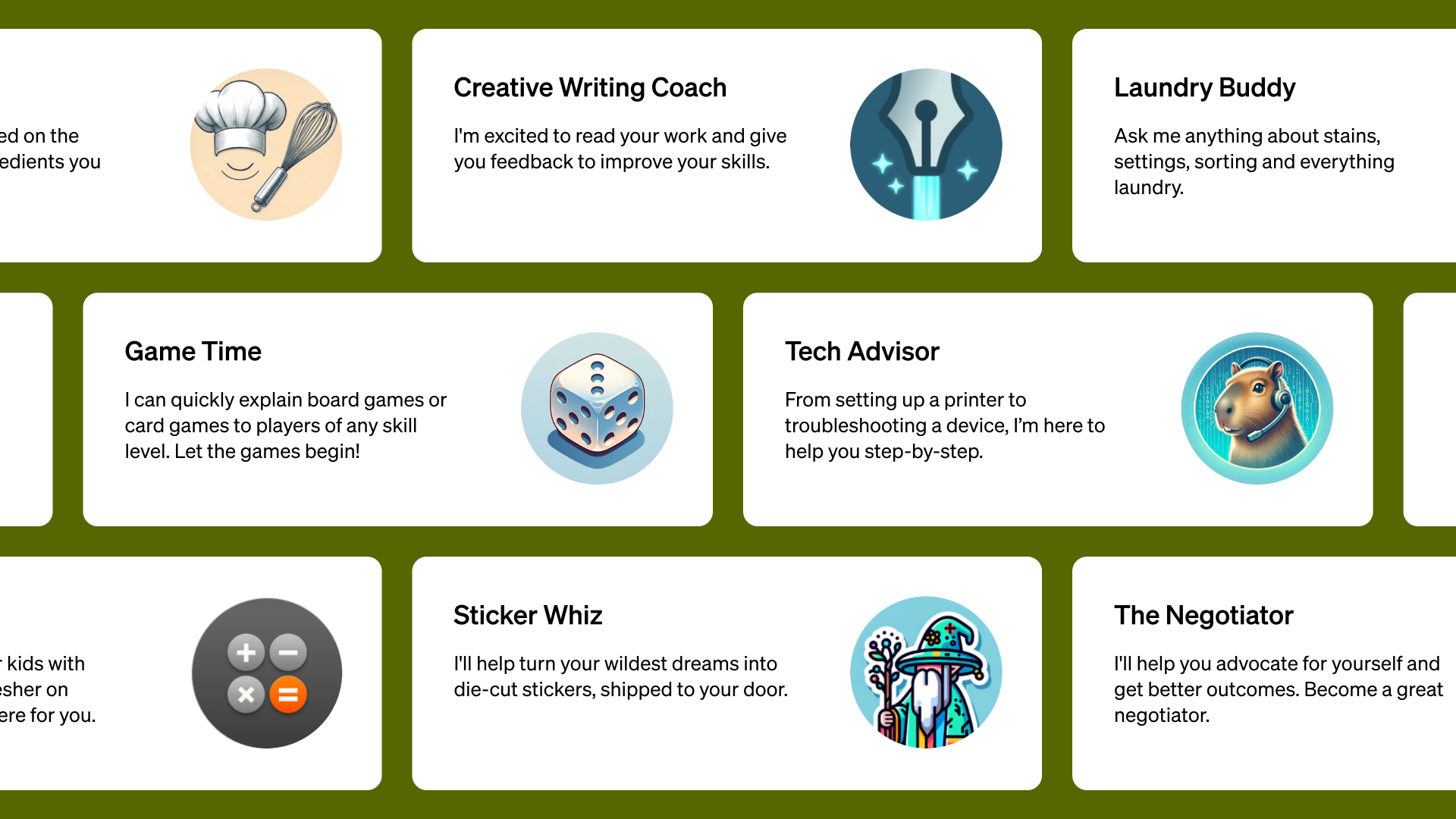
We’re rolling out custom versions of ChatGPT that you can create for a specific purpose—called GPTs. GPTs are a new way for anyone to create a tailored version of ChatGPT to be more helpful in their daily life, at specific tasks, at work, or at home—and then share that creation with others. For example, GPTs can help you learn the rules to any board game, help teach your kids math, or design stickers.

Anyone can easily build their own GPT—no coding is required. You can make them for yourself, just for your company’s internal use, or for everyone. Creating one is as easy as starting a conversation, giving it instructions and extra knowledge, and picking what it can do, like searching the web, making images or analyzing data. Try it out at chat.openai.com/create.

Example GPTs are available today for ChatGPT Plus and Enterprise users to try out including Canva and Zapier AI Actions. We plan to offer GPTs to more users soon.

GPTs let you customize ChatGPT for a specific purpose

Since launching ChatGPT people have been asking for ways to customize ChatGPT to fit specific ways that they use it. We launched Custom Instructions in July that let you set some preferences, but requests for more control kept coming. Many power users maintain a list of carefully crafted prompts and instruction sets, manually copying them into ChatGPT. GPTs now do all of that for you.

The best GPTs will be invented by the community

We believe the most incredible GPTs will come from builders in the community. Whether you’re an educator, coach, or just someone who loves to build helpful tools, you don’t need to know coding to make one and share your expertise.

The GPT Store is rolling out later this month

Starting today, you can create GPTs and share them publicly. Later this month, we’re launching the GPT Store, featuring creations by verified builders. Once in the store, GPTs become searchable and may climb the leaderboards. We will also spotlight the most useful and delightful GPTs we come across in categories like productivity, education, and “just for fun”. In the coming months, you’ll also be able to earn money based on how many people are using your GPT.

We built GPTs with privacy and safety in mind

As always, you are in control of your data with ChatGPT. Your chats with GPTs are not shared with builders. If a GPT uses third party APIs, you choose whether data can be sent to that API. When builders customize their own GPT with actions or knowledge, the builder can choose if user chats with that GPT can be used to improve and train our models. These choices build upon the existing privacy controls users have, including the option to opt your entire account out of model training. 

We’ve set up new systems to help review GPTs against our usage policies. These systems stack on top of our existing mitigations and aim to prevent users from sharing harmful GPTs, including those that involve fraudulent activity, hateful content, or adult themes. We’ve also taken steps to build user trust by allowing builders to verify their identity. We’ll continue to monitor and learn how people use GPTs and update and strengthen our safety mitigations. If you have concerns with a specific GPT, you can also use our reporting feature on the GPT shared page to notify our team.

GPTs will continue to get more useful and smarter, and you’ll eventually be able to let them take on real tasks in the real world. In the field of AI, these systems are often discussed as “agents”. We think it’s important to move incrementally towards this future, as it will require careful technical and safety work—and time for society to adapt. We have been thinking deeply about the societal implications and will have more analysis to share soon.

Developers can connect GPTs to the real world

In addition to using our built-in capabilities, you can also define custom actions by making one or more APIs available to the GPT. Like plugins, actions allow GPTs to integrate external data or interact with the real-world. Connect GPTs to databases, plug them into emails, or make them your shopping assistant. For example, you could integrate a travel listings database, connect a user’s email inbox, or facilitate e-commerce orders.

The design of actions builds upon insights from our plugins beta, granting developers greater control over the model and how their APIs are called. Migrating from the plugins beta is easy with the ability to use your existing plugin manifest to define actions for your GPT.

Enterprise customers can deploy internal-only GPTs

Since we launched ChatGPT Enterprise a few months ago, early customers have expressed the desire for even more customization that aligns with their business. GPTs answer this call by allowing you to create versions of ChatGPT for specific use cases, departments, or proprietary datasets. Early customers like Amgen, Bain, and Square are already leveraging internal GPTs to do things like craft marketing materials embodying their brand, aid support staff with answering customer questions, or help new software engineers with onboarding.

Enterprises can get started with GPTs on Wednesday. You can now empower users inside your company to design internal-only GPTs without code and securely publish them to your workspace. The admin console lets you choose how GPTs are shared and whether external GPTs may be used inside your business. Like all usage on ChatGPT Enterprise, we do not use your conversations with GPTs to improve our models.

We want more people to shape how AI behaves

We designed GPTs so more people can build with us. Involving the community is critical to our mission of building safe AGI that benefits humanity. It allows everyone to see a wide and varied range of useful GPTs and get a more concrete sense of what’s ahead. And by broadening the group of people who decide ‘what to build’ beyond just those with access to advanced technology it’s likely we’ll have safer and better aligned AI. The same desire to build with people, not just for them, drove us to launch the OpenAI API and to research methods for incorporating democratic input into AI behavior, which we plan to share more about soon.

We’ve made ChatGPT Plus fresher and simpler to use

Finally, ChatGPT Plus now includes fresh information up to April 2023. We’ve also heard your feedback about how the model picker is a pain. Starting today, no more hopping between models; everything you need is in one place. You can access DALL·E, browsing, and data analysis all without switching. You can also attach files to let ChatGPT search PDFs and other document types. Find us at chatgpt.com.

Originally published at: OpenAI

Source: cyberpogo.com
Hubble Provides Unique Ultraviolet View Of Jupiter

0

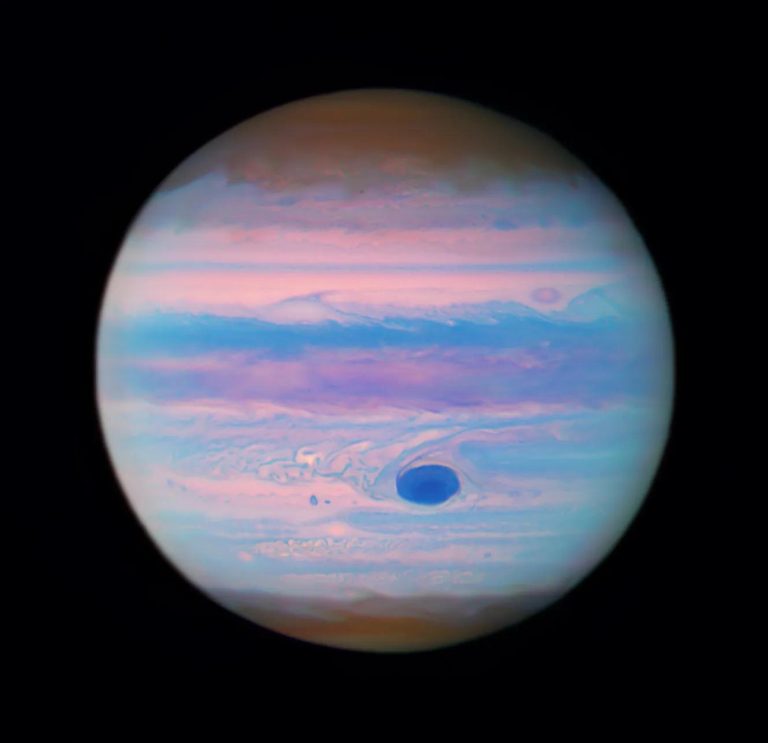
NASA’s Hubble Space Telescope reveals an ultraviolet view of Jupiter.
NASA, ESA, and M. Wong (University of California – Berkeley); Processing: Gladys Kober (NASA/Catholic University of America)

This newly released image from the NASA Hubble Space Telescope shows the planet Jupiter in a color composite of ultraviolet wavelengths. Released in honor of Jupiter reaching opposition, which occurs when the planet and the Sun are in opposite sides of the sky, this view of the gas giant planet includes the iconic, massive storm called the “Great Red Spot.” Though the storm appears red to the human eye, in this ultraviolet image it appears darker because high altitude haze particles absorb light at these wavelengths. The reddish, wavy polar hazes are absorbing slightly less of this light due to differences in either particle size, composition, or altitude. 

The data used to create this ultraviolet image is part of a Hubble proposal that looked at Jupiter’s stealthy superstorm system. The researchers plan to map deep water clouds using the Hubble data to define 3D cloud structures in Jupiter’s atmosphere.

Hubble has a long history of observing the outer planets. From the Comet Shoemaker-Levy 9 impacts to studying Jupiter’s storms, Hubble’s decades-long career and unique vantage point provide astronomers with valuable data to chart the evolution of this dynamic planet.

Hubble’s ultraviolet-observing capabilities allow astronomers to study the short, high-energy wavelengths of light beyond what the human eye can see. Ultraviolet light reveals fascinating cosmic phenomena, including light from the hottest and youngest stars embedded in local galaxies; the composition, densities, and temperatures of the material between stars; and the evolution of galaxies.

This is a false-color image because the human eye cannot detect ultraviolet light. Therefore, colors in the visible light spectrum were assigned to the images, each taken with a different ultraviolet filter. In this case, the assigned colors for each filter are: Blue: F225W, Green: F275W, and Red: F343N.

Media Contact:

Claire Andreoli
NASA’s Goddard Space Flight CenterGreenbelt, MD
[email protected]

By: NASA Hubble Mission Team
Originally published at: NASA

NASA Completes Key Step In Aviation Safety Research

0

NASA’s transformational vision for the skies above our communities includes enabling safer and more efficient air travel. Part of this goal involves using advanced new technology to prevent safety risks long before they have a chance to arise.
MTSI / NASA

NASA’s aeronautical innovators have completed a significant step in their pursuit of safer, more efficient aviation technologies that spot hazards before they occur.

Through its System-Wide Safety project, NASA and its partners in government, industry, and academia are exploring new technologies and techniques to improve current aviation safety and potentially enable widespread use of new types of aircraft such as drones or air taxis.

The project recently completed Technical Challenge 1 (TC-1), Terminal Area Risk Management, the first step towards achieving what is known as an In-Time Aviation Safety Management System. This new type of aviation safety technology can effectively address potential hazards expected with the rise in demand for the number and types of aircraft flying in the National Airspace System.

As aviation operations continue to grow in scale and diversity, and with new modes of flight expected to rise in the near future, keeping the skies safe becomes increasingly complex and drives the need to transform the way order is maintained above our communities.

“What we’ve accomplished with TC-1 is really just beginning to scratch the surface of what’s possible,” said Kyle Ellis, NASA’s project manager for System-Wide Safety. “Developing these systems enables a new economy for aviation uses that will benefit us all in the future.”

Planning Ahead

In a busy aviation environment, an In-Time Aviation Safety Management System can efficiently identify and predict safety issues a human would be hard tasked to keep up with.

In today’s airspace safety system, let’s say an air traffic manager is looking at their screen and guiding 10 airplanes towards their destinations. This person would use a combination of established safety rules and pattern recognition to make sure those aircraft remain a safe distance apart. If this person saw a hazard that posed a safety risk, they would work with the pilots aboard the aircraft and resolve the issue.

Now, let’s think about the airspace of tomorrow. Instead of 10 airplanes total, 10 air taxis, 10 ultra-efficient airliners, and 10 commercial supersonic jets might be sharing the same confined airspace. Preventing and addressing hazards would become a more complex issue nearly impossible for a person to identify in time to prevent an accident.

An In-Time Aviation Safety Management System is designed to identify these events much more rapidly than human operators, then quickly deliver actionable safety procedures to prevent the dangerous situation long before it develops.

Furthermore, preventing these situations from ever arising in the first place increases the efficiency of the airspace overall, since not as much time and effort would be spent by managers keeping things running smoothly.

Laying the Foundation

TC-1 contributed several important pieces of technology working towards the development of such a system. These contributions improve aviation safety not just for tomorrow – but also for today.

For example, part of the research included using new machine learning algorithms to analyze data gathered from major airlines, which use existing aviation safety management systems, to discover potential safety risks that had previously been undefined – overall making things safer.

Researchers also gathered information on exact ways human safety managers, pilots, air traffic controllers, and others interact with safety procedures. The team identified useful, efficient practices, as well as those that could potentially lead to safety risks. Their work contributes substantially to improving training and safety operations.

Additionally, researchers studied human performance and fatigue, partnering with pilots to study how various factors such as flight scheduling, certain short-haul routes, and even the COVID-19 pandemic affect operations.

Other results include prototype safety tools and surveys on human performance.

With this more comprehensive understanding of the safety landscape, NASA and its partners can more effectively continue ushering in new safety technologies.

“We focused on gathering data on current-day operations, but always have an eye for the near future,” said Nikunj Oza, subproject manager for TC-1. “We can use the lessons learned about current aviation safety to best inform new systems.”

By: John Gould (Aeronautics Research Misson Directorate)
Originally published at: NASA

Five Takeaways From UK’s AI Safety Summit At Bletchley Park

0

Rishi Sunak hails conference as diplomatic coup after it produces international declaration to address AI risks

Ursula von der Leyen, Kamala Harris and Rishi Sunak attend the AI safety summit at Bletchley Park in Milton Keynes, England. Photograph: Tolga Akmen/EPA

Rishi Sunak has hailed this week’s artificial intelligence summit as a diplomatic breakthrough after it produced an international declaration to address risks with the technology.

Here are five things we have learned from the summit.

The UK pulled off a diplomatic coup

The prime minister spent diplomatic capital convening global leaders, tech executives, academics and civil society figures at Bletchley Park in Milton Keynes, the base for second world war codebreakers.

Those attending included the US vice-president, Kamala Harris, the European Commission president, Ursula von der Leyen, award-winning computer scientists, executives at all the leading AI companies – and Elon Musk.

Even if Emmanuel Macron and Joe Biden were among the no-shows, the gathering had political and commercial heft.

Tino Cuéllar, the president of the Carnegie Endowment for International Peace, said it was a “remarkable achievement” in diplomatic terms. This was symbolised by the signing of an international declaration that recognised the need to address risks represented by AI development, backed by more than 25 countries and the EU. France will host the next full-blown AI safety summit in 2024 – guaranteeing that Sunak’s initiative will live on.

The US is a hard power in AI

The White House made clear its power to set the AI agenda this week. Biden issued an executive order requiring tech firms to submit test results for powerful AI systems to the government before they are released to the public. Harris gave a speech about AI in London on day one of the summit and announced the establishment of an AI safety institute, echoing a similar announcement by Biden last week.

The UK tech secretary, Michelle Donelan, said she was unfazed by the US initiatives, pointing to the fact the majority of cutting-edge AI companies, such as the ChatGPT developer OpenAI, are based in the US. That remark underlined the fact that the US has commercial, as well as political, strength in AI.

Elon Musk has the star power

Elon Musk brought the glitz to the AI safety summit. Photograph: Reuters

The world’s richest man attended the summit and brought glitz, as well as distraction, to the gathering. Sunak invited him to Downing Street for a streamed fireside chat and the Tesla CEO’s warning that AI was “one of the biggest threats to humanity” overshadowed more nuanced contributions.

Some guests viewed the attendance of Musk, whose nascent AI venture xAI is nowhere near the scale of the bigger players, as an example of Fomo (fear of missing out). But his presence brought extra attention to the summit.

Existential risk is divisive, but short-term risk is not

The possibility that AI can wipe out humanity – a view held by less hyperbolic figures than Musk – remains a divisive one in the tech community. That difference of opinion was not healed by two days of debate in Buckinghamshire.

But if there is a consensus on risk among politicians, executives and thinkers, then it focuses on the immediate fear of a disinformation glut. There are concerns that elections in the US, India and the UK next year could be affected by malicious use of generative AI.

Nick Clegg, president of global affairs at Mark Zuckerberg’s Meta, said this week that existential fears were being overplayed but he was concerned about the immediate threat to democratic polls. “We have some things which we need to deal with now,” he said.

Countries are moving at their own speeds

Every delegation at Bletchley was keen to claim preeminence in AI regulation, from European diplomats noting they had started the regulatory process four years ago to Americans talking up the power of their new AI safety institute.

While the EU is moving closer to passing its AI act, UK officials have made clear they do not think regulation is needed, or even possible at this stage given how fast the industry is moving.

But most agree on the importance of international summits such as this one, not least to help define the problem different countries are trying to tackle.

One official said: “What we need most of all from the international stage is a panel like the International Panel on Climate Change, which at least establishes a scientific consensus about what AI models are able to do.”

By: Dan Milmo and Kiran Stacey
Originally published at: The Guardian

Today Sierra Space Introduces Tenacity

0

The First Spaceplane in the Revolutionary New Dream Chaser® Fleet

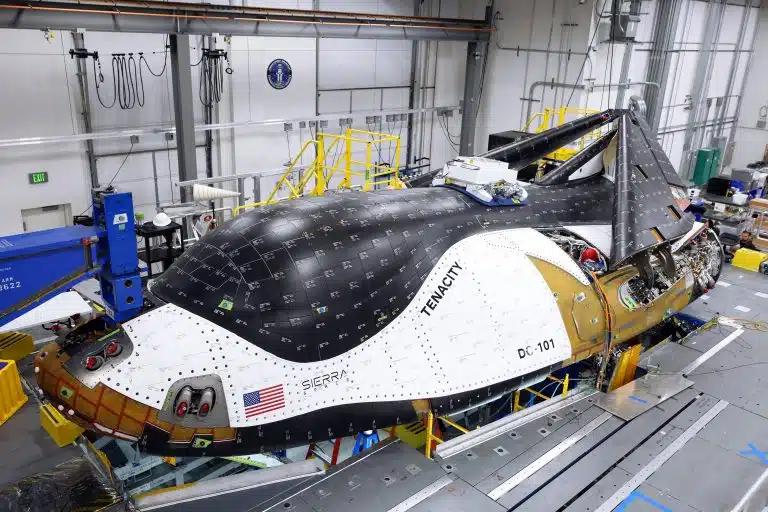
LOUISVILLE, Colo. – Nov. 2, 2023  Sierra Space, a leading pureplay commercial space company building the first end-to-end business and technology platform in space, today proudly revealed the fruit of years of passionate determination, countless breakthrough innovations and relentless commitment – the remarkable Dream Chaser spaceplane. The first vehicle is complete and will ship to NASA’s Neil A. Armstrong Test Facility in Ohio for environmental testing in coming weeks.

Dream Chaser is a leap forward in space technology, heralded as the world’s sole commercial runway-capable spaceplane. Supported by a substantial contract from NASA to resupply the International Space Station, Dream Chaser is poised to lead the way in democratizing access to space, forging a path towards shared space exploration and international cooperation.

Sierra Space Tenacity

“Today we have arrived at a profound milestone in both our company’s journey and our industry’s future – one that has been years in the making and is shaped by audacious dreaming and tenacious doing,” said Sierra Space CEO Tom Vice.

“I am reminded of a comment made by Steve Jobs that every once in a while, a revolutionary product comes along that changes everything. I think Dream Chaser is that product. This breakthrough shifts paradigms and redefines space travel. The Dream Chaser is not just a product; it’s a testament to human spirit, determination and the relentless pursuit of what lies beyond.”

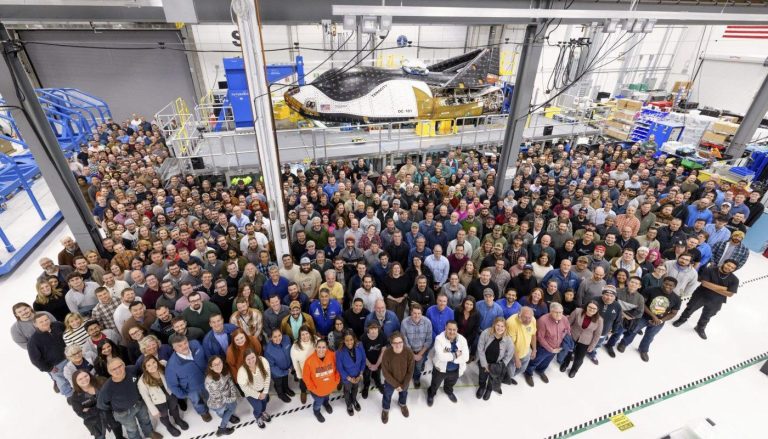
Sierra Space team members gathered to celebrate this milestone moment on October 30th, at the company’s Louisville, CO, production facility.

Unlocking Opportunities for Space Access

The versatile Dream Chaser spaceplane fleet is meticulously designed to facilitate the transportation of cargo and, in the future, crew to low-Earth orbit (LEO). This multi-mission platform offers customization options to cater to the needs of both domestic and international customers, further enhancing its role in global space operations. Under NASA’s Commercial Resupply Services 2 (CRS-2) contract, Dream Chaser has been selected to provide essential cargo delivery, return, and disposal services for the International Space Station.

Unparalleled Design and Precision

At the heart of Dream Chaser is an unparalleled design, meticulously crafted with precision. Every curve and contour of this remarkable vehicle is engineered for excellence, seamlessly merging engineering with a beautiful design, and enabling the seamless integration of space travel and hypersonic atmospheric speeds.

Pinnacle of Technological Advancement

Harnessing cutting-edge technology, Dream Chaser showcases its mettle by safely withstanding temperatures exceeding 3,000 degrees during re-entry, all while being cool to the touch mere minutes after landing. The incorporation of the most advanced autonomous flight system, ensuring a minimum 15-mission lifespan, marks a monumental leap forward in space transportation.

Safety as a Cornerstone

Safety remains at the core of the Dream Chaser’s mission. Advanced safety mechanisms fortify the spaceplane, guaranteeing the integrity of the cargo – including sensitive scientific payloads – and the well-being of all those aboard the International Space Station who will interact with the new vehicle.

A Commitment to Sustainability

While we soar towards the heavens in pursuit of dreams, we remain resolutely anchored to our commitment to the planet. Dream Chaser is designed with sustainability as a foundational principle, working toward a better future for all. Years of dedication have resulted in the creation of a revolutionary new propulsion and oxidizer-fuel system, a testament to our pledge to a more eco-friendly and responsible approach to space travel.

Tenacity’s Historic Mission

The inaugural Dream Chaser spaceplane, “Tenacity,” is poised to embark on its initial seven cargo missions to and from the International Space Station, carrying essential supplies such as food, water and scientific experiments. One of Dream Chaser’s groundbreaking features is its capability to safely return critical cargo to Earth at fewer than 1.5g’s, ensuring the preservation of invaluable payloads. This innovative spaceplane offers unparalleled flexibility and can land at any compatible commercial runway worldwide, just like a narrow body commercial airliner.

Setting New Standards for Reusability and Adaptability

Dream Chaser’s high reusability and adaptability set it apart, making it an optimal choice for a wide range of applications while ensuring rapid turnaround times to meet various LEO requirements. The launch for this extraordinary journey is schedule to occur from NASA’s Kennedy Space Center. Sierra Space’s launch provider, United Launch Alliance (ULA), will carry Dream Chaser into orbit on the second Vulcan Centaur rocket. Tenacity’s maiden resupply mission will culminate with the vehicle’s return, landing at the historic NASA Space Shuttle Landing Facility.

As we unveil the Dream Chaser, we invite you to join us on this extraordinary journey. Together, we embark on a new chapter in space transportation, redefining what’s possible and shaping the future of human exploration. Sierra Space’s Dream Chaser spaceplane symbolizes the dawn of a new era in space commercialization – The Orbital Age™, marked by heightened efficiency, extensive reusability and boundless opportunities. As “Tenacity” embarks on its maiden mission, it sets the stage for a brighter future of space transportation and cooperation, bringing humanity’s dreams of space exploration one step closer to reality.

About Sierra Space

Sierra Space is a leading, pureplay commercial space company at the forefront of innovation and the commercialization of space in the Orbital Age™, building an EarthspaceTM ecosystem to benefit life on Earth. With more than 30 years and 500 missions of space flight heritage, the company is enabling the future of space transportation with Dream Chaser®, the world’s only commercial spaceplane, and is bringing LIFE™ (Large Integrated Flexible Environment) to Low Earth Orbit with its modular, three-story commercial habitation and science platform. Sierra Space also builds and delivers a host of systems and subsystems across solar power, mechanics and motion control, environmental control, life support, propulsion and thermal control, offering myriad space-as-a-service solutions for the new space economy.

###

MEDIA CONTACT:
Alex Walker, Sierra Space
(303) 803-2297 | [email protected]

NASA Supports Tests of Dust Sensor to Aid Lunar Landings

0
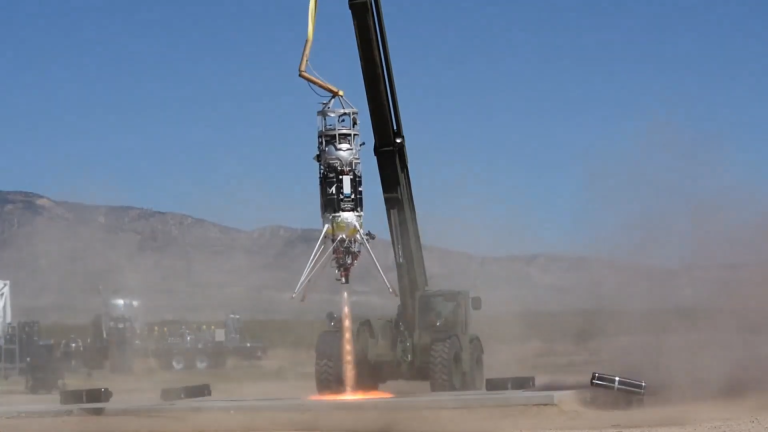
University of Central Florida researchers tested an instrument designed to measure the size and speed of surface particles kicked up by the exhaust from a rocket-powered lander on the Moon or Mars. The four tethered flights on Astrobotic’s Xodiac rocket-powered lander took place in Mojave, California, from Sept. 12 through Oct. 4, 2023. Researchers tested the Ejecta STORM technology’s integration with a lander and operation in flight conditions that simulated the plume effects of a lunar lander.
Credits: Astrobotic

A research team from the University of Central Florida recently tested an instrument designed to measure the size and speed of surface particles kicked up by the exhaust from a rocket-powered lander on the Moon or Mars. Supported by NASA’s Flight Opportunities program, researchers evaluated the instrument in a series of flight tests on Astrobotic’s Xodiac rocket-powered lander in Mojave, California.

When spacecraft land on the Moon or Mars, the rocket exhaust plume creates regolith ejecta – abrasive dust and large particles moving at high speeds – that can damage the lander and surrounding structures. Understanding how a rocket engine’s exhaust affects this ejecta will help mission designers plan more effectively for lunar landings by allowing them to model the soil erosion rate, the particle size distribution, and the velocities associated with plume-surface interaction.

Researchers at the University of Central Florida developed the laser-based instrument, named Ejecta STORM (Sheet Tracking, Opacity, and Regolith Maturity), to answer this need while embracing the Flight Opportunities program’s “fly, fix, fly” ethos to quickly advance the technology.

Four tethered flights enabled researchers to test the system’s integration with a lander and operation in flight conditions that simulated the plume effects of a lunar lander. These tests build on data collected during a 2020 flight campaign leveraging Xodiac. These 2020 flight tests, funded by the program’s TechFlights solicitation, allowed researchers to measure the density and size of particles during terrestrial simulations of lunar landings.

Researchers expect the technology to inform model development and reduce risk for future lunar landings, ultimately improving mission design for rover-based planetary science missions, crewed missions to the Moon and other bodies, and in-situ resource utilization. Flight Opportunities is managed at NASA’s Armstrong Flight Research Center in Edwards, California, and is part of the agency’s Space Technology Mission Directorate.

By Chloe Tuck

NASA’s Armstrong Flight Research Center

Image credits: NASA Space Tech

Originally published at: NASA

Northrop Grumman Selected To Deliver Nearly 40 More Data Transport Satellites For Space Development Agency’s Next Generation Low-earth Orbit Constellation Of Connectivity

0

REDONDO BEACH, Calif. – Oct. 30, 2023 – The Space Development Agency (SDA) awarded Northrop Grumman Corporation (NYSE: NOC) an agreement with a total potential value of approximately $732 million to design and build 38 data transport satellites. These satellites will support Tranche 2 Transport Layer – Alpha (T2TL-Alpha), the latest iteration of SDA’s low-Earth orbit Proliferated Warfighter Space Architecture (PWSA).

  • This Alpha announcement follows an August 2023 award to Northrop Grumman of 36 satellites as part of Tranche 2 Transport Layer – Beta (T2TL-Beta); Alpha and Beta satellites are designed to interoperate on orbit.
  • This contract includes supporting ground elements and five years of operations and sustainment with the satellites scheduled to launch starting December 2026.
  • Northrop Grumman was also awarded a contract for Tranche 1 Transport Layer 1 (T1TL), which similarly provide low latency, high volume data transport supporting U.S. military missions around the world.
  • Northrop Grumman’s approach to the PWSA contracts is to combine our satellite technology and mission experience with strategic commercial partnerships to move at the pace the environment demands.

Expert:

Blake Bullock, vice president, communication systems, Northrop Grumman: “Northrop Grumman, in partnership with our industry teammates, is fully committed to the Space Development Agency’s vision of fielding a next-generation, low-Earth orbit architecture connecting and protecting our warfighters wherever they serve. Our Northrop Grumman team is bringing our deep Military SATCOM experience to this mission, and we’re executing on our commitments.”

Details on the Proliferated Warfighter Space Network:

Northrop Grumman provides both space vehicles and ground systems for the SDA’s PWSA, a next-generation constellation in low-Earth orbit. PWSA has two major lines of effort:

  • The Transport Layer: Designed to provide low-latency, high volume data connectivity supporting U.S. military missions around the world.
  • The Tracking Layer: Designed to detect, track and ultimately target hypersonic and ballistic missiles.
An artist’s rendering of Northrop Grumman’s Tranche 2 Transport Layer satellites on orbit. Space Development Agency announced October 30 it had awarded Northrop Grumman 38 satellites as part of its Tranche 2 Transport Layer Alpha program. Artist Rendering (Credit: Northrop Grumman)

An artist’s rendering of Northrop Grumman’s Tranche 2 Transport Layer satellites on orbit. Space Development Agency announced October 30 it had awarded Northrop Grumman 38 satellites as part of its Tranche 2 Transport Layer Alpha program. Artist Rendering (Credit: Northrop Grumman)

Both layers are designed to interoperate in space using a common data standard allowing satellites made by various manufacturers to communicate seamlessly with one another. Taken together, these satellites are designed to connect elements of an integrated sensing architecture, and the network they create will deliver persistent, secure connectivity, serving as a critical element for Joint All Domain Command Control.

To date, SDA has announced awards to Northrop Grumman of 132 satellites.

Northrop Grumman is a leading global aerospace and defense technology company. Our pioneering solutions equip our customers with the capabilities they need to connect and protect the world, and push the boundaries of human exploration across the universe. Driven by a shared purpose to solve our customers’ toughest problems, our employees define possible every day.

Apple Unveils M3, M3 Pro, And M3 Max, The Most Advanced Chips For A Personal Computer

0

October 30, 2023
PRESS RELEASE

Apple unveils M3, M3 Pro, and M3 Max, the most advanced chips for a personal computer

The industry’s first 3-nanometer chips for a personal computer debut a next-generation GPU architecture and deliver dramatic performance improvements, a faster CPU and Neural Engine, and support for more unified memory

CUPERTINO, CALIFORNIA Apple today announced M3, M3 Pro, and M3 Max, three chips featuring groundbreaking technologies that deliver dramatically increased performance and unleash new capabilities for Mac. These are the first personal computer chips built using the industry-leading 3-nanometer process technology, allowing more transistors to be packed into a smaller space and improving speed and efficiency. Together, M3, M3 Pro, and M3 Max show how far Apple silicon for the Mac has come since the debut of the M1 family of chips. 

The M3 family of chips features a next-generation GPU that represents the biggest leap forward in graphics architecture ever for Apple silicon. The GPU is faster and more efficient, and introduces a new technology called Dynamic Caching, while bringing new rendering features like hardware-accelerated ray tracing and mesh shading to Mac for the first time. Rendering speeds are now up to 2.5x faster than on the M1 family of chips.1 The CPU performance cores and efficiency cores are 30 percent and 50 percent faster than those in M1, respectively, and the Neural Engine is 60 percent faster than the Neural Engine in the M1 family of chips. And, a new media engine now includes support for AV1 decode, providing more efficient and high-quality video experiences from streaming services. The M3 family of chips continues the tremendous pace of innovation in Apple silicon, and brings massive enhancements and new features to the new MacBook Pro and iMac.

“Apple silicon has completely redefined the Mac experience. Every aspect of its architecture is designed for performance and power efficiency,” said Johny Srouji, Apple’s senior vice president of Hardware Technologies. “With 3-nanometer technology, a next-generation GPU architecture, a higher-performance CPU, faster Neural Engine, and support for even more unified memory, M3, M3 Pro, and M3 Max are the most advanced chips ever built for a personal computer.”

The M3 family of chips is built using the industry-leading 3-nanometer process technology, and continues the tremendous pace of innovation in Apple silicon.

All-New GPU Features Dynamic Caching, Mesh Shading, and Hardware-Accelerated Ray Tracing

The next-generation GPU inside the M3 family of chips represents the largest leap forward in graphics architecture for Apple silicon. It features Dynamic Caching that, unlike traditional GPUs, allocates the use of local memory in hardware in real time. With Dynamic Caching, only the exact amount of memory needed is used for each task. This is an industry first, transparent to developers, and the cornerstone of the new GPU architecture. It dramatically increases the average utilization of the GPU, which significantly increases performance for the most demanding pro apps and games.

With the M3 family of chips, hardware-accelerated ray tracing comes to the Mac for the first time. Ray tracing models the properties of light as it interacts with a scene, allowing apps to create extremely realistic and physically accurate images. This, along with the new graphics architecture, allows pro apps to deliver up to 2.5x the speed of the M1 family of chips. Game developers can use ray tracing for more accurate shadows and reflections, creating deeply immersive environments. Additionally, the new GPU brings hardware-accelerated mesh shading to the Mac, delivering greater capability and efficiency to geometry processing, and enabling more visually complex scenes in games and graphics-intensive apps. This breakthrough GPU architecture enables all of these enhancements and features while maintaining Apple silicon’s legendary power efficiency. In fact, the M3 GPU is able to deliver the same performance as M1 using nearly half the power, and up to 65 percent more performance at its peak.

A Faster and More Efficient CPU

The next-generation CPU in M3, M3 Pro, and M3 Max features architectural improvements to the performance and efficiency cores. The performance cores are up to 30 percent faster than those in the M1 family, so tasks like compiling and testing millions of lines of code in Xcode are even faster, and musicians can use hundreds of audio tracks, plug-ins, and virtual instruments in Logic Pro. The efficiency cores are up to 50 percent faster than the efficiency cores in M1, so everyday tasks are faster than ever, while allowing the system to maximize battery life. Together, these cores create a CPU that delivers the same multithreaded performance as M1 using as little as half the power, and up to 35 percent more performance at peak power.

Unrivaled Unified Memory Architecture, up to 128GB

Each chip in the M3 family features a unified memory architecture, a hallmark of Apple silicon. This delivers high bandwidth, low latency, and unmatched power efficiency. Having a single pool of memory within a custom package means all of the technologies in the chip can access the same data without copying it between multiple pools of memory, further improving performance and efficiency, and reducing the amount of memory a system requires for the majority of tasks. Additionally, support for up to 128GB of memory unlocks workflows previously not possible on a laptop, such as AI developers working with even larger transformer models with billions of parameters.

Custom Engines for AI and Video

M3, M3 Pro, and M3 Max also have an enhanced Neural Engine to accelerate powerful machine learning (ML) models. The Neural Engine is up to 60 percent faster than in the M1 family of chips, making AI/ML workflows even faster while keeping data on device to preserve privacy. Powerful AI image processing tools, like noise reduction and super resolution in Topaz, get even faster. Scene edit detection in Adobe Premiere and Smart Conform in Final Cut Pro also see a boost in performance.

All three chips in the M3 family also have an advanced media engine, providing hardware acceleration to the most popular video codecs, including H.264, HEVC, ProRes, and ProRes RAW. And for the first time, the media engine supports AV1 decoding, enabling power-efficient playback of streaming services to further extend battery life.

The Neural Engine in M3, M3 Pro, and M3 Max is up to 60 percent faster than in the M1 family of chips, making AI and machine learning workflows even faster.

M3: Phenomenal Performance for the Most Popular Systems

M3 features 25 billion transistors — 5 billion more than M2. It has a 10-core GPU featuring the next-generation architecture that is 65 percent faster than M1 for graphics performance. Games like Myst have incredibly realistic lighting, shadows, and reflections. M3 has an 8-core CPU, with four performance cores and four efficiency cores, that is up to 35 percent faster than M1 for CPU performance. And it supports up to 24GB of unified memory.

M3 Pro: For Users Who Need Even More Performance

M3 Pro consists of 37 billion transistors and an 18-core GPU, delivering extremely fast performance when working on more graphics-intensive tasks. The GPU is up to 40 percent faster than M1 Pro. Support for unified memory goes up to 36GB, enabling larger projects to be tackled on MacBook Pro when users are on the go. The 12-core CPU design has six performance cores and six efficiency cores, offering single-threaded performance that is up to 30 percent faster than M1 Pro. Actions like stitching together and manipulating enormous panoramic photos in Adobe Photoshop are faster than ever with M3 Pro on the new MacBook Pro.

M3 Max: A Tremendous Leap in Performance for the Most Demanding Pro Workloads

M3 Max pushes the transistor count up to 92 billion and takes pro performance to the next level. The 40-core GPU is up to 50 percent faster than M1 Max, and support for up to 128GB of unified memory allows AI developers to work with even larger transformer models with billions of parameters. The 16-core CPU features 12 performance cores and four efficiency cores, achieving astonishing performance that’s up to 80 percent faster than M1 Max. And with two ProRes engines, M3 Max makes video post-production work on even the highest-resolution content fast and fluid, whether using DaVinci Resolve, Adobe Premiere Pro, or Final Cut Pro. M3 Max is designed for pros needing the highest performance available in a MacBook Pro with industry-leading battery life in a pro laptop.

M3 Max consists of 92 billion transistors and delivers a tremendous increase in performance for the most demanding pro workloads.

Better for the Environment

The power-efficient performance of M3, M3 Pro, and M3 Max helps the new MacBook Pro and iMac meet Apple’s high standards for energy efficiency, and helps the new MacBook Pro achieve the longest battery life ever in a Mac — up to 22 hours.2 This results in less time needing to be plugged in and less energy consumed over its lifetime.

Today, Apple is carbon neutral for global corporate operations, and by 2030, plans to have net-zero climate impact across the entire business, which includes the entire manufacturing supply chain and life cycle of every product. This means that every chip in every Mac, from design to manufacturing, will be carbon neutral.

About Apple

Apple revolutionized personal technology with the introduction of the Macintosh in 1984. Today, Apple leads the world in innovation with iPhone, iPad, Mac, Apple Watch, and Apple TV. Apple’s five software platforms — iOS, iPadOS, macOS, watchOS, and tvOS — provide seamless experiences across all Apple devices and empower people with breakthrough services including the App Store, Apple Music, Apple Pay, and iCloud. Apple’s more than 100,000 employees are dedicated to making the best products on earth, and to leaving the world better than we found it.

  1. Results are compared to the previous-generation 16-inch MacBook Pro with M1 Max, a 10-core CPU, a 32-core GPU, 64GB of RAM, and 8TB SSD.
  2. Testing was conducted by Apple in September and October 2023 using preproduction 16-inch MacBook Pro systems with Apple M3 Pro, a 12-core CPU, an 18-core GPU, 36GB of RAM, and 512GB SSD. The wireless web test measures battery life by wirelessly browsing 25 popular websites with display brightness set to eight clicks from the bottom. The Apple TV app movie playback test measures battery life by playing back HD 1080p content with display brightness set to eight clicks from the bottom. Battery life varies by use and configuration. See apple.com/batteries for more information.

Press Contacts

Todd Wilder
Apple
[email protected]

Apple Media Helpline
[email protected]

Apple Supercharges 24‑inch iMac With New M3 Chip

0

October 30, 2023
PRESS RELEASE

Apple supercharges 24‑inch iMac with new M3 chip

The world’s best all-in-one gets even better, featuring the M3 chip and up to 2x faster performance in its strikingly thin design with expansive 4.5K Retina display

CUPERTINO, CALIFORNIA Apple today unveiled the new 24-inch iMac featuring the amazing M3 chip, making the world’s best all-in-one even more powerful and more capable. Thanks to the efficiency of Apple silicon, the new iMac delivers a huge leap in performance in its remarkably thin design and spectrum of seven vibrant colors that users love. iMac with M3 is up to 2x faster than the prior generation with M1.1 And for those upgrading from an Intel-based iMac, the new iMac is up to 2.5x faster than the most popular 27-inch models,2 and 4x faster than the most powerful 21.5-inch model.3 It also features an expansive 4.5K Retina display with 11.3 million pixels and over a billion colors, faster wireless connectivity, and a seamless experience with iPhone. Combined with its best-in-class camera, speakers, and mics, along with macOS Sonoma, iMac with M3 is better than ever — perfect for everyone, from families to small businesses, aspiring creatives, students, and gamers. Customers can order the new iMac starting today, with availability beginning Tuesday, November 7.

“We’re excited to give iMac a big boost in performance with the M3 chip,” said John Ternus, Apple’s senior vice president of Hardware Engineering. “Millions of users absolutely love iMac for its stunning design and expansive 24-inch, 4.5K Retina display that’s the perfect size to spread out with all their favorite apps and get things done. And now M3 brings even more speed to everything users do, whether multitasking, creating captivating images and videos, working on a business plan, or playing their favorite games. The new iMac with M3 is incredible for anyone, especially those who haven’t yet upgraded from Intel, providing a giant leap in performance and capabilities only possible with Apple silicon.”

The new iMac with M3 delivers even more performance and capabilities to everyone, from families to small businesses to aspiring creatives, along with students and gamers.

Supercharged by M3

The M3 chip brings another huge leap in performance to iMac, featuring an 8-core CPU, up to a 10-core GPU, and support for up to 24GB of unified memory. It’s up to 2x faster than the previous generation with M1.1 Users will feel the speed and power of M3 in everything they do, from multitasking across everyday productivity apps to exploring creative passions like editing high-resolution photos or multiple streams of 4K video. Featuring the next-generation GPU of M3, iMac supports hardware-accelerated mesh shading and ray tracing, providing more accurate lighting, reflections, and shadows for extremely realistic gaming experiences, and making three-dimensional design and creation even faster. With a 16-core Neural Engine and the latest media engine, iMac also delivers blazing machine learning and video performance.

iMac delivers phenomenal productivity to small businesses, students, gamers, and everyday consumers. When compared to the previous-generation 24-inch iMac:1

  • Safari, the world’s fastest browser, performs up to 30 percent faster.
  • Productivity apps like Microsoft Excel perform up to 30 percent faster.
  • Games load even faster, and users will experience up to 50 percent fasterframe rates.

From content creation to video editing or photography, iMac is perfect for aspiring creatives. When compared to the previous-generation 24-inch iMac,1 creatives can:

  • Edit and play back up to 12 streams of 4K video, which is 3x more than before.
  • Produce video projects in Final Cut Pro and Adobe Premiere Pro up to 2x faster.
  • Process photos in apps like Adobe Photoshop up to 2x faster.
iMac with M3 brings more performance to everything users do.

A Perfect Desktop for Intel Upgraders and New Mac Users

For Intel-based upgraders, iMac with M3 delivers a huge difference in performance and features. Upgraders will experience 4x faster performance than the most powerful 21.5-inch iMac model,3 and up to 2.5x faster performance when compared to the most popular 27-inch iMac models.2 They’ll love the immersive 24-inch, 4.5K Retina display with 11.3 million pixels, and it’s the perfect size and resolution to replace both the 4K and the 5K Intel-based models in an even more versatile design. Upgraders also get its industry-leading camera, speakers, and mics, the advanced technologies of Apple silicon, like the Neural Engine and media engine, and the option to choose Touch ID.4

New iMac customers will enjoy all of these benefits and see up to 4x faster performance than the bestselling 24-inch all-in-one PC with the latest Intel Core i7 processor.5 The stunning 4.5K Retina display features 5x more pixels than the bestselling 24-inch all-in-one PC. Additionally, Migration Assistant makes getting started on the Mac easy, and Continuity features let users work effortlessly between iPhone and their other Apple devices.

The World’s Best All-in-One

iMac features an industry-leading 4.5K Retina display, the latest wireless connectivity, and best-in-class camera, speakers, and mics, all in a strikingly thin design — making it the world’s best all-in-one.

  • Expansive Retina display: iMac features a 24-inch, 4.5K Retina display with 11.3 million pixels, a P3 wide color gamut, over a billion colors, and 500 nits of brightness.6 iMac delivers a vivid and brilliant viewing experience, whether users are working on presentations, managing their small businesses, editing photos, or watching movies and shows.
  • Advanced connectivity: iMac now features Wi-Fi 6E, which delivers download speeds that are up to twice as fast as the previous generation, and Bluetooth 5.3, which allows users to connect to the latest Bluetooth accessories. It also features up to four USB‑C ports, including two Thunderbolt ports for superfast data transfer; support for Gigabit Ethernet standard on select models; and up to a 6K display.
  • Camera, mics, and speakers: With a 1080p FaceTime camera and studio-quality mics, iMac delivers an unmatched video conferencing experience, so users can look and sound their best while taking calls from home or the office. It also boasts a six-speaker sound system with support for Spatial Audio when playing music or video with Dolby Atmos for a theater-like experience.
  • Standout design: iMac transforms any space with its spectrum of seven vibrant colors. Available in green, yellow, orange, pink, purple, blue, and silver, iMac comes with new, bold, color-matched wallpapers, and its strikingly thin, all-in-one design measures just 11.5 millimeters, which is only possible with Apple silicon.
  • Color-matched accessories and Touch ID: iMac features a color-matched keyboard, mouse, and trackpad. With the option to choose a Magic Keyboard with Touch ID,4 users can easily and securely unlock their computer, use Apple Pay, and download apps. Additionally, Touch ID works with Fast User Switching, so customers can change to a different user profile with just the press of a finger.
  • Better together with iPhone: With the magic of Continuity, iMac delivers a seamless experience with iPhone and other Apple devices on a big, beautiful screen. Users can send a message or answer a phone call right from their iMac, or scan a document with their iPhone and watch it instantly appear on their iMac. And with Universal Clipboard, they can easily copy images, video, or text from an app on iPhone and seamlessly paste them into another app on a nearby iMac. All together with iPhone, iMac delivers an unmatched experience.
iMac features a 1080p FaceTime HD camera so users can look their best on video calls.

macOS Sonoma Brings the iMac Experience to the Next Level

macOS Sonoma brings a rich set of features to iMac that make work and play even more powerful. Widgets unlock an entirely new way to personalize. Users can now place widgets right on the desktop, interact with them with just a click, and through the magic of Continuity, access the extensive ecosystem of iPhone widgets on their iMac. Video conferencing gets more engaging with great features to help users present remotely, like Presenter Overlay, which places a presenter on top of the content being shared, and Reactions, which enables fun gesture-triggered video effects in cinematic quality. Significant updates come to Safari, taking the web experience to the next level. Profiles keeps browsing separate between multiple topics or projects, and web apps provide faster access to favorite sites. macOS Sonoma also comes with a collection of stunning new screen savers featuring slow-motion videos of locations around the world. With Game Mode, gaming gets even better by prioritizing graphics tasks to deliver consistently high frame rates and drastically reducing latency with wireless accessories, so users can enjoy even more immersive gameplay with titles like Baldur’s Gate 3, Lies of P, and DEATH STRANDING DIRECTOR’S CUT.

Together with macOS Sonoma, the new iMac experience is unrivaled.

Better for the Environment

iMac is designed to minimize its impact on the environment. The new iMac with M3 is built using 100 percent recycled aluminum in the stand, recycled rare earth magnets, recycled tin soldering in multiple printed circuit boards, and, in a first for iMac, 100 percent recycled gold in the plating of multiple printed circuit boards. iMac is also free of numerous harmful substances such as beryllium, brominated flame retardants, and mercury, and 100 percent of the wood fiber in the packaging is recycled or comes from responsibly managed forests.

Today, Apple is carbon neutral for global corporate operations, and by 2030, plans to be carbon neutral across the entire manufacturing supply chain and all product life cycles. This means that every Apple device sold, from component manufacturing, assembly, transport, customer use, all the way to recycling and material recovery, will be carbon neutral.

Pricing and Availability

  • The new 24-inch iMac with M3 is available to order today, Monday, October 30, on apple.com/store and in the Apple Store app in 27 countries and regions, including the U.S. It will begin arriving to customers and will be in Apple Store locations and Apple Authorized Resellers starting Tuesday, November 7.
  • iMac with 8-core GPU starts at $1,299 (U.S.) and $1,249 (U.S.) for education, and is available in green, pink, blue, and silver. It features an 8-core CPU, 8GB of unified memory, 256GB SSD, two Thunderbolt ports, Magic Keyboard, and Magic Mouse.
  • iMac with 10-core GPU starts at $1,499 (U.S.) and $1,399 (U.S.) for education, and is available in green, yellow, orange, pink, purple, blue, and silver. It features an 8-core CPU, 8GB of unified memory, 256GB SSD, two Thunderbolt ports, two additional USB 3 ports, Magic Keyboard with Touch ID, Magic Mouse, and Gigabit Ethernet.
  • Additional technical specifications, configure-to-order options, and accessories are available at apple.com/mac.
  • With Apple Trade In, customers can trade in their current computer and get credit toward a new Mac. Customers can visit apple.com/shop/trade-in to see what their device is worth.
  • Every customer who buys a Mac from Apple can enjoy a free Online Personal Session with an Apple Specialist, get their product set up in select stores — including help with data transfer — and receive guidance on how to make their new Mac work the way they want.

About Apple Apple revolutionized personal technology with the introduction of the Macintosh in 1984. Today, Apple leads the world in innovation with iPhone, iPad, Mac, Apple Watch, and Apple TV. Apple’s five software platforms — iOS, iPadOS, macOS, watchOS, and tvOS — provide seamless experiences across all Apple devices and empower people with breakthrough services including the App Store, Apple Music, Apple Pay, and iCloud. Apple’s more than 100,000 employees are dedicated to making the best products on earth, and to leaving the world better than we found it.

  1. Results are compared to previous-generation 24-inch iMac systems with Apple M1, 8-core CPU, 8-core GPU, 16GB of RAM, and 2TB SSD.
  2. Results are compared to previous-generation 3.3GHz 6-core Intel Core i5-based 27-inch iMac systems with Radeon Pro 5300 with 4GB of GDDR6 memory, 8GB of RAM, and 512GB SSD.
  3. Results are compared to previous-generation 3.0GHz 6-core Intel Core i5-based 21.5-inch iMac systems with Radeon Pro 560X with 4GB of GDDR5 memory, 8GB of RAM, and 256GB SSD.
  4. iMac with 8-core GPU can configure to Magic Keyboard with Touch ID, and iMac with 10-core GPU comes standard with Touch ID.
  5. Testing conducted by Apple in September and October 2023 using preproduction 24-inch iMac systems with Apple M3, 8-core CPU, 10-core GPU, 16GB of RAM, and 512GB SSD, as well as production Intel Core i7-based PC systems with Intel Iris Xe Graphics, 16GB of RAM, 512GB SSD, and the latest version of Microsoft Windows 11 Home available at the time of testing. Bestselling 24-inch Windows all-in-one PC with the latest Intel i7 processor is based on publicly available sales data over the prior 12 months. Tested with Affinity Photo 2 v2.2.0 using the built-in benchmark version 21000. Performance tests are conducted using specific computer systems and reflect the approximate performance of iMac.
  6. Actual diagonal screen measurement is 23.5 inches.

Press Contacts

Michelle Del Rio
Apple
[email protected]

Starlayne Meza
Apple
[email protected]

Apple Media Helpline
[email protected]