
Home Blog Page 25

Science Release: Hubble Finds Weird Home Of Farthest Fast Radio Burst

0

Astronomers using the NASA/ESA Hubble Space Telescope have found a rare oddball event in an oddball place.

A Fast Radio Burst (FRB) is a fleeting blast of energy that can – for a few milliseconds – outshine an entire galaxy. Over the past few years hundreds of FRBs have been detected. They pop off all over the sky like camera flashes at a stadium event, but the sources behind these intense bursts of radiation remain uncertain.

This FRB is particularly weird because it erupted halfway across the Universe, making it the farthest and most powerful one detected to date.

And if that’s not strange enough, it just got weirder based on the follow-up Hubble observations after its discovery. The FRB flashed in what seems like an unlikely place, a collection of galaxies that existed when the Universe was only 5 billion years old. Previous FRBs have been found in isolated galaxies.

FRB 20220610A was first detected on 10 June 2022 by the Australian Square Kilometre Array Pathfinder (ASKAP) radio telescope in Western Australia, and confirmed to come from a distant origin by the European Southern Observatory’s Very Large Telescope in Chile. It is four times more energetic than closer FRBs. This might challenge models of what is producing FRBs. Or could it be a selection effect where only very bright FRBs can be detected halfway across the Universe?

“It required Hubble’s keen sharpness and sensitivity to pinpoint exactly where the FRB came from,” said lead author Alexa Gordon of Northwestern University in Evanston, Illinois. “Without Hubble’s imaging, it would still remain a mystery as to whether this was originating from one monolithic galaxy or from some type of interacting system. It’s these types of environments – these weird ones – that are driving us toward better understanding the mystery of FRBs.”

Hubble’s crisp images suggest there may be as many as seven galaxies on a possible path to merging, which would also be very significant, say researchers. Such groups of galaxies are rare, and it’s possible this led to the conditions that triggered the FRB.

“We are ultimately trying to answer the questions: What causes them? What are their progenitors and what are their origins? The Hubble observations provide a spectacular view of the surprising types of environments that give rise to these mysterious events,” said co-investigator Wen-fai Fong, also of Northwestern University.

Though astronomers do not have a consensus on the possible mechanism behind this extraordinary phenomenon, it’s generally thought that FRBs must involve some sort of compact object, like a black hole or neutron star. One extreme type of neutron star is called a magnetar – the most intensely magnetic type of neutron star in the Universe. It has a magnetic field that is so strong that, if a magnetar were located halfway between Earth and the Moon, it would erase the magnetic strip on everyone’s credit card in the world. Much worse yet, if an astronaut travelled within a few hundred kilometres of the magnetar, they would effectively be dissolved, because every atom in their body would be disrupted.

Possible mechanisms involve some kind of jarring starquake, or alternatively, an explosion caused when a magnetar’s twisting magnetic field lines snap and reconnect. A similar phenomenon happens on the Sun, causing solar flares, but a magnetar’s field is a trillion times stronger than the Sun’s magnetosphere. The snapping would generate an FRB’s flash, or might make a shock wave that incinerates surrounding dust and heats gas into a plasma.

There could be several flavours of magnetars. In one case, it could be an exploding object orbiting a black hole surrounded by a disk of material. Another alternative is a pair of orbiting neutron stars whose magnetospheres periodically interact, creating a cavity where eruptions can take place. It’s estimated that magnetars are active for about 10,000 years before settling down, so they would be expected to be found where a firestorm of star birth is taking place. But this doesn’t seem to be the case for all magnetars.

In the near future, FRB experiments will increase their sensitivity, leading to an unprecedented rate in the number of FRBs detected at these distances. Hubble will play a crucial role in characterising the environments in which these FRBs occur. Astronomers will soon learn just how special the environment of this FRB was.

“We just need to keep finding more of these FRBs, both nearby and far away, and in all these different types of environments,” said Gordon.

The results are being presented at the 243rd meeting of the American Astronomical Society in New Orleans, Louisiana.
NASA Shares Progress Toward Early Artemis Moon Missions with Crew

0

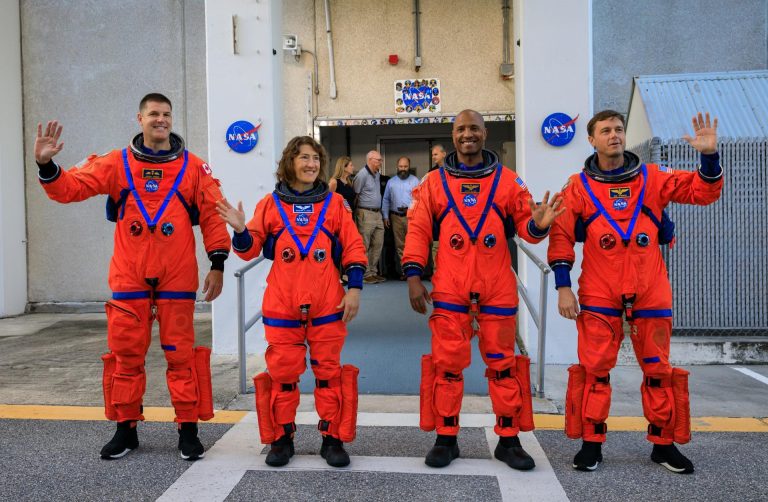
Artemis II crew members (from left) CSA (Canadian Space Agency) astronaut Jeremy Hansen, and NASA astronauts Christina Koch, Victor Glover, and Reid Wiseman walk out of Astronaut Crew Quarters inside the Neil Armstrong Operations and Checkout Building to the Artemis crew transportation vehicles prior to traveling to Launch Pad 39B as part of an integrated ground systems test at Kennedy Space Center in Florida on Wednesday, Sept. 20, to test the crew timeline for launch day.
NASA

NASA announced Tuesday updates to its Artemis campaign that will establish the foundation for long-term scientific exploration at the Moon, land the first woman and first person of color on the lunar surface, and prepare for human expeditions to Mars for the benefit of all. To safely carry out these missions, agency leaders are adjusting the schedules for Artemis II and Artemis III to allow teams to work through challenges associated with first-time developments, operations, and integration.

NASA will now target September 2025 for Artemis II, the first crewed Artemis mission around the Moon, and September 2026 for Artemis III, which is planned to land the first astronauts near the lunar South Pole. Artemis IV, the first mission to the Gateway lunar space station, remains on track for 2028.

“We are returning to the Moon in a way we never have before, and the safety of our astronauts is NASA’s top priority as we prepare for future Artemis missions,” said NASA Administrator Bill Nelson. “We’ve learned a lot since Artemis I, and the success of these early missions relies on our commercial and international partnerships to further our reach and understanding of humanity’s place in our solar system. Artemis represents what we can accomplish as a nation – and as a global coalition. When we set our sights on what is hard, together, we can achieve what is great.”

Ensuring crew safety is the primary driver for the Artemis II schedule changes. As the first Artemis flight test with crew aboard the Orion spacecraft, the mission will test critical environmental control and life support systems required to support astronauts. NASA’s testing to qualify components to keep the crew safe and ensure mission success has uncovered issues that require additional time to resolve. Teams are troubleshooting a battery issue and addressing challenges with a circuitry component responsible for air ventilation and temperature control.

NASA’s investigation into unexpected loss of char layer pieces from the spacecraft’s heat shield during Artemis I is expected to conclude this spring. Teams have taken a methodical approach to understand the issue, including extensive sampling of the heat shield, testing, and review of data from sensors and imagery.

The new timeline for Artemis III aligns with the updated schedule for Artemis II, ensures the agency can incorporate lessons learned from Artemis II into the next mission, and acknowledges development challenges experienced by NASA’s industry partners. As each crewed Artemis mission increases complexity and adds flight tests for new systems, the adjusted schedule will give the providers developing new capabilities – SpaceX for the human landing system and Axiom Space for the next-generation spacesuits – additional time for testing and any refinements ahead of the mission.

“We are letting the hardware talk to us so that crew safety drives our decision-making. We will use the Artemis II flight test, and each flight that follows, to reduce risk for future Moon missions,” said Catherine Koerner, associate administrator, Exploration Systems Development Mission Directorate at NASA Headquarters in Washington. “We are resolving challenges associated with first-time capabilities and operations, and we are closer than ever to establishing sustained exploration of Earth’s nearest neighbor under Artemis.”

In addition to the schedule updates for Artemis II and III, NASA is reviewing the schedule for launching the first integrated elements of Gateway, previously planned for October 2025, to provide additional development time and better align that launch with the Artemis IV mission in 2028.

NASA also shared that it has asked both Artemis human landing system providers  SpaceX and Blue Origin – to begin applying knowledge gained in developing their systems as part of their existing contracts toward future variations to potentially deliver large cargo on later missions.

“Artemis is a long-term exploration campaign to conduct science at the Moon with astronauts and prepare for future human missions to Mars. That means we must get it right as we develop and fly our foundational systems so that we can safely carry out these missions,” said Amit Kshatriya, deputy associate administrator of Exploration Systems Development, and manager of NASA’s Moon to Mars Program Office at headquarters. “Crew safety is and will remain our number one priority.”

NASA leaders emphasized the importance of all partners delivering on time so the agency can maximize the flight objectives with available hardware on a given mission. NASA regularly assesses progress and timelines and as a part of integrated programmatic planning to ensure the agency and its partners can successfully accomplish its Moon to Mars exploration goals.

With Artemis, NASA will explore more of the Moon than ever before, learn how to live and work away from home, and prepare for future human exploration of the Red Planet. NASA’s SLS (Space Launch System) rocket, exploration ground systems, and Orion spacecraft, along with the human landing system, next-generation spacesuits, Gateway lunar space station, and future rovers are NASA’s foundation for deep space exploration.

For more information about Artemis, visit:

-end-

Kathryn Hambleton / Rachel Kraft
Headquarters, Washington
202-358-1100 / 202-365-7575
[email protected] / [email protected]

The Future is ALL ON: CES 2024 Opens, Showcasing the Latest Innovations in AI, Sustainability and Mobility

0

LAS VEGAS — Jan 09, 2024

CES® 2024 opened today showing it is the venue to set the agenda for the year ahead in technology, business and entertainment, even powering a surge in global awareness as companies began debuting innovative technologies.
CES, the world’s most powerful tech platform, welcomed more than 4000 exhibiting companies from across the globe to share their innovations and partnerships in artificial intelligence, sustainability, and other fields that are tackling big global challenges. Up to 130,000 attendees and media will see the stories of these companies. They include a record-breaking number of startups in Eureka Park® , the home of breakthrough technology, demonstrating that anyone can scale an idea that will change the world.

Media coverage of CES 2024 exhibitors has already exploded. Before the show even began, the most discussed topics were artificial intelligence, entertainment and office hardware, plus gaming and e-sports. Brands are leveraging the power of CES to go viral, with advances in display technology, smart home and assistive tech, plus unexpected partnerships and solutions for enterprise.

“At CES 2024, we’re thrilled to bring together exhibitors, attendees and media to display and dream up the technology of tomorrow, and the innovations that are solving today’s greatest challenges,” said Gary Shapiro, president and CEO, Consumer Technology Association®  (CTA). “CES is where business and policy converge, and there’s no place like it for building B2B and B2C connections.”

Attendees from across the globe travel to CES to do business efficiently and discover what’s next in tech. During CTA’s State of the Industry Address on Tuesday morning, Shapiro recognized the 100th anniversary of CTA, owner and producer of CES, and underscored the importance of technology that can enhance human capabilities to address issues like access to clean air and water, food, healthcare and technology. Kinsey Fabrizio, CTA Sr. VP, CES and membership, joined Shapiro on stage to provide updates on trends and sessions at the show.

Keynotes
Siemens President and CEO Roland Busch on Monday night shared the company’s vision for a future that’s not just innovative but also sustainable. Highlighting partnerships with AWS, Blendhub, Red Bull Racing, Sony and Unlimited Tomorrow, Busch unveiled innovations that are combining the real world and the digital worlds to redefine reality. Siemens announced breakthroughs in AI and immersive engineering to enable the industrial metaverse, and highlighted how these technologies are empowering the world’s innovators to thrive using its open digital business platform, Siemens Xcelerator.

In the first-ever beauty keynote at CES, L’Oréal Groupe CEO Nicolas Hieronimus revealed the CES 2024 Innovation Award-winning technology, the AirLight Pro and detailed the company’s strategic investments in the future of beauty during his keynote. Eva Longoria joined Hieronimus and Barbara Lavernos, Deputy Chief Executive Officer in charge of Research, Innovation and Technology to talk about L’Oréal’s Colorsonic hair coloring product. The AirLight Pro, in partnership with Zuvi, uses technology to care for multiple hair needs while reducing environmental impact. The technology is designed to adapt to the needs of the individual user with hardware, firmware and app working seamlessly to make it possible for every user to customize the settings for their individual needs.

Media Days
CES Media Days on January 7 and 8 at Mandalay Bay featured 23 press conferences from global brands that More than 60% of news coverage during the two days of media events prior to the official show opening came from outlets outside of the U.S. Making announcements were: Abbott, Ambient Scientific, Bosch, Doosan, EssilorLuxottica, Harbor Lockers, Hyundai, Hisense, Indy Autonomous Challenge, Ink Invent, KIA, LG Electronics, Ottonomy, Panasonic, Samsung, SK Hynix, Sony, Swapery, TCL, Timekettle, UHD Alliance, Valeo and Volkswagen.

Hot Products
CES Unveiled Las Vegas, a first-hand preview of the products launching at CES 2024, featured unexpected technology from 180 companies such as Caterpillar’s zero-exhaust emission underground loader, NOWATCH wellness wearable, Sevvy Smart Cooker, and Xpeng AEROHT’s flying car. Other hot products making waves at CES include Verge Motorcycle’s TS Ultra electric motorcycles with a “sense of sight,” Palmplug’s Theraplay virtual reality game that helps rehabilitate stroke patients and XREAL’s Air 2 Ultra augmented reality sunglasses.

“Unveiled Las Vegas is such a great way to kick off CES each year and to get a sneak peek into some of the early trends at the show, and it was no surprise to see AI everywhere amid diverse offerings across accessibility, digital health, food tech, mobility and smart home,” Fabrizio said.

Tech Trends
CTA’s Director of Thematic Programs Brian Comiskey and Director of Research Jessica Boothe presented 2024’s Top Tech Trends to Watch. This year’s presentations showcased how AI, sustainability and inclusive tech design will advance tomorrow’s technologies such as mobility, digital health, content, gaming and agrifood tech. Underpinning these trends and evolution in the industry is the rise of Gen Z as a sizable and influential segment, especially in emerging market nations where they’re rapidly connecting to the internet to shape worldwide trends. In turn, innovation in both the consumer and the enterprise will advance to a more intelligent, greener, and more inclusive tomorrow.

Elsewhere at CES
In addition to more than 250 conference sessions and the Innovation Policy Summit for global policymakers, CTA today launched the Consumer Technology Circularity Initiative (CTCI), a groundbreaking and voluntary industry initiative to reduce waste, encourage more reuse, enhance recycling, reduce climate impact, and see less disposal of consumer electronics. Founding partners include Lenovo, LG Electronics, Panasonic, Samsung and Sony Electronics Inc.

Visit CES.tech to get live updates and streams from CES 2024. The CES App has everything you need to plan for and navigate CES. Download the app by searching “CES 2024” in the Android or Apple appstores. View CES keynotes, Great Minds and select programming live here and replays on-demand here.

NASA’s Artemis I Spacecraft Prepped To Depart To Ohio Facility

0

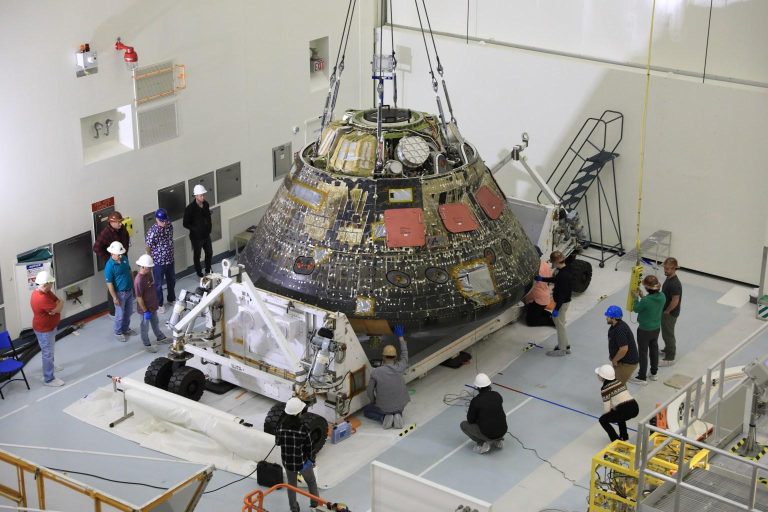
Technicians inside NASA’s Kennedy Space Centers Multi-Payload Processing Facility (MPPF) in Florida use a crane to load the Artemis I spacecraft – now called an environmental test article – into the crew module transportation fixture in preparation for its departure to NASA’s Neil Armstrong Test Facility in Sandusky, Ohio.
NASA/Kim Shiflett

From Florida to the Moon and back, NASA’s Orion spacecraft is still making moves. The crew module that flew more than 1.4 million miles during the agency’s historic Artemis I mission is getting ready for its next destination – NASA’s Neil Armstrong Test Facility in Sandusky, Ohio.  

Technicians inside NASA’s Multi-Payload Processing Facility at the agency’s Kennedy Space Center in Florida, use a crane to lift the Artemis I spacecraft – now called an environmental test article – into the crew module transportation fixture in preparation for its departure. Engineers will use it in qualification tests to better understand how Orion would perform in the event of a launch or inflight abort. 

After splashing down in the Pacific Ocean, the Orion spacecraft for the Artemis I mission returned to Kennedy in December 2022. Components scheduled for reuse on Artemis II were removed and the crew module was reconfigured to serve as a test article. With crew module function tests now complete, the test article has been prepared for transport with the installation of the aft, mid bay back shell, and the side hatch in final closure. 

By: Allison Tankersley
Originally published at: NASA

A Carbon-Lite Atmosphere Could Be A Sign Of Water And Life On Other Terrestrial Planets, MIT Study Finds

0

A low carbon abundance in planetary atmospheres, which the James Webb Space Telescope can detect, could be a signature of habitability.

Jennifer Chu | MIT News
https://news.mit.edu/2023/carbon-lite-atmosphere-life-terrestrial-planets-mit-study-1228

Caption:In the search for extraterrestrial life, MIT scientists say a planet’s carbon-lite atmosphere, relative to its neighbors, could be a sure and detectable signal of habitability. Credits:Image: Christine Daniloff, MIT; iStock

Scientists at MIT, the University of Birmingham, and elsewhere say that astronomers’ best chance of finding liquid water, and even life on other planets, is to look for the absence, rather than the presence, of a chemical feature in their atmospheres.

The researchers propose that if a terrestrial planet has substantially less carbon dioxide in its atmosphere compared to other planets in the same system, it could be a sign of liquid water — and possibly life — on that planet’s surface.

What’s more, this new signature is within the sights of NASA’s James Webb Space Telescope (JWST). While scientists have proposed other signs of habitability, those features are challenging if not impossible to measure with current technologies. The team says this new signature, of relatively depleted carbon dioxide, is the only sign of habitability that is detectable now.

“The Holy Grail in exoplanet science is to look for habitable worlds, and the presence of life, but all the features that have been talked about so far have been beyond the reach of the newest observatories,” says Julien de Wit, assistant professor of planetary sciences at MIT. “Now we have a way to find out if there’s liquid water on another planet. And it’s something we can get to in the next few years.”

The team’s findings appear today in Nature Astronomy. De Wit co-led the study with Amaury Triaud of the University of Birmingham in the UK. Their MIT co-authors include Benjamin Rackham, Prajwal Niraula, Ana Glidden Oliver Jagoutz, Matej Peč, Janusz Petkowski, and Sara Seager, along with Frieder Klein at the Woods Hole Oceanographic Institution (WHOI), Martin Turbet of Ècole Polytechnique in France, and Franck Selsis of the Laboratoire d’astrophysique de Bordeaux.

Beyond a glimmer

Astronomers have so far detected more than 5,200 worlds beyond our solar system. With current telescopes, astronomers can directly measure a planet’s distance to its star and the time it takes it to complete an orbit. Those measurements can help scientists infer whether a planet is within a habitable zone. But there’s been no way to directly confirm whether a planet is indeed habitable, meaning that liquid water exists on its surface.

Across our own solar system, scientists can detect the presence of liquid oceans by observing “glints” — flashes of sunlight that reflect off liquid surfaces. These glints, or specular reflections, have been observed, for instance, on Saturn’s largest moon, Titan, which helped to confirm the moon’s large lakes.

Detecting a similar glimmer in far-off planets, however, is out of reach with current technologies. But de Wit and his colleagues realized there’s another habitable feature close to home that could be detectable in distant worlds.

“An idea came to us, by looking at what’s going on with the terrestrial planets in our own system,” Triaud says.

Venus, Earth, and Mars share similarities, in that all three are rocky and inhabit a relatively temperate region with respect to the sun. Earth is the only planet among the trio that currently hosts liquid water. And the team noted another obvious distinction: Earth has significantly less carbon dioxide in its atmosphere.

“We assume that these planets were created in a similar fashion, and if we see one planet with much less carbon now, it must have gone somewhere,” Triaud says. “The only process that could remove that much carbon from an atmosphere is a strong water cycle involving oceans of liquid water.”

Indeed, the Earth’s oceans have played a major and sustained role in absorbing carbon dioxide. Over hundreds of millions of years, the oceans have taken up a huge amount of carbon dioxide, nearly equal to the amount that persists in Venus’ atmosphere today. This planetary-scale effect has left Earth’s atmosphere significantly depleted of carbon dioxide  compared to its planetary neighbors.

“On Earth, much of the atmospheric carbon dioxide has been sequestered in seawater and solid rock over geological timescales, which has helped to regulate climate and habitability for billions of years,” says study co-author Frieder Klein.

The team reasoned that if a similar depletion of carbon dioxide were detected in a far-off planet, relative to its neighbors, this would be a reliable signal of liquid oceans and life on its surface.

“After reviewing extensively the literature of many fields from biology, to chemistry, and even carbon sequestration in the context of climate change, we believe that indeed if we detect carbon depletion, it has a good chance of being a strong sign of liquid water and/or life,” de Wit says.

A roadmap to life

In their study, the team lays out a strategy for detecting habitable planets by searching for a signature of depleted carbon dioxide. Such a search would work best for “peas-in-a-pod” systems, in which multiple terrestrial planets, all about the same size, orbit relatively close to each other, similar to our own solar system. The first step the team proposes is to confirm that the planets have atmospheres, by simply looking for the presence of carbon dioxide, which is expected to dominate most planetary atmospheres.

“Carbon dioxide is a very strong absorber in the infrared, and can be easily detected in the atmospheres of exoplanets,” de Wit explains. “A signal of carbon dioxide can then reveal the presence of exoplanet atmospheres.”

Once astronomers determine that multiple planets in a system host atmospheres, they can move on to measure their carbon dioxide content, to see whether one planet has significantly less than the others. If so, the planet is likely habitable, meaning that it hosts significant bodies of liquid water on its surface.

But habitable conditions doesn’t necessarily mean that a planet is inhabited. To see whether life might actually exist, the team proposes that astronomers look for another feature in a planet’s atmosphere: ozone.

On Earth, the researchers note that plants and some microbes contribute to drawing carbon dioxide, although not nearly as much as the oceans. Nevertheless, as part of this process, the lifeforms emit oxygen, which reacts with the sun’s photons to transform into ozone — a molecule that is far easier to detect than oxygen itself.

The researchers say that if a planet’s atmosphere shows signs of both ozone and depleted carbon dioxide, it likely is a habitable, and inhabited world.

“If we see ozone, chances are pretty high that it’s connected to carbon dioxide being consumed by life,” Triaud says. “And if it’s life, it’s glorious life. It would not be just a few bacteria. It would be a planetary-scale biomass that’s able to process a huge amount of carbon, and interact with it.”

The team estimates that NASA’s James Webb Space Telescope would be able to measure carbon dioxide, and possibly ozone, in nearby, multiplanet systems such as TRAPPIST-1 — a seven-planet system that orbits a bright star, just 40 light years from Earth.

“TRAPPIST-1 is one of only a handful of systems where we could do terrestrial atmospheric studies with JWST,” de Wit says. “Now we have a roadmap for finding habitable planets. If we all work together, paradigm-shifting discoveries could be done within the next few years.”

Reprinted with permission of MIT News (http://news.mit.edu/)

Consumer Technology Association Forecast: U.S. Tech Industry Revenue To Rise 2.8% In 2024

0

Arlington, VA, Jan. 4, 2024 – Leading into CES® 2024, the Consumer Technology Association® projects retail revenues for the U.S. consumer technology industry will grow 2.8% in 2024 to $512 billion (up $14 billion from 2023). This signals an uptick in consumer spending on technology products and services, according to CTA’s One-Year Industry Forecast.

“Despite inflation in most sectors of the U.S. economy, it’s noteworthy that consumer tech products like TVs, smartphones, and gaming hardware are being bought at lower prices by consumers,” said Richard Kowalski, Sr. Director of Business Intelligence at CTA. “Technology by nature is deflationary as innovation leads industries to find newer, more efficient ways to compete. Looking ahead to 2024, I expect developments in artificial intelligence will accelerate growth for consumer and enterprise technology companies as they become more efficient and find more ways to meet consumer needs.”

Trends to Watch in 2024:

  1. The Year of the Megabundle: Content providers will increase their promotion of “service bundles” to draw more consumer interest. Megabundles have the potential to offer consumers discounted rates on their favorite services while also simplifying their payment process.
  2. Streaming Up: Consumers will spend $14 billion (up 6% over 2023) on audio streaming services and $48 billion (up 4%) on video streaming in 2024.
  3. Gaming Hardware Boom: Product refreshes in tablets, augmented and virtual reality headsets and gaming (Major brand console refresh in 2024/2025) will boost gaming revenues in 2024. Gaming will also be amplified by 12% growth in subscription services (growing to $3.5 billion in 2024). Generative artificial intelligence is expected to improve the gaming experience while also helping developers bring games to market faster.
  4. Devices and Services Go Hand-in-Hand: Services continue to be an essential part of product purchase, as seen through growth in the services segment. CTA estimates that 25% of all consumer spending on tech was for various software and subscription services in 2019. In just 5 years to 2024, CTA projects the same services to be just under one-third of all consumer spending.
  5. Believe the AI Hype: Over 230 million smartphones and PCs shipping to the U.S. this year will tap the powers of generative AI through mobile apps, browsers and on-device software. AI is being deployed in mobility safety systems, fitness tracking apps on smartwatches and picture quality improvements on televisions.

“I am excited by the breadth of innovation I’m seeing from companies large and small going into CES 2024,” said Gary Shapiro, president and CEO, CTA. “By embracing pro-innovation regulatory policies, encouraging investment, reforming immigration to embrace global talent, and enhancing trade partnerships that strengthen innovation, we can drive innovation benefiting all people.

Not Registered for CES? Sign Up Today.

Methodology
Twice each year since 1967, CTA updates its forecast of more than 125 consumer technology products and services. This forecast serves as the benchmark for the consumer technology industry, charting the size and growth of underlying categories and the industry. It is used by manufacturers and retailers for creating product development plans; financial analysts for sizing market opportunities; industry and general media for providing context in their coverage; government staff for understanding the scope of the industry to guide policy decisions; and CTA itself for highlighting the successes and challenges of the industry. 

Sign up for CTA Research Insights.

About Consumer Technology Association:
As North America’s largest technology trade association, CTA® is the tech sector. Our members are the world’s leading innovators – from startups to global brands – helping support more than 18 million American jobs. CTA owns and produces CES® – the most powerful tech event in the world. Find us at CTA.tech. Follow us @CTAtech.

What Not To Miss At CES 2024

0

Arlington, VA — Jan 04, 2024

CES®, the world’s most powerful tech event, returns to Las Vegas on January 9-12, bringing together 4000+ exhibitors, including global brands and startups, industry professionals, media and government leaders. 

“The CES platform is ALL ON for 2024. No other event in the world connects the full ecosystem of the tech industry like CES,” said Gary Shapiro, president and CEO, Consumer Technology Association (CTA)®. “This year at CES, we are excited to spotlight the critical role that technology is playing to improve every aspect of the human experience. CES 2024 will be the hub where business leaders meet, dream, and solve.”  

Prepare for the ALL ON Experience 

  • CES 2024 App – Your one-stop shop to plan for and navigate CES. Search “CES 2024” in your app store. 
  • CES Tech Talk Podcast – Download or subscribe for the top trends at CES 2024.

 Top Themes 

  • Artificial Intelligence – AI will be front and center with applications that can improve health care, sustainability, productivity, accessibility and more. 
    Exhibitor examples: Garmin, Intel, Qualcomm, Walmart. 
  • Human Security for All (HS4A) – CES will again partner with the United Nations Trust Fund for Human Security and World Academy of Art and Science on the Human Security for All global campaign, showcasing how technology is solving some of the world’s biggest challenges.   
    Exhibitor examples: Abbott, AARP, Bosch, Nasdaq, Siemens. 
  • Mobility – 250+ exhibitors from automotive tech to self-driving and electric vehicles and personal mobility. 
    Exhibitor examples: BMW, Hyundai, Kia, Mercedes, Volkswagen. 
  • Sustainability – Companies will show how they are making a positive impact through innovations in accessibility, energy, food tech, resilience, smart cities, clean water and more. 
    Exhibitor examples: Exeger, HD Hyundai, Honda, John Deere, Supernal. 

Must-See Keynotes 

  • Siemens CEO Roland Busch – Jan. 8, 6:30 PM, Venetian, Palazzo Ballroom  
  • L’Oréal CEO Nicolas Hieronimus – Jan. 9, 8:30 AM, Venetian, Palazzo Ballroom  
  • Snap CEO Evan Spiegel and MediaLink CEO Michael Kassan – Jan. 9, 11 AM, ARIA  
  • Walmart CEO Doug McMillon – Jan. 9, 2 PM, Venetian, Palazzo Ballroom  
  • Intel CEO Pat Gelsinger – Jan. 9, 5 PM, Venetian, Palazzo Ballroom  
  • Elevance Health CEO Gail K. Boudreaux – Jan. 9, 5 PM, Venetian, Palazzo Ballroom  
  • HD Hyundai CEO Kisun Chung – Jan. 10, 9 AM, Venetian, Palazzo Ballroom  
  • Nasdaq CEO Adena Friedman – Jan. 10, 2 PM, Venetian, Palazzo Ballroom  
  • Qualcomm CEO Cristiano Amon – Jan. 10, 2 PM, Venetian, Palazzo Ballroom  
  • Best Buy CEO Corie Barry – Jan. 10, 6 PM, LIT Dinner (invitation only) 

Featured Speakers & Celebrities

  • Celebrity Guests – See a star-studded lineup of celebrity, athlete and personality appearances at CES 2024. 
  • Government Officials – Hear from U.S. Senators Jacky Rosen (D-NV), Ben Ray Lujan (D-NM) and Cynthia Lummis (R-WY); FDA Commissioner Robert Califf, FCC Commissioners Brendan Carr and Anna Gomez, FTC Commissioner Rebecca Slaughter and more. 

Top Conference Tracks & Content 

Accessibility – Discover the technologies that help people of all ages and abilities.  

  • CTA Foundation CES highlighted events 
  • AARP AgeTech Summit – Jan. 10, 10 and 11 AM, Venetian, Level 4, Marcello 4404 
  • Driving Innovation Through Inclusive Design – Jan. 10, 10 AM, Venetian Expo, Hall G Startup Stage 
  • The Evolution of Accessible Gaming – Jan. 10, 11 AM, LVCC West Level 2, W218 
  • OTC Hearing Aids: An Update – Jan. 11, 3 PM, Venetian Level 4, Marcello 4404

C Space – features the marketing, entertainment and media industries exploring tech trends impacting content consumption, advertising and consumer behavior.  

  • C Space Storytellers – features influencers and newsmakers sharing their stories, best practices and case studies with the brand and content community at CES. 
  • Omnicom: Working Together Towards More Inclusive AI – Jan. 10, 9 AM, ARIA Level 2, Mariposa 4 
  • Arsenal FC x LA Rams: Technology in Football – Jan. 10, 10 AM, ARIA Level 2, Mariposa 4 
  • From Pilot to Product – Lessons from Coach, Dr. Martens & Gen Phoenix – Jan. 10, 3 PM, ARIA Level 2, Mariposa 4 
  • C Space Studio Interviews – Executive interviews from top global brands including Deloitte, General Mills, iHeartMedia, Uber Ads, The Female Quotient and Tik Tok.

Digital Health Summit – Learn about the innovations that lower costs, improve health equity and empower consumers to take control of their health. 

  • Digital Health at CES highlighted events 
  • Can Policy Affect Health Innovation? – Jan. 9, 1 PM, LVCC North Level 2, N262 
  • Exploring Innovations in Mental Health – Jan. 9, 4 PM, Venetian Expo, Hall G Startup Stage 
  • Gen AI and the Future of Health Care – Jan. 10, 1 PM, LVCC North Level 2, N250 
  • The Human Component – Exploring CTA and BBC Storyworks new video series – Jan. 10, 4 PM, LVCC, Grand Lobby, CTA Stage 
  • This Time, It’s Different: Where Healthcare Transformation is Working – Jan. 11, 4:30 PM, LVCC North Level 2, N250

Great Minds – The Great Minds series will explore the new era of innovation ahead and highlight the great minds who are helping steer companies through a time of incredible societal change and pioneering a new future powered by technology.  

  • Great Minds, Bold Visions: What’s Next for AI? – Jan. 9, 10 AM, LVCC West Level 2, W232 
  • The Intersection of Music and Technology – Jan. 10, 9 AM, LVCC West Level 2, W232 
  • Ahead of the Game: Revolutionizing Athlete Safety with Emerging Health Tech – Jan. 10, 10 AM, LVCC West Level 2, W232 
  • How to Think Like an Innovator and Change the World – with UN Secretary General’s Envoy on Technology –  Jan. 10, 1 PM, LVCC, West Level 2, W232

Innovation for All – The Innovation for All program will bring together thought leaders and allies for engagement opportunities, networking, and to share best practices in advancing diversity, equity, and inclusion in the tech industry. 

  • The Future of the Chief Diversity Officer: What’s Next? – Jan. 9, 2 PM, LVCC, CTA Stage  
  • Emerging Technologies Shaping the Tech Workforce – Jan. 10, 9 AM, Venetian, Hall G, Startup Stage 
  • Closing the Gender Equity Gap – Jan. 10, 1 PM, LVCC, Grand Lobby, CTA Stage

​Innovation Policy Summit – CES gathers policymakers from across the world to discuss domestic and global tech policy issues including privacy, trade, competition, artificial intelligence, self-driving vehicles, and more. 

  • Conversation with a Commissioner – Jan. 10, 10:20 AM, LVCC North Hall, N262 
  • Conversations with U.S. Government Leaders – Jan. 11, 10:20 AM, LVCC North Hall, N262 
  • Senate Perspectives on Emerging Tech Policy – Jan. 12, 11 AM, LVCC West Hall W232

Research Summit – Learn about consumer and enterprise trends across verticals.  

  • CES 2024 Trends to Watch, presented by CTA – Jan. 8, 10 AM, LVCC, West Level 2, W232 
  • Cracking the Smart Car: What Truly Defines Them? – Jan. 8, 3 PM, LVCC, West Level 2, W232 
  • Technology and AI Building a Sustainable, Secure, Superior Future, presented by HS4A – Jan. 8, 4 PM, LVCC, West Level 2, W232 


Experience CES on the Show Floor 

Explore interactive exhibits, compelling programming, and visions from first-time exhibitors including: EssilorLuxottica, Fandom, Kroger Precision Marketing, Kubota, Madhive, Midea, Nexstar Media Group, Noom, Paramount, Purdue, Pyxis, Recaro, ResMed, Supernal and the U.S. Navy. 

  • CTA celebrates 100 years of history and igniting innovation. The CTA Center includes a 3D activation as we reflect on where we’ve been, how we got here and most importantly what’s to come. LVCC, Grand Lobby.  
  • The Official CES Store returns to CES for 2024, offering high-quality, branded goods to CES 2024 attendees. LVCC (Grand Lobby, West Hall, Central Plaza) and Venetian. 
  • Dassault Systemes virtual twin of the human heart can help doctors understand heart diseases, give simulations on complicated heart procedures. LVCC, North Hall, #8705. 
  • Exeger will showcase Powerfoyle, a unique solar cell that converts all forms of light into electrical energy. Venetian, Hall A-D, #53713. 
  • Garmin will highlight health and fitness accessibility features, plus Autoland, the world’s first certified system of its kind to land aircraft. LVCC, West Hall, #3519.  
  • Goodyear will bring its iconic Goodyear Blimp, showcasing its innovation in sustainability and mobility. LVCC, West Hall, #4917.  
  • Honda will introduce the Motocompacto, a compact, folding, and portable electric mobility device that takes up almost 20% less space than a carry-on suitcase. LVCC, North Hall, #10015. 
  • Indy Autonomous Challenge, the global innovator in autonomous racing, returns to push the boundaries of autonomous racing and showcasing the future of autonomous mobility. LVCC, West Hall, #5901 and Las Vegas Motor Speedway.  
  • Innovation Awards: This year’s hottest products are recognized through the CES Innovation Awards program, an annual competition honoring outstanding design and engineering in consumer technology products. View the Showcase at the Venetian, Level 2, #56332.  
  • Kangsters Wheely-X will show their stationary fitness trainer for wheelchair users. Venetian, Eureka Park, #62919. 
  • Netflix will offer a 3 Body Problem experience for the sci-fi drama series from Game of Thrones duo David Benioff and D.B. Weiss and Alexander Woo. LVCC, Central Hall, #17048. 
  • SK will host an interactive amusement park booth design (SK Wonderland) that will feature a clean energy train, magic carpet ride and dancing EV. LVCC, Central Hall, #18730. 
  • Startups – Uncover more than 1200 of the world’s most promising tech pioneers and startups in Eureka Park and compelling programming on the Startup Stage. See country pavilions from France, Italy, Japan, Korea, Netherlands, Ukraine and more. Venetian Expo, Hall G.
    • CTA Foundation Pitch Contest: Health Tech – see eight incredible startups from around the world compete for the grand prize in this year’s health tech themed startup. Jan. 10, 2 PM, Venetian, Eureka Park, Startup Stage. 
    • Eureka Park Accessibility Contest Winners – visit the five incredible innovations to improve the lives of people with disabilities or older adults that won this year’s CTA Foundation Accessibility contest. Concha Labs (60448), OneCourt (60450), DreamFace (60452), Glidance (60454) and VisionAid (60259). 
  • Shark Tank Open Call. Jan. 12, 9 AM, Venetian, Level 1, Room 101.  
  • Supernal is unveiling its first eVTOL at CES 2024. LVCC, Diamond Lot, #DL-110. 
  • TSA PreCheck® Enrollment Event. LVCC, North Hall, #9671. 
  • Valeo x BMW will present a solution for teleoperation from a cockpit with high reliability. Visitors will drive a BMW Series iX located on the BMW booth while remaining at the Valeo booth. LVCC, Silver 3. 
  • Vizio will bring their VIZIO bus to CES. LVCC, Central Plaza, #CP-42. 
  • Walmart will showcase an immersive 10,000 square foot exhibit highlighting the next generation of retail. LVCC, Central Plaza, #CP-12.

Media Exclusives 

Media Days 

Hear from dozens of the world’s leading companies breaking news at two days of media only events, Jan. 7-8 at Mandalay Bay. Plus get early access to CES Unveiled following Tech Trends to Watch.  

  • Press conferences – Hear first from brands making announcements, including Bosch, Doosan, Hyundai, Hisense, KIA, LG Electronics, Panasonic, Samsung, Sony, TCL and Valeo. Jan. 7-8. 
  • Tech Trends to Watch – Exclusive insight on the latest tech research and trends to watch during CES 2024 at CTA’s much-anticipated annual presentation. Jan. 7, 4 PM, Lagoon. 
  • CES Unveiled Las Vegas – First-hand preview of the products launching at CES 2024, for the first time including a food tasting area. Jan. 7, 5 PM, Shorelines.

Media Resources 

  • B-Roll and Photos – High-definition video and photos from CES available for easy download.  
  • Media Rooms – Media-only workrooms that offer content creation space, internet, laptops, meeting rooms, printers, beverages and lunch. 
  • Exhibitor Press Releases – See all CES exhibitors’ press releases in a single feed.
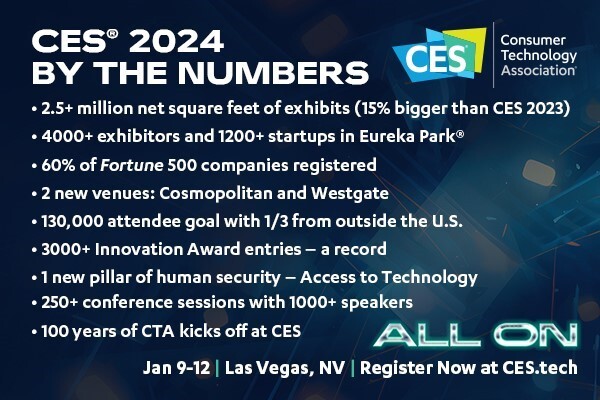
CES by the numbers
CES by the numbers

The Birthplaces Of Stars In The Whirlpool Galaxy

0

For the first time, signatures of individual cold and dense star-forming clouds in a galaxy outside the Milky Way have been mapped over a wide area.

An international research team led by astronomers from the Max Planck Institute for Astronomy (MPIA) has meticulously mapped expansive cold and dense gas regions, the future stellar nurseries, in a galaxy outside the Milky Way with unprecedented detail. Utilizing the NOEMA interferometer, these observations cover a vast expanse within the galaxy, providing insight into varying conditions conducive to star formation. The data marks a ground-breaking achievement in this type of measurement, allowing researchers, for the first time, to scrutinize the early phases of star formation beyond the Milky Way on scales as minute as individual gas clouds birthing stars.

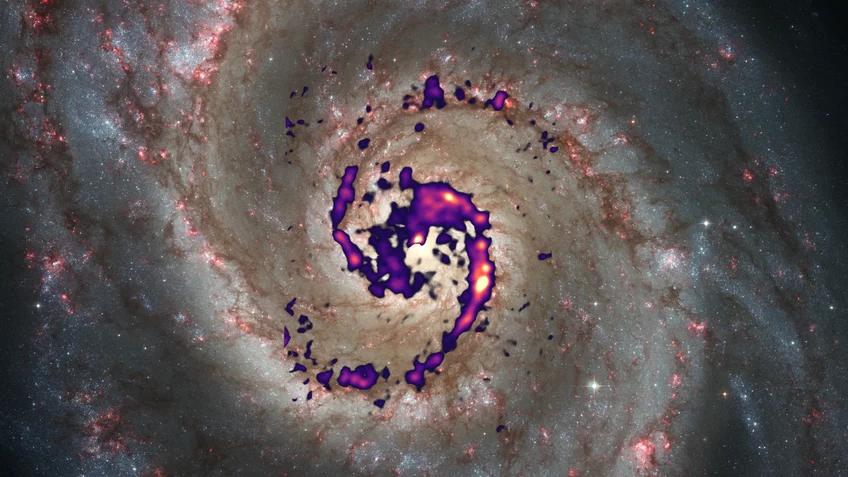
This illustration depicts the distribution of diazenylium molecule radiation (false colours) in the Whirlpool Galaxy, compared with an optical image. The reddish areas in the photograph represent luminous gas nebulae containing hot, massive stars traversing dark zones of gas and dust in the spiral arms. The presence of diazenylium in these dark regions suggests particularly cold and dense gas clouds. © Thomas Müller (HdA/MPIA), S. Stuber et al. (MPIA), NASA, ESA, S. Beckwith (STScI), and the Hubble Heritage Team (STScI/AURA)

Paradoxically, the evolution of hot stars initiates in some of the coldest realms of the universe —dense clouds of gas and dust that traverse entire galaxies. “To investigate the early phases of star formation, where gas gradually condenses to eventually produce stars, we must first identify these regions,” says Sophia Stuber, a PhD student at the Max Planck Institute for Astronomy (MPIA) in Heidelberg. She is the lead author of the research article slated for publication in Astronomy & Astrophysics. “For this purpose, we typically measure the radiation emitted by specific molecules that are particularly abundant in these extremely cold and dense zones.

Molecules as chemical probes

Astronomers typically employ molecules such as HCN (hydrogen cyanide) and N2H+ (diazenylium) as chemical probes in exploring star formation within the Milky Way. “But only now have we been able to measure these signatures in great detail over an extensive range within a galaxy outside the Milky Way, covering various zones with diverse conditions,” explains Eva Schinnerer, research group leader at MPIA. “Even at first glance, it’s evident that while the two molecules effectively reveal dense gas, they also disclose interesting differences.

Through collisions with the abundant hydrogen molecules, which are themselves challenging to detect, other molecules are set into rotation. Following a reduction in rotational speed, they emit radiation with characteristic wavelengths, approximately three millimetres for the abovementioned molecules.

These measurements are part of a comprehensive observational program named SWAN (Surveying the Whirlpool at Arcsecond with NOEMA), co-led by Schinnerer and Frank Bigiel from the University of Bonn. Utilizing the Northern Extended Millimetre Array (NOEMA), a radio interferometer in the French Alps, the team aims to study the distribution of various molecules within the inner 20,000 light-years of the Whirlpool Galaxy (Messier 51), including hydrogen cyanide and diazenylium. In addition to the 214 hours of observation from this program, about 70 hours from other observation campaigns with the 30-metre single-dish telescope in southern Spain complement the dataset.

As data from radio interferometers are much more complex than telescope images, processing and refining the data took approximately another year,” notes Jérôme Pety from the Institute de Radioastronomie Millimétrique (IRAM), the institution operating the telescopes. Interferometric telescopes like NOEMA consist of multiple individual antennas, collectively achieving detail resolution comparable to a telescope with a primary mirror diameter equivalent to the spacing between the individual telescopes.

Gas properties depend on the environment

As we observe this galaxy from a distance of approximately 28 million light-years, we can distinguish signatures of individual gas clouds in diverse areas, such as the centre and the spiral arms. “We leveraged this circumstance to determine how well the two gases trace the dense clouds in this galaxy for us and whether they are equally suited,” Stuber explains.

While the radiation intensity of hydrogen cyanide and diazenylium consistently increases and decreases across the spiral arms, providing equally reliable results for determining gas density, the astronomers find a notable deviation in the galactic centre. Compared to diazenylium, the brightness of hydrogen cyanide emission increases more significantly in this region. There appears to be a mechanism there that stimulates hydrogen cyanide to emit additional light, which is not observed in diazenylium.

We suspect that the active galactic nucleus in the Whirlpool Galaxy is responsible for this,” Schinnerer says. This region surrounds the central massive black hole. Before the gas drops into the black hole, it forms a rotating disk, accelerates to high speeds, and is heated to thousands of degrees through friction, emitting intense radiation. This radiation could indeed contribute partially to the additional emission of hydrogen cyanide molecules. “However, we still need to explore in detail what makes the two gases behave differently,” Schinnerer adds.

A worthwhile challenge

Hence, at least in the central region of the Whirlpool Galaxy, diazenylium appears to be the more reliable density probe compared to hydrogen cyanide. Unfortunately, it shines five times fainter on average for the same gas density, significantly increasing the measurement effort. The required additional sensitivity is achieved through a considerably longer observation period.

The prospect of exploring the early phases in detail within galaxies outside the Milky Way brings hope to scientists. Such a clear view of the Whirlpool Galaxy is unavailable for the Milky Way. While molecular clouds and star-forming regions are closer in the Milky Way, determining the exact structure and location of spiral arms and clouds is considerably more challenging.

Although we can learn a lot from the detailed observation program with the Whirlpool Galaxy, it is, in a sense, a pilot project,” Stuber points out. “We would love to explore more galaxies in this way in the future.” However, this possibility currently faces limitations due to technical capabilities. The Whirlpool Galaxy shines exceptionally brightly in the light of those chemical probes. For other galaxies, telescopes and instruments need to be far more sensitive.

The next-generation Very Large Array (ngVLA), currently in planning, is likely to be sufficiently powerful,” Schinnerer hopes. If all goes well, it will only be available in approximately ten years from now. Until then, the Whirlpool Galaxy serves as a rich laboratory to explore star formation on a galactic scale.

Background information

The MPIA researchers involved in this study are Sophia Stuber and Eva Schinnerer.

Other contributors are Jérôme Pety (IRAM and Observatoire de Paris/PSL, France [PSL]), Frank Bigiel (University of Bonn, Germany [UB]), Antonio Usero (Observatorio Astronómica Nacional/IGN, Madrid, Spain [OAN]), Ivana Bešlić (PSL), Miguel Querejeta (OAN), J. María Jiménez-Donaire (OAN and Observatorio de Yebes/IGN, Guadalajara, Spain), Adam Leroy (Ohio State University, Columbus, USA), Jakob den Brok (Center for Astrophysics, Harvard & Smithsonian, Cambridge, USA), Lukas Neumann (UB), Cosima Eibensteiner (UB), Yu-Hsuan Teng (University of California San Diego, La Jolla, USA), Ashley Barnes (European Southern Observatory, Garching, Germany [ESO]), Mélanie Chevance (Centre for Astronomy, Heidelberg University, Germany [ZAH] and Cosmic Origins of Life Research DAO), Dario Colombo (UB), Daniel A. Dale (University of Wyoming, Laramie, USA), Simon C.O. Glover (ZAH), Daizhong Liu (Max Planck Institute for Extraterrestrial Physics, Garching, Germany), and Hsi-An Pan (Tamkang University, Taiwan).

By: Dr. Markus Nielbock, Sophia K. Stuber and Dr. Eva Schinnerer
Originally published at: Max Planck Institute

Goodbye, 2023! Why 2024 Could Be the Plot Twist We’ve Been Waiting For

0

As we wave a cheerful goodbye to the rollercoaster of a year that was 2023 and tiptoe gingerly into 2024, it’s time to take a ride on the retrospective carousel and look ahead to the shiny, new rollercoaster that awaits us.

A Year of Plot Twists

2023 was like a binge-worthy TV series with more plot twists than anyone could have predicted. From the pandemic’s encore performance to climate chaos, economic cliffhangers, political drama, technological breakthroughs, celebrities, and wars, it had it all. Yet, amid all this chaos, the human spirit shone as the ultimate protagonist. We witnessed the real-life superheroes in healthcare, scientists pulling off vaccine miracles, and communities coming together (albeit at a distance). In the face of adversity, we found reserves of resilience we never knew we had.

Life Lessons from the School of Hard Knocks

Beyond being a plot-heavy drama, 2023 was a crash course in life’s most valuable lessons. It hammered home the message that our dear planet needs some TLC and that climate change is not a Netflix series we can binge-watch until it’s too late. It reminded us that kindness and empathy are our superpowers, as we saw folks from all walks of life helping each other out. And it proved, once and for all, that science and innovation are the heroes we need.

Hello, 2024

As we say goodbye to the wild ride of 2023, we’re ready to embrace the unknowns and excitement of 2024. It’s a year that beckons with promise and potential. We can’t predict the plot, but we sure can influence it. 2024 is like an unwritten book, and we’re the authors. It’s a year where we can collectively work towards a better world, one chapter at a time. It’s a chance to build bridges, heal rifts, and create a plot twist that no one saw coming.

Embracing the Unknown of 2024

Now, as we turn the page to 2024, what lies ahead? While we can’t predict the exact plot twists, we can identify themes and potential storylines that may define the year.

Theme One: Environmental Resurgence

2024 could see a renewed focus on environmental conservation. The lessons of climate chaos may drive governments, businesses, and individuals to take concrete steps toward sustainability. Renewable energy, conservation efforts, and eco-friendly practices could gain momentum.

Theme Two: Economic Adaptation

Economic recovery and adaptation may be key themes in 2024. Innovations in remote work, digital currencies, and supply chain resilience could reshape the economic landscape. Governments may explore new policies to address income inequality and support small businesses.

Theme Three: Political Evolution

The political drama of 2023 may continue to unfold in unexpected ways. Elections, diplomatic negotiations, and grassroots movements could influence the course of nations. The world may witness shifts in leadership and ideologies.

Theme Four: Science and Innovation

Science and innovation are unlikely to take a back seat in 2024. Breakthroughs in healthcare, technology, artificial intelligence, and space exploration could capture headlines. Collaboration across borders may lead to innovative solutions to global challenges.

Theme Five: Social Connection

The year 2024 may also emphasise the importance of social connection. Communities, both physical and virtual, may play a pivotal role in addressing societal issues. People may seek meaningful connections and ways to bridge divides.

The Power of Resolutions

As we navigate the unwritten chapters of 2024, let’s make resolutions that guide our journey:

  1. Environmental Responsibility: Commit to reducing your environmental footprint by embracing sustainable practices in your daily life.
  2. Economic Empowerment: Support local businesses, explore new career opportunities, and invest in financial literacy.
  3. Political Engagement: Stay informed, participate in civic activities, and advocate for causes you believe in.
  4. Scientific Curiosity: Foster a spirit of curiosity and support scientific endeavours that benefit society.
  5. Community Building: Strengthen bonds with your community, whether it’s through volunteering, mentoring, or simply being there for others.

As we bid adieu to the tumultuous year of 2023, let’s remember that every twist and turn has shaped us for the better. The story of 2024 is ours to write, and it holds the potential for plot twists that inspire, unite, and uplift.

So, here’s to 2024—a year of infinite possibilities and the plot twist we’ve been waiting for. As the author of your own narrative, embrace the unknown, champion the values that matter, and let’s make this story unforgettable.

Happy New Year!

Plan Is Vital. But Planning is Critical.

0

Why is that time travel in books, movies, and other mediums fascinating to watch. From saving a magical beast from being disposed of through a time turning device to stopping a machine army from destroying the world. This scenario has existed not just in books and movies, but also in the world of gaming.

What captivates us must be the convenience of being able to have a second chance. The ability to try again and do something differently. Doing it multiple times until the desired outcome has been achieved.

But the truth is, as we all know, time spent cannot be altered. That is the reality. Every decision we make changes our future. That is why we have to take control of it. Or manage it as much as possible. Since there is only so much we can do with the time we have on earth (or space, if we managed to live in Mars in the next years to come).

There are many ways to juggle our time efficiently. There are simpler methods that can be employed or there are hacks that can be implemented to overcome laziness. Most of these are changes that can be done by tweaking our way of life. 

But there are also some tools and devices that can help as along the way. 

If You Fail To Plan, You Plan To Fail

For example, you could utilize a 3-minute timer for making soft-boiled eggs or another way to use it is for doing short breaks after certain tasks. This is a simple tool just to get yourself organise that has a cascading effect with time saved. As time saved can be used for something much more important.

Another are planning schedules for personal life and work (and sometimes the boundary between these two are non-existent too). A simple calendar to take note of important dates, whether they are a birthday of a special someone or the day you need to buy toiletries again. This can be managed by a weekly planner or even the plain old reliable notebook.

There are brief moments when just remember things that are important, and it’s imperative that we take note, else we forget it. A simple note on a small piece of paper will suffice. These are guidepost, a small reminder, but a big life saver.

We may note have a time turner, a time travelling car, the time stone, or some deus ex machina plot armor to go back into the past and do it all over again. But what we do have is our ability to think, strategize, and plan on things that we can control. And for those mistakes or missed opportunities that we can’t control, we adapt and try again.