

Home Blog Page 26

How Stars Forge The Universe’s Heaviest Elements

0

(Image Credit: Getty Images)

In studying how the rich diversity of elements in the universe came to exist, new research has put a number on how heavy an atom nature can produce—and it happens under extreme conditions in specific types of stars and supernovae.

The universe’s heaviest elements are produced in spectacular fashion: in the hot centers of certain stars. By studying the patterns of which elements are present in many different stars, and in what amounts, astronomers can learn how elements are made.

“During their lifetimes, stars fuse lighter elements into heavier ones, and that fusion process is why stars shine,” says lead author Ian Roederer, who completed much of the work as a University of Michigan research professor of astronomy. “When a star dies, it recycles those heavier elements back into space, where they can reform into the next generation of stars.”

In rare types of supernovae and in the collisions of neutron stars—the collapsed cores of massive supergiant stars—something called the “rapid neutron-capture process” takes place. During this process, a rapid burst of neutrons grows lighter elements into heavier ones in less than a second. In fact, before our solar system was born, the r-process in ancient stars produced about half of the heaviest elements found on Earth today, Roederer says.

Now, Roederer and a team of researchers conducted a meta-analysis based on studies from the last three decades that have detailed the concentrations of heavy elements in ancient stars in the Milky Way. The team focused on 42 ancient stars where r-process elements are present in a range of concentrations.

By examining these stars collectively, rather than individually as is more common, they were able to identify previously unrecognized patterns.

They found that elements fell into two unexpectedly related groups: a lighter group that includes ruthenium, palladium, and silver, and a heavier group that includes gadolinium, dysprosium, and erbium. The most likely explanation to explain this relationship is that these groups of elements were produced in part as the fragments of much heavier atoms, through a process called fission. In fission, an extremely massive atomic nucleus splits into two lighter nuclei.

The findings appear in the journal Science.

“The nuclei that are fissioning are all radioactive. They are likely heavier than any elements found in nature, and heavier than uranium, so we call them ‘transuranic elements,’” says Roederer, now a professor at North Carolina State University. “If our explanation is correct, then we are finding the fragments of the fission process among these lighter elements listed near the middle of the periodic table.”

The researchers’ findings also identified the lower bounds of how heavy an atom that nature can produce. The heaviest atom of uranium that occurs naturally on Earth has 238 protons and neutrons in its nucleus. This study finds that stars can produce an atom that has at least 260 protons and neutrons in its nucleus.

“This is higher than the heaviest atom that was recovered from nuclear weapons tests conducted in the latter half of the 20th century,” Roederer says. “We cannot yet say whether so-called ‘super-heavy’ atoms were present—ones with at least 284 protons plus neutrons—but our results show that answering this question is potentially on the table going forward.”

Another potential answer on the table is to the question of how fission works.

“You cannot reproduce the cosmic conditions of the r-process in a laboratory, or even in a nuclear weapon, to study it up close. The conditions are just too extreme, not to mention dangerous,” Roederer says. “We have some ideas about how fission works, but we have not had reliable evidence from astronomical observations to tell us which of those ideas, if any, are correct. Now we have our first clues about where and how to look to the stars for those answers.”

Roederer hopes astronomers will soon be able to directly detect these transuranic elements in space. To do this, astronomers would need to observe a colliding pair of neutron stars—and now, researchers may be able to do this with the James Webb Space Telescope, launched in 2021. These colliding stars and other extreme sites could provide opportunities for scientists to study fission.

“In the 20th century, scientists used nuclear weapons as physics experiments. It has been several decades since those experiments were conducted in the US, and there were many complex ethical questions about those tests, both then and now,” Roederer says. “I hope this study can inspire us to think about how to use observations of the cosmos to gather some of that same information, and potentially even pursue previously unanswerable questions.”

Source: University of Michigan

Original Study DOI: 10.1126/science.adf1341

By: MORGAN SHERBURNE-MICHIGAN
Originally published at: Futurity

Meet The Stars: Celebrity Guests At CES 2024

0

ARLINGTON, VA — Dec 28, 2023

The Consumer Technology Association (CTA)® today announced a star-studded lineup of celebrity appearances coming to CES® 2024, January 9-12 in Las Vegas.

“CES has a long history of welcoming celebrities and ambassadors for the world’s most well-known brands, and this year is no exception,” said Gary Shapiro, president and CEO, CTA. “We are excited for their participation at CES. These individuals and the brands they represent put a spotlight on important issues in the tech industry.”

As the home for the advertising, entertainment and content community at CES in Las Vegas, the C Space Studio brings together the world’s leading brands, advertisers, media platforms and content. This year, the C Space Studio interviews on January 9 and 10 will feature celebrities including:

  • Robert Downey Jr., the actor known for roles including Iron Man, will join MediaLink’s Marketing Reinvented conference session on January 9
  • Blake Griffin, co-founder of Mortal Media, former NBA player for the Boston Celtics
  • Ryan Kalil, co-founder of Mortal Media, television producer and former NFL player for the Carolina Panthers
  • T-Pain, music artist and record producer.

As part of the AgeTech Collaborative from AARP at CES, which brings together a network of startups, investors, enterprises and creatives in the AgeTech ecosystem, celebrity guests will be featured, including:

  • Utkarsh Ambudkar, actor and music artist
  • Freestyle+ cast, members of the Tony Award winning Broadway show Freestyle Love Supreme
  • Howie Mandel, comedian and television actor
  • Guy Raz, host and podcast creator whose work includes two of NPR’s most popular programs, TED Radio Hour and How I Built This
  • Anthony Veneziale, cofounder at freestyle+.

Additionally, the following celebrities are expected to make appearances at CES:

  • Steve Aoki, DJ and music producer
  • David Benioff and Daniel Brett Weiss, television writers, producers andco-creators of Game of Thrones – see them at the Netflix booth on January 9
  • Bianca D’Ambrosio, Emmy nominated actor, producer, executive of Mirror Image Films
  • Chiara D’Ambrosio, Emmy winning actor, producer and founding executive of Mirror Image Films
  • Esther Choi, chef/owner of mŏkbar and mŏkbar Brooklyn
  • Mark Cuban, businessman and tech entrepreneur, as well as, part-owner of the NBA team the Dallas Mavericks, Shark Tank investor, and co-founder of Cost Plus Drugs, will be speaking about healthcare transformation on January 11
  • Daymond John, businessman andShark Tank investor
  • Geoffrey Moore, New York Times bestselling author
  • Ludacris, music artist, actor and businessman
  • Chip Wade, businessman, Emmy-winning host and executive producer
  • Will.i.am, music artist and singer-songwriter, will be joining CES exhibitor Mercedes
  • Wu-Tang Clan, music collective
  • Bo Yokely, actor in Apple TV’s Swagger.

These celebrities also join a recently announced slate of senior government officials and keynotes from CEOs of some of the world’s most innovative companies. Stay tuned and follow CES social media channels for more celebrity announcements.

From The Moon’s South Pole To An Ice-covered Ocean World, Several Exciting Space Missions Are Slated For Launch In 2024

0
NASA isn’t the only space agency with exciting missions to watch for in 2024.
AP Photo/John Raoux

Ali M. Bramson, Purdue University

The year 2023 proved to be an important one for space missions, with NASA’s OSIRIS-REx mission returning a sample from an asteroid and India’s Chandrayaan-3 mission exploring the lunar south pole, and 2024 is shaping up to be another exciting year for space exploration.

Several new missions under NASA’s Artemis plan and Commercial Lunar Payload Services initiative will target the Moon.

The latter half of the year will feature several exciting launches, with the launch of the Martian Moons eXploration mission in September, Europa Clipper and Hera in October and Artemis II and VIPER to the Moon in November – if everything goes as planned.

I’m a planetary scientist, and here are six of the space missions I’m most excited to follow in 2024.

1. Europa Clipper

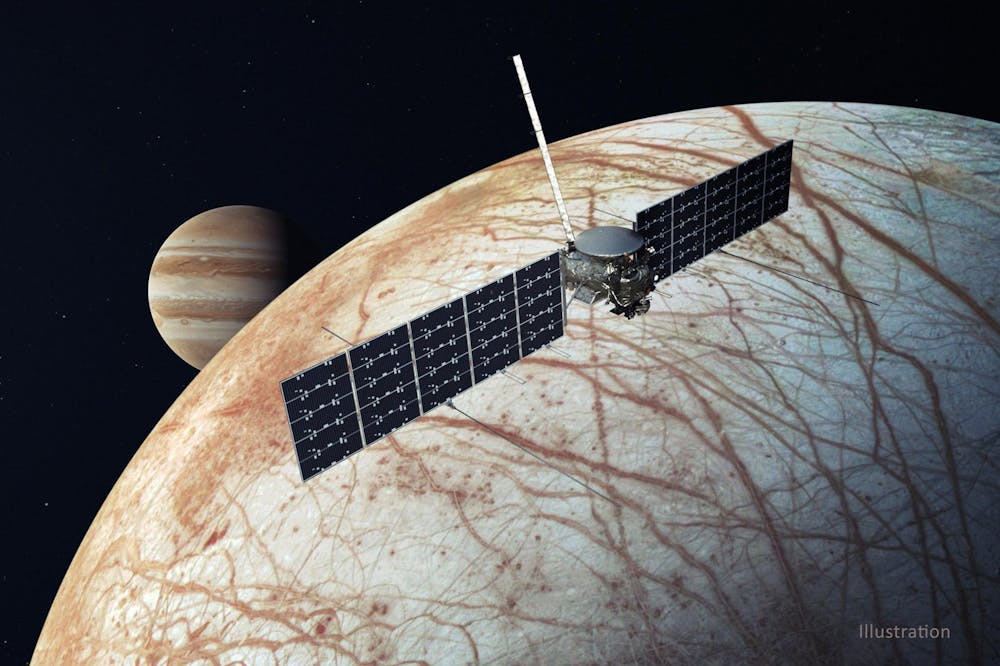
A spacecraft with two large rectangular panels coming off a small cylinder flies above a brown and white moon, with a brown striped planet in the background.

Illustration of what the Europa Clipper spacecraft will look like flying by Europa, a moon of Jupiter.
NASA/JPL-Caltech

NASA will launch Europa Clipper, which will explore one of Jupiter’s largest moons, Europa. Europa is slightly smaller than Earth’s Moon, with a surface made of ice. Beneath its icy shell, Europa likely harbors a saltwater ocean, which scientists expect contains over twice as much water as all the oceans here on Earth combined.

With Europa Clipper, scientists want to investigate whether Europa’s ocean could be a suitable habitat for extraterrestrial life.

The mission plans to do this by flying past Europa nearly 50 times to study the moon’s icy shell, its surface’s geology and its subsurface ocean. The mission will also look for active geysers spewing out from Europa.

This mission will change the game for scientists hoping to understand ocean worlds like Europa.

The launch window – the period when the mission could launch and achieve its planned route – opens Oct. 10, 2024, and lasts 21 days. The spacecraft will launch on a SpaceX Falcon Heavy rocket and arrive at the Jupiter system in 2030.

2. Artemis II launch

Four people in orange spacesuits stand in a small white room.

The Artemis II astronauts at the launchpad during a ground systems test in September 2023 at Kennedy Space Center.
NASA

The Artemis program, named after Apollo’s twin sister in Greek mythology, is NASA’s plan to go back to the Moon. It will send humans to the Moon for the first time since 1972, including the first woman and the first person of color. Artemis also includes plans for a longer-term, sustained presence in space that will prepare NASA for eventually sending people even farther – to Mars.

Artemis II is the first crewed step in this plan, with four astronauts planned to be on board during the 10-day mission.

The mission builds upon Artemis I, which sent an uncrewed capsule into orbit around the Moon in late 2022.

Artemis II will put the astronauts into orbit around the Moon before returning them home. It is currently planned for launch as early as November 2024. But there is a chance it will get pushed back to 2025, depending on whether all the necessary gear, such as spacesuits and oxygen equipment, is ready.

3. VIPER to search for water on the Moon

The VIPER rover to survey water at the south pole of the Moon.

VIPER, which stands for Volatiles Investigating Polar Exploration Rover, is a robot the size of a golf cart that NASA will use to explore the Moon’s south pole in late 2024.

Originally scheduled for launch in 2023, NASA pushed the mission back to complete more tests on the lander system, which Astrobotic, a private company, developed as part of the Commercial Lunar Payload Services program.

This robotic mission is designed to search for volatiles, which are molecules that easily vaporize, like water and carbon dioxide, at lunar temperatures. These materials could provide resources for future human exploration on the Moon.

The VIPER robot will rely on batteries, heat pipes and radiators throughout its 100-day mission, as it navigates everything from the extreme heat of lunar daylight – when temperatures can reach 224 degrees Fahrenheit (107 degrees Celsius) – to the Moon’s frigid shadowed regions that can reach a mind-boggling -400 F (-240 C).

VIPER’s launch and delivery to the lunar surface is scheduled for November 2024.

4. Lunar Trailblazer and PRIME-1 missions

NASA has recently invested in a class of small, low-cost planetary missions called SIMPLEx, which stands for Small, Innovative Missions for PLanetary Exploration. These missions save costs by tagging along on other launches as what is called a rideshare, or secondary payload.

One example is the Lunar Trailblazer. Like VIPER, Lunar Trailblazer will look for water on the Moon.

But while VIPER will land on the Moon’s surface, studying a specific area near the south pole in detail, Lunar Trailblazer will orbit the Moon, measuring the temperature of the surface and mapping out the locations of water molecules across the globe.

Currently, Lunar Trailblazer is on track to be ready by early 2024.

However, because it is a secondary payload, Lunar Trailblazer’s launch timing depends on the primary payload’s launch readiness. The PRIME-1 mission, scheduled for a mid-2024 launch, is Lunar Trailblazer’s ride.

PRIME-1 will drill into the Moon – it’s a test run for the kind of drill that VIPER will use. But its launch date will likely depend on whether earlier launches go on time.

An earlier Commercial Lunar Payload Services mission with the same landing partner was pushed back to February 2024 at the earliest, and further delays could push back PRIME-1 and Lunar Trailblazer.

5. JAXA’s Martian Moon eXploration mission

The JAXA MMX mission concept to study Phobos and Deimos, Mars’ moons.

While Earth’s Moon has many visitors – big and small, robotic and crewed – planned for 2024, Mars’ moons Phobos and Deimos will soon be getting a visitor as well. The Japanese Aerospace Exploration Agency, or JAXA, has a robotic mission in development called the Martian Moon eXploration, or MMX, planned for launch around September 2024.

The mission’s main science objective is to determine the origin of Mars’ moons. Scientists aren’t sure whether Phobos and Deimos are former asteroids that Mars captured into orbit with its gravity or if they formed out of debris that was already in orbit around Mars.

The spacecraft will spend three years around Mars conducting science operations to observe Phobos and Deimos. MMX will also land on Phobos’ surface and collect a sample before returning to Earth.

6. ESA’s Hera mission

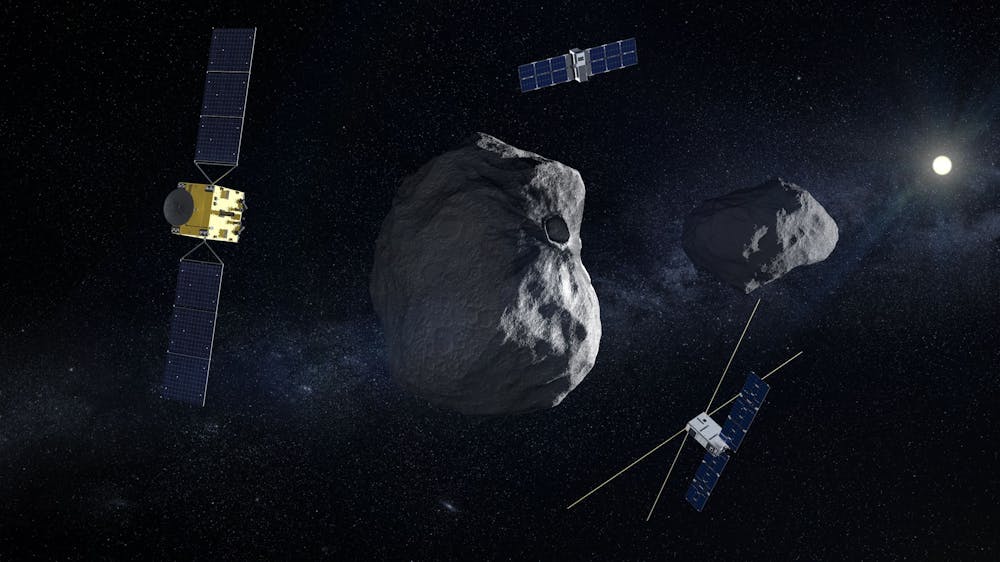
An illustration of two gray asteroids, next to a gold box with two large rectangular panels on either side, and two smaller crafts.

An artist’s conception of the Hera mission to literally measure the impact of NASA’s DART mission in 2022.
ESA

Hera is a mission by the European Space Agency to return to the Didymos-Dimorphos asteroid system that NASA’s DART mission visited in 2022.

But DART didn’t just visit these asteroids, it collided with one of them to test a planetary defense technique called “kinetic impact.” DART hit Dimorphos with such force that it actually changed its orbit.

The kinetic impact technique smashes something into an object in order to alter its path. This could prove useful if humanity ever finds a potentially hazardous object on a collision course with Earth and needs to redirect it.

Hera will launch in October 2024, making its way in late 2026 to Didymos and Dimorphos, where it will study physical properties of the asteroids.The Conversation

Ali M. Bramson, Assistant Professor of Earth, Atmospheric, and Planetary Sciences, Purdue University

This article is republished from The Conversation under a Creative Commons license. Read the original article (https://theconversation.com/from-the-moons-south-pole-to-an-ice-covered-ocean-world-several-exciting-space-missions-are-slated-for-launch-in-2024-218000).

Source: cyberpogo.com

NASA’s Deep Space Network Turns 60 and Prepares for the Future

0

The agency’s DSN provides critical communications and navigation services to dozens of space missions, and it’s being modernized to support dozens more.

NASA’s Deep Space Network marks its 60th year on Dec. 24. In continuous operations since 1963, the DSN is what makes it possible for NASA to communicate with spacecraft at or beyond the Moon. The dazzling galactic images captured by the James Webb Space Telescope, the cutting-edge science data being sent back from Mars by the Perseverance rover, and the historic images sent from the far side of the Moon by Artemis I – they all reached Earth via the network’s giant radio dish antennas.

During 2024, these and other historic contributions from the past 60 years will be celebrated by NASA’s Space Communications and Navigation (SCaN) program, which manages and directs the ground-based facilities and services that the DSN provides.

More than 40 missions depend on the network, which is expected to support twice that number in the coming years. That’s why NASA is looking to the future by expanding and modernizing this critical global infrastructure with new dishes, new technologies, and new approaches.

“The DSN is the heart of NASA – it has the vital job of keeping the data flowing between Earth and space,” said Philip Baldwin, acting director of the network services division for SCaN at NASA Headquarters in Washington. “But to support our growing portfolio of robotic missions, and now the human Artemis missions to the Moon, we need to push forward with the next phase of DSN modernization.”

Meeting Added Demands

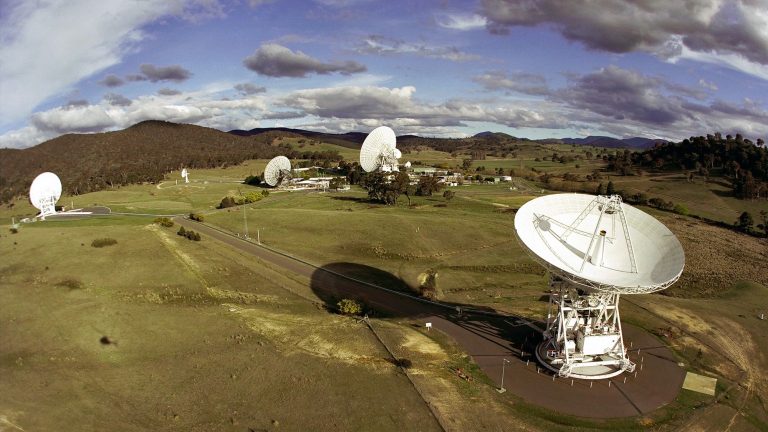
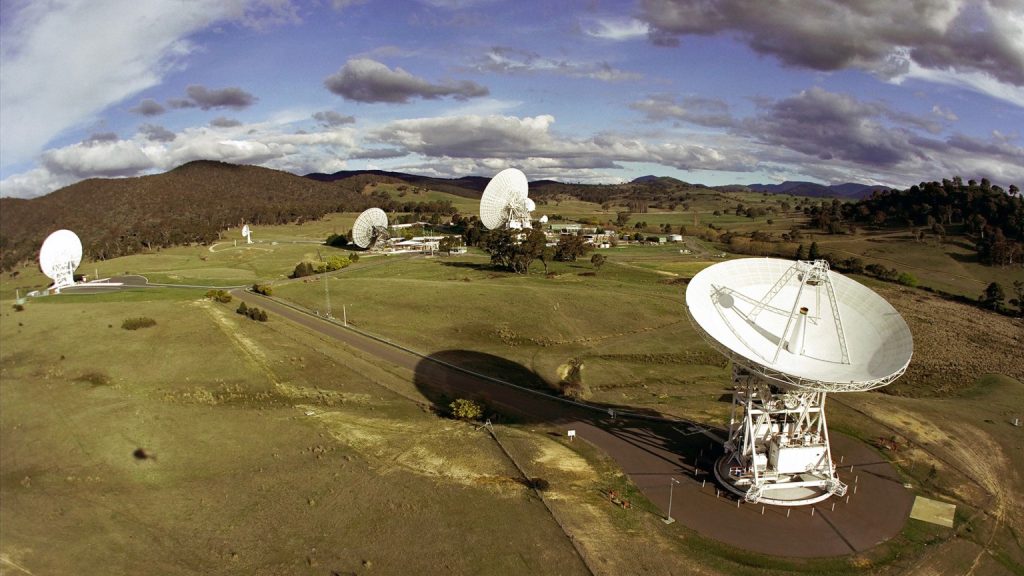
Managed by NASA’s Jet Propulsion Laboratory in Southern California for SCaN, the DSN allows missions to track, send commands to, and receive scientific data from faraway spacecraft. To ensure those spacecraft can always connect with Earth, the DSN’s 14 antennas are divided between three complexes spaced equally around the world – in Goldstone, California; Canberra, Australia; and Madrid, Spain.

The Deep Space Network is much more than a deep space messaging service. Learn more about how the DSN carries out radio and gravity science experiments throughout the solar system. Credit: NASA/JPL-Caltech

To make sure the network can maximize coverage between so many missions, schedulers work with DSN team members to secure network support for critical operations. For more efficiency, NASA has also changed how the network is operated: With a protocol called “Follow the Sun,” each complex takes turns running the entire network during their day shift and then hands off control to the next complex at the end of the day in that region – essentially, a global relay race that takes place every 24 hours. The cost savings, in turn, help fund DSN enhancements.

At the same time, NASA has been busy making improvements to increase capacity, from upgrading and adding dishes to developing new technologies that will help support more spacecraft and dramatically increase the amount of data that can be delivered.

One such technology is laser, or optical, communications, which could enable more data to be packed into transmissions. “Laser communications could transform how NASA communicates with faraway space missions,” said Amy Smith, deputy project manager for the DSN at JPL.

After successfully testing the technique in Earth orbit and out to the Moon, NASA is currently using the DSOC (Deep Space Optical Communications) technology demonstration to test laser communications from ever-greater distances. Riding aboard the agency’s Psyche mission, DSOC has already sent video via laser to Earth from 19 million miles (31 million kilometers) away and aims to prove that high-bandwidth data can be sent from as far away as Mars.

“NASA is proving that laser communication is viable, so now we are looking at ways to build optical terminals inside the existing radio antennas,” said Smith. “These hybrid antennas will be able to still transmit and receive radio frequencies but will also support optical frequencies.”

Technological Heritage

New technology is something that NASA and the DSN have embraced from their inception. The network’s roots extend to 1958, when JPL was contracted by the U.S. Army to deploy portable radio tracking stations to receive telemetry of the first successful U.S. satellite, Explorer 1, which JPL built. A few days after Explorer 1’s launch, but before the creation of NASA later that year, JPL was tasked with figuring out what would be needed to create an unprecedented telecommunications network to support future deep space missions, beginning with the early Pioneer missions.

After NASA formed in 1958, JPL’s ground stations were named Deep Space Information Facilities, and they operated largely independently from one another until 1963. That’s when the DSN was officially founded and the ground stations were connected to JPL’s new network control center, which was nearing completion. Called the Space Flight Operations Facility, that building remains the “Center of the Universe” through which data from the DSN’s three global complexes flows.

“We have six decades driving technological innovation, supporting hundreds of missions that have made countless discoveries about our planet and the universe it inhabits,” said Bradford Arnold, deputy director for the Interplanetary Network at JPL. “Our amazing workforce that continues to drive that innovation today forms a steadfast foundation upon which we can build the next 60 years of space exploration and scientific advancement.”

For more information about the DSN, visit:

https://www.nasa.gov/communicating-with-missions/dsn/

News Media Contact

Ian J. O’Neill
Jet Propulsion Laboratory, Pasadena, Calif.
818-354-2649
[email protected]

2023-187

By: Jet Propulsion Laboratory
Originally published at: NASA

Experience a British Christmas Wherever You Are with guzz

0

The holiday season is synonymous with a certain magic, a time of year steeped in tradition and celebration. In the UK, Christmas is not just a festival; it’s an experience. From the twinkling lights on Regent Street to the festive markets in Edinburgh, there’s a unique charm to a British Christmas.

But what if you’re miles away from the UK? How do you capture that quintessential British holiday spirit? guzz, your personal shopper in the UK, brings the solution, delivering the magic of a British Christmas to your doorstep, anywhere in the world.

The Essence of a British Christmas

There’s something deeply nostalgic and heartwarming about the British approach to Christmas. It’s in the handcrafted decorations adorning the homes, the bespoke gifts exchanged, and the artisanal treats that grace the tables. This year, even if you are far from British shores, you can still experience this festive charm. Guzz offers you a direct link to a wide range of British Christmas essentials and luxuries, perfect for creating your own holiday magic.

Guzz: Bringing UK’s Festive Delights to You

As your personal shopper in the UK, Guzz is dedicated to curating and delivering the finest British holiday products. Whether it’s festive homewares, seasonal apparel, or the rich flavours of British Christmas cuisine, we bring it all to you. Our extensive network across the UK ensures that we source the best and the most authentic holiday items.

How It Works

The process is as simple as hanging your stockings by the fireplace:

  1. List Your Desires: Visit guzz’s Personal Shopper Request Form and specify what British Christmas items you’re looking for.
  2. We Source for You: Our team, with their elf-like efficiency, will scour the UK to find exactly what you need, be it a specific brand of Christmas pudding or hand-knitted winter wear.
  3. A Parcel of Joy: We arrange for the purchase and safe delivery of your items right to your doorstep, anywhere in the world.

A Glimpse of What Guzz Offers This Christmas

  • Handcrafted Decorations: Imagine adorning your home with handmade wreaths or bespoke ornaments that carry the essence of a traditional British Christmas.
  • Seasonal Apparel: From woollen scarves to festive jumpers, our range of apparel and accessories will add a touch of British elegance to your holiday wardrobe.
  • Festive Foods and Treats: Craving for mince pies or Christmas pudding? We source the most authentic and delicious British festive treats.
  • Unique Gifts: Find that perfect, one-of-a-kind British gift for your loved ones. From artisanal crafts to luxury items, we have a plethora of options.

The Joy of Shopping with Guzz

Guzz is not just about shopping; it’s about experiencing the joy and tradition of a British Christmas. We understand that the holiday season is about creating memories and upholding traditions. Our goal is to make this Christmas as special and authentic as it would be if you were strolling through London street.

Whether you’re a British expat longing for a taste of home or simply an admirer of the UK’s festive traditions, guzz is here to make your Christmas wishes come true. Visit us, let us know what would make your holiday season special, and we’ll bring the British Christmas spirit right to your living room; the warmth and joy of a UK Christmas are just a click away.

The Ideal Wardrobe Solution for Programmers – The Coda Line Exclusively at guzz

0

In the rapidly evolving digital world, where lines of code create landscapes of opportunity, there’s a unique breed of professionals we all depend on – programmers. They are the architects of our digital infrastructure, the silent warriors of the tech world. And if you are a programmer or have a programmer in your life, you’ll understand that their world is one of logic, efficiency, and precision. It’s a world where every second counts, and ironically, the last thing they need to be pondering over is what shirt to wear.

In comes the Coda Line from the Ideals Collection, exclusively available at guzz – a stylish solution that celebrates the essence of programming while offering practical daily wear.

Understanding the Programmer’s Mindset

The life of a programmer is one of intense focus and dedication. Their days (and often nights) are spent in the pursuit of creating seamless digital experiences, debugging complex codes, and innovating for the future. This rigorous lifestyle leaves little room for trivial decisions, especially mundane ones like choosing an outfit for the day. That’s where the Ideals Coda Collection steps in.

The Ideals Coda Collection: Style Meets Functionality

In collaboration with London design house Z/O/E, guzz has curated a collection that speaks directly to the heart of every programmer. The Coda Line is not just a range of apparel; it’s a statement – a way for programmers to wear their identity with pride and for those around them to show appreciation for their tireless efforts.

This exclusive collection features shirts that are thoughtfully designed with subtle nods to the programming world. Imagine wearing a shirt that has a sleek, minimalist design with an abstract representation of a code snippet or a witty programming pun. These are shirts that don’t scream for attention but rather, resonate with a quiet confidence – much like the programmers themselves.

Perfect Gift for the Programmer in Your Life

Choosing gifts for programmers can be a daunting task. What do you get someone whose life revolves around coding and technology? The Coda Line presents a perfect solution. It’s a thoughtful, practical, and stylish gift that any programmer would appreciate. It’s not just another shirt; it’s a garment that understands and celebrates their passion and profession.

In collaboration with Z/O/E, Guzz ensures that each piece in the collection meets the highest standards of design and quality. As the world becomes increasingly digital, the role of programmers in shaping our future becomes more significant. The Ideals Collection is more than just apparel; it’s a celebration of this evolving culture, a nod to those who are building the digital world one line of code at a time.

Whether you’re a programmer looking to add a touch of personal expression to your wardrobe or someone looking to show appreciation for a programmer in your life, the Ideals Coda Collection at Guzz is your ideal choice. It’s time to embrace the coding culture with style, comfort, and pride.

Visit guzz today and discover more. It’s not just a purchase; it’s a tribute to the spirit of programming.

Give The Gift Of Exquisite British Craftsmanship This Christmas

0

As the festive season approaches, bringing with it the perennial question of what to gift our loved ones, why not consider something truly special this year? British craftsmanship, renowned for its quality and attention to detail, offers a range of exquisite gifts that are perfect for the festive season. At guzz, our collection celebrates the best of British artisanal and handmade products, from bespoke apparel to charming homewares, all imbued with a touch of class and tradition unique to the UK.

The Allure of British Handmade Apparel

British fashion is celebrated globally for its combination of timeless elegance and contemporary design. This Christmas, consider gifting a piece of this heritage. At guzz, we offer an array of British-made apparel, each piece crafted with meticulous care. From luxurious knitwear to tailored garments, these pieces aren’t just clothes; they’re heirlooms that carry the legacy of British sartorial excellence.

Homewares with a British Touch

When it comes to home decor, British craftsmanship speaks volumes in elegance and quality. Our selection of homewares ranges from hand-thrown pottery to bespoke decor pieces. These items are more than mere objects; they tell a story of traditional techniques passed down through generations, making them perfect gifts that add a touch of British charm to any home.

Literary Gifts for the Book Lovers

The UK has a rich literary heritage, and what better gift for the book enthusiasts in your life than a beautifully bound volume or a piece of literary memorabilia? Our selection at guzz includes collector’s editions of classic British literature, contemporary works from UK authors, and elegant stationery, ideal for penning one’s own stories or musings.

Scented Delights from the British Isles

The art of fragrance is another realm where British artisans excel. This Christmas, choose from a range of handcrafted scents, be it luxurious candles or bespoke perfumes, each with a unique fragrance that captures the essence of the British countryside or the sophistication of its cities.

At guzz, we pride ourselves on curating a selection that showcases the finest British craftsmanship. Our commitment is to offer products that are not only of exceptional quality but also ethically sourced and sustainably made. When you choose a gift from guzz, you’re not just giving a present; you’re passing on a piece of British heritage and artistry.

As we celebrate this season of giving, let us embrace the beauty and quality that British craftsmanship brings. Visit guzz to find that perfect, thoughtful gift that your loved ones will treasure for years to come.

Winter Is Here. The Best Months Ahead To Get Cozy.

0

Winter is here and its here to stay for a fairly long time. It is the moment for a holiday. From visiting ski resorts or for others opting to to travel to a warmer climate. While winter in the United States, United Kingdom, Japan and similar temperate climates are different, the one that remains common is the chill it brings.

If you and your family decided to stay in the comfort of your home. We must make sure to keep ourselves warm and cozy. There is a saying that “Air conditioning is man’s  triumph against nature”, but we must also realise that “fire was the first discovery of man”. And through the years we have excelled in keeping ourselves heated as much as possible.

Take for example, the heater, it has improved so much that it has become portable. While room heaters is still common and still the most efficient. Portable ones like heating blanket are as just much of “need” rather than just a “want”.

If you’ve been Japan you would know that there are these warm blanket called Kotatsu. Which are basically heated table. You sit down, put your legs inside the table, and the special futon that will keep the warmth in together with a heater. If that’s not your thing, there are many kinds of warming devices available

The warmth of a home is often associated with love. What better way to enjoy the winter with loved ones (or by yourself), than to be in a pleasant environment where you could relax in the most comfortable temperature you could achieve.

Tuck in, brew a hot cup of cocoa, coffee or tea, and get comfortable as winter is coming.

A Day In the Life of a Chess Player

0

The day started in the most awe-inspiring sunshine. The coffee maker started rumbling, a signal that it’s time to get out of your comfortable bed. Cooking your own breakfast, or better yet, a special someone made it for you.

Being a chess player is a life filled with hard work, practice and concentration. While most of the time spent on high level chess is memorising. There are also moments where time and effort is put into research. 

After hours and hours of focus on chess you’d need time to relax while. You sit back. Then taking a glance in the place of comfort you see this amazing chess set

Chess Set

The design just simply take you back in time. As the pieces are actually a replica, where the original is housed in British Museum. You will feel that these are how it looked like when chess was also played decades ago. 

There are also some interesting fact about this chess set. They were found in the vicinity of Uig on the Isle of Lewis, but were probably made in Norway, in around 1150-1200 AD. As most of us know there is a chess grandmaster, considered to be the GOAT, named Magnus Carlsen, who has won not just one but five times the World Chess Championship. Who by coincidence is also from Norway.

With all the talk of cheating, accusations and other accusations in the world of chess. Sometimes it’s just stressful for those who are actually doing their best. Trying to make a living by joining online tournaments. Why not relax for a bit and look at a chess set, and realise how timeless the game has been.

Wouldn’t it be a great reminder, while mastering chess, you would instantly feel or be blessed by the chess players in Norway many years ago? Just look at how it would make your place of focus, give a perception to you, on how amazing chess is.

Gifts For The Geeks – The Ultimate Apparel & Accessories For Programmers

0

Attention all coders, programmers, and tech enthusiasts! Have you ever felt the urge to express your passion for programming through more than just lines of code? If so, guzz has got you covered. Our unique range of products is specially designed to speak your language – the language of code, creativity, and coolness. Let’s dive into our collection of shirts, mugs, notebooks, and more, each boasting witty, programming-related designs that are sure to delight any tech aficionado.

Programmer-Approved Shirts

First up, check out our Real Main Shirt and our Hello World Shirt. These aren’t just shirts; they’re conversation starters. Perfect for casual Fridays at the office or a laid-back weekend hackathon. They’re a way to say, “I’m a programmer, and I’ve got style.” And to complete your weekday set, see our whole Ideals Collection here.

guzz-coda-line-banner-image-20231213-1200x630

Mugs That Get You

Next, let’s talk mugs. Our Hello World Mug and Back Home Mug are more than just vessels for your favourite caffeine fix; they’re your new code companions. And for those on the move, our Data Types Travel Mug is a must-have. Keep your drinks warm while you decode the world.

Notebooks for Bright Ideas

Every programmer knows that great ideas start with a single line… of notes. Our Real Main Spiral Notebook is perfect for jotting down those late-night ideas or sketching out your next big project. It’s not just a notebook; it’s a vault for your next brilliant invention.

Step Into Code Comfort

And let’s not forget our Programmer’s Home Doormat. Welcome guests into your abode with a mat that says, “Home Sweet Home” like a programmer.

Why guzz?

At guzz, we understand that being a geek is a badge of honour. It’s about embracing your passions, your quirks, and your unique perspective on the world. Our products are designed not just to meet your needs, but to echo your personality. So, whether you’re shopping for yourself or looking for the perfect gift for that special coder in your life, Guzz is your one-stop-shop. It’s time to celebrate the geek within. And to cap it off, get 10% discount on first purchase using the promo code ‘HEYGUZZ10’.