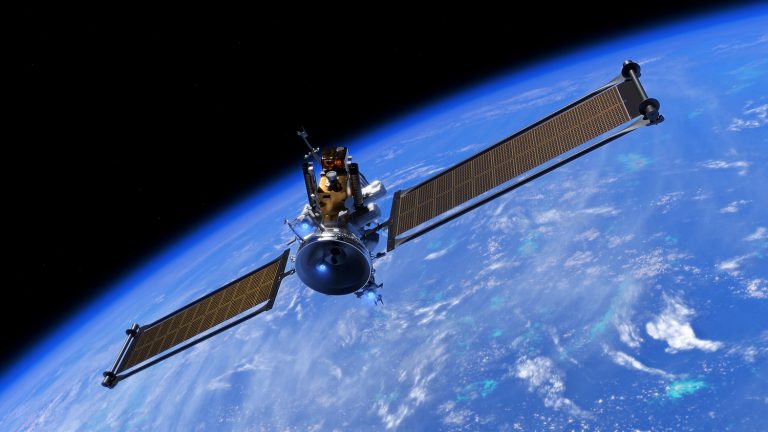
Blue Origin will demonstrate Blue Ring’s mission operation capabilities and core flight systems on an upcoming Defense Innovation Unit (DIU)-sponsored launch, furthering its mission to build a road to space.
Blue Ring’s end-to-end services will seamlessly connect ground and space communications to support a variety of missions on-orbit. The DarkSky-1 (DS-1) mission will demonstrate Blue Origin’s flight systems, including space-based processing capabilities, telemetry, tracking and command (TT&C) hardware, and ground-based radiometric tracking.
“The lessons learned from this DS-1 mission will provide a leap forward for Blue Ring and its ability to provide greater access to multiple orbits, bringing us closer to our vision of millions of people living and working in space for the benefit of Earth,” said Paul Ebertz, Senior Vice President of Blue Origin’s In-Space Systems.
The DS-1 mission is a collaboration between Blue Origin and DIU for in-flight validation of Blue Ring’s orbital payload and mission operation capabilities under an Other Transaction Agreement. The U.S. Space Force’s Space Systems Command’s Assured Access to Space Mission Manifest Office manifested the DS-1 mission to fly on a National Security Space Launch.
Blue Ring has unprecedented delta-V capabilities for commercial and government customers to easily maneuver through multiple orbits. The spacecraft platform also provides in-space processing and access to onboard data storage to ensure a customer’s successful mission.
The DarkSky-1 mission is expected to be launched co-manifested on the upper stage of a future National Security Space Launch. The launch service provider and specific timeframe have not been disclosed.
Throughout time, eclipses have inspired societies to understand the cosmos and its events. (Shutterstock)
Nikhil Arora, Queen’s University, Ontario and Mark Richardson, Queen’s University, Ontario
On April 8, 2024, there will be a total solar eclipse in Canada. This is an opportunity to experience, learn from and participate in the excitement and wonder. And rather than hiding inside, researchers have been communicating how people can safely enjoy this unique opportunity.
Roughly every 18 months, the sun, moon and Earth come into perfect alignment and somewhere on Earth experiences a solar eclipse. During this phenomenon, the moon casts a roughly 250 km wide shadow onto Earth.
This ephemeral daytime darkness can be a once-in-a-lifetime experience. The last time Toronto experienced a total solar eclipse was on Jan. 24, 1925; the next total solar eclipse will occur in 120 years, on Oct. 26, 2144.
Our interpretation of, and response to, total solar eclipses has advanced enormously. Eclipses were once considered cosmic omens that predicted dying kings, good harvests or the need for new territorial treaties. Today, they provide a unique opportunity to consider the physical nature of the universe, and the cosmic privilege of witnessing the alignment of the moon and sun.
Eclipses and knowledge creation
Due to their sudden darkness, solar eclipses have been perceived through history as catastrophic events. Many societies developed stories to explain these unusual events, often filled with fear and violence.
A mural of the Hindu demon Rahu swallowing the moon at the temple Wat Phang La in southern Thailand. (Anandajoti Bhikkhu/flickr), CC BY
Indian myths tell of an immortal demon seeking revenge on Vishnu by trying to eat the sun and moon. The Pomo, Indigenous people of Northern California, describe a huge angry bear trying to eat the sun. In other mythologies, eclipses were thought to be heavenly forces removing our source of warmth and life.
Beliefs about eclipses motivated ancient Greek astronomers to create the antikythera mechanism, a complex analog computer that predicted the timing of future eclipses with a precision of 30 minutes. These predictions were critical for Greek society as a solar eclipse could mean an upcoming death of the king, requiring the appointment of a pseudo-emperor to be killed instead.
Our reactions to eclipses have evolved, driving us to better understand the solar system and the universe at large.
During the eclipse on Aug. 18, 1868, astronomers Norman Lockyer and Pierre Janssen each studied the light from the solar corona to discover a new chemical element. This chemical element was named helium, after the Greek word for the sun.
On May 29, 1919, Frank Watson Dyson and Arthur Stanley Eddington studied the bent path of starlight during a total solar eclipse for the first experimental “triumph of Einstein’s theory” of general relativity.
Fragments of an antikythera mechanism on display at a museum in Athens, Greece. (Shutterstock)
Eclipse experiences
Unlike many other cosmic events, such as meteor showers or comets, which require expensive telescopes or dark sky places, eclipses are a barrier-free celestial event. To safely enjoy the eclipse, one simply needs eclipse viewing glasses or a cardboard box.
Many universities across Canada are using the opportunity of the total solar eclipse to engage with people to safely experience this astronomical phenomenon. For example, Queen’s University in Kingston, Canada is making 120,000 eclipse glasses available to make safe eclipse viewing possible for anyone.
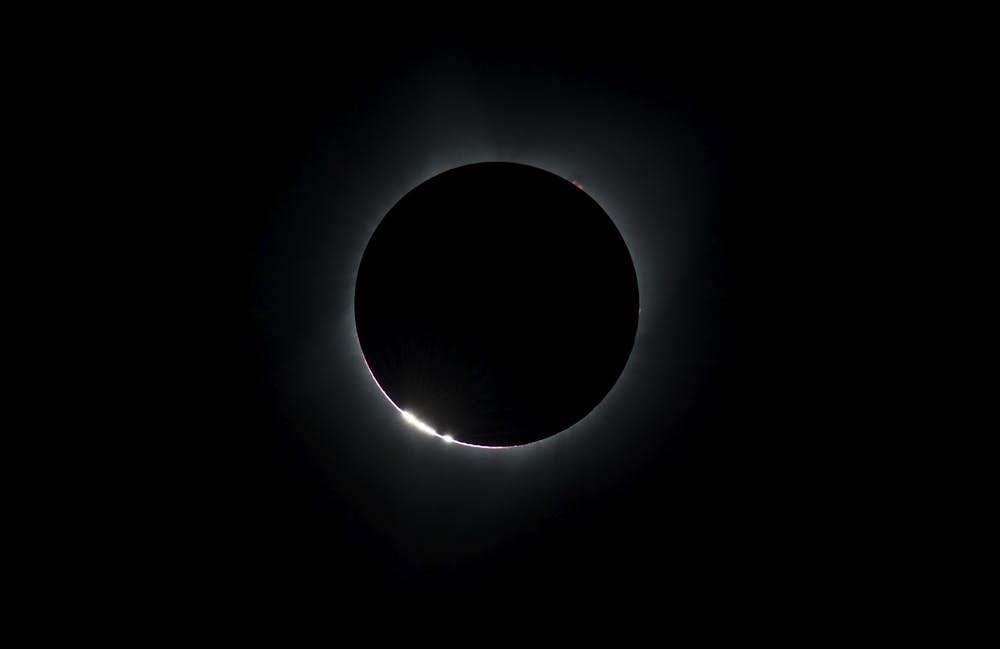
In the spirit of education, hundreds of eclipse ambassadors are heading to schools to engage with students about having a profound and safe experience during the eclipse. These ambassadors lead workshops on building inexpensive pinhole cameras to project the sun during the eclipse, explaining unique features that can be seen during eclipses, such as Bailey’s beads and the diamond ring effect, and helping everyone appreciate the vastness of the solar system.
The Baily’s Beads effect occurs when gaps in the moon’s rugged terrain allow sunlight to pass through in some places just before the total phase of the eclipse. (Aubrey Gemignani/NASA)
These efforts demonstrate the universal value of science, and promote science engagement beyond classrooms and institutions.
Not only is the upcoming eclipse being leveraged as an opportunity to inspire the next generation of scientists, but it is also being used for the advancement of scientific knowledge. Unlike the experiments of Dyson, Eddington and Lockyer that were limited to the academy, today’s institutions are mobilizing the public to conduct citizen science experiments.
Initiated by NASA, the Eclipse Megamovie project will use photos taken during totality of the solar eclipse to study the solar corona. In 2017, photos collected during the total eclipse helped researchers identify a plasma plume in the solar corona. The 2024 eclipse will help researchers study this plume in greater detail.
Anyone with a DSLR camera and a tripod can submit a picture of the total solar eclipse to the Eclipse Megamovie project. The public data collected for the 2024 eclipse will far exceed what could be accomplished by any one experiment or location.
April’s total solar eclipse, and others to come, will remind people that science is exciting and inspiring, and that scientific expertise is of profound universal value. Such a celestial coincidence is an opportunity to engage with local communities and discuss the origin and mechanics of our solar system, all while including the public in scientific discovery through crowd-sourcing images of their experience.
All that’s left is to hope for clear skies and marvel once more at the cosmos.
Nikhil Arora, Postdoctoral fellow, Physics, Engineering Physics & Astronomy, Queen’s University, Ontario and Mark Richardson, Manager for Education and Public Outreach, Adjunct Professor of Physics and Astronomy, Queen’s University, Ontario
This article is republished from The Conversation under a Creative Commons license. Read the original article (https://theconversation.com/total-solar-eclipses-provide-an-opportunity-to-engage-with-science-culture-and-history-222707.
Scales to Tens of Thousands of Grace Blackwell Superchips Using Most Advanced NVIDIA Networking, NVIDIA Full-Stack AI Software, and Storage Features up to 576 Blackwell GPUs Connected as One With NVIDIA NVLink NVIDIA System Experts Speed Deployment for Immediate AI Infrastructure
GTC—NVIDIA today announced its next-generation AI supercomputer — the NVIDIA DGX SuperPOD™ powered by NVIDIA GB200 Grace Blackwell Superchips — for processing trillion-parameter models with constant uptime for superscale generative AI training and inference workloads.
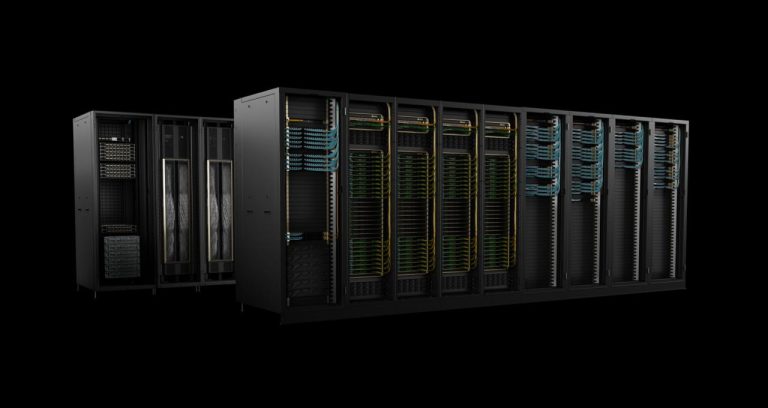
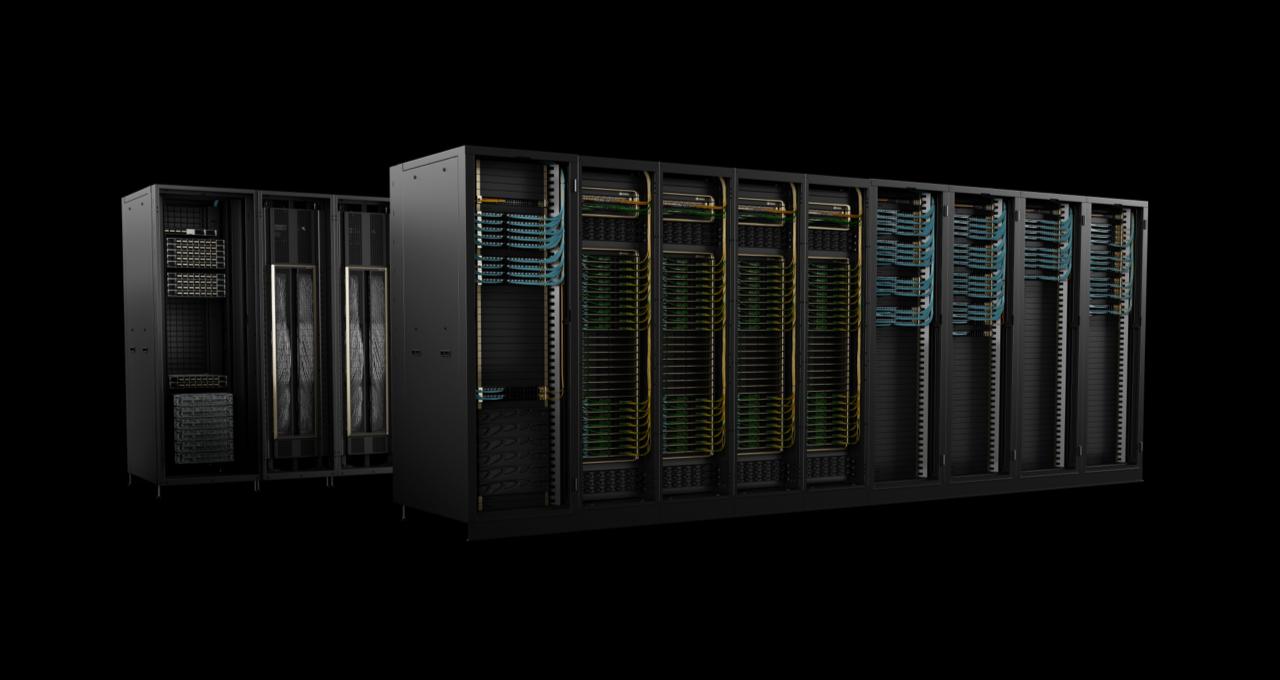
Featuring a new, highly efficient, liquid-cooled rack-scale architecture, the new DGX SuperPOD is built with NVIDIA DGX™ GB200 systems and provides 11.5 exaflops of AI supercomputing at FP4 precision and 240 terabytes of fast memory — scaling to more with additional racks.
Each DGX GB200 system features 36 NVIDIA GB200 Superchips — which include 36 NVIDIA Grace CPUs and 72 NVIDIA Blackwell GPUs — connected as one supercomputer via fifth-generation NVIDIA NVLink®. GB200 Superchips deliver up to a 30x performance increase compared to the NVIDIA H100 Tensor Core GPU for large language model inference workloads.
“NVIDIA DGX AI supercomputers are the factories of the AI industrial revolution,” said Jensen Huang, founder and CEO of NVIDIA. “The new DGX SuperPOD combines the latest advancements in NVIDIA accelerated computing, networking and software to enable every company, industry and country to refine and generate their own AI.”
The Grace Blackwell-powered DGX SuperPOD features eight or more DGX GB200 systems and can scale to tens of thousands of GB200 Superchips connected via NVIDIA Quantum InfiniBand. For a massive shared memory space to power next-generation AI models, customers can deploy a configuration that connects the 576 Blackwell GPUs in eight DGX GB200 systems connected via NVLink.
New Rack-Scale DGX SuperPOD Architecture for Era of Generative AI The new DGX SuperPOD with DGX GB200 systems features a unified compute fabric. In addition to fifth-generation NVIDIA NVLink, the fabric includes NVIDIA BlueField®-3 DPUs and will support NVIDIA Quantum-X800 InfiniBand networking, announced separately today. This architecture provides up to 1,800 gigabytes per second of bandwidth to each GPU in the platform.
Additionally, fourth-generation NVIDIA Scalable Hierarchical Aggregation and Reduction Protocol (SHARP)™ technology provides 14.4 teraflops of In-Network Computing, a 4x increase in the next-generation DGX SuperPOD architecture compared to the prior generation.
Turnkey Architecture Pairs With Advanced Software for Unprecedented Uptime The new DGX SuperPOD is a complete, data-center-scale AI supercomputer that integrates with high-performance storage from NVIDIA-certified partners to meet the demands of generative AI workloads. Each is built, cabled and tested in the factory to dramatically speed deployment at customer data centers.
The Grace Blackwell-powered DGX SuperPOD features intelligent predictive-management capabilities to continuously monitor thousands of data points across hardware and software to predict and intercept sources of downtime and inefficiency — saving time, energy and computing costs.
The software can identify areas of concern and plan for maintenance, flexibly adjust compute resources, and automatically save and resume jobs to prevent downtime, even without system administrators present.
If the software detects that a replacement component is needed, the cluster will activate standby capacity to ensure work finishes in time. Any required hardware replacements can be scheduled to avoid unplanned downtime.
NVIDIA DGX B200 Systems Advance AI Supercomputing for Industries NVIDIA also unveiled the NVIDIA DGX B200 system, a unified AI supercomputing platform for AI model training, fine-tuning and inference.
DGX B200 is the sixth generation of air-cooled, traditional rack-mounted DGX designs used by industries worldwide. The new Blackwell architecture DGX B200 system includes eight NVIDIA Blackwell GPUs and two 5th Gen Intel® Xeon® processors. Customers can also build DGX SuperPOD using DGX B200 systems to create AI Centers of Excellence that can power the work of large teams of developers running many different jobs.
DGX B200 systems include the FP4 precision feature in the new Blackwell architecture, providing up to 144 petaflops of AI performance, a massive 1.4TB of GPU memory and 64TB/s of memory bandwidth. This delivers 15x faster real-time inference for trillion-parameter models over the previous generation.
DGX B200 systems include advanced networking with eight NVIDIA ConnectX™-7 NICs and two BlueField-3 DPUs. These provide up to 400 gigabits per second bandwidth per connection — delivering fast AI performance with NVIDIA Quantum-2 InfiniBand and NVIDIA Spectrum™-X Ethernet networking platforms.
Software and Expert Support to Scale Production AI All NVIDIA DGX platforms include NVIDIA AI Enterprise software for enterprise-grade development and deployment. DGX customers can accelerate their work with the pretrained NVIDIA foundation models, frameworks, toolkits and new NVIDIA NIM microservices included in the software platform.
NVIDIA DGX experts and select NVIDIA partners certified to support DGX platforms assist customers throughout every step of deployment, so they can quickly move AI into production. Once systems are operational, DGX experts continue to support customers in optimizing their AI pipelines and infrastructure.
Availability NVIDIA DGX SuperPOD with DGX GB200 and DGX B200 systems are expected to be available later this year from NVIDIA’s global partners.
For more information, watch a replay of the GTC keynote or visit the NVIDIA booth at GTC, held at the San Jose Convention Center through March 21.
About NVIDIA Since its founding in 1993, NVIDIA (NASDAQ: NVDA) has been a pioneer in accelerated computing. The company’s invention of the GPU in 1999 sparked the growth of the PC gaming market, redefined computer graphics, ignited the era of modern AI and is fueling industrial digitalization across markets. NVIDIA is now a full-stack computing infrastructure company with data-center-scale offerings that are reshaping industry. More information at https://nvidianews.nvidia.com/.
Certain statements in this press release including, but not limited to, statements as to: the benefits, impact, performance, features, and availability of NVIDIA’s products and technologies, including NVIDIA DGX SuperPOD, NVIDIA GB200 Grace Blackwell Superchips, NVIDIA DGX GB200 systems, NVIDIA GB200 Superchips, NVIDIA Grace CPUs, NVIDIA Blackwell GPUs, NVIDIA NVLink, NVIDIA H100 Tensor Core GPU, NVIDIA BlueField-3 DPUs, NVIDIA Quantum-X800 InfiniBand networking, NVIDIA Scalable Hierarchical Aggregation and Reduction Protocol (SHARP) technology, NVIDIA DGX B200 system, NVIDIA B200 Tensor Core GPUs, NVIDIA ConnectX-7 NICs, NVIDIA Quantum-2 InfiniBand, NVIDIA Spectrum-X Ethernet, NVIDIA AI Enterprise software, and NVIDIA NIM; the new DGX SuperPOD enabling every company, industry and country to refine and generate their own AI; and third parties’ use or adoption of our products, platforms and technologies and the benefits and impacts thereof are forward-looking statements that are subject to risks and uncertainties that could cause results to be materially different than expectations. Important factors that could cause actual results to differ materially include: global economic conditions; our reliance on third parties to manufacture, assemble, package and test our products; the impact of technological development and competition; development of new products and technologies or enhancements to our existing product and technologies; market acceptance of our products or our partners’ products; design, manufacturing or software defects; changes in consumer preferences or demands; changes in industry standards and interfaces; unexpected loss of performance of our products or technologies when integrated into systems; as well as other factors detailed from time to time in the most recent reports NVIDIA files with the Securities and Exchange Commission, or SEC, including, but not limited to, its annual report on Form 10-K and quarterly reports on Form 10-Q. Copies of reports filed with the SEC are posted on the company’s website and are available from NVIDIA without charge. These forward-looking statements are not guarantees of future performance and speak only as of the date hereof, and, except as required by law, NVIDIA disclaims any obligation to update these forward-looking statements to reflect future events or circumstances.
Many of the products and features described herein remain in various stages and will be offered on a when-and-if-available basis. The statements above are not intended to be, and should not be interpreted as a commitment, promise, or legal obligation, and the development, release, and timing of any features or functionalities described for our products is subject to change and remains at the sole discretion of NVIDIA. NVIDIA will have no liability for failure to deliver or delay in the delivery of any of the products, features or functions set forth herein.
NVIDIA Quantum-X800 InfiniBand for Highest-Performance AI-Dedicated Infrastructure
NVIDIA Spectrum-X800 Ethernet for AI-Optimized Networking in Every Data Center
NVIDIA Software Distributes Computing Across Blackwell, New Switches and BlueField-3 SuperNICs to Boost AI, Data Processing, HPC and Cloud Workloads
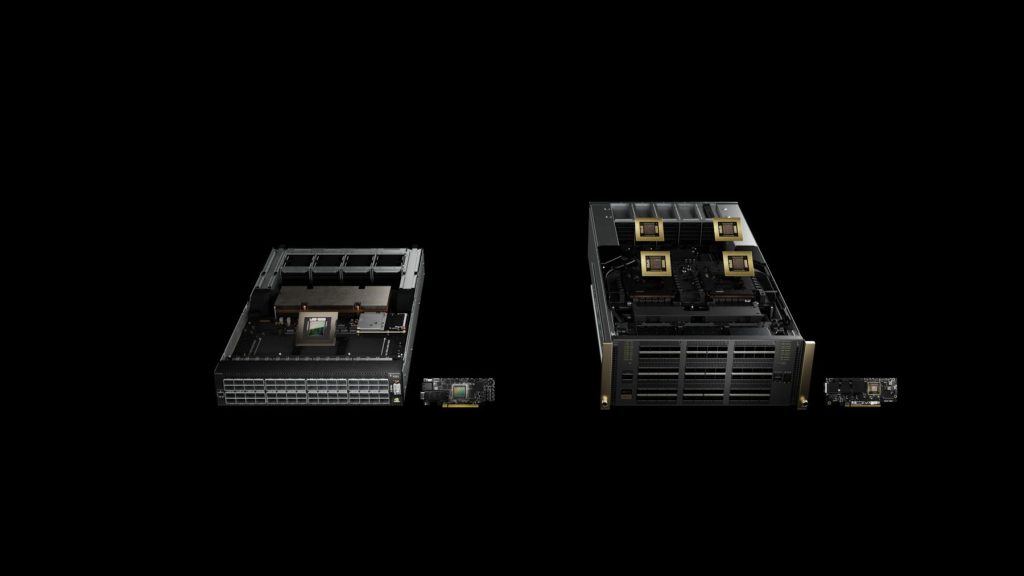
GTC—NVIDIA today announced a new wave of networking switches, the X800 series, designed for massive-scale AI.
The world’s first networking platforms capable of end-to-end 800Gb/s throughput, NVIDIA Quantum-X800 InfiniBand and NVIDIA Spectrum™-X800 Ethernet push the boundaries of networking performance for computing and AI workloads. They feature software that further accelerates AI, cloud, data processing and HPC applications in every type of data center, including those that incorporate the newly released NVIDIA Blackwell architecture-based product lineup.
“NVIDIA Networking is central to the scalability of our AI supercomputing infrastructure,” said Gilad Shainer, senior vice president of Networking at NVIDIA. “NVIDIA X800 switches are end-to-end networking platforms that enable us to achieve trillion-parameter-scale generative AI essential for new AI infrastructures.”
Initial adopters of Quantum InfiniBand and Spectrum-X Ethernet include Microsoft Azure and Oracle Cloud Infrastructure.
“AI is a powerful tool to turn data into knowledge. Behind this transformation is the evolution of data centers into high-performance AI engines with increased demands for networking infrastructure,” said Nidhi Chappell, Vice President of AI Infrastructure at Microsoft Azure. “With new integrations of NVIDIA networking solutions, Microsoft Azure will continue to build the infrastructure that pushes the boundaries of cloud AI.”
Coreweave is also among early adopters.
Next Standard for Extreme Performance The Quantum-X800 platform sets a new standard in delivering the highest performance for AI-dedicated Infrastructure. It includes the NVIDIA Quantum Q3400 switch and the NVIDIA ConnectX®-8 SuperNIC™, which together achieve an industry-leading end-to-end throughput of 800Gb/s. This is 5x higher bandwidth capacity and a 9x increase of 14.4Tflops of In-Network Computing with NVIDIA’s Scalable Hierarchical Aggregation and Reduction Protocol (SHARPv4) compared to the previous generation.
The Spectrum-X800 platform delivers optimized networking performance for AI cloud and enterprise infrastructure. Utilizing the Spectrum SN5600 800Gb/s switch and the NVIDIA BlueField®-3 SuperNIC, the Spectrum-X800 platform provides advanced feature sets crucial for multi-tenant generative AI clouds and large enterprises.
Spectrum-X800 optimizes network performance, facilitating faster processing, analysis, and execution of AI workloads, thereby expediting the development, deployment, and time to market of AI solutions. Designed specifically for multi-tenant environments, Spectrum-X800 ensures performance isolation for each tenant’s AI workloads to maintain optimal and consistent performance levels, enhancing customer satisfaction and service quality.
NVIDIA Software Support NVIDIA provides a comprehensive suite of network acceleration libraries, software development kits and management software to optimize performance for trillion-parameter AI models.
This includes NVIDIA Collective Communications Library (NCCL), which extends GPU parallel computing tasks to the Quantum-X800 network fabric, taking advantage of its powerful In-Network Computing capabilities with SHARPv4 supporting FP8, supercharging performance for large model training and generative AI.
NVIDIA’s full-stack software approach provides advanced programmability, making data center networks more flexible, reliable and responsive, ultimately increasing overall operational efficiency and supporting the needs of modern applications and services.
Ecosystem Momentum Next year, Quantum-X800 and Spectrum-X800 will be available from a wide range of leading infrastructure and system vendors around the world, including Aivres, DDN, Dell Technologies, Eviden, Hitachi Vantara, Hewlett Packard Enterprise, Lenovo, Supermicro and VAST Data.
About NVIDIA Since its founding in 1993, NVIDIA (NASDAQ: NVDA) has been a pioneer in accelerated computing. The company’s invention of the GPU in 1999 sparked the growth of the PC gaming market, redefined computer graphics, ignited the era of modern AI and is fueling industrial digitalization across markets. NVIDIA is now a full-stack computing infrastructure company with data-center-scale offerings that are reshaping industry. More information at https://nvidianews.nvidia.com/.
Certain statements in this press release including, but not limited to, statements as to: the benefits, impact, performance, features, and availability of NVIDIA’s products and technologies, including NVIDIA Quantum-X800 InfiniBand, NVIDIA Spectrum-X800 Ethernet, NVIDIA Blackwell architecture-based products, NVIDIA Quantum Q3400 switch, NVIDIA ConnectX-8 SuperNIC, NVIDIA’s Scalable Hierarchical Aggregation and Reduction Protocol (SHARPv4), Spectrum SN5600 800Gb/s switch, NVIDIA BlueField-3 SuperNIC, and NVIDIA Collective Communications Library (NCCL); NVIDIA X800 switches enabling us to achieve trillion-parameter-scale generative AI essential for new AI infrastructures; NVIDIA’s full-stack software approach making data center networks more flexible, reliable and responsive, ultimately increasing overall operational efficiency and supporting the needs of modern applications and services; and third parties’ use and adoption of NVIDIA’s products and technologies, and the benefits thereof are forward-looking statements that are subject to risks and uncertainties that could cause results to be materially different than expectations. Important factors that could cause actual results to differ materially include: global economic conditions; our reliance on third parties to manufacture, assemble, package and test our products; the impact of technological development and competition; development of new products and technologies or enhancements to our existing product and technologies; market acceptance of our products or our partners’ products; design, manufacturing or software defects; changes in consumer preferences or demands; changes in industry standards and interfaces; unexpected loss of performance of our products or technologies when integrated into systems; as well as other factors detailed from time to time in the most recent reports NVIDIA files with the Securities and Exchange Commission, or SEC, including, but not limited to, its annual report on Form 10-K and quarterly reports on Form 10-Q. Copies of reports filed with the SEC are posted on the company’s website and are available from NVIDIA without charge. These forward-looking statements are not guarantees of future performance and speak only as of the date hereof, and, except as required by law, NVIDIA disclaims any obligation to update these forward-looking statements to reflect future events or circumstances.
NVIDIA cuLitho Accelerates Semiconductor Manufacturing’s Most Compute-Intensive Workload by 40-60x, Opens Industry to New Generative AI Algorithms
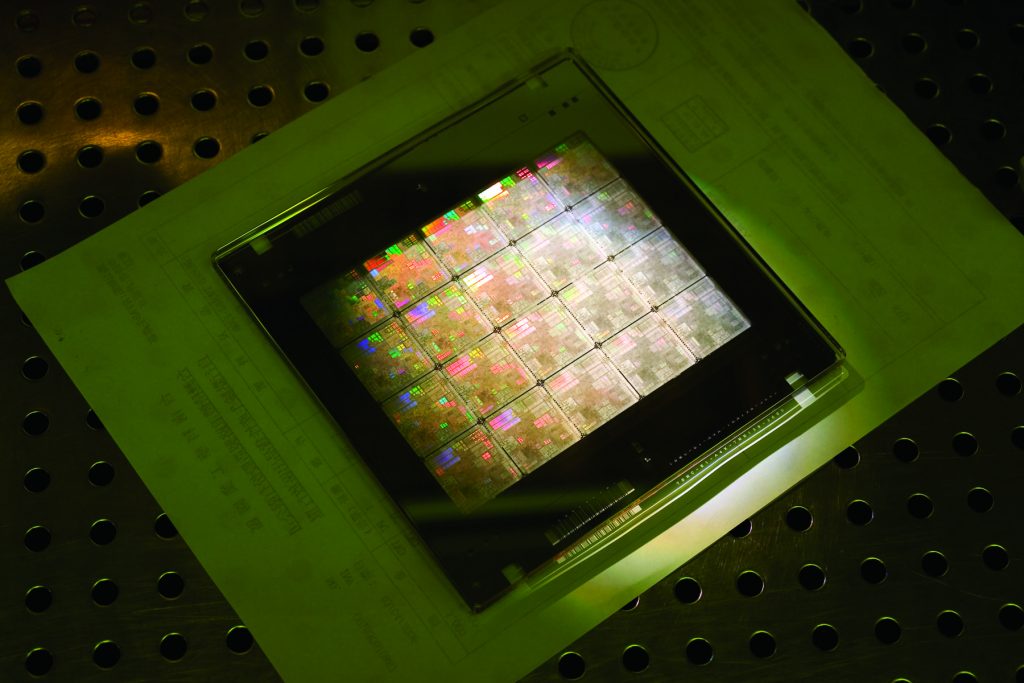
GTC—NVIDIA today announced that TSMC and Synopsys are going into production with NVIDIA’s computational lithography platform to accelerate manufacturing and push the limits of physics for the next generation of advanced semiconductor chips.
TSMC, the world’s leading foundry, and Synopsys, the leader in silicon to systems design solutions, have integrated NVIDIA cuLitho with their software, manufacturing processes and systems to speed chip fabrication, and in the future support the latest-generation NVIDIA Blackwell architecture GPUs.
“Computational lithography is a cornerstone of chip manufacturing,” said Jensen Huang, founder and CEO of NVIDIA. “Our work on cuLitho, in partnership with TSMC and Synopsys, applies accelerated computing and generative AI to open new frontiers for semiconductor scaling.”
NVIDIA also introduced new generative AI algorithms that enhance cuLitho, a library for GPU-accelerated computational lithography, dramatically improving the semiconductor manufacturing process over current CPU-based methods.
Semiconductor Leaders Advance cuLitho Platform Computational lithography is the most compute-intensive workload in the semiconductor manufacturing process, consuming tens of billions of hours per year on CPUs. A typical mask set for a chip — a key step in its production — could take 30 million or more hours of CPU compute time, necessitating large data centers within semiconductor foundries. With accelerated computing, 350 NVIDIA H100 systems can now replace 40,000 CPU systems, accelerating production time, while reducing costs, space and power.
“Our work with NVIDIA to integrate GPU-accelerated computing in the TSMC workflow has resulted in great leaps in performance, dramatic throughput improvement, shortened cycle time and reduced power requirements,” said Dr. C.C. Wei, CEO of TSMC. “We are moving NVIDIA cuLitho into production at TSMC, leveraging this computational lithography technology to drive a critical component of semiconductor scaling.”
Since its introduction last year, cuLitho has enabled TSMC to open new opportunities for innovative patterning technologies. In testing cuLitho on shared workflows, the companies jointly realized a 45x speedup of curvilinear flows and a nearly 60x improvement on more traditional Manhattan-style flows. These two types of flows differ — with curvilinear the mask shapes are represented by curves, while Manhattan mask shapes are constrained to be either horizontal or vertical.
“For more than two decades Synopsys Proteus mask synthesis software products have been the production-proven choice for accelerating computational lithography — the most demanding workload in semiconductor manufacturing,” said Sassine Ghazi, president and CEO of Synopsys. “With the move to advanced nodes, computational lithography has dramatically increased in complexity and compute cost. Our collaboration with TSMC and NVIDIA is critical to enabling angstrom-level scaling as we pioneer advanced technologies to reduce turnaround time by orders of magnitude through the power of accelerated computing.”
Synopsys is the pioneer in delivering advanced techniques for accelerating the performance of computational lithography. Synopsys’ Proteus™ optical proximity correction software running on the NVIDIA cuLitho software library significantly speeds computational workloads compared to current CPU-based methods. With Proteus mask synthesis products, manufacturers like TSMC can achieve exceptional precision, efficiency and speed in proximity correction, model building for correction, and analyzing proximity effects on corrected and uncorrected IC layout patterns, revolutionizing the chip fabrication process.
Breakthrough Generative AI Support for Computational Lithography NVIDIA has developed algorithms to apply generative AI to further enhance the value of the cuLitho platform. The new generative AI workflow delivers an additional 2x speedup on top of the accelerated processes enabled through cuLitho. The application of generative AI enables creation of a near-perfect inverse mask or inverse solution to account for diffraction of light. The final mask is then derived by traditional and physically rigorous methods, speeding up the overall optical proximity correction (OPC) process by a factor of two.
Many changes in the fab process currently necessitate a revision in OPC, driving up the amount of compute required and creating bottlenecks in the fab development cycle. These costs and bottlenecks are alleviated with the accelerated computing cuLitho provides and generative AI, enabling fabs to allocate available compute capacity and engineering bandwidth to design more novel solutions in development of new technologies for 2nm and beyond.
To learn more, watch Huang’s GTC keynote. Register for GTC to attend 900+ sessions from NVIDIA and industry leaders through March 21.
About NVIDIA Since its founding in 1993, NVIDIA (NASDAQ: NVDA) has been a pioneer in accelerated computing. The company’s invention of the GPU in 1999 sparked the growth of the PC gaming market, redefined computer graphics, ignited the era of modern AI and is fueling industrial digitalization across markets. NVIDIA is now a full-stack computing infrastructure company with data-center-scale offerings that are reshaping industry. More information at https://nvidianews.nvidia.com/.
Certain statements in this press release including, but not limited to, statements as to: the benefits, impact, performance, features, and availability of NVIDIA’s products and technologies, including NVIDIA’s computational lithography platform, NVIDIA Blackwell architecture GPUs, NVIDIA H100 systems, and the NVIDIA cuLitho software library; third parties using our products, services and platforms and our collaborations with them; our work on cuLitho, in partnership with third parties, applying accelerated computing and generative AI to open new frontiers for semiconductor scaling; the new generative AI algorithms introduced by NVIDIA that enhance cuLitho dramatically improving the semiconductor manufacturing process over current CPU-based methods; a typical mask set for a chip taking 30 million or more hours of CPU compute time, necessitating large data centers within semiconductor foundries; the ability of manufacturers like TSMC to achieve exceptional precision, efficiency and speed in proximity correction, model building for correction, and analyzing proximity effects on corrected and uncorrected IC layout patterns, revolutionizing the chip fabrication process with Synopsys’ Proteus mask synthesis products; the application of generative AI enabling creation of a near-perfect inverse mask or inverse solution to account for diffraction of light; and the accelerated computing cuLitho provides and generative AI enabling fabs to allocate available compute capacity and engineering bandwidth to design more novel solutions in development of new technologies for 2nm and beyond are forward-looking statements that are subject to risks and uncertainties that could cause results to be materially different than expectations. Important factors that could cause actual results to differ materially include: global economic conditions; our reliance on third parties to manufacture, assemble, package and test our products; the impact of technological development and competition; development of new products and technologies or enhancements to our existing product and technologies; market acceptance of our products or our partners’ products; design, manufacturing or software defects; changes in consumer preferences or demands; changes in industry standards and interfaces; unexpected loss of performance of our products or technologies when integrated into systems; as well as other factors detailed from time to time in the most recent reports NVIDIA files with the Securities and Exchange Commission, or SEC, including, but not limited to, its annual report on Form 10-K and quarterly reports on Form 10-Q. Copies of reports filed with the SEC are posted on the company’s website and are available from NVIDIA without charge. These forward-looking statements are not guarantees of future performance and speak only as of the date hereof, and, except as required by law, NVIDIA disclaims any obligation to update these forward-looking statements to reflect future events or circumstances.
NVIDIA Blackwell powers a new era of computing, enabling organizations everywhere to build and run real-time generative AI on trillion-parameter large language models.
New Blackwell GPU, NVLink and Resilience Technologies Enable Trillion-Parameter-Scale AI Models
New Tensor Cores and TensorRT- LLM Compiler Reduce LLM Inference Operating Cost and Energy by up to 25x
New Accelerators Enable Breakthroughs in Data Processing, Engineering Simulation, Electronic Design Automation, Computer-Aided Drug Design and Quantum Computing
Widespread Adoption by Every Major Cloud Provider, Server Maker and Leading AI Company
SAN JOSE, Calif., March 18, 2024 (GLOBE NEWSWIRE) — Powering a new era of computing, NVIDIA today announced that the NVIDIA Blackwell platform has arrived — enabling organizations everywhere to build and run real-time generative AI on trillion-parameter large language models at up to 25x less cost and energy consumption than its predecessor.
The Blackwell GPU architecture features six transformative technologies for accelerated computing, which will help unlock breakthroughs in data processing, engineering simulation, electronic design automation, computer-aided drug design, quantum computing and generative AI — all emerging industry opportunities for NVIDIA.
“For three decades we’ve pursued accelerated computing, with the goal of enabling transformative breakthroughs like deep learning and AI,” said Jensen Huang, founder and CEO of NVIDIA. “Generative AI is the defining technology of our time. Blackwell is the engine to power this new industrial revolution. Working with the most dynamic companies in the world, we will realize the promise of AI for every industry.”
Among the many organizations expected to adopt Blackwell are Amazon Web Services, Dell Technologies, Google, Meta, Microsoft, OpenAI, Oracle, Tesla and xAI.
Sundar Pichai, CEO of Alphabet and Google: “Scaling services like Search and Gmail to billions of users has taught us a lot about managing compute infrastructure. As we enter the AI platform shift, we continue to invest deeply in infrastructure for our own products and services, and for our Cloud customers. We are fortunate to have a longstanding partnership with NVIDIA, and look forward to bringing the breakthrough capabilities of the Blackwell GPU to our Cloud customers and teams across Google, including Google DeepMind, to accelerate future discoveries.”
Andy Jassy, president and CEO of Amazon: “Our deep collaboration with NVIDIA goes back more than 13 years, when we launched the world’s first GPU cloud instance on AWS. Today we offer the widest range of GPU solutions available anywhere in the cloud, supporting the world’s most technologically advanced accelerated workloads. It’s why the new NVIDIA Blackwell GPU will run so well on AWS and the reason that NVIDIA chose AWS to co-develop Project Ceiba, combining NVIDIA’s next-generation Grace Blackwell Superchips with the AWS Nitro System’s advanced virtualization and ultra-fast Elastic Fabric Adapter networking, for NVIDIA’s own AI research and development. Through this joint effort between AWS and NVIDIA engineers, we’re continuing to innovate together to make AWS the best place for anyone to run NVIDIA GPUs in the cloud.”
Michael Dell, founder and CEO of Dell Technologies: “Generative AI is critical to creating smarter, more reliable and efficient systems. Dell Technologies and NVIDIA are working together to shape the future of technology. With the launch of Blackwell, we will continue to deliver the next-generation of accelerated products and services to our customers, providing them with the tools they need to drive innovation across industries.”
Demis Hassabis, cofounder and CEO of Google DeepMind: “The transformative potential of AI is incredible, and it will help us solve some of the world’s most important scientific problems. Blackwell’s breakthrough technological capabilities will provide the critical compute needed to help the world’s brightest minds chart new scientific discoveries.”
Mark Zuckerberg, founder and CEO of Meta: “AI already powers everything from our large language models to our content recommendations, ads, and safety systems, and it’s only going to get more important in the future. We’re looking forward to using NVIDIA’s Blackwell to help train our open-source Llama models and build the next generation of Meta AI and consumer products.”
Satya Nadella, executive chairman and CEO of Microsoft: “We are committed to offering our customers the most advanced infrastructure to power their AI workloads. By bringing the GB200 Grace Blackwell processor to our datacenters globally, we are building on our long-standing history of optimizing NVIDIA GPUs for our cloud, as we make the promise of AI real for organizations everywhere.”
Sam Altman, CEO of OpenAI: “Blackwell offers massive performance leaps, and will accelerate our ability to deliver leading-edge models. We’re excited to continue working with NVIDIA to enhance AI compute.”
Larry Ellison, chairman and CTO of Oracle: “Oracle’s close collaboration with NVIDIA will enable qualitative and quantitative breakthroughs in AI, machine learning and data analytics. In order for customers to uncover more actionable insights, an even more powerful engine like Blackwell is needed, which is purpose-built for accelerated computing and generative AI.”
Elon Musk, CEO of Tesla and xAI: “There is currently nothing better than NVIDIA hardware for AI.”
Named in honor of David Harold Blackwell — a mathematician who specialized in game theory and statistics, and the first Black scholar inducted into the National Academy of Sciences — the new architecture succeeds the NVIDIA Hopper™ architecture, launched two years ago.
Blackwell Innovations to Fuel Accelerated Computing and Generative AI Blackwell’s six revolutionary technologies, which together enable AI training and real-time LLM inference for models scaling up to 10 trillion parameters, include:
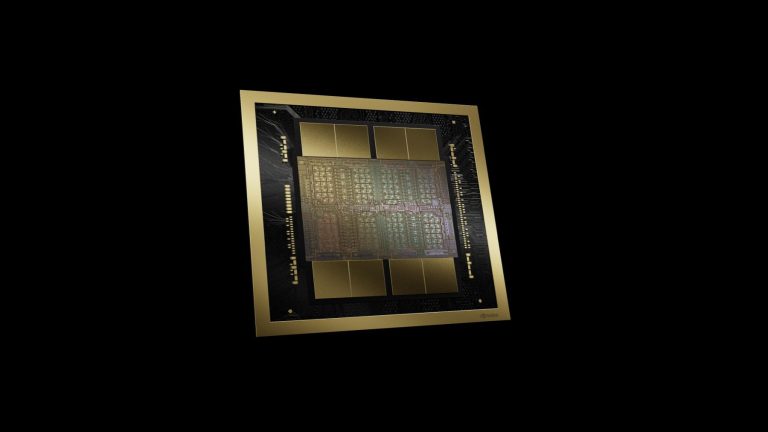
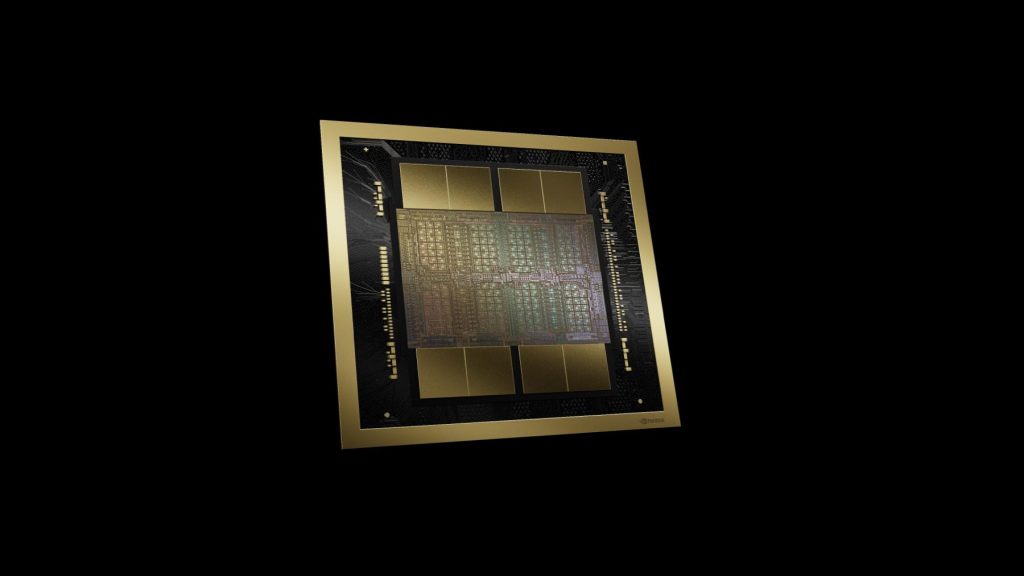
World’s Most Powerful Chip — Packed with 208 billion transistors, Blackwell-architecture GPUs are manufactured using a custom-built 4NP TSMC process with two-reticle limit GPU dies connected by 10 TB/second chip-to-chip link into a single, unified GPU.
Second-Generation Transformer Engine — Fueled by new micro-tensor scaling support and NVIDIA’s advanced dynamic range management algorithms integrated into NVIDIA TensorRT™-LLM and NeMo Megatron frameworks, Blackwell will support double the compute and model sizes with new 4-bit floating point AI inference capabilities.
Fifth-Generation NVLink — To accelerate performance for multitrillion-parameter and mixture-of-experts AI models, the latest iteration of NVIDIA NVLink® delivers groundbreaking 1.8TB/s bidirectional throughput per GPU, ensuring seamless high-speed communication among up to 576 GPUs for the most complex LLMs.
RAS Engine — Blackwell-powered GPUs include a dedicated engine for reliability, availability and serviceability. Additionally, the Blackwell architecture adds capabilities at the chip level to utilize AI-based preventative maintenance to run diagnostics and forecast reliability issues. This maximizes system uptime and improves resiliency for massive-scale AI deployments to run uninterrupted for weeks or even months at a time and to reduce operating costs.
Secure AI — Advanced confidential computing capabilities protect AI models and customer data without compromising performance, with support for new native interface encryption protocols, which are critical for privacy-sensitive industries like healthcare and financial services.
Decompression Engine — A dedicated decompression engine supports the latest formats, accelerating database queries to deliver the highest performance in data analytics and data science. In the coming years, data processing, on which companies spend tens of billions of dollars annually, will be increasingly GPU-accelerated.
A Massive Superchip The NVIDIA GB200 Grace Blackwell Superchip connects two NVIDIA B200 Tensor Core GPUs to the NVIDIA Grace CPU over a 900GB/s ultra-low-power NVLink chip-to-chip interconnect.
For the highest AI performance, GB200-powered systems can be connected with the NVIDIA Quantum-X800 InfiniBand and Spectrum™-X800 Ethernet platforms, also announced today, which deliver advanced networking at speeds up to 800Gb/s.
The GB200 is a key component of the NVIDIA GB200 NVL72, a multi-node, liquid-cooled, rack-scale system for the most compute-intensive workloads. It combines 36 Grace Blackwell Superchips, which include 72 Blackwell GPUs and 36 Grace CPUs interconnected by fifth-generation NVLink. Additionally, GB200 NVL72 includes NVIDIA BlueField®-3 data processing units to enable cloud network acceleration, composable storage, zero-trust security and GPU compute elasticity in hyperscale AI clouds. The GB200 NVL72 provides up to a 30x performance increase compared to the same number of NVIDIA H100 Tensor Core GPUs for LLM inference workloads, and reduces cost and energy consumption by up to 25x.
The platform acts as a single GPU with 1.4 exaflops of AI performance and 30TB of fast memory, and is a building block for the newest DGX SuperPOD.
NVIDIA offers the HGX B200, a server board that links eight B200 GPUs through NVLink to support x86-based generative AI platforms. HGX B200 supports networking speeds up to 400Gb/s through the NVIDIA Quantum-2 InfiniBand and Spectrum-X Ethernet networking platforms.
Global Network of Blackwell Partners Blackwell-based products will be available from partners starting later this year.
AWS, Google Cloud, Microsoft Azure and Oracle Cloud Infrastructure will be among the first cloud service providers to offer Blackwell-powered instances, as will NVIDIA Cloud Partner program companies Applied Digital, CoreWeave, Crusoe, IBM Cloud and Lambda. Sovereign AI clouds will also provide Blackwell-based cloud services and infrastructure, including Indosat Ooredoo Hutchinson, Nebius, Nexgen Cloud, Oracle EU Sovereign Cloud, the Oracle US, UK, and Australian Government Clouds, Scaleway, Singtel, Northern Data Group’s Taiga Cloud, Yotta Data Services’ Shakti Cloud and YTL Power International.
GB200 will also be available on NVIDIA DGX™ Cloud, an AI platform co-engineered with leading cloud service providers that gives enterprise developers dedicated access to the infrastructure and software needed to build and deploy advanced generative AI models. AWS, Google Cloud and Oracle Cloud Infrastructure plan to host new NVIDIA Grace Blackwell-based instances later this year.
Cisco, Dell, Hewlett Packard Enterprise, Lenovo and Supermicro are expected to deliver a wide range of servers based on Blackwell products, as are Aivres, ASRock Rack, ASUS, Eviden, Foxconn, GIGABYTE, Inventec, Pegatron, QCT, Wistron, Wiwynn and ZT Systems.
Additionally, a growing network of software makers, including Ansys, Cadence and Synopsys — global leaders in engineering simulation — will use Blackwell-based processors to accelerate their software for designing and simulating electrical, mechanical and manufacturing systems and parts. Their customers can use generative AI and accelerated computing to bring products to market faster, at lower cost and with higher energy efficiency.
NVIDIA Software Support The Blackwell product portfolio is supported by NVIDIA AI Enterprise, the end-to-end operating system for production-grade AI. NVIDIA AI Enterprise includes NVIDIA NIM™ inference microservices — also announced today — as well as AI frameworks, libraries and tools that enterprises can deploy on NVIDIA-accelerated clouds, data centers and workstations.
To learn more about the NVIDIA Blackwell platform, watch the GTC keynote and register to attend sessions from NVIDIA and industry leaders at GTC, which runs through March 21.
About NVIDIA Since its founding in 1993, NVIDIA (NASDAQ: NVDA) has been a pioneer in accelerated computing. The company’s invention of the GPU in 1999 sparked the growth of the PC gaming market, redefined computer graphics, ignited the era of modern AI and is fueling industrial digitalization across markets. NVIDIA is now a full-stack computing infrastructure company with data-center-scale offerings that are reshaping industry. More information at https://nvidianews.nvidia.com/.
Certain statements in this press release including, but not limited to, statements as to: the benefits, impact, performance, features, and availability of NVIDIA’s products and technologies, including NVIDIA Blackwell platform, Blackwell GPU architecture, Resilience Technologies, Custom Tensor Core technology, NVIDIA TensorRT-LLM, NeMo Megatron framework, NVLink, NVIDIA GB200 Grace Blackwell Superchip, B200 Tensor Core GPUs, NVIDIA Grace CPU, NVIDIA H100 Tensor Core GPU, NVIDIA Quantum-X800 InfiniBand and Spectrum-X800 Ethernet platforms, NVIDIA GB200 NVL72, NVIDIA BlueField-3 data processing units, DGX SuperPOD, HGX B200, Quantum-2 InfiniBand and Spectrum-X Ethernet platforms, BlueField-3 DPUs, NVIDIA DGX Cloud, NVIDIA AI Enterprise, and NVIDIA NIM inference microservices; our goal of enabling transformative breakthroughs like deep learning and AI; Blackwell GPUs being the engine to power a new industrial revolution; our ability to realize the promise of AI for every industry as we working with the most dynamic companies in the world; our collaborations and partnerships with third parties and the benefits and impacts thereof; third parties who will offer or use our products, services and infrastructures and who will deliver servers based on our products; and the ability of the customers of global leaders in engineering simulation to use generative AI and accelerated computing to bring products to market faster, at lower cost and with higher energy efficiency are forward-looking statements that are subject to risks and uncertainties that could cause results to be materially different than expectations. Important factors that could cause actual results to differ materially include: global economic conditions; our reliance on third parties to manufacture, assemble, package and test our products; the impact of technological development and competition; development of new products and technologies or enhancements to our existing product and technologies; market acceptance of our products or our partners’ products; design, manufacturing or software defects; changes in consumer preferences or demands; changes in industry standards and interfaces; unexpected loss of performance of our products or technologies when integrated into systems; as well as other factors detailed from time to time in the most recent reports NVIDIA files with the Securities and Exchange Commission, or SEC, including, but not limited to, its annual report on Form 10-K and quarterly reports on Form 10-Q. Copies of reports filed with the SEC are posted on the company’s website and are available from NVIDIA without charge. These forward-looking statements are not guarantees of future performance and speak only as of the date hereof, and, except as required by law, NVIDIA disclaims any obligation to update these forward-looking statements to reflect future events or circumstances.
SpaceX’s Starship, the largest and most powerful rocket ever built, was destroyed during its return to Earth after nearly completing itsthird test flight.
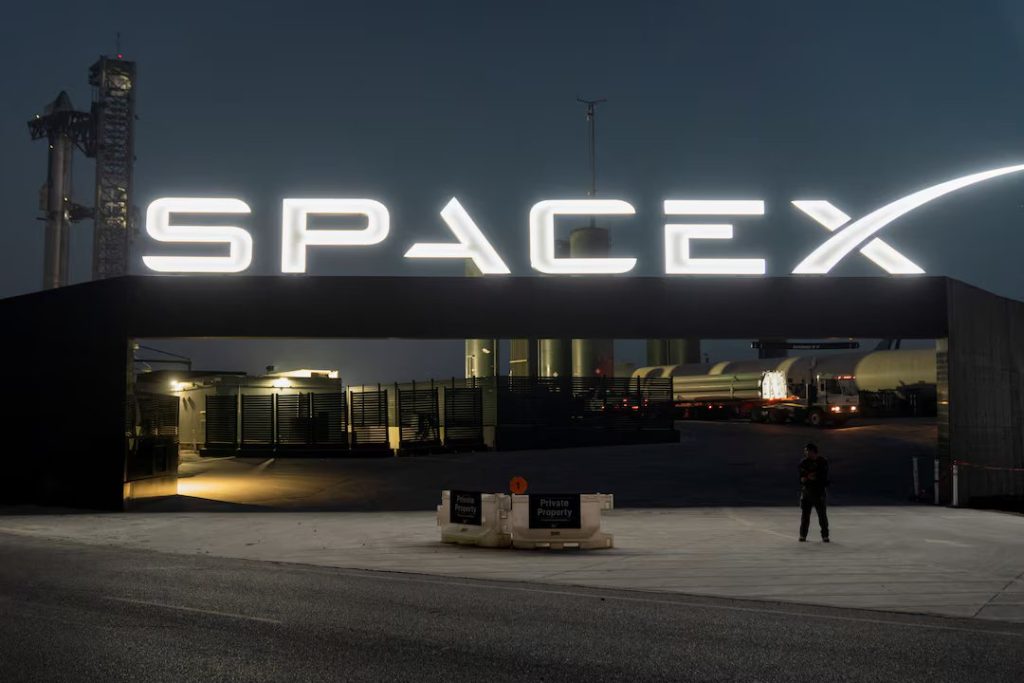
The 120-metre system, which weighs about 5,000 tonnes when fully fuelled, took off from SpaceX’s spaceport, named Starbase, on the Gulf of Mexico in Boca Chica, Texas. SpaceX aims to use the spacecraft to one day carry astronauts to the moon and Mars.
For the first time, the spacecraft’s cruise vessel flew around the globe, but contact was lost during the final stages of the test, just as it re-entered the atmosphere.
SpaceX never intended to recover the ship, which was nearing a planned entry into the Indian Ocean minutes later. It presumably either burned up or came apart during re-entry.
“The ship has been lost. So no splashdown today,” said SpaceX’s Dan Huot. “But again, it’s incredible to see how much further we got this time around.”
Elon Musk, SpaceX’s billionaire founder, said on X, his social media platform: “SpaceX has come a long way.”
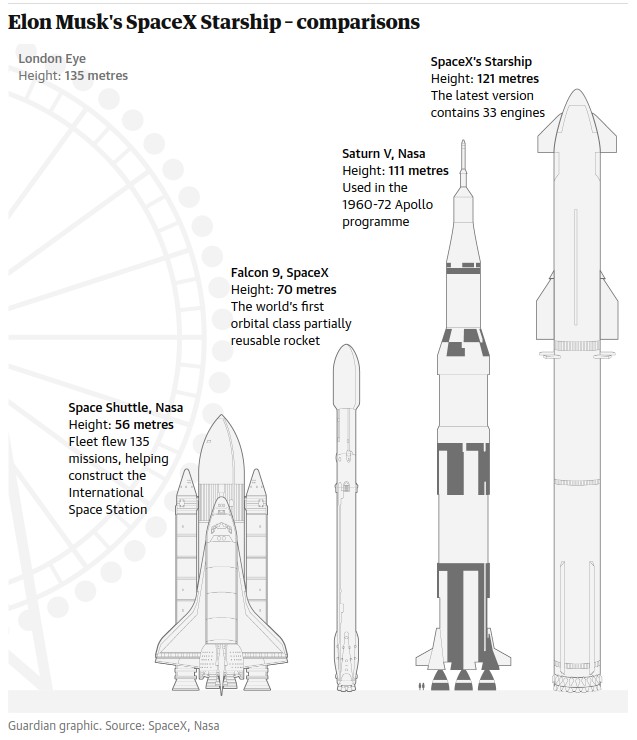
Two previous attempts ended in the explosion of both the spacecraft’s 33-engine booster, nicknamed Super Heavy, and the cruise vessel, which is designed to eventually carry up to 100 astronauts. Stacked together, they stand at 10 metres taller than the Saturn V rocket that sent humans to the moon in 1969.
The first Starship launch attempt lasted four minutes and the second lasted eight, with the latter reaching space. The third lasted more than 50 minutes.
SpaceX is much more tolerant of risk than Nasa and has a flight-testing strategy that aims to frequently push its spacecraft prototypes to the limit and beyond. The company says frequent flight testing will provide valuable data that will help it design and develop a more robust rocket.
“Each of these flight tests continue to be just that: a test,” SpaceX said in a statement before the third launch attempt, in an apparent attempt to manage expectations in case the system exploded. “They aren’t occurring in a lab or on a test stand, but are putting flight hardware in a flight environment to maximise learning.”
The third flight conducted several tests, including opening a payload door and making an internal fuel transfer while in space.
Both the upper and lower segments of Starship are designed to eventually power themselves safely back to Earth for a soft landing so that they can be reused, which will be significantly cheaper than building entirely new parts for each mission.
Musk hopes Starship will be the first step on a human journey further into space that ever before. He says he developed Starship, previously named the BFR (heavily hinted to mean “big fucking rocket”), so that humans can eventually become a “multiplanetary species”. To do this, Musk intends to begin the colonisation of Mars so that humanity can survive a planet-destroying event on Earth, such as a sentient AI takeover or asteroid strike.
Nasa has contracted SpaceX to land astronauts, including the first woman, on the moon as soon as 2026, although that date is likely to be pushed back. Several other Starship systems are already in production for future tests.
Nasa’s chief, Bill Nelson, congratulated SpaceX on what he called “a successful test flight” in a statement posted on X.
Despite the outcome of Thursday’s test, all indications are that Starship remains a considerable distance from becoming fully operational.
Musk has said the rocket should fly hundreds of uncrewed missions before carrying its first humans.
Musk had previously said the total development cost of Starship could be between $2bn and $10bn. Each launch is estimated to cost tens of millions of dollars.
The company makes money by operating smaller rockets to launch satellites as well as sending astronauts to the International Space Station. It has announced longer-term plans to use the spacecraft as a shuttle for commercial travel on Earth, promising trips from London to Tokyo in less than an hour.
AFP and the Associated Press contributed to this report
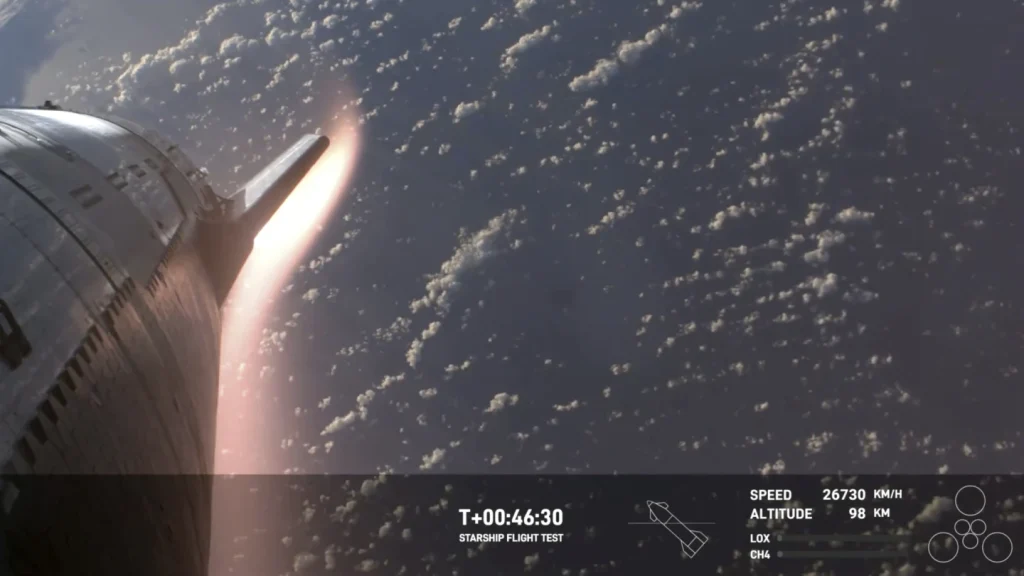
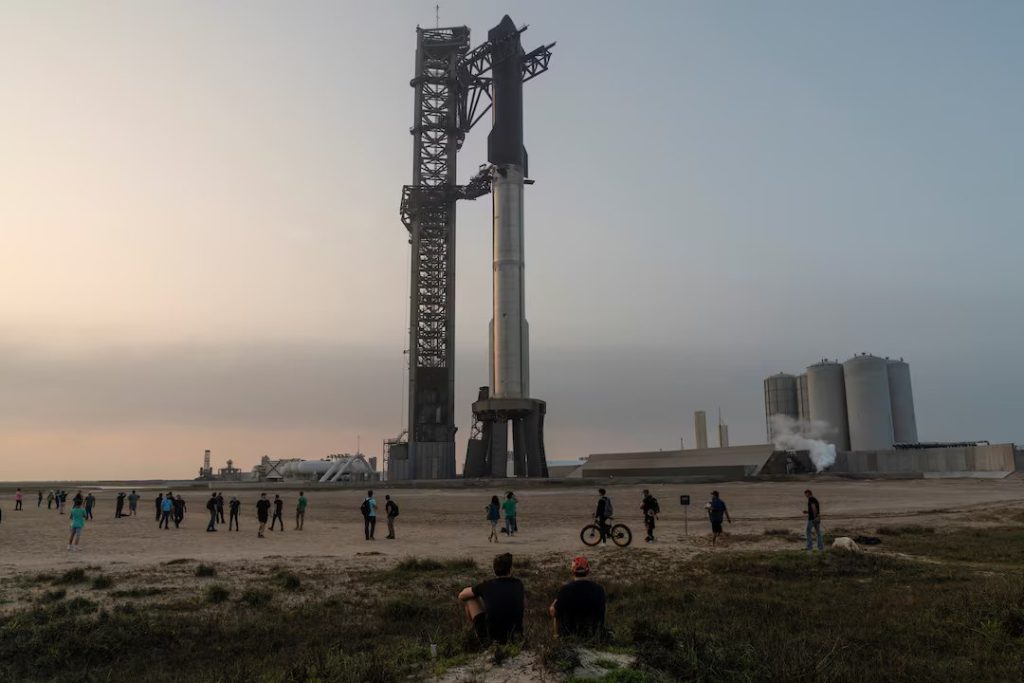
People gather to watch SpaceX’s mega rocket Starship launch it’s third test flight from Starbase in Boca Chica, Texas, Thursday, March 14, 2024. (AP Photo/Eric Gay)In this image from video provided by SpaceX, the company’s Starship re-enters the Earth’s atmosphere on Thursday, March 14, 2024. SpaceX came close to completing an hourlong test flight of its mega rocket on its third try Thursday, but the spacecraft was lost as it descended back to Earth. (SpaceX via AP)
SpaceX came close to completing an hourlong test flight of its mega rocket on its third try Thursday, but the spacecraft was lost as it descended back to Earth.
The company said it lost contact with Starship as it neared its goal, a splashdown in the Indian Ocean. The first-stage booster also ended up in pieces, breaking apart much earlier in the flight over the Gulf of Mexico after launching from the southern tip of Texas near the Mexican border.
“The ship has been lost. So no splashdown today,” said SpaceX’s Dan Huot. “But again, it’s incredible to see how much further we got this time around.”
Two test flights last year both ended in explosions minutes after liftoff. By surviving for close to 50 minutes this time, Thursday’s effort was considered a win by not only SpaceX’s Elon Musk, but NASA as well as Starship soared higher and farther than ever before. The space agency is counting on Starship to land its astronauts on the moon in another few years.
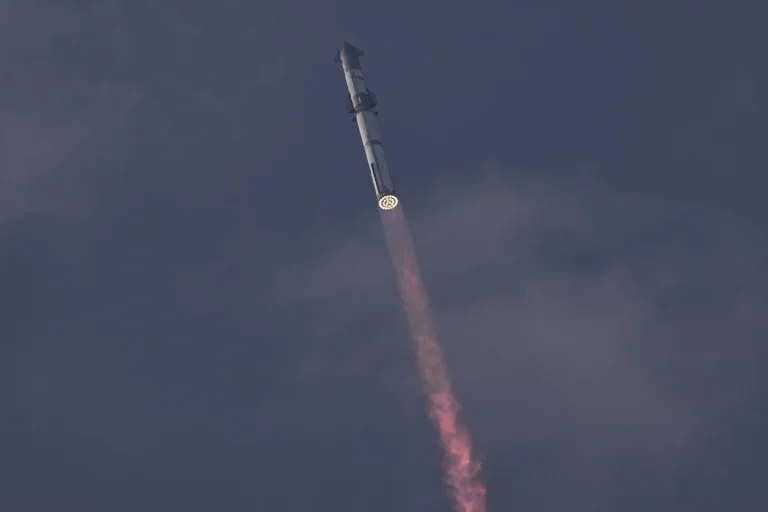
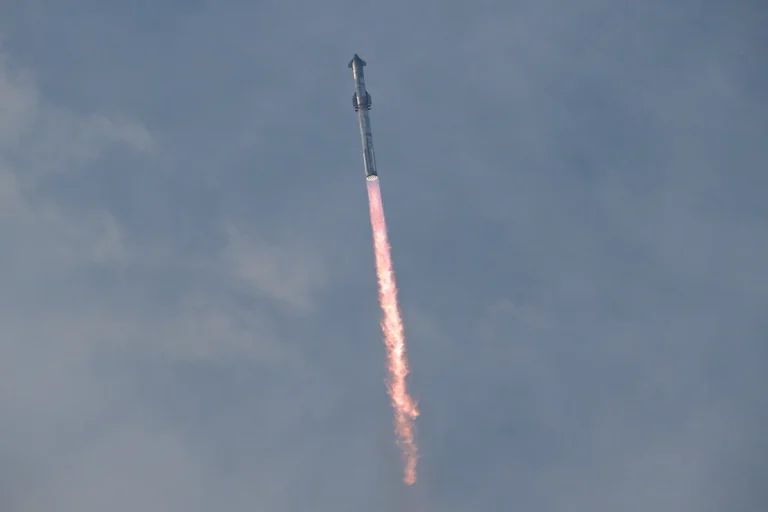
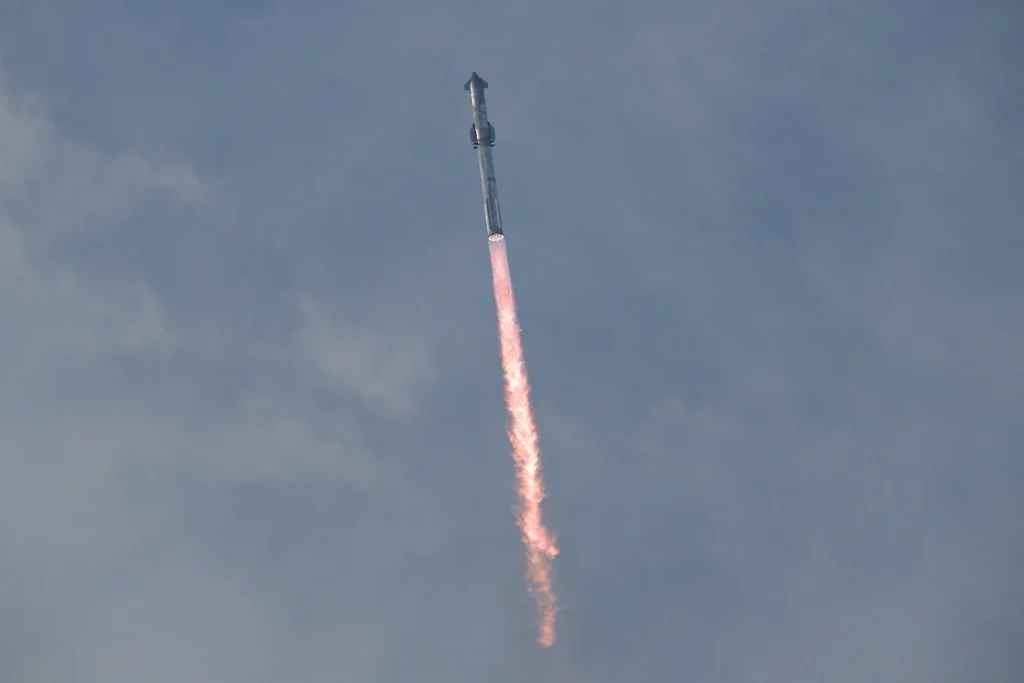
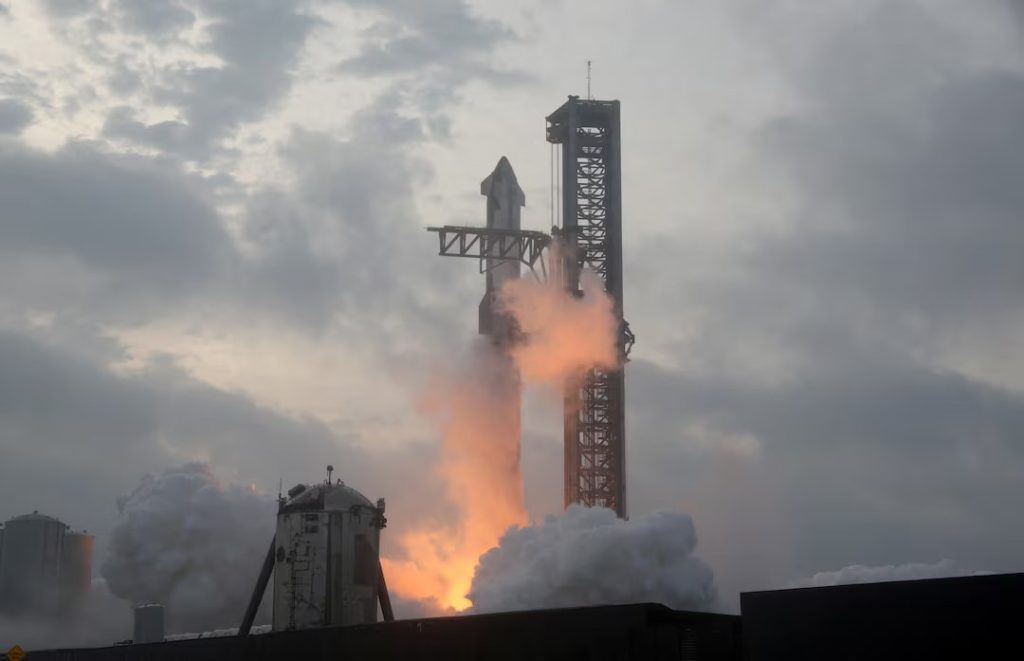
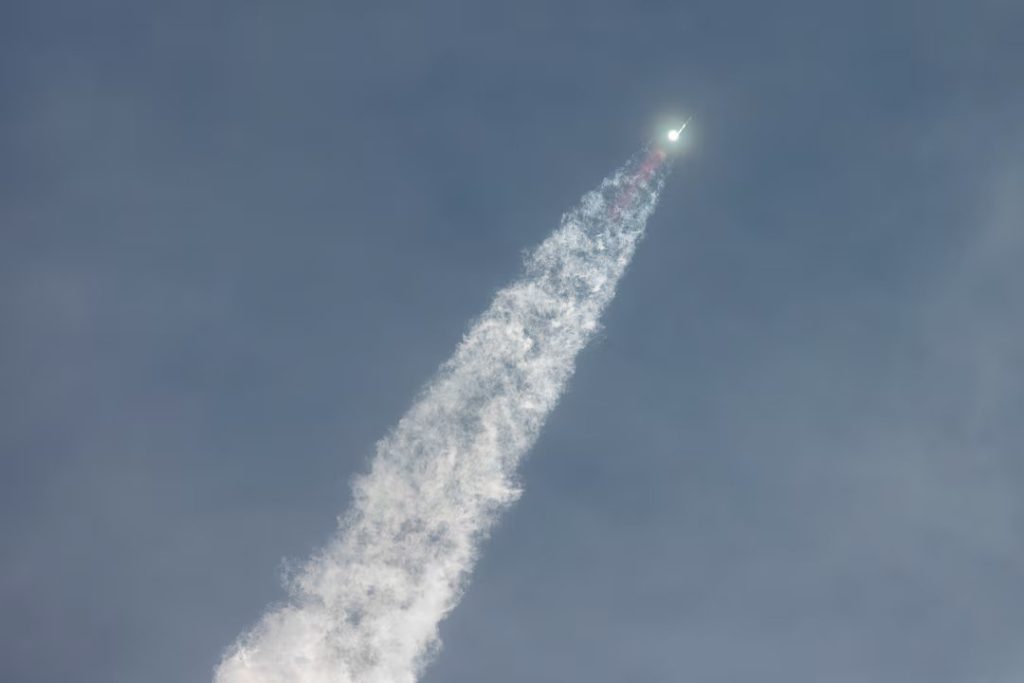
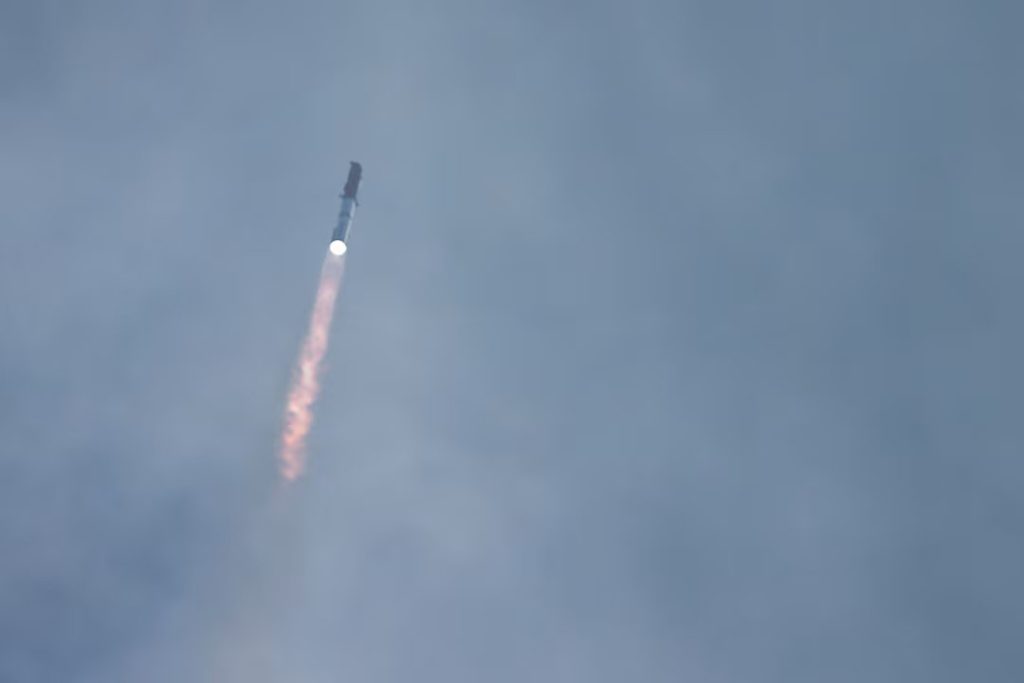
The nearly 400-foot (121-meter) Starship, the biggest and most powerful rocket ever built, headed out over the Gulf of Mexico after liftoff Thursday morning, flying east. Spectators crowded the nearby beaches in South Padre Island and Mexico.
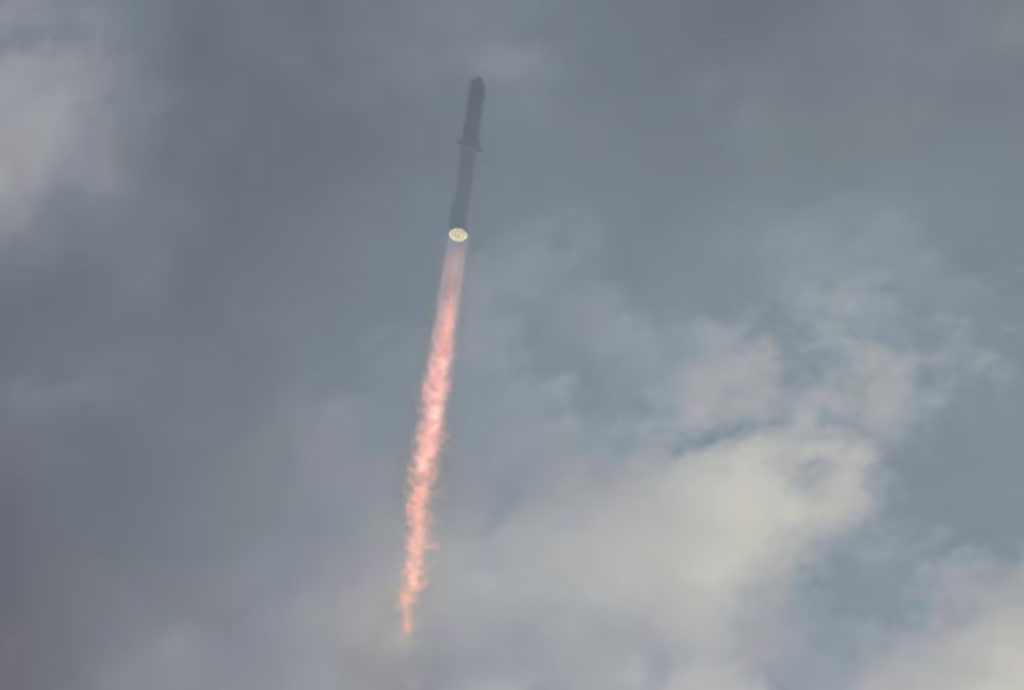
A few minutes later, the booster separated seamlessly from the spaceship, but broke apart 1,500 feet (462 meters) above the gulf, instead of plummeting into the water intact. By then, the spacecraft was well to the east and continuing upward, with no people or satellites on board.
Starship reached an altitude of about 145 miles (233 kilometers) as it coasted across the Atlantic and South Africa, before approaching the Indian Ocean. But 49 minutes into the flight — with just 15 minutes remaining — all contact was lost and the spacecraft presumably broke apart.
At that point, it was 40 miles (65 kilometers) high and traveling around 16,000 mph (25,700 kph).
SpaceX’s Elon Musk had just congratulated his team a little earlier. “SpaceX has come a long way,” he said via X, formerly called Twitter. The rocket company was founded exactly 22 years ago Thursday.
NASA watched with keen interest: The space agency needs Starship to succeed in order to land astronauts on the moon in the next two or so years. This new crop of moonwalkers — the first since last century’s Apollo program — will descend to the lunar surface in a Starship after transferring from NASA’s Orion capsule in lunar orbit.
NASA Administrator Bill Nelson quickly congratulated SpaceX on what he called a successful test flight as part of the space agency’s Artemis moon-landing program.
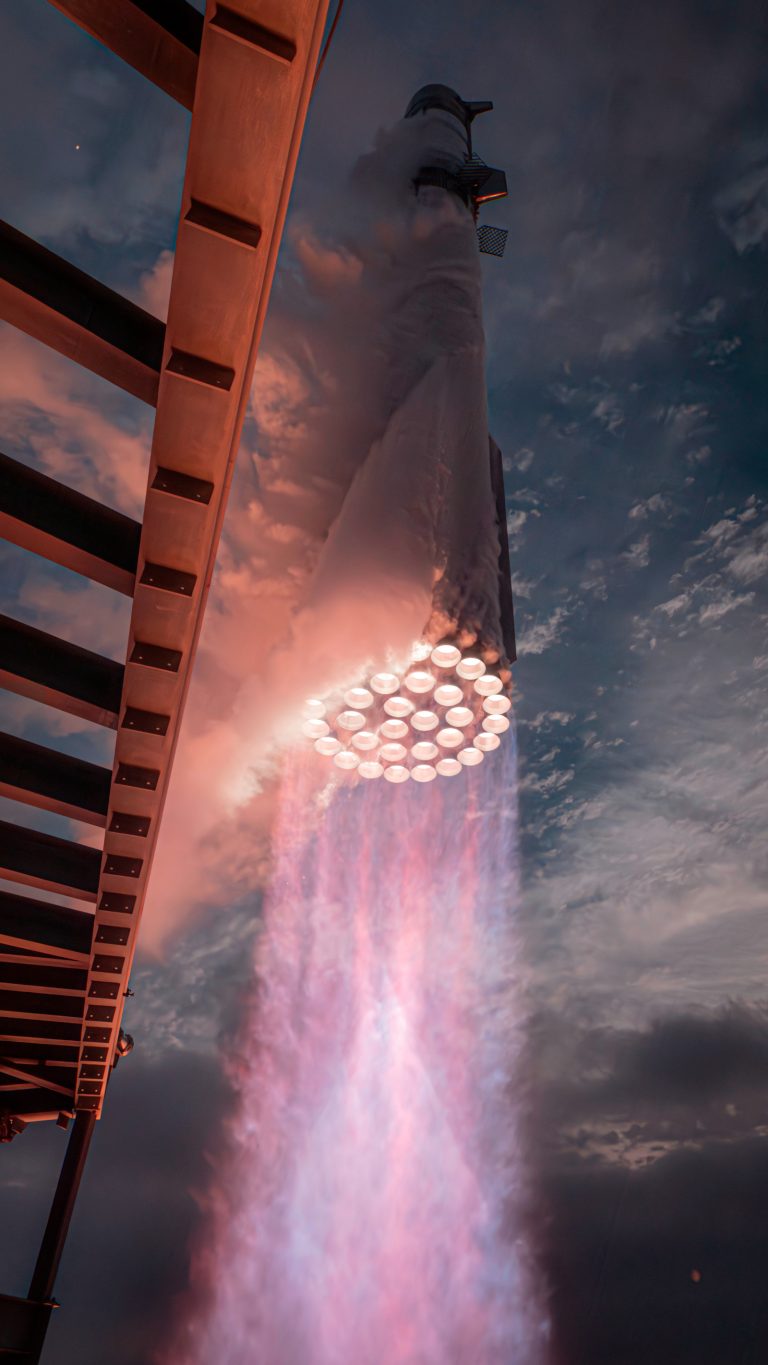
The stainless steel, bullet-shaped spacecraft launched atop a first-stage booster known as the Super Heavy. Both the booster and the spacecraft are designed to be reusable, although they were never meant to be salvaged Thursday.
On Starship’s inaugural launch last April, several of the booster’s 33 methane-fueled engines failed and the booster did not separate from the spacecraft, causing the entire vehicle to explode and crash into the gulf four minutes after liftoff.
SpaceX managed to double the length of the flight during November’s trial run. While all 33 engines fired and the booster peeled away as planned, the flight ended in a pair of explosions, first the booster and then the spacecraft.
The Federal Aviation Administration reviewed all the corrections made to Starship, before signing off on Thursday’s launch. The FAA said after the flight that it would again investigate what happened. As during the second flight, all 33 booster engines performed well during ascent, according to SpaceX.
Initially, SpaceX plans to use the mammoth rockets to launch the company’s Starlink internet satellites, as well as other spacecraft. Test pilots would follow to orbit, before the company flies wealthy clients around the moon and back. Musk considers the moon a stepping stone to Mars, his ultimate quest.
NASA is insisting that an empty Starship land successfully on the moon, before future moonwalkers climb aboard. The space agency is targeting the end of 2026 for the first moon landing crew under the Artemis program, named after the mythological twin sister of Apollo.
The Associated Press Health and Science Department receives support from the Howard Hughes Medical Institute’s Science and Educational Media Group. The AP is solely responsible for all content.
A SpaceX Starship rocket launched on its third test flight from the Starbase facility in Boca Chica, Texas, and achieved multiple milestones Thursday morning before likely breaking apart.
The deep-space rocket system went through nearly an hour-long integrated flight test. The spacecraft was expected to splash down in the Indian Ocean at the conclusion of the flight, putting the gargantuan vehicle in a position to move on to more complex test flights and, eventually, carry NASA astronauts to the moon’s surface.
But after reentry the team lost two key pieces of communication at the same time: Contact with Starlink, SpaceX’s internet service, and with TDRSS — or Tracking and Data Relay Satellite System.
“The team has made the call that the ship has been lost, so no splashdown today,” said Dan Huot, SpaceX communications manager, during the live broadcast. “But again, just it’s incredible to see how much further we got this time around.”
SpaceX also never intended to recover Starship after this flight test. The spacecraft was expected to make a hard landing. And the Starship spacecraft made it much further into flight than during two previous tests in 2023.
The company routinely frames failures during these early test flights as normal. The goal of these flight tests is to gather crucial data so that engineers can go back and tinker with Starship, improving it for future missions.
The Starship vehicle — which includes the upper Starship spacecraft and a rocket booster known as the Super Heavy — took off from SpaceX’s private Starbase facility in Boca Chica, Texas, at 8:25 a.m. CT (9:25 a.m. ET).
SpaceX considers the Starship system crucial to its founding mission: to carry humans to Mars for the first time. And critically, NASA has chosen Starship as the landing vehicle that will ferry its astronauts to the lunar surface on the Artemis III mission slated to take off as soon as September 2026.
“Congrats to SpaceX on a successful test flight! Starship has soared into the heavens. Together, we are making great strides through Artemis to return humanity to the Moon— then look onward to Mars,” wrote NASA Administrator Bill Nelson on X, formerly known as Twitter.
The Super Heavy booster — the first stage, or bottommost part, of the launch vehicle roared to life and soared out over the Gulf of Mexico.
The Super Heavy booster burned through most of its fuel and broke away from the Starship spacecraft, the upper stage that rides atop the Super Heavy.
The booster was expected to make an autonomous, controlled landing in the ocean, but the booster “didn’t light all the engines that we expected and we did lose the booster,” Huot said.
SpaceX said it’s working to get video of what occurred before the booster hit the water. But the the booster made it farther into flight than a Super Heavy booster has previously made it. On the past two flights, Super Heavy was destroyed midair before it had a chance to try out landing maneuvers.
Meanwhile, the Federal Aviation Administration will investigate the “mishap” involving both the Super Heavy booster and the Starship spacecraft. The agency licenses commercial rocket launches and oversees mishap investigations when spacecraft are lost during flight. Such investigations are routine and carried out whether or not SpaceX expects a loss of the vehicle.
“A mishap occurred during the SpaceX Starship OFT-3 mission that launched from Boca Chica, Texas, on March 14,” according to a statement released by the FAA. “No public injuries or public property damage have been reported. The FAA is overseeing the SpaceX-led mishap investigation to ensure the company complies with its FAA-approved mishap investigation plan and other regulatory requirements.”
The third test flight occurred on SpaceX’s 22nd anniversary, according to the livestream.
Aiming for orbital speeds
SpaceX CEO Elon Musk has said a primary goal of these early test flights is to get Starship to orbital speeds — velocities quick enough to allow the spacecraft to enter a stable orbit around Earth.
Typically, such a feat requires speeds topping 17,500 miles per hour (28,000 kilometers per hour).
Starship reached its orbital speeds goal and did not aim to actually enter orbit on this flight.
Starship tests and tech demos
Starship burned its engine for about six minutes before it entereds a coasting phase. The spacecraft ranthrough a few key tests and tech demonstrations.
First, Starship reached speeds close to what would be required to put the vehicle in orbit. The Starship’s payload door — a hatch that must open for the spacecraft to deploy satellites into space after reaching orbit — also swung open before resealing in a crucial test of that mechanism.
The SpaceX Starship rocket system lifts off from Starbase in Boca Chica, Texas, for its third integrated test flight on Thursday. Chandan Khanna/AFP/Getty Images
SpaceX also carried out what the company is calling a “propellant transfer demonstration.” The goal was to move some of the propellant on board the Starship vehicle from one tank to another, according to a December email from NASA explaining the test.
SpaceX engineers designed that demo to begin hashing out how Starship will be refueled on future missions while it’s in orbit.
The team will “need to do some data review” of both the payload door opening and the propellant transfer demonstration to determine how successful each test was, according to the live broadcast.
However, after reaching several milestones, SpaceX revealed it opted not to attempt to reignite Starship’s engines after a half-hour coasting phase that was originally planned for the flight test.
Starship was on a “pretty steep trajectory,” Huot said. That meant Earth’s gravity would likelrapidly drag Starship back toward Earth, whether or not engines are relit.
It’s not clear why SpaceX decided to forgo that test, but engineers noted a lot of data needs to be evaluated in the hours and days ahead.
“The atmosphere is actually doing us a huge favor here by acting as a braking system for starship,” said Kate Tice, one of the hosts of SpaceX’s livestream.
The Starship spacecraft is coated in about 18,000 lightweight, ceramic hexagon tiles designed to protect the vehicle from the scorching-hot temperatures as it plunges back into the Earth’s atmosphere.
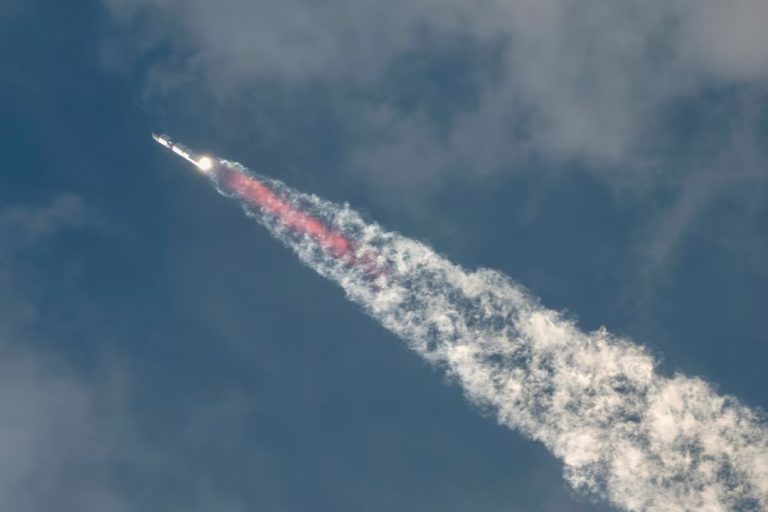
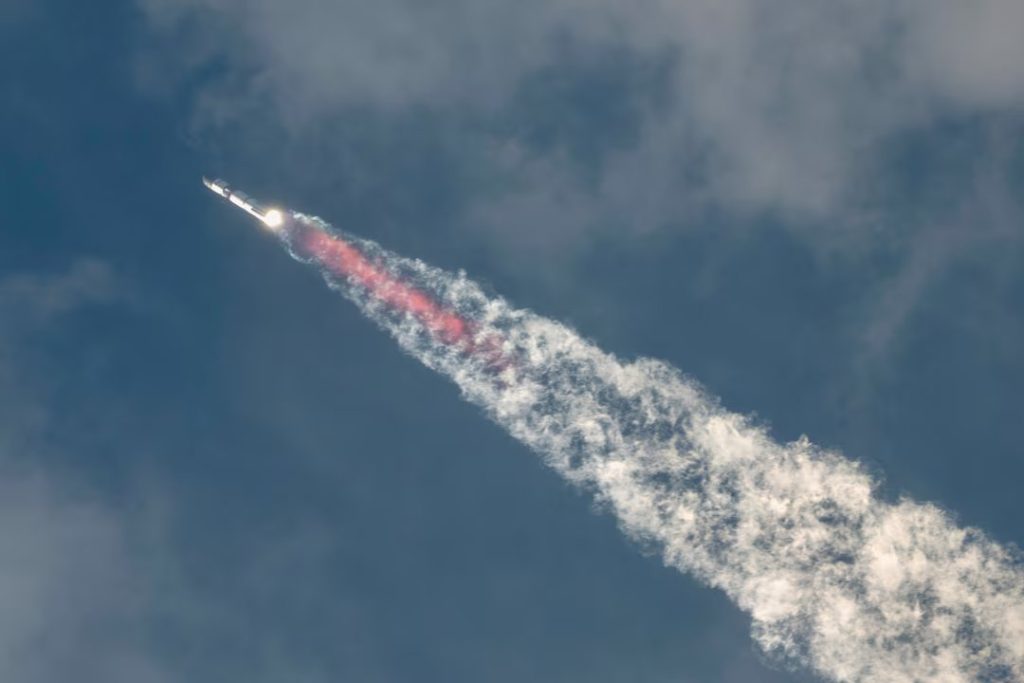
During the livestream, a vibrant halo of bright red plasma, created by extreme heat and pressure as Starship entered the atmosphere, could be seen glowing around the vehicle.
Shortly after, the team lost communication with the spacecraft.
NASA Artemis moon mission
Topping off the spacecraft’s fuel will be critical for Starship’s high-profile missions down the road.
When Starship makes a journey to the moon under NASA’s Artemis program — it will have to sit in orbit close to Earth as SpaceX launches separate vehicles that will transport only fuel to the spacecraft. To get to the moon, SpaceX may have to make more than a dozen refueling trips.
SpaceX received approval from regulators on Wednesday to carry out this latest test flight.
SpaceX’s explosive test-flight process
Musk has said he was more confident this flight will be successful compared with the 2023 attempts. A success would potentially give the company crucial data that could allow Starship to move on to more difficult test flights.
“I don’t want to jinx it, but I think the probability of reaching orbit is good — 80%,” he said during a recent talk posted to social media. “Certainly the third flight is a much better rocket than flights one or two.”
Still, SpaceX officials have repeatedly said the company does not expect 100% accuracy on these early test flights.
“Each of these flight tests continue to be just that: a test. They aren’t occurring in a lab or on a test stand, but are putting flight hardware in a flight environment to maximize learning,” the company said in a statement posted to its website. “This rapid iterative development approach has been the basis for all of SpaceX’s major innovative advancements.”
By: Jackie Wattles and Ashley Strickland Originally published at: CNN
BOCA CHICA, Texas, March 14 (Reuters) – SpaceX’s Starship rocket, designed to eventually send astronauts to the moon and beyond, completed nearly an entire test flight through space on its third try on Thursday, getting farther than ever before, but disintegrated on its return to Earth.
During a webcast of the flight, SpaceX commentators said mission control lost communication with Starship from two satellite systems simultaneously while the spacecraft was re-entering the planet’s atmosphere at hypersonic speed.
The spacecraft at that point was nearing a planned splashdown in the Indian Ocean, about an hour after launch from south Texas.
Contact with Starship cut out moments after a live video feed from a camera mounted on the vehicle showed high-definition images of a reddish glow enveloping the silvery spacecraft from the heat of re-entry friction as it plunged earthward.
A few minutes later, SpaceX confirmed that the spacecraft had been “lost” – meaning incinerated or broken apart – during the stress of re-entry.
For reasons that were left unclear, SpaceX opted to skip one of the test flight’s core objectives – an attempt to re-ignite one of Starship’s Raptor engines while it coasted in a shallow orbit. That milestone is considered key to its future success.
Still, completion of many of Starship’s intended flight objectives represented progress in the development of a spacecraft crucial to the growing satellite launch business of SpaceX, founded by Elon Musk in 2002, and NASA’s moon program.
NASA chief Bill Nelson congratulated SpaceX on what he called “a successful test flight” in a statement posted on social media platform X. The U.S. space agency is SpaceX’s biggest customer.
SpaceX President Gwynne Shotwell wrote in an X post that the test marked an “incredible day.”
The two-stage spacecraft, consisting of the Starship cruise vessel mounted atop its towering Super Heavy rocket booster, blasted off from the company’s Starbase launch site near Boca Chica Village on the Gulf Coast of Texas. The upper-stage Starship reached peak altitudes of 145 miles (234 km).
The spacecraft far exceeded its two past performances, both of which were cut short by explosions minutes after launch. The company had acknowledged in advance a high probability that its latest flight might similarly end with the spacecraft’s demise before the mission profile was finished.
SpaceX’s next-generation Starship spacecraft, atop its powerful Super Heavy rocket, lifts off on its third launch from the company’s Boca Chica launchpad on an uncrewed test flight, near Brownsville, Texas, U.S. March 14, 2024. REUTERS/Cheney Orr Purchase Licensing RightsSpaceX’s next-generation Starship spacecraft atop its powerful Super Heavy rocket lifts off on its third launch from the company’s Boca Chica launchpad on an uncrewed test flight, near Brownsville, Texas, U.S. March 14, 2024. REUTERS/Joe Skipper Purchase Licensing RightsSpaceX’s next-generation Starship spacecraft atop its powerful Super Heavy rocket lifts off on its third launch from the company’s Boca Chica launchpad on an uncrewed test flight, near Brownsville, Texas, U.S. March 14, 2024. REUTERS/Joe Skipper Purchase Licensing RightsSpaceX’s next-generation Starship spacecraft atop its powerful Super Heavy rocket lifts off on its third launch from the company’s Boca Chica launchpad on an uncrewed test flight, near Brownsville, Texas, U.S. March 14, 2024. REUTERS/Joe Skipper Purchase Licensing RightsSpaceX’s next-generation Starship spacecraft atop its powerful Super Heavy rocket lifts off on its third launch from the company’s Boca Chica launchpad on an uncrewed test flight, near Brownsville, Texas, U.S. March 14, 2024. REUTERS/Joe Skipper Purchase Licensing RightsA security guard monitors the entrance as SpaceX’s next-generation Starship spacecraft atop its powerful Super Heavy rocket is prepared for a third launch from the company’s Boca Chica launchpad on an uncrewed test flight, near Brownsville, Texas, U.S. March 13, 2024. REUTERS/Cheney Orr Purchase Licensing Rights, opens new tab
A spectator, with his dog, looks on as SpaceX’s next-generation Starship spacecraft atop its powerful Super Heavy rocket is prepared for a third launch from the company’s Boca Chica launchpad on an uncrewed test flight, near Brownsville, Texas, U.S. March 13, 2024. REUTERS/Cheney Orr Purchase Licensing RightsSpectators gather as SpaceX’s next-generation Starship spacecraft atop its powerful Super Heavy rocket is prepared for a third launch from the company’s Boca Chica launchpad on an uncrewed test flight, near Brownsville, Texas, U.S. March 13, 2024. REUTERS/Cheney Orr Purchase Licensing Rights
SpaceX’s engineering culture, considered more risk-tolerant than many of the aerospace industry’s more established players, is built on a flight-testing strategy that pushes spacecraft to the point of failure, then fine-tunes improvements through frequent repetition.
ENGINEERING GOALS
Thursday’s flight achieved many of the engineering goals set for the mission: a repeat of successful stage separation during initial ascent; the first test of Starship’s ability to open and close its payload door in orbit; and the transfer of super-cooled rocket propellant from one tank to another during spaceflight.
What SpaceX failed to demonstrate on top of Starship’s re-entry failure and the skipped engine re-ignition test was an attempt to fly the Super Heavy rocket back to Earth, part of SpaceX’s routine strategy of recovering its launch boosters for re-use.
SpaceX officials have said they plan to conduct at least six more test flights of Starship this year, subject to regulatory approval.
The company is required to investigate each test mission failure and deliver its findings and corrective actions to the Federal Aviation Administration for the agency’s approval before the vehicle can fly again.
On the whole, Thursday’s test encompassed a fraction of the remaining demonstrations and missions the vehicle must get through before it is proven safe enough to fly people to space.
Still, Musk is counting on Starship to fulfill his goal of producing a large, multipurpose next-generation spacecraft capable of sending people and cargo to the moon later this decade, and ultimately flying to Mars.
Closer to home, Musk also sees Starship as eventually replacing the SpaceX Falcon 9 rocket as the workhorse in the company’s commercial launch business. It already lofts most of the world’s satellites and other payloads to low-Earth orbit.
NASA also has a lot riding on the success of Starship, which the agency is giving a central role in its Artemis program, successor to the Apollo missions that put astronauts on the moon for the first time more than 50 years ago.
While NASA executives have embraced Musk’s frequent flight-testing approach, agency officials in recent months have made clear their desire to see greater progress with Starship’s development as the United States races with China to the lunar surface.
By: Joe Skipper, Steve Gorman and Joey Roulette Originally published at: Reuters