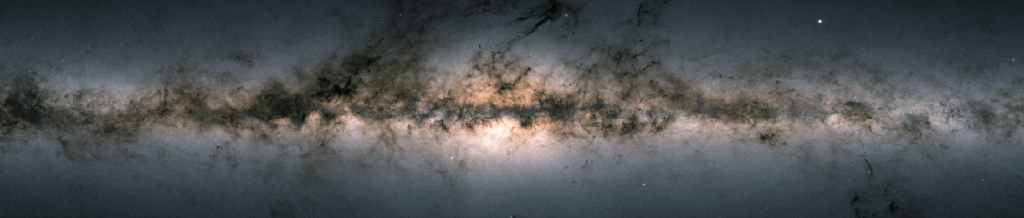
The plane of our Milky Way galaxy, as seen by ESA’s Gaia space mission. It contains more than a billion stars, along with darker, dusty regions Gaia couldn’t see through. With its greater sensitivity and longer wavelength coverage, NASA’s Nancy Grace Roman Space Telescope’s galactic plane survey will peer through more of the dust and reveal far more stars.
Credit: ESA/Gaia/DPAC
NASA’s Nancy Grace Roman Space Telescope team has announced plans for an unprecedented survey of the plane of our Milky Way galaxy. It will peer deeper into this region than any other survey, mapping more of our galaxy’s stars than all previous observations combined.
“There’s a really broad range of science we can explore with this type of survey, from star formation and evolution to dust in between stars and the dynamics of the heart of the galaxy,” said Catherine Zucker, an astrophysicist at the Center for Astrophysics | Harvard & Smithsonian in Cambridge, Massachusetts, who co-authored a white paper describing some of the benefits of such an observing program.
Scientists have studied our solar system’s neighborhood pretty well, but much of the galaxy remains shrouded from view. NASA’s Nancy Grace Roman Space Telescope will peer through thick bands of dust to reveal parts of our galaxy we’ve never been able to explore before, thanks to a newly selected galactic plane survey. Credit: NASA’s Goddard Space Flight Center
A galactic plane survey was the top-ranked submission following a 2021 call for Roman survey ideas. Now, the scientific community will work together to design the observational program ahead of Roman’s launch by May 2027.
“There will be lots of trade-offs since scientists will have to choose between, for example, how much area to cover and how completely to map it in all the different possible filters,” said paper co-author Robert Benjamin, an astronomer at the University of Wisconsin-Whitewater.
While the details of the survey remain to be determined, scientists say if it covered about 1,000 square degrees – a region of sky as large as 5,000 full moons – it could reveal well over 100 billion cosmic objects (mainly stars).
“That would be pretty close to a complete census of all the stars in our galaxy, and it would only take around a month,” said Roberta Paladini, a senior research scientist at Caltech/IPAC in Pasadena, California, and the white paper’s lead author. “It would take decades to observe such a large patch of the sky with the Hubble or James Webb space telescopes. Roman will be a survey machine!”
Milky Way Anatomy
Observatories with smaller views of space have provided exquisite images of other galaxies, revealing complex structures. But studying our own galaxy’s anatomy is surprisingly difficult. The plane of the Milky Way covers such a large area on the sky that studying it in detail can take a very long time. Astronomers also must peer through thick dust that obscures distant starlight.
While we’ve studied our solar system’s neighborhood well, Zucker says, “we have a very incomplete view of what the other half of that Milky Way looks like beyond the galactic center.”
Observatories like NASA’s retired Spitzer Space Telescope have conducted large-area surveys of the galactic plane in longer wavelengths of light and revealed some star-forming regions on the far side of the galaxy. But it couldn’t resolve fine details like Roman will do.
“Spitzer set up the questions that Roman will be able to solve,” Benjamin said.
Roman’s combination of a large field of view, crisp resolution, and the ability to peer through dust make it the ideal instrument to study the Milky Way. And seeing stars in different wavelengths of light – optical and infrared – will help astronomers learn things such as the stars’ temperatures. That one piece of information unlocks much more data, from the star’s evolutionary stage and composition to its luminosity and size.
“We can do very detailed studies of things like star formation and the structure of our own galaxy in a way that we can’t do for any other galaxy,” Paladini said.
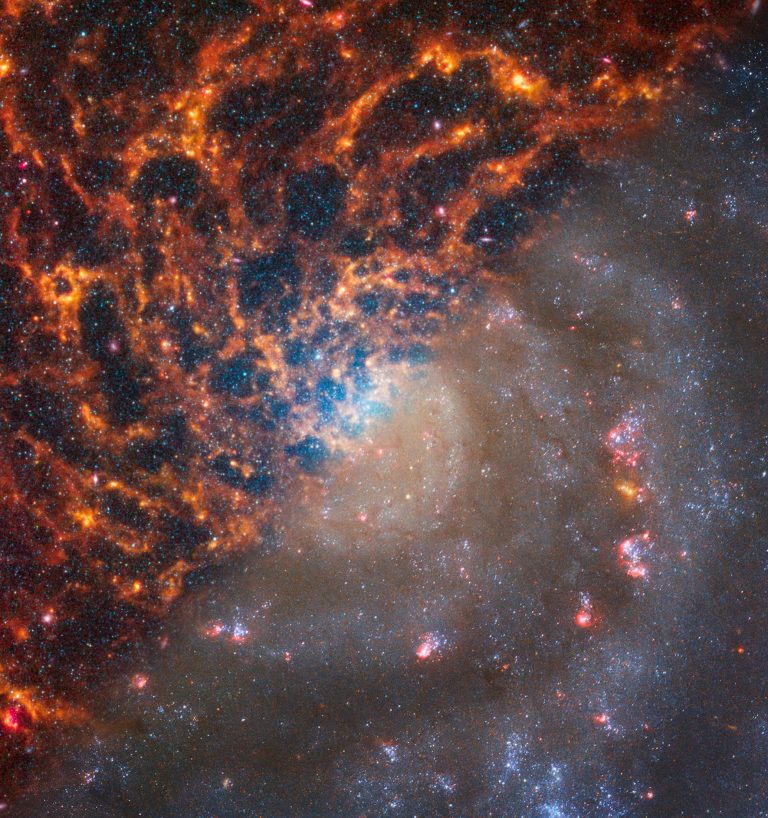
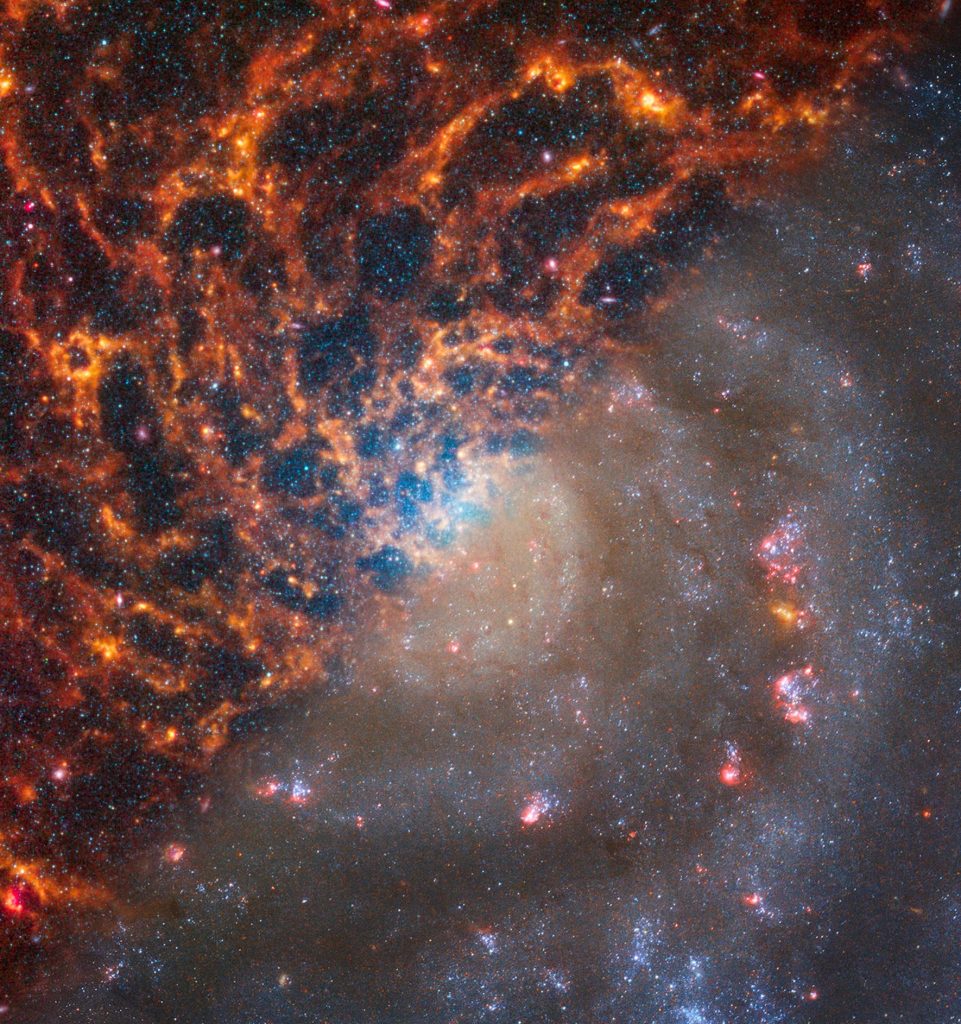
This image shows two views of the same spiral galaxy, called IC 5332, as seen by two NASA observatories – the James Webb Space Telescope’s observations appear at the top left and the Hubble Space Telescope’s at the bottom right. The views are mainly so different due to the wavelengths of light they each showcase. Hubble’s visible and ultraviolet observation features dark regions where dust absorbs those types of light. Webb sees longer wavelengths and detects that dust glowing in infrared. But neither could conduct an efficient survey of our Milky Way galaxy because it covers so much sky area; since IC 5332 is around 30 million light-years away, it appears as a small spot. It would take Hubble or Webb decades to survey the Milky Way, but NASA’s upcoming Nancy Grace Roman Space Telescope could do it in less than a month.
Credit: NASA, ESA, CSA, STScI, Janice Lee (STScI), Thomas Williams (Oxford), Rupali Chandar (UToledo), PHANGS Team
Roman will offer new insights about the structure of the central region known as the bulge, the “bar” that stretches across it, and the spiral arms that extend from it.
“We’ll basically rewrite the 3D picture of the far side of the galaxy,” Zucker said.
Roman’s sharp vision will help astronomers see individual stars even in stellar nurseries on the far side of the galaxy. That will help Roman generate a huge new catalog of stars since it will be able to map 10 times farther than previous precision mapping by ESA’s (the European Space Agency’s) Gaia space mission. Gaia mapped over 1 billion stars in 3D largely within about 10,000 light-years. Roman could map up to 100 billion stars 100,000 light-years away or more (stretching out to the most distant edge of our galaxy and beyond).
The Galactic Plane Survey is Roman’s first announced general astrophysics survey – one of several observation programs Roman will do in addition to its three core community surveys and Coronagraph technology demonstration. At least 25% of Roman’s five-year primary mission will be allocated to general astrophysics surveys in order to pursue science that can’t be done with only the mission’s core community survey data. Astronomers from all over the world will have the opportunity to use Roman and propose cutting-edge research, enabling the astronomical community to utilize the full potential of Roman’s capabilities to conduct extraordinary science.
The Nancy Grace Roman Space Telescope is managed at NASA’s Goddard Space Flight Center in Greenbelt, Maryland, with participation by NASA’s Jet Propulsion Laboratory and Caltech/IPAC in Southern California, the Space Telescope Science Institute in Baltimore, and a science team comprising scientists from various research institutions. The primary industrial partners are BAE Systems in Boulder, Colorado; L3Harris Technologies in Melbourne, Florida; and Teledyne Scientific & Imaging in Thousand Oaks, California.
Download high-resolution video and images from NASA’s Scientific Visualization Studio
By Ashley Balzer NASA’s Goddard Space Flight Center, Greenbelt, Md.
Media contact:
Claire Andreoli NASA’s Goddard Space Flight Center, Greenbelt, Md. [email protected] 301-286-1940
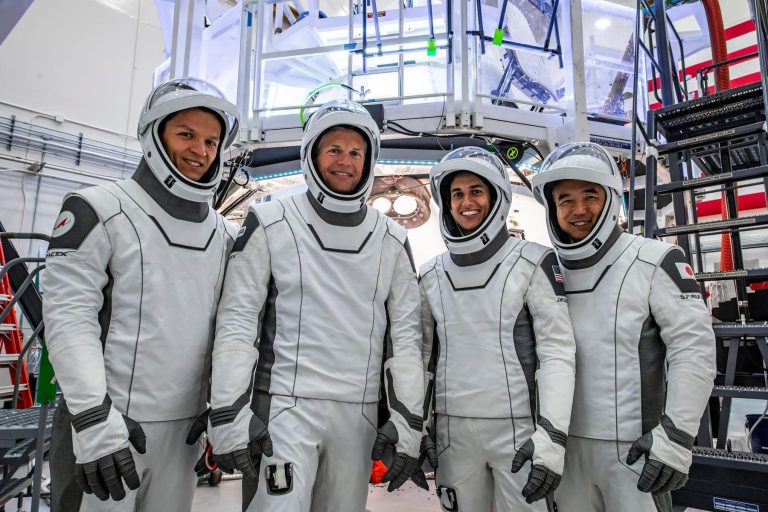
NASA’s SpaceX Crew-7 poses for a photo before their mission to the International Space Station. From left to right: Mission Specialist Konstantin Borisov, Pilot Andreas Mogensen, Commander Jasmin Moghbeli, and Mission Specialist Satoshi Furukawa. Credits: SpaceX
NASA will provide live coverage of the agency’s SpaceX Crew-7 return to Earth from the International Space Station, beginning with a change-of-command ceremony at 11:55 a.m. EDT on Sunday, March 10.
NASA astronaut Jasmin Moghbeli, ESA (European Space Agency) astronaut Andreas Mogensen, JAXA (Japan Aerospace Exploration Agency) astronaut Satoshi Furukawa, and Roscosmos cosmonaut Konstantin Borisov are preparing to wrap up their nearly six-month science mission, and bring home time-sensitive research to Earth.
Pending weather conditions off the coast of Florida, the SpaceX Dragon spacecraft is scheduled to undock from the space station at 11:05 a.m. Monday, March 11, to begin the journey home, with NASA coverage beginning at 10:45 a.m. NASA and SpaceX are targeting as early as 5:35 a.m. Tuesday, March 12, for splashdown off the Florida coast.
The return and related activities will air live on NASA+, NASA Television, the NASA app, and the agency’s website. Learn how to stream NASA TV through a variety of platforms including social media.
NASA’s coverage is as follows (all times Eastern and subject to change based on real-time operations):
Sunday, March 10
11:55 a.m.: Crew-7 farewell remarks and change of command ceremony aboard the space station
Monday, March 11
9 a.m.: Hatch closure coverage begins
9:15 a.m.: Hatch closing
10:45 a.m.: Undocking coverage begins
11:05 a.m.: Undocking
Following conclusion of Dragon departure from station, NASA coverage will continue with audio only, with full coverage resuming ahead of the deorbit burn and splashdown.
Tuesday, March 12
4:30 a.m.: Coverage begins as the spacecraft leaves low Earth orbit, completes re-entry, and prepares for splashdown
5:35 a.m.: Splashdown
7 a.m.: Return to Earth media teleconference call with the following participants:
Steve Stich, manager, NASA’s Commercial Crew Program
Jeff Arend, manager for systems engineering and integration, NASA’s International Space Station Office
SpaceX representative
Eric Van Der Wal, Houston office team leader, ESA
Hiroshi Sasaki, vice president for human space flight and space exploration, JAXA
Media may ask questions via phone. For the dial-in number and passcode, media should contact the Kennedy newsroom no later than 6 a.m. Tuesday, March 11, at [email protected].
See full mission coverage, NASA’s commercial crew blog, and more information about the mission at:
https://www.nasa.gov/commercialcrew
-end-
Joshua Finch Headquarters, Washington 202-358-1100 [email protected]
Steve Siceloff Kennedy Space Center, Fla. 321-867-2468 [email protected]
Leah Cheshier Johnson Space Center, Houston 281-483-5111 [email protected]
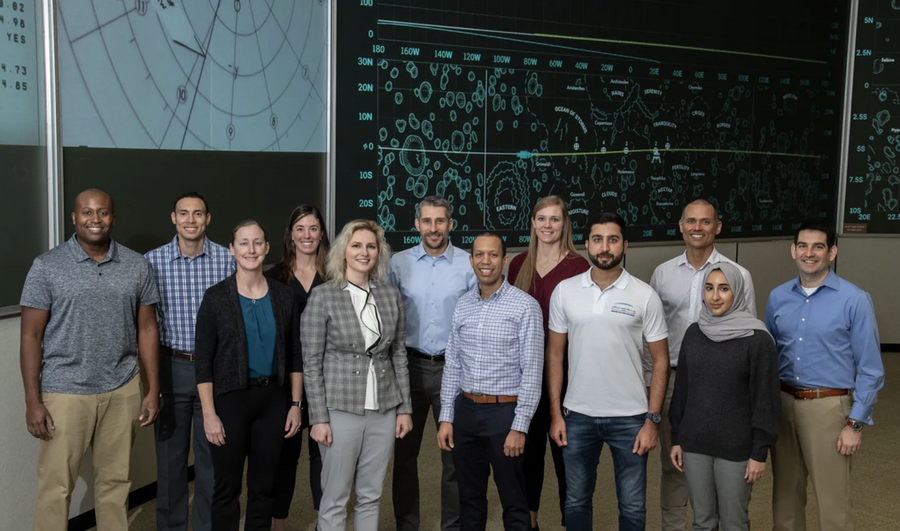
Marcos Berríos ’06, Christina Birch PhD ’15, and Christopher Williams PhD ’12, now eligible for spaceflight assignments, encourage MIT students to apply for the next astronaut class.
Sandi Miller | Department of Physics MIT News (https://news.mit.edu/2024/three-mit-alumni-graduate-nasa-astronaut-training-0307)
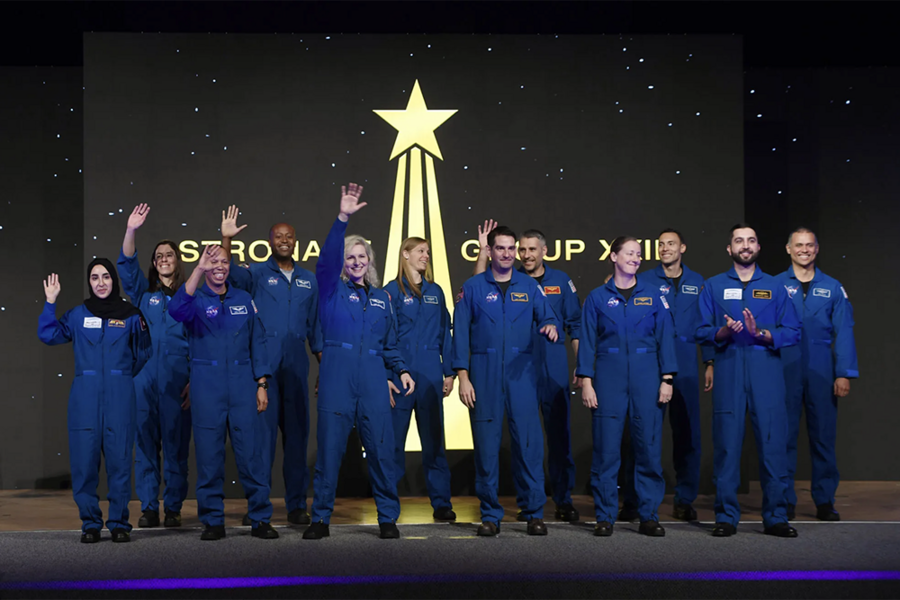
The March 5 graduation of Marcos Berríos ’06 (third from right), Christina Birch PhD ’15 (second from left), and Christopher Williams PhD ’12 (third from left) brings the total number of MIT astronaut alumni to 44, of the 360 NASA selected by NASA to serve as astronauts since the original Mercury Seven in 1959.
Credits:Photo courtesy of NASA.
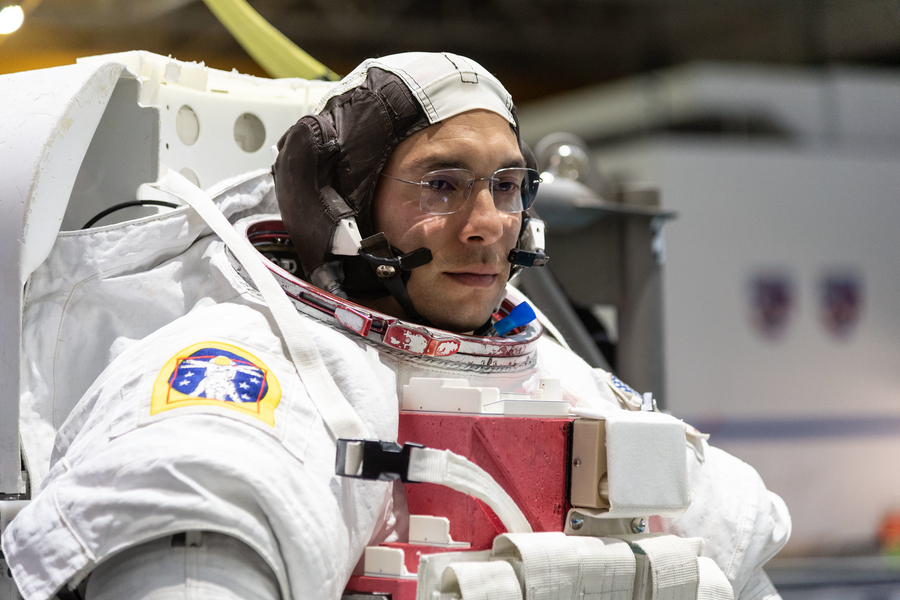
Marcos Berríos ’06 wears a spacesuit prior to underwater training at NASA Johnson Space Center’s Neutral Buoyancy Laboratory.
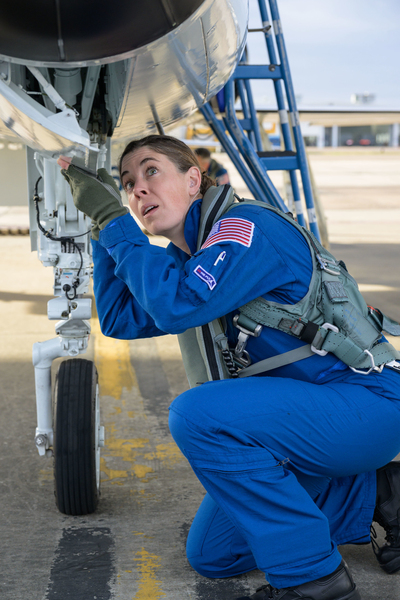
Credits:Photo: Bill Stafford/NASAChristina Birch PhD ’15, prepares for T-38 flight training at Ellington Field in Houston, Texas.
Credits:Photo: Robert Markowitz/NASAChristopher Williams PhD ’12 takes part in SAFER Intro training in the VR lab at NASA’s Johnson Space Center in Houston, Texas.
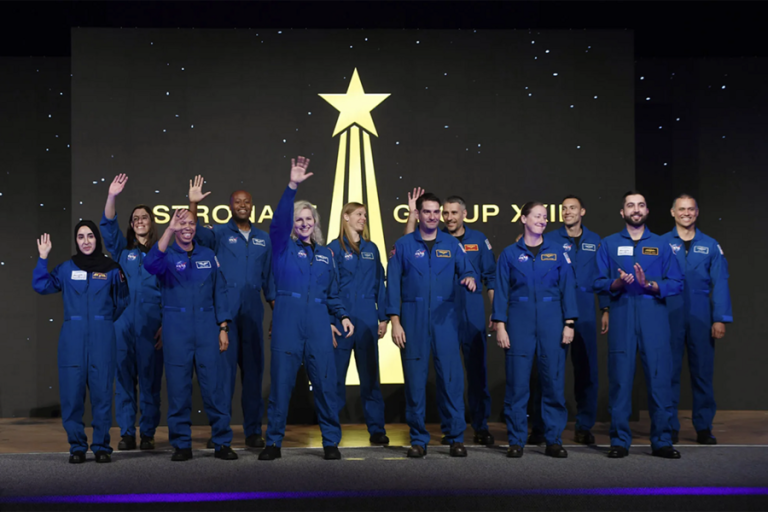
Credits:Photo: Riley McClenaghan/NASANASA Astronaut Group 23, nicknamed “The Flies,” are the newest generation of Artemis astronauts. Ten hail from the United States, and two are from the United Arab Emirates.
Credits:Photo courtesy of NASA.
“It’s been a wild ride,” says Christopher Williams PhD ’12, moments after he received his astronaut pin, signifying graduation into the NASA astronaut corps.
Williams, along with Marcos Berríos ’06 and Christina “Chris” Birch PhD ’15, were among the 12-member class of astronaut candidates to graduate from basic training at NASA’s Johnson Space Center in Houston, Texas, on Tuesday, March 5.
NASA Astronaut Group 23 are the newest generation of Artemis astronauts, which includes 10 hailing from the United States, as well as two from the United Arab Emirates who trained alongside them.
During their more than two years of basic training, the group became proficient in such areas as spacewalking, robotics, space station systems, T-38 jets, and Russian language. The graduates also said that they asked endless questions about the functions of their spacesuit, which they wore while submerged in huge pools to practice spacewalks. They jumped into a frigid lake during a 10-day hike in Wyoming and shared the hauling of a 30-pound lava rock back to camp for more geology study, as well as the last bag of peanut M&Ms after running out of ready-to-eat meals during survival training in the Alabama back country.
“We feel ready to put our efforts and our energy into supporting NASA’s science on the space station or in support of our return to the moon and this program,” says Birch. “All of the Flies feel a great sense of responsibility and excitement for what comes next.”
The team earned the nickname “The Flies” from the previous astronaut class, the “Turtles,” and even designed their team patch into a housefly shape. (Although team prefers calling themselves the Swarm, “which has a little bit more pizzazz,” says Birch.) “Traditionally, these names are usually things that do not take well to flight,” Birch adds. “We were really surprised that they gave us a flying creature. I think they have a lot of faith in us and hope that we fly soon.”
The Turtles were the first class to graduate under NASA’s Artemis program, in 2020. They included three aeronautics and astronautics alumni: Raja Chari SM ’01, Jasmin Moghbeli ’05, and Warren “Woody” Hoburg ’08. Former Whitehead Institute for Biomedical Research research fellow Kate Rubins, who was selected as a NASA astronaut in 2009 and had served as a flight engineer aboard the International Space Station, also joined the team.
After the newest graduates received their silver NASA astronaut pins, they joined the other 36 current astronauts eligible “to sit on the pointy end of a rocket” for such initiatives as assignments to the International Space Station, future commercial destinations, deep-space missions to destinations including the moon on NASA’s Orion spacecraft and Space Launch System rocket, and eventually, missions to Mars. The Artemis initiative also includes plans for the first woman and first person of color to walk on the moon.
For now, the Flies will be supporting all of these initiatives while Earthbound.
“Hopefully within next two or three years, my name will be called to go to space,” says Berrios. For now, he will stay in Houston, where he’ll be working in the human landing system program, including with private companies such as SpaceX and Blue Origin. He’ll also continue his training in advanced robotics and Russian, and he is training at various international partner countries working with space station modules.
Marcos Berríos
When he was selected to join the NASA astronaut program, Berríos had been serving as the commander of Detachment 1, 413th Flight Test Squadron and deputy director of the Combat Search and Rescue (CSAR) Combined Task Force. As a test pilot, he has accumulated more than 110 combat missions and 1,400 hours of flight time in more than 21 different aircraft.
Berríos calls Guaynabo, Puerto Rico, his hometown, and says he appreciated other Latino American astronauts, including Franklin R. Chang Diaz PhD ’77, serving as his role models and mentors. He hopes to do the same for others.
“Today, hopefully, marks another opportunity to open doors for others like me in the future, to recognize that the talent in the Latin American community is strong,” he said on the day of his graduation. His advice to those dreaming of being an astronaut is “to not give up, to stay curious, stay humble, be disciplined, and throughout all adversity, throughout all obstacles, that would all be worth it in the end.”
“I’ve always wanted to be an astronaut,” he says. He read a lot of astronaut autobiographies, and frequently Googled class 2.007 (Design and Manufacturing I), which led him to study mechanical engineering at MIT. He earned his master’s degree in mechanical engineering as well as a doctorate in aeronautics and astronautics from Stanford University, and then enrolled at the U.S. Naval Test Pilot School in Patuxent River, Maryland.
As a developmental test pilot at the CSAR Combined Test Force at Nellis Air Force Base in Nevada, he learned avionics, defensive systems, synthetic vision technologies, and electric vertical-takeoff-and-landing vehicles.
Berríos says that MIT, particularly while working with Professor Alexander Slocum, instilled within him the discipline required for his successes. “I don’t want to admit how spending, like, 24 hours on problem set after problem set just provided that attitude and mentality of like, ‘Yeah, this is tough, this is hard,’ but you know we’ve got the skills, we’ve got the resources, we’ve got our colleagues, and we’re going to figure it out … and we’re going to find a pretty novel way to solve it.”
He says he found spacewalk training to be especially tough “physically, because you’re in a pressurized spacesuit — it’s stiff, it requires strength and stamina — but also mentally, because you have to be focused for six hours at a time and maintain high awareness of your surroundings as well as for your partner.”
The new astronaut says he identifies first as an engineer and researcher. “We’re kind of a jack-of-all-trades,” he says. “One of the amazing things about being an astronaut, and certainly one of the things that was very captivating for me about this job, was all of the different subject matters that we get to touch on. I mean, it’s incredible.”
Christina Birch
An Arizona native, Birch graduated from the University of Arizona with bachelor’s degrees in mathematics, biochemistry, and molecular biophysics. As a doctoral candidate in biological engineering at MIT, she conducted original research at the intersection of synthetic biology, microfluidics, and infectious disease, and worked in the Jacquin Niles lab in the Department of Biological Engineering. “I really am grateful for (her advisor, Niles) taking me on, especially when he was starting up his lab.”
After graduation, she taught bioengineering at the University of California at Riverside, and scientific writing and communication at Caltech. But she didn’t forget the skills she gained while on the MIT cycling team; in 2018, she left academia to become a decorated track cyclist on the U.S. National Team. She was training for the 2020 Summer Olympics, while also working as a scientific consultant for startups in various technology sectors from robotics to vaccine development, when she was selected by NASA.
“I really need to give a shout out to the MIT cycling team,” she says. “They helped give me my start,” she says. “It was just a fantastic place to get a taste of that cycling community which I’m still a part of. I do still ride; I’m focused on longer-distance races, and I like to do gravel races.”
She’s also excited that the International Space Station has a bike trainer called CEVIS, and Teal CEVIS, to reduce muscle and bone loss experienced in microgravity.
Her next role is to support the Orion program.
“Last week, I was out in San Diego supporting the underway recovery training, which is the landing and recovery team’s practice to recover crew from the Orion capsule after a simulated splashdown in the Pacific. It was just such an incredible learning opportunity for me getting up to speed on this new vehicle. We’re doing the Orion 2 mission, which is really an incredible test flight.”
“The more I learn about the program, the more I see how many different elements that we are building from scratch,” she says. “What really sets NASA apart is our dedication to safety, and I know that we will fly astronauts to the moon when we’re ready, and now that comes under a little bit of my purview and my responsibilities.”
How does she incorporate her backgrounds in cycling and her biological engineering research into the space program? “The common link between my pursuit of the pointy edge of the bike race, and also original research at MIT, has always been the stepping into the unknown, comfort-pushing boundaries. Whether it’s getting into the T38 jet for the first time — I don’t have any prior aviation experience — and standing up in front of an audience to give a scientific lecture or to make an attack on the bike, you know I’ve done that emotional practice.
“I think being comfortable in discomfort and the unknown, stepping through that process with a rigorous sort of like engineering-questioning, is because MIT set me up so well with a strong foundation of understanding engineering principles, and applying those to big questions. Places where we don’t have full understanding of a system or how something works, and then there is spaceflight, how we are very much developing these technologies and testing them as we go. Ultimately, human lives are going to depend on asking really good questions.”
She says her biggest challenge so far has been diversifying her skill set.
“I had to make a pretty big transition when I arrived (to NASA training) because I had previously been in a mentality of trying to be the best in the world at something, be it the best in the world on the bike, or you know, being the expert in RNA aptamer malaria-targeting technologies, which is the research I was doing at MIT, and then having to switch to being both knowledgeable and skillful in a huge number of different areas that are required of an astronaut. I don’t have an aviation background so that was something very new, very exciting, and very fun, it turns out. But also having to develop spacewalk skills, learning to speak Russian, learning to fly a robotic arm, and learning all about the International Space Station systems, so going from a specialist, really, to a generalist was a pretty big transition.
“One of the hardest things about astronaut training is finding balance, because we are switching between all of these different technical topics, sometimes in the span of a day. You might be in the jet in the morning and then you have to turn around and go to an emergency simulation for a space station in the afternoon. Reid Wiseman, the commander of the Artemis 2 mission, says, ‘Be where your feet are.’ And that was some of the best advice that he gave us coming into the office as candidates.”
Christopher Williams
Williams knew going into the training program that he would learn things in which he had no prior background.
“When you’re flying in one of the T38 jets you’re having to do, you know, back-of-the-envelope math estimating things while operating in a dynamic environment,” he recalls. “Other things, like doing an underwater run in the spacesuit, to finding alternatives when conjugating Russian verbs … learning how to approach problems and to solve them came from my time at MIT. Going through the physics grad program there made me much stronger at taking new topics and just sort of digesting them, figuring to how to break them down and solve them.”
He did end up working with many MIT alumni. “Lots of MIT people have rotated through, so I’ve had lots of good conversations with Kate Rubins and a bunch of folks that passed through AeroAstro [the Department of Aeronautics and Astronautics].”
Williams grew up in Potomac, Maryland, dreaming of being an astronaut. A private pilot and Eagle Scout, Williams spent much of his high school and Stanford University years at the U.S. Naval Research Laboratory in Washington, studying supernovae using the Very Large Array radio telescope, and researching supernovae at NASA’s Goddard Space Flight Center.
At MIT, he pursued his doctorate in physics with a focus on astrophysics. When he wasn’t working as a campus emergency medical technician and volunteer firefighter, Williams and his advisor, Jackie Hewitt, built the Murchison Widefield Array, a low-frequency radio telescope array in Western Australia designed to study the epoch of reionization of the early universe.
After graduation, he joined the faculty at Harvard Medical School, and was a medical physicist in the Radiation Oncology Department at the Brigham and Women’s Hospital and Dana-Farber Cancer Institute. As the lead physicist for the institute’s MRI-guided adaptive radiation therapy program, Williams focused on developing image guidance techniques for cancer treatments.
He will be supporting the ongoing missions until it’s his turn to head to space. In the meantime, he looks forward to using his background in medicine to research how the human body is affected by space radiation and being in orbit.
“It’s strange, because as a scientist you know you’re kind of in a different role. There are physics experiments on the space station, and tons of biology and chemistry experiments. It’s actually really fun because I get to stretch different parts of my brain that I haven’t had to before.”
“We’re really representing all of NASA, all of America all over the world,” he says. “That’s a huge responsibility on us. I really want to make everybody proud.”
Encouraging the next generation of astronauts
After the graduation ceremonies ended, NASA announced that it is accepting applications for new astronaut candidates through April 2.
Berrios advises MIT students that no matter what their background is, they should apply if they want to be an astronaut. “Try and express in words how your education, how your career, and how your hobbies relate to human space exploration. Chris [Birch] and I have very different backgrounds and combinations of skill sets … I guarantee the next class is going to have an individual from MIT that has a background that we haven’t even thought of yet.”
Birch says that just interviewing for the Artemis program “absolutely changed my life. I knew that even if I didn’t become an astronaut, I had met, you know, a real incredible group of people that inspired me to push further to do more to find another way to serve and so I would really just encourage people to apply. A lot of people (who were accepted) applied more than once.”
Adds Williams, “If you meet the requirements, just do it. If that’s your dream, tell people about it — because people will be excited for you and want to help you to achieve.”
Reprinted with permission of MIT News (http://news.mit.edu/)
For the first time in more than 50 years, NASA was able to collect data from new science instruments and technology demonstrations on the Moon. The data comes from the first successful landing of a delivery through NASA’s CLPS (Commercial Lunar Payload Services) initiative and Artemis campaign.
The six instruments ceased science and technology operations eight days after landing in the lunar South Pole region aboard Intuitive Machines’ Odysseus, meeting pre-launch projected mission operations. Known as IM-1, this was the first U.S. soft landing on the Moon in decades, touching down on Feb. 22, proving commercial vendors can deliver instruments designed to expand the scientific and technical knowledge on the Moon.
Aboard the lunar lander, NASA science instruments measured the radio noise generated by the Earth and Sun. Technology instruments, aided Intuitive Machines in navigating to the Moon and gathered distance and speed (velocity) of the lander as touched down on the lunar surface.
“This mission includes many firsts. This is the first time in over 50 years that an American organization has landed instruments on the surface of the Moon,” said Joel Kearns, deputy association administrator for exploration of NASA’s Science Mission Directorate in Washington. “This mission also provides evidence of the Commercial Lunar Payload Services model, that NASA can purchase the service of sending instruments to the Moon and receiving their data back. Congratulations to the entire Intuitive Machines team and our NASA scientists and engineers for this next leap to advance exploration and our understanding of Earth’s nearest neighbor.”
During transit from Earth to the Moon, all powered NASA instruments received data and completed transit checkouts.
During descent, the Radio Frequency Mass Gauge and Navigation Doppler Lidar collected data during the lander’s powered descent and landing.
After landing, NASA payload data was acquired consistent with the communications and other constraints resulting from the lander orientation.
During surface operations, the Radio-wave Observations at the Lunar Surface of the Photoelectron Sheath and Lunar Node-1 were powered on, performed surface operations, and have received data.
The Stereo Cameras for Lunar Plume-Surface Studies was powered on and captured images during transit and several days after landing but was not successfully commanded to capture images of the lander rocket plume interaction with the lunar surface during landing.
The Laser Retroreflector Array is passive and initial estimates suggest it is accessible for laser ranging from the Lunar Reconnaissance Orbiter’s Lunar Orbiter Laser Altimeter to create a permanent location marker on the Moon.
“The bottom line is every NASA instrument has met some level of their objectives, and we are very excited about that,” said Sue Lederer, project scientist for CLPS. “We all worked together and it’s the people who really made a difference and made sure we overcame challenges to this incredible success – and that is where we are at today, with successes for all of our instruments.”
NASA and Intuitive Machines co-hosted a news conference non Feb. 28 to provide a status update on the six NASA instruments that collected data on the IM-1 mission. Mission challenges and successes were discussed during the briefing, including more than approximately 500 megabytes of science, technology, and spacecraft data downloaded and ready for analysis by NASA and Intuitive Machines.
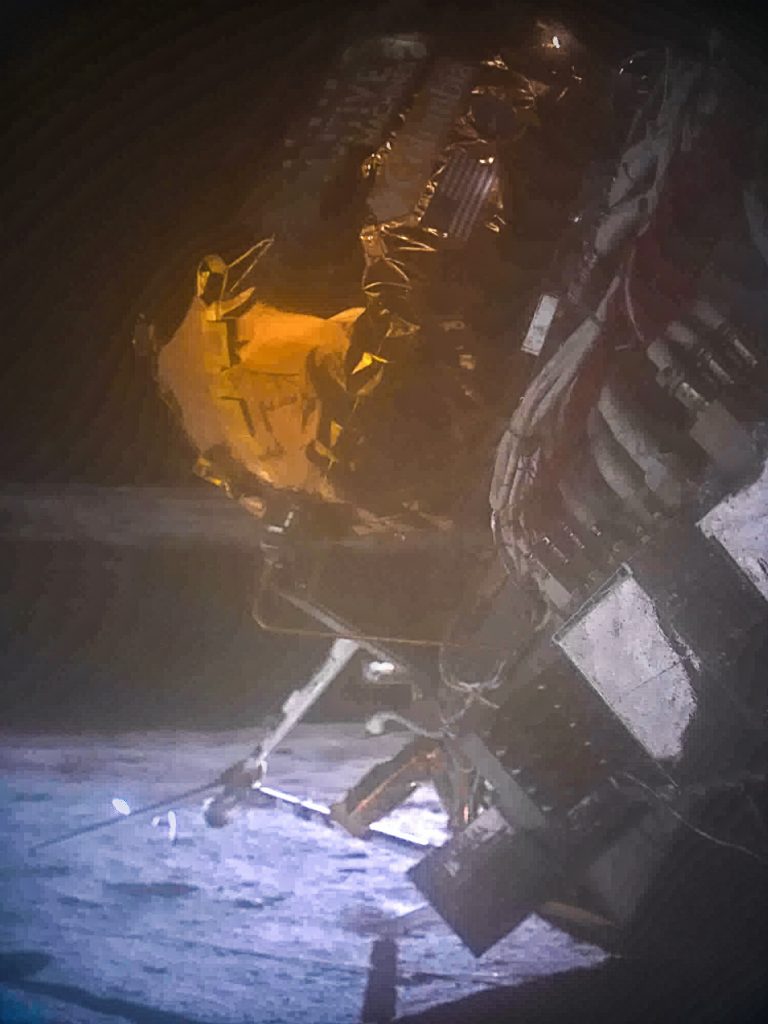
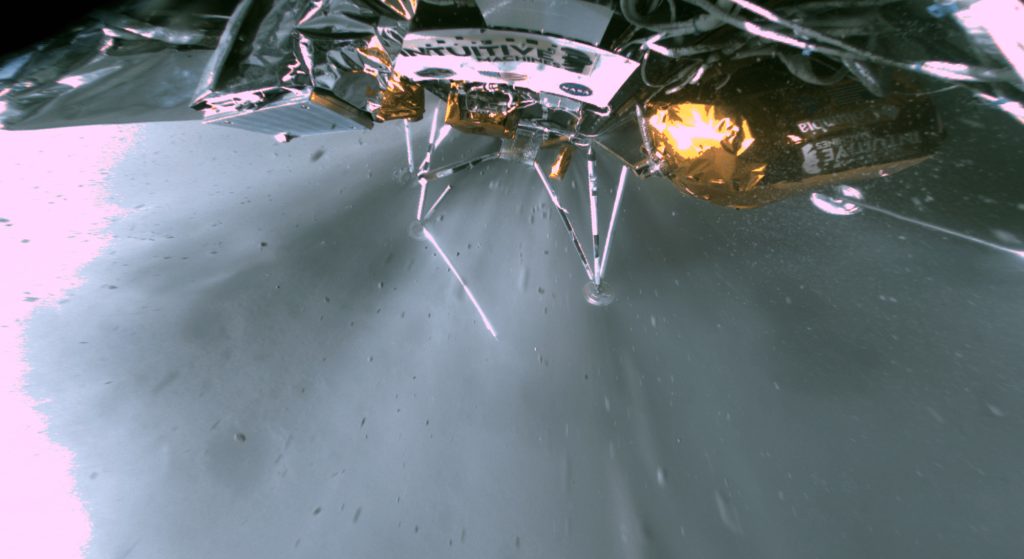
The first images from this historical mission are now available and showcase the orientation of the lander along with a view of the South Pole region on the Moon. Odysseus is gently leaning into the lunar surface, preserving the ability to return scientific data. After successful transmission of images to Earth, Intuitive Machines continues to gain additional insight into Odysseus’ position on the lunar surface. All data gathered from this mission will aid Intuitive Machines in their next two CLPS contracts that NASA has previously awarded.
For more information about the agency’s Commercial Lunar Payload Services initiative, visit:
https://www.nasa.gov/clps
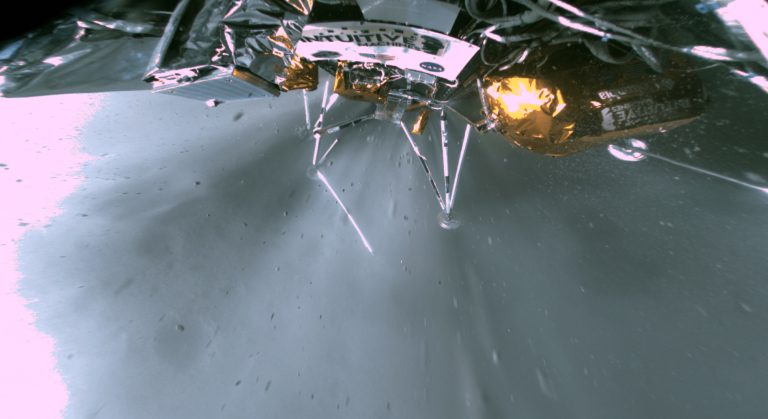
Odysseus’ landing captured a leg, as it performed its primary task, absorbing first contact with the lunar surface. With the lander’s liquid methane and liquid oxygen engine still throttling, it provided stability.
Credit: Intuitive Machines
Taken on Tuesday, Feb. 27, Odysseus captured an image using its narrow-field-of-view camera.
Credit: Intuitive Machines
By: Johnson Space Center Office of Communications Originally published at: NASA
Today, we’re announcing the Claude 3 model family, which sets new industry benchmarks across a wide range of cognitive tasks. The family includes three state-of-the-art models in ascending order of capability: Claude 3 Haiku, Claude 3 Sonnet, and Claude 3 Opus. Each successive model offers increasingly powerful performance, allowing users to select the optimal balance of intelligence, speed, and cost for their specific application.
Opus and Sonnet are now available to use in claude.ai and the Claude API which is now generally available in 159 countries. Haiku will be available soon.
Claude 3 model family
A new standard for intelligence
Opus, our most intelligent model, outperforms its peers on most of the common evaluation benchmarks for AI systems, including undergraduate level expert knowledge (MMLU), graduate level expert reasoning (GPQA), basic mathematics (GSM8K), and more. It exhibits near-human levels of comprehension and fluency on complex tasks, leading the frontier of general intelligence.
All Claude 3 models show increased capabilities in analysis and forecasting, nuanced content creation, code generation, and conversing in non-English languages like Spanish, Japanese, and French.
Below is a comparison of the Claude 3 models to those of our peers on multiple benchmarks [1] of capability:
Near-instant results
The Claude 3 models can power live customer chats, auto-completions, and data extraction tasks where responses must be immediate and in real-time.
Haiku is the fastest and most cost-effective model on the market for its intelligence category. It can read an information and data dense research paper on arXiv (~10k tokens) with charts and graphs in less than three seconds. Following launch, we expect to improve performance even further.
For the vast majority of workloads, Sonnet is 2x faster than Claude 2 and Claude 2.1 with higher levels of intelligence. It excels at tasks demanding rapid responses, like knowledge retrieval or sales automation. Opus delivers similar speeds to Claude 2 and 2.1, but with much higher levels of intelligence.
Strong vision capabilities
The Claude 3 models have sophisticated vision capabilities on par with other leading models. They can process a wide range of visual formats, including photos, charts, graphs and technical diagrams. We’re particularly excited to provide this new modality to our enterprise customers, some of whom have up to 50% of their knowledge bases encoded in various formats such as PDFs, flowcharts, or presentation slides.
Fewer refusals
Previous Claude models often made unnecessary refusals that suggested a lack of contextual understanding. We’ve made meaningful progress in this area: Opus, Sonnet, and Haiku are significantly less likely to refuse to answer prompts that border on the system’s guardrails than previous generations of models. As shown below, the Claude 3 models show a more nuanced understanding of requests, recognize real harm, and refuse to answer harmless prompts much less often.
Improved accuracy
Businesses of all sizes rely on our models to serve their customers, making it imperative for our model outputs to maintain high accuracy at scale. To assess this, we use a large set of complex, factual questions that target known weaknesses in current models. We categorize the responses into correct answers, incorrect answers (or hallucinations), and admissions of uncertainty, where the model says it doesn’t know the answer instead of providing incorrect information. Compared to Claude 2.1, Opus demonstrates a twofold improvement in accuracy (or correct answers) on these challenging open-ended questions while also exhibiting reduced levels of incorrect answers.
In addition to producing more trustworthy responses, we will soon enable citations in our Claude 3 models so they can point to precise sentences in reference material to verify their answers.
Long context and near-perfect recall
The Claude 3 family of models will initially offer a 200K context window upon launch. However, all three models are capable of accepting inputs exceeding 1 million tokens and we may make this available to select customers who need enhanced processing power.
To process long context prompts effectively, models require robust recall capabilities. The ‘Needle In A Haystack’ (NIAH) evaluation measures a model’s ability to accurately recall information from a vast corpus of data. We enhanced the robustness of this benchmark by using one of 30 random needle/question pairs per prompt and testing on a diverse crowdsourced corpus of documents. Claude 3 Opus not only achieved near-perfect recall, surpassing 99% accuracy, but in some cases, it even identified the limitations of the evaluation itself by recognizing that the “needle” sentence appeared to be artificially inserted into the original text by a human.
Responsible design
We’ve developed the Claude 3 family of models to be as trustworthy as they are capable. We have several dedicated teams that track and mitigate a broad spectrum of risks, ranging from misinformation and CSAM to biological misuse, election interference, and autonomous replication skills. We continue to develop methods such as Constitutional AI that improve the safety and transparency of our models, and have tuned our models to mitigate against privacy issues that could be raised by new modalities.
Addressing biases in increasingly sophisticated models is an ongoing effort and we’ve made strides with this new release. As shown in the model card, Claude 3 shows less biases than our previous models according to the Bias Benchmark for Question Answering (BBQ). We remain committed to advancing techniques that reduce biases and promote greater neutrality in our models, ensuring they are not skewed towards any particular partisan stance.
While the Claude 3 model family has advanced on key measures of biological knowledge, cyber-related knowledge, and autonomy compared to previous models, it remains at AI Safety Level 2 (ASL-2) per our Responsible Scaling Policy. Our red teaming evaluations (performed in line with our White House commitments and the 2023 US Executive Order) have concluded that the models present negligible potential for catastrophic risk at this time. We will continue to carefully monitor future models to assess their proximity to the ASL-3 threshold. Further safety details are available in the Claude 3 model card.
Easier to use
The Claude 3 models are better at following complex, multi-step instructions. They are particularly adept at adhering to brand voice and response guidelines, and developing customer-facing experiences our users can trust. In addition, the Claude 3 models are better at producing popular structured output in formats like JSON—making it simpler to instruct Claude for use cases like natural language classification and sentiment analysis.
Model details
Claude 3 Opus is our most intelligent model, with best-in-market performance on highly complex tasks. It can navigate open-ended prompts and sight-unseen scenarios with remarkable fluency and human-like understanding. Opus shows us the outer limits of what’s possible with generative AI.
Task automation: plan and execute complex actions across APIs and databases, interactive codingR&D: research review, brainstorming and hypothesis generation, drug discoveryStrategy: advanced analysis of charts & graphs, financials and market trends, forecasting
Differentiator
Higher intelligence than any other model available.
*1M tokens available for specific use cases, please inquire.
Claude 3 Sonnet strikes the ideal balance between intelligence and speed—particularly for enterprise workloads. It delivers strong performance at a lower cost compared to its peers, and is engineered for high endurance in large-scale AI deployments.
Data processing: RAG or search & retrieval over vast amounts of knowledgeSales: product recommendations, forecasting, targeted marketingTime-saving tasks: code generation, quality control, parse text from images
Differentiator
More affordable than other models with similar intelligence; better for scale.
Claude 3 Haiku is our fastest, most compact model for near-instant responsiveness. It answers simple queries and requests with unmatched speed. Users will be able to build seamless AI experiences that mimic human interactions.
Customer interactions: quick and accurate support in live interactions, translationsContent moderation: catch risky behavior or customer requestsCost-saving tasks: optimized logistics, inventory management, extract knowledge from unstructured data
Differentiator
Smarter, faster, and more affordable than other models in its intelligence category.
Model availability
Opus and Sonnet are available to use today in our API, which is now generally available, enabling developers to sign up and start using these models immediately. Haiku will be available soon. Sonnet is powering the free experience on claude.ai, with Opus available for Claude Pro subscribers.
Sonnet is also available today through Amazon Bedrock and in private preview on Google Cloud’s Vertex AI Model Garden—with Opus and Haiku coming soon to both.
Smarter, faster, safer
We do not believe that model intelligence is anywhere near its limits, and we plan to release frequent updates to the Claude 3 model family over the next few months. We’re also excited to release a series of features to enhance our models’ capabilities, particularly for enterprise use cases and large-scale deployments. These new features will include Tool Use (aka function calling), interactive coding (aka REPL), and more advanced agentic capabilities.
As we push the boundaries of AI capabilities, we’re equally committed to ensuring that our safety guardrails keep apace with these leaps in performance. Our hypothesis is that being at the frontier of AI development is the most effective way to steer its trajectory towards positive societal outcomes.
We’re excited to see what you create with Claude 3 and hope you will give us feedback to make Claude an even more useful assistant and creative companion. To start building with Claude, visit anthropic.com/claude.
Footnotes
This table shows comparisons to models currently available commercially that have released evals. Our model card shows comparisons to models that have been announced but not yet released, such as Gemini 1.5 Pro. In addition, we’d like to note that engineers have worked to optimize prompts and few-shot samples for evaluations and reported higher scores for a newer GPT-4T model. Source (https://github.com/microsoft/promptbase).
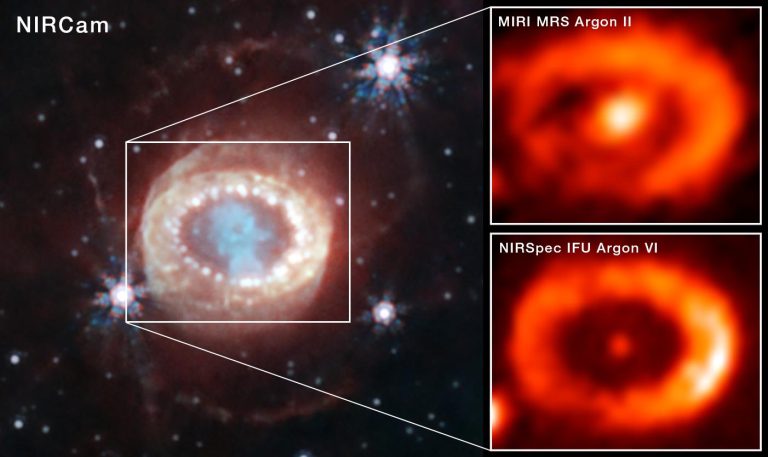
Webb has observed the best evidence yet for emission from a neutron star at the site of Supernova 1987A. Left, an image from Webb’s NIRCam. Top right, light from singly ionized argon captured by the telescope’s MIRI. Bottom right, light from multiply ionized argon captured by Webb’s NIRSpec. Download the full-resolution image here. Credit: NASA, ESA, CSA, STScI, C. Fransson (Stockholm University), M. Matsuura (Cardiff University), M. J. Barlow (University College London), P. J. Kavanagh (Maynooth University), J. Larsson (KTH Royal Institute of Technology)
The telescope’s MIRI instrument helped identify the collapsed core of one of the nearest and youngest stellar explosions ever identified.
NASA’s James Webb Space Telescope has found the best evidence yet for emission from a neutron star at the site of a recently observed supernova. The supernova, known as SN 1987A, was a core-collapse supernova, meaning the compacted remains at its core formed either a neutron star or a black hole. Evidence for such a compact object has long been sought, and while indirect evidence for the presence of a neutron star has previously been found, this is the first time that the effects of high-energy emission from the probable young neutron star have been detected.
Supernovae – the explosive final death throes of some massive stars – blast out within hours, and the brightness of the explosion peaks within a few months. The remains of the exploding star will continue to evolve at a rapid rate over the following decades, offering a rare opportunity for astronomers to study a key astronomical process in real time.
Supernova 1987A
The supernova SN 1987A occurred 160,000 light-years from Earth in the Large Magellanic Cloud. It was first observed on Earth in February 1987, and its brightness peaked in May of that year. It was the first supernova that could be seen with the naked eye since Kepler’s Supernova was observed in 1604.
About two hours prior to the first visible-light observation of SN 1987A, three observatories around the world detected a burst of neutrinos lasting only a few seconds. The two different types of observations were linked to the same supernova event, and provided important evidence to inform the theory of how core-collapse supernovae take place. This theory included the expectation that this type of supernova would form a neutron star or a black hole. Astronomers have searched for evidence for one or the other of these compact objects at the center of the expanding remnant material ever since.
Indirect evidence for the presence of a neutron star at the center of the remnant has been found in the past few years, and observations of much older supernova remnants – such as the Crab Nebula – confirm that neutron stars are found in many supernova remnants. However, no direct evidence of a neutron star in the aftermath of SN 1987A (or any other such recent supernova explosion) had been observed, until now.
Claes Fransson of Stockholm University, and the lead author on this study, explained: “From theoretical models of SN 1987A, the 10-second burst of neutrinos observed just before the supernova implied that a neutron star or black hole was formed in the explosion. But we have not observed any compelling signature of such a newborn object from any supernova explosion. With this observatory, we have now found direct evidence for emission triggered by the newborn compact object, most likely a neutron star.”
Webb’s Observations of SN 1987A
Webb began science observations in July 2022, and the Webb observations behind this work were taken on July 16, making the SN 1987A remnant one of the first objects observed by Webb. The team used the Medium Resolution Spectrograph (MRS) mode of Webb’s MIRI (Mid-Infrared Instrument), which members of the same team helped to develop. The MRS is a type of instrument known as an Integral Field Unit (IFU).
IFUs are able to image an object and take a spectrum of it at the same time. An IFU forms a spectrum at each pixel, allowing observers to see spectroscopic differences across the object. Analysis of the Doppler shift of each spectrum also permits the evaluation of the velocity at each position.
Spectral analysis of the results showed a strong signal due to ionized argon from the center of the ejected material that surrounds the original site of SN 1987A. Subsequent observations using Webb’s NIRSpec (Near-Infrared Spectrograph) IFU at shorter wavelengths found even more heavily ionized chemical elements, particularly five times ionized argon (meaning argon atoms that have lost five of their 18 electrons). Such ions require highly energetic photons to form, and those photons have to come from somewhere.
“To create these ions that we observed in the ejecta, it was clear that there had to be a source of high-energy radiation in the center of the SN 1987A remnant,” Fransson said. “In the paper we discuss different possibilities, finding that only a few scenarios are likely, and all of these involve a newly born neutron star.”
More observations are planned this year, with Webb and ground-based telescopes. The research team hopes ongoing study will provide more clarity about exactly what is happening in the heart of the SN 1987A remnant. These observations will hopefully stimulate the development of more detailed models, ultimately enabling astronomers to better understand not just SN 1987A but all core-collapse supernovae.
These findings were published in the journal Science.
More About the Mission
The James Webb Space Telescope is the world’s premier space science observatory. Webb is solving mysteries in our solar system, looking beyond to distant worlds around other stars, and probing the mysterious structures and origins of our universe and our place in it. Webb is an international program led by NASA with its partners, ESA (European Space Agency) and the Canadian Space Agency.
NASA Headquarters oversees the mission for the agency’s Science Mission Directorate. NASA’s Goddard Space Flight Center in Greenbelt, Maryland, manages Webb for the agency and oversees work on the mission performed by the Space Telescope Science Institute, Northrop Grumman, and other mission partners. In addition to Goddard, several NASA centers contributed to the project, including the agency’s Johnson Space Center in Houston; Jet Propulsion Laboratory in Southern California; Marshall Space Flight Center in Huntsville, Alabama; Ames Research Center in California’s Silicon Valley; and others.
MIRI was developed through a 50-50 partnership between NASA and ESA. JPL led the U.S. efforts for MIRI, and a multinational consortium of European astronomical institutes contributes for ESA. George Rieke with the University of Arizona is the MIRI science team lead. Gillian Wright is the MIRI European principal investigator.
The MIRI cryocooler development was led and managed by JPL, in collaboration with Northrop Grumman in Redondo Beach, California, and NASA’s Goddard Space Flight Center in Greenbelt, Maryland.
Originally published at: Jet Propulsion Laboratory
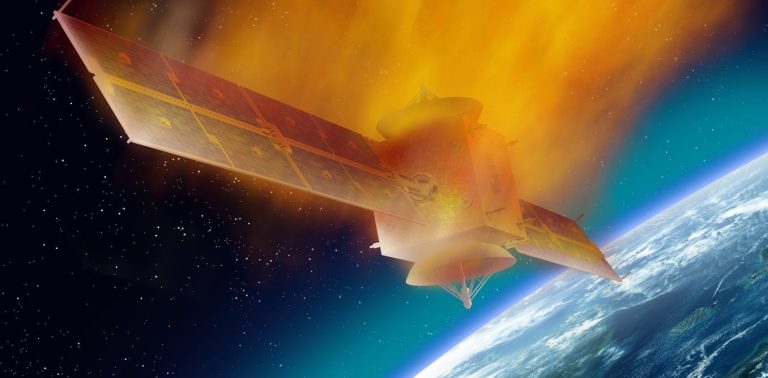
Elon Musk’s SpaceX has announced it will dispose of 100 Starlink satellites over the next six months, after it discovered a design flaw that may cause them to fail. Rather than risk posing a threat to other spacecraft, SpaceX will “de-orbit” these satellites to burn up in the atmosphere.
But atmospheric scientists are increasingly concerned that this sort of apparent fly-tipping by the space sector will cause further climate change down on Earth. One team recently, and unexpectedly, found potential ozone-depleting metals from spacecraft in the stratosphere, the atmospheric layer where the ozone layer is formed.
The relative “low earth orbit” where satellites monitoring Earth’s ecosystems are found is increasingly congested – Starlink alone has more than 5,000 spacecraft in orbit. Clearing debris is therefore a priority for the space sector. Newly launched spacecraft must also be removed from orbit within 25 years (the US recently implemented a stricter five-year rule) either by moving upwards to a so-called “graveyard orbit” or down into the Earth’s atmosphere.
Lower orbiting satellites are usually designed to use any remaining fuel and the pull of the Earth’s gravity to re-enter the atmosphere. In a controlled reentry, the spacecraft enters the atmosphere at a pre-set time to land in the most remote part of the Pacific Ocean at Point Nemo (aka the spacecraft cemetery). In an uncontrolled re-entry, spacecraft are left to follow a “natural demise” and burn up in the atmosphere.
Nasa and the European Space Agency promote this form of disposal as part of a design philosophy called “design for demise”. It is an environmental challenge to build, launch and operate a satellite robust enough to function in the hostility of space yet also able to break up and burn up easily on re-entry to avoid dangerous debris reaching the Earth’s surface. It’s still a work in progress.
Satellite operators must prove their design and re-entry plans have a low “human-hit” rate before they are awarded a license. But there is limited concern regarding the impact on Earth’s upper atmosphere during the re-entry stage. This is not an oversight.
Initially, neither the space sector nor the astrophysics community considered burning up satellites on re-entry to be a serious environmental threat – to the atmosphere, at least. After all, the number of spacecraft particles released is small when compared with 440 tonnes of meteoroids that enter the atmosphere daily, along with volcanic ash and human-made pollution from industrial processes on Earth.
Bad news for the ozone layer?
So are atmospheric climate scientists overreacting to the presence of spacecraft particles in the atmosphere? Their concerns draw on 40 years of research into the cause of the ozone holes above the south and north poles, that were first widely observed in the 1980s.
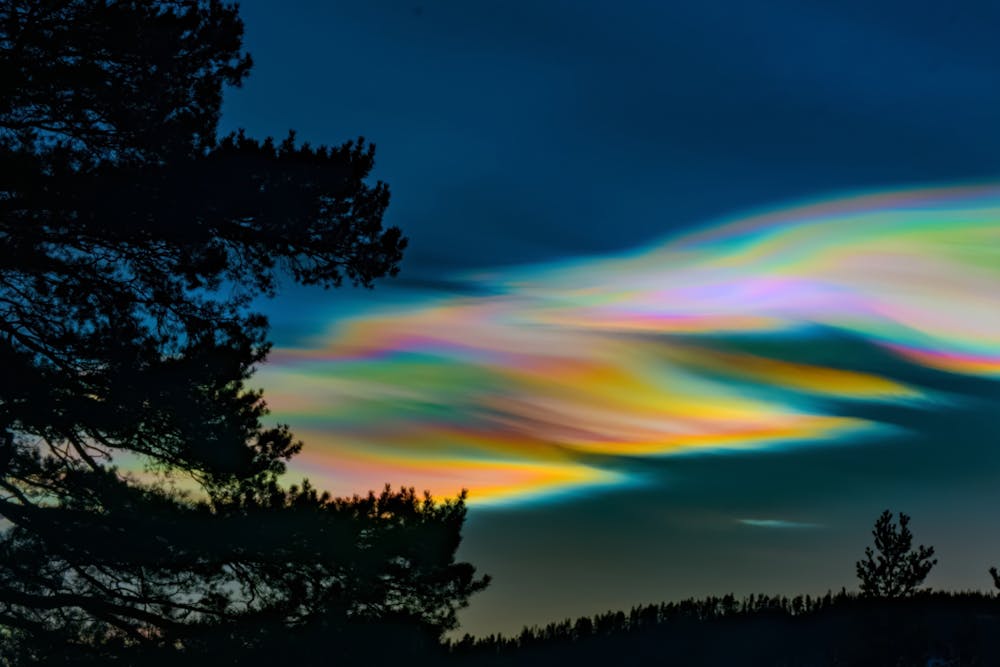
Today, they now know that ozone loss is caused by human-made industrial gases, which combine with natural and very high altitude polar stratospheric clouds or mother of pearl clouds. The surfaces of these ethereal clouds act as catalysts, turning benign chemicals into more active forms that can rapidly destroy ozone.
Mother of pearl cloud in the stratosphere above Norway. Uwe Michael Neumann / shutterstock
Dan Cziczo is an atmospheric scientist at Purdue University in the US, and a co-author of the recent study that found ozone depleting substances in the stratosphere. He explains to me that the question is whether the new particles from spacecraft will help the formation of these clouds and lead to ozone loss at a time when the Earth’s atmosphere is just beginning to recover.
Of more concern to atmospheric scientists such as Cziczo is that only a few new particles could create more of these types of polar clouds – not only at the upper atmosphere, but also in the lower atmosphere, where cirrus clouds form. Cirrus clouds are the thin, wispy ice clouds you might spot high in the sky, above six kilometres. They tend to let heat from the sun pass through but then trap it on the way out, so in theory more cirrus clouds could add extra global warming on top of what we are already seeing from greenhouse gases. But this is uncertain and still being studied.
Cziczo also explains that from anecdotal evidence we know that the high-altitude clouds above the poles are changing – but we don’t know yet what is causing this change. Is it natural particles such as meteoroids or volcanic debris, or unnatural particles from spacecrafts? This is what we need to know.
Concerned, but not certain
So how do we answer this question? We have some research from atmospheric scientists, spacecraft builders and astrophysicists, but it’s not rigorous or focused enough to make informed decisions on which direction to take. Some astrophysicists claim that alumina (aluminium oxide) particles from spacecraft will cause chemical reactions in the atmosphere that will likely trigger ozone destruction.
Atmospheric scientists who study this topic in detail have not made this jump as there isn’t enough scientific evidence. We know particles from spacecraft are in the stratosphere. But what this means for the ozone layer or the climate is still unknown.
It is tempting to overstate research findings to garner more support. But this is the path to research hell – and deniers will use poor findings at a later date to discredit the research. We also don’t want to use populist opinions. But we’ve also learnt that if we wait until indisputable evidence is available, it may be too late, as with the loss of ozone. It’s a constant dilemma.
Fionagh Thomson, Senior Research Fellow in Space Ethics and Sustainability, Durham University
This article is republished from The Conversation under a Creative Commons license. Read the original article (https://theconversation.com/satellites-are-burning-up-in-the-upper-atmosphere-and-we-still-dont-know-what-impact-this-will-have-on-the-earths-climate-223618).
Engineering is a huge field with endless applications. From aerospace to ergonomics, engineers play an important role in designing, building, and testing technologies all around us.
We asked three engineers at NASA’s Ames Research Center in California’s Silicon Valley to share their experiences, from early challenges they faced in their careers to the day-to-day of being a working engineer.
Give us a look behind the curtain – what is it like being an engineer at NASA?
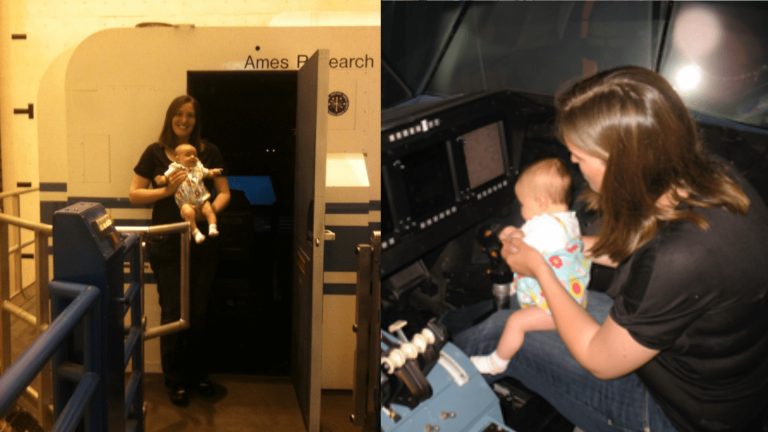
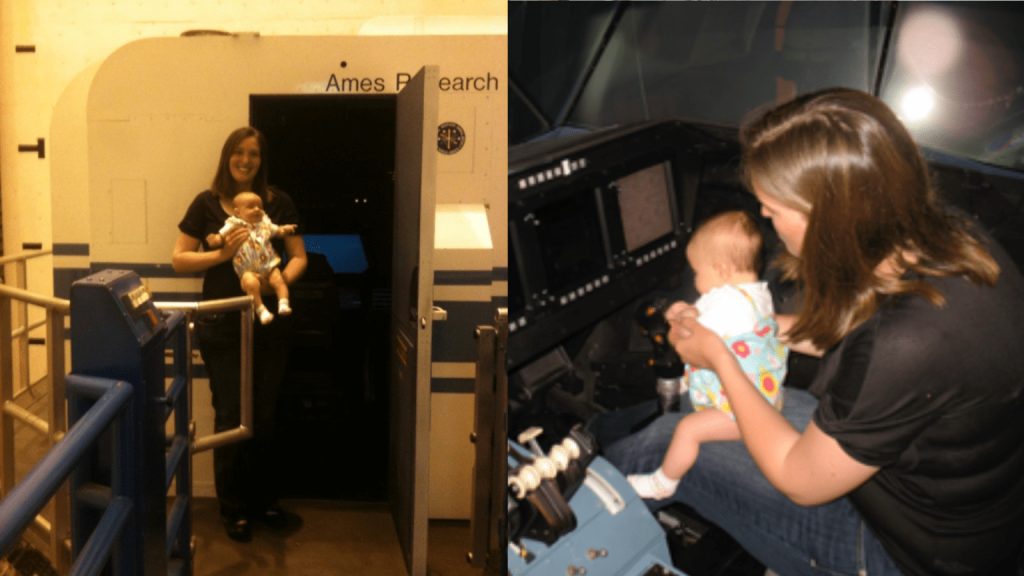
In her early days at NASA, Diana Acosta visited her aeronautics research and development team during her maternity leave and her daughter got her first introduction to flight simulation technology.
NASA/Diana Acosta
Diana Acosta: I remember working on my first simulations. We were developing new aircraft with higher efficiency that could operate in new places, such as shorter runways. My team was putting together control techniques and introducing new algorithms to help pilots fly these new aircraft in a safer way. We were creating models and testing, then changing things and testing again.
We had a simulator that worked on my laptop, and we had a lab with a pilot seat and controls. Every week, I made it my goal to finish my modeling or controls work and put that into the lab environment so that I could fly the aircraft. Every Friday afternoon, I would fly the aircraft in simulation and try out the changes I’d made to see if we were going in a good direction. We’d later integrate that into the Vertical Motion Simulator at Ames (which was used to train all the original space shuttle pilots) so that we could do a full motion test with a collection of pilots to get feedback.
When simulation time came around, it was during my maternity leave and my team had to take the project to simulation without me. It’s hard to get out of the house with a newborn, but sometimes I’d come by with my daughter and bring brownies to the team. I have two daughters now, and they’ve both been in simulators since a young age.
Diana Acosta is Chief of the Aerospace Simulation and Development Branch at NASA’s Ames Research Center. She has worked at NASA for 17 years.
What’s a challenge you’ve overcome to become an engineer?
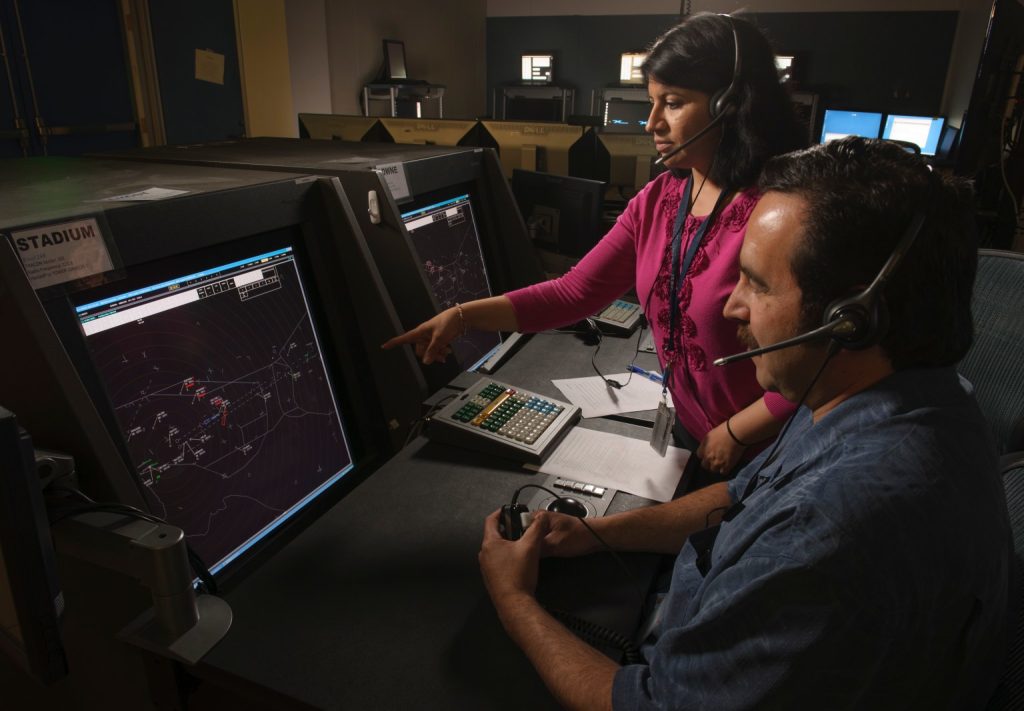
Savvy Verma (standing) reviews simulation activity with Gus Guerra in the Terminal Tactical Separation Assured Flight Environment at NASA’s Ames Research Center in California’s Silicon Valley.
NASA/Dominic Hart
Savvy Verma (standing) reviews simulation activity with Gus Guerra in the Terminal Tactical Separation Assured Flight Environment at NASA’s Ames Research Center in California’s Silicon Valley.
NASA/Dominic Hart
Savvy Verma: One of the biggest challenges when I started working was that I was sometimes the only woman in a group of men, and I was also much younger. It was sometimes a challenge to get my voice through, or to be heard. I had mentors who taught me to speak up and say things the way I saw them, and that’s what helped me. A good mentor will back you up and support you when you’re in big meetings or giving presentations. They’ll stand up and corroborate you when you’re right, and that goes a long way toward establishing your credibility. It also helped build my confidence, it made me feel like I was on the right track and not out of line. I had both male and female mentors. The female mentor I had always encouraged me to speak my mind. She said the integrity of the experimental result is more important than trying to change things because someone doesn’t like it or doesn’t want to express it a certain way.
I have a lot more women coworkers now, things have changed a lot. In my group there are four women and three men.
Savvy Verma is an aerospace engineer at NASA’s Ames Research Center. She has worked at NASA for 22 years.
Can you become an engineer if you struggle with math in school?
Dorcas Kaweesa: When I introduce myself as an engineer, people always say, “You must be good at math,” and I say, “Oh, I work at it.”
When you want to become an engineer, you must remain adaptable, hardworking, and always willing to learn something new. We’re constantly learning, critically thinking, and problem solving. Most of the time we apply mathematical concepts to the engineering problems we’re solving and not every problem is the same. If you struggle with math, my advice is to maintain the passion for learning, especially learning from your mistakes. It comes down to practicing and challenging yourself to think beyond the immediate struggle. There are so many types of math problems and if you’re not good at one, maybe you’re good at another. Maybe it’s just a hiccup. Also, seek help when you need it, there are instructors and peers out there willing to support you.
Personally, I sought help from my instructors, peers, and mentors, in the math and engineering classes that I found challenging. I also practiced a great deal to improve my problem solving and critical thinking skills. In my current role, I am constantly learning new things based on the task at hand. Learning never ends! If you’re struggling with a math concept, don’t give up. Keep trying, keep accepting the challenge, and keep practicing, you’ll steadily make progress.
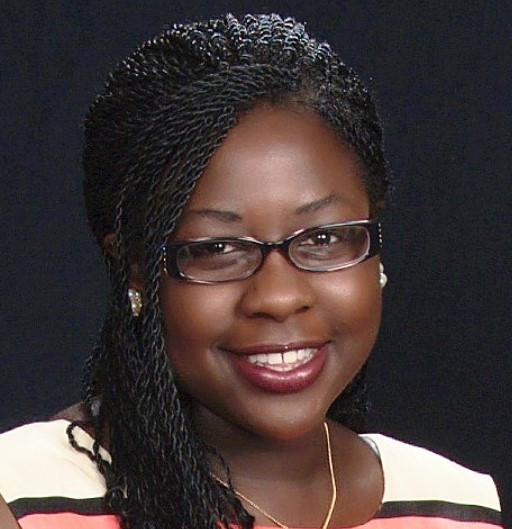
Dorcas Kaweesa is mechanical engineer and structures analyst at NASA’s Ames Research Center. She has worked at NASA for over 2 years.
By: Arezu Sarvestani Originally published at: NASA
Sora is an AI model that can create realistic and imaginative scenes from text instructions.
All videos on this page were generated directly by Sora without modification.
We’re teaching AI to understand and simulate the physical world in motion, with the goal of training models that help people solve problems that require real-world interaction.
Introducing Sora, our text-to-video model. Sora can generate videos up to a minute long while maintaining visual quality and adherence to the user’s prompt.
Prompt: Several giant wooly mammoths approach treading through a snowy meadow, their long wooly fur lightly blows in the wind as they walk, snow covered trees and dramatic snow capped mountains in the distance, mid afternoon light with wispy clouds and a sun high in the distance creates a warm glow, the low camera view is stunning capturing the large furry mammal with beautiful photography, depth of field.
Today, Sora is becoming available to red teamers to assess critical areas for harms or risks. We are also granting access to a number of visual artists, designers, and filmmakers to gain feedback on how to advance the model to be most helpful for creative professionals.
We’re sharing our research progress early to start working with and getting feedback from people outside of OpenAI and to give the public a sense of what AI capabilities are on the horizon.
Prompt: Historical footage of California during the gold rush.
Sora is able to generate complex scenes with multiple characters, specific types of motion, and accurate details of the subject and background. The model understands not only what the user has asked for in the prompt, but also how those things exist in the physical world.
Prompt: The camera follows behind a white vintage SUV with a black roof rack as it speeds up a steep dirt road surrounded by pine trees on a steep mountain slope, dust kicks up from it’s tires, the sunlight shines on the SUV as it speeds along the dirt road, casting a warm glow over the scene. The dirt road curves gently into the distance, with no other cars or vehicles in sight. The trees on either side of the road are redwoods, with patches of greenery scattered throughout. The car is seen from the rear following the curve with ease, making it seem as if it is on a rugged drive through the rugged terrain. The dirt road itself is surrounded by steep hills and mountains, with a clear blue sky above with wispy clouds.
The model has a deep understanding of language, enabling it to accurately interpret prompts and generate compelling characters that express vibrant emotions. Sora can also create multiple shots within a single generated video that accurately persist characters and visual style.
Prompt: Tour of an art gallery with many beautiful works of art in different styles.
The current model has weaknesses. It may struggle with accurately simulating the physics of a complex scene, and may not understand specific instances of cause and effect. For example, a person might take a bite out of a cookie, but afterward, the cookie may not have a bite mark.
The model may also confuse spatial details of a prompt, for example, mixing up left and right, and may struggle with precise descriptions of events that take place over time, like following a specific camera trajectory.
Prompt: Step-printing scene of a person running, cinematic film shot in 35mm.
Prompt: Step-printing scene of a person running, cinematic film shot in 35mm.
Weakness: Sora sometimes creates physically implausible motion.
Safety
We’ll be taking several important safety steps ahead of making Sora available in OpenAI’s products. We are working with red teamers — domain experts in areas like misinformation, hateful content, and bias — who will be adversarially testing the model.
We’re also building tools to help detect misleading content such as a detection classifier that can tell when a video was generated by Sora. We plan to include C2PA metadata in the future if we deploy the model in an OpenAI product.
In addition to us developing new techniques to prepare for deployment, we’re leveraging the existing safety methods that we built for our products that use DALL·E 3, which are applicable to Sora as well.
For example, once in an OpenAI product, our text classifier will check and reject text input prompts that are in violation of our usage policies, like those that request extreme violence, sexual content, hateful imagery, celebrity likeness, or the IP of others. We’ve also developed robust image classifiers that are used to review the frames of every video generated to help ensure that it adheres to our usage policies, before it’s shown to the user.
We’ll be engaging policymakers, educators and artists around the world to understand their concerns and to identify positive use cases for this new technology. Despite extensive research and testing, we cannot predict all of the beneficial ways people will use our technology, nor all the ways people will abuse it. That’s why we believe that learning from real-world use is a critical component of creating and releasing increasingly safe AI systems over time.
Prompt: The camera directly faces colorful buildings in burano italy. An adorable dalmation looks through a window on a building on the ground floor. Many people are walking and cycling along the canal streets in front of the buildings.
Research techniques
Sora is a diffusion model, which generates a video by starting off with one that looks like static noise and gradually transforms it by removing the noise over many steps.
Sora is capable of generating entire videos all at once or extending generated videos to make them longer. By giving the model foresight of many frames at a time, we’ve solved a challenging problem of making sure a subject stays the same even when it goes out of view temporarily.
Similar to GPT models, Sora uses a transformer architecture, unlocking superior scaling performance.
We represent videos and images as collections of smaller units of data called patches, each of which is akin to a token in GPT. By unifying how we represent data, we can train diffusion transformers on a wider range of visual data than was possible before, spanning different durations, resolutions and aspect ratios.
Sora builds on past research in DALL·E and GPT models. It uses the recaptioning technique from DALL·E 3, which involves generating highly descriptive captions for the visual training data. As a result, the model is able to follow the user’s text instructions in the generated video more faithfully.
In addition to being able to generate a video solely from text instructions, the model is able to take an existing still image and generate a video from it, animating the image’s contents with accuracy and attention to small detail. The model can also take an existing video and extend it or fill in missing frames. Learn more in our technical report.
Sora serves as a foundation for models that can understand and simulate the real world, a capability we believe will be an important milestone for achieving AGI.
Research Leads Bill Peebles & Tim Brooks
Systems LeadConnor Holmes
Contributors
Clarence Wing Yin Ng David Schnurr Eric Luhman Joe Taylor Li Jing Natalie Summers Ricky Wang Rohan Sahai Ryan O’Rourke Troy Luhman Will DePue Yufei Guo
Special Thanks Bob McGrew, Brad Lightcap, Chad Nelson, David Medina, Gabriel Goh, Greg Brockman, Ian Sohl, Jamie Kiros, James Betker, Jason Kwon, Hannah Wong, Mark Chen, Michelle Fradin, Mira Murati, Nick Turley, Prafulla Dhariwal, Rowan Zellers, Sarah Yoo, Sandhini Agarwal, Sam Altman, Srinivas Narayanan & Wesam Manassra
Communications
Elie Georges Justin Wang Kendra Rimbach Niko Felix Thomas Degry Veit Moeller
Legal
Che Chang Fred von Lohmann Gideon Myles Tom Stasi
External Engagement Alex Baker-Whitcomb, Allie Teague, Anna Makanju, Anna McKean, Becky Waite, Brittany Smith, Chan Park, Chris Lehane, David Duxin, David Robinson, James Hairston, Jonathan Lachman, Justin Oswald, Krithika Muthukumar, Lane Dilg, Leher Pathak, Ola Nowicka, Ryan Biddy, Sandro Gianella, Stephen Petersilge, Tom Rubin & Varun Shetty
Executive Producer Aditya Ramesh
Built by OpenAI in San Francisco, California Published February 15, MMXXIV
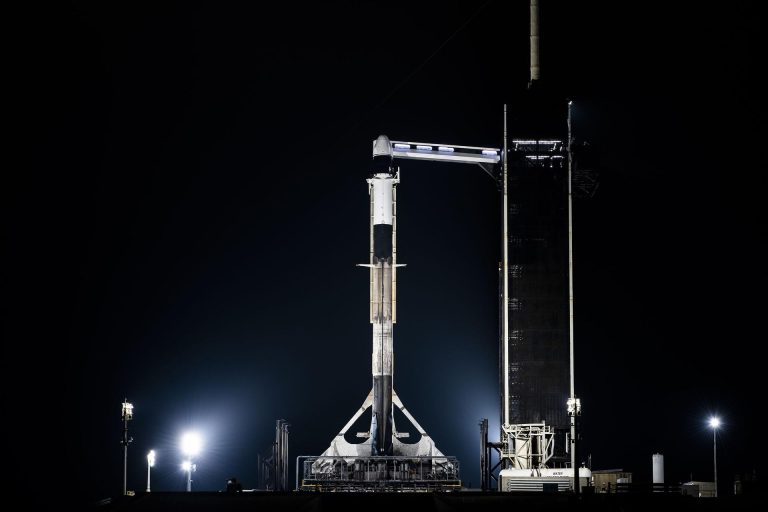
The SpaceX Falcon 9 rocket, with the company’s Dragon cargo spacecraft atop, pictured at Launch Complex 39A at NASA’s Kennedy Space Center in Florida on March 13, 2023. SpaceX
Media accreditation is open at NASA’s Kennedy Space Center in Florida for SpaceX’s 30th Commercial Resupply Services (CRS-30) mission to the International Space Station for the agency.
Liftoff of the SpaceX Dragon cargo spacecraft on the company’s Falcon 9 rocket is targeted no earlier than mid-March from Launch Complex 39A at NASA’s Kennedy Space Center in Florida.
Media prelaunch and launch activities will take place at NASA Kennedy. Attendance for this launch is open to U.S. citizens. The application deadline for U.S. media is 11:59 p.m. EST Tuesday, Feb. 27.
All accreditation requests should be submitted online at:
https://media.ksc.nasa.gov
Credentialed media will receive a confirmation email upon approval. NASA’smedia accreditation policy is online. For questions about accreditation, or to request special logistical needs, please email [email protected]. For other questions, please contact Kennedy’s newsroom at: 321-867-2468.
Para obtener información sobre cobertura en español en el Centro Espacial Kennedy o si desea solicitor entrevistas en español, comuníquese con Antonia Jaramillo o Messod Bendayan a: [email protected] o [email protected].
SpaceX’s Dragon will deliver new science investigations, food, supplies, and equipment to the international crew. NASA and partner research flying aboard the CRS-30 mission includes a look at plant metabolism in space, a set of new sensors for free-flying Astrobee robots to provide 3D mapping capabilities, and a fluid physics study that could benefit solar cell technology. Other studies launching include JAXA’s (Japan Aerospace Exploration Agency) FLARE, which continues flame behavior studies in space, and a university project from CSA (Canadian Space Agency) that will monitor sea ice and ocean conditions.
Commercial resupply by U.S. companies significantly increases NASA’s ability to conduct more investigations aboard the orbiting laboratory. These investigations lead to new technologies, medical treatments, and products that improve life on Earth. Other U.S. government agencies, private industry, and academic and research institutions can also conduct microgravity research through the agency’s partnership with the International Space Station National Laboratory.
Humans have occupied the space station continuously since November 2000. In that time, 276 people and a variety of international and commercial spacecraft have visited the orbital outpost. It remains the springboard to NASA’s next great leap in exploration, including future missions to the Moon under Artemis, and ultimately, human exploration of Mars.
For more information about commercial resupply missions, visit: