New AI foundation model offers insights beyond forecasting for scientists, developers, and businesses to better understand and analyze weather and climate data
YORKTOWN HEIGHTS, N.Y., Sept. 23, 2024 /PRNewswire/ — IBM (NYSE: IBM) today announced a new AI foundation model for a variety of weather and climate use cases, available in open-source to the scientific, developer, and business communities. Developed by IBM and NASA, with contributions from Oak Ridge National Laboratory, the model offers a flexible, scalable way to address a variety of challenges related to short-term weather as well as long-term climate projection.
Because of its unique design and training regime, the weather and climate foundation model can tackle far more applications than existing weather AI models, as outlined in a paper recently published on arXiv, “Prithvi WxC: Foundation Model for Weather and Climate.” Potential applications include creating targeted forecasts based on local observations, detecting and predicting severe weather patterns, improving the spatial resolution of global climate simulations, and improving how physical processes are represented in numerical weather and climate models. In one experiment in the above identified paper, the foundation model accurately reconstructed global surface temperatures from a random sample of only five percent original data, suggesting a broader application to problems in data assimilation.
This model was pre-trained on 40 years of Earth observation data from NASA’s Modern-Era Retrospective analysis for Research and Applications, Version 2 (MERRA-2). As a foundation model, it has a unique architecture which allows it to be fine-tuned to global, regional, and local scales. This flexibility makes it suited for a range of weather studies.
The foundation model is available for download on Hugging Face, along with two fine-tuned versions of the model that tackle specific scientific and industry-relevant applications. These are:
Climate and weather data downscaling: A common meteorological practice is downscaling—inferring high-resolution outputs from low-resolution variables. Typical data inputs include temperature, precipitation, and surface winds, all of which can have varied resolutions. The model can depict both weather and climate data at up to 12x resolution, generating localized forecasts and climate projections. The fine-tuned downscaling model is available on the IBM Granite page on Hugging Face.
Gravity wave parameterization: Gravity waves are ubiquitous throughout the atmosphere and can affect many atmospheric processes related to climate and weather, such as cloud formation and aircraft turbulence. Traditionally, existing numerical climate models have not sufficiently captured gravity waves, which leads to uncertainties in terms of how exactly gravity waves can affect climate processes. This weather and climate foundation model can help scientists better estimate gravity wave generation, to improve the accuracy of numerical weather and climate models and constrain uncertainty when simulating future weather and climate events. This gravity wave parameterization model is being released as part of the NASA-IBM Prithvi family of models on Hugging Face.
“Advancing NASA’s Earth science for the benefit of humanity means delivering actionable science in ways that are useful to people, organizations, and communities. The rapid changes we’re witnessing on our home planet demand this strategy to meet the urgency of the moment,” said Karen St. Germain, director of the Earth Science Division of NASA’s Science Mission Directorate. “The NASA foundation model will help us produce a tool that people can use: weather, seasonal, and climate projections to help inform decisions on how to prepare, respond, and mitigate.”
“This space has seen the emergence of large AI models that focus on a fixed dataset and single use case — primarily forecasting. We have designed our weather and climate foundation model to go beyond such limitations so that it can be tuned to a variety of inputs and uses,” said Juan Bernabe-Moreno, Director of IBM Research Europe (UK and Ireland) and IBM’s Accelerated Discovery Lead for Climate and Sustainability. “For example, the model can run both on the entire earth as well as in a local context. With such flexibility on the technology side, this model is well-suited to help us understand meteorological phenomena such as hurricanes or atmospheric rivers, reason about future potential climate risks by increasing the resolution of climate models, and finally inform our understanding of imminent severe weather events.”
“As a premier research institution and computing facility, we’re focused on supporting teams to make research breakthroughs across many areas of science,” said Arjun Shankar, director of the National Center for Computational Sciences at Oak Ridge National Laboratory. “Our collaboration with IBM and NASA to support the creation of the Prithvi weather and climate foundation model was a key part of our goal to bring advanced computing and data to problems of national importance, in this case, for weather and climate applications, which need continued computational science and model skill improvements to be impactful.”
IBM has already collaborated with Environment and Climate Change Canada (ECCC) with a view to test the flexibility of the model with additional weather forecasting use cases. With the model, ECCC is exploring very short-term precipitation forecasts using a technique called precipitation nowcasting that ingests real-time radar data as input. The team is also testing the downscaling approach from global model forecasts at 15 km to km-scale resolution.
This weather and climate model is part of a larger collaboration between IBM Research and NASA to use AI technology to explore our planet, and joins the Prithvi family of AI foundation models. Last year, IBM and NASA made the Prithvi geospatial AI foundation model the largest open-source geospatial AI model available on Hugging Face. This geospatial foundation model has since been used by governments, companies, and public institutions to examine changes in disaster patterns, biodiversity, land use, and other geophysical processes. The foundation model and the gravity wave parameterization model can be accessed through the NASA-IBM Hugging Face page and the downscaling model can be accessed through the IBM Granite Hugging Face page.
About IBM IBM is a leading provider of global hybrid cloud and AI, and consulting expertise. We help clients in more than 175 countries capitalize on insights from their data, streamline business processes, reduce costs and gain the competitive edge in their industries. Thousands of governments and corporate entities in critical infrastructure areas such as financial services, telecommunications and healthcare rely on IBM’s hybrid cloud platform and Red Hat OpenShift to affect their digital transformations quickly, efficiently and securely. IBM’s breakthrough innovations in AI, quantum computing, industry-specific cloud solutions and consulting deliver open and flexible options to our clients. All of this is backed by IBM’s long-standing commitment to trust, transparency, responsibility, inclusivity and service.
Media Contact Bethany Hill McCarthy IBM Research Communications [email protected]
NASA has awarded a total of $1.5 million to two U.S. teams for their novel technology solutions addressing energy distribution, management, and storage as part of the agency’s Watts on the Moon Challenge. The innovations from this challenge aim to support NASA’s Artemis missions, which will establish long-term human presence on the Moon.
Team H.E.L.P.S. (High Efficiency Long-Range Power Solution) from The University of California, Santa Barbara won the $1 million grand prize in NASA’s Watts on the Moon Challenge. Their team developed a low-mass, high efficiency cable and featured energy storage batteries on both ends of their power transmission and energy storage system.
Credit: NASA/GRC/Sara Lowthian-Hanna
This two-phase competition has challenged U.S. innovators to develop breakthrough power transmission and energy storage technologies that could enable long-duration Moon missions to advance the nation’s lunar exploration goals. The final phase of the challenge concluded with a technology showcase and winners’ announcement ceremony Friday at Great Lakes Science Center, home of the visitor center for NASA’s Glenn Research Center in Cleveland.
“Congratulations to the finalist teams for developing impactful power solutions in support of NASA’s goal to sustain human presence on the Moon,” said Kim Krome-Sieja, acting program manager for NASA Centennial Challenges at NASA’s Marshall Space Flight Center in Huntsville, Alabama. “These technologies seek to improve our ability to explore and make discoveries in space and could have implications for improving power systems on Earth.”
The winning teams are:
First prize ($1 million): H.E.L.P.S. (High Efficiency Long-Range Power Solution) of Santa Barbara, California
Second prize ($500,000): Orbital Mining Corporation of Golden, Colorado
Four teams were invited to refine their hardware and deliver full system prototypes in the final stage of the competition, and three finalist teams completed their technology solutions for demonstration and assessment at NASA Glenn. The technologies were the first power transmission and energy storage prototypes to be tested by NASA in a vacuum chamber mimicking the freezing temperature and absence of pressure found at the permanently shadowed regions of the Lunar South Pole. The simulation required the teams’ power systems to demonstrate operability over six hours of solar daylight and 18 hours of darkness with the user three kilometers (nearly two miles) away from the power source.
During this competition stage, judges scored the finalists’ solutions based on a Total Effective System Mass (TESM) calculation, which measures the effectiveness of the system relative to its size and weight – or mass – and the total energy provided by the power source. The highest-performing solution was identified based on having the lowest TESM value – imitating the challenges that space missions face when attempting to reduce mass while meeting the mission’s electrical power needs.
Team H.E.L.P.S. (High Efficiency Long-Range Power Solution) from University of California, Santa Barbara, won the grand prize for their hardware solution, which had the lowest mass and highest efficiency of all competitors. The technology also featured a special cable operating at 800 volts and an innovative use of energy storage batteries on both ends of the transmission system. They also employed a variable radiation shield to switch between conserving heat during cold periods and disposing of excess heat during high power modes. The final 48-hour test proved their system design effectively met the power transmission, energy storage, and thermal challenges in the final phase of competition.
Orbital Mining Corporation, a space technology startup, received the second prize for its hardware solution that also successfully completed the 48-hour testwith high performance. They employed a high-voltage converter system coupled with a low-mass cable and a lithium-ion battery.
“The energy solutions developed by the challenge teams are poised to address NASA’s space technology priorities,” said Amy Kaminski, program executive for Prizes, Challenges, and Crowdsourcing in NASA’s Space Technology Mission Directorate at NASA Headquarters in Washington. “These solutions support NASA’s recently ranked civil space shortfalls, including in the top category of surviving and operating through the lunar night.”
During the technology showcase and winners’ announcement ceremony, NASA experts, media, and members of the public gathered to see the finalist teams’ technologies and hear perspectives from the teams’ participation in the challenge. After the winners were announced, event attendees were also welcome to meet NASA astronaut Stephen Bowen.
The Watts on the Moon Challenge is a NASA Centennial Challenge led by NASA Glenn. NASA Marshall Space Flight Center manages Centennial Challenges, which are part of the agency’s Prizes, Challenges, and Crowdsourcing program in the Space Technology Mission Directorate. NASA contracted HeroX to support the administration of this challenge.
For more information on NASA’s Watts on the Moon Challenge, visit:
Watching for changes in the Red Planet’s orbit over time could be new way to detect passing dark matter.
Jennifer Chu | MIT News https://news.mit.edu/2024/mars-wobble-could-be-dark-matter-mit-study-finds-0917
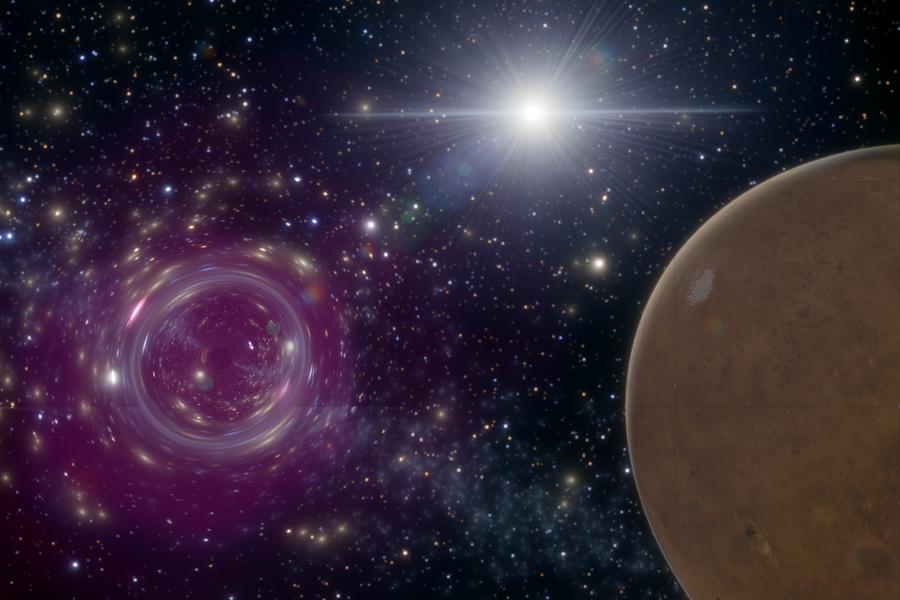
Caption:An artist’s illustration depicts a primordial black hole (at left) flying past, and briefly “wobbling” the orbit of Mars (at right), with the sun in the background. MIT scientists say such a wobble could be detectable by today’s instruments.
Credits:Credit: Image by Benjamin Lehmann, using SpaceEngine @ Cosmographic Software LLC.
In a new study, MIT physicists propose that if most of the dark matter in the universe is made up of microscopic primordial black holes — an idea first proposed in the 1970s — then these gravitational dwarfs should zoom through our solar system at least once per decade. A flyby like this, the researchers predict, would introduce a wobble into Mars’ orbit, to a degree that today’s technology could actually detect.
Such a detection could lend support to the idea that primordial black holes are a primary source of dark matter throughout the universe.
“Given decades of precision telemetry, scientists know the distance between Earth and Mars to an accuracy of about 10 centimeters,” says study author David Kaiser, professor of physics and the Germeshausen Professor of the History of Science at MIT. “We’re taking advantage of this highly instrumented region of space to try and look for a small effect. If we see it, that would count as a real reason to keep pursuing this delightful idea that all of dark matter consists of black holes that were spawned in less than a second after the Big Bang and have been streaming around the universe for 14 billion years.”
Kaiser and his colleagues report their findings today in the journal Physical Review D. The study’s co-authors are lead author Tung Tran ’24, who is now a graduate student at Stanford University; Sarah Geller ’12, SM ’17, PhD ’23, who is now a postdoc at the University of California at Santa Cruz; and MIT Pappalardo Fellow Benjamin Lehmann.
Beyond particles
Less than 20 percent of all physical matter is made from visible stuff, from stars and planets, to the kitchen sink. The rest is composed of dark matter, a hypothetical form of matter that is invisible across the entire electromagnetic spectrum yet is thought to pervade the universe and exert a gravitational force large enough to affect the motion of stars and galaxies.
Physicists have erected detectors on Earth to try and spot dark matter and pin down its properties. For the most part, these experiments assume that dark matter exists as a form of exotic particle that might scatter and decay into observable particles as it passes through a given experiment. But so far, such particle-based searches have come up empty.
In recent years, another possibility, first introduced in the 1970s, has regained traction: Rather than taking on a particle form, dark matter could exist as microscopic, primordial black holes that formed in the first moments following the Big Bang. Unlike the astrophysical black holes that form from the collapse of old stars, primordial black holes would have formed from the collapse of dense pockets of gas in the very early universe and would have scattered across the cosmos as the universe expanded and cooled.
These primordial black holes would have collapsed an enormous amount of mass into a tiny space. The majority of these primordial black holes could be as small as a single atom and as heavy as the largest asteroids. It would be conceivable, then, that such tiny giants could exert a gravitational force that could explain at least a portion of dark matter. For the MIT team, this possibility raised an initially frivolous question.
“I think someone asked me what would happen if a primordial black hole passed through a human body,” recalls Tung, who did a quick pencil-and-paper calculation to find that if such a black hole zinged within 1 meter of a person, the force of the black hole would push the person 6 meters, or about 20 feet away in a single second. Tung also found that the odds were astronomically unlikely that a primordial black hole would pass anywhere near a person on Earth.
Their interest piqued, the researchers took Tung’s calculations a step further, to estimate how a black hole flyby might affect much larger bodies such as the Earth and the moon.
“We extrapolated to see what would happen if a black hole flew by Earth and caused the moon to wobble by a little bit,” Tung says. “The numbers we got were not very clear. There are many other dynamics in the solar system that could act as some sort of friction to cause the wobble to dampen out.”
Close encounters
To get a clearer picture, the team generated a relatively simple simulation of the solar system that incorporates the orbits and gravitational interactions between all the planets, and some of the largest moons.
“State-of-the-art simulations of the solar system include more than a million objects, each of which has a tiny residual effect,” Lehmann notes. “But even modeling two dozen objects in a careful simulation, we could see there was a real effect that we could dig into.”
The team worked out the rate at which a primordial black hole should pass through the solar system, based on the amount of dark matter that is estimated to reside in a given region of space and the mass of a passing black hole, which in this case, they assumed to be as massive as the largest asteroids in the solar system, consistent with other astrophysical constraints.
“Primordial black holes do not live in the solar system. Rather, they’re streaming through the universe, doing their own thing,” says co-author Sarah Geller. “And the probability is, they’re going through the inner solar system at some angle once every 10 years or so.”
Given this rate, the researchers simulated various asteroid-mass black holes flying through the solar system, from various angles, and at velocities of about 150 miles per second. (The directions and speeds come from other studies of the distribution of dark matter throughout our galaxy.) They zeroed in on those flybys that appeared to be “close encounters,” or instances that caused some sort of effect in surrounding objects. They quickly found that any effect in the Earth or the moon was too uncertain to pin to a particular black hole. But Mars seemed to offer a clearer picture.
The researchers found that if a primordial black hole were to pass within a few hundred million miles of Mars, the encounter would set off a “wobble,” or a slight deviation in Mars’ orbit. Within a few years of such an encounter, Mars’ orbit should shift by about a meter — an incredibly small wobble, given the planet is more than 140 million miles from Earth. And yet, this wobble could be detected by the various high-precision instruments that are monitoring Mars today.
If such a wobble were detected in the next couple of decades, the researchers acknowledge there would still be much work needed to confirm that the push came from a passing black hole rather than a run-of-the-mill asteroid.
“We need as much clarity as we can of the expected backgrounds, such as the typical speeds and distributions of boring space rocks, versus these primordial black holes,” Kaiser notes. “Luckily for us, astronomers have been tracking ordinary space rocks for decades as they have flown through our solar system, so we could calculate typical properties of their trajectories and begin to compare them with the very different types of paths and speeds that primordial black holes should follow.”
To help with this, the researchers are exploring the possibility of a new collaboration with a group that has extensive expertise simulating many more objects in the solar system.
“We are now working to simulate a huge number of objects, from planets to moons and rocks, and how they’re all moving over long time scales,” Geller says. “We want to inject close encounter scenarios, and look at their effects with higher precision.”
“It’s a very neat test they’ve proposed, and it could tell us if the closest black hole is closer than we realize,” says Matt Caplan, associate professor of physics at Illinois State University, who was not involved in the study. “I should emphasize there’s a little bit of luck involved too. Whether or not a search finds a loud and clear signal depends on the exact path a wandering black hole takes through the solar system. Now that they’ve checked this idea with simulations, they have to do the hard part — checking the real data.”
This work was supported in part by the U.S. Department of Energy and the U.S. National Science Foundation, which includes an NSF Mathematical and Physical Sciences postdoctoral fellowship.
Reprinted with permission of MIT News http://news.mit.edu/
A new series of reasoning models for solving hard problems. Available starting 9.12
We’ve developed a new series of AI models designed to spend more time thinking before they respond. They can reason through complex tasks and solve harder problems than previous models in science, coding, and math.
Today, we are releasing the first of this series in ChatGPT and our API. This is a preview and we expect regular updates and improvements. Alongside this release, we’re also including evaluations for the next update, currently in development.
How it works
We trained these models to spend more time thinking through problems before they respond, much like a person would. Through training, they learn to refine their thinking process, try different strategies, and recognize their mistakes.
In our tests, the next model update performs similarly to PhD students on challenging benchmark tasks in physics, chemistry, and biology. We also found that it excels in math and coding. In a qualifying exam for the International Mathematics Olympiad (IMO), GPT-4o correctly solved only 13% of problems, while the reasoning model scored 83%. Their coding abilities were evaluated in contests and reached the 89th percentile in Codeforces competitions. You can read more about this in our technical research post.
As an early model, it doesn’t yet have many of the features that make ChatGPT useful, like browsing the web for information and uploading files and images. For many common cases GPT-4o will be more capable in the near term.
But for complex reasoning tasks this is a significant advancement and represents a new level of AI capability. Given this, we are resetting the counter back to 1 and naming this series OpenAI o1.
Safety
As part of developing these new models, we have come up with a new safety training approach that harnesses their reasoning capabilities to make them adhere to safety and alignment guidelines. By being able to reason about our safety rules in context, it can apply them more effectively.
One way we measure safety is by testing how well our model continues to follow its safety rules if a user tries to bypass them (known as “jailbreaking”). On one of our hardest jailbreaking tests, GPT-4o scored 22 (on a scale of 0-100) while our o1-preview model scored 84. You can read more about this in the system card and our research post.
To match the new capabilities of these models, we’ve bolstered our safety work, internal governance, and federal government collaboration. This includes rigorous testing and evaluations using our Preparedness Framework(opens in a new window), best-in-class red teaming, and board-level review processes, including by our Safety & Security Committee.
To advance our commitment to AI safety, we recently formalized agreements with the U.S. and U.K. AI Safety Institutes. We’ve begun operationalizing these agreements, including granting the institutes early access to a research version of this model. This was an important first step in our partnership, helping to establish a process for research, evaluation, and testing of future models prior to and following their public release.
Whom it’s for
These enhanced reasoning capabilities may be particularly useful if you’re tackling complex problems in science, coding, math, and similar fields. For example, o1 can be used by healthcare researchers to annotate cell sequencing data, by physicists to generate complicated mathematical formulas needed for quantum optics, and by developers in all fields to build and execute multi-step workflows.
OpenAI o1-mini
The o1 series excels at accurately generating and debugging complex code. To offer a more efficient solution for developers, we’re also releasing OpenAI o1-mini, a faster, cheaper reasoning model that is particularly effective at coding. As a smaller model, o1-mini is 80% cheaper than o1-preview, making it a powerful, cost-effective model for applications that require reasoning but not broad world knowledge.
How to use OpenAI o1
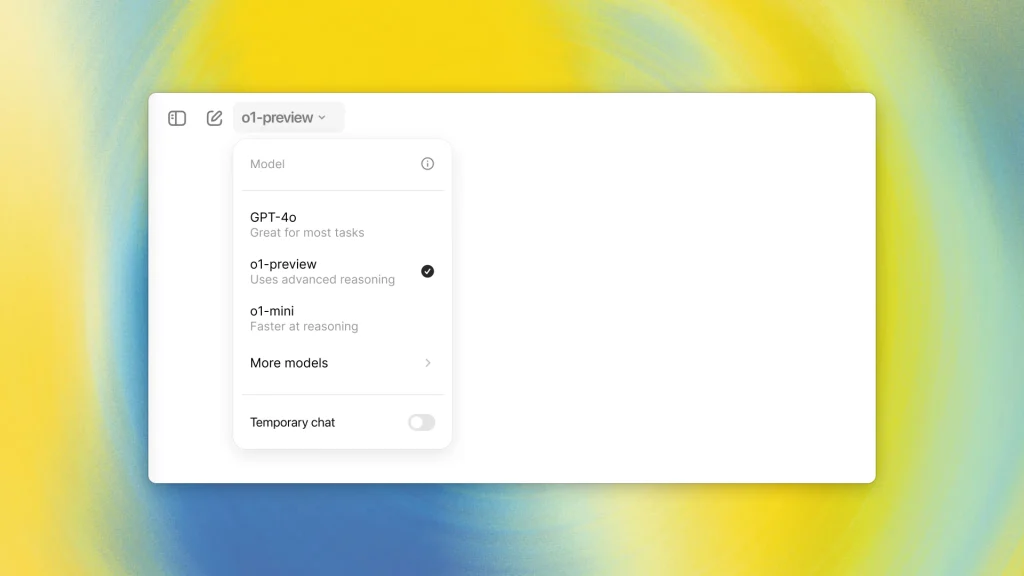
ChatGPT Plus and Team users will be able to access o1 models in ChatGPT starting today. Both o1-preview and o1-mini can be selected manually in the model picker, and at launch, weekly rate limits will be 30 messages for o1-preview and 50 for o1-mini. We are working to increase those rates and enable ChatGPT to automatically choose the right model for a given prompt.
ChatGPT Enterprise and Edu users will get access to both models beginning next week.
Developers who qualify for API usage tier 5(opens in a new window) can start prototyping with both models in the API today with a rate limit of 20 RPM. We’re working to increase these limits after additional testing. The API for these models currently doesn’t include function calling, streaming, support for system messages, and other features. To get started, check out the API documentation(opens in a new window).
We also are planning to bring o1-mini access to all ChatGPTFree users.
What’s next
This is an early preview of these reasoning models in ChatGPT and the API. In addition to model updates, we expect to add browsing, file and image uploading, and other features to make them more useful to everyone.
We also plan to continue developing and releasing models in our GPT series, in addition to the new OpenAI o1 series.
Powered by the A18 Pro chip and built for Apple Intelligence, the Pro lineup introduces larger display sizes, Camera Control, innovative pro camera features, and a huge leap in battery life
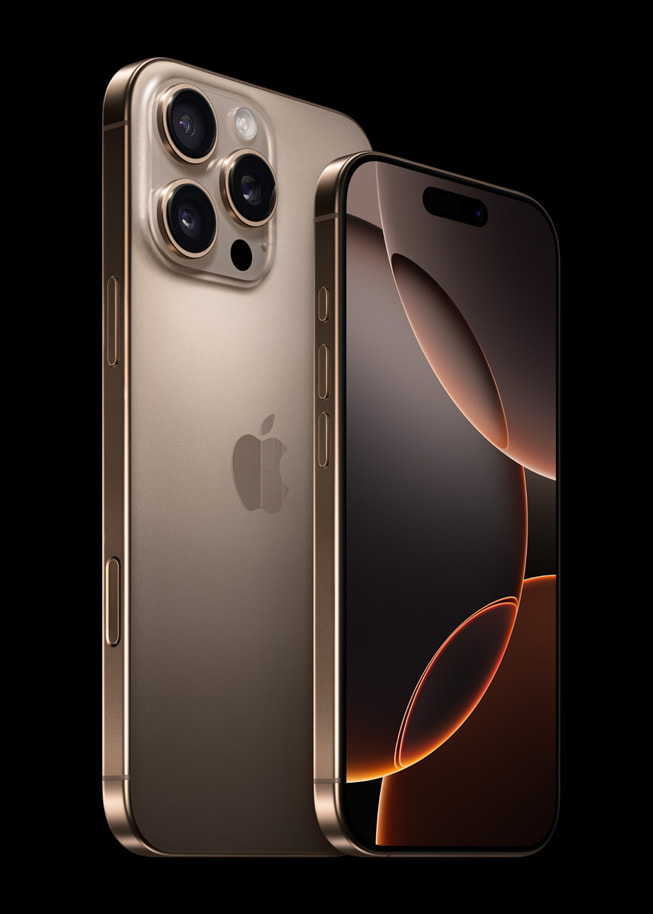
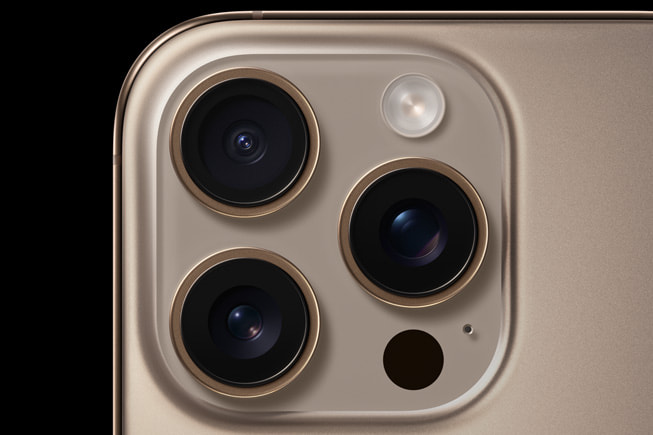
CUPERTINO, CALIFORNIA Apple today introduced iPhone 16 Pro and iPhone 16 Pro Max, featuring Apple Intelligence, larger display sizes, new creative capabilities with innovative pro camera features, stunning graphics for immersive gaming, and more — all powered by the A18 Pro chip. With Apple Intelligence, powerful Apple-built generative models come to iPhone in the easy-to-use personal intelligence system that understands personal context to deliver intelligence that is helpful and relevant while protecting user privacy. Camera Control unlocks a fast, intuitive way to tap into visual intelligence and easily interact with the advanced camera system. Featuring a new 48MP Fusion camera with a faster quad-pixel sensor that enables 4K120 fps video recording in Dolby Vision, these new Pro models achieve the highest resolution and frame-rate combination ever available on iPhone. Additional advancements include a new 48MP Ultra Wide camera for higher-resolution photography, including macro; a 5x Telephoto camera on both Pro models; and studio-quality mics to record more true-to-life audio. The durable titanium design is strong yet lightweight, with larger display sizes, the thinnest borders on any Apple product, and a huge leap in battery life — with iPhone 16 Pro Max offering the best battery life on iPhone ever.
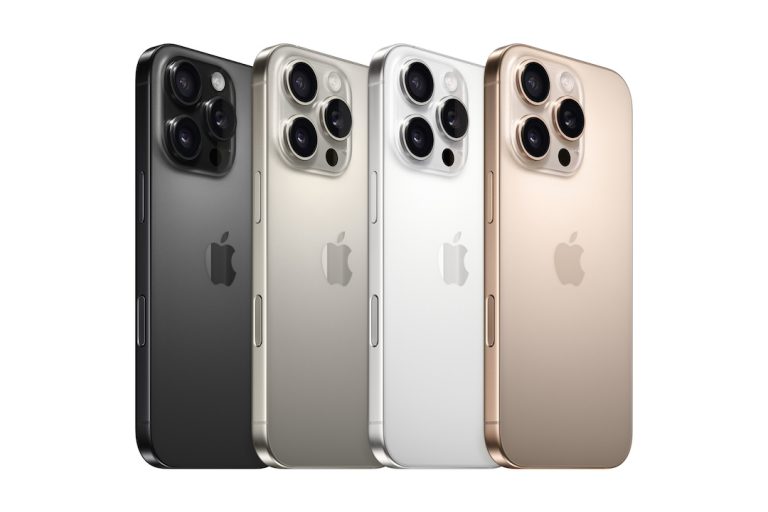
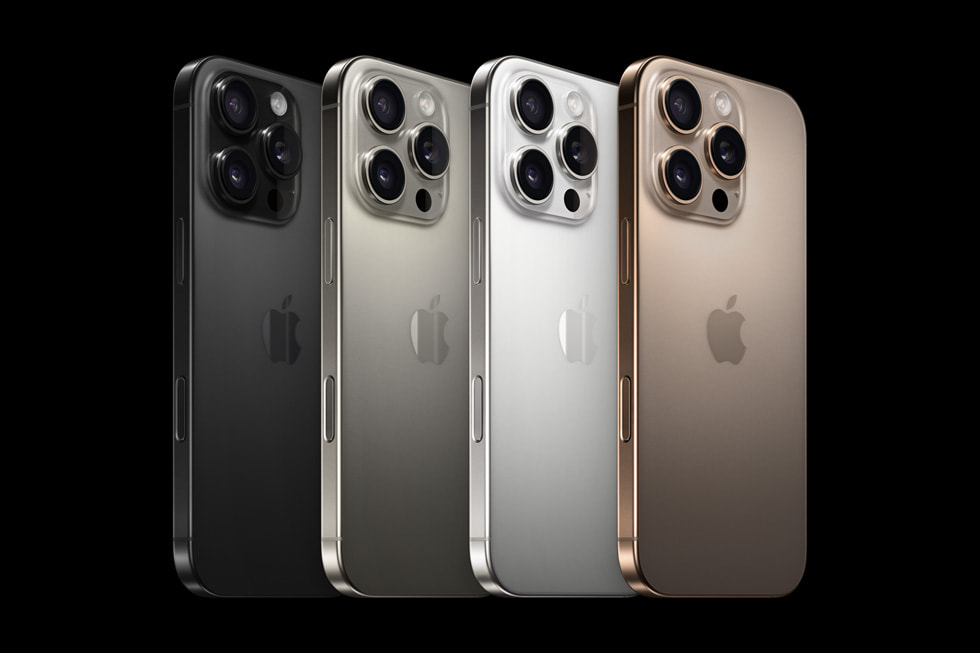
iPhone 16 Pro and iPhone 16 Pro Max will be available in four stunning finishes: black titanium, natural titanium, white titanium, and desert titanium.
iPhone 16 Pro and iPhone 16 Pro Max will be available in four stunning finishes: black titanium, natural titanium, white titanium, and desert titanium. Pre-orders begin Friday, September 13, with availability beginning Friday, September 20.
“Powered by the faster, more efficient A18 Pro chip and built for Apple Intelligence, iPhone 16 Pro and iPhone 16 Pro Max are the most advanced iPhone models we’ve ever made,” said Greg Joswiak, Apple’s senior vice president of Worldwide Marketing. “Customers who are looking for the best possible iPhone will be able to take advantage of this huge step forward, whether they’re applying edits to a photo without lifting a finger, rewriting meeting notes for a more professional tone, or using the advanced camera system to capture their next masterpiece in 4K120 fps in Dolby Vision — all while enjoying extraordinary battery life.”
Built for Apple Intelligence
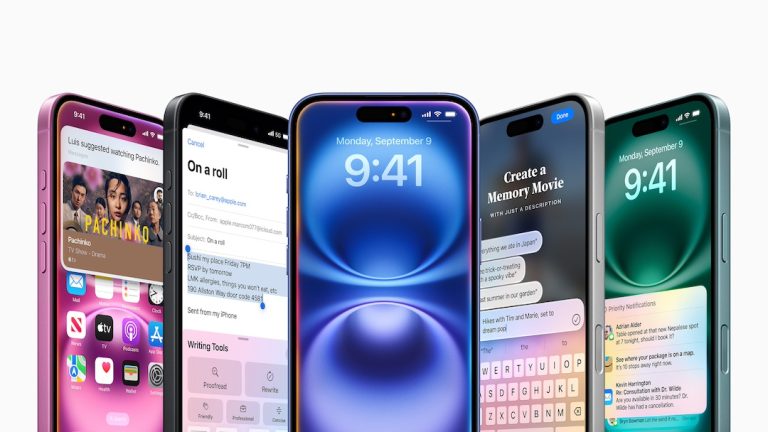
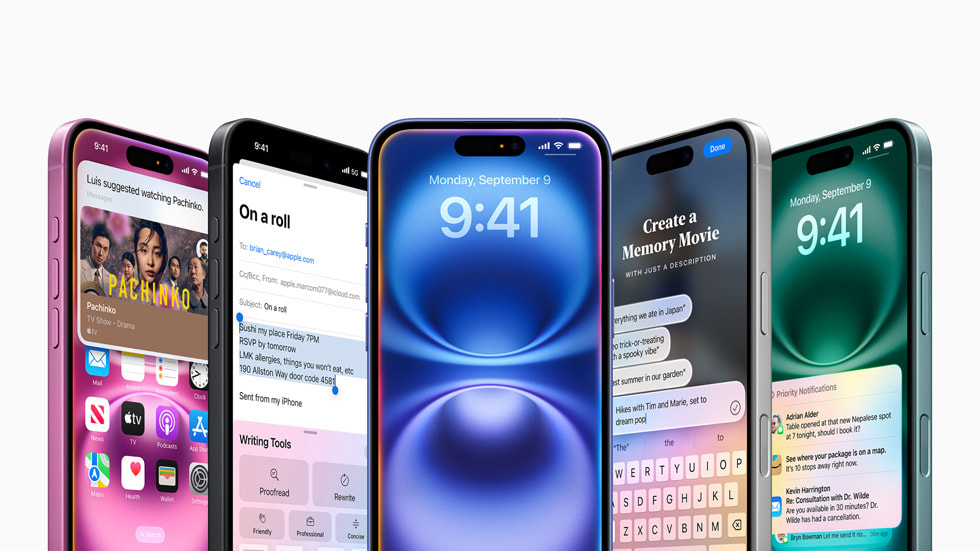
Apple Intelligence on the iPhone 16 lineup harnesses the power of Apple silicon and Apple-built generative models to understand and create language and images, take action across apps, and draw from personal context to simplify and accelerate everyday tasks. Apple Intelligence maintains the privacy and security of user data with Private Cloud Compute. This groundbreaking approach provides the ability to flex and scale computational capacity between on-device processing and larger, server-based models that run on dedicated Apple silicon servers — an extraordinary step forward for privacy in artificial intelligence. Apple Intelligence will be available as a free software update, with the first set of features rolling out next month in U.S. English for most regions around the world.
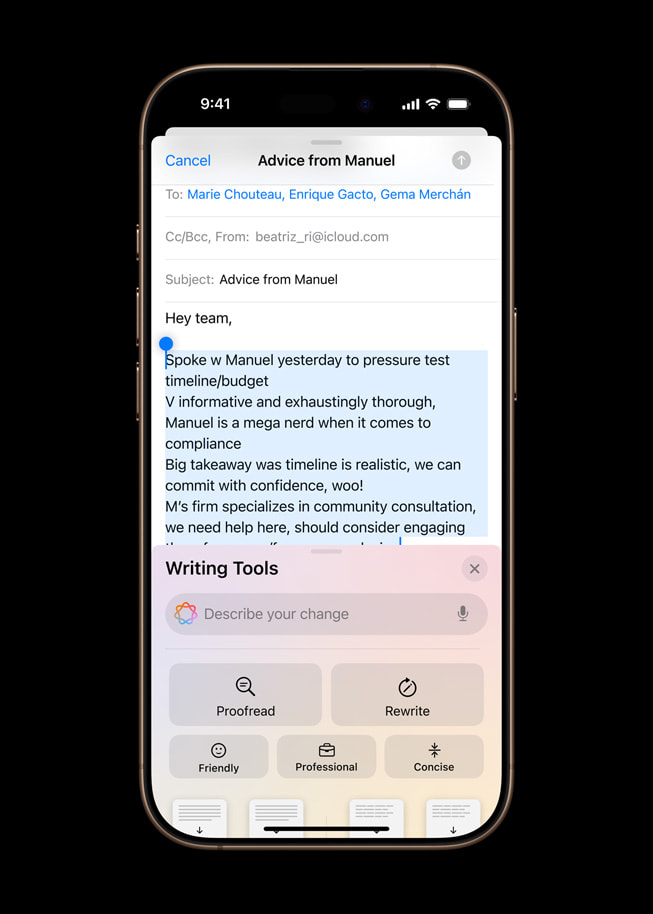
With systemwide Writing Tools, users can adjust notes or emails to be more friendly, more concise, or add a more professional tone to their writing; check for grammar, word choice, and sentence structure; and summarize selected text to make it more digestible. In the Notes and Phone apps, users can also record, transcribe, and summarize audio. When a recording is initiated while on a call in the Phone app, participants are automatically notified, and once the call ends, Apple Intelligence generates a summary to recall key points.
With systemwide Writing Tools, available with the first set of Apple Intelligence features, users can rewrite, proofread, and summarize text nearly everywhere they write.
Apple Intelligence helps users prioritize with summarized notifications, along with Priority Messages in Mail, a feature that understands the content of emails and surfaces time-sensitive messages. Across a user’s inbox, summaries convey the most important information of each email instead of previewing the first few lines.
Siri becomes more deeply integrated into the system experience and gets a brand-new design with an elegant glowing light that wraps around the edge of the screen when active. With richer language-understanding capabilities, communicating with Siri is more natural and flexible. Siri follows along when users stumble over their words, and maintains context from one request to the next. Users can type to Siri at any time, and switch fluidly between text and voice as they accelerate everyday tasks. Siri also now has extensive product knowledge to answer thousands of questions about features on iPhone and other Apple devices.
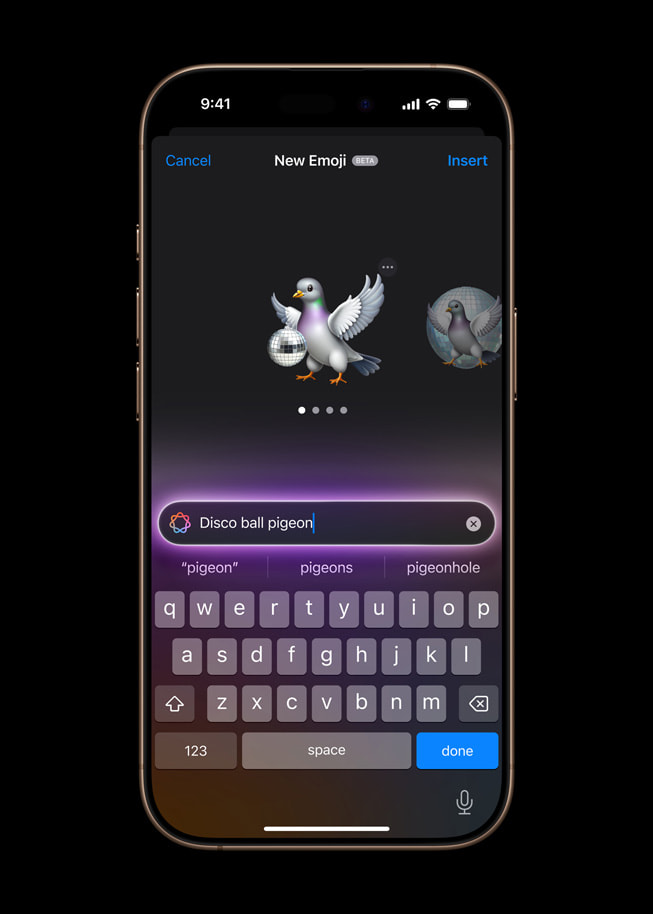
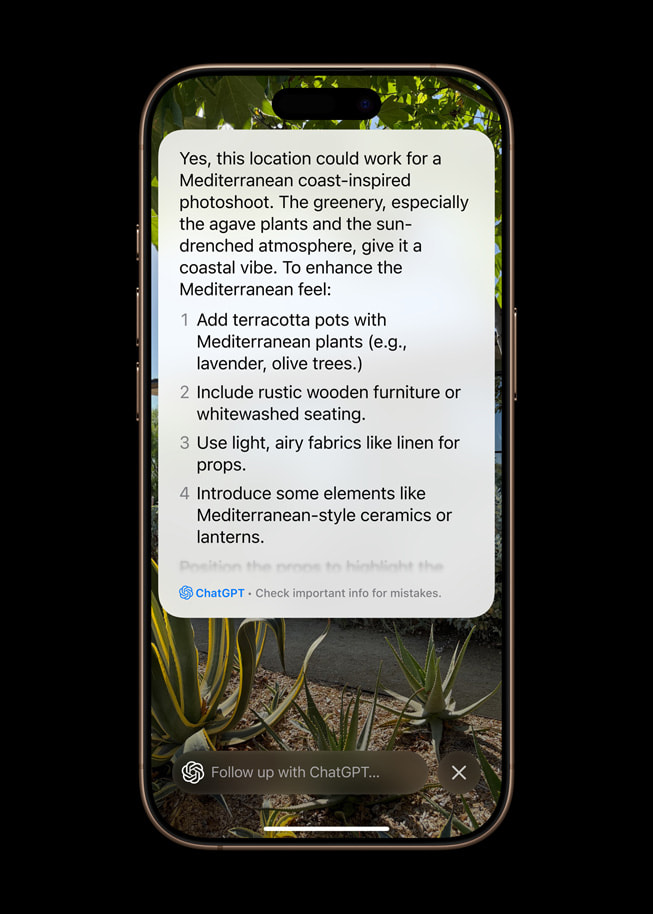
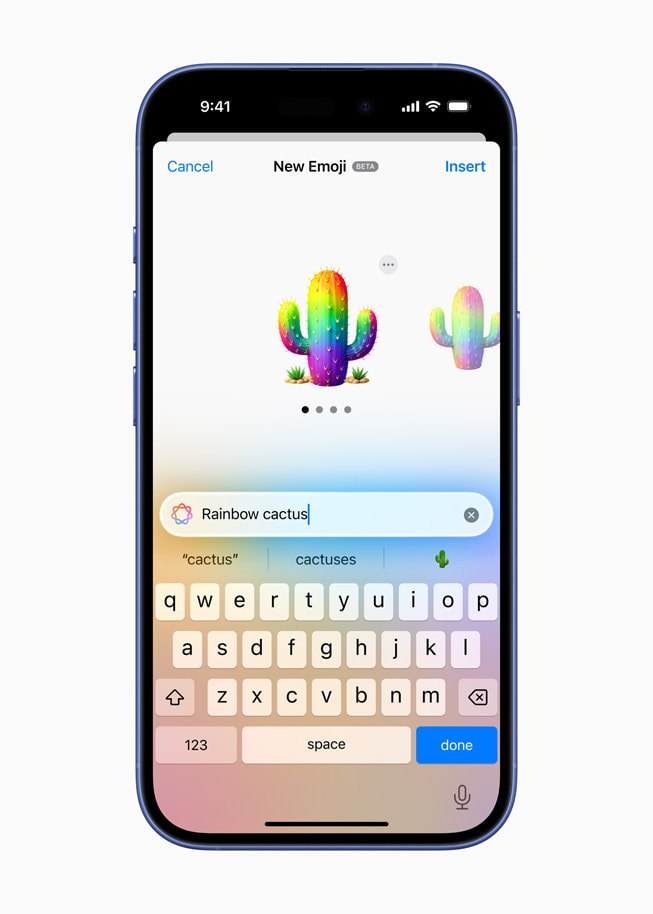
Additional Apple Intelligence features will roll out later this year and in the months following, including Image Playground, which allows users to create playful images in moments. Emoji will be taken to an entirely new level with the ability to create original Genmoji by simply typing a description, or by selecting a photo of a friend or family member. Siri will be able to draw on a user’s personal context to deliver intelligence that is tailored to them. It will also gain onscreen awareness to understand and take action with users’ content, as well as take hundreds of new actions in and across Apple and third-party apps. And while using iOS 18 features like Siri and Writing Tools, users will be able to easily access ChatGPT from OpenAI.
An Incredibly Light and Durable Design with Larger Displays
The new Pro lineup features the thinnest borders of any Apple product and introduces larger display sizes: 6.3 inches on iPhone 16 Pro and 6.9 inches on iPhone 16 Pro Max — the largest iPhone display ever.1 The stunning Super Retina XDR displays with Always-On and ProMotion technologies help users accomplish more. Both models offer industry-leading durability with a strong, lightweight titanium design, as well as the latest-generation Ceramic Shield, which has an advanced formulation that is 2x tougher than glass on any other smartphone. The new mechanical architecture improves heat dissipation and efficiency for up to 20 percent better sustained performance. Along with the new internal design and advanced power management of iOS 18, larger batteries are optimized to offer a huge leap in battery life.
Introducing Camera Control
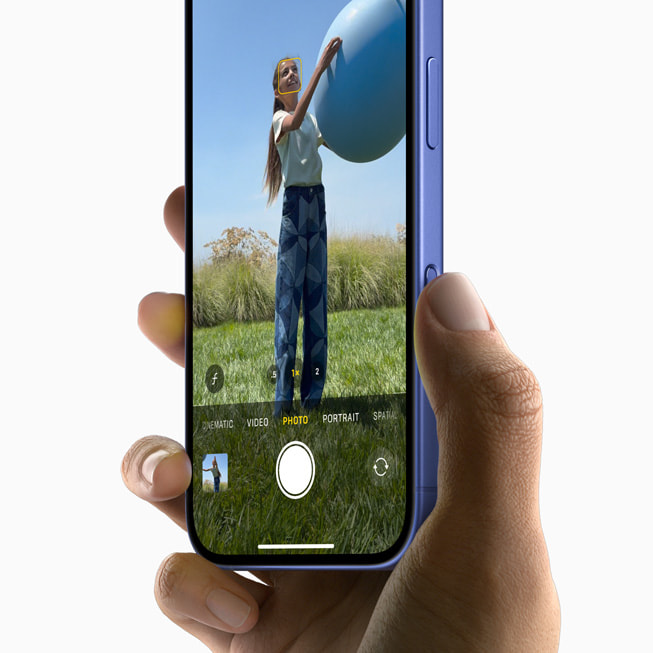
Camera Control — a result of thoughtful hardware and software integration — makes the pro camera system more versatile with an innovative new way to quickly launch the camera, take a photo, and start video recording. It has a tactile switch that powers the click experience, a high-precision force sensor that enables the light press gesture, and a capacitive sensor that allows for touch interactions. A new camera preview helps users frame the shot and adjust other control options — such as zoom, exposure, or depth of field — to compose a stunning photo or video by sliding their finger on the Camera Control. Later this fall, Camera Control will be updated with a two-stage shutter to automatically lock focus and exposure on a subject with a light press, letting users reframe the shot without losing focus. Additionally, developers will be able to bring Camera Control to third-party apps such as Kino, which will offer users the ability to adjust white balance and set focus points, including at various levels of depth in their scene.
Later this year, Camera Control will unlock visual intelligence to help users learn about objects and places faster than ever before. Users can click and hold Camera Control to pull up the hours or ratings for a restaurant they pass, add an event from a flyer to their calendar, quickly identify a dog by breed, and more. Camera Control will also serve as a gateway into third-party tools with specific domain expertise, like when users want to search on Google to find where they can buy an item, or to benefit from ChatGPT’s problem-solving skills. Users are in control of when third-party tools are used and what information is shared.
New Pro Creativity Across Photo, Video, and Audio
With iPhone 16 Pro and iPhone 16 Pro Max, the world’s favorite camera gets even more powerful. Powered by A18 Pro, the upgraded camera system introduces a new 48MP Fusion camera with a faster, more efficient quad-pixel sensor and Apple Camera Interface, unlocking 4K120 fps video recording in Dolby Vision — the highest resolution and frame-rate combination ever available on iPhone, and a smartphone first. The quad-pixel sensor can read data 2x faster, enabling zero shutter lag for 48MP ProRAW or HEIF photos. A new 48MP Ultra Wide camera also features a quad-pixel sensor with autofocus, so users can take higher-resolution 48MP ProRAW and HEIF images when capturing uniquely framed, wider-angle shots or getting close to their subjects with macro photography. The powerful 5x Telephoto camera now comes on both iPhone 16 Pro and iPhone 16 Pro Max, allowing users to catch the action from farther away, no matter which model they choose. iPhone 16 Pro and iPhone 16 Pro Max now take spatial photos in addition to videos to help users relive memories with remarkable depth on Apple Vision Pro.
Users can capture 4K120 fps in Slo-mo or Video mode, and adjust the playback speed after capture in the Photos app, including a quarter-speed playback, a new half-speed option for a dreamy effect, and a fifth-speed option that corresponds to 24 fps. When coupled with the new image signal processor (ISP) of A18 Pro, users can do frame-by-frame cinema-quality color grading for 4K120 fps in Dolby Vision. Users can also capture 4K120 fps ProRes and Log directly to an external storage device for efficient pro workflows.
Both Pro models feature four new studio-quality mics that preserve true-to-life recorded sounds, and video can now be captured in Spatial Audio for immersive listening with AirPods, Apple Vision Pro, or a surround sound system. The iPhone 16 Pro lineup also introduces creative new ways to edit video sound with Audio Mix — allowing users to adjust their sound after capture to focus on the voice of the person on camera, make it sound like the video was recorded inside a professional studio, or position vocal tracks in the front and environmental noises in surround sound. With wind noise reduction, powerful machine learning (ML) algorithms reduce unwanted noise for better audio quality.
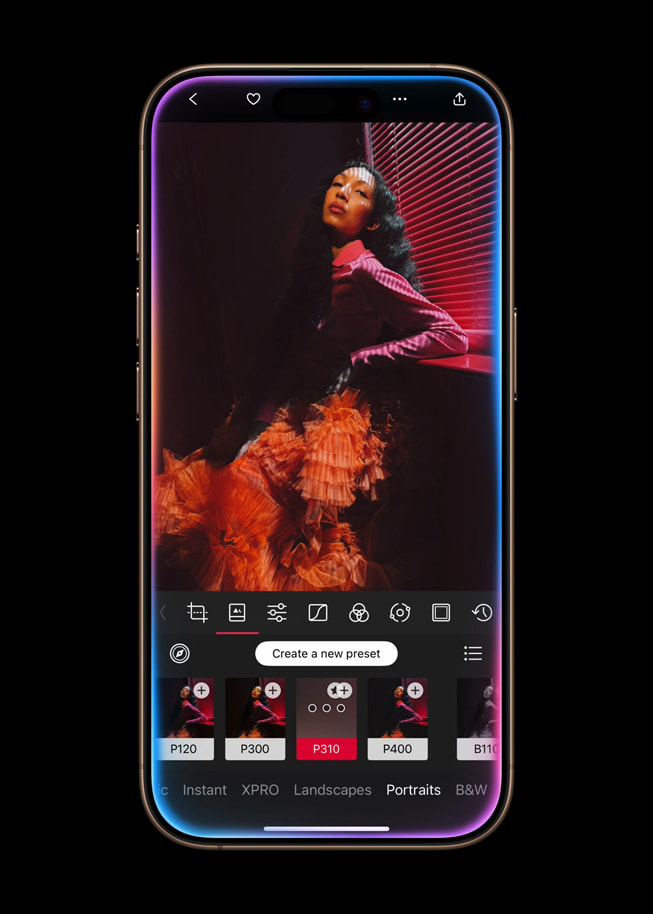
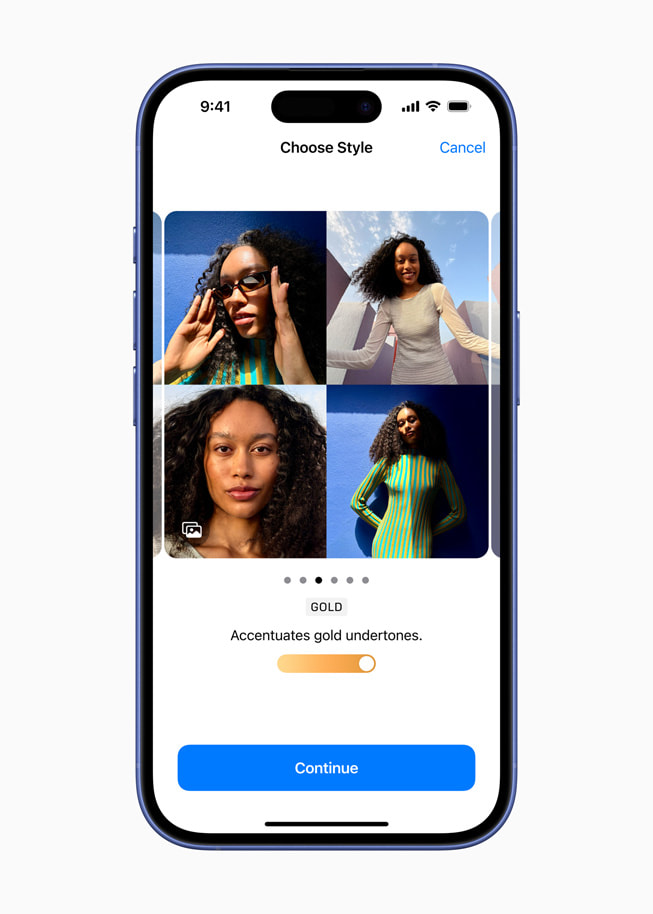
Next-generation Photographic Styles help users express their creativity and customize their photos by locally adjusting color, highlights, and shadows in real time. Styles also have a deeper understanding of skin undertones, so users can personalize how they appear in photos. Unlike filters, which often use a one-size-fits-all approach by adding a color to an entire scene, adjustments are applied to specific colors of a selected style. A wider set of styles offers more creative options for editing a photo’s aesthetic, and styles can be further personalized with an easy-to-use new control pad and intensity slider for simultaneous adjustments across tone and color. These adjustments can be rendered during live preview, applied after a photo is taken, or even reversed later.
Apple Intelligence takes the pro camera system to a new level. Coming later, Siri will be able to complete in-app requests and take action across apps, like pulling up a specific shot from a user’s Photos library and then applying an edit to the image in Darkroom. Siri can also help users fully utilize the wide range of photo and editing capabilities, such as asking how to adjust the blur in the background of a photo.
Industry-Leading Performance and Power Efficiency
The new A18 Pro chip is designed with industry-leading compute power to propel Apple Intelligence, ushering in a new era of pro performance. Built with second-generation 3-nanometer technology and featuring a new architecture with smaller, faster transistors, A18 Pro delivers unprecedented efficiency. The new 16-core Neural Engine is faster and more efficient than the previous generation, powering remarkable on-device performance for Apple Intelligence. A 17 percent increase in total system memory bandwidth — the highest ever in iPhone — enables faster experiences when using Writing Tools and Image Playground, and helps deliver astounding graphics. The bandwidth increase also benefits the 6-core GPU, which is up to 20 percent faster than the previous generation, driving graphics rendering for Apple Intelligence and stunning visuals for gaming. Hardware-accelerated ray tracing gets up to 2x faster for even more realistic light sources and reflections, and Game Mode in iOS 18 unlocks more consistent frame rates while making AirPods, game controllers, and other wireless accessories incredibly responsive. A new 6-core CPU is the fastest in a smartphone, with two performance cores and four efficiency cores that can run the same workload as the previous generation 15 percent faster while using 20 percent less power. Next-generation ML accelerators are optimized for Apple Intelligence, and save power by handling high-efficiency, high-throughput, and low-latency computations on the CPU without engaging the Neural Engine.
A18 Pro enables Always-On and ProMotion technologies for an exceptional viewing experience on iPhone, as well as faster USB 3 speeds and ProRes video recording. A new ISP and video encoder process 2x the amount of data for faster video encoding and pro workflows.
Expanded Safety and Communication Capabilities
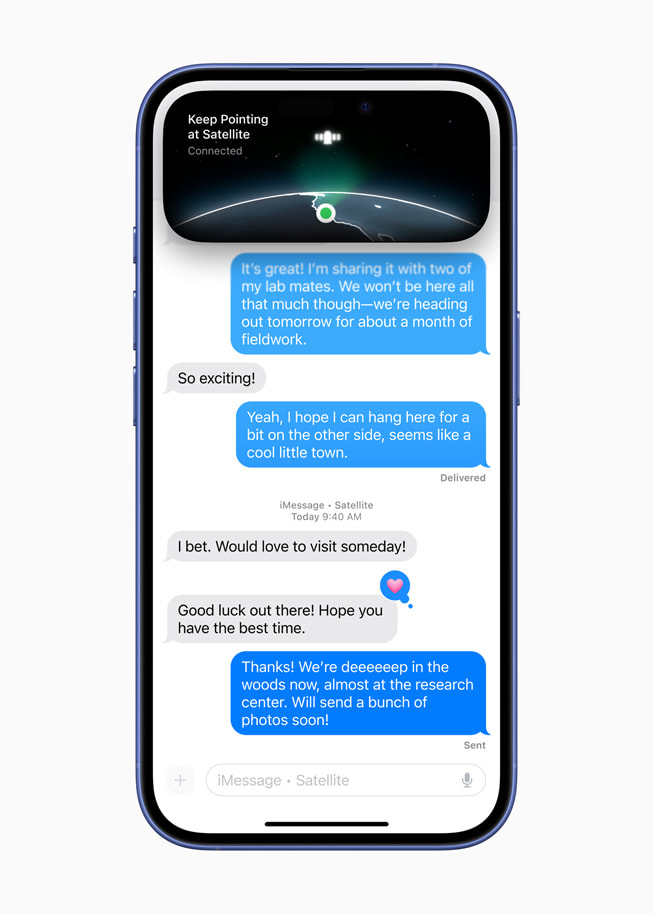
The iPhone 16 Pro lineup features innovative ways to stay connected and provides enhanced safety capabilities for peace of mind. Powered by the same groundbreaking technology as Emergency SOS via satellite, users are able to connect to the nearest satellite to send and receive texts, emoji, and Tapbacks over iMessage and SMS while outside cellular and Wi-Fi coverage.2 Messages via satellite in iOS 18 are end-to-end encrypted. Also new with iOS 18, Emergency SOS Live Video allows users to share a live video feed or photos with participating emergency dispatchers during an emergency call.3 Later this fall, Roadside Assistance via satellite — which connects users to a roadside assistance provider if they have car trouble while off the grid — expands beyond the U.S. to the U.K.
Better for the Environment
iPhone 16 Pro and iPhone 16 Pro Max are designed with the environment in mind. As part of Apple 2030, the company’s ambitious goal to be carbon neutral across its entire carbon footprint by the end of this decade, Apple is prioritizing renewable electricity in manufacturing, and investing in wind and solar projects around the world to address the electricity used to charge all Apple products, including the iPhone 16 lineup. Today, all Apple facilities run on 100 percent renewable electricity — including the data centers that power Apple Intelligence.
To achieve Apple 2030, the company is also designing products with recycled and renewable materials. iPhone 16 Pro and iPhone 16 Pro Max feature more than 25 percent recycled content overall, including 100 percent recycled aluminum in the internal structural frame and 80 percent or more recycled steel across multiple components. The battery is made with 100 percent recycled cobalt and — in a first for iPhone — over 95 percent recycled lithium.4 The iPhone 16 Pro lineup also meets Apple’s high standards for energy efficiency, and is free of mercury and PVC. The packaging is entirely fiber-based, bringing Apple closer to its goal of removing plastic from its packaging by next year.
Pricing and Availability
Customers in more than 58 countries and regions, including Australia, Canada, China, France, Germany, India, Japan, Malaysia, Mexico, South Korea, Türkiye, the UAE, the U.K., and the U.S., will be able to pre-order iPhone 16 Pro and iPhone 16 Pro Max beginning at 5 a.m. PDT this Friday, September 13, with availability beginning Friday, September 20.
Apple Intelligence will be available as a free software update. The first set of Apple Intelligence features will be available in beta next month as part of iOS 18.1, iPadOS 18.1, and macOS Sequoia 15.1, with more features rolling out in the months to come. It will be available on iPhone 16, iPhone 16 Plus, iPhone 16 Pro, iPhone 16 Pro Max, iPhone 15 Pro, iPhone 15 Pro Max, and iPad and Mac with M1 and later, with device and Siri language set to U.S. English. Additional languages and platforms are coming over the course of the next year. Later this year, Apple Intelligence will add support for localized English in Australia, Canada, New Zealand, South Africa, and the U.K. In the coming year, Apple Intelligence will expand to more languages, including Chinese, French, Japanese, and Spanish.
In addition to an iPhone 16 Pro and iPhone 16 Pro Max Clear Case, available for $49 (U.S.), a Silicone Case with MagSafe will be available for $49 (U.S.) in black, denim, fuchsia, lake green, plum, star fruit, stone gray, and ultramarine. Apple cases for the iPhone 16 lineup work seamlessly with Camera Control, featuring a sapphire crystal coupled to a conductive layer that communicates finger movements to the Camera Control. FineWoven Wallet with MagSafe will be available for $59 (U.S.) in black, blackberry, dark green, and deep blue.
iCloud+ plans start at 50GB for $0.99 (U.S.) per month and offer up to 12TB for $59.99 (U.S.) per month, providing additional storage to keep files, photos, videos, and more safe in the cloud, accessible across devices, and easy to share with others. iCloud+ also gives access to premium features, including Private Relay, Hide My Email, Custom Email Domains, and HomeKit Secure Video support.
About Apple
Apple revolutionized personal technology with the introduction of the Macintosh in 1984. Today, Apple leads the world in innovation with iPhone, iPad, Mac, AirPods, Apple Watch, and Apple Vision Pro. Apple’s six software platforms — iOS, iPadOS, macOS, watchOS, visionOS, and tvOS — provide seamless experiences across all Apple devices and empower people with breakthrough services including the App Store, Apple Music, Apple Pay, iCloud, and Apple TV+. Apple’s more than 150,000 employees are dedicated to making the best products on earth and to leaving the world better than we found it.
128GB storage capacity is available on iPhone 16 Pro.
The display has rounded corners that follow a beautiful curved design, and these corners are within a standard rectangle. When measured as a standard rectangular shape, the screen is 6.27 inches (iPhone 16 Pro) or 6.85 inches (iPhone 16 Pro Max) diagonally. Actual viewable area is less.
Apple’s satellite features are included for free for two years starting at the time of activation of a new iPhone 14 or later. For Emergency SOS via satellite availability, visit support.apple.com/en-us/HT213426. Messages via satellite will be available in the U.S. and Canada in iOS 18. SMS availability will depend on carrier. Carrier fees may apply. Users should check with their carrier for details. Roadside Assistance via satellite is currently available in the U.S. with AAA and Verizon Roadside Assistance, and is launching in the U.K. with Green Flag this fall. Participating roadside assistance providers may charge for services, and iPhone users who are not members can take advantage of their roadside assistance services on a pay-per-use basis. Apple’s satellite services were designed for use in open spaces with a clear line of sight to the sky. Performance may be impacted by obstructions such as trees or surrounding buildings.
Emergency SOS Live Video will be available in the U.S. in iOS 18.
All cobalt and lithium references are on a mass balance allocation.
Built for Apple Intelligence with the all-new A18 chip, both models feature Camera Control, powerful upgrades to the advanced camera system, the Action button to quickly access useful features, and a big boost in battery life
iPhone 16 and iPhone 16 Plus are built for Apple Intelligence, and feature Camera Control, the Action button, a 48MP Fusion camera, and the A18 chip.
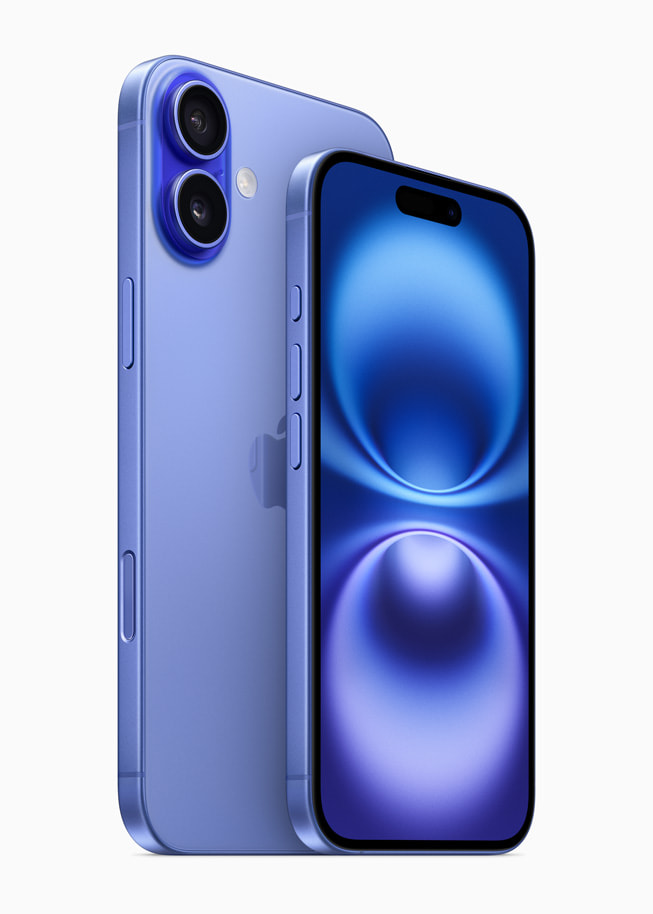
CUPERTINO, CALIFORNIA Apple today announced iPhone 16 and iPhone 16 Plus, built for Apple Intelligence, the easy-to-use personal intelligence system that understands personal context to deliver intelligence that is helpful and relevant while protecting user privacy. The iPhone 16 lineup also introduces Camera Control, which brings new ways to capture memories, and will help users quickly access visual intelligence to learn about objects or places around them faster than ever before. The powerful camera system features a 48MP Fusion camera with a 2x Telephoto option, giving users two cameras in one, while a new Ultra Wide camera enables macro photography. Next-generation Photographic Styles help users personalize their images, and spatial photo and video capture allows users to relive life’s precious memories with remarkable depth on Apple Vision Pro. The new A18 chip delivers a huge leap in performance and efficiency, enabling demanding AAA games, as well as a big boost in battery life.
Available in 6.1-inch and 6.7-inch display sizes, iPhone 16 and iPhone 16 Plus feature a gorgeous, durable design and offer a big boost in battery life.
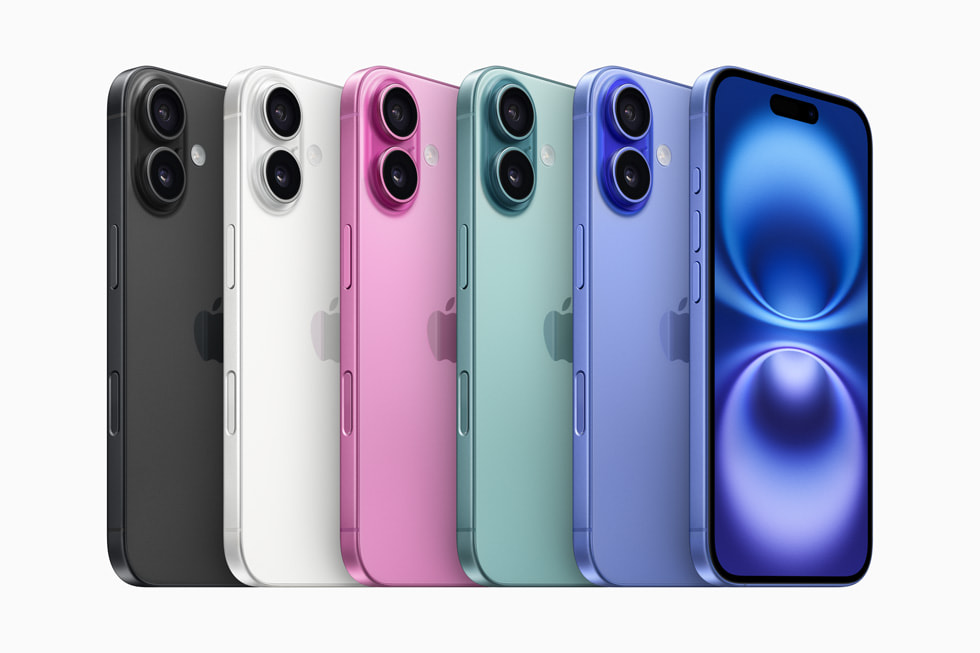
iPhone 16 and iPhone 16 Plus will be available in five bold colors: black, white, pink, teal, and ultramarine. Pre-orders begin Friday, September 13, with availability beginning Friday, September 20.
“iPhone 16 and iPhone 16 Plus mark the beginning of a new era for iPhone with Apple Intelligence delivering powerful, personal, and private experiences to our users,” said Kaiann Drance, Apple’s vice president of Worldwide iPhone Product Marketing. “With new ways to discover the world around you and capture memories using Camera Control; a 48MP Fusion camera that gives you two optical-quality cameras in one; a big boost in battery life; and powerful, efficient performance thanks to the A18 chip, this is the perfect time for customers to upgrade or make the switch to iPhone.”
iPhone 16 and iPhone 16 Plus will be available in five bold colors: black, white, pink, teal, and ultramarine.
Built for Apple Intelligence
Apple Intelligence on the iPhone 16 lineup harnesses the power of Apple silicon and Apple-built generative models to understand and create language and images, take action across apps, and draw from personal context to simplify and accelerate everyday tasks. Apple Intelligence maintains the privacy and security of user data with Private Cloud Compute. This groundbreaking approach provides the ability to flex and scale computational capacity between on-device processing and larger, server-based models that run on dedicated Apple silicon servers — an extraordinary step forward for privacy in artificial intelligence. Apple Intelligence will be available as a free software update, with the first set of features rolling out next month in U.S. English for most regions around the world.
Apple Intelligence combines the power of Apple-built generative models with personal context while taking an extraordinary step forward for privacy.
Apple Intelligence unlocks new ways for users to enhance their writing. With systemwide Writing Tools built into iOS 18, users can rewrite, proofread, and summarize text nearly everywhere they write, including Mail, Notes, Pages, and third-party apps. In the Notes and Phone apps, users can also record, transcribe, and summarize audio. When a recording is initiated while on a call in the Phone app, participants are automatically notified, and once the call ends, Apple Intelligence generates a summary to recall key points.
Apple Intelligence helps users prioritize with summarized notifications, along with Priority Messages in Mail, a feature that understands the content of emails and surfaces time-sensitive messages. Across a user’s inbox, summaries convey the most important information of each email instead of previewing the first few lines.
Siri becomes more deeply integrated into the system experience and gets a brand-new design with an elegant glowing light that wraps around the edge of the screen when active. With richer language-understanding capabilities, communicating with Siri is more natural and flexible. Siri follows along when users stumble over their words, and maintains context from one request to the next. Users can type to Siri at any time, and switch fluidly between text and voice as they accelerate everyday tasks. Siri also now has extensive product knowledge to answer thousands of questions about features on iPhone and other Apple devices.
Additional Apple Intelligence features will roll out later this year and in the months following, including Image Playground, which allows users to create playful images in moments. Emoji will be taken to an entirely new level with the ability to create original Genmoji by simply typing a description, or by selecting a photo of a friend or family member. Siri will be able to draw on a user’s personal context to deliver intelligence that is tailored to them. It will also gain onscreen awareness to understand and take action with users’ content, as well as take hundreds of new actions in and across Apple and third-party apps. And while using iOS 18 features like Siri and Writing Tools, users will also be able to easily access ChatGPT from OpenAI.
Users will be able to create an original Genmoji to express themselves — taking emoji to an entirely new level.
A Beautiful New Design with Industry-Leading Durability
iPhone 16 and iPhone 16 Plus are beautiful and built to last. iPhone holds its value longer than any other smartphone thanks to its industry-leading durability, including the strong back glass, a water- and dust-resistant design, regular software updates, and the latest-generation Ceramic Shield with an advanced formulation that is 50 percent tougher than the first generation and 2x tougher than glass on any other smartphone.1 The internal design of iPhone 16 and iPhone 16 Plus has been reengineered to allow for an even larger battery and to better dissipate heat, while making battery service easier. With the new internal design and advanced power management of iOS 18, the batteries are optimized to offer a big boost in battery life. Available in 6.1-inch and 6.7-inch display sizes, the Super Retina XDR display with OLED technology and the Dynamic Island offers an exceptional viewing experience.2
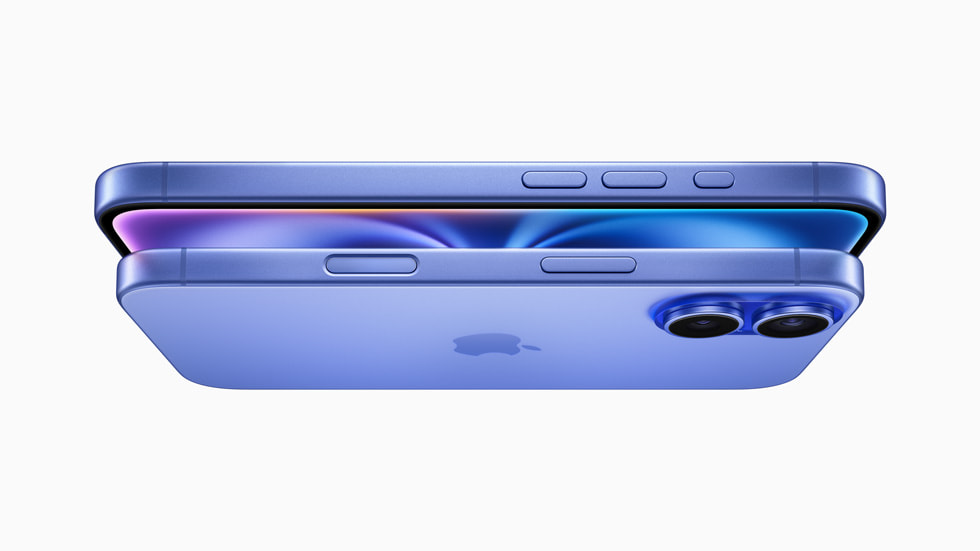
The Action button comes to iPhone 16 and iPhone 16 Plus, allowing users to easily access a variety of functions with just a press. Users can quickly open the camera, flashlight, or controls; switch between Ring and Silent; recognize music with Shazam; activate Voice Memos, Focus, Translate, and accessibility features like Magnifier; or use Shortcuts for more options. The Action button can also access in-app functionality, like helping a user unlock and lock their car with FordPass.3
Introducing Camera Control
Camera Control — a result of thoughtful hardware and software integration — elevates the camera experience on the iPhone 16 lineup. It is packed with innovation, including a tactile switch that powers the click experience, a high-precision force sensor that enables the light press gesture, and a capacitive sensor that allows for touch interactions. Camera Control can quickly launch the camera, take a photo, and start video recording so users don’t miss the moment. A new camera preview helps users frame the shot and adjust other control options — such as zoom, exposure, or depth of field — to compose a stunning photo or video by sliding their finger on the Camera Control. Additionally, developers will be able to bring Camera Control to third-party apps such as Snapchat.
Later this year, Camera Control will unlock visual intelligence to help users learn about objects and places faster than ever before. Users can click and hold Camera Control to pull up the hours or ratings for a restaurant they pass, add an event from a flyer to their calendar, quickly identify a dog by breed, and more. Camera Control will also serve as a gateway into third-party tools with specific domain expertise, like when users want to search on Google to find where they can buy an item, or to benefit from ChatGPT’s problem-solving skills. Users are in control of when third-party tools are used and what information is shared.
New Camera Experiences
The powerful new camera system helps users capture both everyday moments and cherished memories like never before. The 48MP Fusion camera enables a 2x optical-quality Telephoto option, which is like having two cameras in one, so users can get closer to the subject to easily frame a photo. In addition to wider-angle shots, the new 12MP Ultra Wide camera with autofocus enables macro photography. The Ultra Wide camera also gathers up to 2.6x more light for higher image quality. Additionally, iPhone 16 and iPhone 16 Plus now take spatial photos and videos to help users relive memories with remarkable depth on Apple Vision Pro.
Next-generation Photographic Styles help users express their creativity and customize their photos by locally adjusting color, highlights, and shadows in real time. Styles also have a deeper understanding of skin undertones, so users can personalize how they appear in photos. Unlike filters, which often use a one-size-fits-all approach by adding a color to an entire scene, adjustments are applied to specific colors of a selected style. A wider set of styles offers more creative options for editing a photo’s aesthetic, and styles can be rendered during live preview, applied after a photo is taken, or even reversed later.
Video can now be captured in Spatial Audio for immersive listening with AirPods, Apple Vision Pro, or a surround sound system. Both iPhone models introduce creative new ways to edit video sound with Audio Mix — allowing users to adjust their sound after capture to focus on the voice of the person on camera, make it sound like the video was recorded inside a professional studio, or position vocal tracks in the front and environmental noises in surround sound. With wind noise reduction, powerful machine learning (ML) algorithms reduce unwanted noise for better audio quality.
Powered by Apple Intelligence, users can search for specific photos in the Photos app using natural language, and search for specific moments in video clips. Additionally, the new Clean Up tool can identify and remove distracting objects in the background of a photo without altering the subject.
A18: Next-Level Performance and Mobile Gaming
A18 delivers a huge leap in performance and power efficiency, and is built on second-generation 3-nanometer technology to further accelerate Apple Intelligence. An upgraded 16-core Neural Engine is optimized for large generative models and runs ML models up to 2x faster than the A16 Bionic chip.
The 6-core CPU is 30 percent faster than the A16 Bionic chip and faster than all the competition. It is also more power efficient and can run the same workload with 30 percent less power than A16 Bionic. The 5-core GPU is up to 40 percent faster and 35 percent more efficient than A16 Bionic to power stunning graphics performance for Apple Intelligence, and puts a powerful gaming device in users’ pockets. Now with hardware-accelerated ray tracing, games on iPhone 16 and iPhone 16 Plus more accurately represent the behavior of light with up to 5x higher frame rates than with software-based ray tracing. Both models support the AAA games previously only available on iPhone 15 Pro, as well as new titles like Honor of Kings: World with an ultra graphics mode optimized for the iPhone 16 lineup, coming next year. Game Mode in iOS 18 delivers more consistent frame rates while making AirPods, game controllers, and other wireless accessories incredibly responsive. The efficiency of A18 and the device’s rearchitected internal design deliver up to 30 percent higher sustained performance for gaming while ensuring Apple Intelligence runs efficiently on iPhone.
Expanded Communication and Safety Capabilities
The iPhone 16 lineup features innovative ways to stay connected and provides enhanced safety capabilities for peace of mind. Powered by the same groundbreaking technology as Emergency SOS via satellite, users are able to connect to the nearest satellite to send and receive texts, emoji, and Tapbacks over iMessage and SMS while outside of cellular and Wi-Fi coverage.4 Messages via satellite in iOS 18 are end-to-end encrypted. Also new with iOS 18, Emergency SOS Live Video allows users to share a live video feed or photos with participating emergency dispatchers during an emergency call.5 Later this fall, Roadside Assistance via satellite — which connects users to a roadside assistance provider if they have car trouble while off the grid — expands beyond the U.S. to the U.K.
Better for the Environment
iPhone 16 and iPhone 16 Plus are designed with the environment in mind. As part of Apple 2030, the company’s ambitious goal to be carbon neutral across its entire carbon footprint by the end of this decade, Apple is prioritizing renewable electricity in manufacturing, and investing in wind and solar projects around the world to address the electricity used to charge all Apple products, including the iPhone 16 lineup. Today, all Apple facilities run on 100 percent renewable electricity — including the data centers that power Apple Intelligence.
To achieve Apple 2030, the company is also designing products with recycled and renewable materials. iPhone 16 and iPhone 16 Plus feature more than 30 percent recycled content overall, including 85 percent recycled aluminum in the enclosure and 80 percent or more recycled steel across multiple components. The battery is made with 100 percent recycled cobalt and — in a first for iPhone — over 95 percent recycled lithium.6 The iPhone 16 lineup meets Apple’s high standards for energy efficiency, and is free of mercury and PVC. The packaging is entirely fiber-based, bringing Apple closer to its goal of removing plastic from its packaging by next year.
Pricing and Availability
Customers in more than 58 countries and regions, including Australia, Canada, China, France, Germany, India, Japan, Malaysia, Mexico, South Korea, Türkiye, the UAE, the U.K., and the U.S., will be able to pre-order iPhone 16 and iPhone 16 Plus beginning at 5 a.m. PDT this Friday, September 13, with availability beginning Friday, September 20.
Apple Intelligence will be available as a free software update. The first set of Apple Intelligence features will be available in beta next month as part of iOS 18.1, iPadOS 18.1, and macOS Sequoia 15.1, with more features rolling out in the months to come. It will be available on iPhone 16, iPhone 16 Plus, iPhone 16 Pro, iPhone 16 Pro Max, iPhone 15 Pro, iPhone 15 Pro Max, and iPad and Mac with M1 and later, with device and Siri language set to U.S. English. Additional languages and platforms are coming over the course of the next year. Later this year, Apple Intelligence will add support for localized English in Australia, Canada, New Zealand, South Africa, and theU.K. In the coming year, Apple Intelligence will expand to more languages, including Chinese, French, Japanese, and Spanish.
In addition to an iPhone 16 and iPhone 16 Plus Clear Case, available for $49 (U.S.), a Silicone Case with MagSafe will be available for $49 (U.S.) in black, denim, fuchsia, lake green, plum, star fruit, stone gray, and ultramarine. Apple cases for the iPhone 16 lineup work seamlessly with Camera Control, featuring a sapphire crystal coupled to a conductive layer that communicates finger movements to the Camera Control. FineWoven Wallet with MagSafe will be available for $59 (U.S.) in black, blackberry, dark green, and deep blue.
iCloud+ plans start at 50GB for $0.99 (U.S.) per month and offer up to 12TB for $59.99 (U.S.) per month, providing additional storage to keep files, photos, videos, and more safe in the cloud, accessible across devices, and easy to share with others. iCloud+ also gives access to premium features, including Private Relay, Hide My Email, Custom Email Domains, and HomeKit Secure Video support.
Share article
Text of this article
Images in this article
About Apple
Apple revolutionized personal technology with the introduction of the Macintosh in 1984. Today, Apple leads the world in innovation with iPhone, iPad, Mac, AirPods, Apple Watch, and Apple Vision Pro. Apple’s six software platforms — iOS, iPadOS, macOS, watchOS, visionOS, and tvOS — provide seamless experiences across all Apple devices and empower people with breakthrough services including the App Store, Apple Music, Apple Pay, iCloud, and Apple TV+. Apple’s more than 150,000 employees are dedicated to making the best products on earth and to leaving the world better than we found it.
All cobalt and lithium references are on a mass balance allocation.
iPhone 16 and iPhone 16 Plus are splash-, water-, and dust-resistant. They were tested under controlled laboratory conditions and have a rating of IP68 under IEC standard 60529 (maximum depth of 6 meters for up to 30 minutes). Splash, water, and dust resistance are not permanent conditions. Resistance might decrease as a result of normal wear. Do not attempt to charge a wet iPhone; refer to the user guide for cleaning and drying instructions. Liquid damage is not covered under warranty.
The display has rounded corners that follow a beautiful curved design, and these corners are within a standard rectangle. When measured as a standard rectangular shape, the screen is 6.12 inches (iPhone 16) or 6.69 inches (iPhone 16 Plus) diagonally. The actual viewable area is smaller.
Vehicle Control on FordPass with the Action button and Control Center will be available this fall in 56 countries and regions, including Australia, Canada, France, Germany, Mexico, Thailand, the U.K., the U.S., and Vietnam. Some features may not be available for all countries and regions, or all areas.
Apple’s satellite features are included for free for two years starting at the time of activation of a new iPhone 14 or later. For Emergency SOS via satellite availability, visit support.apple.com/en-us/HT213426. Messages via satellite will be available in the U.S. and Canada in iOS 18. SMS availability will depend on carrier. Carrier fees may apply. Users should check with their carrier for details. Roadside Assistance via satellite is currently available in the U.S. with AAA and Verizon Roadside Assistance, and is launching in the U.K. with Green Flag this fall. Participating roadside assistance providers may charge for services, and iPhone users who are not members can take advantage of their roadside assistance services on a pay-per-use basis. Apple’s satellite services were designed for use in open spaces with a clear line of sight to the sky. Performance may be impacted by obstructions such as trees or surrounding buildings.
Emergency SOS Live Video will be available in the U.S. in iOS 18.
The new AirPods lineup includes a brand-new design for AirPods 4, a new array of colors for AirPods Max, and revolutionary Hearing Protection, Hearing Test, and Hearing Aid features for AirPods Pro 2
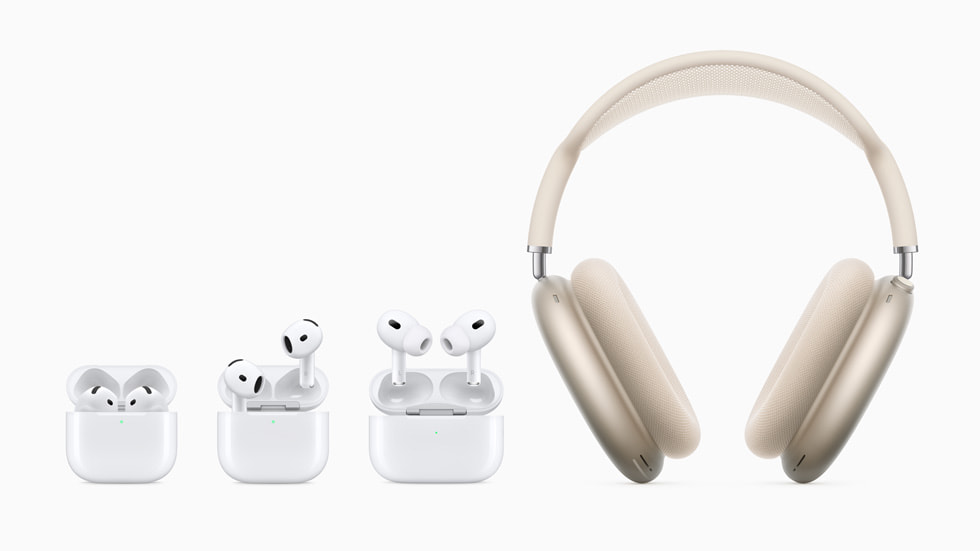
CUPERTINO, CALIFORNIA Apple today announced a groundbreaking new lineup of AirPods models and features. The new AirPods 4 are the most advanced and comfortable headphones Apple has ever created with an open-ear design, and today, customers can choose between two distinct models: AirPods 4 and AirPods 4 with Active Noise Cancellation (ANC). AirPods Max now come in midnight, starlight, blue, purple, and orange, and offer USB-C charging for more convenience. This fall, AirPods Pro 2 will introduce the world’s first end-to-end hearing health experience, delivering active Hearing Protection,1 a scientifically validated Hearing Test, and a clinical-grade Hearing Aid feature.2
AirPods 4 and AirPods Max will be available to pre-order starting today, with availability in stores beginning Friday, September 20. New hearing health features will be available this fall for AirPods Pro 2 users in more than 100 countries and regions.
“With AirPods 4, customers can enjoy Active Noise Cancellation and the most advanced audio experience ever in an open-ear design,” said John Ternus, Apple’s senior vice president of Hardware Engineering. “And with a revolutionary update to the world’s best-selling headphones, AirPods Pro will deliver groundbreaking new capabilities — including Hearing Test and Hearing Aid features — to help more than a billion people affected by hearing loss.”
AirPods 4 Unveil an Industry-Defining Design
With incredible sound quality, up to 24-hour battery life with the charging case, and an iconic design, the original AirPods offered wireless convenience and seamless pairing with the Apple ecosystem of products. That experience gets even better with AirPods 4 and AirPods 4 with ANC, offering a brand-new fit and an array of powerful features and capabilities.
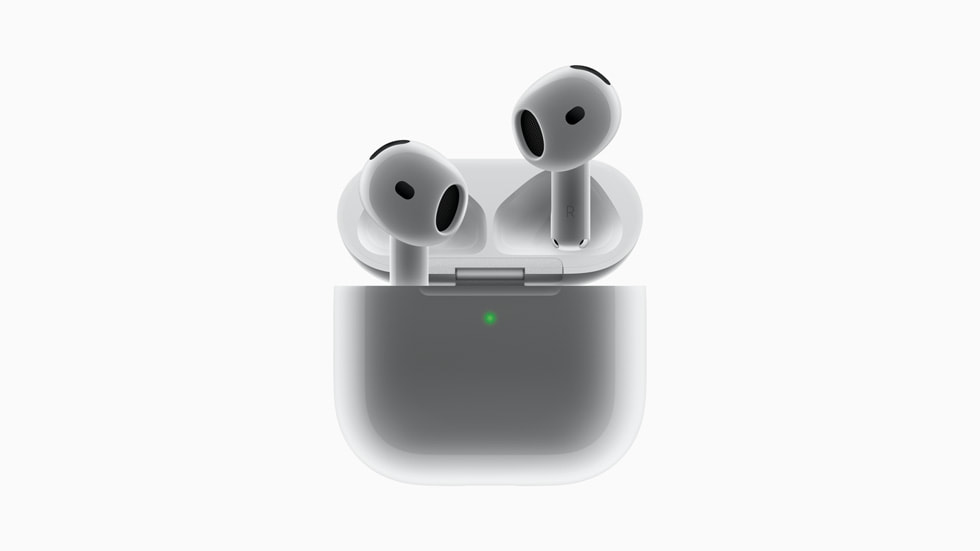
AirPods 4 are the best headphones Apple has ever created with an open-ear design, setting an entirely new benchmark for fit and comfort. The new design is built with an unparalleled data set that uses advanced modeling tools, like 3D photogrammetry and laser topography, to precisely map and analyze thousands of ear shapes and over 50 million individual data points in total. This process helped refine the design to deliver the most comfortable AirPods ever with one shape that naturally fits even more users around the world.
Delivering a massive improvement in sound quality, AirPods 4 feature an entirely new acoustic architecture, low-distortion driver, and high dynamic range amplifier, and add Personalized Spatial Audio with dynamic head tracking for the most immersive media experience. With the H2 chip, AirPods 4 unlock intelligent audio experiences only Apple silicon can deliver, such as Voice Isolation, enabling clearer call quality no matter the environmental conditions, and Siri Interactions, allowing users to simply nod their head yes or gently shake their head no to respond to Siri announcements. For even more control, AirPods 4 also feature a new force sensor on the stem to play or pause media and mute or end calls with a quick press. Thanks to the H2 chip, AirPods 4 are also great for gaming, delivering low wireless audio latency and excellent voice quality when chatting with teammates and other players, including support for 16-bit, 48kHz audio.
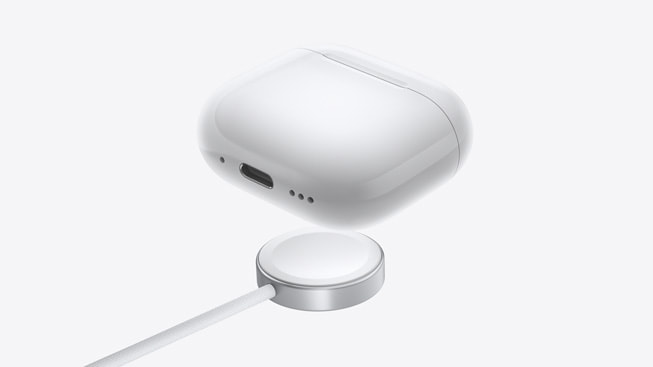
For additional convenience, the charging case now offers USB-C charging and is more than 10 percent smaller in volume than its predecessor — all while still delivering up to 30 hours of battery life.3 In addition to a USB-C charging cable, customers that choose AirPods 4 with ANC can charge using an Apple Watch charger or Qi-certified charger, and at just 50mm wide, the charging case is the smallest in the industry with wireless charging capabilities.
AirPods 4 Bring ANC to an Open-Ear Fit
For the first time, AirPods 4 bring ANC to an open-ear design with an additional model. With upgraded microphones, the power of the H2 chip, and advanced computational audio, AirPods 4 with ANC help to reduce environmental noise like airplane engines, city traffic, and more. Working across hardware and software to deliver the most natural listening experience, AirPods 4 with ANC also introduce intelligent features like Transparency mode to keep users aware of their environment; Adaptive Audio, which dynamically blends Transparency mode and ANC based on the conditions of a user’s environment; and Conversation Awareness, which lowers the user’s media volume when they start speaking to someone nearby.
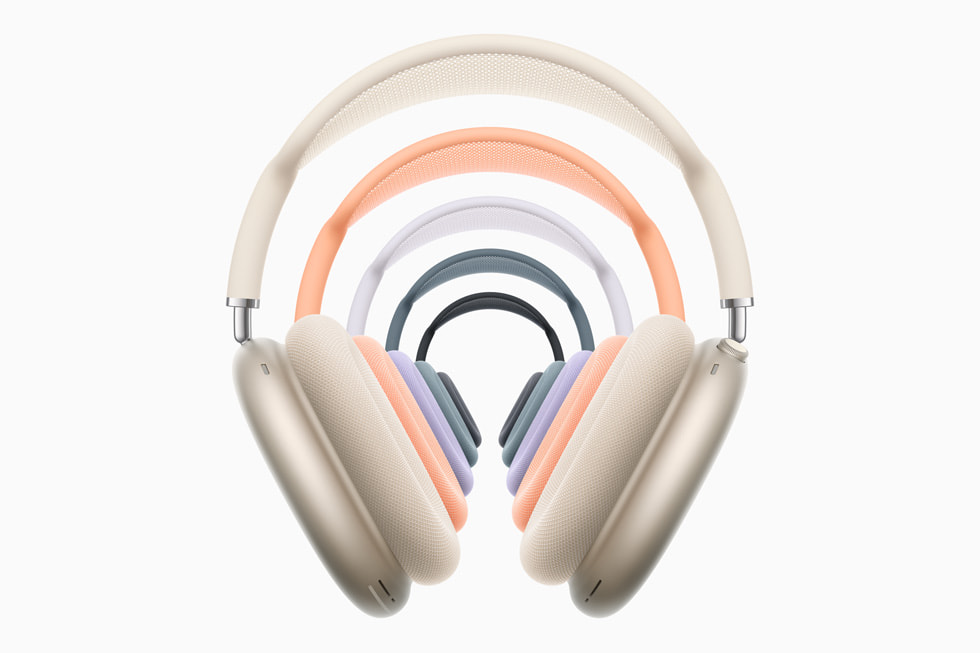
AirPods Max Get Five New Colors
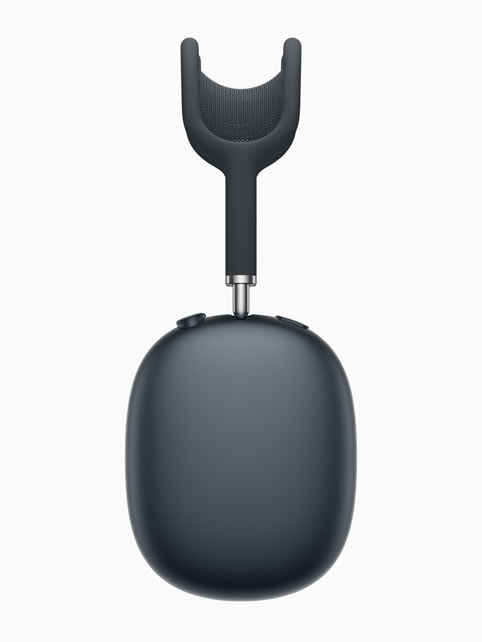
AirPods Max are available in five beautiful new colors, including midnight, starlight, blue, orange, and purple, and offer complementary finishes alongside other Apple products like Mac and iPad. Additionally, AirPods Max now feature USB-C charging capabilities, making them more convenient than ever to charge at home or on the go.
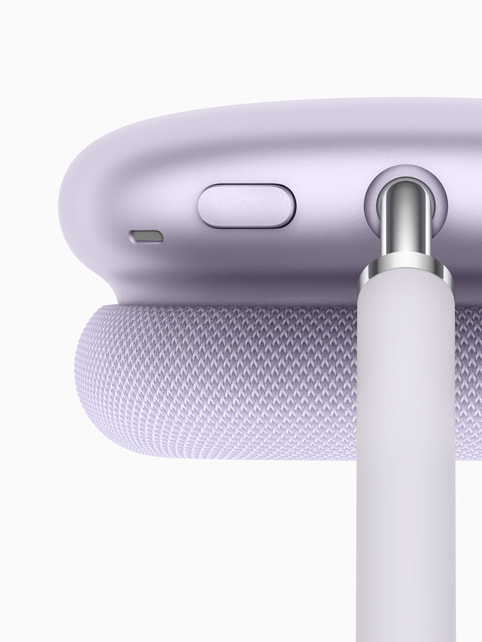
From left to right: (1) AirPods Max feature a breathable knit mesh canopy, distributing weight to reduce on-head pressure. (2) The noise control button easily switches between Active Noise Cancellation and Transparency mode.
AirPods Pro 2 Introduce the World’s First All-in-One Hearing Health Experience
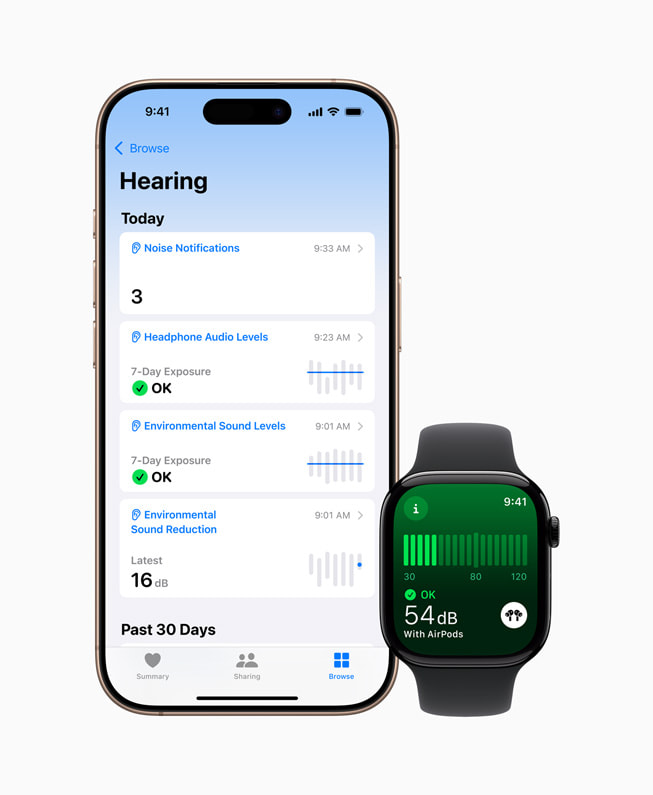
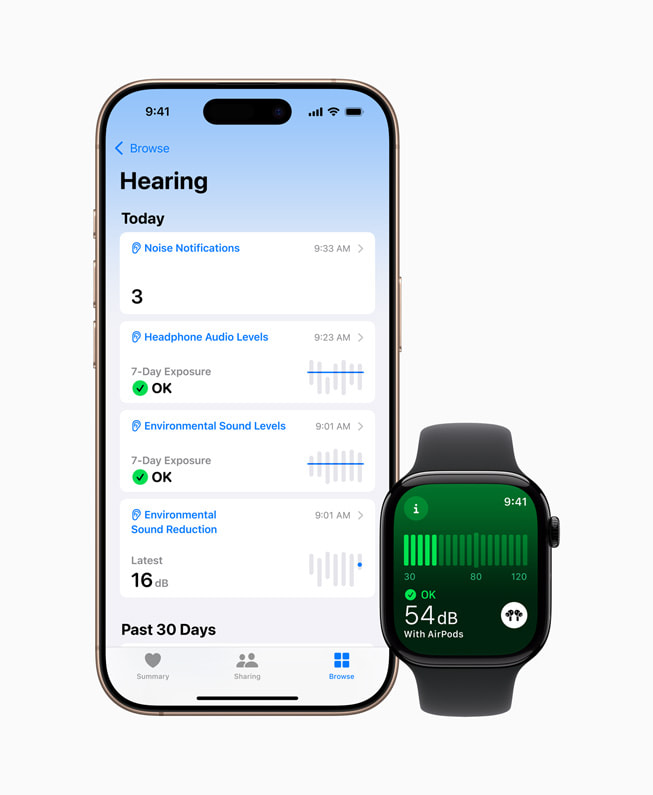
Approximately 1.5 billion people around the world are living with hearing loss, according to the World Health Organization. Building on years of work in hearing health — including the Noise app on Apple Watch, headphone audio levels with iPhone, hearing accessibility features, and the Apple Hearing Study — Apple is introducing an end-to-end experience focused on prevention, awareness, and assistance.
Prevention
According to the Apple Hearing Study, one in three people are regularly exposed to loud environmental noise levels that can impact their hearing. That can include common scenarios like taking the subway while commuting, mowing the lawn at home, attending a sporting event, and many more. In order to help users prevent exposure to loud environmental noise while preserving the sound signature of what they’re listening to, Hearing Protection comes to AirPods Pro. The ear tips help to provide passive noise reduction, while the H2 chip helps to actively reduce louder, more intermittent noise at 48,000 times per second. On by default across all listening modes, Hearing Protection is helpful in a variety of loud settings. Plus, with an all-new multiband high dynamic range algorithm, sounds at live events like concerts remain natural and vibrant so users don’t miss a beat.
Awareness
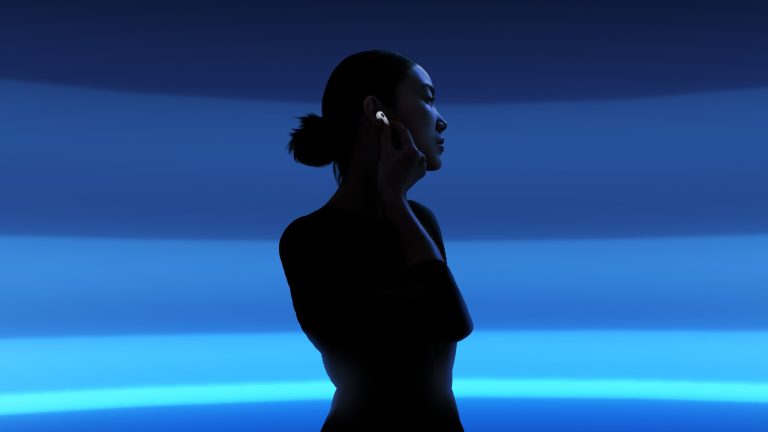
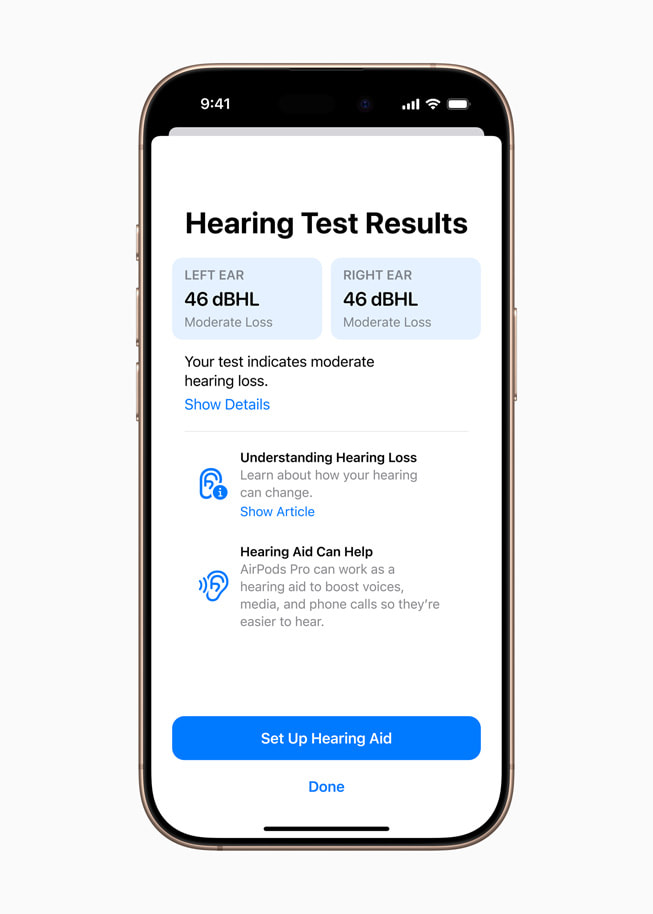
Apple is also introducing a scientifically validated Hearing Test feature with AirPods Pro and a compatible iPhone or iPad, expanding the ability for users to quickly check their hearing from the comfort of their home in minutes. The test is simple to take, utilizes a standard clinical approach called pure-tone audiometry, leverages advanced acoustic science, and provides users with an interactive experience. When a user completes the test, they will see an easy-to-understand summary of their results in a personalized hearing profile for AirPods Pro, which is stored privately and securely in their Health app. Users can also share these results with their healthcare providers for more informed conversations.
Assistance
“Hearing health is an essential part of our overall wellbeing, yet it can often be overlooked — in fact, according to the Apple Hearing Study, a staggering 75 percent of people diagnosed with hearing loss go untreated,” said Sumbul Desai, M.D., Apple’s vice president of Health. “We’re thrilled to provide breakthrough software features with AirPods Pro that put users’ hearing health front and center, bringing new ways to help test for and receive assistance for hearing loss.”
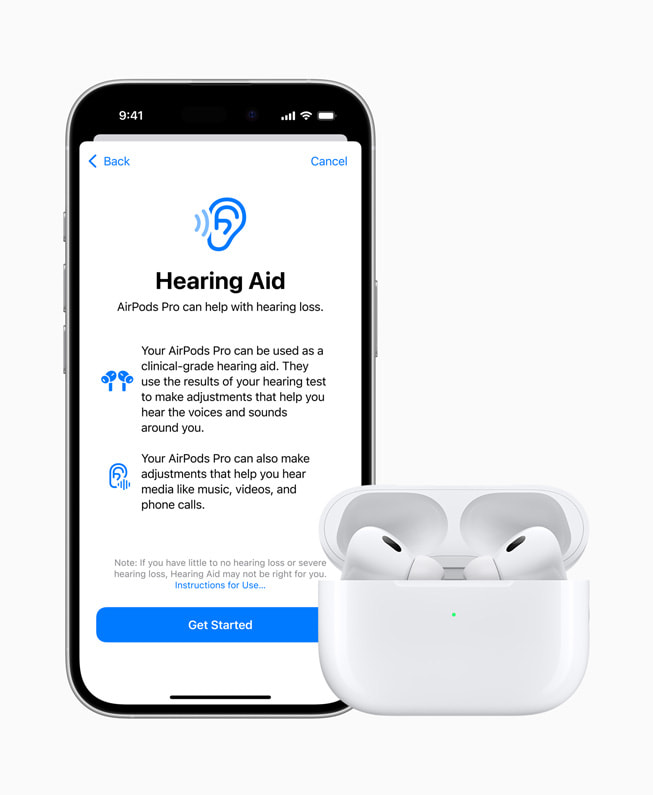
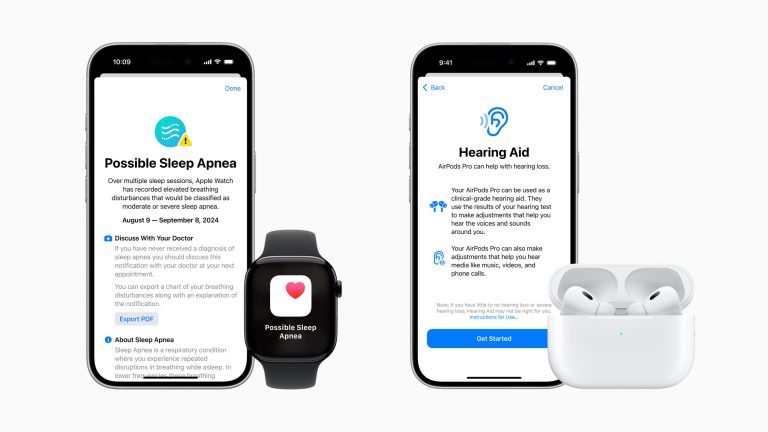
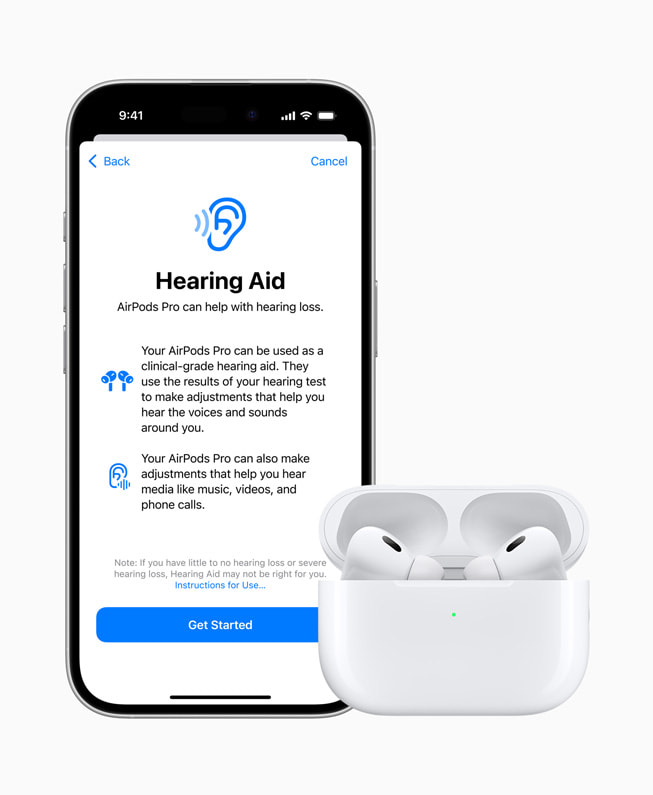
AirPods Pro also add an innovative, over-the-counter Hearing Aid capability for users with mild to moderate hearing loss. Using the personalized hearing profile from the Hearing Test, this new feature seamlessly transforms AirPods Pro into a clinical-grade hearing aid. After setup, the feature enables personalized dynamic adjustments so users have the sounds around them boosted in real time. This helps users better engage in conversation and keeps them connected to the people and environment around them. With the incredible audio quality of AirPods Pro, the user’s personalized hearing profile is automatically applied to music, movies, games, and phone calls across their devices without needing to adjust any settings. This first-of-its-kind software-based Hearing Aid feature brings users the ability to fine-tune their experience at any time, making access to hearing assistance easier than ever at an approachable price point. Users can also set up the Hearing Aid feature with an audiogram created by a hearing health professional. Both the Hearing Test and Hearing Aid features are grounded in science and were validated through rigorous scientific studies. The Hearing Test and Hearing Aid features are expected to receive marketing authorization from global health authorities soon, and will be available this fall in more than 100 countries and regions, including the United States, Germany, and Japan.
After taking the Hearing Test, users can also use their hearing profile to personalize the AirPods Pro listening experience. This benefits even more people, including those with little to no hearing loss, who can take advantage of specific adjustments at individual frequencies. To help provide the best listening experience, Media Assist is an all-new feature that helps boost certain parts of speech on a phone call or instruments within a soundtrack to help an even broader population.
Better for the Environment
AirPods are designed to minimize their impact on the environment. The new AirPods 4 design includes the use of 100 percent recycled rare earth elements in all magnets and 100 percent recycled gold in the plating of multiple printed circuit boards. The case also uses 100 percent recycled tin in the solder of the main logic board and 100 percent recycled aluminum in the hinge. AirPods 4 are free of potentially harmful substances such as mercury, BFRs, and PVC. In a first for AirPods, 100 percent of the packaging is made using fiber-based materials, bringing Apple closer to its goal of completely removing plastic from all packaging by 2025. Additionally, Apple reduced the packaging volume by more than 30 percent compared to the previous generation, which helps decrease emissions from shipping and move closer to Apple’s commitment of becoming carbon neutral by 2030.
Pricing and Availability
Customers can now pre-order AirPods 4 for $129 (U.S.) from apple.com/store and in the Apple Store app in the U.S. and more than 58 other countries and regions, with availability beginning Friday, September 20.
Customers can now pre-order AirPods 4 with Active Noise Cancellation for $179 (U.S.) from apple.com/store and in the Apple Store app in the U.S. and more than 58 other countries and regions, with availability beginning Friday, September 20.
New hearing health features will be available this fall for AirPods Pro 2 customers in a free software update when paired with iPhone or iPad running iOS 18 or iPadOS 18.
AirPods Pro 2 are available for $249 (U.S.) from apple.com/store and in the Apple Store app today.
Customers can now pre-order AirPods Max with USB-C charging for $549 (U.S.) from apple.com/store and in the Apple Store app in the U.S. and more than 60 other countries and regions, with availability beginning Friday, September 20.
New subscribers can get Apple Music free for three months with the purchase of any AirPods, AirPods Pro, or AirPods Max. See apple.com/promo for details.
For full feature functionality, use AirPods 4, AirPods Pro 2, and AirPods Max paired with an Apple device running the latest operating system software.
AppleCare+ for Headphones provides unparalleled service and support. This includes unlimited incidents of accidental damage, battery service coverage, and priority support from the people who know AirPods best.
About Apple
Apple revolutionized personal technology with the introduction of the Macintosh in 1984. Today, Apple leads the world in innovation with iPhone, iPad, Mac, AirPods, Apple Watch, and Apple Vision Pro. Apple’s six software platforms — iOS, iPadOS, macOS, watchOS, visionOS, and tvOS — provide seamless experiences across all Apple devices and empower people with breakthrough services including the App Store, Apple Music, Apple Pay, iCloud, and Apple TV+. Apple’s more than 150,000 employees are dedicated to making the best products on earth and to leaving the world better than we found it.
The Hearing Protection feature works with AirPods Pro 2 with the latest firmware when paired with a compatible iPhone, iPad, or Mac running the latest operating system software. The feature will be available in the U.S. and Canada. See support.apple.com/120850 for total attenuation and more information.
The Hearing Test and Hearing Aid features are expected to be available fall 2024. The Hearing Aid feature is pending marketing authorization from global health authorities. The Hearing Test and Hearing Aid features will be supported on AirPods Pro 2 with the latest firmware paired with a compatible iPhone or iPad with iOS 18 or iPadOS 18 and later, and are intended for people 18 years or older. The Hearing Aid feature is intended for people with perceived mild to moderate hearing loss.
Apple Watch delivers new sleep apnea notifications, and AirPods Pro 2 provide the world’s first all-in-one hearing health experience including a clinical-grade, over-the-counter Hearing Aid feature
CUPERTINO, CALIFORNIA Apple today unveiled breakthrough sleep and hearing health features coming to Apple Watch and AirPods Pro 2 that further deliver on Apple’s commitment to health with experiences that enrich users’ lives. These new features expand across products, bringing informative and powerful ways to support users in their sleep and hearing health for conditions that impact billions globally.
Using an innovative new Breathing Disturbances metric, sleep apnea notifications come to Apple Watch, adding to the many ways Apple Watch acts as an intelligent guardian for users’ health. The sleep apnea notifications are expected to receive marketing authorization from the Food and Drug Administration (FDA) and other global health authorities soon, with availability this month in more than 150 countries and regions, including the U.S., the EU, and Japan.1
Apple is providing the world’s first all-in-one hearing health experience with AirPods Pro with active Hearing Protection,2 a clinically validated Hearing Test feature, and an over-the-counter Hearing Aid feature. The first-of-its-kind software-based Hearing Aid feature helps make access to hearing assistance easier than ever at an approachable price point. The Hearing Test and Hearing Aid features are expected to receive marketing authorization from global health authorities soon, and will be available this fall in more than 100 countries and regions, including the U.S., Germany, and Japan.3
“At Apple, we believe that technology can help you live a healthier life, and we’re excited to enable incredible new health capabilities for serious conditions that affect billions of people around the world, while continuing to keep user data private,” said Sumbul Desai, M.D., Apple’s vice president of Health. “With Apple Watch, we continue to offer our users the ability to uncover important health conditions with new sleep apnea notifications. And on AirPods Pro, powerful features put users’ hearing health front and center, bringing new ways to help test for and receive assistance for hearing loss.”
A Powerful Way to Detect Signs of Sleep Apnea
Sleep is an important area of health as it impacts a person’s overall physical and mental wellbeing. Sleep apnea is a prevalent disorder in which breathing momentarily stops during sleep, preventing the body from getting enough oxygen. The condition is estimated to impact more than 1 billion people worldwide, and in most cases, goes undiagnosed. If left untreated, it can have important health consequences over time, including increased risk of hypertension, type 2 diabetes, and cardiac issues.
Breathing Disturbances is an innovative new Apple Watch metric that uses the accelerometer to detect small movements at the wrist associated with interruptions to normal respiratory patterns during sleep. Every 30 days, Apple Watch will analyze breathing disturbance data and notify users if it shows consistent signs of moderate to severe sleep apnea so they can speak to their doctor about next steps, including potential diagnosis and treatment.
Because overall quality of sleep is important, Breathing Disturbances can also be used to assess restfulness of sleep. Breathing Disturbances can be influenced by alcohol, medications, sleep position, and more. Users can view their nightly Breathing Disturbances in the Health app, where they are classified as elevated or not elevated, and can be viewed over a one-month, six-month, or one-year period.
For more informed conversations with their healthcare providers, users can export a PDF that shows when sleep apnea may have occurred, three months of breathing disturbance data, and additional information. Educational articles are also available within the Health app to help users learn more about sleep apnea.
The sleep apnea notification algorithm was developed using advanced machine learning and an extensive data set of clinical-grade sleep apnea tests. The feature was then validated in a clinical study — unprecedented in size for sleep apnea technology. In the clinical validation study, every participant identified by the algorithm had at least mild sleep apnea.
“Empowering consumers everywhere to have the ability to reliably identify the presence of abnormal breathing patterns during sleep can help uncover a woefully underdiagnosed and serious medical condition such as sleep apnea,” said Sairam Parthasarathy, M.D., University of Arizona Health Sciences Center for Sleep, Circadian, and Neurosciences’s professor and director in Tucson, Arizona. “This is a major step forward in improving public health.”
Sleep apnea notifications and Breathing Disturbances add to a range of sleep health features for Apple Watch users. In addition to monitoring important overnight health metrics like heart rate and respiratory rate, Apple Watch also helps users meet their sleep goals and track their sleep over time.
The World’s First All-in-One Hearing Health Experience
Approximately 1.5 billion people around the world are living with hearing loss, according to the World Health Organization. Research has also identified links between hearing loss and impact on a person’s overall wellbeing, including dementia and social isolation.
To help users better understand their hearing health, Apple is introducing an end-to-end experience focused on prevention, awareness, and assistance.
Prevention
According to the Apple Hearing Study — a longitudinal, virtual public research study conducted in collaboration with the University of Michigan School of Public Health and the World Health Organization — one in three people are regularly exposed to loud environmental noise levels that can impact their hearing. That can include common scenarios like taking the subway while commuting, mowing the lawn at home, attending a sporting event, and many more.
In order to help users prevent exposure to loud environmental noise while preserving the sound signature of what they’re listening to, Hearing Protection comes to AirPods Pro. The ear tips help to provide passive noise reduction, while the H2 chip helps to actively reduce louder, more intermittent noise at 48,000 times per second. On by default across all listening modes, Hearing Protection is helpful in a variety of loud settings. Plus, with an all-new multiband high dynamic range algorithm, sounds at live events like concerts remain natural and vibrant.
Awareness
Hearing loss often worsens gradually, leaving many people unaware that they may be living with the condition. Eighty percent of adults in the U.S. have not had their hearing checked in the last five years, according to the American Speech-Language-Hearing Association. To give users even more insights into hearing health, Apple is introducing an intuitive, clinical-grade hearing test based on the standard clinical approach called pure-tone audiometry that users can take themselves with their AirPods Pro and a compatible iPhone or iPad.
Users can take the convenient test in about five minutes from the comfort of their own home. The Hearing Test feature leverages advanced acoustic science and provides users with an interactive experience. When a user completes the test, they will see an easy-to-understand summary of their results, including a number representing hearing loss in each ear, a classification, and recommendations. The results, which include an audiogram, are stored privately and securely in the Health app, and can be shared with a healthcare provider to have more informed conversations.
The Hearing Test builds on learnings from the Apple Hearing Study and was developed using large-scale, real-world data. The feature was then validated against the clinical gold standard of pure-tone audiometry.
“Hearing health is a cornerstone of overall wellbeing. Protecting and preserving our hearing enhances our quality of life both in the short-term and long-term,” said Rick Neitzel, University of Michigan School of Public Health’s professor of Environmental Health Sciences and principal investigator of the Apple Hearing Study. “I’m thrilled Apple is introducing important tools to support people’s hearing health. These tools will help people protect their ears from noise pollution, be aware of changes in their hearing over time, and have important conversations with their healthcare providers when they need additional support.”
Assistance
Learning about hearing loss is a critical step to getting necessary assistance, which can often be challenging due to cost and access. Global research shows hearing loss often goes untreated. In fact, the Apple Hearing Study revealed that 75 percent of people diagnosed with hearing loss haven’t received the assistive support that they need.
AirPods Pro add an innovative over-the-counter Hearing Aid capability for users with mild to moderate hearing loss. Using the personalized hearing profile from the Hearing Test, this new feature seamlessly transforms AirPods Pro into a clinical-grade hearing aid. After setup, the feature enables personalized dynamic adjustments so users have the sounds around them boosted in real time. This helps them better engage in conversation, and keeps them connected to the people and environment around them. With the incredible audio quality of AirPods Pro, the user’s personalized hearing profile is automatically applied to music, movies, games, and phone calls across their devices, without needing to adjust any settings. Users can also set up the Hearing Aid feature with an audiogram created by a hearing health professional.
The Hearing Aid feature was clinically validated in a controlled, randomized study that evaluated the perceived benefit of the feature and its custom settings compared to an audiologist-assisted setup.
After taking the Hearing Test, the user’s hearing profile can also help to personalize the AirPods Pro listening experience for even more people, including those with little to no hearing loss who can still benefit from specific adjustments at individual frequencies. To help provide the best listening experience, Media Assist is an all-new feature that helps boost certain parts of speech on a phone call or instruments within a soundtrack to help an even broader population.
These features build on the hearing health tools Apple currently offers its users. For example, with the Noise app, Apple Watch users can enable notifications for when environmental noise levels might affect their hearing health. On iPhone, users can set a headphone volume limit where they can turn on Reduce Loud Audio and drag a slider to a preferred decibel level. Apple also offers additional accessibility features for users to customize settings to meet their hearing needs.
“For decades, Apple has led the way in designing products for everyone and supporting users with a broad spectrum of hearing abilities,” said Sarah Herrlinger, Apple’s senior director of Global Accessibility Policy and Initiatives. “These features on AirPods Pro will make an impact on so many people by driving more awareness around hearing health and empowering individuals with new customizable tools to help them stay connected.”
Additional features coming to Apple Watch, iPhone, and iPad include:
Since launching the Health app in 2014, Apple has introduced meaningful features that focus on 18 areas of health and fitness across Apple Watch, AirPods, iPhone, and iPad. Apple is committed to empowering users on their health journey by building actionable features into the products they use every day that are grounded in science, and have privacy at the core.
Built with Privacy at the Core
Privacy is fundamental in the design and development across all of Apple’s health features. When a user’s device is locked with a passcode, Touch ID, or Face ID, all of their health and fitness data in the Health app — other than Medical ID — is encrypted. Any Health data backed up to iCloud is encrypted both in transit and on Apple servers. When using iOS, iPadOS, and watchOS with the default two-factor authentication and a passcode, Health app data synced to iCloud is encrypted end-to-end, meaning that Apple does not have the key to decrypt the data and therefore cannot read it.
Availability
Some features may not be available in all regions or all languages, or with all makes and models.
The sleep apnea notifications are expected to receive marketing authorization from the FDA and other global health authorities soon, with availability this month in more than 150 countries and regions, including the U.S., the EU, and Japan. The feature will be supported on Apple Watch Series 9, Apple Watch Series 10, and Apple Watch Ultra 2.
The Hearing Test and Aid features are expected to receive marketing authorization from global health authorities soon and will be supported with AirPods Pro 2 with the latest firmware when paired with a compatible iPhone or iPad, and will be available this fall in more than 100 countries and regions, including the U.S., Germany, and Japan.
The Hearing Protection feature is expected to be available in fall 2024 and will work with AirPods Pro 2 with the latest firmware when paired with a compatible iPhone, iPad, or Mac running the latest operating system. The feature will be available in the U.S. and Canada.
About Apple
Apple revolutionized personal technology with the introduction of the Macintosh in 1984. Today, Apple leads the world in innovation with iPhone, iPad, Mac, AirPods, Apple Watch, and Apple Vision Pro. Apple’s six software platforms — iOS, iPadOS, macOS, watchOS, visionOS, and tvOS — provide seamless experiences across all Apple devices and empower people with breakthrough services including the App Store, Apple Music, Apple Pay, iCloud, and Apple TV+. Apple’s more than 150,000 employees are dedicated to making the best products on earth and to leaving the world better than we found it.
The Hearing Test and Hearing Aid features are expected to be available fall 2024. The Hearing Aid feature is pending marketing authorization from the FDA and other global health authorities. The Hearing Test and Hearing Aid features will be supported on AirPods Pro 2 with the latest firmware paired with a compatible iPhone or iPad with iOS 18 or iPadOS 18 and later, and is intended for people 18 years or older. The Hearing Aid feature is intended for people with perceived mild to moderate hearing loss.
The sleep apnea notification feature is pending FDA clearance and is expected to be available later this month. The feature will be supported on Apple Watch Series 9, Apple Watch Series 10, and Apple Watch Ultra 2. It is intended to detect signs of moderate to severe sleep apnea for people 18 years or older without a diagnosis of sleep apnea.
The Hearing Protection feature works with AirPods Pro 2 with the latest firmware when paired with a compatible iPhone, iPad, or Mac running the latest operating system. The feature will be available in the U.S. and Canada. See support.apple.com/120850 for total attenuation and more information.
Centuries after it was first theorised, the sunlight propulsion method could herald a new era of space exploration
Nasa has unfurled a solar sail in space for the first time, aiming to harness the propulsive power of sunlight for interstellar travel.
The US space agency revealed that it had deployed the solar sail 1,000 kilometres (600 miles) above Earth on Thursday, four months after launching it into space. The first images from the craft are expected to be available on Wednesday.
Measuring 80 square metres – roughly the same size as six parking spaces – Nasa said the craft will be visible from Earth and as bright as the brightest star in the night sky under ideal viewing conditions.
Nasa’s solar sail aims to unlock interstellar space travel
“The advanced composite solar sail system introduces a new way to explore the cosmos,” Nasa said. “Much like a sail boat is propelled by wind, a solar sail spacecraft is pushed by light from the Sun.”
The system works by utilising the pressure exerted by photons as they bounce off the reflective sail, thus eliminating the need for heavy propulsion equipment like rockets.
The method allows a spacecraft to travel indefinitely, without the need to refuel or reposition itself – however its size and structure makes it vulnerable to damage from dust, debris and other particles.
A Nasa concept for a near-Earth Asteroid Scout that uses a solar sail
The next-generation propulsion method, which was first theorised in the 17th century, has been limited by the materials and structure that the sail requires to be effective.
Recent advances have finally made it possible to harness the force of sunlight on the sail, which is roughly equivalent to the weight of a paperclip on Earth.
“Booms have tended to be either heavy and metallic or made of lightweight composite with a bulky design – neither of which work well for today’s small spacecraft. Solar sails need very large, stable, and lightweight booms that can fold down compactly,” said Keats Wilkie, the mission’s principal investigator at Nasa’s Langley Research Center in Hampton, Virginia.
“This sail’s booms are tube-shaped and can be squashed flat and rolled like a tape measure into a small package while offering all the advantages of composite materials, like less bending and flexing during temperature changes.”
Future solar sails could be as large as 2,000 square metres – roughly equivalent to half a football pitch – and could potentially power trips to the Moon, Mars and beyond.
“The Sun will continue burning for billions of years, so we have a limitless source of propulsion. Instead of launching massive fuel tanks for future missions, we can launch larger sails that use ‘fuel’ already available,” said Alan Rhodes, the mission’s lead systems engineer at Nasa’s Ames Research Center in California’s Silicon Valley.
“We will demonstrate a system that uses this abundant resource to take those next giant steps in exploration and science.”
By: Anthony Cuthbertson Originally published at: Independent
For 25 years, the Office of STEM Engagement (OSTEM) at NASA’s Johnson Space Center has inspired and provided high school students across the state of Texas with NASA-focused learning experiences through the High School Aerospace Scholars (HAS) program. The OSTEM team celebrated the milestone on Monday, July 29 at Johnson’s Gilruth Center with poster sessions, special presentations, and a networking reception.
Fifty-one students who participated in the 2024 High School Aerospace Scholars program were invited to NASA’s Johnson Space Center in Houston to participate in an on-site experience.
NASA/James Blair
An authentic STEM learning experience for Texas high school juniors, HAS provides opportunities for students to engage with NASA’s missions and become the next generation of explorers. The year-long program begins in the fall with an online, state-aligned STEM learning experience focused on Earth science, technology, aeronautics, the solar system, the International Space Station, and NASA’s Moon to Mars exploration approach. Students engage in approximately four months of virtual learning through curriculum including interactive lessons, rubric-based activities, and quizzes.
Students who complete the online courses with an overall average of 70% or greater receive an invitation to a five-day virtual summer experience called Moonshot. While actively mentored by NASA scientists and engineers, students work with a team to complete an Artemis-themed Moon to Mars mission and design challenge. The summer session also includes numerous gamified activities and guidance towards pathways to STEM careers.
High School Aerospace Scholars collaborated on an engineering design challenge during their on-site experience at Johnson Space Center.
NASA/Bill Stafford
The top performing Moonshot teams are then invited to a four-day residential experience at Johnson, with lodging, meals, and transportation provided at no cost to the students. During the on-site session, students participate in NASA facility tours, complete engineering design challenges, and meet with NASA scientists and engineers who offer guidance on STEM careers. At the completion of the program, students can earn up to one full science elective credit for school.
The HAS 25th anniversary celebration coincided with this year’s on-site experience. During the 2023-2024 school year, 798 students participated in the HAS online course, with 359 advancing to the summer Moonshot experience. The top six Moonshot teams (51 students) were invited to Johnson.
High School Aerospace Scholars presented their Moonshot projects to Johnson Space Center team members during a poster session.
NASA/James Blair
The 51 selected students kicked off the anniversary celebration with a poster session to present their Moonshot projects. Following the session, students heard from Johnson Center Director Vanessa Wyche and Deputy Director Steve Koerner during a fireside chat. Speakers included Pam Melroy, NASA Deputy Administrator; Arturo Sanchez, Johnson External Relations Office Director; Mike Kincaid, NASA OSTEM Associate Administrator; Greg Bonnen, member of the Texas House of Representatives; Brian Freedman, Bay Area Houston Economic Partnership President; and Shelly Tornquist, director of Texas A&M University College of Engineering’s education outreach program, Spark!
NASA astronaut Mike Fincke meets with 2024 High School Aerospace Scholars.
NASA/Helen Arase Vargas
Other notable attendees included NASA astronaut Mike Fincke, HAS activity managers from the past 25 years, and current HAS activity manager, Jakarda Varnado.
Continuing the celebration, HAS hosted the second annual Alumni Social on Wednesday, July 31 encouraging current and former HAS students and mentors to connect over lunch. The annual student rocket launch was also held onsite on Thursday, August 1.
2024 High School Aerospace Scholars prepare their model rockets for launch during the program’s on-site activities at Johnson Space Center.
NASA/Josh Valcarcel
Additionally, the HAS team activated a mobile exhibit at two different on-site locations throughout the week. Over 150 guests stopped by the exhibit, which featured a HAS video montage and the opportunity to touch a lunar sample. Several of the visitors communicated their appreciation for HAS, noting the program has made significant impact on their children’s motivation, school performance, and career paths. Many alumni have gone on to pursue careers within STEM, including nearly 30 HAS participants who have been employed by NASA within the past five years.
2024 High School Aerospace Scholars connected with program alumni and HAS mentors during the Alumni Social held onsite at Johnson Space Center.
NASA/Helen Arase Vargas
For alumni who wish to continue their experience beyond the year-long program, HAS recently launched a mentorship course, for high school seniors. The course contains modules about leadership and STEM career opportunities and was designed to continue to engage the students as they prepare for the next step in their education or to launch their careers. Alumni also act as an additional layer of support for the junior scholars as they navigate their HAS experience.
HAS is made possible through collaborations among NASA, the State of Texas, Bay Area Houston Economic Partnership, Texas A&M Engineering Experiment Station, Houston Livestock Show and Rodeo, and Rotary National Award for Space Achievement.
Applications will reopen in September for students interested in participating in the 2025 HAS experience.