A weak magnetic field likely pulled matter inward to form the outer planetary bodies, from Jupiter to Neptune.
Jennifer Chu | MIT News https://news.mit.edu/2024/asteroid-grains-shed-light-outer-solar-systems-origins-1106
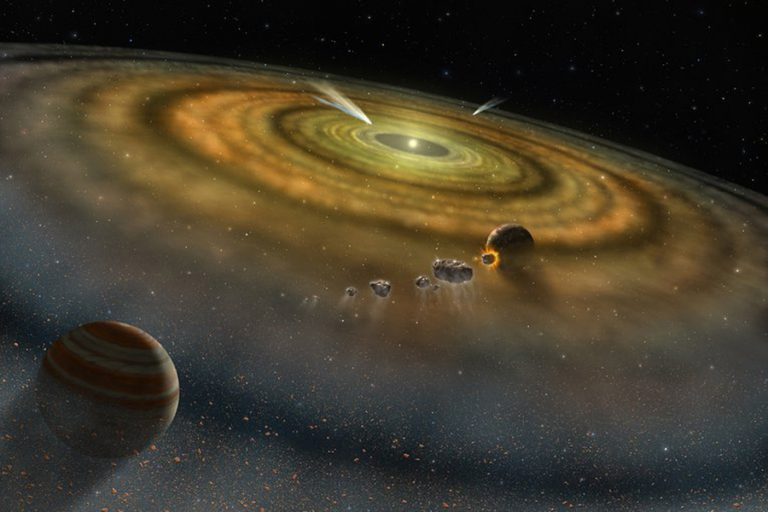
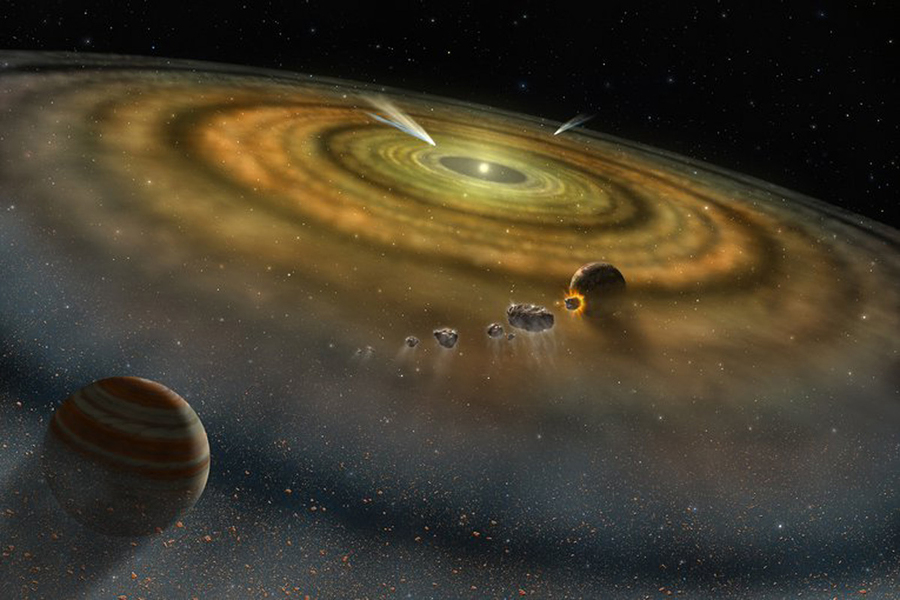
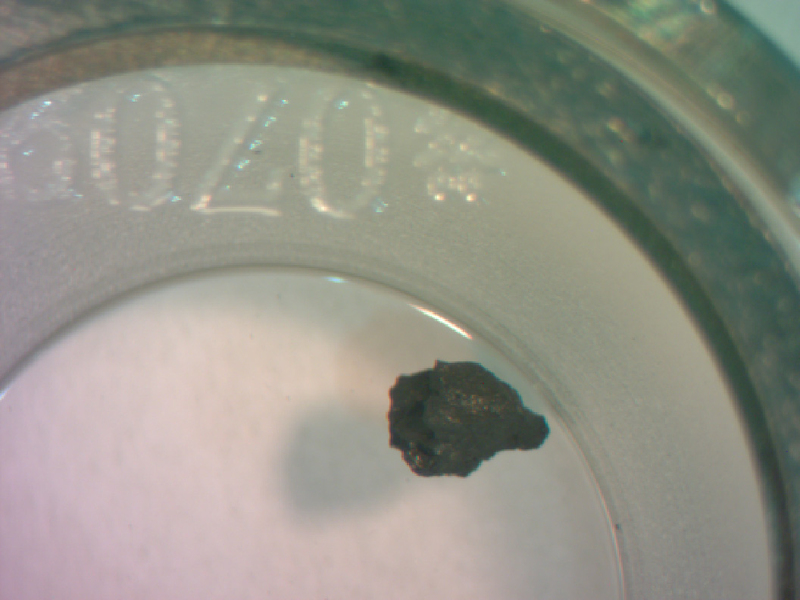
Caption:Artist’s conception of the dust and gas surrounding a newly formed planetary system. Credits:Credit: NASAMIT scientists analyzed one of several particles (shown in black) from the asteroid Ryugu, and found evidence that a weak magnetic field likely existed in the outer solar system where the asteroid is thought to have first formed, more than 4.6 billion years ago. Credits:Credit: Elias Mansbach
Tiny grains from a distant asteroid are revealing clues to the magnetic forces that shaped the far reaches of the solar system over 4.6 billion years ago.
Scientists at MIT and elsewhere have analyzed particles of the asteroid Ryugu, which were collected by the Japanese Aerospace Exploration Agency’s (JAXA) Hayabusa2 mission and brought back to Earth in 2020. Scientists believe Ryugu formed on the outskirts of the early solar system before migrating in toward the asteroid belt, eventually settling into an orbit between Earth and Mars.
The team analyzed Ryugu’s particles for signs of any ancient magnetic field that might have been present when the asteroid first took shape. Their results suggest that if there was a magnetic field, it would have been very weak. At most, such a field would have been about 15 microtesla. (The Earth’s own magnetic field today is around 50 microtesla.)
Even so, the scientists estimate that such a low-grade field intensity would have been enough to pull together primordial gas and dust to form the outer solar system’s asteroids and potentially play a role in giant planet formation, from Jupiter to Neptune.
The team’s results, which are published today in the journal AGU Advances, show for the first time that the distal solar system likely harbored a weak magnetic field. Scientists have known that a magnetic field shaped the inner solar system, where Earth and the terrestrial planets were formed. But it was unclear whether such a magnetic influence extended into more remote regions, until now.
“We’re showing that, everywhere we look now, there was some sort of magnetic field that was responsible for bringing mass to where the sun and planets were forming,” says study author Benjamin Weiss, the Robert R. Shrock Professor of Earth and Planetary Sciences at MIT. “That now applies to the outer solar system planets.”
The study’s lead author is Elias Mansbach PhD ’24, who is now a postdoc at Cambridge University. MIT co-authors include Eduardo Lima, Saverio Cambioni, and Jodie Ream, along with Michael Sowell and Joseph Kirschvink of Caltech, Roger Fu of Harvard University, Xue-Ning Bai of Tsinghua University, Chisato Anai and Atsuko Kobayashi of the Kochi Advanced Marine Core Research Institute, and Hironori Hidaka of Tokyo Institute of Technology.
A far-off field
Around 4.6 billion years ago, the solar system formed from a dense cloud of interstellar gas and dust, which collapsed into a swirling disk of matter. Most of this material gravitated toward the center of the disk to form the sun. The remaining bits formed a solar nebula of swirling, ionized gas. Scientists suspect that interactions between the newly formed sun and the ionized disk generated a magnetic field that threaded through the nebula, helping to drive accretion and pull matter inward to form the planets, asteroids, and moons.
“This nebular field disappeared around 3 to 4 million years after the solar system’s formation, and we are fascinated with how it played a role in early planetary formation,” Mansbach says.
Scientists previously determined that a magnetic field was present throughout the inner solar system — a region that spanned from the sun to about 7 astronomical units (AU), out to where Jupiter is today. (One AU is the distance between the sun and the Earth.) The intensity of this inner nebular field was somewhere between 50 to 200 microtesla, and it likely influenced the formation of the inner terrestrial planets. Such estimates of the early magnetic field are based on meteorites that landed on Earth and are thought to have originated in the inner nebula.
“But how far this magnetic field extended, and what role it played in more distal regions, is still uncertain because there haven’t been many samples that could tell us about the outer solar system,” Mansbach says.
Rewinding the tape
The team got an opportunity to analyze samples from the outer solar system with Ryugu, an asteroid that is thought to have formed in the early outer solar system, beyond 7 AU, and was eventually brought into orbit near the Earth. In December 2020, JAXA’s Hayabusa2 mission returned samples of the asteroid to Earth, giving scientists a first look at a potential relic of the early distal solar system.
The researchers acquired several grains of the returned samples, each about a millimeter in size. They placed the particles in a magnetometer — an instrument in Weiss’ lab that measures the strength and direction of a sample’s magnetization. They then applied an alternating magnetic field to progressively demagnetize each sample.
“Like a tape recorder, we are slowly rewinding the sample’s magnetic record,” Mansbach explains. “We then look for consistent trends that tell us if it formed in a magnetic field.”
They determined that the samples held no clear sign of a preserved magnetic field. This suggests that either there was no nebular field present in the outer solar system where the asteroid first formed, or the field was so weak that it was not recorded in the asteroid’s grains. If the latter is the case, the team estimates such a weak field would have been no more than 15 microtesla in intensity.
The researchers also reexamined data from previously studied meteorites. They specifically looked at “ungrouped carbonaceous chondrites” — meteorites that have properties that are characteristic of having formed in the distal solar system. Scientists had estimated the samples were not old enough to have formed before the solar nebula disappeared. Any magnetic field record the samples contain, then, would not reflect the nebular field. But Mansbach and his colleagues decided to take a closer look.
“We reanalyzed the ages of these samples and found they are closer to the start of the solar system than previously thought,” Mansbach says. “We think these samples formed in this distal, outer region. And one of these samples does actually have a positive field detection of about 5 microtesla, which is consistent with an upper limit of 15 microtesla.”
This updated sample, combined with the new Ryugu particles, suggest that the outer solar system, beyond 7 AU, hosted a very weak magnetic field, that was nevertheless strong enough to pull matter in from the outskirts to eventually form the outer planetary bodies, from Jupiter to Neptune.
“When you’re further from the sun, a weak magnetic field goes a long way,” Weiss notes. “It was predicted that it doesn’t need to be that strong out there, and that’s what we’re seeing.”
The team plans to look for more evidence of distal nebular fields with samples from another far-off asteroid, Bennu, which were delivered to Earth in September 2023 by NASA’s OSIRIS-REx spacecraft.
“Bennu looks a lot like Ryugu, and we’re eagerly awaiting first results from those samples,” Mansbach says.
This research was supported, in part, by NASA.
Reprinted with permission of MIT News http://news.mit.edu/
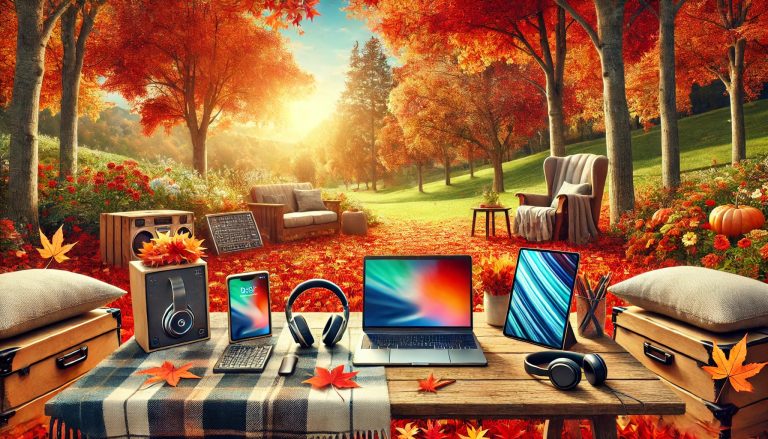
While we would already prefer to give these kind of gifts on the holiday season this coming December. Let’s just think of it as thanksgiving gifts. To our loved (or ourselves) who loves to play video games whether they are starting or have already started playing video games.
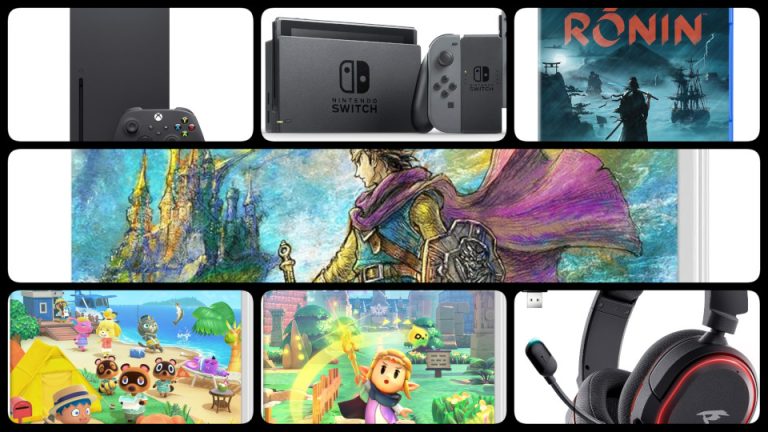
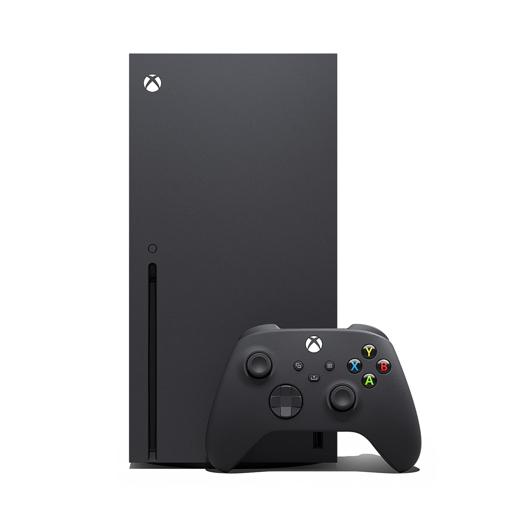
If you are planning to gift a gaming console to your children, grandchildren or even for yourself. This 9th generation video game console is the latest console you could acquire from Microsoft. Concerning its price, it did decrease by almost 50 USD from it’s initial release.
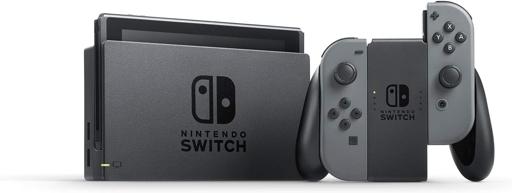
The Switch is still the latest handheld console from Nintendo. There is a large variety of games available to it, since it’s initial release in 2017. The collection of games numbers up almost five thousand to date.
Note that this version of the switch is the older version. If they already have this, it is recommended to get the OLED version instead. As it has slightly better graphics and slightly larger screen. For the OLED version, see here.
This action-role playing game is available for the PS5. It is a vast open-world adventure that can be played in an online multiplayer setting. If interested in games that involves a lot action and requires skill, then this game is a great pick.
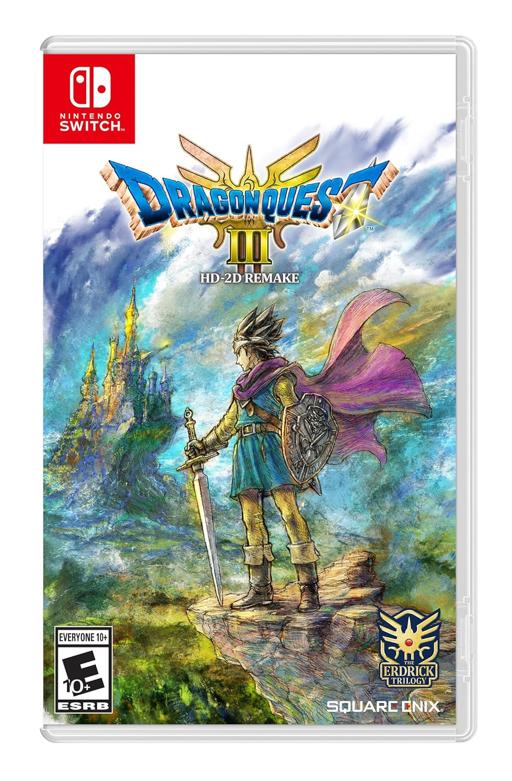
This classic game that came out initially for the Famicom (Family Computer) game console in 1988, has been remaked in HD-2D. Giving it a new look with better graphics and probably and hopefully better gameplay. This game is expected be available on November 14, 2024, a few days from the publishing of this article. The game is available in Nintendo Switch along with PS5 and XBox Series X.
Note that there is pre-order bonus if you purchase it before it becomes available.
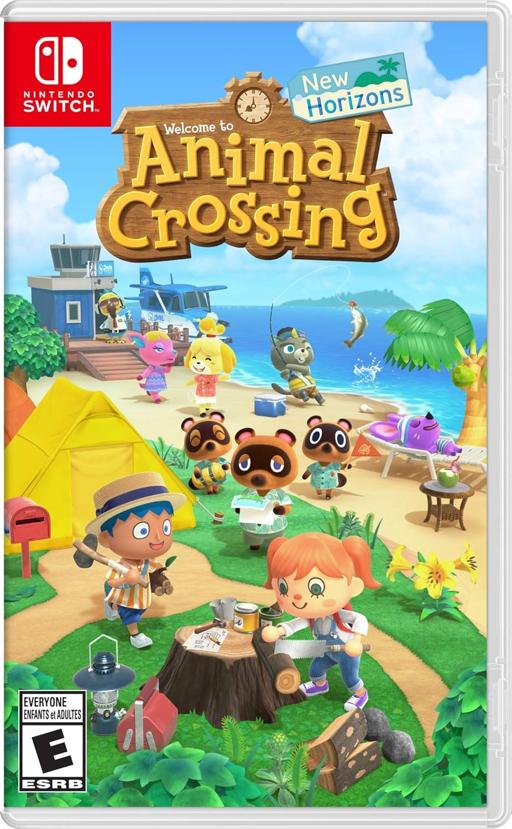
If you are a fan of farm simulation game like Harvest Moon and Stardew Valley, you might want to check out Animal Crossing. It has features similar to those kind of games. But the icing on the cake for this is the multiplayer function, as you can play up to 8 players online.
The latest game from the Legend of Zelda. While the two previous games, Breath of the Wild and Tears of the Kingdom allowed you play as Link. This time, you will become Zelda and save Link and the kingdom of Hyrule.
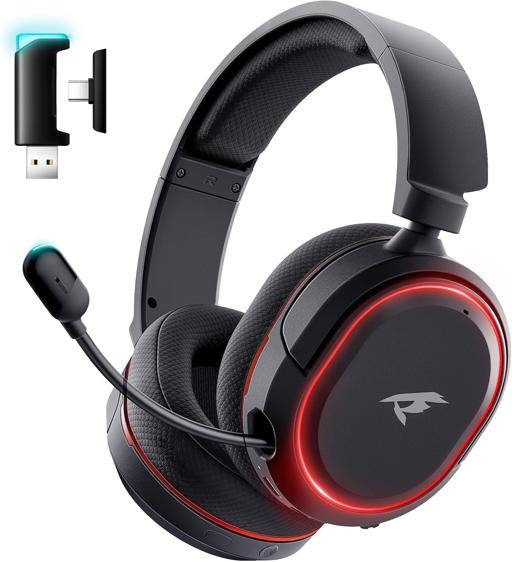
This wireless headless gaming headset is essential if you are playing in online games. It offers a 7.1 Surround Sound, which is a common setup for a home theatre. Giving the feeling of positional audio when playing games that involves environments like shooters and role playing games. It also comes with a 100-hour battery life, making sure that you won’t get interrupted while playing your favorite game.
Thanksgiving, it is the time of the year when we travel to your families and loved one. It is one of the most busiest time of the year. Not to mention the traffic that comes with it. We advise to plan ahead with the trip to travel along with the gifts you bring to your dearest friends and family.
Here are some of the most well-known gifts that you can give in this time of being thankful for your blessings.
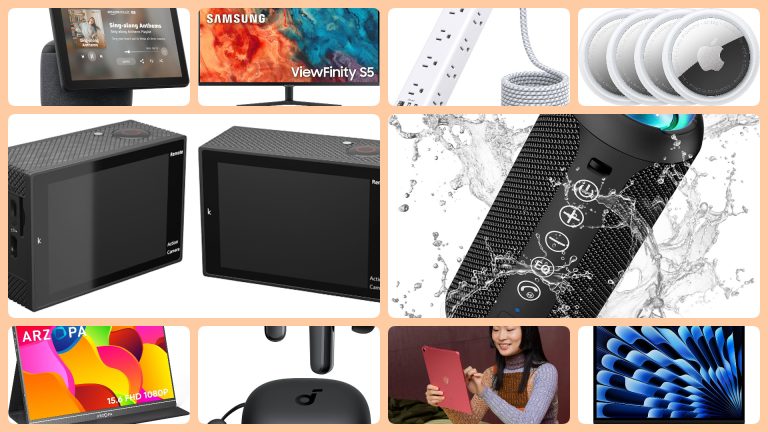
A good choice for a laptop. While it is no gaming laptop, don’t sell it short. It has an 8-core CPU and a default memory of 8GB. Pretty decent enough for work and casual use. It’s also worth it’s price.
This powerful tablet is a great gift for your parents or grandparents. The battery can last up to 10 hours from a full charge. Pairing with the Apple pencil and keyboard and you have a mobile workstation.
Just for it’s price and it’s already worth it. This money-worth earbuds has a powerful bass, long playtime of about 10 hours, and has a mic function. Don’t worry about the mic as it has an AI algorithm that properly filters out noise.
Just like socks, you can never have too much monitor. And this one is portable. Making your ambiance different everytime you want. Whether you are in the garden, the kitchen, the dining room, or outside.
This wireless bluetooth speaker has an added bonus of producing a colorful light show. Just like how gaming PCs are usually paired with RGB LEDs, this speaker has a similar effect. If you’ve noticed the image, there are water droplets with it, it is because these are waterproof.
This waterproof camera is a perfect gift for those who likes to immerse themselves in outdoor activities. It can support up to 131 ft of underwater diving. It has a smooth video stabilization technology and is excellent for mountain bike riding or even surfing.
With the coming of thanksgiving and the holiday season, setting up decorations with lights and other electronics comes with the difficulty in wiring. This 10ft extension cord not only will cover the length of any place in the house but comes with an overload protection. Giving you an added assurance of avoiding fire hazard situations.
This 34 inches monitor has been researched and tested to the point that it comes into the top monitors to buy. It comes with bluelight technology that will ease the strain for the eyes.
Having Amazon Alexa as an assistant is always entertaining. Just asking for the weather, playing a song while doing errands, controlling alarms and other smart home devices are only some of the things it can do. The bonus is having a screen for watching videos and making video calls.
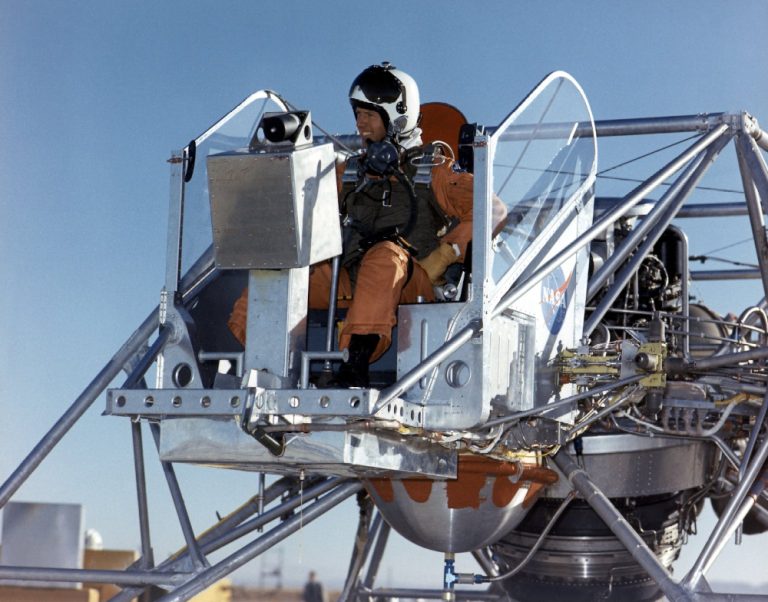
NASA pilot Joe Walker sits in the pilot’s platform of the Lunar Landing Research Vehicle (LLRV) number 1 on Oct. 30, 1964. The LLRV and its successor the Lunar Landing Training Vehicle (LLTV) provided the training tool to simulate the final 200 feet of the descent to the Moon’s surface.
The LLRVs, humorously referred to as flying bedsteads, were used by NASA’s Flight Research Center, now NASA’s Armstrong Flight Research Center in California, to study and analyze piloting techniques needed to fly and land the Apollo lunar module in the moon’s airless environment.
It’s a few days before Halloween. What if you forgot to buy the necessary decorations, treats and costumes? Or were just too busy. Here are some top picks from our reviewers on what to get for the upcoming festivity.
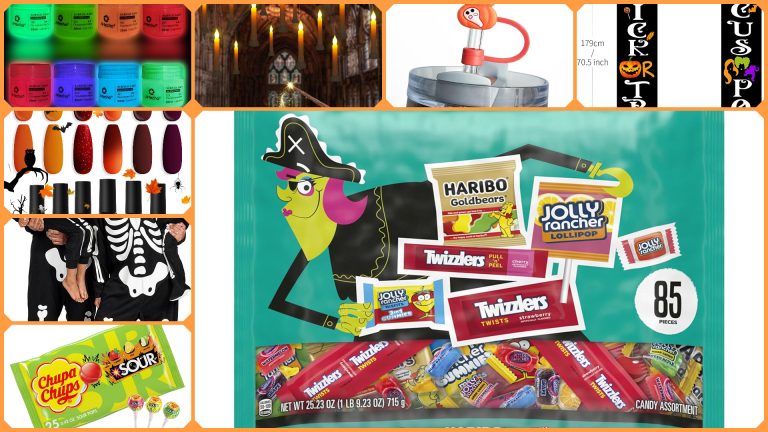
These glow in the dark paint set is a definite grab for those who want to exhude an eerie, spine-chilling atmosphere. It’s also viable for christmas decorations.
Going for a Harry Potter-themed environment? Floating candles will be a great addition, and as an added bonus it is remotely ignited using a wand. All you need to do now is flick your wand and say the word, “Incendio!”
This fine addition to your drinks, specifically the straw will let you feel the Halloween ambiance ten fold, when you drink your pumpkin spice latte. But do tone down on the sweet, or you might turn yourself into a pumpkin.
Of course we have something for the ladies. These nail polish are specifically designed and themed to go well with the festivities. There are also other selections to choose from, even for Christmas.
Going for a full house combo with this costume set is a good choice when involving the whole family. Just make sure to check that everyone’s size is available before purchasing.
What does autumn have to do with how we pick our bags?
While the scenery of the autumn season bring us a sense of peace and tranquility. We should take care not to fall for backpack that is not fit for the job. During the season of fall, the temperature takes a significant drop compared to Summer, but less colder than Winter.
We have compiled here some of the attributes that you should look out for when selecting your backpacks.
Good Material
With the frequent rain and cooler weather, having a durable and water-resistant material for your backpack is a must. It must protect your belongings, specially your extra set of clothes in case you get soaked from a passing rain. It will also be critical to prevent your devices from getting soaked, and possibly breaking it beyond repair.
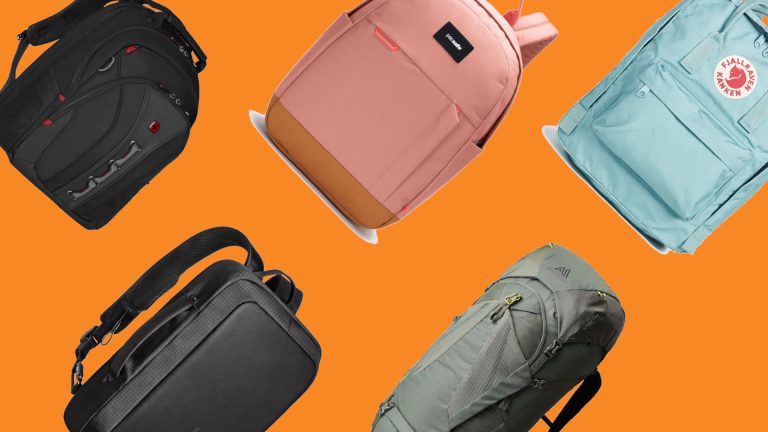
The Swiss Gear backpacks are constructed with a Polyester material and are considered not to be a highly absorbent fibre. As such, it will not readily absorb water, but being submerged in water will eventually make it wet.
This lightweight backpack can support up to a 16-inch laptop. It also has ScanSmart feature that helps you speed up at airport security checks by avoiding the need to remove your laptop for scans.
The season of autumn also brings in the change not only the weather but also in the colors of nature. With nature’s palette changing from vibrant green of the summer to the colorful range of orange, red, yellow and brown. Going for a color that either goes well with this theme or contrast of it are some of the choices you can make.
This Pacsafe backpack in the color of rose does the trick of standing out. It becomes a highlight within the natural colors of the leaves. The complexion will also make it easy for you to locate your bag in case you left it behind a pile of grass when you marvel at the beauty of the forest.
Having a comfy experience while carrying your backpack is a must when in the midst of a hiking activity. To get the maximum amount of comfort is to have an adjustable strap that will support your shoulder, chest and hip.
The Zulu 55 not only have an adjustable strap, but also comes with the FreeFloat suspension premium materials. With cushioned hipbelt that conforms to your lower back and hips supporting the weight. This will allow you flexible movement during any adventure.
Another point for consideration is the versatility of your backpack. While bag lovers tend to use different bags depending on the occasion. It is advisable to have one that can be used in more ways than one. From bags that you use for work to casual events. It should also be able to withstand autumn and winter.
The Bobby Bizz 2.0 is as versatile it can be. You can convert this backpack into a briefcase in a short amount of time. The shoulder straps can be removed and placed into the back pocket. It has an anti-cut resistant material and zinc alloy lock that can be used for security.
Size is never an overlooked feature of a backpack. It almost always dictates that purpose on why you choose. While autumn is the season for hiking and other extended period of activity. Sometimes a quick stroll through the park to see the autumn foliage is also a scenario that can play out. A relatively smaller backpack would suffice.
The Kanken by Fjallraven is an everyday outdoor type of backpack. While our researchers say that it’s perfect as a daypack, it can also be used for a short hiking trip. Aside from being a charming bag, it is also durable, water resistant and quick drying.
The quasars appear to have few cosmic neighbors, raising questions about how they first emerged more than 13 billion years ago.
Jennifer Chu | MIT News MIT News (https://news.mit.edu/2024/astronomers-detect-ancient-lonely-quasars-murky-origins-1017)
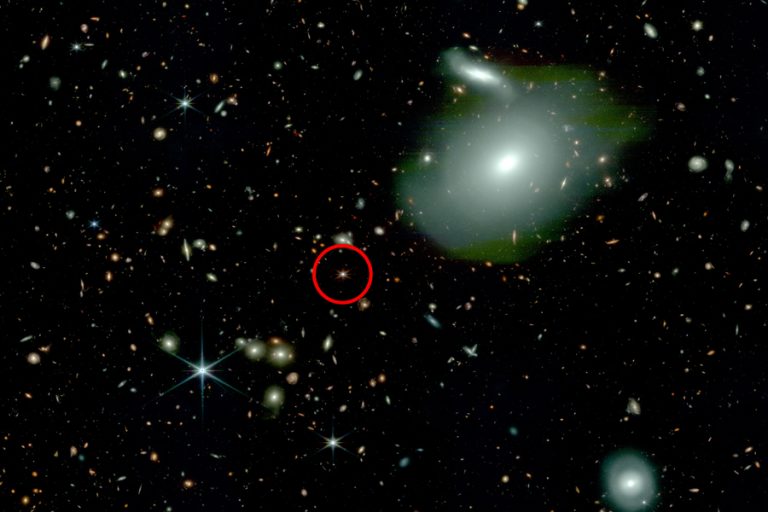
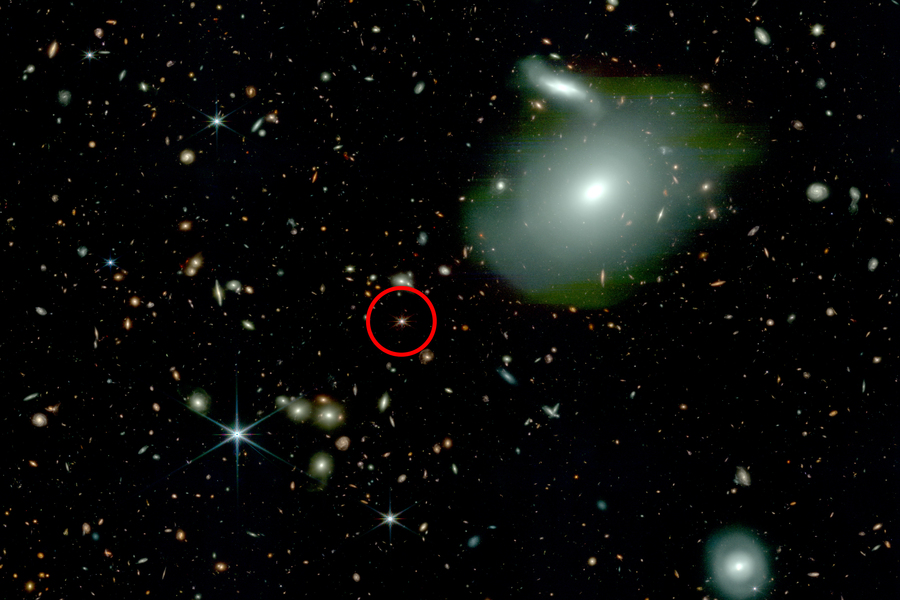
This image, taken by NASA’s James Webb Space Telescope, shows an ancient quasar (circled in red) with fewer than expected neighboring galaxies (bright spheres), challenging physicists’ understanding of how the first quasars and supermassive black holes formed.
Credits:Credit: Christina Eilers/EIGER team
A quasar is the extremely bright core of a galaxy that hosts an active supermassive black hole at its center. As the black hole draws in surrounding gas and dust, it blasts out an enormous amount of energy, making quasars some of the brightest objects in the universe. Quasars have been observed as early as a few hundred million years after the Big Bang, and it’s been a mystery as to how these objects could have grown so bright and massive in such a short amount of cosmic time.
Scientists have proposed that the earliest quasars sprang from overly dense regions of primordial matter, which would also have produced many smaller galaxies in the quasars’ environment. But in a new MIT-led study, astronomers observed some ancient quasars that appear to be surprisingly alone in the early universe.
The astronomers used NASA’s James Webb Space Telescope (JWST) to peer back in time, more than 13 billion years, to study the cosmic surroundings of five known ancient quasars. They found a surprising variety in their neighborhoods, or “quasar fields.” While some quasars reside in very crowded fields with more than 50 neighboring galaxies, as all models predict, the remaining quasars appear to drift in voids, with only a few stray galaxies in their vicinity.
These lonely quasars are challenging physicists’ understanding of how such luminous objects could have formed so early on in the universe, without a significant source of surrounding matter to fuel their black hole growth.
“Contrary to previous belief, we find on average, these quasars are not necessarily in those highest-density regions of the early universe. Some of them seem to be sitting in the middle of nowhere,” says Anna-Christina Eilers, assistant professor of physics at MIT. “It’s difficult to explain how these quasars could have grown so big if they appear to have nothing to feed from.”
There is a possibility that these quasars may not be as solitary as they appear, but are instead surrounded by galaxies that are heavily shrouded in dust and therefore hidden from view. Eilers and her colleagues hope to tune their observations to try and see through any such cosmic dust, in order to understand how quasars grew so big, so fast, in the early universe.
Eilers and her colleagues report their findings in a paper appearing today in the Astrophysical Journal. The MIT co-authors include postdocs Rohan Naidu and Minghao Yue; Robert Simcoe, the Francis Friedman Professor of Physics and director of MIT’s Kavli Institute for Astrophysics and Space Research; and collaborators from institutions including Leiden University, the University of California at Santa Barbara, ETH Zurich, and elsewhere.
Galactic neighbors
The five newly observed quasars are among the oldest quasars observed to date. More than 13 billion years old, the objects are thought to have formed between 600 to 700 million years after the Big Bang. The supermassive black holes powering the quasars are a billion times more massive than the sun, and more than a trillion times brighter. Due to their extreme luminosity, the light from each quasar is able to travel over the age of the universe, far enough to reach JWST’s highly sensitive detectors today.
“It’s just phenomenal that we now have a telescope that can capture light from 13 billion years ago in so much detail,” Eilers says. “For the first time, JWST enabled us to look at the environment of these quasars, where they grew up, and what their neighborhood was like.”
The team analyzed images of the five ancient quasars taken by JWST between August 2022 and June 2023. The observations of each quasar comprised multiple “mosaic” images, or partial views of the quasar’s field, which the team effectively stitched together to produce a complete picture of each quasar’s surrounding neighborhood.
The telescope also took measurements of light in multiple wavelengths across each quasar’s field, which the team then processed to determine whether a given object in the field was light from a neighboring galaxy, and how far a galaxy is from the much more luminous central quasar.
“We found that the only difference between these five quasars is that their environments look so different,” Eilers says. “For instance, one quasar has almost 50 galaxies around it, while another has just two. And both quasars are within the same size, volume, brightness, and time of the universe. That was really surprising to see.”
Growth spurts
The disparity in quasar fields introduces a kink in the standard picture of black hole growth and galaxy formation. According to physicists’ best understanding of how the first objects in the universe emerged, a cosmic web of dark matter should have set the course. Dark matter is an as-yet unknown form of matter that has no other interactions with its surroundings other than through gravity.
Shortly after the Big Bang, the early universe is thought to have formed filaments of dark matter that acted as a sort of gravitational road, attracting gas and dust along its tendrils. In overly dense regions of this web, matter would have accumulated to form more massive objects. And the brightest, most massive early objects, such as quasars, would have formed in the web’s highest-density regions, which would have also churned out many more, smaller galaxies.
“The cosmic web of dark matter is a solid prediction of our cosmological model of the Universe, and it can be described in detail using numerical simulations,” says co-author Elia Pizzati, a graduate student at Leiden University. “By comparing our observations to these simulations, we can determine where in the cosmic web quasars are located.”
Scientists estimate that quasars would have had to grow continuously with very high accretion rates in order to reach the extreme mass and luminosities at the times that astronomers have observed them, fewer than 1 billion years after the Big Bang.
“The main question we’re trying to answer is, how do these billion-solar-mass black holes form at a time when the universe is still really, really young? It’s still in its infancy,” Eilers says.
The team’s findings may raise more questions than answers. The “lonely” quasars appear to live in relatively empty regions of space. If physicists’ cosmological models are correct, these barren regions signify very little dark matter, or starting material for brewing up stars and galaxies. How, then, did extremely bright and massive quasars come to be?
“Our results show that there’s still a significant piece of the puzzle missing of how these supermassive black holes grow,” Eilers says. “If there’s not enough material around for some quasars to be able to grow continuously, that means there must be some other way that they can grow, that we have yet to figure out.”
This research was supported, in part, by the European Research Council.
Reprinted with permission of MIT News http://news.mit.edu/
While the benefits of the autumn season brings in the cooler temperature and the coziness of staying indoor for activities. The gadgets that we use now requires some careful considerations.
Here some key factors to think about when determining a suitable laptop that can also endure the golden season.
Chilly Temperature
The cold weather has an impact on batteries. These chilly temperature can reduce the battery life of gadgets, including laptops and smartphones. Colder environment can affect the performance or potential damaging the battery during charging.
This high performance laptop with it’s precision crafted with it’s slim design boast a long battery life. It has a 63 Wh Lithium-Ion battery, which can last for about 6 to 7 hours of work. The charging take takes about 1 to 2 hrs. With it’s high specifications, it can be more than enough for a typical work laptop.
Another consideration for you gadgets is that they be weatherproof as much as possible. While we are not expecting people to go using their devices in the rain, we cannot avoid the weather entirely, specially if we are on the go.
The ASUS Zenbook Duo Laptop offers military-grade durability. So what does that even mean, can it survive a violent attack. Probably not. But it has been tested for various situations. These include high and low temperatures, shock test, vibration test, and altitude test. You can check out the “MIL-STD-810” test that it has passed.
As daylight hours decrease during these autumn days, we need to adjust the brightness of the screen. Or better yet is to enable night time mode that can help reduce eye strain. Blue light filtering has also been widely implemented technology for both laptops and smart phones. And if you are not familiar, these technology help improve sleep quality. Just remember to enable it a few hours before you intend to sleep.
An external monitor is always a big advantage when working or even when playing video games. The ASUS VA329HE is a special type of monitor that has been imbued with the TÜV Rheinland-certified Flicker-free and low blue light technologies to ensure your working and/or gaming experience is as comfortable as it can be.
While it is not yet as cold as winter, we will tend to be clad in bulky anti-freezing weather condition. This will tend to multiple layers of clothes bundled together. And with this already packed-up baggage, having a lightweight laptop will be a more prudent choice.
The ExpertBook B5 Flip would be one of the best choice for these kind of icy situations. Don’t let it’s featherweight design of 1.4kg fool you in to thinking this little frosty can’t do work. It has an Intel Core i7 with a minimum memory of 16GB for it’s miniscule weight.
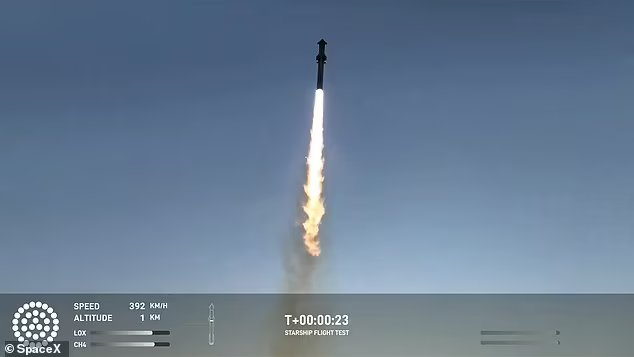
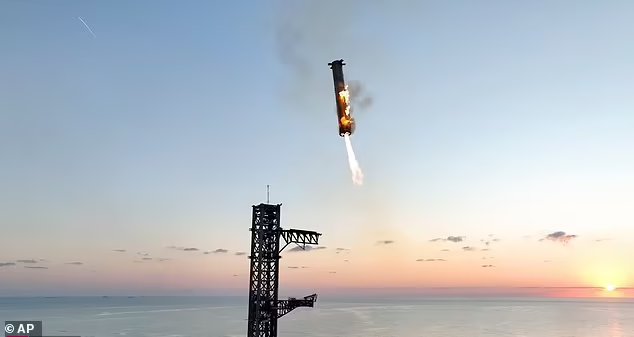
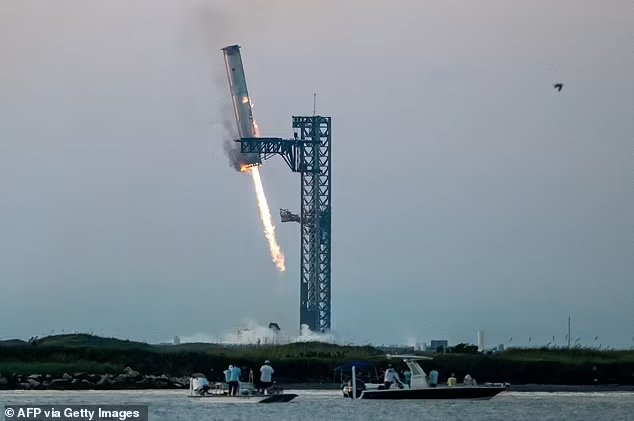
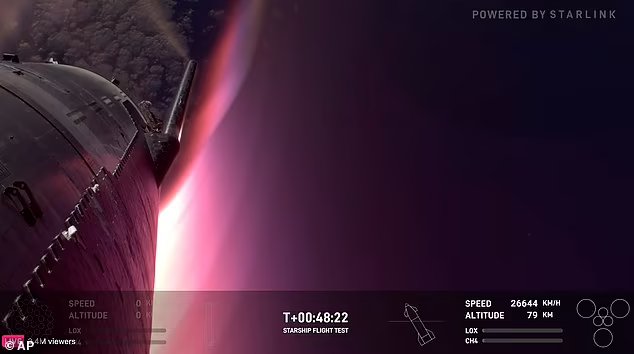
SpaceX pulled off its boldest test flight yet of the enormous Starship rocket on Sunday, catching the returning booster back at the launch pad with metal ‘chopsticks’ – marking another milestone on Elon Musk’s quest to get humanity to Mars.
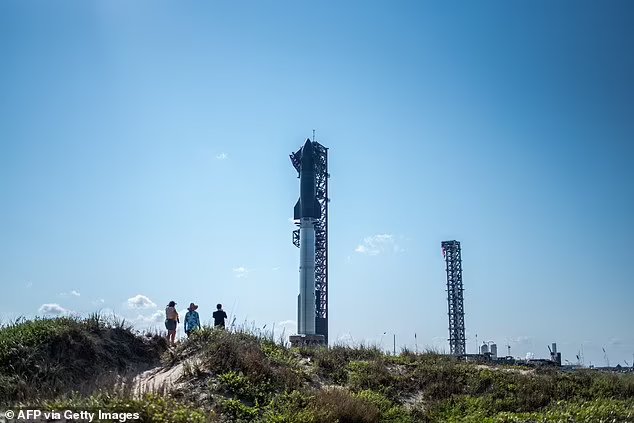
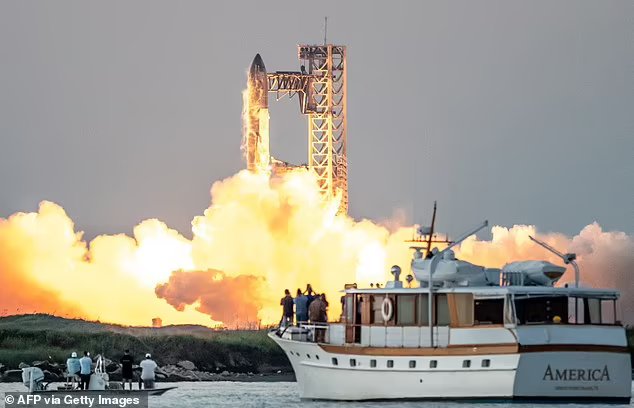
The400-foot spacecraft blasted off at sunrise from close to the Mexico border before successfully landing on a pad with mechanical arms for the first time.
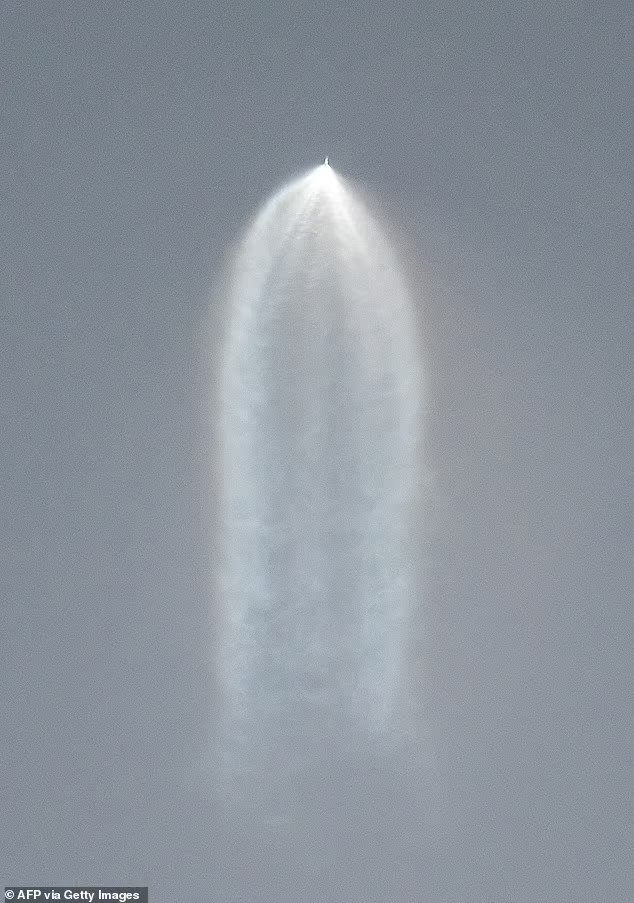
It arced over the Gulf of Mexico like the four Starships before it that ended up being destroyed, either soon after liftoff or while ditching into the sea. The last one in June was the most successful yet, completing its flight without exploding.
‘Even in this day and age, what we just saw is magic,’ Dan Huot observed from close to the launch site after the booster touched down. ‘I am shaking right now.’
‘The tower has caught the rocket!!’ SpaceX founder and CEO Elon Musk said via X as the spacecraft made the dramatic touchdown.
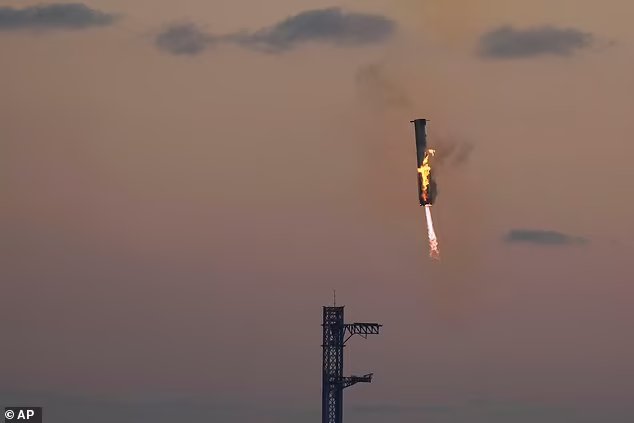
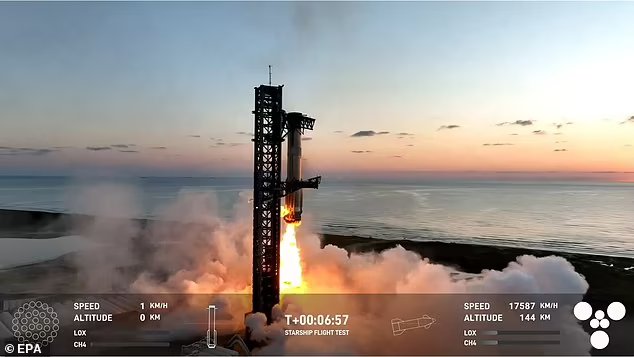
The 400-foot spacecraft blasted off at sunrise from close to the Mexico border before successfully landing on a pad with mechanical arms for the first timeIt arced over the Gulf of Mexico like the four Starships before it that ended up being destroyed, either soon after liftoff or while ditching into the seaSpaceX brought the first-stage booster back to land at the pad from which it had soared seven minutes earlierThe launch tower sported monstrous metal arms, dubbed chopsticks, that caught the descending 232-foot (71-meter) boosterTowering almost 400 feet (121 meters), the empty rocket blasted off at sunrise from the southern tip of Texas near the Mexican border
Company employees screamed with joy as the booster slowly lowered itself into the launch tower’s arms.
‘Folks, this is a day for the engineering history books,’ added Kate Tice from SpaceX headquarters in Hawthorne, California.
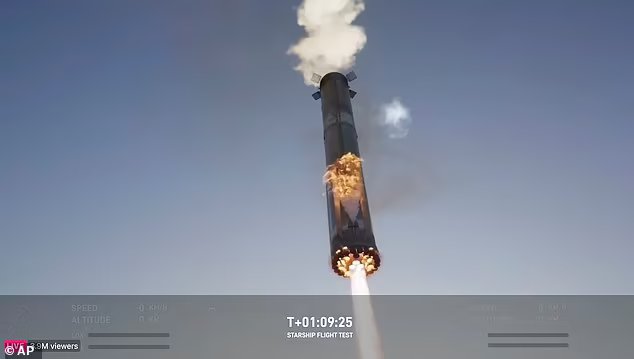
SpaceX brought the first-stage booster back to land at the pad from which it had soared seven minutes earlier.
The launch tower sported monstrous metal arms, dubbed chopsticks, that caught the descending 232-foot (71-meter) booster.
It was up to the flight director to decide, in real time with a manual control, whether to attempt the landing.
SpaceX said both the booster and launch tower had to be in good, stable conditionCompany employees screamed with joy as the booster slowly lowered itself into the launch tower’s armsThis time, SpaceX founder and CEO Elon Musk upped the challenge and risk
SpaceX said both the booster and launch tower had to be in good, stable condition. Otherwise, it was going to end up in the gulf like the previous ones.
Everything was judged to be ready for the catch.
The retro-looking stainless steel spacecraft on top continued around the world once free of the booster, targeting a controlled splashdown in the Indian Ocean, where it would sink to the bottom.
The entire flight was expected to last just over an hour.
The June flight came up short at the end after pieces came off. SpaceX upgraded the software and reworked the heat shield, improving the thermal tiles.
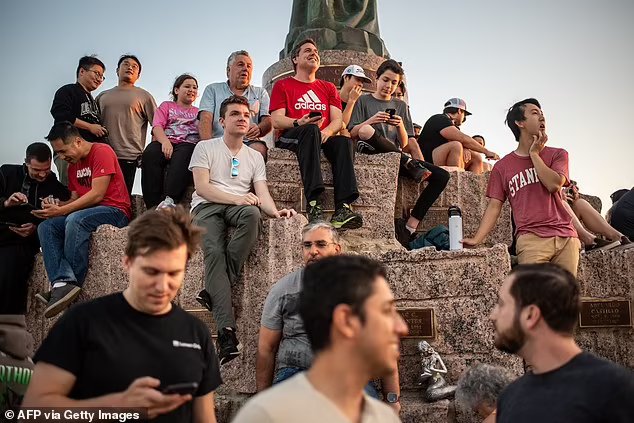
The SpaceX Starship lifts off from Starbase near Boca Chica, Texas, on October 13, 2024SpaceX’s mega Starship rocket returning during a test flightPeople watch the launch of the SpaceX Starship from Starbase near Boca Chica, TexasSpaceX’s mega rocket booster returning to the launch pad to be captured during a test flight Sunday
SpaceX has been recovering the first-stage boosters of its smaller Falcon 9 rockets for nine years, after delivering satellites and crews to orbit from Florida or California.
But they land on floating ocean platforms or on concrete slabs several miles from their launch pads – not on them.
Recycling Falcon boosters has sped up the launch rate and saved SpaceX millions. Musk intends to do the same for Starship, the biggest and most powerful rocket ever built with 33 methane-fuel engines on the booster alone.
NASA has ordered two Starships to land astronauts on the moon later this decade.
SpaceX intends to use Starship to send people and supplies to the moon and, eventually Mars.
By: Laura Parnaby and Perkin Amalaraj Originally published at: Daily Mail
This year’s laureates used tools from physics to construct methods that helped lay the foundation for today’s powerful machine learning. John Hopfield created a structure that can store and reconstruct information. Geoffrey Hinton invented a method that can independently discover properties in data and which has become important for the large artificial neural networks now in use.
Many people have experienced how computers can translate between languages, interpret images and even conduct reasonable conversations. What is perhaps less well known is that this type of technology has long been important for research, including the sorting and analysis of vast amounts of data. The development of machine learning has exploded over the past fifteen to twenty years and utilises a structure called an artificial neural network. Nowadays, when we talk about artificial intelligence, this is often the type of technology we mean.
Although computers cannot think, machines can now mimic functions such as memory and learning. This year’s laureates in physics have helped make this possible. Using fundamental concepts and methods from physics, they have developed technologies that use structures in networks to process information.
Machine learning differs from traditional software, which works like a type of recipe. The software receives data, which is processed according to a clear description and produces the results, much like when someone collects ingredients and processes them by following a recipe, producing a cake. Instead of this, in machine learning the computer learns by example, enabling it to tackle problems that are too vague and complicated to be managed by step by step instructions. One example is interpreting a picture to identify the objects in it.
Mimics the brain
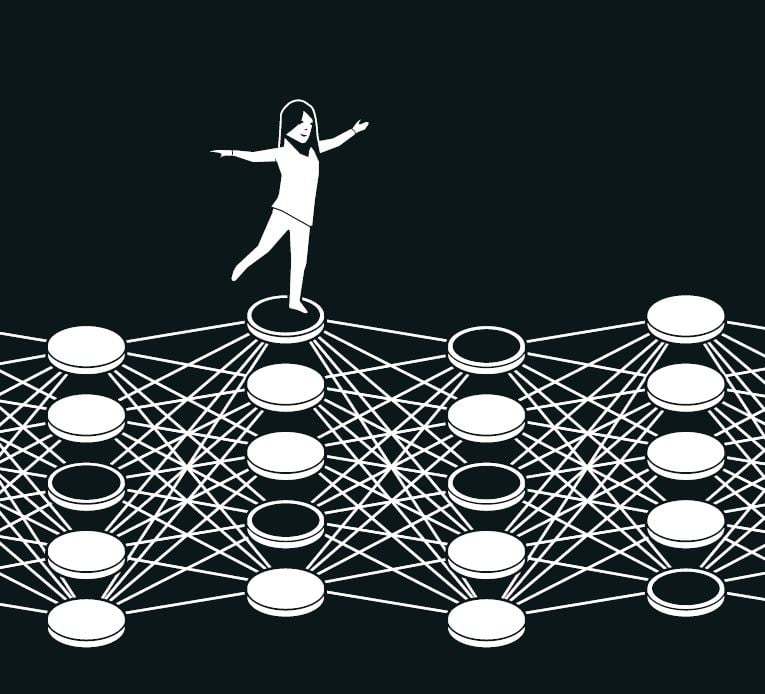
An artificial neural network processes information using the entire network structure. The inspiration initially came from the desire to understand how the brain works. In the 1940s, researchers had started to reason around the mathematics that underlies the brain’s network of neurons and synapses. Another piece of the puzzle came from psychology, thanks to neuroscientist Donald Hebb’s hypothesis about how learning occurs because connections between neurons are reinforced when they work together.
Later, these ideas were followed by attempts to recreate how the brain’s network functions by building artificial neural networks as computer simulations. In these, the brain’s neurons are mimicked by nodes that are given different values, and the synapses are represented by connections between the nodes that can be made stronger or weaker. Donald Hebb’s hypothesis is still used as one of the basic rules for updating artificial networks through a process called training.
At the end of the 1960s, some discouraging theoretical results caused many researchers to suspect that these neural networks would never be of any real use. However, interest in artificial neural networks was reawakened in the 1980s, when several important ideas made an impact, including work by this year’s laureates.
Associative memory
Imagine that you are trying to remember a fairly unusual word that you rarely use, such as one for that sloping floor often found in cinemas and lecture halls. You search your memory. It’s something like ramp… perhaps rad…ial? No, not that. Rake, that’s it!
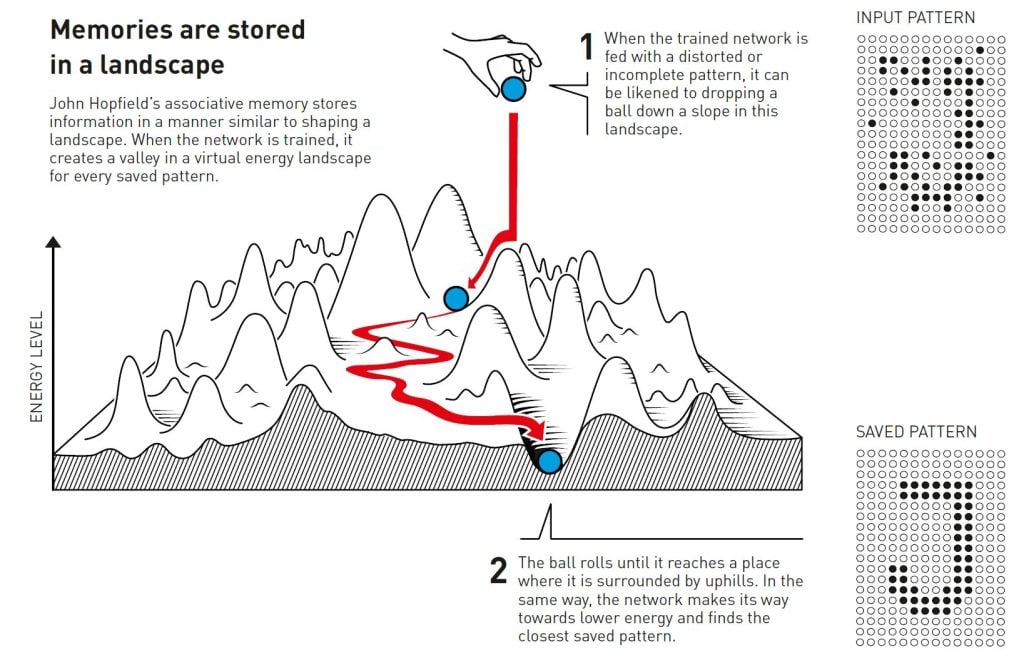
This process of searching through similar words to find the right one is reminiscent of the associative memory that the physicist John Hopfield discovered in 1982. The Hopfield network can store patterns and has a method for recreating them. When the network is given an incomplete or slightly distorted pattern, the method can find the stored pattern that is most similar.
Hopfield had previously used his background in physics to explore theoretical problems in molecular biology. When he was invited to a meeting about neuroscience he encountered research into the structure of the brain. He was fascinated by what he learned and started to think about the dynamics of simple neural networks. When neurons act together, they can give rise to new and powerful characteristics that are not apparent to someone who only looks at the network’s separate components.
In 1980, Hopfield left his position at Princeton University, where his research interests had taken him outside the areas in which his colleagues in physics worked, and moved across the continent. He had accepted the offer of a professorship in chemistry and biology at Caltech (California Institute of Technology) in Pasadena, southern California. There, he had access to computer resources that he could use for free experimentation and to develop his ideas about neural networks.
However, he did not abandon his foundation in physics, where he found inspiration for his understanding of how systems with many small components that work together can give rise to new and interesting phenomena. He particularly benefitted from having learned about magnetic materials that have special characteristics thanks to their atomic spin – a property that makes each atom a tiny magnet. The spins of neighbouring atoms affect each other; this can allow domains to form with spin in the same direction. He was able to make a model network with nodes and connections by using the physics that describes how materials develop when spins influence each other.
The network saves images in a landscape
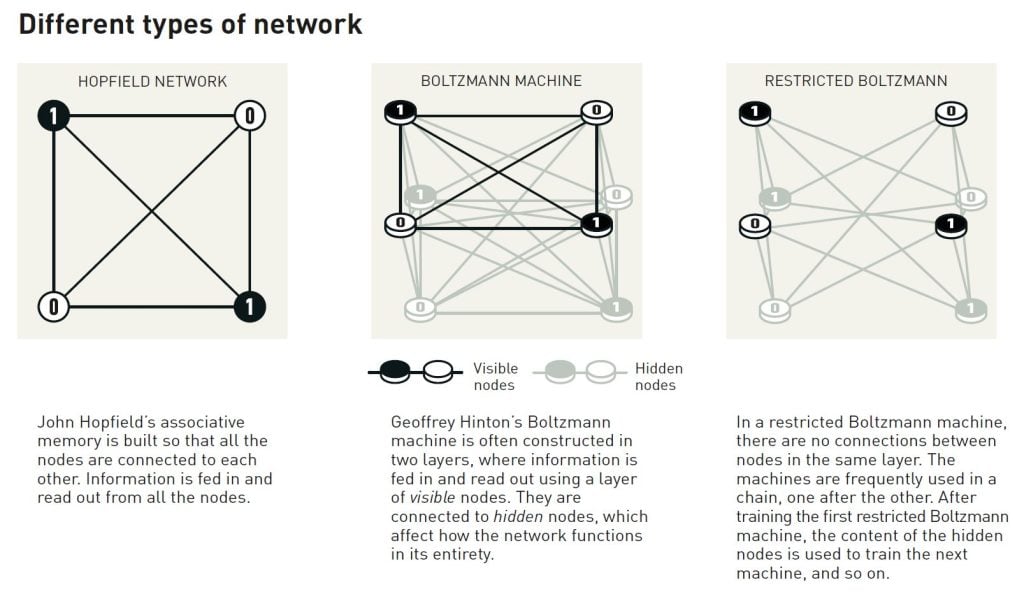
The network that Hopfield built has nodes that are all joined together via connections of different strengths. Each node can store an individual value – in Hopfield’s first work this could either be 0 or 1, like the pixels in a black and white picture.
Hopfield described the overall state of the network with a property that is equivalent to the energy in the spin system found in physics; the energy is calculated using a formula that uses all the values of the nodes and all the strengths of the connections between them. The Hopfield network is programmed by an image being fed to the nodes, which are given the value of black (0) or white (1). The network’s connections are then adjusted using the energy formula, so that the saved image gets low energy. When another pattern is fed into the network, there is a rule for going through the nodes one by one and checking whether the network has lower energy if the value of that node is changed. If it turns out that energy is reduced if a black pixel is white instead, it changes colour. This procedure continues until it is impossible to find any further improvements. When this point is reached, the network has often reproduced the original image on which it was trained.
This may not appear so remarkable if you only save one pattern. Perhaps you are wondering why you don’t just save the image itself and compare it to another image being tested, but Hopfield’s method is special because several pictures can be saved at the same time and the network can usually differentiate between them.
Hopfield likened searching the network for a saved state to rolling a ball through a landscape of peaks and valleys, with friction that slows its movement. If the ball is dropped in a particular location, it will roll into the nearest valley and stop there. If the network is given a pattern that is close to one of the saved patterns it will, in the same way, keep moving forward until it ends up at the bottom of a valley in the energy landscape, thus finding the closest pattern in its memory.
The Hopfield network can be used to recreate data that contains noise or which has been partially erased.
Hopfield and others have continued to develop the details of how the Hopfield network functions, including nodes that can store any value, not just zero or one. If you think about nodes as pixels in a picture, they can have different colours, not just black or white. Improved methods have made it possible to save more pictures and to differentiate between them even when they are quite similar. It is just as possible to identify or reconstruct any information at all, provided it is built from many data points.
Classification using nineteenth-century physics
Remembering an image is one thing, but interpreting what it depicts requires a little more.
Even very young children can point at different animals and confidently say whether it is a dog, a cat, or a squirrel. They might get it wrong occasionally, but fairly soon they are correct almost all the time. A child can learn this even without seeing any diagrams or explanations of concepts such as species or mammal. After encountering a few examples of each type of animal, the different categories fall into place in the child’s head. People learn to recognise a cat, or understand a word, or enter a room and notice that something has changed, by experiencing the environment around them.
When Hopfield published his article on associative memory, Geoffrey Hinton was working at Carnegie Mellon University in Pittsburgh, USA. He had previously studied experimental psychology and artificial intelligence in England and Scotland and was wondering whether machines could learn to process patterns in a similar way to humans, finding their own categories for sorting and interpreting information. Along with his colleague, Terrence Sejnowski, Hinton started from the Hopfield network and expanded it to build something new, using ideas from statistical physics.
Statistical physics describes systems that are composed of many similar elements, such as molecules in a gas. It is difficult, or impossible, to track all the separate molecules in the gas, but it is possible to consider them collectively to determine the gas’ overarching properties like pressure or temperature. There are many potential ways for gas molecules to spread through its volume at individual speeds and still result in the same collective properties.
The states in which the individual components can jointly exist can be analysed using statistical physics, and the probability of them occurring calculated. Some states are more probable than others; this depends on the amount of available energy, which is described in an equation by the nineteenth-century physicist Ludwig Boltzmann. Hinton’s network utilised that equation, and the method was published in 1985 under the striking name of the Boltzmann machine.
Recognising new examples of the same type
The Boltzmann machine is commonly used with two different types of nodes. Information is fed to one group, which are called visible nodes. The other nodes form a hidden layer. The hidden nodes’ values and connections also contribute to the energy of the network as a whole.
The machine is run by applying a rule for updating the values of the nodes one at a time. Eventually the machine will enter a state in which the nodes’ pattern can change, but the properties of the network as a whole remain the same. Each possible pattern will then have a specific probability that is determined by the network’s energy according to Boltzmann’s equation. When the machine stops it has created a new pattern, which makes the Boltzmann machine an early example of a generative model.
The Boltzmann machine can learn – not from instructions, but from being given examples. It is trained by updating the values in the network’s connections so that the example patterns, which were fed to the visible nodes when it was trained, have the highest possible probability of occurring when the machine is run. If the same pattern is repeated several times during this training, the probability for this pattern is even higher. Training also affects the probability of outputting new patterns that resemble the examples on which the machine was trained.
A trained Boltzmann machine can recognise familiar traits in information it has not previously seen. Imagine meeting a friend’s sibling, and you can immediately see that they must be related. In a similar way, the Boltzmann machine can recognise an entirely new example if it belongs to a category found in the training material, and differentiate it from material that is dissimilar.
In its original form, the Boltzmann machine is fairly inefficient and takes a long time to find solutions. Things become more interesting when it is developed in various ways, which Hinton has continued to explore. Later versions have been thinned out, as the connections between some of the units have been removed. It turns out that this may make the machine more efficient.
During the 1990s, many researchers lost interest in artificial neural networks, but Hinton was one of those who continued to work in the field. He also helped start the new explosion of exciting results; in 2006 he and his colleagues Simon Osindero, Yee Whye Teh and Ruslan Salakhutdinov developed a method for pretraining a network with a series of Boltzmann machines in layers, one on top of the other. This pretraining gave the connections in the network a better starting point, which optimised its training to recognise elements in pictures.
The Boltzmann machine is often used as part of a larger network. For example, it can be used to recommend films or television series based on the viewer’s preferences.
Machine learning – today and tomorrow
Thanks to their work from the 1980s and onward, John Hopfield and Geoffrey Hinton have helped lay the foundation for the machine learning revolution that started around 2010.
The development we are now witnessing has been made possible through access to the vast amounts of data that can be used to train networks, and through the enormous increase in computing power. Today’s artificial neural networks are often enormous and constructed from many layers. These are called deep neural networks and the way they are trained is called deep learning.
A quick glance at Hopfield’s article on associative memory, from 1982, provides some perspective on this development. In it, he used a network with 30 nodes. If all the nodes are connected to each other, there are 435 connections. The nodes have their values, the connections have different strengths and, in total, there are fewer than 500 parameters to keep track of. He also tried a network with 100 nodes, but this was too complicated, given the computer he was using at the time. We can compare this to the large language models of today, which are built as networks that can contain more than one trillion parameters (one million millions).
Many researchers are now developing machine learning’s areas of application. Which will be the most viable remains to be seen, while there is also wide-ranging discussion on the ethical issues that surround the development and use of this technology.
Because physics has contributed tools for the development of machine learning, it is interesting to see how physics, as a research field, is also benefitting from artificial neural networks. Machine learning has long been used in areas we may be familiar with from previous Nobel Prizes in Physics. These include the use of machine learning to sift through and process the vast amounts of data necessary to discover the Higgs particle. Other applications include reducing noise in measurements of the gravitational waves from colliding black holes, or the search for exoplanets.
In recent years, this technology has also begun to be used when calculating and predicting the properties of molecules and materials – such as calculating protein molecules’ structure, which determines their function, or working out which new versions of a material may have the best properties for use in more efficient solar cells.
Further reading
Additional information on this year’s prizes, including a scientific background in English, is available on the website of the Royal Swedish Academy of Sciences, www.kva.se, and at www.nobelprize.org, where you can watch video from the press conferences, the Nobel Lectures and more. Information on exhibitions and activities related to the Nobel Prizes and the Prize in Economic Sciences is available at www.nobelprizemuseum.se.
The Royal Swedish Academy of Sciences has decided to award the Nobel Prize in Physics 2024 to
JOHN J. HOPFIELD Born 1933 in Chicago, IL, USA. PhD 1958 from Cornell University, Ithaca, NY, USA. Professor at Princeton University, NJ, USA.
GEOFFREY E. HINTON Born 1947 in London, UK. PhD 1978 from The University of Edinburgh, UK. Professor at University of Toronto, Canada.
“for foundational discoveries and inventions that enable machine learning with artificial neural networks”