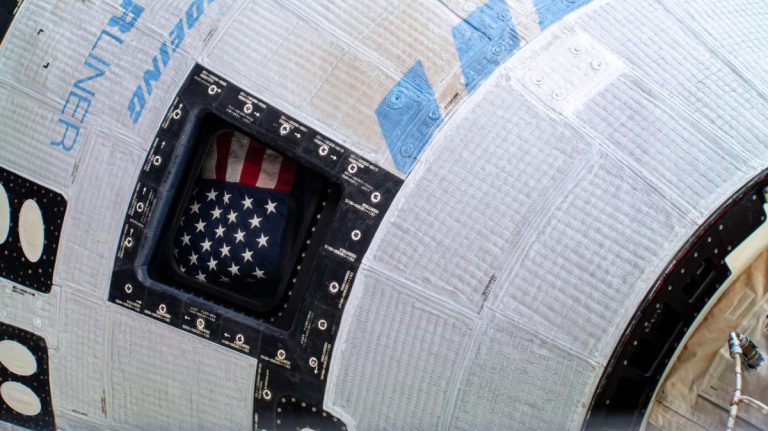
The American flag pictured inside the window of Boeing’s Starliner spacecraft at the International Space Station. Credit: NASA
NASA will provide live coverage of the upcoming activities for Boeing’s Starliner spacecraft departure from the International Space Station and return to Earth. The uncrewed spacecraft will depart from the orbiting laboratory for a landing at White Sands Space Harbor in New Mexico.
Starliner is scheduled to autonomously undock from the space station at approximately 6:04 p.m. EDT Friday, Sept. 6, to begin the journey home, weather conditions permitting. NASA and Boeing are targeting approximately 12:03 a.m., Saturday, Sept. 7, for the landing and conclusion of the flight test.
NASA’s live coverage of return and related activities will stream on NASA+, the NASA app, and the agency’s website. Learn how to stream NASA programming through a variety of platforms including social media.
Ahead of Starliner’s return, NASA will host a pre-departure news conference at 12 p.m., Wednesday, Sept. 4, from the agency’s Johnson Space Center in Houston. NASA’s Commercial Crew and International Space Station Program managers and a flight director will participate.
To attend the pre-departure news conference in person, U.S. media must contact the NASA Johnson newsroom by 5 p.m., Tuesday, Sept. 3, at [email protected] or 281-483-5111. To join the pre-departure news conference by phone, media must contact the NASA newsroom no later than two hours prior to the start of the call.
NASA astronauts Butch Wilmore and Suni Williams launched aboard Boeing’s Starliner spacecraft on June 5 for its first crewed flight, arriving at the space station on June 6. As Starliner approached the orbiting laboratory, NASA and Boeing identified helium leaks and experienced issues with the spacecraft reaction control thrusters. For the safety of the astronauts, NASA announced on Aug. 24 that Starliner will return to Earth from the station without a crew. Wilmore and Williams will remain aboard the station and return home in February 2025 aboard the SpaceX Dragon spacecraft with two other crew members assigned to NASA’s SpaceX Crew-9 mission.
NASA’s coverage is as follows (all times Eastern and subject to change based on real-time operations):
Wednesday, Sept. 4
12 p.m. – Starliner pre-departure news conference from NASA’s Johnson Space Center on NASA+, the NASA app, YouTube, and the agency’s website.
Friday, Sept. 6
5:45 p.m. – Undocking coverage begins on NASA+, the NASA app, YouTube, and the agency’s website.
6:04 p.m. – Undocking
10:50 p.m. – Coverage resumes for deorbit burn, entry, and landing on NASA+, the NASA app, YouTube, and the agency’s website.
Saturday, Sept. 7
12:03 a.m. – Targeted landing
1:30 a.m. – Post-landing news conference with the following participants:
Joel Montalbano, deputy associate administrator, Space Operations Mission Directorate at NASA Headquarters in Washington
Steve Stich, manager, Commercial Crew Program, NASA Kennedy Space Center in Florida
Dana Weigel, manager, International Space Station, NASA Johnson
John Shannon, vice president, Boeing Exploration Systems
Mark Nappi, vice president and program manager, Boeing Commercial Crew Program
Coverage of the post-landing news conference will stream live on NASA+, the NASA app, YouTube, and the agency’s website (http://nasa.gov/nasatv).
To attend the post-landing news conference in person, U.S. media must contact the NASA Johnson newsroom by 12 p.m., Sept. 6. To join the post-landing news conference by phone, media must contact the NASA Johnson newsroom no later than one hour prior to the start of the event.
See full mission coverage, NASA’s commercial crew blog, and more information about the mission at:
NASA’s James Webb Space Telescope has captured a phenomenon for the very first time. The bright red streaks at top left of this June 20, 2024, image are aligned protostar outflows – jets of gas from newborn stars that all slant in the same direction.
This image supports astronomers’ assumption that as clouds collapse to form stars, the stars will tend to spin in the same direction. Previously, the objects appeared as blobs or were invisible in optical wavelengths. Webb’s sensitive infrared vision was able to pierce through the thick dust, resolving the stars and their outflows.
In this image of the Serpens Nebula from NASA’s James Webb Space Telescope, astronomers found a grouping of aligned protostellar outflows within one small region (the top left corner). Serpens is a reflection nebula, which means it’s a cloud of gas and dust that does not create its own light, but instead shines by reflecting the light from stars close to or within the nebula.
NASA, ESA, CSA, STScI, Klaus Pontoppidan (NASA-JPL), Joel Green (STScI)
Image credit: NASA, ESA, CSA, STScI, Klaus Pontoppidan (NASA-JPL), Joel Green (STScI)
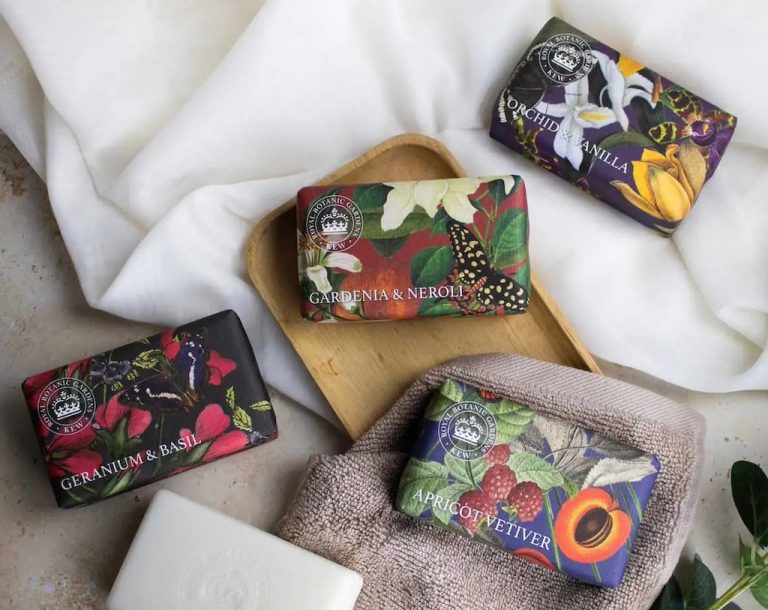
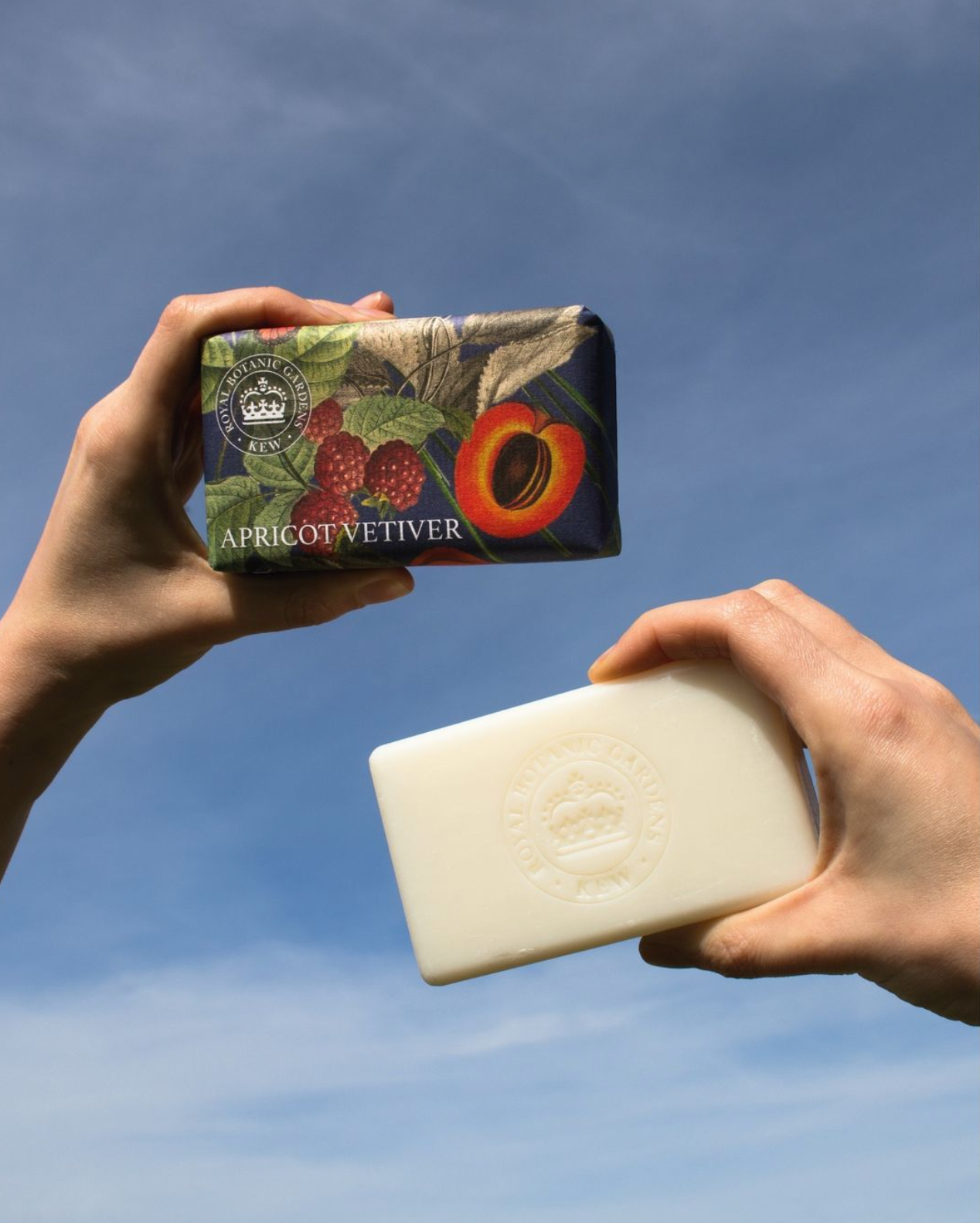
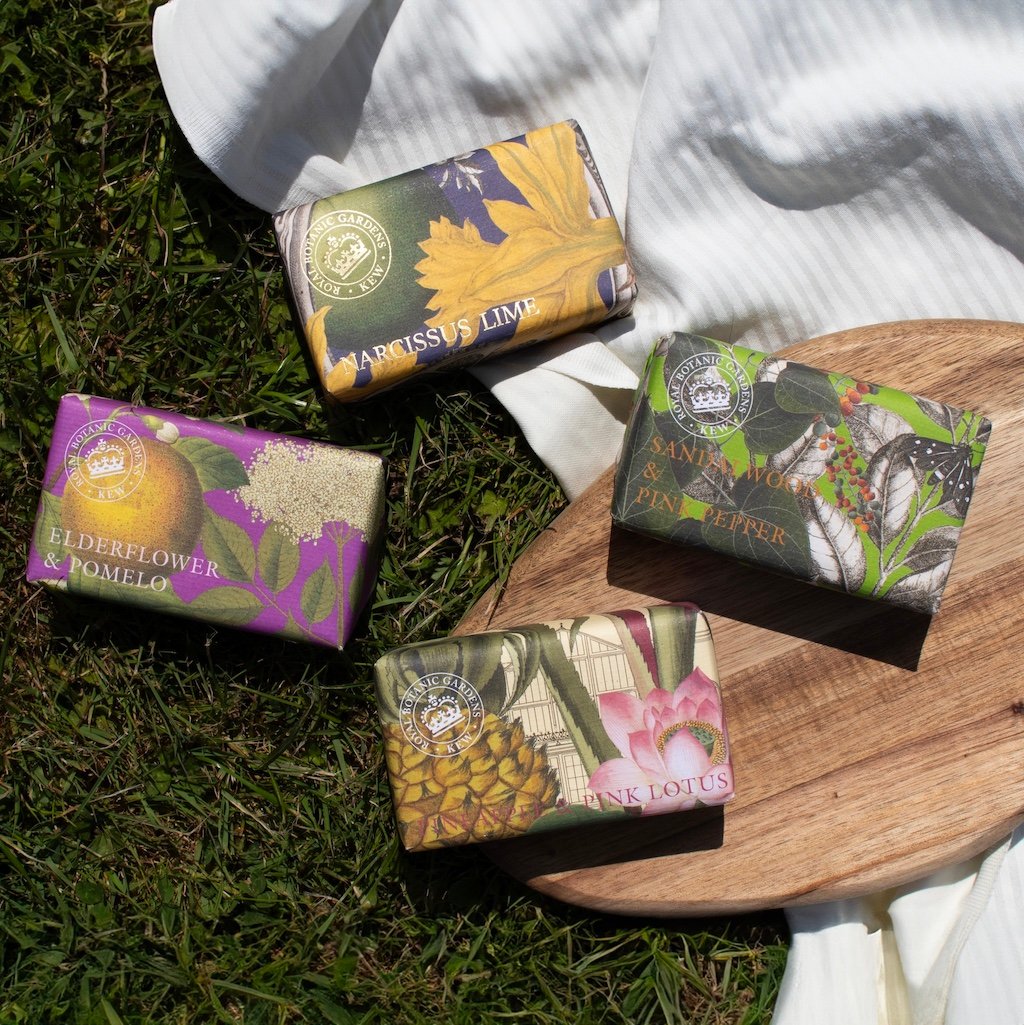
Immerse yourself in a world of pure indulgence with our exquisite collection of handmade artisan soaps. Crafted with meticulous care in the heart of the Sussex countryside, each soap bar is a masterpiece of nature’s finest ingredients and centuries-old traditions.
Our soaps are more than just cleansers; they are a sensory experience. Enveloped in a rich, creamy lather, your skin is treated to a gentle yet effective cleanse, leaving it feeling refreshed, hydrated, and enveloped in a delicate fragrance. Infused with nourishing shea butter and vegetable glycerine, these luxurious soaps pamper and protect your skin, revealing its natural radiance.
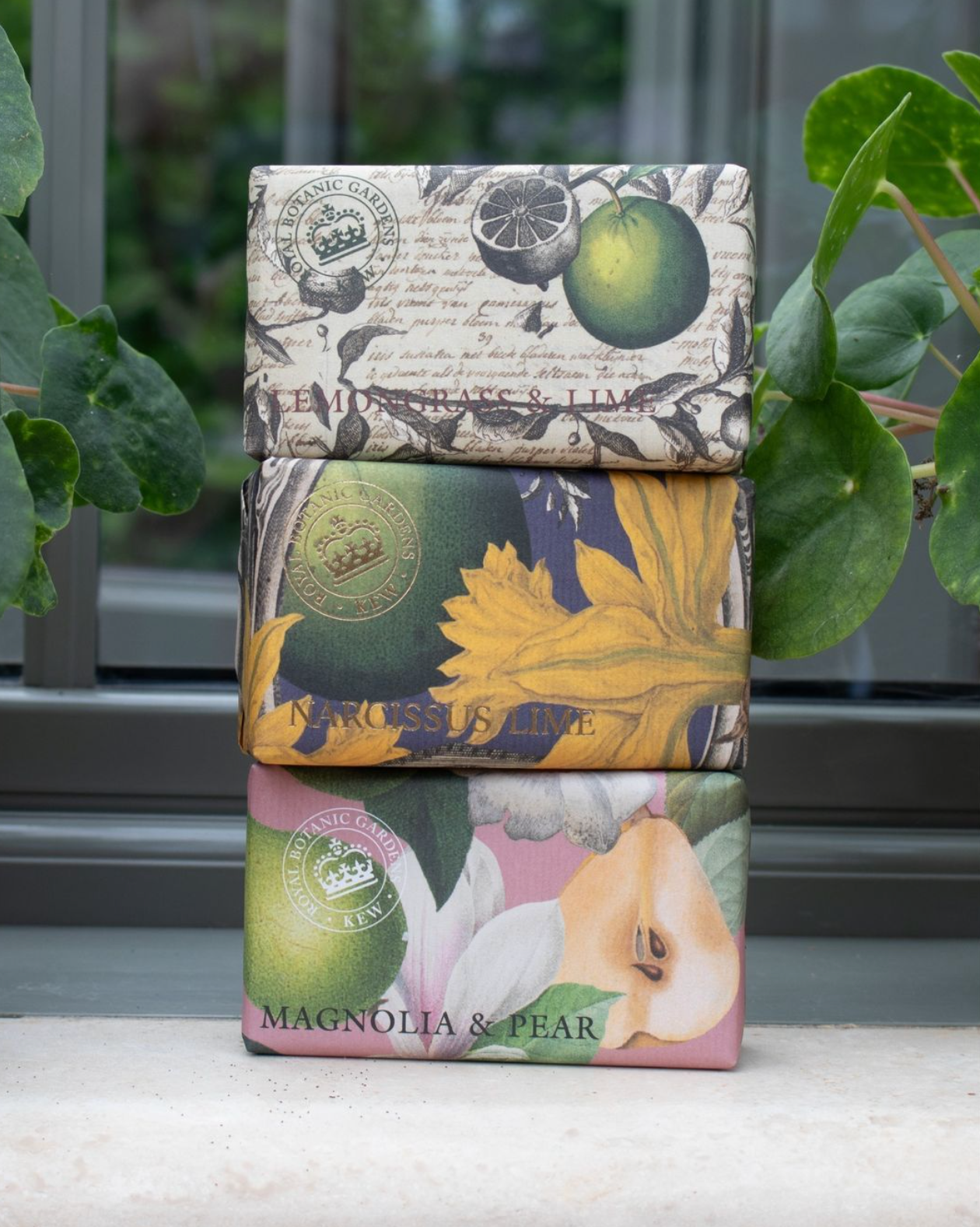
From the moment you unwrap one of our beautifully packaged soaps, you’ll be transported to a tranquil oasis. Our captivating fragrances, inspired by the enchanting blooms of nature, will awaken your senses and elevate your daily routine. Whether you prefer the soothing embrace of lavender and rosemary or the invigorating zest of lemongrass and lime, there’s a scent to match every mood and occasion.
Indulge in the ultimate act of self-care with our handmade artisan soaps. Perfect for personal use or as a thoughtful gift, they make a luxurious addition to any bathroom. Experience the difference that true craftsmanship and natural ingredients can make.
Discover the magic of our handmade soaps today.
Visit heyguzz.com and let nature’s luxury envelop you.
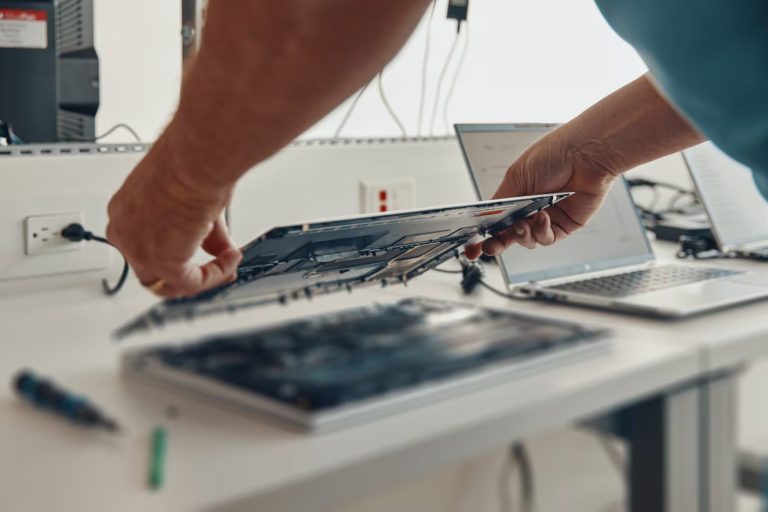
New research highlights growing concern over nation-state threat actors targeting physical supply chains and tampering with device hardware and firmware integrity.
HP Inc. (NYSE: HPQ) today released the findings of a global survey highlighting the growing concern over nation-state threat actors targeting physical supply chains and tampering with device hardware and firmware integrity. The study of 800 IT and security decision-makers (ITSDMs) responsible for device security highlights the need for businesses to focus on device hardware and firmware integrity, with attacks on hardware supply chains and device tampering expected to increase.
Key findings include:
Almost one-in-five (19%) organizations surveyed say they have been impacted by nation-state threat actors targeting physical PC, laptop or printer supply chains. In the US, this figure rises to 29%.
Over a third (35%) of organizations surveyed believe that they or others they know have already been impacted by nation-state threat actors targeting supply chains to try and insert malicious hardware or firmware into devices.
Overall, 91% believe nation-state threat actors will target physical PC, laptop or printer supply chains to insert malware or malicious components into hardware and/or firmware.
Almost two-thirds (63%) believe the next major nation-state attack will involve poisoning hardware supply chains to sneak in malware.
“System security relies on strong supply chain security, starting with the assurance that devices are built with the intended components and haven’t been tampered with during transit. If an attacker compromises a device at the firmware or hardware layer, they’ll gain unparalleled visibility and control over everything that happens on that machine. Just imagine what that could look like if it happens to the CEO’s laptop,” comments Alex Holland, Principal Threat Researcher in the HP Security Lab.
Holland continues, “Such attacks are incredibly hard to detect, as most security tools sit within the operating system. Moreover, attacks that successfully establish a foothold below the OS are very difficult to remove and remediate, adding to the challenge for IT security teams.”
Considering the scale of the challenge, it’s unsurprising that 78% of ITSDMs say their attention to software and hardware supply chain security will grow as attackers try to infect devices during transit. Organizations are concerned that they are blind and unequipped to mitigate device supply chain threats like tampering. Over half (51%) of ITSDMs are concerned that they cannot verify if PC, laptop or printer hardware and firmware have been tampered with during transit. A further 77% say they need a way to verify hardware integrity to mitigate the risk of device tampering.
“In today’s threat landscape, managing security across a distributed hybrid workplace environment must start with the assurance that devices haven’t been tampered with at the lower level. This is why HP is focused on delivering PCs and printers with industry-leading hardware and firmware security foundations designed for resilience, to allow organizations to manage, monitor and remediate device hardware and firmware security throughout the lifetime of devices, across the fleet,” comments Boris Balacheff, Chief Technologist for Security Research and Innovation, HP Inc. Security Lab.
In recognition of these risks, HP Wolf Security is advising customers to take the following steps to help proactively manage device hardware and firmware security, right from the factory:
Adopt Platform Certificate technology, designed to enable verification of hardware and firmware integrity upon device delivery.
Securely manage firmware configuration of your devices, using technology like HP Sure Admin (for PCs) or HP Security Manager (Support). These enable administrators to manage firmware remotely using public-key cryptography, eliminating the use of less secure password-based methods.
Take advantage of vendor factory services to enable hardware and firmware security configurations right from the factory, such as HP Tamper Lock, Sure Admin, or Sure Recover technologies.
Monitor ongoing compliance of device hardware and firmware configuration across your fleet of devices.
Watch this space: Further findings from the study will be shared later this year.
About the data The survey was conducted by Censuswide on behalf of HP Inc. from the 22nd February – 5th March 2024. It is based on a survey of 803 IT and security decision-makers in the US, Canada, UK, Japan, Germany, and France. The survey was carried out online.
About HP HP Inc. (NYSE: HPQ) is a global technology leader and creator of solutions that enable people to bring their ideas to life and connect to the things that matter most. Operating in more than 170 countries, HP delivers a wide range of innovative and sustainable devices, services and subscriptions for personal computing, printing, 3D printing, hybrid work, gaming, and more. For more information, please visit: http://www.hp.com.
About HP Wolf Security HP Wolf Security is world class endpoint security. HP’s portfolio of hardware-enforced security and endpoint-focused security services are designed to help organizations safeguard PCs, printers, and people from circling cyber predators. HP Wolf Security provides comprehensive endpoint protection and resiliency that starts at the hardware level and extends across software and services. Visit https://hp.com/wolf.
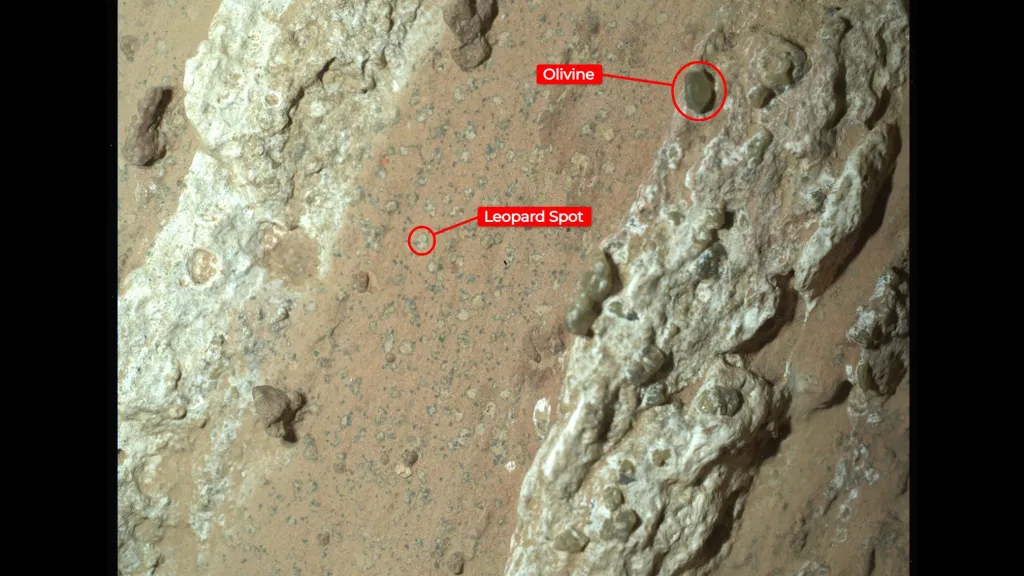
NASA’s Perseverance rover discovered “leopard spots” on a reddish rock nicknamed “Cheyava Falls” in Mars’ Jezero Crater in July 2024. Scientists think the spots may indicate that, billions of years ago, the chemical reactions in this rock could have supported microbial life; other explanations are being considered.
NASA/JPL-Caltech/MSSSAn annotated version of the image of “Cheyava Falls” indicates the markings akin to leopard spots, which have particularly captivated scientists, and the olivine in the rock. The image was captured by the WATSON instrument on NASA’s Perseverance Mars rover on July 18.
NASA/JPL-Caltech/MSSS
The six-wheeled geologist found a fascinating rock that has some indications it may have hosted microbial life billions of years ago, but further research is needed.
A vein-filled rock is catching the eye of the science team of NASA’s Perseverance rover. Nicknamed “Cheyava Falls” by the team, the arrowhead-shaped rock contains fascinating traits that may bear on the question of whether Mars was home to microscopic life in the distant past.
Analysis by instruments aboard the rover indicates the rock possesses qualities that fit the definition of a possible indicator of ancient life. The rock exhibits chemical signatures and structures that could possibly have been formed by life billions of years ago when the area being explored by the rover contained running water. Other explanations for the observed features are being considered by the science team, and future research steps will be required to determine whether ancient life is a valid explanation.
The rock — the rover’s 22nd rock core sample — was collected on July 21, as the rover explored the northern edge of Neretva Vallis, an ancient river valley measuring a quarter-mile (400 meters) wide that was carved by water rushing into Jezero Crater long ago.
NASA’s Perseverance Mars rover took this selfie, made up of 62 individual images, on July 23. A rock nicknamed “Cheyava Falls,” which has features that may bear on the question of whether the Red Planet was long ago home to microscopic life, is to the left of the rover near the center of the image.
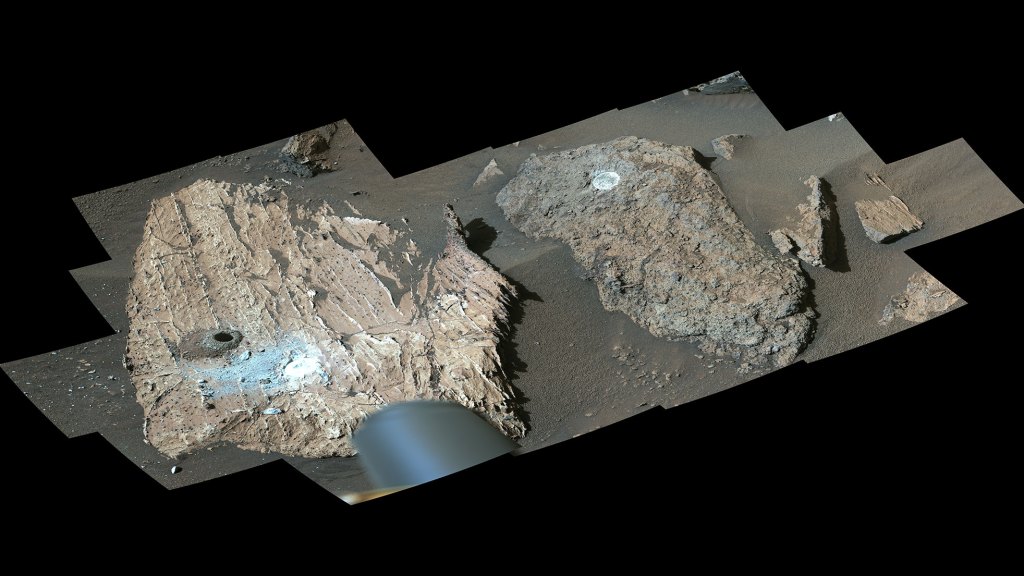
NASA/JPL-Caltech/MSSS“Cheyava Falls” (left) shows the dark hole where NASA’s Perseverance took a core sample; the white patch is where the rover abraded the rock to investigate its composition. A rock nicknamed “Steamboat Mountain” (right) also shows an abrasion patch. This image was taken by Mastcam-Z on July 23.
NASA/JPL-Caltech/ASU/MSSSNASA’s Perseverance used its Mastcam-Z instrument to view the “Cheyava Falls” rock sample within the rover’s drill bit. Scientists believe markings on the rock contain fascinating traits that may bear on the question of whether Mars was home to microscopic life in the distant past.
NASA/JPL-Caltech/ASU/MSSS
“We have designed the route for Perseverance to ensure that it goes to areas with the potential for interesting scientific samples,” said Nicola Fox, associate administrator, Science Mission Directorate at NASA Headquarters in Washington. “This trip through the Neretva Vallis riverbed paid off as we found something we’ve never seen before, which will give our scientists so much to study.”
Multiple scans of Cheyava Falls by the rover’s SHERLOC (Scanning Habitable Environments with Raman & Luminescence for Organics & Chemicals) instrument indicate it contains organic compounds. While such carbon-based molecules are considered the building blocks of life, they also can be formed by non-biological processes.
“Cheyava Falls is the most puzzling, complex, and potentially important rock yet investigated by Perseverance,” said Ken Farley,Perseverance project scientist of Caltech in Pasadena. “On the one hand, we have our first compelling detection of organic material, distinctive colorful spots indicative of chemical reactions that microbial life could use as an energy source, and clear evidence that water — necessary for life — once passed through the rock. On the other hand, we have been unable to determine exactly how the rock formed and to what extent nearby rocks may have heated Cheyava Falls and contributed to these features.”
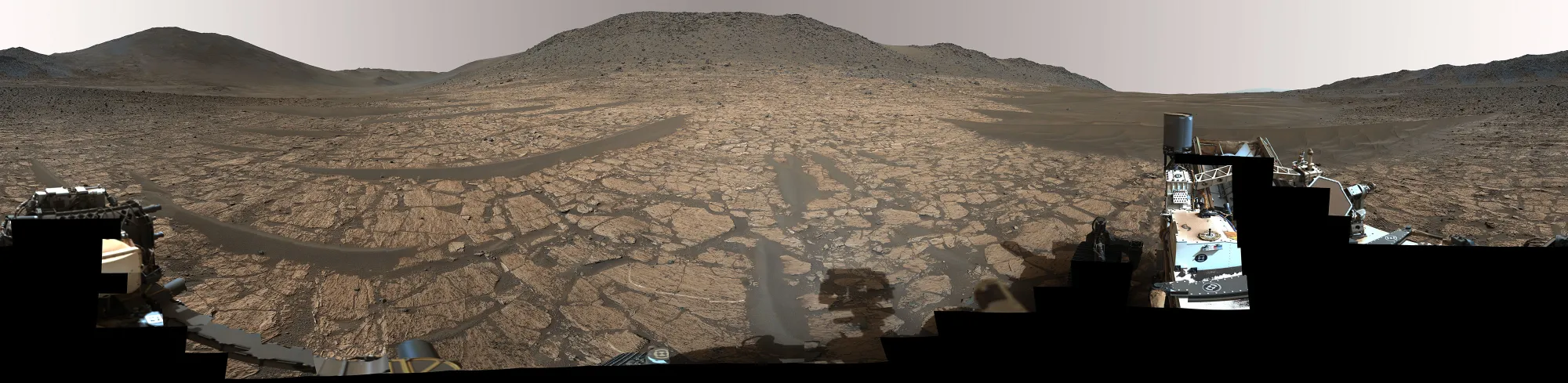
NASA’s Perseverance rover used its Mastcam-Z instrument to capture this 360-degree panorama of a region on Mars called “Bright Angel,” where an ancient river flowed billions of years ago. “Cheyava Falls” was discovered in the area slightly right of center, about 361 feet (110 meters) from the rover.
NASA/JPL-Caltech/ASU/MSSS
Other details about the rock, which measures 3.2 feet by 2 feet (1 meter by 0.6 meters) and was named after a Grand Canyon waterfall, have intrigued the team, as well.
How Rocks Get Their Spots
In its search for signs of ancient microbial life, the Perseverance mission has focused on rocks that may have been created or modified long ago by the presence of water. That’s why the team homed in on Cheyava Falls.
“This is the kind of key observation that SHERLOC was built for — to seek organic matter as it is an essential component of a search for past life,” said SHERLOC’s principal investigator Kevin Hand of NASA’s Jet Propulsion Laboratory in Southern California, which manages the mission.
Running the length of the rock are large white calcium sulfate veins. Between those veins are bands of material whose reddish color suggests the presence of hematite, one of the minerals that gives Mars its distinctive rusty hue.
When Perseverance took a closer look at these red regions, it found dozens of irregularly shaped, millimeter-size off-white splotches, each ringed with black material, akin to leopard spots. Perseverance’s PIXL (Planetary Instrument for X-ray Lithochemistry) instrument has determined these black halos contain both iron and phosphate.
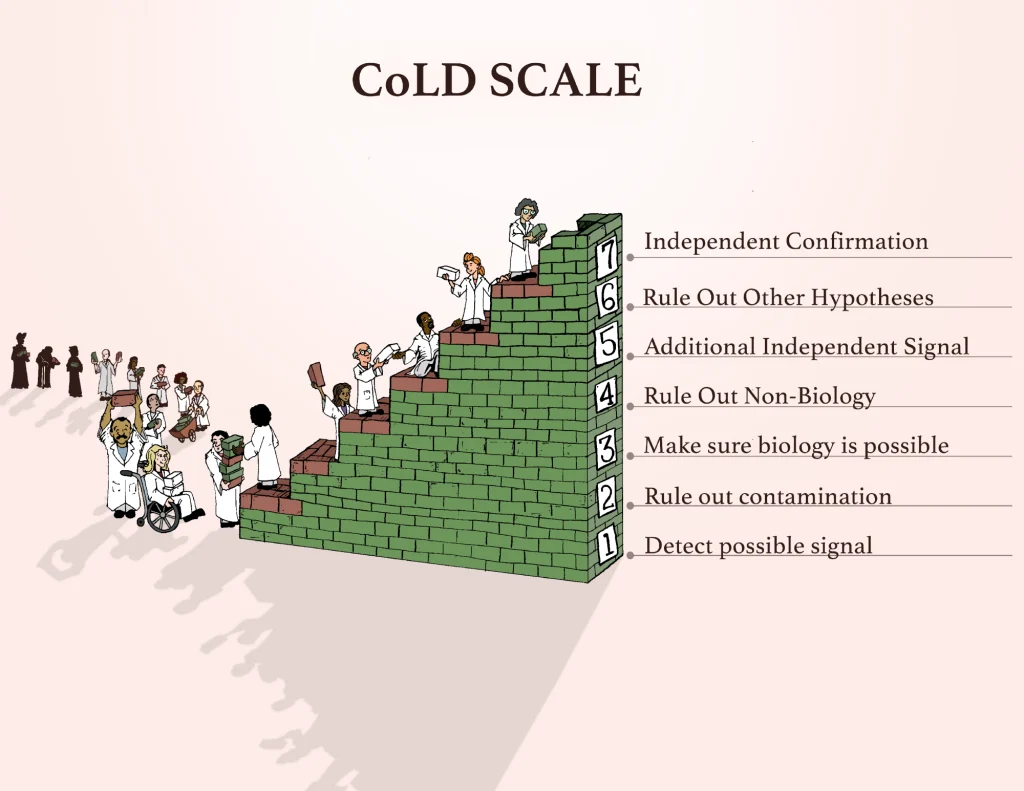
As shown in this graphic, astrobiologists catalog a seven-step scale, called the CoLD (Confidence of Life Detection) scale, to research whether a sample could indicate life. This “Cheyava Falls” sample is an example of Step One: “Detect possible signal.” Much additional research must be conducted to learn more.
NASA/Aaron Gronstal
“These spots are a big surprise,” said David Flannery, an astrobiologist and member of the Perseverance science team from the Queensland University of Technology in Australia. “On Earth, these types of features in rocks are often associated with the fossilized record of microbes living in the subsurface.”
Spotting of this type on sedimentary terrestrial rocks can occur when chemical reactions involving hematite turn the rock from red to white. Those reactions can also release iron and phosphate, possibly causing the black halos to form. Reactions of this type can be an energy source for microbes, explaining the association between such features and microbes in a terrestrial setting.
In one scenario the Perseverance science team is considering, Cheyava Falls was initially deposited as mud with organic compounds mixed in that eventually cemented into rock. Later, a second episode of fluid flow penetrated fissures in the rock, enabling mineral deposits that created the large white calcium sulfate veins seen today and resulting in the spots.
NASA’s Perseverance rover has made very compelling observations in a Martian rock that, with further study, could prove that life was present on Mars in the distant past — but how can we determine that from a rock, and what do we need to do to confirm it? Morgan Cable, a scientist on the Perseverance team, takes a closer look. Credit: NASA/JPL-Caltech
Another Puzzle Piece
While both the organic matter and the leopard spots are of great interest, they aren’t the only aspects of the Cheyava Falls rock confounding the science team. They were surprised to find that these veins are filled with millimeter-size crystals of olivine, a mineral that forms from magma. The olivine might be related to rocks that were formed farther up the rim of the river valley and that may have been produced by crystallization of magma.
If so, the team has another question to answer: Could the olivine and sulfate have been introduced to the rock at uninhabitably high temperatures, creating an abiotic chemical reaction that resulted in the leopard spots?
“We have zapped that rock with lasers and X-rays and imaged it literally day and night from just about every angle imaginable,” said Farley. “Scientifically, Perseverance has nothing more to give. To fully understand what really happened in that Martian river valley at Jezero Crater billions of years ago, we’d want to bring the Cheyava Falls sample back to Earth, so it can be studied with the powerful instruments available in laboratories.”
More Mission Information
A key objective of Perseverance’s mission on Mars is astrobiology, including caching samples that may contain signs of ancient microbial life. The rover will characterize the planet’s geology and past climate, to help pave the way for human exploration of the Red Planet and as the first mission to collect and cache Martian rock and regolith.
NASA’s Mars Sample Return Program, in cooperation with ESA (European Space Agency), is designed to send spacecraft to Mars to collect these sealed samples from the surface and return them to Earth for in-depth analysis.
The Mars 2020 Perseverance mission is part of NASA’s Moon to Mars exploration approach, which includes Artemis missions to the Moon that will help prepare for human exploration of the Red Planet.
NASA’s Jet Propulsion Laboratory, which is managed for the agency by Caltech, built and manages operations of the Perseverance rover.
For more about Perseverance:
science.nasa.gov/mission/mars-2020-perseverance
By: Jet Propulsion Laboratory Originally published at: NASA
Starting to code can feel like a daunting task, but pairing courses with the right books can provide both hands-on skills and in-depth knowledge. To help you on this journey, we’ve curated a list of five must-read books that cover everything from clean code practices to mastering design patterns.
Let’s turn the page!
Code Complete: A Practical Handbook of Software Construction (Second Edition), Steve McConnell
Imagine having a seasoned software engineer by your side, guiding you through the challenges of writing exceptional code. That’s what Steve McConnell offers in Code Complete. This book is packed with best practices and proven techniques for producing high-quality software. Whether it’s about naming conventions, code organization, or debugging, McConnell covers it all with clarity and depth.
Why you’ll love it:
Learn best practices for clean, efficient code.
Discover detailed advice on software design and construction.
Master techniques for effective debugging.
The Pragmatic Programmer (Twentieth Anniversary Edition), David Thomas and Andrew Hunt
The Pragmatic Programmer is one of those tech books you’ll read, re-read, and read again over the years. Packed with real-world advice and anecdotes, this book helps you approach software development pragmatically. It covers everything from debugging to version control.
Why you’ll love it:
Gain practical techniques for software development.
Receive actionable advice for boosting productivity.
Develop a pragmatic mindset towards coding challenges.
The Programmer’s Brain, Felienne Hermans
Did you know that understanding how your brain works can actually speed up your coding? In The Programmer’s Brain, you’ll find practical strategies grounded in cognitive science to enhance your memory, focus, and problem-solving skills. For instance, you’ll explore how the use of mnemonic devices can help you remember syntax and functions, and how cognitive load theory can guide you in structuring your code for better readability. These insights will not only make coding easier but also help you learn new technologies faster and more efficiently, giving you a competitive edge in your career.
Why you’ll love it:
Explore cognitive techniques to enhance your programming skills.
Learn strategies to speed up learning and debugging.
Engage in practical exercises to boost coding efficiency.
Design Patterns: Elements of Reusable Object-Oriented Software, Erich Gamma, Richard Helm, Ralph Johnson, and John Vlissides
If you want to stand out as a programmer, mastering design patterns is essential. Design Patterns provides solutions to common software design problems, making your code more efficient. By learning these patterns, you’ll be equipped to tackle complex design challenges with confidence.
Why you’ll love it:
Gain solutions to common software design issues.
Learn 23 essential design patterns for software development.
Write cleaner, more efficient code that stands out.
Code: The Hidden Language of Computer Hardware and Software (Second Edition), Charles Petzold
Curious about how computers work? Charles Petzold’s Code explains it all, starting with simple electrical circuits and building up to complex systems. This book brings the intricate world of computer hardware and software to life in an easy-to-understand way.
Why you’ll love it:
Understand the fundamental concepts of hardware and software interaction.
Learn how computers work from the ground up.
Gain a deeper appreciation of the technology behind everyday devices.
Reading these books shows that theory and practice go hand in hand when becoming a top-notch programmer. At JetBrains Academy, we blend solid theory with hands-on practice. Choose the best courses from our catalog to help you take what you’ve learned and apply it in the real world, opening up incredible career opportunities in IT.
Teams with NASA’s Exploration Ground Systems (EGS) Program successfully tested the upgraded environmental control system on mobile launcher 1 while it’s at Launch Pad 39B at the agency’s Kennedy Space Center in Florida in preparation for Artemis II. This system provides air supply, thermal control, and pressurization to SLS (Space Launch System) and the Orion spacecraft during cryogenic propellant loading.
During propellant loading, the environmental control system purges specific compartments within Orion and SLS using gaseous nitrogen to maintain the proper environmental conditions. This is critical, as the rocket and spacecraft must be in a safe and stable configuration and temperature when dealing with hazardous gasses. The severtal-week test, which started April 17, was conducted in two parts. Teams first started flowing air through the system and then followed by flowing gaseous nitrogen.
This marks the next set of tests complete for EGS teams as part of the integrated system verification and validation testing in preparation for Artemis II, the first crewed Artemis mission that will send four astronauts around the Moon and back next year.
The testing puts the team and ground infrastructures to work and ensures each are functioning properly and allows the team to update and refine procedures ahead of launch. Part of this series includes testing the launch pad’s environmental control system, the emergency egress system, the ignition overpressure protection and sound suppression system, among others.
By: Antonia Jaramillo Botero Originally published at: NASA Blog
Introducing Apple Intelligence, the personal intelligence system that puts powerful generative models at the core of iPhone, iPad, and Mac
Setting a new standard for privacy in AI, Apple Intelligence understands personal context to deliver intelligence that is helpful and relevant
CUPERTINO, CALIFORNIA Apple today introduced Apple Intelligence, the personal intelligence system for iPhone, iPad, and Mac that combines the power of generative models with personal context to deliver intelligence that’s incredibly useful and relevant. Apple Intelligence is deeply integrated into iOS 18, iPadOS 18, and macOS Sequoia. It harnesses the power of Apple silicon to understand and create language and images, take action across apps, and draw from personal context to simplify and accelerate everyday tasks. With Private Cloud Compute, Apple sets a new standard for privacy in AI, with the ability to flex and scale computational capacity between on-device processing and larger, server-based models that run on dedicated Apple silicon servers.
“We’re thrilled to introduce a new chapter in Apple innovation. Apple Intelligence will transform what users can do with our products — and what our products can do for our users,” said Tim Cook, Apple’s CEO. “Our unique approach combines generative AI with a user’s personal context to deliver truly helpful intelligence. And it can access that information in a completely private and secure way to help users do the things that matter most to them. This is AI as only Apple can deliver it, and we can’t wait for users to experience what it can do.”
New Capabilities for Understanding and Creating Language
Apple Intelligence unlocks new ways for users to enhance their writing and communicate more effectively. With brand-new systemwide Writing Tools built into iOS 18, iPadOS 18, and macOS Sequoia, users can rewrite, proofread, and summarise text nearly everywhere they write, including Mail, Notes, Pages, and third-party apps.
Whether tidying up class notes, ensuring a blog post reads just right, or making sure an email is perfectly crafted, Writing Tools help users feel more confident in their writing. With Rewrite, Apple Intelligence allows users to choose from different versions of what they have written, adjusting the tone to suit the audience and task at hand. From finessing a cover letter, to adding humour and creativity to a party invitation, Rewrite helps deliver the right words to meet the occasion. Proofread checks grammar, word choice, and sentence structure while also suggesting edits — along with explanations of the edits — that users can review or quickly accept. With Summarise, users can select text and have it recapped in the form of a digestible paragraph, bulleted key points, a table, or a list.
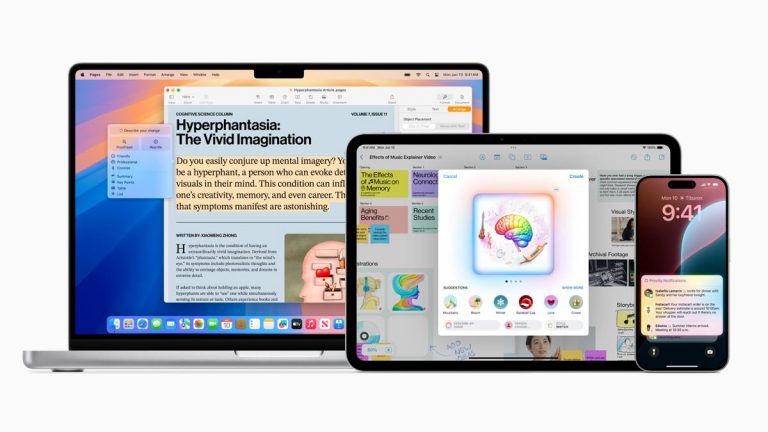
With brand-new systemwide Writing Tools powered by Apple Intelligence, users can rewrite, proofread, and summarise text nearly everywhere they write.
In Mail, staying on top of emails has never been easier. With Priority Messages, a new section at the top of the inbox shows the most urgent emails, like a same-day dinner invitation or boarding pass. Across a user’s inbox, instead of previewing the first few lines of each email, they can see summaries without needing to open a message. For long threads, users can view pertinent details with just a tap. Smart Reply provides suggestions for a quick response, and will identify questions in an email to ensure everything is answered.
With Priority Messages in Mail, a new section at the top of the inbox shows the most urgent emails.
Deep understanding of language also extends to Notifications. Priority Notifications appear at the top of the stack to surface what’s most important, and summaries help users scan long or stacked notifications to show key details right on the Lock Screen, such as when a group chat is particularly active. And to help users stay present in what they’re doing, Reduce Interruptions is a new Focus that surfaces only the notifications that might need immediate attention, like a text about an early pickup from daycare.
Priority Notifications surface what’s most important, and summaries help users scan long or stacked notifications to show key details right on the Lock Screen.
In the Notes and Phone apps, users can now record, transcribe, and summarise audio. When a recording is initiated while on a call, participants are automatically notified, and once the call ends, Apple Intelligence generates a summary to help recall key points.
In the Notes and Phone apps, users can now record, transcribe, and summarise audio.
Image Playground Makes Communication and Self‑Expression Even More Fun
Apple Intelligence powers exciting image creation capabilities to help users communicate and express themselves in new ways. With Image Playground, users can create fun images in seconds, choosing from three styles: Animation, Illustration, or Sketch. Image Playground is easy to use and built right into apps including Messages. It’s also available in a dedicated app, perfect for experimenting with different concepts and styles. All images are created on device, giving users the freedom to experiment with as many images as they want.
Easy to use and built right into apps like Messages, Image Playground allows users to create fun images in seconds.
With Image Playground, users can choose from a range of concepts from categories like themes, costumes, accessories, and places; type a description to define an image; choose someone from their personal photo library to include in their image; and pick their favourite style.
With the Image Playground experience in Messages, users can quickly create fun images for their friends, and even see personalised suggested concepts related to their conversations. For example, if a user is messaging a group about going hiking, they’ll see suggested concepts related to their friends, their destination, and their activity, making image creation even faster and more relevant.
In Messages, users can use Image Playground to quickly create fun images for their friends, and see personalised suggested concepts related to their conversations.
In Notes, users can access Image Playground through the new Image Wand in the Apple Pencil tool palette, making notes more visually engaging. Rough sketches can be turned into delightful images, and users can even select empty space to create an image using context from the surrounding area. Image Playground is also available in apps like Keynote, Freeform, and Pages, as well as in third-party apps that adopt the new Image Playground API.
Genmoji Creation to Fit Any Moment
Taking emoji to an entirely new level, users can create an original Genmoji to express themselves. By simply typing a description, their Genmoji appears, along with additional options. Users can even create Genmoji of friends and family based on their photos. Just like emoji, Genmoji can be added inline to messages, or shared as a sticker or reaction in a Tapback.
By simply typing a description, a Genmoji appears, along with additional options.
New Features in Photos Give Users More Control
Searching for photos and videos becomes even more convenient with Apple Intelligence. Natural language can be used to search for specific photos, such as “Maya skateboarding in a tie-dye shirt,” or “Katie with stickers on her face.” Search in videos also becomes more powerful with the ability to find specific moments in clips so users can go right to the relevant segment. Additionally, the new Clean Up tool can identify and remove distracting objects in the background of a photo — without accidentally altering the subject.
With Memories, users can create the story they want to see by simply typing a description. Using language and image understanding, Apple Intelligence will pick out the best photos and videos based on the description, craft a storyline with chapters based on themes identified from the photos, and arrange them into a movie with its own narrative arc. Users will even get song suggestions to match their memory from Apple Music. As with all Apple Intelligence features, user photos and videos are kept private on device and are not shared with Apple or anyone else.
With Memories, Apple Intelligence can pick out the best photos and videos based on a user’s description, craft a storyline, and arrange it all into a movie with its own narrative arc.
Siri Enters a New Era
Powered by Apple Intelligence, Siri becomes more deeply integrated into the system experience. With richer language-understanding capabilities, Siri is more natural, more contextually relevant, and more personal, with the ability to simplify and accelerate everyday tasks. It can follow along if users stumble over words and maintain context from one request to the next. Additionally, users can type to Siri, and switch between text and voice to communicate with Siri in whatever way feels right for the moment. Siri also has a brand-new design with an elegant glowing light that wraps around the edge of the screen when Siri is active.
Now users can type to Siri, and switch between text and voice to communicate with Siri in whatever way feels right for the moment.
Siri can now give users device support everywhere they go, and answer thousands of questions about how to do something on iPhone, iPad, and Mac. Users can learn everything from how to schedule an email in the Mail app, to how to switch from Light to Dark Mode.
Now Siri can give users device support everywhere they go, answering thousands of questions about how to do something on iPhone, iPad, and Mac.
With onscreen awareness, Siri will be able to understand and take action with users’ content in more apps over time. For example, if a friend texts a user their new address in Messages, the receiver can say, “Add this address to his contact card.”
With Apple Intelligence, Siri will be able to take hundreds of new actions in and across Apple and third-party apps. For example, a user could say, “Bring up that article about cicadas from my Reading List,” or “Send the photos from the barbecue on Saturday to Malia,” and Siri will take care of it.
Siri can now take hundreds of new actions in and across apps, including finding book recommendations sent by a friend in Messages and Mail.
Siri will be able to deliver intelligence that’s tailored to the user and their on-device information. For example, a user can say, “Play that podcast that Jamie recommended,” and Siri will locate and play the episode, without the user having to remember whether it was mentioned in a text or an email. Or they could ask, “When is Mum’s flight landing?” and Siri will find the flight details and cross-reference them with real-time flight tracking to give an arrival time.
A New Standard for Privacy in AI
To be truly helpful, Apple Intelligence relies on understanding deep personal context while also protecting user privacy. A cornerstone of Apple Intelligence is on-device processing, and many of the models that power it run entirely on device. To run more complex requests that require more processing power, Private Cloud Compute extends the privacy and security of Apple devices into the cloud to unlock even more intelligence.
With Private Cloud Compute, Apple Intelligence can flex and scale its computational capacity and draw on larger, server-based models for more complex requests. These models run on servers powered by Apple silicon, providing a foundation that allows Apple to ensure that data is never retained or exposed.
Independent experts can inspect the code that runs on Apple silicon servers to verify privacy, and Private Cloud Compute cryptographically ensures that iPhone, iPad, and Mac do not talk to a server unless its software has been publicly logged for inspection. Apple Intelligence with Private Cloud Compute sets a new standard for privacy in AI, unlocking intelligence users can trust.
ChatGPT Gets Integrated Across Apple Platforms
Apple is integrating ChatGPT access into experiences within iOS 18, iPadOS 18, and macOS Sequoia, allowing users to access its expertise — as well as its image- and document-understanding capabilities — without needing to jump between tools.
Siri can tap into ChatGPT’s expertise when helpful. Users are asked before any questions are sent to ChatGPT, along with any documents or photos, and Siri then presents the answer directly.
When a user grants permission, Siri can tap into ChatGPT’s broad world knowledge and present an answer directly.
Additionally, ChatGPT will be available in Apple’s systemwide Writing Tools, which help users generate content for anything they are writing about. With Compose, users can also access ChatGPT image tools to generate images in a wide variety of styles to complement what they are writing.
ChatGPT will be available in Apple’s systemwide Writing Tools in macOS, which help users generate content for anything they are writing about.
Privacy protections are built in for users who access ChatGPT — their IP addresses are obscured, and OpenAI won’t store requests. ChatGPT’s data-use policies apply for users who choose to connect their account.
ChatGPT will come to iOS 18, iPadOS 18, and macOS Sequoia later this year, powered by GPT-4o. Users can access it for free without creating an account, and ChatGPT subscribers can connect their accounts and access paid features right from these experiences.
Availability
Apple Intelligence is free for users, and will be available in beta as part of iOS 18, iPadOS 18, and macOS Sequoia this autumn in U.S. English. Some features, software platforms, and additional languages will come over the course of the next year. Apple Intelligence will be available on iPhone 15 Pro, iPhone 15 Pro Max, and iPad and Mac with M1 and later, with Siri and device language set to U.S. English. For more information, visit apple.com/apple-intelligence.
About Apple
Apple revolutionised personal technology with the introduction of the Macintosh in 1984. Today, Apple leads the world in innovation with iPhone, iPad, Mac, AirPods, Apple Watch, and Apple Vision Pro. Apple’s six software platforms — iOS, iPadOS, macOS, watchOS, visionOS, and tvOS — provide seamless experiences across all Apple devices and empower people with breakthrough services including the App Store, Apple Music, Apple Pay, iCloud, and Apple TV+. Apple’s more than 150,000 employees are dedicated to making the best products on earth and to leaving the world better than we found it.
tvOS 18 introduces new cinematic experiences with InSight, Enhance Dialogue, and subtitles
CUPERTINO, CALIFORNIA Apple today announced software updates across its Home products that supercharge entertainment and deliver greater everyday convenience. With tvOS 18, intelligent new features like InSight — and updates to Enhance Dialogue and subtitles — level up cinematic experiences, while new Apple Fitness+, Apple Music, and FaceTime capabilities get even better on users’ biggest screen. The Home app gains new features with iOS 18, like guest access and hands-free unlock with home keys, delivering effortless and secure access to the home. tvOS 18 and iOS 18 are available as developer betas today, and will be available as free software updates this autumn.
“We design our Home products to elevate users’ everyday lives, and our latest updates reinforce that goal by delivering even more convenience and connection,” said Stan Ng, Apple’s vice president of Apple Watch, Audio, Health, and Home Product Marketing. “This autumn, tvOS 18 and our services take entertainment in the home to the next level by bringing timely information to fans about their favourite characters and scenes.”
tvOS 18 Takes Home Entertainment to the Next Level
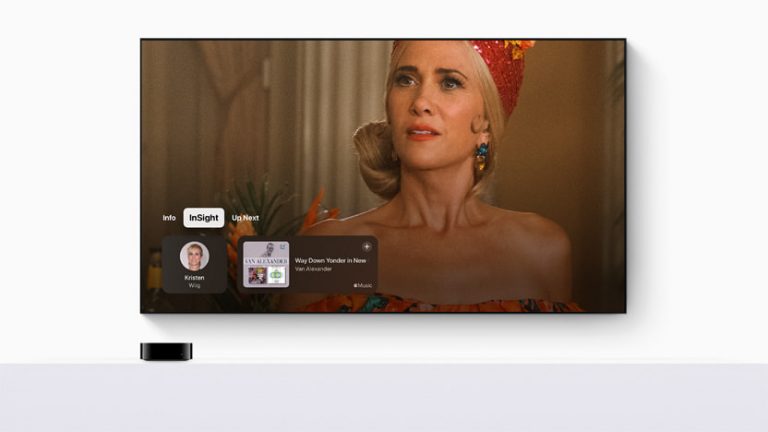
This autumn, the Apple TV app introduces InSight, a feature that displays timely information about actors, characters, and music from Apple TV+ movies and shows onscreen in real time. Users can simply select an actor to view their background and filmography page, or quickly view the song that is playing in a scene and add it to an Apple Music playlist. Viewers can also see InSight information on their iPhone when using it as an Apple TV remote.
Enhance Dialogue gets smarter with tvOS 18, leveraging machine learning and computational audio to deliver greater vocal clarity over music, action, and background noise on Apple TV 4K. In addition to HomePod speakers, users can now enjoy Enhance Dialogue when listening through built-in TV or HDMI-connected speakers, AirPods, and other Bluetooth-connected devices, and when playing supported content on iPhone and iPad.
Enhance Dialogue in tvOS 18 leverages machine learning and computational audio to deliver greater vocal clarity. Users can stream The Instigators on the Apple TV app with a subscription, available beginning August 9, 2024.
Subtitles allow users to stay engaged with their favourite content. For even more convenience, subtitles now automatically appear at just the right moments with tvOS 18, including when the language in a show or film does not match the device language, when users mute, or when they skip back while watching something.
Subtitles now automatically appear at just the right moments with tvOS 18.
tvOS 18 also brings 21:9 support for playing movies and shows on projectors, and introduces stunning new screen savers like Portraits, TV and Movies, and even Snoopy, who takes over the screen with Woodstock in a delightful animation before coming to a rest in various locations, including his doghouse.
Apple Services and Experiences Get Even Better in the Home
This autumn, anyone can share control of music playing from HomePod and HomePod mini using SharePlay and Apple Music. To join a SharePlay session, users can simply bring an iPhone close to another iPhone — or scan the QR code in the Apple Music SharePlay window on another iPhone — to add songs to the playlist and control playback, even if they do not have an Apple Music subscription.
New updates to FaceTime with Continuity Camera come with tvOS 18, making it more accessible than ever. With the introduction of Live Captions for English in the U.S. and Canada, users can read what others are saying on a FaceTime call — all from the biggest screen in the home.
Apple Fitness+ has been redesigned in tvOS 18 to help users make the most of its robust library, stay motivated, and keep consistent with their fitness routine. Updates include a personalised For You space, Explore and Library spaces, search features, and enhanced awards.
A redesigned Apple Fitness+ helps users make the most of its robust library on the biggest screen in the home.
Home Entry and Understanding Electricity Use Get Even More Convenient
With iOS 18, the Home app introduces guest access, providing users with convenient ways to grant guests control of locks, garage doors, and security systems; schedule individualised or time-based access to the home with smart locks; and view Activity History for guests. Additionally, hands-free unlock with home keys allows users to instantly open supported entry locks as soon as they are six feet away from their door, for an even more effortless home entry experience.
Guest access in the Home app offers easy ways to grant guests control of select smart home accessories and more.
The Home app also makes it easier for users to access, understand, and make more informed decisions about their home electricity use in partnership with leading utilities, beginning with Pacific Gas & Electric Company in California. Eligible users can easily view their electricity usage in the Home app’s Energy category when they connect their utility account.
In the Home app‘s Energy category, users can now easily view their electricity usage when they connect their utility account.
Additional features coming to the Home app and Apple TV include:
Robot vacuum cleaners are now compatible with the Home app, so they can participate in automations and scenes, and can be activated by a user’s voice using Siri.
AirPlay adds Spatial Audio so users can get an immersive audio experience, including support for Dolby Atmos, when using AirPlay to stream audio from iPhone and iPad to HomePod and compatible third-party audio equipment.
Availability
The tvOS 18, iOS 18, and HomePod software version 18 developer betas are available for Apple Developer Program members at developer.apple.com starting today, and public betas will be available to users next month at beta.apple.com. New software features will be available as free updates beginning this autumn. For more information, visit apple.com/tv-home and apple.com/ios/ios-18-preview. Features are subject to change. Some features may not be available in all regions, all languages, or on all devices, and compatible hardware and software may be required. For more information about availability, visit apple.com.
About Apple
Apple revolutionised personal technology with the introduction of the Macintosh in 1984. Today, Apple leads the world in innovation with iPhone, iPad, Mac, AirPods, Apple Watch, and Apple Vision Pro. Apple’s six software platforms — iOS, iPadOS, macOS, watchOS, visionOS, and tvOS — provide seamless experiences across all Apple devices and empower people with breakthrough services including the App Store, Apple Music, Apple Pay, iCloud, and Apple TV+. Apple’s more than 150,000 employees are dedicated to making the best products on earth and to leaving the world better than we found it.
Apple Vision Pro arrives in new countries and regions beginning June 28
Customers in China mainland, Hong Kong, Japan, and Singapore can pre-order Apple Vision Pro on June 13, and customers in Australia, Canada, France, Germany, and the U.K. can pre-order on June 28
CUPERTINO, CALIFORNIA Apple today announced Apple Vision Pro will expand to new countries and regions, with pre-orders for China mainland, Hong Kong, Japan, and Singapore beginning this Thursday, June 13, at 6 p.m. PT and availability beginning Friday, June 28. Customers in Australia, Canada, France, Germany, and the United Kingdom can pre-order Vision Pro beginning Friday, June 28, at 5 a.m. PT, with availability beginning Friday, July 12. Vision Pro seamlessly blends digital content with the physical world to deliver powerful spatial experiences that transform the way people work, collaborate, connect, relive memories, enjoy entertainment, and much more.
“The enthusiasm for Apple Vision Pro has been extraordinary, and we are thrilled to introduce the magic of spatial computing to more customers around the world,” said Tim Cook, Apple’s CEO. “We can’t wait for more people to see the impossible become possible, whether working and collaborating with an infinite canvas for apps, reliving treasured memories in three dimensions, watching TV shows and movies in a one-of-a-kind personal cinema, or enjoying brand-new spatial experiences that defy imagination.”
Apple Vision Pro utilises the most advanced materials possible in a beautiful, compact design.Apple Vision Pro is designed to sustain high-performance workloads and is capable of running for 2 hours on a single charge.The Light Seal is made of a soft textile and comes in a range of shapes and sizes, flexing to conform to a user’s face for a precise fit.Flexible straps ensure audio remains close to the user’s ears, while the included Solo Knit Band and Dual Loop Band allow users to find the optimal fit for them.
A Revolutionary Spatial Computer
Apple Vision Pro is powered by visionOS, a revolutionary operating system, intuitive spatial user interface, and magical input system that users navigate with their eyes, hands, and voice. visionOS is built upon decades of engineering and design innovation in iOS, iPadOS, and macOS, and works seamlessly with Apple’s ecosystem of hardware, software, and services to deliver a delightful experience across users’ favourite Apple devices.
Users interact with apps by simply looking at them and tapping their fingers together. They can also speak to dictate text, use the virtual keyboard to type, and ask Siri to open and close apps, play media, answer questions, and more. The infinite canvas frees apps from the boundaries of a physical display, so they can appear side by side at any scale, providing users with the ultimate workspace for productivity, collaboration, and entertainment. Environments — stunning, dynamic landscapes like Haleakalā, Joshua Tree, Yosemite, and even the moon — are designed to help users focus, reduce visual clutter, and enjoy immersive experiences.
With visionOS 2, available as a free software update this autumn, all Apple Vision Pro users will gain access to even more features that enhance how they engage with spatial computing, including a powerful way to transform photos into 3D memories; intuitive hand gestures to easily access the Home View and important information at a glance; new capabilities for Mac Virtual Display, Travel Mode, and Guest User; enhancements to Mindfulness, Safari, and the Apple TV app; and much more.
A Robust Catalogue of Apps, Games, and Experiences
The App Store now features more than 2,000 apps designed for Apple Vision Pro; more than 1.5 million compatible iOS and iPadOS apps; and even more apps on Mac using Mac Virtual Display that work seamlessly alongside one another.1 The unique capabilities of Vision Pro, paired with apps built by Apple’s worldwide developer community, make it a remarkably versatile device for users.
An Enormous, Private, and Portable Workspace
Leading business and productivity apps — including Box, Craft, Fantastical, MindNode, Slack, Things 3, Webex, Zoom, and apps from Microsoft 365 — help users collaborate with colleagues and accomplish everyday tasks. Users can also supercharge their productivity with utility apps such as AirLauncher, GlanceBar, Splitscreen, Screens 5, and Widgetsmith — and by pairing Bluetooth accessories, such as Magic Keyboard, Magic Trackpad, and with visionOS 2 later this year, Magic Mouse.
An Unmatched Personal Cinema
Top streaming services are available on Apple Vision Pro, including Apple TV+, Amazon Prime Video, Disney+ with Hulu, Max, Peacock, Paramount+ with Showtime, Pluto TV, and Tubi.2 The Apple TV app features all Apple Originals from Apple TV+, and more than 250 3D movies, with select titles available to Apple TV+ subscribers at no additional cost.3 Vision Pro users can enjoy more streaming and online video services through apps like IMAX, Juno, Supercut, and Television, or through Safari. Apps that support SharePlay and spatial Persona allow multiple users to watch together, as if they’re in the same physical space.4
Apple Vision Pro users can watch more than 250 3D movies from the world’s top studios with remarkable depth and clarity.
A Front-Row Seat and Personal Scoreboard for Sports
With apps from major sports leagues and brands — including the NBA, MLS, MLB, NHL, PGA TOUR, The Masters, UFC, World Surf League, and Red Bull TV — Apple Vision Pro users have the opportunity to watch games and follow athletes like never before. Features like multiview, real-time player and game stats, live object mapping, and more bring the benefits of a physical scoreboard or second screen right into view. Fans can also follow live local, national, and international sports with apps from top cable services and sports broadcasters.
Basketball fans can stream up to five games live or on demand simultaneously, view real-time player and team stats, and effortlessly glance at other games and scores with the NBA app on Apple Vision Pro.
An Incredible Gaming Device
Users can explore thousands of fun games, including more than 250 titles with Apple Arcade. New spatial games and content updates launch on Apple Arcade regularly, with recent releases such as Alto’s Odyssey — The Lost City, Crossy Road Castle, and Where Cards Fall, alongside spatial games on the App Store, such as the 2024 Apple Design Award-winning Blackbox, Loóna, and DapTap. Popular immersive games, like Job Simulator, shine on Apple Vision Pro, allowing players to simply use their eyes and hands to simulate various professions, like a gourmet chef or store clerk. Players can also access iPad and iPhone games, PC and console games using apps like Steam Link, and even more games on Mac — which are all compatible with PlayStation DualSense and Xbox Wireless controllers.
An Infinite Canvas for Creativity
New design apps like AirDraw and Da Vinci Eye have been built to leverage the unique capabilities of spatial computing, like the ability for users to sketch, draw, and paint with just their eyes and hands. The 2024 Apple Design Award-winning app djay empowers artists to make music out of thin air, while Lowe’s Style Studio allows users to design their dream kitchen.
Groundbreaking Storytelling Experiences
Apple Vision Pro introduces Apple Immersive Video, a storytelling format that leverages 3D 8K video with a 180-degree field of view and Spatial Audio to transport viewers to the centre of the action. The Apple TV app is home to a growing slate of Apple Immersive films and series, while the App Store features unique immersive and interactive experiences, including Encounter Dinosaurs, GUCCI’s film Who Is Sabato De Sarno? A Gucci Story, and the recently launched What If…? An Immersive Story from Marvel Studios and ILM Immersive.
This month, developers around the world are launching new apps and games for Apple Vision Pro, including DingTalk, Douyin VR Live, Migu Video, Taobao, Tencent Video, and Weibo in China; apps from Yahoo! JAPAN, LIFULL HOME’S, U-NEXT, and Nikkei in Japan; and SINGTEL CAST, StarHub TV+, and mewatch in Singapore — all available from day one. More apps will launch on Vision Pro next month, including MUBI and Soul Spire in the United Kingdom; Canal+, Foxar, OQEE, and SeLoger in France; BILD, OTTO, and ZDF in Germany; Classix and Sportsnet in Canada; and Domain in Australia. Additionally, global productivity tools like apps from Microsoft 365, entertainment services like Disney+, and more will be available in many of these countries and regions at launch.
Businesses across industries are embracing spatial computing, with more than half of the Fortune 100 companies having purchased Apple Vision Pro to develop innovative solutions for their organisations and customers, including apps to collaborate on 3D designs, deliver specialised employee training, guide remote fieldwork, and much more. Vision Pro is also unlocking new opportunities for healthcare professionals and medical institutions in areas such as clinical education, surgical planning, medical imaging, and behaviouralhealth
Unrivalled Hardware Design and Innovation
Apple Vision Pro is designed to deliver phenomenal compute performance in a compact, wearable form factor. The ultra-high-resolution display system uses micro-OLED technology to pack 23 million pixels into two displays, each the size of a postage stamp, delivering more pixels than a 4K TV to each eye. The advanced Spatial Audio system uses two individually amplified drivers to deliver Personalised Spatial Audio, creating the feeling that sounds are coming from the space around the user. Vision Pro also features a high-performance eye tracking system for responsive, intuitive input, and EyeSight helps users stay connected to the people around them. Vision Pro is powered by Apple silicon in a unique dual-chip design. M2 delivers powerful standalone performance, while the first-of-its-kind R1 chip processes input from 12 cameras, five sensors, and six microphones to ensure that content feels like it’s appearing right in front of the user’s eyes.
Apple Vision Pro Embodies Apple’s Values
As with all Apple products, Apple’s values are embedded into Apple Vision Pro:
Powerful accessibility features are built into visionOS. VoiceOver, Zoom, Colour Filters, Switch Control, Guided Access, and more have been reimagined for spatial computing. Users can select a preferred input method with Pointer Control and Dwell Control, and enable eye tracking with one dominant eye. Later this year, visionOS will support systemwide Live Captions, and additional Made for iPhone hearing devices and cochlear hearing processors.
Education apps offer all-new ways to learn. New apps like Art Universe, Beautiful Things, Complete HeartX, JigSpace, LookUp Dictionary, Museas, Pocket Rocket, and Sky Guide are designed to help users gain new perspectives about art, history, science, space, and more with immersive scenes and volumetric objects.
Apple Vision Pro offers industry-leading privacy and security.Optic ID analyses a user’s iris to unlock Apple Vision Pro, autofill passwords, and complete payments with Apple Pay. Where a user looks while navigating Vision Pro stays private, and eye tracking information is not shared with Apple, third-party apps, or websites.
visionOS 2 will feature Live Captions, so everyone — including users who are deaf or hard of hearing — can follow along with spoken dialogue in live conversations and in audio from apps.
Apple Vision Pro and the Environment
Apple Vision Pro is designed with 100 percent recycled rare earth elements in all magnets, and 100 percent recycled tin soldering and gold plating in multiple printed circuit boards. Said circuit boards, also known as multilayer PCBs, are responsible for effective heat dissipation on many devices. Vision Pro meets Apple’s high standards for energy efficiency, and is free of mercury, brominated flame retardants, PVC, and beryllium. The packaging is 100 percent fibre-based, bringing Apple closer to its goal of eliminating plastics in all packaging by 2025. Today, Apple is carbon neutral for its global corporate operations, and by 2030, plans to be carbon neutral across the entire manufacturing supply chain and life cycle of every product.
Pricing and Availability
Apple Vision Pro will be available at all Apple Store locations in China mainland, Hong Kong, Japan, Singapore, Australia, Canada, France, Germany, the U.K., and the U.S., and the Apple Store online, starting at £3,499,with 256GB, 512GB, and 1TB storage capacities.
Customers in China mainland, Hong Kong, Japan, and Singapore will be able to pre-order Apple Vision Pro beginning Thursday, June 13, at 6 p.m. PT,with availability beginning Friday, June 28.
Customers in Australia, Canada, France, Germany, and the U.K. will be able to pre-order Apple Vision Pro beginning Friday, June 28, at 5 a.m. PT, with availability beginning Friday, July 12.
Apple Vision Pro comes with visionOS 1.2, with support for languages in these countries and regions. visionOS 2 will be available to all Apple Vision Pro users as a free software update this autumn.
Customers can purchase Apple Vision Pro by visiting the Apple Store online, Apple Store app, or an Apple Store location with personalised support from Apple Specialists. Customers will be able to book a 30-minute demo of Vision Pro online. More information about demos will be shared when pre-orders open.
When customers order Apple Vision Pro, they will complete a face scan using an iPhone or iPad with Face ID that has the latest version of the Apple Store app. This scan helps users find the optimal Light Seal and head band sizes to provide a precise fit.
Apple Vision Pro comes with a Solo Knit Band, a Dual Loop Band, a personalised Light Seal with two Light Seal Cushions, an Apple Vision Pro Cover, Polishing Cloth, Battery, USB-C Charge Cable, and USB-C Power Adapter.
For users who require vision correction, Apple partnered with ZEISS to develop ZEISS Optical Inserts that magnetically attach to Apple Vision Pro, allowing users to take full advantage of the display’s incredible sharpness and clarity.5 ZEISS Optical Inserts — Readers will be available for £99 , and ZEISS Optical Inserts — Prescription will be available for £149 .
Apple Vision Pro Travel Case will be available for £199.
AppleCare+ for Apple Vision Pro will be available for £499.
For more information on Apple Vision Pro, visit apple.com/apple-vision-pro.
About Apple Apple revolutionised personal technology with the introduction of the Macintosh in 1984. Today, Apple leads the world in innovation with iPhone, iPad, Mac, AirPods, Apple Watch, and Apple Vision Pro. Apple’s six software platforms — iOS, iPadOS, macOS, watchOS, visionOS, and tvOS — provide seamless experiences across all Apple devices and empower people with breakthrough services including the App Store, Apple Music, Apple Pay, iCloud, and Apple TV+. Apple’s more than 150,000 employees are dedicated to making the best products on earth and to leaving the world better than we found it.
App availability varies by country region.
Apple TV+ is available to every Canal+ subscriber at no additional cost. Max Ultimate Ad-Free plan required for 4K viewing and support for Spatial Audio with Dolby Atmos. A Disney+ subscription is required. Hulu content available for eligible Disney Bundle subscribers.
3D movie availability varies by country or region.
Persona is available in beta.
A valid prescription is required. Not all prescriptions are supported. Vision correction accessories are sold separately. ZEISS Optical Inserts — Prescription are only available to purchase online.