
Home Blog Page 115

NASA Announces Unidentified Aerial Phenomena Study Team Members

0

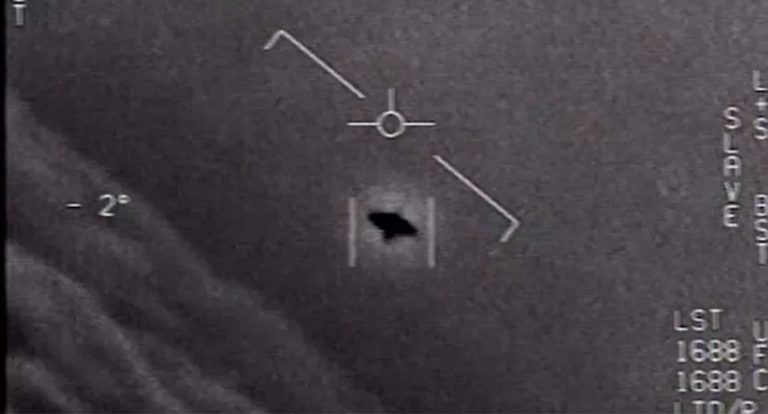
NASA has selected 16 individuals to participate in its independent study team on unidentified aerial phenomena (UAP). Observations of events in the sky that cannot be identified as aircraft or as known natural phenomena are categorized as UAPs.  

The independent study will begin on Monday, Oct. 24. Over the course of nine months, the independent study team will lay the groundwork for future study on the nature of UAPs for NASA and other organizations. To do this, the team will identify how data gathered by civilian government entities, commercial data, and data from other sources can potentially be analyzed to shed light on UAPs. It will then recommend a roadmap for potential UAP data analysis by the agency going forward. 

The study will focus solely on unclassified data. A full report containing the team’s findings will be released to the public in mid-2023. 

“Exploring the unknown in space and the atmosphere is at the heart of who we are at NASA,” said Thomas Zurbuchen, associate administrator of the Science Mission Directorate at NASA Headquarters in Washington. “Understanding the data we have surrounding unidentified aerial phenomena is critical to helping us draw scientific conclusions about what is happening in our skies. Data is the language of scientists and makes the unexplainable, explainable.” 

Unidentified aerial phenomena are of interest for both national security and air safety and the study aligns with one of NASA’s goals to ensure the safety of aircraft. Without access to an extensive set of data, it is nearly impossible to verify or explain any observation, thus the focus of the study is to inform NASA what possible data could be collected in the future to scientifically discern the nature of UAP.  

The NASA official responsible for orchestrating the study is Daniel Evans, the assistant deputy associate administrator for research at NASA’s Science Mission Directorate. As previously announced, the independent study team is chaired by David Spergel, president of the Simons Foundation.  

“NASA has brought together some of the world’s leading scientists, data and artificial intelligence practitioners, aerospace safety experts, all with a specific charge, which is to tell us how to apply the full focus of science and data to UAP,” said Evans. “The findings will be released to the public in conjunction with NASA’s principles of transparency, openness, and scientific integrity.” 

The members of NASA’s independent study team on unidentified aerial phenomena are: 

  • David Spergel was selected to chair NASA’s independent study on unidentified aerial phenomena. He is the president of the Simons Foundation where he was the founding director of its Flatiron Institute for Computational Astrophysics. His interests range from the search for planets and nearby stars to the shape of the universe. He has measured the age, shape and composition of the universe and played a key role in establishing the standard model of cosmology. A MacArthur “Genius” Fellow, Spergel has been cited in publications more than 100,000 times. 
  • Anamaria Berea is an associate professor of Computational and Data Science at George Mason University in Fairfax, Virginia. She is a research affiliate with the SETI Institute in Mountain View, California, and a research investigator with Blue Marble Space Institute of Science in Seattle. Her research is focused on the emergence of communication in complex living systems and on data science applications in astrobiology, for the science of both biosignatures and technosignatures. She uses a wide range of computational methods to uncover fundamental patterns in the data. ​​
  • Federica Bianco is a joint professor at the University of Delaware in the Department of Physics and Astrophysics, the Biden School of Public Policy and Administration and a Senior Scientist at the Multi-city Urban Observatory. She is a cross-disciplinary scientist with a focus on using data-science to study the universe and find solutions to urban-based problems on earth. She is Deputy Project Scientist for the Vera C. Rubin Observatory which in 2023 will start the Legacy Survey of Space and Time to study the night sky in the southern hemisphere and discover new galaxies and stars. She has been published in more than 100 peer-reviewed papers and received that Department of Energy’s “Innovative Development in Energy-Related Applied Science” grant. 
  • Paula Bontempi has been a biological oceanographer for more than 25 years. She is the sixth dean and the second woman to lead the Graduate School of Oceanography at the University of Rhode Island (URI). She is also a professor of oceanography at URI. She spent eighteen years at NASA and was appointed acting deputy director of NASA’s Earth Science Division for the Science Mission Directorate. She also led NASA’s research on ocean biology, biogeochemistry, the carbon cycle and ecosystems, as well as many NASA Earth observing satellite missions in marine science. She is a fellow of The Oceanography Society. 
  • Reggie Brothers is the operating partner at AE Industrial Partners in Boca Raton, Florida. He previously served as CEO and board member of BigBear.ai in Columbia, Maryland. Brothers also was the executive vice president and chief technology officer of Peraton, as well as a principal with the Chertoff Group. Prior to his time in the private sector, he served as the undersecretary for Science and Technology at the U.S. Department of Homeland Security and as Deputy Assistant Secretary of Defense for Research at the Department of Defense. Brothers is also a Distinguished Fellow at Georgetown’s Center for Security and Emerging Technology and he is a member of the Visiting Committee for Sponsored Research at the Massachusetts Institute of Technology (MIT) in Cambridge, Massachusetts. 
  • Jen Buss is the CEO of the Potomac Institute of Policy Studies in Arlington, Virginia. Before she became CEO, Buss worked extensively with NASA to explore policy issues and strategic planning processes for astronaut medical care and cancer diagnostics and therapeutics. She is nationally recognized as an authority in her field for science and technology trends analysis and policy solutions.
  • Nadia Drake is a freelance science journalist and contributing writer at National Geographic. She also regularly writes for Scientific American, and specializes in covering astronomy, astrophysics, planetary sciences, and jungles. She has won journalism awards for her work in National Geographic including the David N. Schramm Award from the High Energy Astrophysics Division of the American Astronomical Society and the Jonathan Eberhart award from the AAS Division of Planetary Sciences. Drake holds a doctorate in genetics from Cornell University.
  • Mike Gold is the executive vice president of Civil Space and External Affairs at Redwire in Jacksonville, Florida. Prior to Redwire, Gold held multiple leadership roles at NASA, including associate administrator for Space Policy and Partnerships, acting associate administrator for the Office of International and Interagency Relations and senior advisor to the Administrator for International and Legal Affairs. He led for NASA, jointly with the Department of State, the creation and execution of the Artemis Accords, which established the norms of behavior in space. He also led the negotiation and adoption of binding international agreements for the lunar Gateway, the creation of new planetary protocols and the first purchase by NASA of a lunar resource. Gold was awarded NASA’s Outstanding Leadership Medal for his work in 2020.Additionally, Gold was appointed by the U.S. Secretary of Transportation to serve as Chair of the Commercial Space Transportation Advisory Committee from 2012 until he joined NASA in 2019.  
  • David Grinspoon is a senior scientist at the Planetary Science Institute in Tuscon, Arizona, and serves as a frequent advisor to NASA on space exploration. He is on science teams for several interplanetary spacecraft missions including the DAVINCI mission to Venus. He is the former inaugural Baruch S. Blumberg NASA/Library of Congress Chair in Astrobiology. His research focuses on comparative planetology especially regarding climate evolution and the implications of habitability on earth-like planets. He was awarded the Carl Sagan Medal by the American Astronomical Society and he is an elected Fellow of the American Association for the Advancement of Science. He is also an adjunct professor of Astrophysical and Planetary Science at the University of Colorado in Boulder, Colorado, as well as Georgetown University in Washington. 
  • Scott Kelly is a former NASA astronaut, test pilot, fighter pilot, and retired U.S. Navy captain. He commanded the International Space Station Expeditions 26, 45, and 46. He was also the pilot of Space Shuttle Discovery for the third Hubble Servicing Mission. He was selected for a year-long mission to the space station where he set the record at the time for the total accumulated number of days spent in space. Prior to NASA, Kelly was the first pilot to fly the F-14 with a new digital flight control system. He flew the F-14 Tomcat in fighter squadron VF-143 aboard the USS Dwight D. Eisenhower. He is a two-time New York Times bestselling author and was recognized by Time magazine in 2015 as one of the most influential people in the world.
  • Matt Mountain is the president of The Association of Universities for Research and Astronomy, known as AURA. At AURA, Mountain oversees a consortium of 44 universities nationwide and four international affiliates who help NASA and the National Science Foundation build and operate observatories including NASA’s Hubble Telescope and James Webb Space Telescope. He also serves as a telescope scientist for Webb and is a member of its Science Working Group. He is the former director of The Space Telescope Science Institute in Baltimore, and the International Gemini Observatory in Hilo, Hawaii.  
  • Warren Randolph is the deputy executive director of the Federal Aviation Administration’s Accident Investigation and Prevention for Aviation Safety department. He has an extensive background in aviation safety at the Federal Aviation Administration (FAA) and is currently responsible for setting and implementing safety management system principles and using data to inform the assessment of future hazards and emerging safety risks. Prior to the FAA, Randolph served as an aerodynamicist for the U.S. Coast Guard and the U.S. Air Force for multiple flight simulations. 
  • Walter Scott is the executive vice president and chief technology officer of Maxar in Westminster, Colorado, a space technology company that specializes in earth intelligence and space infrastructure. In 1992, he founded DigitalGlobe which became part of Maxar in 2017. He has held leadership positions at the Lawrence Livermore National Laboratory in Livermore, California and was the president of Scott Consulting. In 2021, he was inducted into the David W. Thompson Lecture in Space Commerce by the American Institute of Aeronautics and Astronautics. 
  • Joshua Semeter is a professor of electrical and computer engineering as well as the director of the Center for Space Physics at Boston University. At Boston University, he researches interactions between Earth’s ionosphere and the space environment. Activities in Semeter’s lab include the development of optical and magnetic sensor technologies, radar experiment design and signal processing, and the application of tomographic and other inversion techniques to the analysis of distributed, multi-mode measurements of the space environment. 
  • Karlin Toner is the acting executive director of the FAA’s Office of Aviation Policy and Plans. Previously, she served as the director of the FAA’s global strategy where she led the FAA’s international strategy and managed threats to international civil aviation. Prior to the FAA, Toner served at NASA in multiple leadership positions including director of the Airspace Systems Program at NASA Headquarters. She is a NASA Exceptional Achievement Medal recipient and is an associate fellow for the American Institute of Aeronautics and Astronautics. 
  • Shelley Wright is an associate professor of physics at the University of California, San Diego’s Center for Astrophysics and Space Studies. She specializes in galaxies, supermassive black holes and building optical and infrared instruments for telescopes using adaptive optics such as integral field spectrographs. She is a Search for Extraterrestrial Intelligence (SETI) researcher and instrumentalist. She is also the principal investigator for the UC San Diego Optical Infrared Laboratory. Previously, she was an assistant professor at the University of Toronto’s Dunlap Institute.   

Source: NASA
NASA’s Webb Uncovers Dense Cosmic Knot in The Early Universe

0

Astronomers looking into the early universe have made a surprising discovery using NASA’s James Webb Space Telescope: a cluster of massive galaxies in the process of forming around an extremely red quasar. The result will expand our understanding of how galaxy clusters in the early universe came together and formed the cosmic web we see today.

A quasar, a special type of active galactic nucleus (AGN), is a compact region with a supermassive black hole at the center of a galaxy. Gas falling into a supermassive black hole makes the quasar bright enough to outshine all the galaxy’s stars.

The quasar Webb explored, called SDSS J165202.64+172852.3, existed 11.5 billion years ago. It is unusually red not just because of its intrinsic red color, but also because the galaxy’s light has been redshifted by its vast distance. That made Webb, having unparalleled sensitivity in infrared wavelengths, perfectly suited to examine the galaxy in detail.

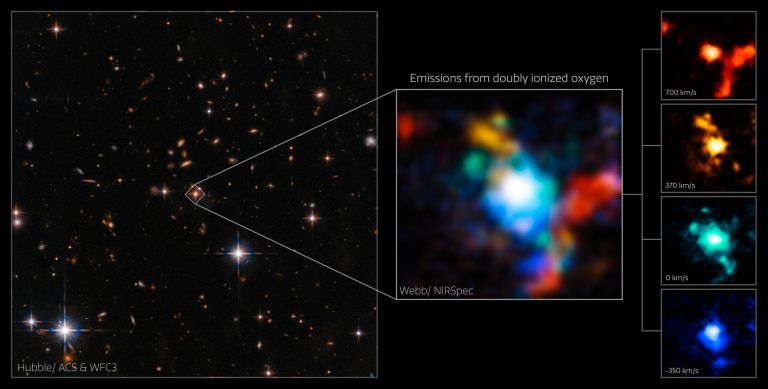
Infographic titled “Motions of Gas Around an Extremely Red Quasar; Hubble ACS and WFC3 Imaging and Webb NIRSpec IFU Spectroscopy.”

At left, the quasar SDSS J165202.64+172852.3 is highlighted in a Hubble Space Telescope image taken in visible and near-infrared light. The images on the right and at bottom present new observations from the James Webb Space Telescope in multiple wavelengths. They demonstrate the distribution and motions of gas within a newly observed galaxy cluster around the central quasar.

Credits: NASA, ESA, CSA, STScI, D. Wylezalek (Heidelberg Univ.), A. Vayner and N. Zakamska (Johns Hopkins Univ.) and the Q-3D Team

Download the full-resolution, uncompressed version and supporting visuals from the Space Telescope Science Institute.

This quasar is one of the most powerful known galactic nuclei that’s been seen at such an extreme distance. Astronomers had speculated that the quasar’s extreme emission could cause a “galactic wind,” pushing free gas out of its host galaxy and possibly greatly influencing future star formation there.

To investigate the movement of the gas, dust and stellar material in the galaxy, the team used the telescope’s Near Infrared Spectrograph (NIRSpec). This powerful instrument uses a technique called spectroscopy to look at the movement of various outflows and winds surrounding the quasar. NIRSpec can simultaneously gather spectra across the telescope’s whole field of view, instead of just from one point at a time, enabling Webb to simultaneously examine the quasar, its galaxy and the wider surroundings.

Previous studies by NASA’s Hubble Space Telescope and other observatories called attention to the quasar’s powerful outflows, and astronomers had speculated that its host galaxy could be merging with some unseen partner. But the team was not expecting Webb’s NIRSpec data to clearly indicate it was not just one galaxy, but at least three more swirling around it. Thanks to spectra over a broad area, the motions of all this surrounding material could be mapped, resulting in the conclusion that the red quasar was in fact part of a dense knot of galaxy formation.

“There are few galaxy protoclusters known at this early time. It’s hard to find them, and very few have had time to form since the big bang,” said astronomer Dominika Wylezalek of Heidelberg University in Germany, who led the study with Webb. “This may eventually help us understand how galaxies in dense environments evolve. It’s an exciting result.”

Using the observations from NIRSpec, the team was able to confirm three galactic companions to this quasar and show how they are connected. Archival data from Hubble hint that there may be even more. Images from Hubble’s Wide Field Camera 3 had shown extended material surrounding the quasar and its galaxy, prompting its selection for this study into its outflow and the effects on its host galaxy. Now, the team suspects they could have been looking at the core of a whole cluster of galaxies – only now revealed by Webb’s crisp imaging.

“Our first look at the data quickly revealed clear signs of major interactions between the neighboring galaxies,” shared team member Andrey Vayner of Johns Hopkins University in Baltimore, Maryland. “The sensitivity of the NIRSpec instrument was immediately apparent, and it was clear to me that we are in a new era of infrared spectroscopy.”

The three confirmed galaxies are orbiting each other at incredibly high speeds, an indication that a great deal of mass is present. When combined with how closely they are packed into the region around this quasar, the team believes this marks one of the densest known areas of galaxy formation in the early universe. “Even a dense knot of dark matter isn’t sufficient to explain it,” Wylezalek says. “We think we could be seeing a region where two massive halos of dark matter are merging together.” Dark matter is an invisible component of the universe that holds galaxies and galaxy clusters together, and is thought to form a “halo” that extends beyond the stars in these structures.

The study conducted by Wylezalek’s team is part of Webb’s investigations into the early universe. With its unprecedented ability to look back in time, the telescope is already being used to investigate how the first galaxies were formed and evolved, and how black holes formed and influenced the structure of the universe. The team is planning follow-up observations into this unexpected galaxy proto-cluster, and hope to use it to understand how dense, chaotic galaxy clusters like this one form, and how it’s affected by the active, supermassive black hole at its heart.

These results will be published in the The Astrophysical Journal Letters. This research was completed as part of Webb’s Early Release Science program #1335.The James Webb Space Telescope is the world’s premier space science observatory. Webb will solve mysteries in our solar system, look beyond to distant worlds around other stars, and probe the mysterious structures and origins of our universe and our place in it. Webb is an international program led by NASA with its partners, ESA (European Space Agency) and CSA (Canadian Space Agency).

Source: NASA

How do you message an alien? Carl Sagan offers some simple suggestions

0

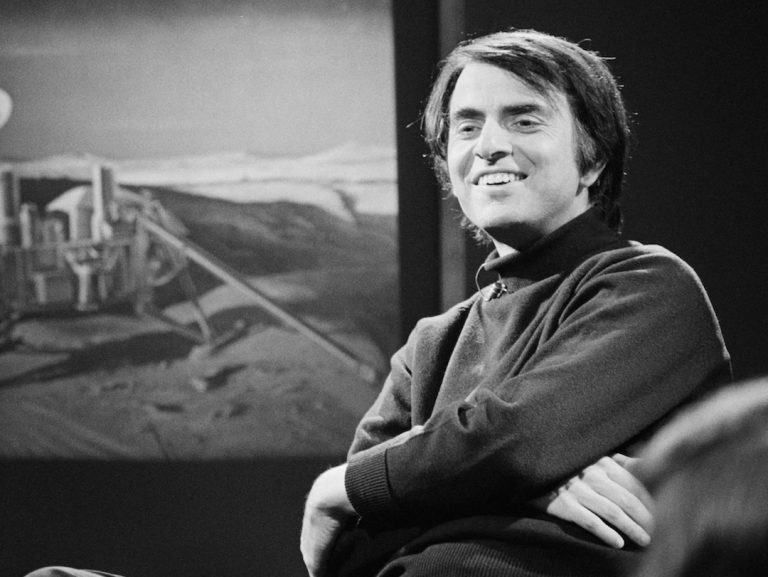
Is there a foolproof way to announce our existence to other intelligent life-forms? It’s a brainteaser with vast potential consequences, and one that scientists seem to love puzzling over – even if some, such as Stephen Hawking, have questioned the wisdom of alerting advanced beings to our humble corner of the Universe. In this short video excerpt from a 1977 lecture at the Royal Institution in London, Carl Sagan – more optimistic about the prospect of alien benevolence than Hawking – offers one possible method. First, he establishes his belief that a common language among dissimilar beings in a shared universe should, in theory, be possible. He then presents a document coded in ones and zeroes, containing a message that he hopes could be decoded by an intelligent being anywhere in the Universe. Finally, Sagan recounts an experiment in which he presented the document to what he considers a ‘reasonably clever’ life-form – some of his graduate students at Cornell University – to see if they could decipher it.

Video by The Royal Institution

Source: Aeon

Addressing climate change with satellites: Canada will contribute to NASA’s international Atmosphere Observing System

0

The Honourable François-Philippe Champagne, Minister of Innovation, Science and Industry, announced today that Canada will contribute to the Atmosphere Observing System (AOS) mission led by NASA. Canada’s contribution is estimated at more than $200 million. Currently slated to launch in 2028 and 2031, this major multi-satellite mission will improve extreme weather prediction, climate modelling, and monitoring of disasters.

Extreme weather events are increasing in frequency and intensity. The dynamics of our planet’s atmosphere are changing. We need better environmental prediction to support adaptation and climate resilience. The AOS, including its Canadian contribution, will measure aerosols and clouds, and how they interact to impact Earth’s weather and climate.

Canada’s contribution to the AOS is the High-altitude Aerosols, Water vapour and Clouds (HAWC) mission. It consists of two Canadian instruments on a Canadian satellite and a third instrument on a NASA satellite, all planned for launch in 2031. These innovative instruments will provide critical data, enabling Canadian climate scientists and weather forecasters to better understand and predict extreme events, like severe storms, floods, droughts and poor air quality conditions. HAWC and AOS data will be fully accessible.

Thanks to early investments from the Canadian Space Agency in concept studies and technology development for these instruments, Canada was well positioned to take part in this important climate science mission. Canadian collaborators in the HAWC mission include a coast-to-coast consortium of universities, Environment and Climate Change Canada, Natural Resources Canada and the National Research Council of Canada.

Canada’s contribution to the AOS mission supports the implementation of Resourceful, Resilient, Ready: Canada’s Strategy for Satellite Earth Observation, which describes how Canada will take full advantage of the unique vantage point of space to address climate change and other key challenges of our time.

Quotes

“Canada has always played a key role in international space programs, helping to find solutions to global challenges. Today’s more than $200 million announcement builds on those successes with our participation in NASA’s AOS program. It also speaks to our commitment to harnessing science and research to address climate change, natural disasters, and other issues that are important to Canadians.”

– The Honourable François Philippe-Champagne, Minister of Innovation, Science and Industry 

“Satellites give us a valuable view of earth; from space we can observe and monitor the weather and our changing climate. The instruments Canada are providing toward this mission will take measurements that are important to understanding weather and climate change, while providing data that will be used by our meteorologists and scientists to enhance predictions and improve our weather, air quality, and climate models.”

– The Honourable Steven Guilbeault, Minister of Environment and Climate Change

Quick facts

  • Global Satellite Earth Observation revenues are expected to grow from just over US$3 billion to over US$7 billion over the next decade.  For the industry and non-profits, the use of satellite EO and geospatial information has been estimated to contribute $20.7 billion in productivity improvements to the Canadian economy annually.
  • The Intergovernmental Panel on Climate Change reports that uncertainties in the representation of aerosol-cloud processes and their interactions with radiation in Earth System Models are the main source of uncertainty in climate change projections.
  • The AOS mission will optimize how we examine links among aerosols, clouds, atmospheric convection, and precipitation. It will provide unique insight into the vertical structure and movement of aerosols, clouds and precipitation in our atmosphere.
  • Led by NASA, the AOS team includes the Canadian Space Agency, JAXA (Japan), CNES (France) and DLR (Germany).
  • The Canadian university consortium includes 13 universities across the country: University of Saskatchewan, University of Toronto, Université du Québec à Montréal, McGill University, University of New Brunswick, Université de Sherbrooke, University of Waterloo, Wilfrid Laurier University, St. Francis Xavier University, Saint Mary’s University, University of Victoria, Western University and Dalhousie University.

From: Canadian Space Agency

The Secret History Of The Moon

0

A massive collision, or something stranger? An epic exploration of lunar origin theories

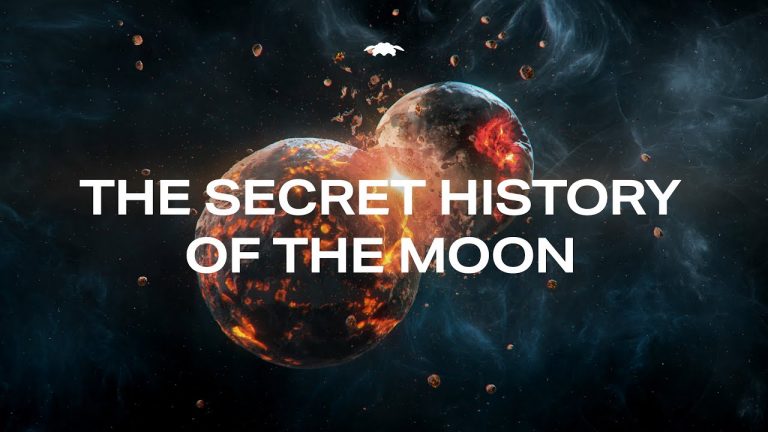
The tidiest theory of the Moon’s origin is known as the Giant Impact Hypothesis – the idea that, amid the volatile early era of the solar system’s formation, a Mars-sized protoplanet collided with the primordial Earth. From the massive ensuing explosion, much of the planetary debris coalesced into a new, Earth-orbiting body. But while the theory accounts for much of what we understand about the Moon, it leaves some critical question unanswered. Namely, if it was formed mostly from a foreign body, why do lunar samples show the chemical makeup of the Moon and Earth to be nearly identical? In this video, the US filmmaker John D Boswell synthesises animations and original music with the voice of the planetary scientist Sarah T Stewart to explore several theories for the Moon’s birth, as well as for how it might have helped to yield life on Earth. The result is a stylish, speculative lunar history that might inspire a renewed sense of awe for our closest celestial companion.

Video by John Boswell

Website: melodysheep

Revisiting ‘Powers of Ten’ – what we’ve learned about the Universe since 1977

0

Directed by Charles and Ray Eames, the legendary husband-and-wife filmmaking and design team, the classic short Powers of Ten (1977) invited viewers to contemplate the edges of our understanding of reality. Starting from a picnic blanket in a Chicago park, that film took viewers on a journey that stretched to the scale of 100 million light years away, and then back down to a single proton. Narrated by the BBC TV presenter Brian Cox – a professor of particle physics in the School of Physics and Astronomy at the University of Manchester – this new short pays homage to the Eames classic by transposing its elegantly simple premise to today. This time, the picnic blanket is in Sicily, and the time horizon stretches to a scale of 100 billion light years away; the resulting film integrates updates in astronomy, astronomical imaging and human understanding into its journey far into the cosmos and back again.

Video by BBC Ideas and The Open University

Producer: Pomona Pictures

Source: Aeon

How would a piano sound on Mars? Embark on an interplanetary sonic journey

0

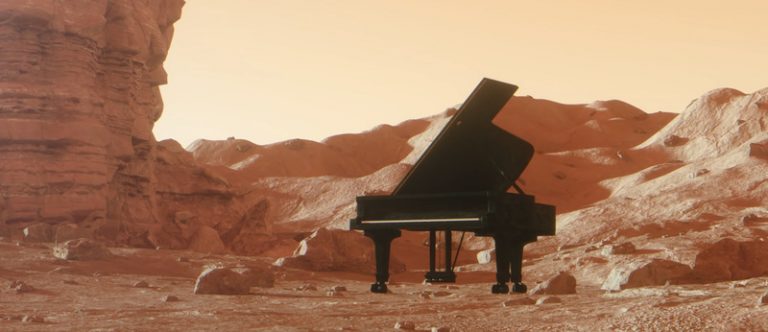
If the Universe is born and no one is present to hear it, does it still make a sound? Well, theoretically, yes. As this video from the US filmmaker John D Boswell (also known as Melodysheep) explores, where a ‘thick soup of atoms’ is present, sound is possible. Made in collaboration with the podcast Twenty Thousand Hertz, this short documentary deploys dramatic CGI visuals, a pulsing score and the voices of prominent scientists to explore the sounds of space – from those humanity has recorded to those we can only speculate about. While ostensibly an interplanetary journey, The Sounds of Space is perhaps most intriguing when viewed as an exploration of the physics of sound, and the science of how we’ve evolved to receive soundwaves right here on Earth.

Video by Melodysheep

Source: Aeon

NASA Reveals Webb Telescope’s First Images of Unseen Universe

0

The dawn of a new era in astronomy is here as the world gets its first look at the full capabilities of NASA’s James Webb Space Telescope, a partnership with ESA (European Space Agency) and CSA (Canadian Space Agency).

nasa-jwst-web_first_images_release
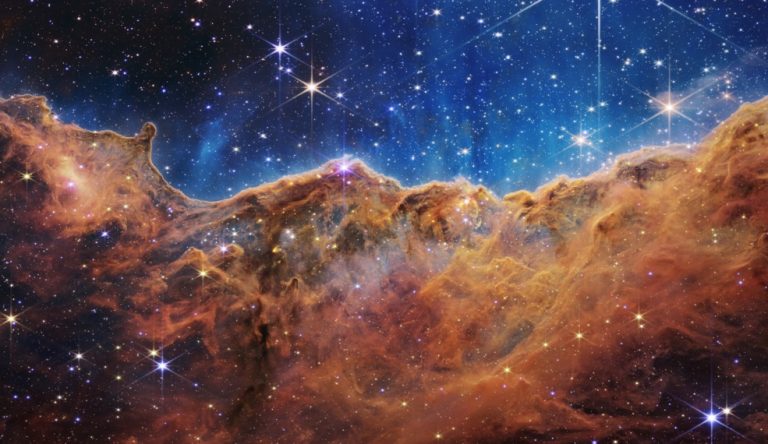
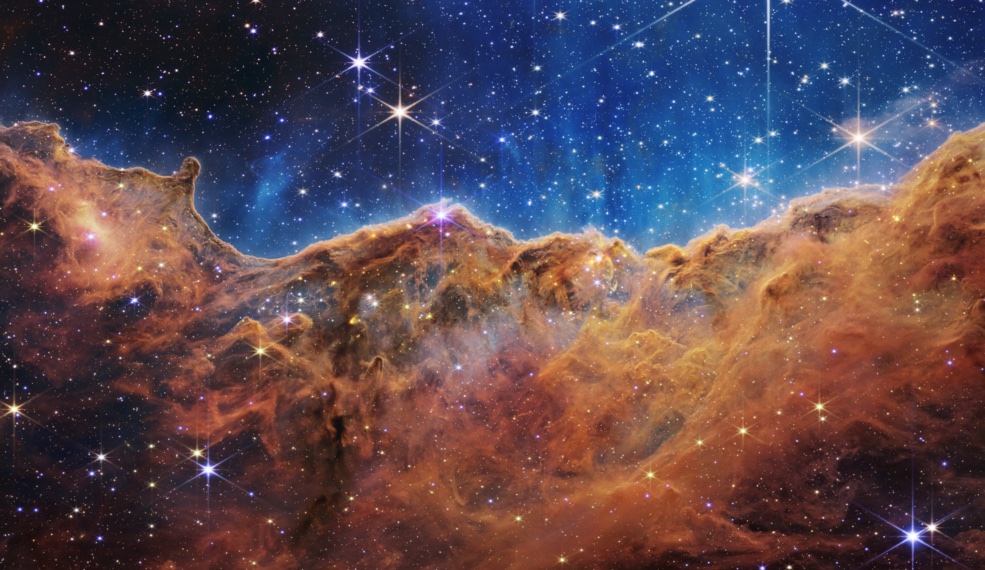
This landscape of “mountains” and “valleys” speckled with glittering stars is actually the edge of a nearby, young, star-forming region called NGC 3324 in the Carina Nebula. Captured in infrared light by NASA’s new James Webb Space Telescope, this image reveals for the first time previously invisible areas of star birth. Credits: NASA, ESA, CSA, and STScI Learn more about this image.

The full set of the telescope’s first full-color images and spectroscopic data, which uncover a collection of cosmic features elusive until now, released Tuesday, are available at:

https://www.nasa.gov/webbfirstimages

“Today, we present humanity with a groundbreaking new view of the cosmos from the James Webb Space Telescope – a view the world has never seen before,” said NASA Administrator Bill Nelson. “These images, including the deepest infrared view of our universe that has ever been taken, show us how Webb will help to uncover the answers to questions we don’t even yet know to ask; questions that will help us better understand our universe and humanity’s place within it.

“The Webb team’s incredible success is a reflection of what NASA does best. We take dreams and turn them into reality for the benefit of humanity. I can’t wait to see the discoveries that we uncover – the team is just getting started!”

NASA explores the unknown in space for the benefit of all, and Webb’s first observations tell the story of the hidden universe through every phase of cosmic history – from neighboring planets outside our solar system, known as exoplanets, to the most distant observable galaxies in the early universe. 

“This is a singular and historic moment,” said Thomas Zurbuchen, associate administrator for NASA’s Science Mission Directorate. “It took decades of drive and perseverance to get us here, and I am immensely proud of the Webb team. These first images show us how much we can accomplish when we come together behind a shared goal, to solve the cosmic mysteries that connect us all. It’s a stunning glimpse of the insights yet to come.”

“We are elated to celebrate this extraordinary day with the world,” said Greg Robinson, Webb program director at NASA Headquarters. “The beautiful diversity and incredible detail of the Webb telescope’s images and data will have a profound impact on our understanding of the universe and inspire us to dream big.”

NASA revealed the first five full-color images and spectrographic data from the world’s most powerful space telescope, the James Webb Space Telescope, a partnership with ESA (European Space Agency), and CSA (Canadian Space Agency). The world got its first look at the full capabilities of the mission at a live event streamed from the agency’s Goddard Space Flight Center in Greenbelt, Maryland, on July 12, 2022.
Credits: NASA

Webb’s first observations were selected by a group of representatives from NASA, ESA, CSA, and the Space Telescope Science Institute. They reveal the capabilities of all four of Webb’s state-of-the-art scientific instruments:

  • SMACS 0723: Webb has delivered the deepest and sharpest infrared image of the distant universe so far – and in only 12.5 hours. For a person standing on Earth looking up, the field of view for this new image, a color composite of multiple exposures each about two hours long, is approximately the size of a grain of sand held at arm’s length. This deep field uses a lensing galaxy cluster to find some of the most distant galaxies ever detected. This image only scratches the surface of Webb’s capabilities in studying deep fields and tracing galaxies back to the beginning of cosmic time.
  • WASP-96b (spectrum): Webb’s detailed observation of this hot, puffy planet outside our solar system reveals the clear signature of water, along with evidence of haze and clouds that previous studies of this planet did not detect. With Webb’s first detection of water in the atmosphere of an exoplanet, it will now set out to study hundreds of other systems to understand what other planetary atmospheres are made of.
  • Southern Ring Nebula: This planetary nebula, an expanding cloud of gas that surrounds a dying star, is approximately 2,000 light years away. Here, Webb’s powerful infrared eyes bring a second dying star into full view for the first time. From birth to death as a planetary nebula, Webb can explore the expelling shells of dust and gas of aging stars that may one day become a new star or planet.
  • Stephan’s Quintet: Webb’s view of this compact group of galaxies, located in the constellation Pegasus, pierced through the shroud of dust surrounding the center of one galaxy, to reveal the velocity and composition of the gas near its supermassive black hole. Now, scientists can get a rare look, in unprecedented detail, at how interacting galaxies are triggering star formation in each other and how the gas in these galaxies is being disturbed.
  • Carina Nebula: Webb’s look at the ‘Cosmic Cliffs’ in the Carina Nebula unveils the earliest, rapid phases of star formation that were previously hidden. Looking at this star-forming region in the southern constellation Carina, as well as others like it, Webb can see newly forming stars and study the gas and dust that made them.

“Absolutely thrilling!” said John Mather, Webb senior project scientist at NASA’s Goddard Space Flight Center in Greenbelt, Maryland. “The equipment is working perfectly, and nature is full of surprising beauty. Congratulations and thanks to our worldwide teams that made it possible.”

The release of Webb’s first images and spectra kicks off the beginning of Webb’s science operations, where astronomers around the world will have their chance to observe anything from objects within our solar system to the early universe using Webb’s four instruments.

The James Webb Space Telescope launched Dec. 25, 2021, on an Ariane 5 rocket from Europe’s Spaceport in French Guiana, South America. After completing a complex deployment sequence in space, Webb underwent months of commissioning where its mirrors were aligned, and its instruments were calibrated to its space environment and prepared for science.

The public can also view the new Webb images Tuesday on several digital screens in New York City’s Times Square and in London’s Piccadilly Circus beginning at 5:30 p.m. EDT and 10:30 p.m. GMT, respectively.

The James Webb Space Telescope is the world’s premier space science observatory. Webb will solve mysteries in our solar system, look beyond to distant worlds around other stars and probe the mysterious structures and origins of our universe and our place in it.

NASA Headquarters oversees the mission for the agency’s Science Mission Directorate. NASA’s Goddard Space Flight Center in Greenbelt, Maryland, manages Webb for the agency and oversees work on the mission performed by the Space Telescope Science Institute, Northrop Grumman, and other mission partners. In addition to Goddard, several NASA centers contributed to the project, including the agency’s Johnson Space Center in Houston, Jet Propulsion Laboratory in Southern California, Marshall Space Flight Center in Huntsville, Alabama, Ames Research Center in California’s Silicon Valley, and others.

For a full array of Webb’s first images and spectra, including downloadable files, visit:

https://webbtelescope.org/news/first-images


Source: NASA

Which Countries are Dominating Space?

0

Believe it or not, there is a lot of stuff in space. In fact, our atmosphere is filled with more than 11,000 objects that have been launched since the foray into space began.

The Space Race started during the Cold War, and early on the Soviet Union dominated when it came to the amount of devices and objects launched into our atmosphere. But a few years ago, the U.S. took back that title with Elon Musk’s SpaceX helping lead the charge.

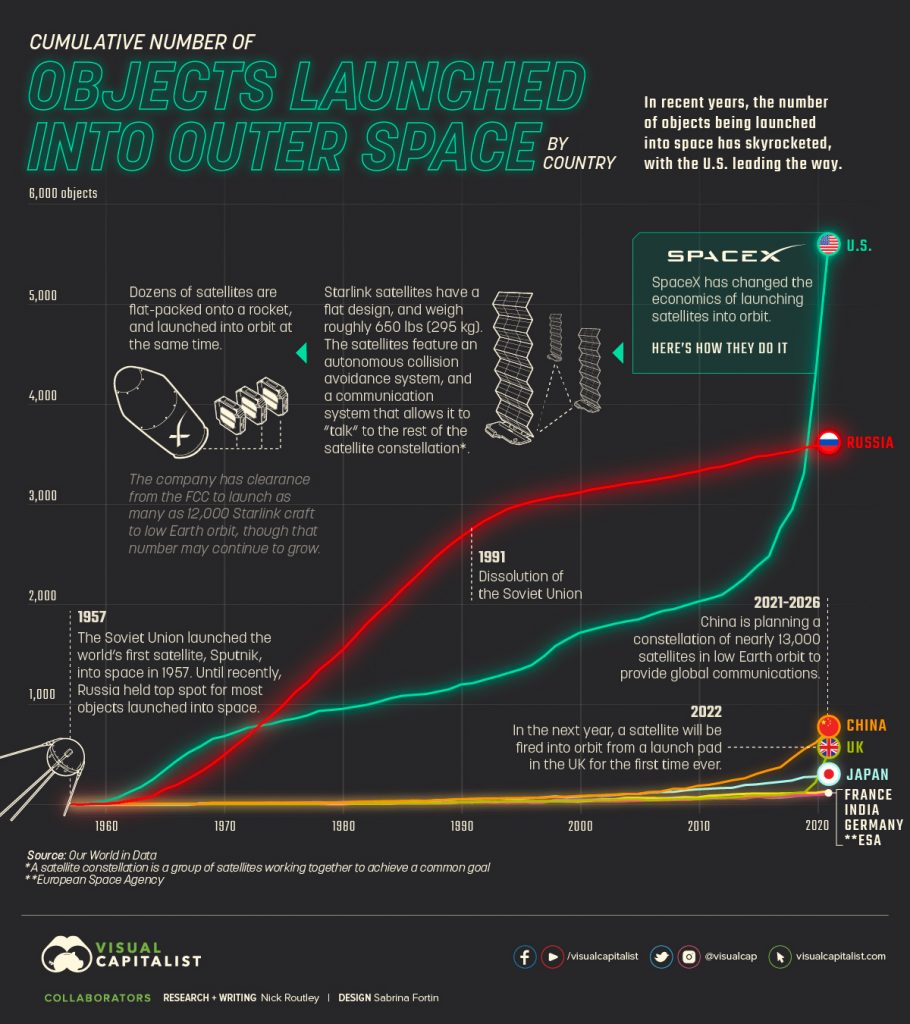
This visual, using data from Our World in Data, breaks down the amount of objects launched into space by country over time.

vc-Objects-Launched-into-Space-July-5-1

What Gets Launched Into Space?

What are the objects being sent into our atmosphere and why are they so important? Here’s a look at just a few:

  • Satellites
  • Crewed spacecraft
  • Probes
  • Space station flight equipment

Probes and landers like the Mars Rover, for example, have helped scientists explore other planets. Satellites provide us with everyday necessities like cell phone service, far reaching television signals, satellite imagery, and GPS.

As of late 2021, there were around 4,852 operational satellites in orbit2,944 belonging to the United States. Here’s a quick look at what the U.S. uses its satellites for:

  • Commercial: 2,516
  • Military: 230
  • Government: 168
  • Civil: 30

Many satellites in orbit, however, are no longer functional. In fact, there is a lot of junk in space—according to NASA, there are over 27,000 pieces of space debris in orbit.

The Space Race, by Country

The venture into outer space began during the Cold War when the USSR launched the first satellite, Sputnik 1 in 1957. After this, the U.S. and Soviet Union entered a definitive competition between technological advancements and scientific exploration into space—an extension of the battle between political ideologies.

Few countries have come close in matching either the U.S. or Russia so far. Here’s a look at the cumulative number of objects different countries have launched into orbit and beyond.Show 102550100 entriesSearch:

RankCountryCumulative Number of Objects Launched into Space
#1🇺🇸 United States5,534
#2🇷🇺 Russia3,611
#3🇨🇳 China731
#4🇬🇧 UK515
#5🇯🇵 Japan300
#6🇫🇷 France130
#7🇮🇳 India127
#8🇩🇪 Germany114
#9🇨🇦 Canada82
#10🇱🇺 Luxembourg53

One important disclaimer here is that not all of these countries have orbital launch capabilities, meaning that although the satellite in space may belong to a certain country, that doesn’t mean that it was launched by said country. For example, the UK’s first launch in 1971 was out of Australia and France’s first launch took place in Algeria in 1965.

In total, around 86 countries have attempted some kind of entry into space. However, as of 2022, only 11 countries have the ability to send objects into space using their own launch vehicles, and only three—the U.S., Russia, and China—have ever launched people into outer space.

The Future of Space

With corporations beginning to take the lead in this new frontier, the landscape of space launches is changing. In 2019 Starlink, a constellation of satellites which provides 36 countries with internet access, was launched. With over 2,200 Starlink satellites in the sky and counting, SpaceX’s ultimate goal is global internet coverage; China is planning a similar venture.

Beyond useful satellites and scientific exploration, other potential space industries are emerging.

As one example, the business of commercial space tourism is no longer a futuristic concept. In late 2021, famous billionaire and founder of Virgin Galactic, Richard Branson flew briefly into space on a private flight. Jeff Bezos, having founded Blue Origin, followed shortly after.

Today, both Blue Origin and Virgin Galactic are licensed by the Federal Aviation Administration for passenger space travel. However, if you want to be launched into space, it will cost you around $250,000-$500,000.

Source: Visual Capitalist

To See The Universe More Clearly, Think In Terms Of Processes, Not Objects

0

Nothing is fixed in time or space. Everything – from quantum particles to people, planets and galaxies – is in constant motion, and part of a constellation of inextricably interwoven systems.

That might seem like a strictly academic observation with little bearing on your day-to-day life, but, as Thomas Nail, a professor of philosophy at the University of Denver, argues in this short video, overlooking this fact can have real-world consequences. Instead of understanding the Universe in terms of inflexible objects, Nail proposes that we view our world in terms of processes subject to constant change. This, he argues, will lead to improvements in science, public policy and even interpersonal relationships.

Source: Aeon