
Home Blog Page 106

Sierra Space Successfully Completes Series Of Major Development Milestones For First Commercial Space Station

0
Second Sub-Scale LIFETM Habitat Test Article Exceeds NASA Certification Requirements After Ultimate Burst Pressure (UBP) Test

Sierra Space, a leading commercial space company building the first end-to-end business and technology platform in space, announced today that the company’s LIFE™ habitat (Large Integrated Flexible Environment) has successfully completed its second sub-scale Ultimate Burst Pressure (UBP) test. Following the success of its first UBP test in July of this year, this second test further establishes Sierra Space as the leader in commercial space station development and the only active commercial space company to meet multiple successful UBP trials.

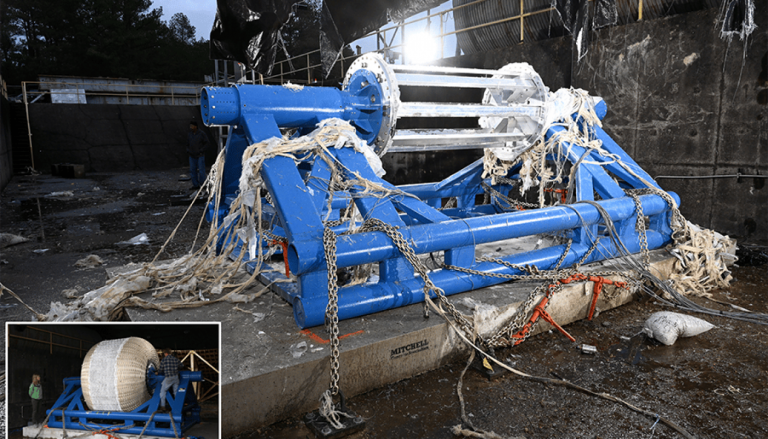
This latest test was performed on November 15 under NASA’s NextSTEP project for space habitation systems, which is managed by the agency’s Marshall Space Flight Center. NASA subject matter experts and ILC Dover collaborated with Sierra Space on the test, which occurred in a historic setting on Redstone Arsenal in Huntsville, Alabama. Due to the explosive nature of the test, the team placed the sub-scale space habitat in the flame trench of the Saturn 1/1B test stand, where NASA tested rockets for the Apollo program.

Sierra Space’s LIFE forms part of the company’s in-space destinations technology portfolio. The inflatable module is a three-story commercial habitation and science platform designed for low-Earth orbit (LEO) that will allow humans to live and work comfortably in space. LIFE is constructed of high-strength “softgoods” materials, which are sewn and woven fabrics – primarily Vectran – that become rigid structures when pressurized Sierra Space is working towards NASA softgoods certification and is already exceeding programmatic requirements that demonstrate LIFE has followed a successful systematic and comprehensive design, fabrication and test program. The two sub-scale UBP tests in July and November achieved maximum burst pressure rates of 192 and 204 psi, respectively. Exceeding the safety requirement of 182.4 psi demonstrates that Sierra Space can meet the 4x safety factor required for softgoods inflatables within its current architecture at one-third scale.

“The LIFE habitat module is essential technology for enabling humans to safely and comfortably begin to develop new civilizations in space,” said Sierra Space CEO Tom Vice. “This project will service many different opportunities for the new space economy, and the results of this most recent test and milestone are testament to the progress our team is making to enable the next chapter in space commercialization. We look forward to continuing to build this key element in our technology portfolio and paving the way for the development of advanced inflatable habitat systems and architectures.”

This series of sub-scale tests is designed to support LIFE’s overall, full-scale development and future inflatable habitats, as Sierra Space builds the next generation of inflatable habitat architectures. These early “fleet” leader tests provide the design and analysis data to determine the safety and reliability of the inflatable architecture systems. “Sierra Space is making incredible strides in the inflatable habitat technology development roadmap. In working with our partners ILC Dover and NASA, Sierra Space is quickly moving closer to softgoods certification,” added Shawn Buckley, LIFE Chief Engineer and Senior Director of Engineering at Sierra Space. “This second successful UBP test proves we can demonstrate design, manufacturing and assembly repeatability, all of which are keys areas for certification.”
Full-scale LIFE UBP tests will begin in 2023, in order to complete NASA’s certification of the habitat’s primary structure for human use in space. NASA’s NextSTEP program falls under the HQ Explorations Systems Development Mission Directorate (ESDMD) Technical Integration’s (TI) Pre-Formulation (PF) Habitation Team. For NextSTEP-2, Sierra Space is focused on performing critical risk reduction tests and assessing LIFE’s extensibility to multiple space destinations including the moon and Mars.

Among other missions in coming years, LIFE will serve as both a habitation and a payload element for the Orbital Reef commercial space station, a collaboration between Sierra Space and Blue Origin.

To view the Ultimate Burst Pressure Test on YouTube, visit: Sierra Space’s LIFE Habitat Successfully Completes Second Ultimate Burst Pressure Test

About Sierra Space

Sierra Space (www.sierraspace.com) is a leading commercial space company at the forefront of innovation and the commercialization of space in the Orbital Age, building platforms in space to benefit life on Earth. With more than 30 years and 500 missions of space flight heritage, the company is enabling the future of space transportation with Dream Chaser®, the world’s only winged commercial spaceplane. Under construction at its Colorado headquarters and expected to launch in 2023 on the first of a series of NASA missions to the International Space Station, Dream Chaser can safely carry cargo – and eventually crew – to on-orbit destinations, returning to land on compatible commercial airport runways worldwide. Sierra Space is also building an array of in-space destinations for low-Earth orbit (LEO) commercialization including the LIFE™ habitat (Large Integrated Flexible Environment), a three-story commercial habitation and science platform designed for LEO. Both Dream Chaser and LIFE are central components to Orbital Reef, a mixed-use business park in LEO being developed by principal partners Sierra Space and Blue Origin, which is expected to be operational by the end of the decade.

MEDIA CONTACT:

Alex Walker
Sierra Space (303) 803-2297
[email protected]
Delta 2 Leverages Space Domain Awareness In Support Of Artemis I

0
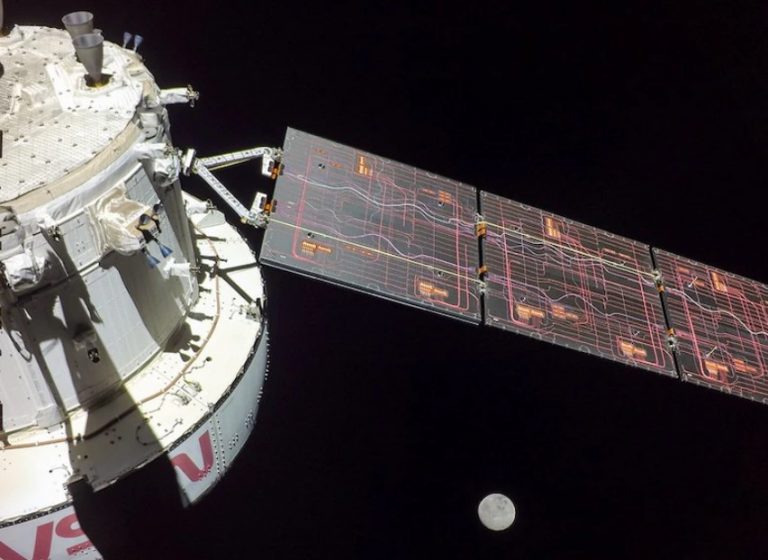
On Flight Day 9, NASA’s Orion spacecraft captured imagery looking back at the Earth from a camera mounted on one of its solar arrays. The spacecraft is enroute to distant retrograde orbit of the Moon.

Guardians at Space Delta 2 honed their skills in Space Domain Awareness by supporting Artemis I’s 25-day, 1.4-million-mile mission.

On November 16, 2022, NASA’s Artemis I successfully launched from Space Launch Complex 39B. This landmark event marks the first successful launch of the Orion spacecraft and Space Launch System rocket. Artemis I reentered Earth’s atmosphere on December 11, 2022.

“Providing support to the Artemis I mission allows Delta 2 sensors to test cislunar tracking tactics, techniques, and procedures for future crewed missions,” said Col Marc A. Brock, Space Delta 2 commander. “SDA requires Space Delta 2 operators to obtain and maintain a continuous, comprehensive, and combat‐relevant understanding of the space situation. This data is critical to satellite operators all over the world in achieving mission success as the space domain becomes more contested and congested.”

Over the course of Artemis I’s flight, Space Delta 2 and its components, the 15th Space Surveillance Squadron, 18th Space Defense Squadron, 19th Space Defense Squadron and 20th Space Surveillance Squadron, collaborated to test capabilities to maintain custody of cislunar objects. Additionally, they defined xGEO tracking, which refers to any area beyond the geosynchronous orbit where the standard laws of orbital dynamics no longer apply. 

Space Delta 2 also functioned as a liaison by sharing information, data points, and lessons learned among the Department of Defense, commercial, academic and other government partners.

Space Delta 2’s mission is to prepare and present assigned and attached forces enabled to execute combat‐ready SDA operations. In other words, they aim to maintain and ensure freedom of action for the United States, its allies and commercial partners in the space domain

“SDA is the foundation for all operations occurring in, from and to space. It serves as the cornerstone for Joint Force success,” said Brock. “Timely and accurate xGEO space object detection and tracking in conjunction with our traditional SDA operations closer to Earth will be essential to our support for human space flight safety from launch to lunar landing and return, to facilitate human exploration and to promote the peaceful and responsible use of space.”

XGEO tracking and the cislunar regime are rapidly receiving more focus from all space-faring nations and must be included in the totality of Space Delta 2’s mission. Space Delta 2’s ability to support missions like Artemis through their operational skillset and integrate with national and global partners help secure our place as a leader for the peaceful use of the global commons.

By 1st Lt. Hillary Gibson 
Source United States Space Force

Latest International Water Satellite Packs An Engineering Punch

0
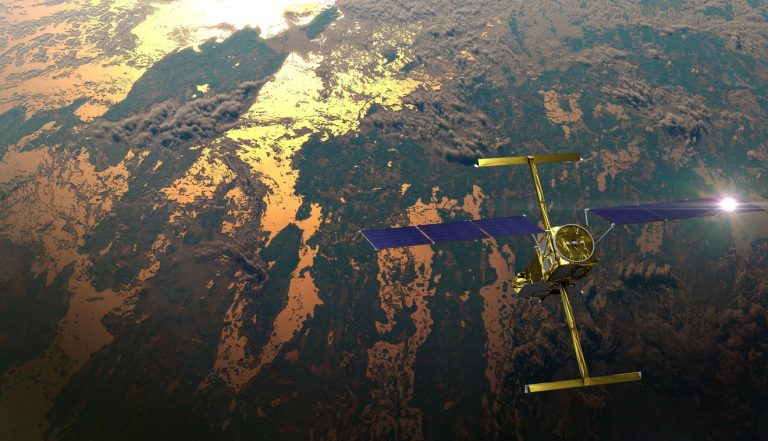
This illustration shows the SWOT satellite in orbit with sunlight glinting off one array of solar panels, as well as both KaRIn instrument antennas deployed.  Credit: CNES Full Image Details

Meet the scientific heart of the Surface Water and Ocean Topography mission, which will see Earth’s water in higher definition than ever before.

Set for a Thursday, Dec. 15 launch, the Surface Water and Ocean Topography (SWOT) satellite promises to provide an extraordinary accounting of water over much of Earth’s surface. Its measurements of fresh water and the ocean will help researchers address some of the most pressing climate questions of our time and help communities prepare for a warming world. Making this possible is a scientific instrument called the Ka-band Radar Interferometer (KaRIn).

This animation shows the two antennas for SWOT’s Ka-band Radar Interferometer (KaRIn) instrument unfolding in orbit. Credit: NASA/JPL-Caltech

Years in development, the instrument has been designed to capture very precise measurements of the height of water in Earth’s freshwater bodies and the ocean. KaRIn will measure the height of water in the ocean, “seeing” features like currents and eddies that are less than 13 miles (20 kilometers) across – up to 10 times smaller than those detectable with other sea level satellites. It will also collect data on lakes and reservoirs larger than 15 acres (62,500 square meters) and rivers wider than 330 feet (100 meters) across.

“For freshwater, this will be a quantum leap in terms of our knowledge,” said Daniel Esteban-Fernandez, KaRIn instrument manager at NASA’s Jet Propulsion Laboratory in Southern California. For example, researchers currently have good data on only a few thousand lakes around the world; SWOT will increase that number to at least a million.

The cutting-edge KaRIn instrument lies at the heart of this international mission, the latest in a longstanding collaboration between NASA and the French space agency Centre National d’Études Spatiales (CNES), with contributions from the Canadian Space Agency (CSA) and the UK Space Agency.

A Bigger Picture

Until now, researchers looking to study a body of water relied on instruments that measure at specific locations – like gauges in rivers or the ocean – or that are space-based, gathering data along narrow “tracks” of Earth they can see from orbit. Researchers then have to extrapolate if they want a broader idea of what’s happening in a water body.

KaRIn is different. The radar instrument uses the Ka-band frequency at the microwave end of the electromagnetic spectrum to penetrate cloud cover and the dark of night. As a result, it can take measurements regardless of weather or time of day. The instrument configuration consists of one antenna at each end of a boom that’s 33 feet (10 meters) long. By bouncing radar pulses off the water’s surface and receiving the return signal with both antennas, KaRIn will collect data along a swath 30 miles (50 kilometers) wide on either side of the satellite. “With KaRIn data, we’ll be able to actually see what’s happening, rather than relying on these extrapolations,” said Tamlin Pavelsky, the NASA freshwater science lead for SWOT, based at the University of North Carolina, Chapel Hill.

The two KaRIn antennas will see the same spot on Earth from 553 miles (890 kilometers) above. Since the antennas look at a given point on Earth from two directions, the return signals reflected back to the satellite arrive at each antenna slightly out of step, or phase, with one another. Using this phase difference, the distance between the two antennas, and the radar wavelength, researchers can calculate the height of the water that KaRIn is looking at.

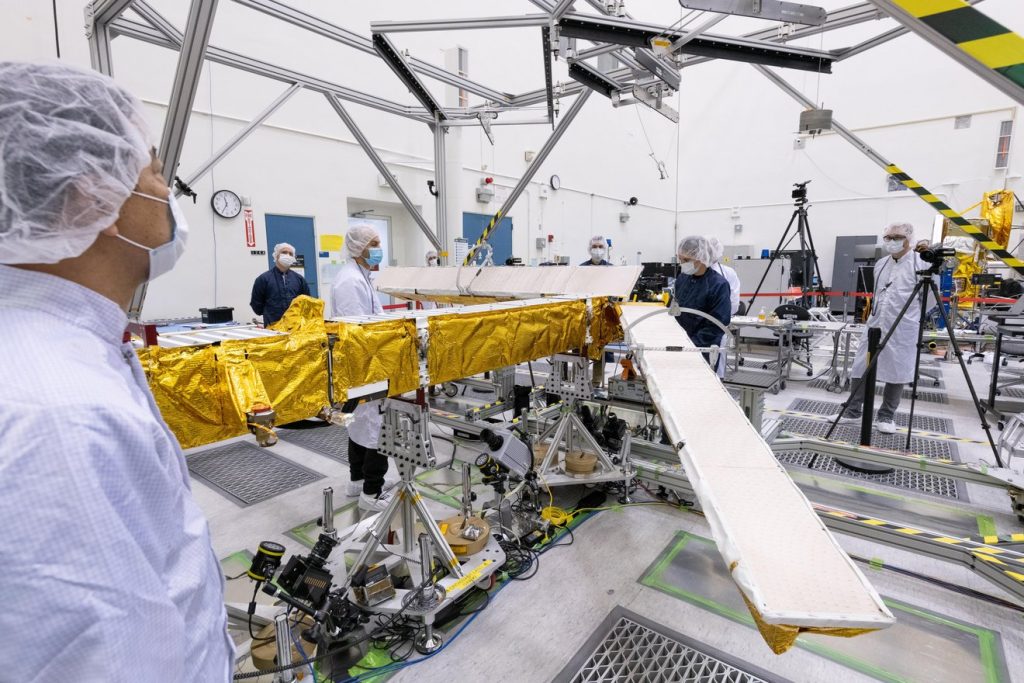
Members of the international SWOT mission test one of the antennas for the Ka-band Radar Interferometer (KaRIn) instrument in a clean room at NASA’s Jet Propulsion Laboratory in Southern California.  Credit: NASA/JPL-Caltech  Full Image Details

Breakthrough Technology

Such a remarkable instrument demanded a lot from the team that developed it. For starters, there was the need for stability. “You have two antennas looking at the same spot on the ground, but if their footprints don’t overlap, you won’t see anything,” said Esteban-Fernandez. That was one of the many technical challenges the mission faced in creating KaRIn.

Engineers also need to know exactly how SWOT is positioned in space to ensure the accuracy of KaRIn’s data. If researchers don’t know the spacecraft is tilted, for instance, they can’t account for that in their calculations. “Imagine that the boom rolls because the spacecraft moves, so one antenna is slightly higher than the other,” Esteban-Fernandez said. “That will skew the results – it’ll look like all your water is on a slope.” So engineers included a high-performance gyroscope on the satellite to account for shifts in SWOT’s position.

Engineers designing KaRIn also had to contend with the amount of radar power transmitted. “To measure things down to centimeter accuracy, you need to transmit radar pulses of 1.5 kilowatts, which is a huge amount of power for a satellite like this,” said Esteban-Fernandez. “In order to generate that, you have to have tens of thousands of volts operating on the satellite.” The engineers needed to use designs and materials specific to high-voltage systems when manufacturing the electronics to help the satellite accommodate such high-power and high-voltage needs.

The team spent years overcoming those and a multitude of other challenges to deliver the KaRIn instrument. Very soon the interferometer will fly for the first time on the SWOT satellite and start sending back terabytes of data. “KaRIn will be putting something on the table that just didn’t exist before,” said Esteban-Fernandez.

More About the Mission

Scheduled to launch from Vandenberg Space Force Base in Central California on Dec. 15, SWOT is being jointly developed by NASA and CNES, with contributions from the CSA and the UK Space Agency. JPL, which is managed for NASA by Caltech in Pasadena, California, leads the U.S. component of the project. For the flight system payload, NASA is providing the Ka-band Radar Interferometer (KaRIn) instrument, a GPS science receiver, a laser retroreflector, a two-beam microwave radiometer, and NASA instrument operations. CNES is providing the Doppler Orbitography and Radioposition Integrated by Satellite (DORIS) system, the dual frequency Poseidon altimeter (developed by Thales Alenia Space), the KaRIn radio-frequency subsystem (together with Thales Alenia Space and with support from the UK Space Agency), the satellite platform, and ground control segment. CSA is providing the KaRIn high-power transmitter assembly. NASA is providing the launch vehicle and associated launch services.

To learn more about SWOT, visit: https://swot.jpl.nasa.gov/
Source JPL

Antihelium Nuclei As Messengers From The Depths Of The Galaxy

0
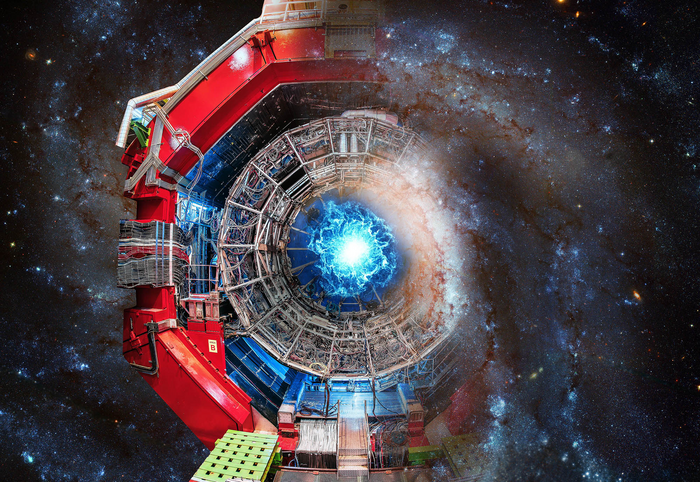
Illustration of antihelium annihilation in the ALICE detector at CERN as well as in the universe. CREDIT ORIGINS Cluster/S. Kwauka

How are galaxies born, and what holds them together? Astronomers assume that dark matter plays an essential role.

However, as yet it has not been possible to prove directly that dark matter exists. A research team including Technical University of Munich (TUM) scientists has now measured for the first time the survival rate of antihelium nuclei from the depths of the galaxy – a necessary prerequisite for the indirect search for Dark Matter.

Many things point to the existence of dark matter. The way in which galaxies move in galactic clusters, or how fast stars circle the center of a galaxy results in calculations which indicate that there must be far more mass present than what we can see. Approximately 85 percent of our Milky Way for example consists of a substance which is not visible and which can only be detected based on its gravitational effects. As of today it has still not been possible to directly prove the existence of this material.

Several theoretical models of dark matter predict that it could be composed of particles which interact weakly with one another. This produces antihelium-3 nuclei, which consist of two antiprotons and one antineutron. These nuclei are also generated in high-energy collisions between cosmic radiation and common matter like hydrogen and helium – however, with energies different from those that would be expected in the interaction of dark matter particles.

In both processes, the antiparticles originate in the depths of the galaxy, several tens of thousands of lightyears away from us. After their creation, a part of them makes its way in our direction. How many of these particles survive this journey unscathed and reach the vicinity of the Earth as messengers of their formation process determines the transparency of the Milky Way for antihelium nuclei. Until now scientists have only been able to roughly estimate this value. However, an improved approximation of transparency, a unit of measure for the number and energies of antinuclei, will be important for interpreting future antihelium measurements.

LHC particle accelerator as antimatter factory

Researchers from the ALICE collaboration have now carried out measurements that have enabled them to determine the transparency more precisely for the first time. ALICE stands for A Large Ion Collider Experiment and is one of the largest experiments in the world to explore physics on the smallest length scales. ALICE is part of the Large Hadron Collider (LHC) at CERN.

The LHC can generate large amounts of light antinuclei such as antihelium. To do so, protons and lead atoms are each put on a collision course. The collisions produce particle showers which are then recorded by the detector of the ALICE experiment. Thanks to several subsystems of the detector, the researchers can then detect the antihelium-3 nuclei that have formed and follow their trails in the detector material. This makes it possible to quantify the probability that an antihelium-3 nucleus will interact with the detector material and disappear. Scientists from TUM and the Excellence Cluster ORIGINS have contributed significantly to the analysis of the experimental data.

Galaxy transparent for antinuclei

Using simulations, the researchers were able to transfer the findings from the ALICE experiment to the entire galaxy. The result: About half of the antihelium-3 nuclei which were expected to be generated in the interaction of dark matter particles would reach the vicinity of the Earth. Our Milky Way is thus 50 percent permeable for these antinuclei. For antinuclei generated in collisions between cosmic radiation and the interstellar medium, the resulting transparency varies from 25 to 90 percent with increasing antihelium-3 momentum. However, these antinuclei can be distinguished from those generated from dark matter based on their higher energy.

This means that antihelium nuclei can not only travel long distances in the Milky Way, but also serve as important informants in future experiments: Depending on how many antinuclei arrive at the Earth and with which energies, the origin of these well-travelled messengers can be interpreted as cosmic rays or dark matter thanks to the new calculations.

Reference for future antinuclei measurements in space

“This is an excellent example of an interdisciplinary analysis that illustrates how measurements at particle accelerators can be directly linked with the study of cosmic rays in space,” says ORIGINS scientist Prof. Laura Fabbietti of the TUM School of Natural Sciences. The results from the ALICE experiment at the LHC are of great importance for the search for antimatter in space with the AMS-02 module (Alpha Magnetic Spectrometer) on the International Space Station (ISS). Starting in 2025 the GAPS balloon experiment over the Arctic will also examine incoming cosmic rays for antihelium-3.

Further information:
The work on the antihelium-3 interaction, led by Prof. Dr. Laura Fabbietti, involved research groups led by Prof. Dr. Alejandro Ibarra at TUM and Dr. Andrew Strong at the Max Planck Institute for Extraterrestrial Physics. This research has been funded by the Federal Ministry of Education and Research, and also by the Deutsche Forschungsgemeinschaft (DFG, German Research Foundation) through the Excellence Cluster ORIGINS, EXC 2094 – 390783311 and the Collaborative Research Center SFB1258.

By Keith Cowing
Source SpaceRef

The First Ultraviolet Imaging Of The Sun’s Middle Corona

0
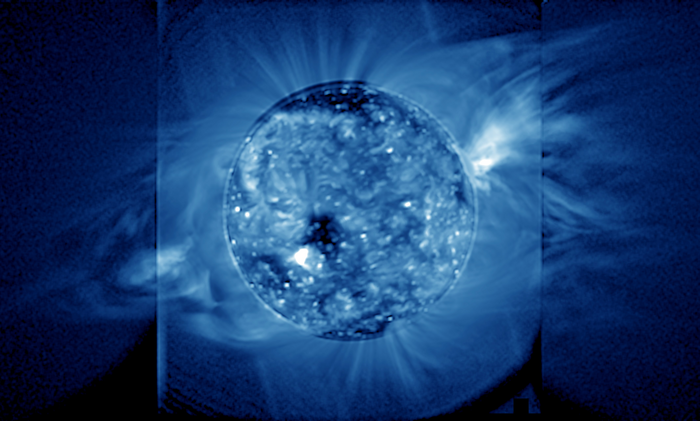
Observation of web-like plasma structures in the Sun’s middle corona, which could lead to a better understanding of the solar wind and its interactions with the rest of the solar system. CREDIT SwRI/NOAA

A team of researchers from Southwest Research Institute (SwRI), NASA and the Max Planck Institute for Solar System Research (MPS) have discovered web-like plasma structures in the Sun’s middle corona.

The researchers describe their innovative new observation method, imaging the middled corona in ultraviolet (UV) wavelength, in a new study published in Nature Astronomy. The findings could lead to a better understanding of the solar wind’s origins and its interactions with the rest of the solar system.

Since 1995, the U.S. National Oceanic and Atmospheric Administration has observed the Sun’s corona with the Large Angle and Spectrometric Coronagraph (LASCO) stationed aboard the NASA and European Space Agency Solar and Heliospheric Observatory (SOHO) spacecraft to monitor space weather that could affect the Earth. But LASCO has a gap in observations that obscures our view of the middle solar corona, where the solar wind originates.

“We’ve known since the 1950s about the outflow of the solar wind. As the solar wind evolves, it can drive space weather and affect things like power grids, satellites and astronauts,” said SwRI Principal Scientist Dr. Dan Seaton, one of the authors of the study. “The origins of the solar wind itself and its structure remain somewhat mysterious. While we have a basic understanding of processes, we haven’t had observations like these before, so we had to work with a gap in information.”

To find new ways to observe the Sun’s corona, Seaton suggested pointing a different instrument, the Solar Ultraviolet Imager (SUVI) on NOAA’s Geostationary Operational Environmental Satellites (GOES), at either side of the Sun instead of directly at it and making UV observations for a month. What Seaton and his colleagues saw were elongated, web-like plasma structures in the Sun’s middle corona. Interactions within these structures release stored magnetic energy propelling particles into space.

“No one had monitored what the Sun’s corona was doing in UV at this height for that amount of time. We had no idea if it would work or what we would see,” he said. “The results were very exciting. For the first time, we have high-quality observations that completely unite our observations of the Sun and the heliosphere as a single system.”

Seaton believes these observations could lead to more comprehensive insights and even more exciting discoveries from missions like PUNCH (Polarimeter to Unify the Corona and Heliosphere), an SwRI-led NASA mission that will image how the Sun’s outer corona becomes the solar wind.

“Now that we can image the Sun’s middle corona, we can connect what PUNCH sees back to its origins and have a more complete view of how the solar wind interacts with the rest of the solar system,” Seaton said. “Prior to these observations, very few people believed you could observe the middle corona to these distances in UV. These studies have opened up a whole new approach to observing the corona on a large scale.”

The paper “Direct observations of a complex coronal web driving highly structured slow solar wind” appears in Nature: https://www.nature.com/articles/s41550-022-01834-5

By Keith Cowing
Source SpaceRef

NASA Commits To Future Artemis Moon Rocket Production

0
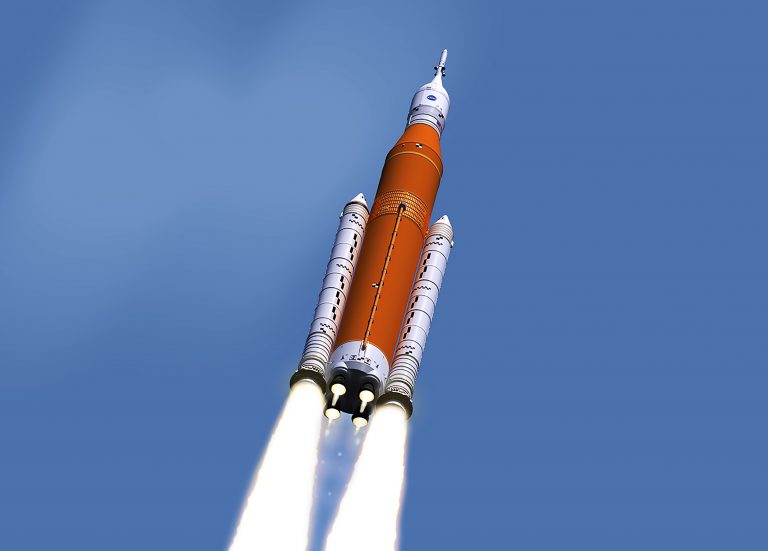
NASA and Space Launch System stages prime contractor Boeing are in various states of production on core stages for future Artemis missions.
NASA and Space Launch System stages prime contractor Boeing are in various states of production on core stages for future Artemis missions. Together with its twin solid rocket boosters, the Space Launch System core stage will produce 8.8 million pounds of thrust to send NASA’s Orion spacecraft, astronauts, and supplies beyond Earth’s orbit to the Moon. A powerful upper stage will be incorporated into the rocket beginning with Artemis IV. NASA joined the Space Launch System rocket’s core stage forward assembly, seen here, with the 130-foot liquid hydrogen tank in March 2022.
Credits: NASA/Eric Bordelon

NASA has finalized its contract with Boeing of Huntsville, Alabama, for approximately $3.2 billion to continue manufacturing core and upper stages for future Space Launch System (SLS) rockets for Artemis missions to the Moon and beyond.

Under the SLS Stages Production and Evolution Contract action, Boeing will produce SLS core stages for Artemis III and IV, procure critical and long-lead material for the core stages for Artemis V and VI, provide the exploration upper stages (EUS) for Artemis V and VI, as well as tooling and related support and engineering services.

In October 2019, NASA provided initial funding and authorization for Artemis III core stage work and targeted long-lead materials and cost-efficient bulk purchases. The finalization of this contract extends production activities and preparations for future work through July 2028. As part of the contract NASA may order up to 10 core stages and eight exploration upper stages total to support future deep space exploration missions.

“NASA’s Space Launch System rocket is the only rocket capable of sending large cargos and soon, astronauts to the Moon,” said John Honeycutt, SLS Program manager. “The SLS core stage is the backbone of NASA’s Moon rocket, producing more than 2 million pounds of thrust at launch, and the addition of the exploration upper stage will enable NASA to support missions to deep space through the 2030s.”

The SLS rocket delivers propulsion in stages and is designed to evolve to more advanced configurations to power NASA’s deep space missions. Each SLS rocket configuration uses the same 212-foot-tall core stage to produce more than 2 million pounds of thrust to help propel the mega rocket off the launch pad.

For the first three Artemis missions, SLS uses an interim cryogenic propulsion stage with one RL10 engine to send NASA’s Orion spacecraft to the Moon. Beginning with Artemis IV, the SLS Block 1B rocket configuration will be propelled by the more powerful EUS with larger fuel tanks and four RL10 engines to send a crewed Orion and large cargos to the Moon. All the structures for the rocket’s core stage and EUS are manufactured at NASA’s Michoud Assembly Facility in New Orleans. 

The contract comes as NASA optimizes manufacturing capabilities as Boeing will use Kennedy Space Center in Florida to perform some core stage assembly and outfitting activities beginning with the Artemis III rocket. In tandem, teams will continue all core stage manufacturing activities at Michoud.

Teams continue to make progress assembling and manufacturing core stages for Artemis II, III, and IV. The Artemis II stage is scheduled to be completed and delivered to Kennedy in 2023. The engine section for Artemis III was recently loaded onto NASA’s Pegasus barge for delivery to Kennedy, where it will be outfitted and later integrated with the rest of the rocket.

With Artemis, NASA will land the first woman and the first person of color on the lunar surface and establish long-term exploration at the Moon in preparation for human missions to Mars. SLS and NASA’s Orion spacecraft, along with the commercial human landing system and the Gateway in orbit around the Moon, are NASA’s backbone for deep space exploration.

For more information about the Space Launch System, visit: https://www.nasa.gov/sls

Rachel Kraft
Headquarters, Washington
202-358-1100
[email protected]

Corinne Edmiston
Marshall Space Flight Center, Huntsville, Alabama
256-975-6798
[email protected]

By Roxana Bardan
Source NASA

Artemis I – Flight Day 26: Orion Splashes Down, Concluding Historic Artemis I Mission

0
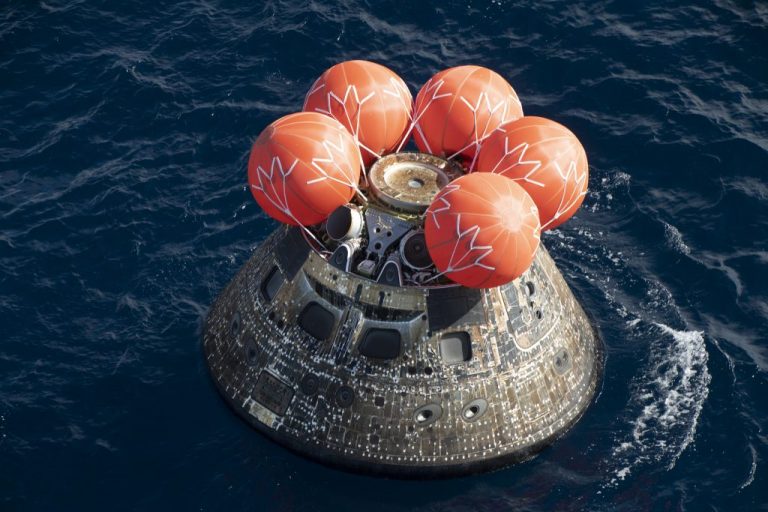
At 12:40 p.m. EST, Dec. 11, 2022, NASA’s Orion spacecraft for the Artemis I mission splashed down in the Pacific Ocean after a 25.5 day mission to the Moon. Orion will be recovered by NASA’s Landing and Recovery team, U.S. Navy and Department of Defense partners aboard the USS Portland ship. Credit: NASA/Kim Shiflett

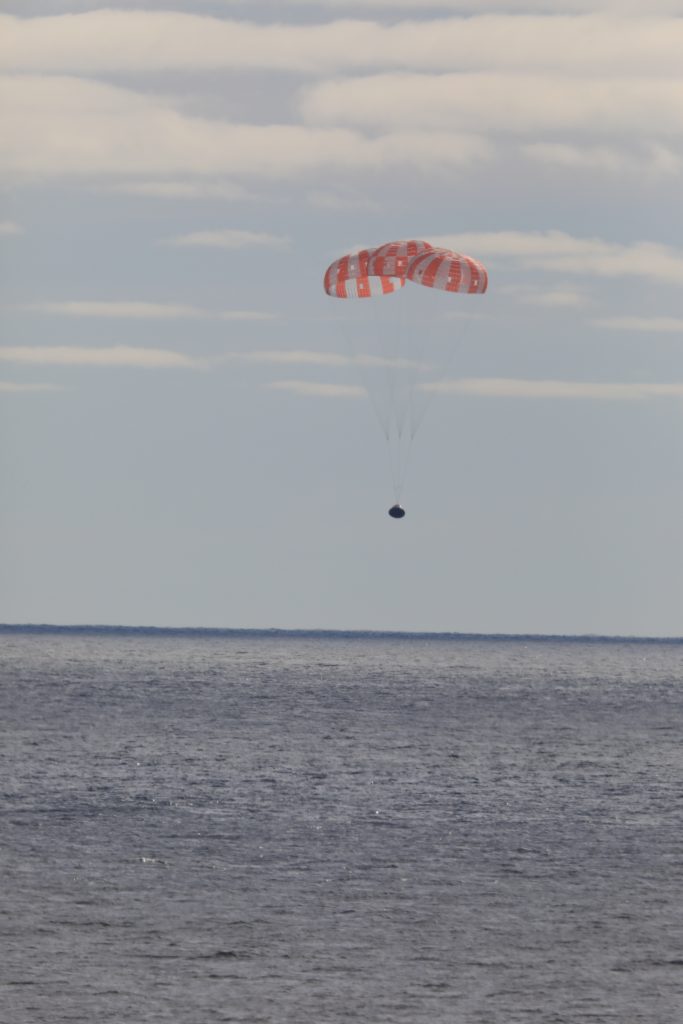
NASA’s Orion spacecraft successfully completed a parachute-assisted splashdown in the Pacific Ocean at 9:40 PST, 12:40 EST as the final major milestone of the Artemis I mission. Engineers will perform several additional tests while Orion is in the water and before powering down the spacecraft and handing it over to the recovery team aboard the USS Portland.

At the direction of the NASA recovery director, Navy divers and other team members in several inflatable boats will approach the spacecraft. When Orion is ready to be pulled into the ship’s well deck at the waterline, the divers will attach a cable, called the winch line, to pull the spacecraft into the ship and up to four additional tending lines to attach points on the crew module. The winch will pull Orion into a specially designed cradle inside the ship’s well deck and the other lines will control the motion of the spacecraft. Once Orion is positioned above the cradle assembly, technicians will drain the well deck and secure it on the cradle.

Once aboard the vessel, teams will take the spacecraft to U.S. Naval Base San Diego and soon return it to NASA’s Kennedy Space Center for inspection. Technicians in Florida will thoroughly inspect Orion, retrieving data recorded on board, removing onboard payloads, and more.

Artemis I was the first integrated test of NASA’s deep space exploration systems – the Orion spacecraft, SLS rocket, and the supporting ground systems – and the first in a series of increasingly complex missions at the Moon. Through Artemis missions, NASA will establish a long-term lunar presence for scientific discovery and prepare for human missions to Mars.

By cballart
Source NASA

Artemis I Update: Orion Secured Inside USS Portland Ahead Of Return To Shore  

0
At 12:40 p.m. EST, Dec. 11, 2022, NASA’s Orion spacecraft for the Artemis I mission splashed down in the Pacific Ocean after a 25.5 day mission to the Moon. Orion will be recovered by NASA’s Landing and Recovery team, U.S. Navy and Department of Defense partners aboard the USS Portland. Credit: NASA/James M. Blair

The Orion spacecraft has been secured in the well deck of the USS Portland. The ship will soon begin its trip back to U.S. Naval Base San Diego, where engineers will remove Orion from the ship in preparation for transport back to Kennedy Space Center in Florida for post-flight analysis.  

Upon Orion’s successful splashdown in the Pacific Ocean west of Baja California at 9:40 PST/12:40 EST Dec. 11, flight controllers in mission control at NASA’s Johnson Space Center in Houston spent about two hours performing tests in open water to gather additional data about the spacecraft, including on its thermal properties after enduring the searing heat of re-entry through Earth’s atmosphere. Recovery personnel also spent time collecting detailed imagery of the spacecraft before beginning to pull the capsule into the USS Portland’s well deck.   

The recovery process involved divers attaching a cable called a winch line and several additional tending lines attached to the crew module. The winch was used to pull Orion into a specially designed cradle inside the ship’s well deck and the other lines were used to control the motion of the spacecraft. The recovery team consists of personnel and assets from the U.S. Department of Defense, including Navy amphibious specialists and Space Force weather specialists, and engineers and technicians from Kennedy Space Center in Florida, Johnson Space Center in Houston, and Lockheed Martin Space Operations.  

Orion is expected to arrive to shore Dec. 13 with offload expected on Dec. 15. 

By Antonia Jaramillo Botero
Source NASA

NASA’s Lunar Flashlight Has Launched – Follow The Mission In Real Time

0
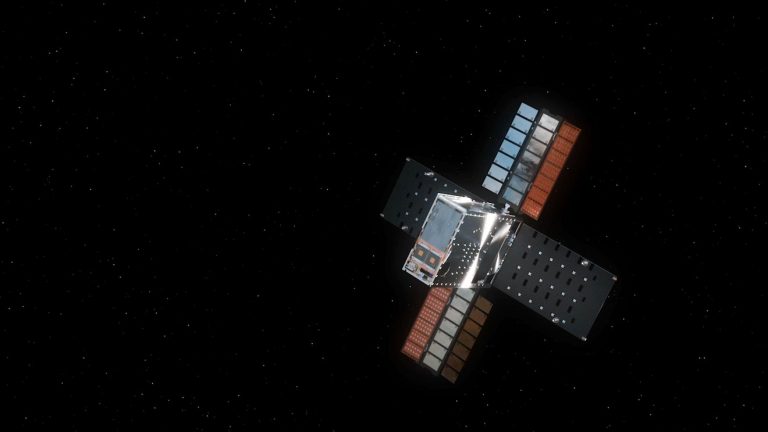
This illustration shows NASA’s Lunar Flashlight, with its four solar arrays deployed, shortly after launch. The small satellite, or SmallSat, will take about three months to reach its science orbit to seek out surface water ice in the darkest craters of the Moon’s South Pole.  Credit: NASA/JPL-Caltech

NASA’s Eyes on the Solar System web-based visualization tool lets you “see” the SmallSat as it journeys to the Moon and seeks out water ice in the darkest craters there.

NASA’s Lunar Flashlight has communicated with mission controllers and confirmed it is healthy after launching Sunday, Dec. 11, at 2:38 a.m. EST (Saturday, Dec. 10, at 11:38 p.m. PST) from Cape Canaveral Space Force Station in Florida. About 53 minutes after launch, the small satellite, or SmallSat, was released from its dispenser to begin a four-month journey to the Moon to seek out surface water ice in permanently shadowed craters at the lunar South Pole.

“It was a beautiful launch,” said John Baker, the Lunar Flashlight project manager at NASA’s Jet Propulsion Laboratory in Southern California. “The whole team is excited to see this small spacecraft do some big science in a few months’ time.”

While Lunar Flashlight will never return to Earth, the world hasn’t missed its last chance to see the briefcase-size spacecraft. Rendered in crisp detail, a 3D digital version of the solar-powered SmallSat has made its debut in NASA’s Eyes on the Solar System, the agency’s recently revamped visualization tool.

A 3D model of NASA’s Lunar Flashlight can be viewed in the fully interactive Eyes on the Solar System, including its journey to the Moon and when it reaches orbit to search for surface water ice at the lunar South Pole. Zoom out and use the fast-forward and rewind controls to follow the SmallSat.

“As soon as the Lunar Flashlight mission reached space, Eyes began tracking it, just as it will throughout the SmallSat’s entire science mission,” said Jason Craig, visualization producer at JPL. “The system uses real trajectory data from the mission, so as Lunar Flashlight’s journey unfolds, you can see exactly where the SmallSat is.”

The spacecraft’s avatar is an exact model of the real thing, down to its four solar arrays, science instrument, and thrusters. With the drag of a finger or mouse, users can change their perspective of the SmallSat and see where it is in space, whether on its long trek to lunar orbit or when it’s zooming above the lunar surface, collecting science data.

To get close to the Moon’s surface, the SmallSat will employ what’s called a near-rectilinear halo orbit – designed for energy efficiency – that will take it within just 9 miles (15 kilometers) over the lunar South Pole and 43,000 miles (70,000 kilometers) away at its farthest point. Only one other spacecraft has employed this type of orbit: NASA’s Cislunar Autonomous Positioning System Technology Operations and Navigation Experiment (CAPSTONE) mission, which launched earlier this year and can also be viewed in NASA Eyes, including as it makes its closest passes over the lunar North Pole.

Lunar Ice Science

Lunar Flashlight will use a reflectometer equipped with four lasers that emit near-infrared light in wavelengths readily absorbed by surface water ice. This is the first time that multiple colored lasers will be used to seek out ice inside these dark regions on the Moon, which haven’t seen sunlight in billions of years. Should the lasers hit bare rock or regolith (broken rock and dust), the light will reflect back to the spacecraft. But if the target absorbs the light, that would indicate the presence of water ice. The greater the absorption, the more ice there may be.

The science data collected by the mission will be compared with observations made by other lunar missions to help reveal the distribution of surface water ice on the Moon for potential use by future astronauts.

Lunar Flashlight will use a new kind of “green” propellant that is safer to transport and store than the commonly used in-space propellants such as hydrazine. In fact, the SmallSat will be the first interplanetary spacecraft to use this propellant, and one of the mission’s primary goals is to demonstrate this technology for future use. The propellant was successfully tested on a previous NASA technology demonstration mission in Earth orbit.

More About the Mission

Lunar Flashlight launched on a SpaceX Falcon 9 rocket as a rideshare with ispace’s HAKUTO-R Mission 1. Lunar Flashlight is managed for NASA by JPL, a division of Caltech in Pasadena, California. Barbara Cohen, the mission’s principal investigator, is based at NASA’s Goddard Space Flight Center in Greenbelt, Maryland. Lunar Flashlight will be operated by Georgia Tech, including graduate and undergraduate students. The Lunar Flashlight science team is distributed across multiple institutions, including Goddard, the University of California, Los Angeles, Johns Hopkins University Applied Physics Laboratory, and the University of Colorado.

The SmallSat’s propulsion system was developed by NASA’s Marshall Space Flight Center in Huntsville, Alabama, with development and integration support from Georgia Tech. NASA’s Small Business Innovation Research program funded component development from small businesses including Plasma Processes Inc. (Rubicon) for thruster development, Flight Works for pump development, and Beehive Industries (formerly Volunteer Aerospace) for specific 3D printed components. The Air Force Research Laboratory also contributed financially to the development of the Lunar Flashlight propulsion system. Lunar Flashlight is funded by the Small Spacecraft Technology program within NASA’s Space Technology Mission Directorate.

News Media Contact

Ian J. O’Neill
Jet Propulsion Laboratory, Pasadena, Calif.
818-354-2649
[email protected]

Sarah Frazier
NASA Headquarters, Washington
202-358-1600
[email protected]

UK Space Agency And NNL Work On World’s First Space Battery Powered By British Fuel

0
Image Credit: NNL

The UK Space Agency and the National Nuclear Laboratory (NNL) are to collaborate on the world’s first space battery powered by Americium-241.

This work, commissioned and funded by the UK Space Agency from NNL, will be delivered in a new £19 million laboratory in Cumbria equipped with next-generation equipment and technology. It will deliver a sovereign supply of fuel for space batteries in the context of a global shortage, enabling the UK and its partners to pursue new space science and exploration missions.

Creating new highly-skilled jobs in the North West of England, it will drive innovation in radiochemistry and separations science and open a new market for the UK space sector.

Atomic space batteries, also known as Radioisotope Power Systems (RPSs), release heat as the radioactivity within them decays. The heat can be used directly to prevent spacecraft from freezing and it can be converted into electricity to power onboard systems. The batteries go on working for decades, without need for maintenance over the many years in which a spacecraft could be travelling.

PUMA2

The support from the UK Space Agency follows the UK’s record investment to the European Space Agency for a range of new programmes, including £22 million for ENDURE (European Devices Using Radioisotope Energy), which will use radioisotopes to develop systems for warming and powering spacecraft.

Considered ‘mission critical technologies’ by space agencies in the UK and around the world, all the Apollo missions had an atomic battery in tow, as has every rover that has gone to Mars. Until now, these have been powered by Plutonium-238, a radioisotope produced only in the US, where supply is limited, and Russia, so an alternative is urgently needed.

NNL, the UK’s national laboratory for nuclear fission, has been working on this endeavor since 2009, when its researchers first discovered that Americium-241, an alternative to Plutonium-238, is produced during the radioactive decay of used fuel from nuclear reactors and that it emits power for over 400 years.

With the supply plentiful – the new laboratory is being opened at NNL’s flagship Central Laboratory on the Sellafield site, home to the largest resource of Americium-241 available for extraction in the world – the new collaboration will turn a proven scientific concept into a fully-realised technology. It will be operational within the next four years and is expected to be first used on the European Space Agency’s Argonaut mission to the Moon and for future missions into deep space.

Science Minister George Freeman said:

This new capability marks a significant milestone for the North West Space Cluster, adding skilled jobs to the existing 2,000 strong workforce.

This exciting work from the National Nuclear Laboratory is supported by over £19 million in government funding, creating a nuclear-based fuel that will put Sellafield and the North West firmly on the global space technology map.

Being able to offer a globally unique supply of Americium-241 will encourage investment and unlock growth opportunities for all sorts of UK industries looking to explore nuclear energy.

Professor Tim Tinsley, account director for this work at the National Nuclear Laboratory said:

For the past 50 years space missions have used Plutonium-238 to stop spacecrafts from freezing but it is in very limited supply. At NNL we have identified significant reserves of Americium-241, a radioisotope with similar properties to Plutonium-238 but game-changing potential for the UK’s space ambitions.

This work, which is being made possible through the support of UK Space Agency, will see us applying decades of experience in separating and purifying used nuclear material in order to unlock great public benefits, and it goes to the heart of our purpose of nuclear science to benefit society.

Dr Paul Bate, CEO at the UK Space Agency said:

We are backing technology and capabilities to support ambitious space exploration missions and boost sector growth across the UK.

This innovative method to create Americium to power space missions will allow us not only to sustain exploration of the Moon and Mars for longer periods of time, but to venture further into space than ever before.

Supporting the National Nuclear Laboratory’s expansion will make the UK the only country in the world capable of producing this viable alternative to Plutonium, reducing the global space community’s reliance on limited supplies, which are increasingly difficult and costly to obtain.

The UK Space Agency is committed to keeping space activities sustainable, and this resourceful technology exploits otherwise unused waste Plutonium biproducts without generating additional waste.