
Home Blog Page 98

NASA Missions Find ‘Jetlets’ Could Power The Solar Wind

0
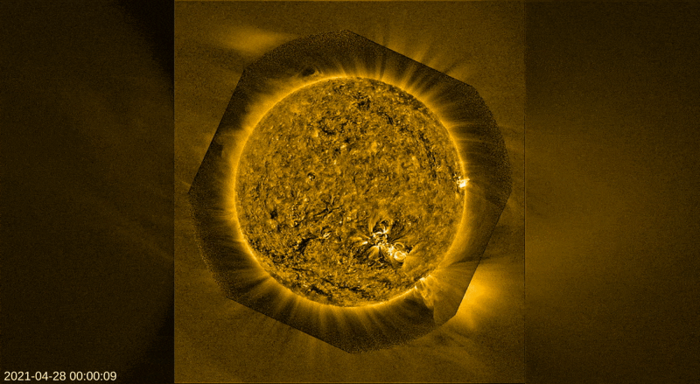
In the center, a gold, rotating Sun. Gold and black swirls across the surface of the Sun. Around the edges, streams of golden solar particles escape the star, into space. A composite video from NASA’s Solar Dynamics Observatory and NOAA’s Geostationary Operational Environmental Satellite – R Series Solar Ultraviolet Imager instrument shows small-scale jetlet activity at the base of the solar corona, or the Sun’s upper atmosphere, and its extension to higher altitudes. This can be seen in the wavy structures emanating from the surface of the Sun. The observations were made over the course of approximately 10 hours on April 28, 2021. CREDIT NASA/SDO/GOES-R

Scientists with NASA’s Parker Solar Probe mission have uncovered significant new clues about the origins of the solar wind – a continual stream of charged particles released from the Sun that fills the solar system.

Observations from multiple space and ground-based observatories show the solar wind could be largely fueled by small-scale jets, or “jetlets,” at the base of the corona – the Sun’s upper atmosphere. This finding is helping scientists better understand the 60-year-old mystery of what heats and accelerates the solar wind.

“This new data shows us how the solar wind gets going at its source,” said Nour Raouafi, the study lead and the Parker Solar Probe project scientist at the Johns Hopkins Applied Physics Laboratory (APL) in Laurel, Maryland. “You can see the flow of the solar wind rising from tiny jets of million-degree plasma all over the base of the corona. These findings will have a huge impact on our understanding of the heating and acceleration of the coronal and solar wind plasma.”

Understanding the solar wind is fundamental to our understanding of our solar system and others throughout the universe – and is the primary science goal of the Parker Solar Probe mission. Made of electrons, protons, and heavier ions, the solar wind courses through the solar system at roughly 1 million miles per hour. When the solar wind interacts with Earth’s magnetic field, it can create stunning auroras as well as disruptions in GPS and communications systems. Over time, the solar wind, and stellar winds in other solar systems, can also affect the composition and evolution of planetary atmospheres – even influencing planets’ habitability.

Strength in Numbers

At Earth, the solar wind is usually a constant breeze. Scientists have therefore been looking for a steady source at the Sun that could continually power the solar wind. However, the new findings – accepted for publication in the Astrophysical Journal and published on the ArXiv, an online preprint site – show the solar wind might be largely energized and fueled by individual jetlets that are intermittently erupting into the lower part of the corona. Though each jetlet is relatively small – just a few hundred miles long – their collective energy and mass could be enough to create the solar wind.

“This result implies that essentially all of the solar wind is likely released intermittently, becoming a steady flow in much the same way that the individual clapping sounds in an auditorium become a steady roar as an audience applauds,” said Craig DeForest, a solar physicist at the Southwest Research Institute in Boulder, Colorado, and coauthor on the new paper. “This changes the paradigm for how we think about certain aspects of the solar wind.”

Jetlets, which were first observed over a decade ago, are known to be caused by a process known as magnetic reconnection, which occurs as magnetic field lines become tangled and explosively realign. Reconnection is a common process in charged gases called plasmas and is found across the universe from the Sun to near-Earth space to around black holes. In the solar corona, reconnection creates these short-lived jets of plasma that pass energy and material into the upper corona, which escape across the solar system as the solar wind.

To study the jetlets and magnetic fields, scientists primarily used observations from the Solar Dynamics Observatory (SDO) and the Geostationary Operational Environmental Satellite-R Series’ Solar Ultraviolet Imager (GOES-R/SUVI) instrument, as well as high-resolution magnetic field data from the Goode Solar Telescope at the Big Bear Solar Observatory in California. The whole study was driven by a phenomenon first observed by Parker Solar Probe called switchbacks – magnetic zig-zag structures in the solar wind. The combination of observations from many viewpoints, along with the high resolution of those views and Parker Solar Probe’s up-close observations, helped the scientists understand the collective behavior of the jetlets.

“Previously, we could not detect enough such events to explain the observed amount of mass and energy streaming from the Sun,” said Judy Karpen, coauthor on the paper and heliophysicist at NASA’s Goddard Space Flight Center in Greenbelt, Maryland. “But the improved resolution of the observations and meticulous data processing enabled the new findings.”

The observations showed that jetlets are present in the lower solar atmosphere across the entire Sun. This makes them a tenable driver for the constant solar wind, as opposed to other phenomena that wax and wane with the 11-year cycle of solar activity, such as solar flares and coronal mass ejections. Furthermore, the scientists calculated that the energy and mass produced by the jetlets could provide most, if not all, of the amount of energy and mass seen in the solar wind.

A Breakthrough Decades in the Making

The solar wind was first proposed in the late 1950s by the visionary scientist Eugene Parker, namesake of the Parker Solar Probe. In 1988, Parker proposed the corona could be heated by “nanoflares,” tiny explosions on the solar atmosphere. Parker’s theory eventually became a leading candidate to explain the heating and acceleration of the solar wind.

“The tiny reconnection events we observed are, in a way, what Eugene Parker proposed over three decades ago,” Raouafi said. “I am convinced that we are on the right path toward understanding the solar wind and coronal heating.”

Continued observations from Parker Solar Probe and other instruments such as NASA’s Polarimeter to Unify the Corona and Heliosphere, or PUNCH, and the Daniel K. Inouye Solar Telescope, will help scientists confirm whether jetlets are the main source of solar wind.

“The findings make it much easier to explain how the solar wind is accelerated and heated,” DeForest said. “We’re not finished with the puzzle yet, but this is a major step forward for understanding a central mystery of solar physics.”

Parker Solar Probe was developed as part of NASA’s Living With a Star program to explore aspects of the Sun-Earth system that directly affect life and society. The Living With a Star program is managed by the agency’s Goddard Space Flight Center in Greenbelt, Maryland, for NASA’s Science Mission Directorate in Washington. The Johns Hopkins Applied Physics Laboratory designed, built, manages, and operates the spacecraft.

Space Weather

By Keith Cowing
Source SpaceRef
Help Discover Exoplanets With NASA

0
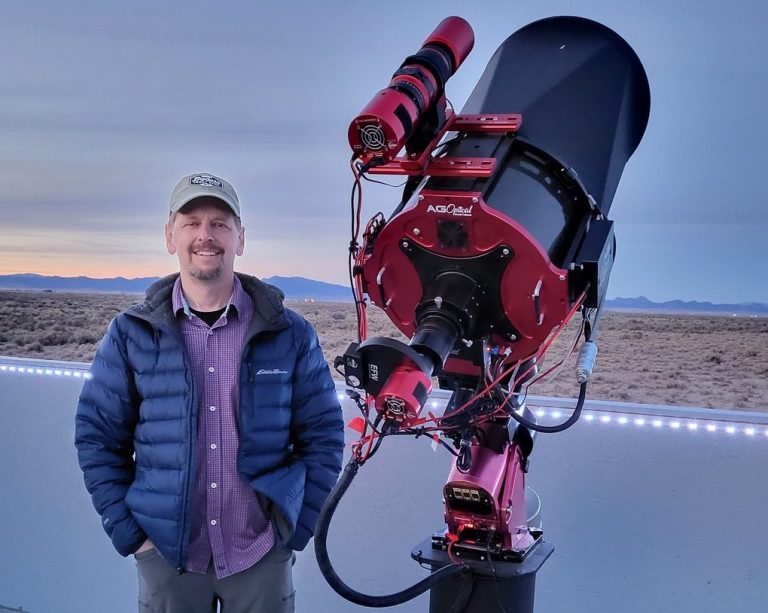
Want to take your own data? Although the number of targets you can see increases with the size of the telescope used, there’s no minimum size requirement. Citizen scientist Bryan E. Martin uses his personal telescope to observe exoplanet transits with NASA’s Universe of Learning Exoplanet Watch. There is no minimum size telescope necessary to participate, and those without a telescope can still analyze exoplanet transit data. Credit: Bryan E. Martin

The Exoplanet Watch project invites you to use your smartphone or personal telescope to help track worlds outside our solar system.

More than 5,000 planets have been confirmed to exist outside our solar system, featuring a wide array of characteristics like clouds made of glass and twin suns. Scientists estimate there could be millions more exoplanets in our home galaxy alone, which means professional astronomers could use your help tracking and studying them. This is where Exoplanet Watch comes in. Participants in the program can use their own telescopes to detect planets outside our solar system, or they can look for exoplanets in data from other telescopes using a computer or smartphone.

A planet passing in front of its parent star creates a drop in the star’s apparent brightness, called a transit. Exoplanet Watch participants can look for transits in data from ground-based telescopes, helping scientists refine measurements of the length of a planet’s orbit around its star. Credit: NASA’s Ames Research Center

Exoplanet Watch began in 2018 under NASA’s Universe of Learning, one of the agency’s Science Activation programs that enables anyone to experience how science is done and discover the universe for themselves. Until recently there were limits on how many people could help look through the data collected by other telescopes, but now this program is easily available to anyone. By following the site’s instructions, participants can download data to their device or access it via the cloud, and then assess it using a custom data analysis tool.

“With Exoplanet Watch you can learn how to observe exoplanets and do data analysis using software that actual NASA scientists use,” said Rob Zellem, the creator of Exoplanet Watch and an astrophysicist at NASA’s Jet Propulsion Laboratory in Southern California. “We’re excited to show more people how exoplanet science is really done.”

Helping Without a Telescope

Participants without telescopes can help astronomers comb through data that’s already been taken. The project has 10 years of exoplanet observations, collected by a small ground-based telescope south of Tucson, Arizona. This year, the project will start collecting additional data from two other telescopes at the Table Mountain facility in Southern California, which JPL manages.

These telescopes look at nearby stars and search for what scientists call exoplanet transits: regular dips in a star’s brightness caused by a planet passing between the star and Earth. Essentially, a transit is an observation of a planet’s silhouette against the bright glare of its star.

Participants in NASA’s Universe of Learning Exoplanet Watch will use the EXOplanet Transit Interpretation Code (EXOTIC) software to analyze data. No experience is necessary, and the project website includes tutorials and guides. Credit: NASA/JPL-Caltech

Multiple NASA telescopes look for exoplanet transits as a way to discover new planets, but Exoplanet Watch participants primarily observe transits by planets that have already been discovered to gain more information about their orbits. The time between exoplanet transits reveals how long it takes an exoplanet to orbit its parent star; the more transits that are measured, the more precisely the length of the orbit is known. If the timing of the orbit isn’t measured precisely, scientists who want to study those planets in more detail with large ground-based or space-based telescopes can lose valuable observing time while they wait for the planet to appear. Having volunteers sort through the data will save significant computing and processing time.

Exoplanet Watch participants will also look for variations in the apparent brightness of stars – changes caused by features such as flares (outbursts of light) and star spots (dark spots on a star’s surface). In transit measurements, these changes make a planet appear smaller or larger than it actually is. This work will help scientists anticipate the variability of a particular star before they study its exoplanets with large, sensitive telescopes like NASA’s James Webb Space Telescope.

Helping With Your Own Telescope

Want to take your own data? Although the number of targets you can see increases with the size of the telescope used, there’s no minimum size requirement. For example, Exoplanet Watch can help you detect exoplanet transits for hundreds of nearby stars with just a 6-inch (15-centimeter) telescope.
Exoplanet Watch combines observations of the same target by multiple sky watchers in order to get a higher-fidelity measurement. Combining observations is also useful if the planet’s transit lasts longer than the time a star is visible in the sky for a single observer: Multiple participants at different locations around the globe can collectively watch the duration of a long transit.

That was the case with a planet called HD 80606 b, which Webb will observe this year. A recent study of this planet led by Kyle Pearson, the Exoplanet Watch deputy science lead at JPL, combined observations from more than 20 Exoplanet Watch participants. The volunteer effort on HD 80606 b will free up almost two hours of time on Webb for other observations. And on missions that aim to observe hundreds or thousands of exoplanets, the number of minutes saved by refining planet transit measurements can add up and free a significant amount of observing time, according to Zellem.

One of the program’s policies requires that the first paper to make use of the observations or analysis done by volunteers will list those volunteers as co-authors, which was the case with the study led by Pearson. “I hope this program lowers barriers to science for a lot of people and inspires the next generation of astronomers to join our field,” said Zellem.

By Keith Cowing
Source SpaceRef

Hydrogen Masers Reveal New Secrets Of Massive Star MWC 349A

0
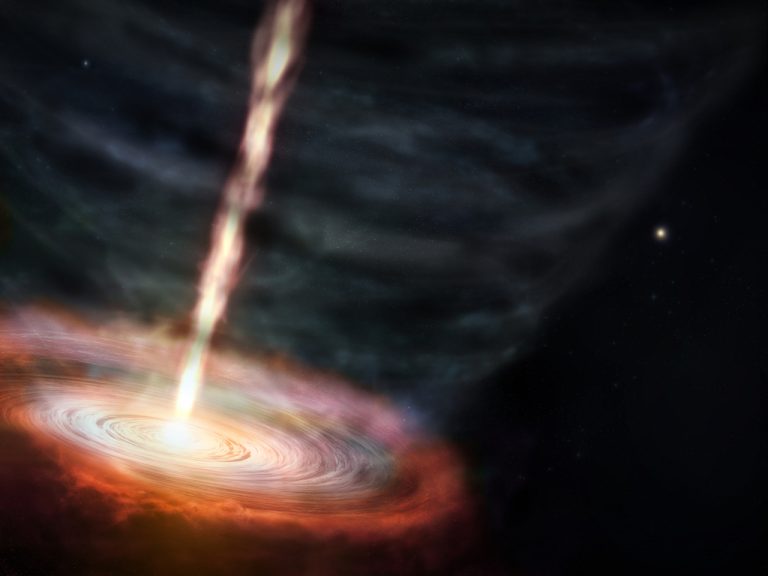
Like lasers in visible light, masers are amplified electromagnetic waves in the microwave wavelengths. We use masers generated by hydrogen to probe the physical and dynamic structures in the gas surrounding star MWC 349A, which is about 30 times the mass of the Sun. Analysis of observations with the Atacama Millimeter/submillimeter Array revealed a flattened gas disk with a diameter of 50 au, approximately the size of the solar system, and a wind moving away from the star at a speed of 500 km/s, possibly launched by the magnetic force. Credit: NRAO/Melissa Weiss

While using the Atacama Large Millimeter/submillimeter Array (ALMA) to study the masers around oddball star MWC 349A scientists discovered something unexpected: a previously unseen jet of material launching from the star’s gas disk at impossibly high speeds.

What’s more, they believe the jet is caused by strong magnetic forces surrounding the star. The discovery could help researchers to understand the nature and evolution of massive stars and how hydrogen masers are formed in space. The new observations were presented today in a press conference at the 241st meeting of the American Astronomical Society (AAS) in Seattle, Washington.

Located roughly 3,900 light-years away from Earth in the constellation Cygnus, MWC 349A’s unique features make it a hot spot for scientific research in optical, infrared, and radio wavelengths. The massive star— roughly 30 times the mass of the Sun— is one of the brightest radio sources in the sky, and one of only a handful of objects known to have hydrogen masers. These masers amplify microwave radio emissions, making it easier to study processes that are typically too small to see. It is this unique feature that allowed scientists to map MWC 349A’s disk in detail for the first time.

“A maser is like a naturally occurring laser,” said Sirina Prasad, an undergraduate research assistant at the Center for Astrophysics | Harvard & Smithsonian (CfA), and the primary author of the paper. “It’s an area in outer space that emits a really bright kind of light. We can see this light and trace it back to where it came from, bringing us one step closer to figuring out what’s really going on.”

Leveraging the resolving power of ALMA’s Band 6, developed by the US National Science Foundation’s National Radio Astronomy Observatory (NRAO), the team was able to use the masers to uncover the previously unseen structures in the star’s immediate environment. Qizhou Zhang, a senior astrophysicist at CfA, and the project’s principal investigator added, “We used masers generated by hydrogen to probe the physical and dynamic structures in the gas surrounding MWC 349A and revealed a flattened gas disk with a diameter of 50 au, approximately the size of the Solar System, confirming the near-horizontal disk structure of the star. We also found a fast-moving jet component hidden within the winds flowing away from the star.”

The observed jet is ejecting material away from the star at a blistering 500 km per second. That’s akin to traveling the distance between San Diego, California and Phoenix, Arizona in the literal blink of an eye. According to researchers, it is probable that a jet moving this fast is being launched by a magnetic force. In the case of MWC 349A, that force could be a magnetohydrodynamic wind— a type of wind whose movement is dictated by the interplay between the star’s magnetic field and gases present in its surrounding disk.

“Our previous understanding of MWC 349A was that the star was surrounded by a rotating disk and photo-evaporating wind. Strong evidence for an additional collimated jet had not yet been seen in this system. Although we don’t yet know for certain where it comes from or how it is made, it could be that a magnetohydrodynamic wind is producing the jet, in which case the magnetic field is responsible for launching rotating material from the system,” said Prasad. “This could help us to better understand the disk-wind dynamics of MWC 349A, and the interplay between circumstellar disks, winds, and jets in other star systems.”

About NRAO

The National Radio Astronomy Observatory (NRAO) is a facility of the National Science Foundation, operated under cooperative agreement by Associated Universities, Inc.

About ALMA

The Atacama Large Millimeter/submillimeter Array (ALMA), an international astronomy facility, is a partnership of the European Organisation for Astronomical Research in the Southern Hemisphere (ESO), the U.S. National Science Foundation (NSF) and the National Institutes of Natural Sciences (NINS) of Japan in cooperation with the Republic of Chile. ALMA is funded by ESO on behalf of its Member States, by NSF in cooperation with the National Research Council of Canada (NRC) and the Ministry of Science and Technology (MOST) and by NINS in cooperation with the Academia Sinica (AS) in Taiwan and the Korea Astronomy and Space Science Institute (KASI).

ALMA construction and operations are led by ESO on behalf of its Member States; by the National Radio Astronomy Observatory (NRAO), managed by Associated Universities, Inc. (AUI), on behalf of North America; and by the National Astronomical Observatory of Japan (NAOJ) on behalf of East Asia. The Joint ALMA Observatory (JAO) provides the unified leadership and management of the construction, commissioning and operation of ALMA.

By Keith Cowing
Source SpaceRef

Why Go Back To The Moon?

0

In a new book, Joseph Silk explores what the moon can offer humans over the next half century.

As our nearest celestial neighbor, the moon has forever captured the awe of human beings. Some ancient cultures worshipped it as a deity or believed its eclipses to be omens. It was Galileo peering through an early telescope in 1609 who discovered the moon’s rocky surface, and NASA’s Apollo 11 mission in 1969 that sent the first humans to walk upon it.

A half-century has now passed since humans last made direct contact with the moon, with Apollo 17 in 1972. But a new era of exploration has begun with zeal, as a number of space agencies and commercial ventures worldwide launch ambitious lunar projects.

Look forward another half-century or so, says Silk, a Johns Hopkins University astrophysicist, and the moon could be teeming with activity: hotels and villages, lunar mining, ports into deeper space, and giant telescopes that could make the James Webb technology look amateur.

“We will build on the moon. We will colonize the moon. We will exploit the moon. We will do science on the moon,” Silk writes in his new book, Back to the Moon: The Next Giant Leap for Humankind (Princeton University Press, 2022). “Lunar science will open up new vistas on the most profound questions we have ever posed.”

As Back to the Moon hits shelves, there is tangible progress on this front. The Japanese company ispace intends to become the first private venture to make a cargo delivery to the moon, aboard a SpaceX rocket. At the same time, NASA is commencing the first test phase of its $93 billion Artemis program, which will send four astronauts to the moon in 2025 and establish a permanent base there, with the grand ambition to use the moon as a launchpad for the first-ever crewed mission to Mars.

A professor of physics and astronomy, Silk has penned previous books on the big bang, infinity, and other weighty cosmological topics. In Back to the Moon, he posits that the moon in fact offers our only pathway to surpassing the current limits of astronomy. “We’re running out of resources on Earth for it,” he says, “but the moon provides a site for achieving much more.”

The low gravity on the moon, for instance, could allow for easier manufacturing of megatelescopes 10 times larger than what’s possible on Earth, and the lack of lunar atmosphere can allow those telescopes to peer farther afield with exquisite precision, Silk says. These features will be crucial for studying far larger samples of Earth-like planets beyond our own solar system—and in turn for tackling one of humanity’s most probing mysteries: Are we alone in this universe?

In searching for exoplanets that could feasibly host life, astronomers know what to look for, as Silk writes: “the reflected glints of oceans, the green glows of forests, the presence of oxygen in the atmospheres, and even more advanced but subtle signs of intelligent life such as… industrial pollution of planetary atmospheres.” The megatelescopes, Silk says, could also help us understand the very origins of the cosmos, the dark ages before the first stars appeared.

A quarter of a million miles and three days from Earth, the moon can also serve as an improved launch site for deeper travels into space—in part because of the prohibitive payload required for rocket fuel to achieve interplanetary transport from Earth. On the moon, we’ll be able to produce that fuel directly from liquefying oxygen and hydrogen found in abundant lunar ice in the depths of permanently shadowed polar craters.

To pursue these endeavors, human settlement on the moon is necessary, Silk says. NASA already intends to build its Artemis base camp on the lunar south pole, where China, too, has plans for an international research station.

Silk also envisions denser habitats, villages or even cities, constructed within the vast lava tubes beneath the moon’s surface, protected from meteorites and other harms. But within the next 15 or 20 years, he says, moon resorts may be the first civilian projects we’ll see—”a very sophisticated tourism that opens up the moon to many more people than astronauts and engineers.” He can imagine lunar golfing and rover rides over lunar terrain. “At first, this will be accessible only to the very wealthy,” Silk says, likening it to the early days of airplane travel. “But just wait a decade or two.”

Silk acknowledges that humans are likely to carry their earthly failings onto the moon, and that intense international competition could erupt over commercial, military, and mining interests. An Outer Space Treaty, signed by the United Nations in 1967, does prohibit any nation from claiming sovereignty over any part of outer space, but Silk says we need something more detailed and enforceable. “We have to get our act together in the next decade to sort out how different countries can collaborate when they do… anything that involves territorial claims,” he says.

The most pressing argument Silk raises for our investment in the moon is chillingly existential: Ultimately, it may present humankind its best chance of longer-term survival. Silk points to extinction-level threats—global warming, pandemics, and wars, among them—that could force us to seek shelter elsewhere. The moon’s barren landscape and extreme temperatures make it not ideal for large or permanent populations, but it can serve as a steppingstone toward distant planets that humans could potentially colonize. It’s the stuff of sci-fi.

“Whether through cryogenic preservation of humans or genetic rebirth, the centurylong travel times to the nearest stars will not deter future generations of astronauts,” he writes, adding that the limitless potential of robotics and artificial intelligence will also open more doors than we can possibly imagine.

“There’s so much to learn,” Silk says. “Humanity has always been interested in discovering distant realms, in solving difficult questions that haven’t been answered. The moon offers us that vista.”

Source: Katie Pearce for Johns Hopkins University

By Johns Hopkins University
Source Futurity

All of the World’s Spaceports on One Map

0

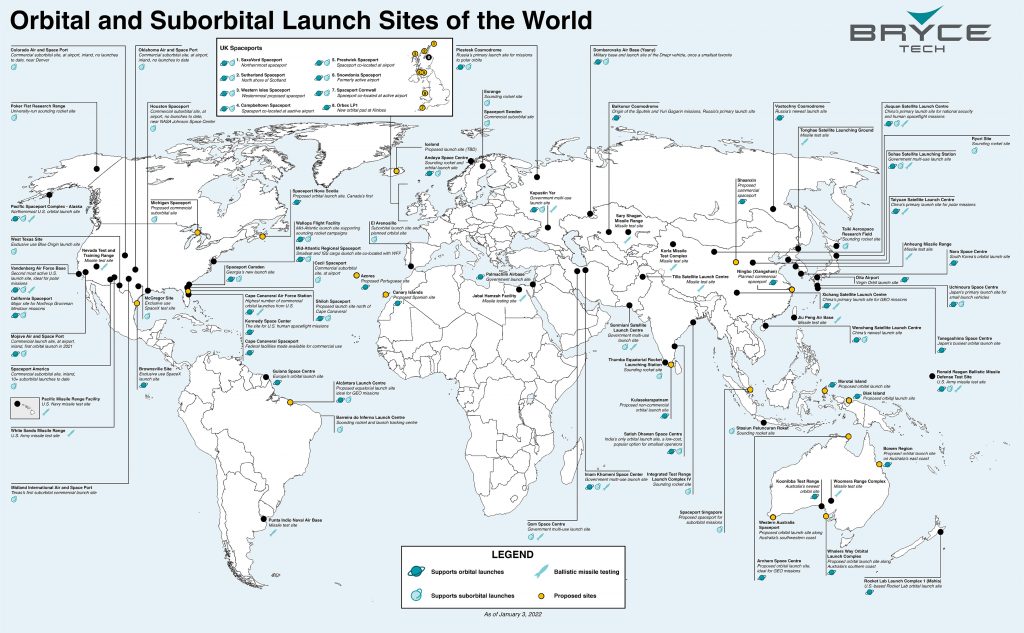
Mapped: The World’s Rocket Launch Sites

From Sputnik 1 to today’s massive satellite constellations, every object in space was launched from just a handful of locations.

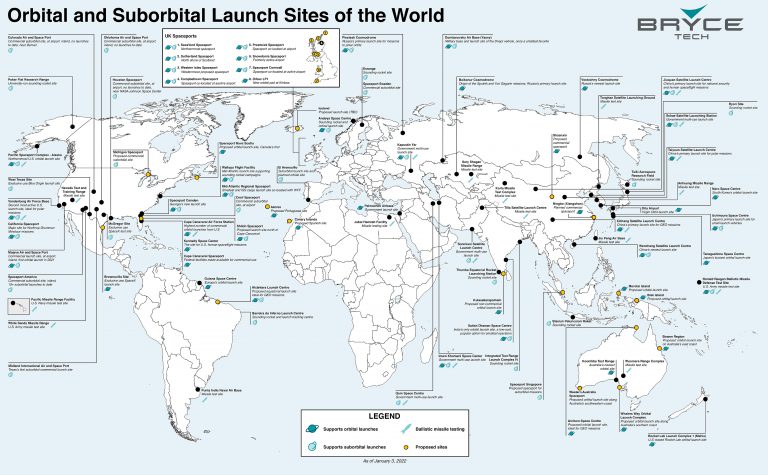
The map above, from BryceTech, is a comprehensive look at the world’s spaceports (both orbital and sub-orbital) as well as ballistic missile test sites.

View the high-resolution map

worlds-rocket-launch-sites-fullsize

In sub-orbital spaceflight, a spacecraft reaches outer space, but it doesn’t complete an orbital revolution or reach escape velocity. In orbital spaceflight, a spacecraft remains in space for at least one orbit.

The World’s Major Spaceports

Though the graphic above is a detailed list of many types of rocket launch sites, we’ll focus on major sites that are sending satellites and passengers into sub-orbit, orbit, and beyond.

Launch FacilityLocationCountry
Spaceport AmericaNew Mexico🇺🇸 U.S.
Launch Site One (Corn Ranch)Texas🇺🇸 U.S.
Houston SpaceportTexas🇺🇸 U.S.
Midland Air & Space PortTexas🇺🇸 U.S.
SpaceX Development and Test FacilityTexas🇺🇸 U.S.
SpaceX StarbaseTexas🇺🇸 U.S.
Spaceport CamdenGeorgia🇺🇸 U.S.
Mid-Atlantic Regional SpaceportVirginia🇺🇸 U.S.
Wallops Flight FacilityVirginia🇺🇸 U.S.
Reagan Test SiteKwajalein Atoll🇲🇭 Marshall Islands

The list above covers fixed locations, and does not include SpaceX’s autonomous spaceport drone ships. There are currently three active drone ships—one based near Los Angeles, and the other two based at Port Canaveral, Florida.

Two of the most famous launch sites on the list are the Baikonur Cosmodrome (Kazakhstan) and Cape Canaveral (United States). The former was constructed as the base of operations for the Soviet space program and was the launch point for Earth’s first artificial satellite, Sputnik 1. The latter was NASA’s primary base of operations and the first lunar-landing flight was launched from there in 1969.

The global roster of spaceports has grown immensely since Baikonur and Cape Canaveral were the only game in town. Now numerous countries have the ability to launch satellites, and many more are getting in on the action.

Wenchang Space Launch Site, on the island of Hainan, is China’s newest launch location. The site recorded its first successful launch in 2016.

Location, Location

One interesting quirk of the map above is the lack of spaceports in Europe. Europe’s ambitions for space are actually launched from the Guiana Space Centre in South America. Europe’s Spaceport has been operating in French Guiana since 1968.

Low altitude launch locations near the equator are the most desirable, as far less energy is required to take a spacecraft from surface level to an equatorial, geostationary orbit.

Islands and coastal areas are also common locations for launch sites. Since the open waters aren’t inhabited, there is minimal risk of harm from debris in the event of a launch failure.

As demand for satellites and space exploration grows, the number of launch locations will continue to grow as well.

Source: Visual Capitalist

NASA Selects Experimental Space Technology Concepts For Initial Study

0

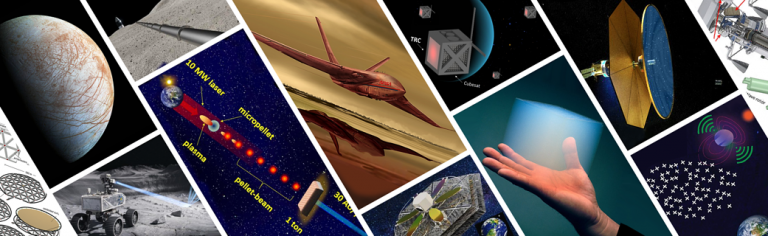
Imagine a future in space where pellet-beam propulsion systems speed up travel to other worlds, pipelines on the Moon transport oxygen between settlements, and Martian bricks grow on their own before being assembled into homes. Researchers will delve into these ideas and more using NASA grant funding.

The NASA Innovative Advanced Concepts (NIAC) program fosters innovation by funding early-stage studies to evaluate technologies that could support future missions. The latest round of awards will provide $175,000 grants to 14 visionaries from nine states. Ten of the selected researchers are first-time NIAC recipients.

“NASA dares to make the impossible possible. That’s only achievable because of the innovators, thinkers, and doers who are helping us imagine and prepare for the future of space exploration,” said NASA Administrator Bill Nelson. “The NIAC program helps give these forward-thinking scientists and engineers the tools and support they need to spur technology that will enable future NASA missions.”

From deep space human exploration to advanced propulsion and robotics, NASA Innovative Advanced Concepts aims to change the possible by supporting early stage space technology research that could radically change the future.
Credits: NASA

The new Phase I projects include innovative sensors and instruments, manufacturing techniques, power systems, and more.

A concept envisioned by Quinn Morley of Planet Enterprises in Gig Harbor, Washington, could investigate the chemistry of Saturn’s largest moon, Titan. Flying on Titan would be relatively easy thanks to its low gravity and thick atmosphere. Morley conceived a flying, heavily instrumented boat that would seamlessly transition between soaring through Titan’s atmosphere and sailing its lakes, much like a seaplane on Earth.

Mary Knapp from the Massachusetts Institute of Technology (MIT) in Cambridge proposed a new kind of space observatory comprised of thousands of identical small satellites. Precisely positioned in deep space, they could work together to detect radio emissions at low frequencies from the earliest epochs of the universe and measure magnetic fields of terrestrial exoplanets, helping identify planets outside the solar system that are rocky like Earth and Mars.

Since 2011, NIAC has nurtured ideas like these that sound like science fiction, but – if successful – just might be possible. The program sits within NASA’s Space Technology Mission Directorate (STMD) and explores technically credible, early-stage aerospace concepts. NIAC researchers, called fellows, form an advanced, collaborative research community. Under their NIAC awards, the fellows investigate the physics of their concepts, roadmap necessary technology development, identify potential limitations, and look for transition opportunities to bring these concepts to reality.

“These initial Phase I NIAC studies help NASA determine whether these futuristic ideas could set the stage for future space exploration capabilities and enable amazing new missions,” said Michael LaPointe, program executive for NIAC at NASA Headquarters.

All NIAC studies are in the very early stages of conceptual development and are not considered official NASA missions. 

The researchers selected to receive NIAC Phase I grants in 2023, their institutions, and the titles of their proposals are:

NIAC is funded by STMD, which is responsible for developing the new cross-cutting technologies and capabilities needed by the agency to achieve its current and future missions.

Learn more about the NIAC program at: https://www.nasa.gov/niac

Sarah Frazier
Headquarters, Washington
202-853-7191
[email protected]

By Gerelle Dodson
Source NASA

Northrop Grumman Assumes Full GMLRS Rocket Motor Production

0

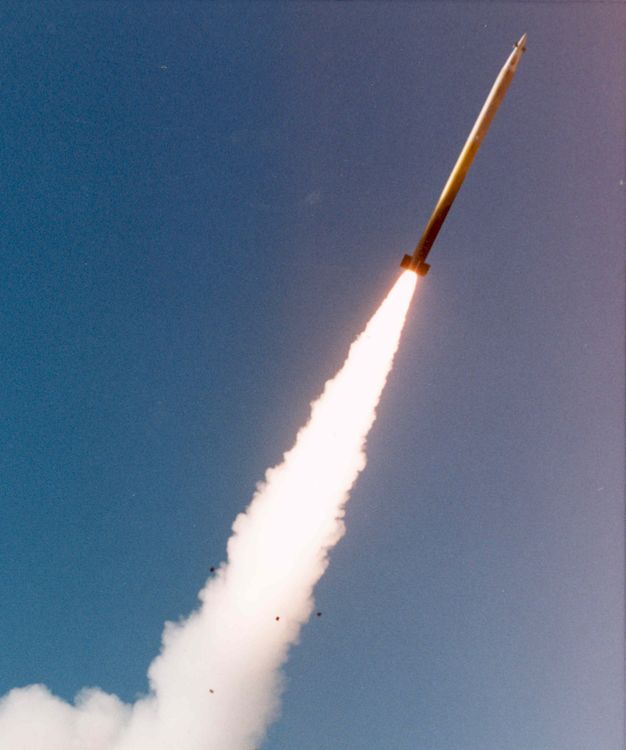
Northrop Grumman Corporation (NYSE: NOC) will assume production of rocket motors for the U.S. Army’s Guided Multiple Launch Rocket System (GMLRS), fulfilling the full contract production quantity. The company recently delivered its 15,000th rocket motor and 20,000th warhead to Lockheed Martin for final assembly.

Northrop Grumman Assumes Full GMLRS Rocket Motor Production

Northrop Grumman will assume production of rocket motors for the U.S. Army’s Guided Multiple Launch Rocket System (GMLRS). (Photo credit: Lockheed Martin)

“We are proactively investing in production facilities and technologies in support of producing even higher rates of rocket motors faster and more affordably to meet our customer’s anticipated demand,” said Jim Kalberer, vice president of missile products, Northrop Grumman. “We are leveraging our capacity and modern manufacturing facilities to deliver critical military needs.”

The propulsion system, once delivered to Lockheed Martin’s Camden, Arkansas, final assembly facility, will be integrated into GMLRS missiles – a ballistic rocket designed to engage targets from 15 to 70 kilometers. Northrop Grumman’s safety enhancing insensitive munition provides the system structural integrity under extreme conditions such as heat, shock and adjacent detonations. The ignition safety device further improves the weapon system’s safety characteristics by preventing unwanted combustion.

“Northrop Grumman is a trusted supplier of GMLRS rocket motors with robust manufacturing capacity to meet the demands of our customer,” said Jay Price, vice president of Precision Fires for Lockheed Martin.

Northrop Grumman designed and constructed a purpose-built manufacturing facility at the Allegany Ballistics Laboratory in Rocket Center, W. Va., using lean manufacturing and digital engineering techniques which enables a robust and resilient Defense Industrial Base. The facility provides for the efficient design, development and production of this critical weapon system component.

Northrop Grumman is a technology company, focused on global security and human discovery. Our pioneering solutions equip our customers with capabilities they need to connect, advance and protect the U.S. and its allies. Driven by a shared purpose to solve our customers’ toughest problems, our 90,000 employees define possible every day.

Northrop Grumman Awarded 2023 Robert H. Goddard Memorial Trophy For NASA’s James Webb Space Telescope

0

 NASA’s James Webb Space Telescope, built in partnership with Northrop Grumman Corporation (NYSE: NOC), has been selected to receive the 2023 Robert H. Goddard Memorial Trophy, the highest honor from the National Space Club and Foundation.

The award recognizes NASA and the industry team led by Northrop Grumman for their extraordinary contributions to U.S. leadership in the field of astronautics. The Goddard Trophy will be presented at the National Space Club and Foundation’s annual Dr. Robert H. Goddard Memorial Dinner in Washington on March 10.

“The Webb team embodies a pioneering spirit that pushed engineering to new levels and is now defining a new era of astronomical discovery,” said Scott Willoughby, vice president, program excellence for space systems, Northrop Grumman.

To enable the observatory’s ambitious scientific mission, Northop Grumman and partners invented 10 technologies, including revolutionary optics, detectors, thermal control systems, a deployable sunshield, cryocooler technologies and the manufacturing of a lightweight composite backplane to carry the weight of Webb’s mirror, telescope optics and scientific instruments.

In 2022, over the course of two weeks after its historic launch, Webb flawlessly deployed its sunshield and mirrors during a series of complex deployments and maneuvers, the first of its kind ever attempted in space. After achieving its final configuration, the team made a series of fine adjustments to the telescope’s optics to bring the telescope’s optical train into precise alignment. The team then tested Webb’s state-of-the-art scientific instruments and brought them to operational temperature, all necessary to begin Webb’s historic mission.

Northrop Grumman leads the industry team for NASA’s James Webb Space Telescope, the largest, most complex and powerful space telescope ever built. The company was recently awarded a sustainment contract by NASA to continue support through June 24, 2027. Northrop Grumman will provide the products and services required to monitor and maintain Webb spacecraft systems including the spacecraft bus, optics/telescope, and sunshield; maintain and update the spacecraft flight software; and trend spacecraft performance and recommend corrections and updates required for spacecraft health and safety.

NASA heads an international partnership that includes the European Space Agency and Canadian Space Agency. The Goddard Space Flight Center manages the Webb Telescope project, and the Space Telescope Science Institute is responsible for science and mission operations, as well as ground station development.     

Northrop Grumman is a technology company, focused on global security and human discovery. Our pioneering solutions equip our customers with capabilities they need to connect, advance and protect the U.S. and its allies. Driven by a shared purpose to solve our customers’ toughest problems, our 90,000 employees define possible every day.

The Sun Has Released Another Strong Solar Flare

0
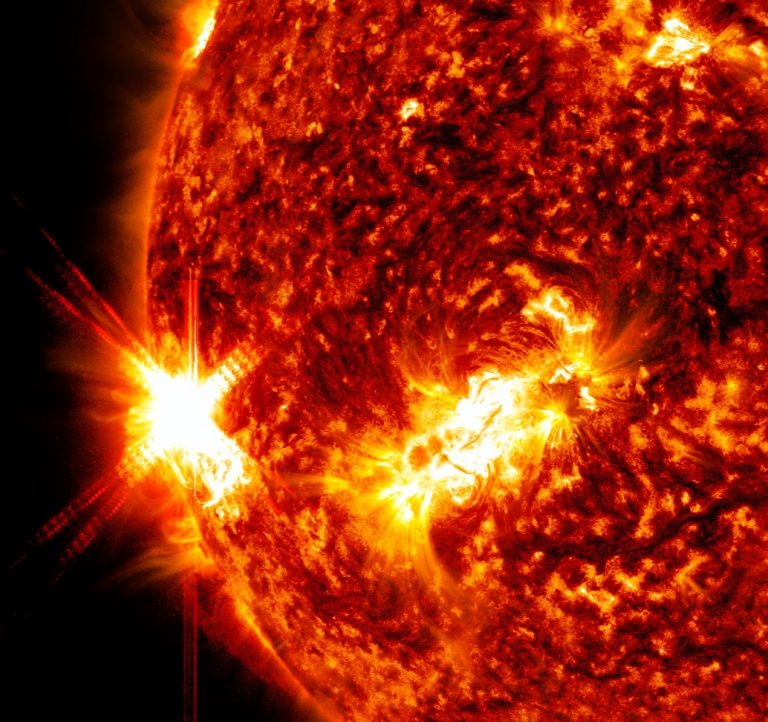
NASA’s Solar Dynamics Observatory captured this image of a solar flare – as seen in the bright flash on the left side of the image – on Jan. 9, 2023. The image shows a subset of extreme ultraviolet light that highlights the extremely hot material in flares and is colorized in red and gold. Credit: NASA/SDO

The Sun emitted a strong solar flare, peaking at 1:50 p.m. EST on Jan. 9, 2023. NASA’s Solar Dynamics Observatory, which watches the Sun constantly, captured imagery of the event.

Solar flares are powerful bursts of energy. Flares and solar eruptions can impact radio communications, electric power grids, navigation signals, and pose risks to spacecraft and astronauts.

This flare is classified as an X1.9 flare. X-class denotes the most intense flares, while the number provides more information about its strength.

To see how such space weather may affect Earth, please visit NOAA’s Space Weather Prediction Center https://spaceweather.gov/, the U.S. government’s official source for space weather forecasts, watches, warnings, and alerts. NASA works as a research arm of the nation’s space weather effort. NASA observes the Sun and our space environment constantly with a fleet of spacecraft that study everything from the Sun’s activity to the solar atmosphere, and to the particles and magnetic fields in the space surrounding Earth.

Space weather


By Keith Cowing
Source SpaceRef

Hubble Gazes At Colorful Cluster Of Scattered Stars

0

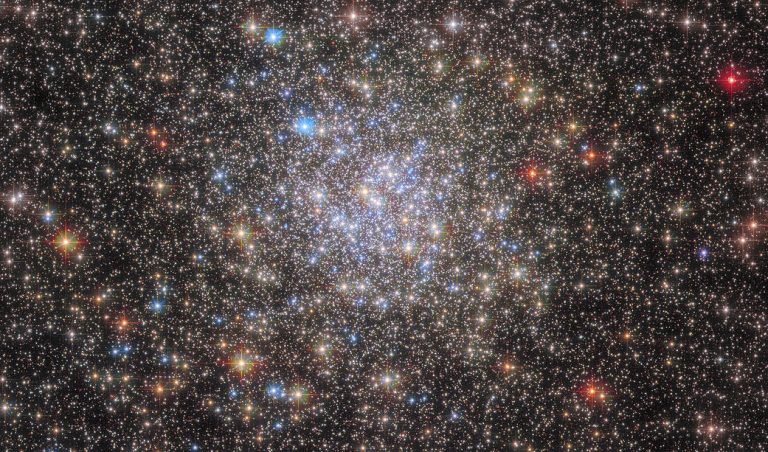
The scattered stars of the globular cluster NGC 6355 are strewn across this image from the NASA/ESA Hubble Space Telescope. NGC 6355 is a galactic globular cluster that resides in our Milky Way galaxy’s inner regions. It is less than 50,000 light-years from Earth in the constellation Ophiuchus.

Globular clusters are stable, tightly bound groups of tens of thousands to millions of stars that are associated with all types of galaxies. Their dense populations of stars and mutual gravitational attraction give these clusters a roughly spherical shape that holds a bright, central concentration of stars surrounded by an increasingly sparse sprinkling of stars. The dense, bright core of NGC 6355 shines in crystal-clear detail as Hubble is able to resolve individual stars in the crowded area toward the center of this image.

Hubble has revolutionized the study of globular clusters. It is almost impossible to distinguish individual stars in globular clusters with ground-based telescopes. Hubble’s unique capabilities and vantage point above Earth’s light-distorting atmosphere allow it to capture a globular cluster’s constituent stars in detail. This image contains data from Hubble’s Advanced Camera for Surveys and Wide Field Camera 3.

Text credit: European Space Agency (ESA)
Image credit: ESA/Hubble & NASA, E. Noyola, R. Cohen

Media Contact:

Claire Andreoli
NASA’s Goddard Space Flight CenterGreenbelt, MD
301-286-1940

By Andrea Gianopoulos
Source NASA