
Home Blog Page 7

The World Is Revalidating Itself

0

We’re barely into the second quarter of 2025, and it already feels like we’ve been collectively thrust into the world’s most consequential election season. Not content with the usual anxiety-inducing chaos of a single nation’s democratic process, the universe has decided to give us a simultaneous masterclass in global democracy—or whatever passes for it these days.

Canada has just ushered in Mark Carney, the former central banker whose technocratic expertise apparently convinced voters he could steer the country through economic rapids better than his predecessors. Meanwhile, Singapore is experiencing what qualifies as a political earthquake in its tightly controlled system, with the People’s Action Party facing unprecedented challenges to its 60-year dominance. The PAP, which has run Singapore since before Singapore was even Singapore, is discovering that even the most meticulously engineered political systems eventually develop cracks.

Then there’s the Philippines, that fascinating study in democratic contradictions—a vibrant economy whose political class seems determined to sabotage progress through endless power struggles. The latest round of political infighting makes “Succession” look like a children’s television show. One wonders if the country’s politicians have considered that economic growth becomes rather difficult when you’re busy sharpening knives for your colleagues’ backs.

But the most fascinating electoral spectacle isn’t happening at a ballot box at all. The Catholic Church is preparing for its conclave to select Pope Francis’s successor after twelve years of his relatively progressive papacy.

conclave-poster-black-smoke

What makes this convergence of global elections particularly striking is the backdrop against which they’re occurring. We’ve got tariff wars that make family holiday arguments seem civilized, and actual wars—in Ukraine, Gaza, and other places—that continue to remind us that humans excel at turning disagreements into tragedy. Climate change isn’t just knocking at our door anymore; it’s kicked it down and is rearranging the furniture. It’s almost as if the world is trying to set fire to itself while simultaneously attempting to decide who gets to hold the extinguisher.

What we’re witnessing isn’t just a series of elections; it’s humanity at a crossroads, collectively voting on its future while that future seems increasingly unstable. It’s against this dystopian backdrop that citizens around the world are being asked to make decisions about leadership. In a very real sense, the world is revalidating itself with its new leaders. 

The irony, of course, is that as these existential threats mount, many democratic systems are simultaneously facing internal erosion. Populist movements continue to challenge institutional guardrails, disinformation flourishes in digital ecosystems designed to prioritize engagement over accuracy, and voter apathy grows in proportion to the sense that the game is rigged.

Either way, these elections across the globe share a common thread: they’re not just about who governs for the next few years, but potentially deciding the fate of our species. Climate change doesn’t care whether Canada’s government leans left or right. The melting Arctic doesn’t distinguish between PAP voters and opposition supporters in Singapore. The consequences of war don’t stop at the Philippines’ territorial waters.  Even the papal conclave, archaic as it seems, will select someone whose moral authority extends to over a billion Catholics worldwide, potentially influencing everything from reproductive rights to climate action. The Church might move at a glacial pace, but then again, so do actual glaciers—until suddenly they don’t.

Maybe that’s the most human thing of all: the persistent belief that we can fix this mess, even as we continue making it worse.

What’s particularly disturbing is how normal this all feels now. We’ve become accustomed to headline whiplash—climate disaster next to election results next to war updates next to celebrity gossip. The world is always in a state of flux, certainly, but the current level of chaos has become our baseline. Like the proverbial frog in slowly heating water, we’ve adjusted to conditions that should be setting off alarm bells.

And yet, there’s something oddly reassuring about watching millions of people around the world still participating in democratic processes, however flawed. Despite everything—the corruption, the disinformation, the sense that individual votes matter little against the tide of corporate influence and geopolitical forces—people still line up to cast ballots. There’s a stubborn hope embedded in that act, a refusal to surrender agency entirely.

Perhaps that’s what these elections really represent: not so much a solution to our problems as a collective assertion that we still believe solutions are possible. That despite the overwhelming evidence that our systems are buckling under the weight of 21st-century challenges, we haven’t yet abandoned the idea that human agency matters.

Is that naive? Possibly. Is it our only option? Almost certainly. Because the alternative—surrendering to fatalism in the face of mounting crises—guarantees the worst outcomes. At least with democracy, however imperfect, we maintain the possibility of change, the chance that somewhere in the global constellation of elections happening now, voters might select leaders equal to the moment.

So as ballots are counted from Ottawa to Manila, as white smoke eventually rises from the Vatican, perhaps what we’re really watching isn’t just democracy in action but humanity’s stubborn insistence on having a say in its own future—even as that future grows increasingly uncertain. In a world that seems to be coming apart at the seams, that small act of collective determination might be the thread that holds us together.

Conclave: How A New Pope Is Chosen

0

The passing of Pope Francis has triggered one of the oldest traditions in the Catholic Church: the conclave. The election of the new Pope is one of Catholicism’s most ancient traditions.

Here is our infographic explaining the process:

Historical Significance

This ritual has evolved since the 11th century yet maintains its core purpose: ensuring the divine guidance of the Holy Spirit in selecting the successor to St. Peter, the Church’s first pope. The conclave’s secrecy and ceremonial aspects underscore the profound spiritual significance of this transition of power within the world’s oldest continuously functioning institution.

Indicators of alien life may have been found – astrophysicist explains what the new research means

0
Darryl Fonseka/Shutterstocl

Ian Whittaker, Nottingham Trent University

What do you think of when it comes to extra terrestrial life? Most popular sci-fi books and TV shows suggest humanoid beings could live on other planets. But when astronomers are searching for extra-terrestrial life, it is usually in the form of emissions from bacteria or other tiny organisms.

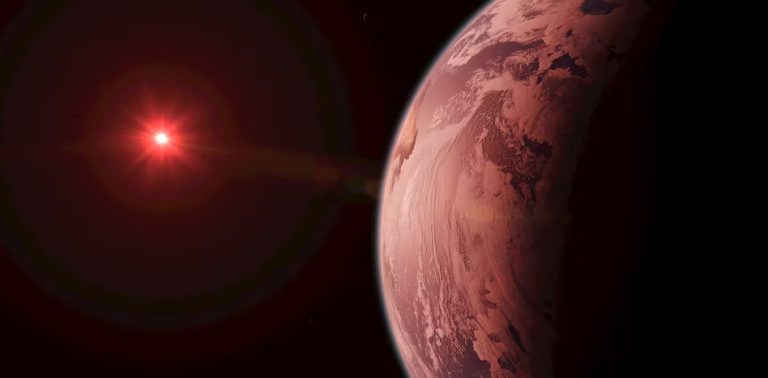
A new research paper in the Astrophysical Journal suggests that Cambridge scientists have managed to find this type of emission with a certainty of 99.7% from a planet called K2-18b, 124 light years away. They used Nasa’s James Webb Space Telescope to analyse the chemical composition of the planet’s atmosphere and say they found promising evidence K2-18b could host life.

It’s an exciting breakthrough but it doesn’t confirm alien life.

Let’s look at why scientists largely do not accept the paper as proof of alien life.

Why it’s so hard to detect to alien life

Exoplanet hunting fell out of public interest quickly due to the staggering number of planets scientists are discovering. The first convincing exoplanet around a sun-like star was discovered in 1995 via radial velocity, where you don’t look at the planet but instead observe its effect on its nearest star. As the star wobbles back and forth it causes a tiny shift in the wavelength of the light it emits, which we can measure. We already know of roughly 7,500 planets.

Only 43 (to date) have been observed directly (about 0.5% of them). Most are discovered through indirect means, such as radial velocity or the transit method. The transit method is where you look at how the brightness of the star decreases as the planet passes in front of it. It will block a tiny amount of the light.

An exoplanet atmosphere

Looking at the atmosphere of an exoplanet is even more difficult. Scientists use spectroscopy to do this. The light coming out of the star can be observed directly and a small amount of it will also pass through the atmosphere of the planet. Researchers can estimate what an exoplanet’s atmosphere is made of by studying which light from the star is emitted or absorbed in the atmosphere.

Let’s try an analogy. You have a desk lamp at one end of a long table and you are standing at the other end, looking at the lamp. There is a glass of liquid in between you and the lamp. In very simple terms, the glass of liquid acting as the exoplanet and atmosphere, looks slightly blue, which allows you to identify it as water. In reality for scientists though, it’s more like the glass of water is a tiny glass bead which is rolling around while someone is messing around with a dimmer switch on the lamp. Then, freak weather results in a gentle mist forming on the table. The liquid is 99% pure water and 1% mineral water and the scientist is trying to see what minerals are in the water.

You can see that the expertise required to be perform this work is incredible. They observed molecules with a 99.7% confidence rate, which is a remarkable achievement.

The data from JWST and K2-18b

The key data in this study is in a graph fitting light absorption rates to which kind of molecules could be there and working out how abundant they are. It features in this short film about the discovery.

The graph produced by the study’s authors shows evidence for dimethyl sulphide and dimethyl disulphide (DMS).

Some scientists think of DMS as a biomarker – a molecular indicator of life on Earth. However DMS is not only produced by bacteria, but has also been found on comet 67P and in the gas and dust of the interstellar medium, the space between stars. It can even be generated by shining UV light onto a simulated atmosphere. The authors acknowledge this and claim the amount they determined was present cannot be produced by any of these conditions.

Similar to other claims of life?

Multiple studies have shown indicators for DMS and life in general on K2-18b and there are many other claims for other exoplanets.

The most recent is the idea that phosphine (another biomarker) was discovered in the Venusian atmosphere, so there must be bacteria in the clouds. This claim was quickly refuted by other researchers. Scientists pointed that a tiny error in the matching of data created results that showed a larger abundance of phosphine than was accurate. The Cambridge study is more rigorous and has more certainty in the result. But it is still not strong enough to convince the academic community, which needs 99.999% certainty.

The study authors suggest their findings indicate liquid oceans and a hydrogen atmosphere but others have countered it could be a gas giant, or a volcanic planet full of magma.

The Cambridge study is not proof of life, but it is an important step forward to characterising what other planets might be like and determining if we are alone or not. The study presented the best result yet and should inspire other scientists to take up the challenge.The Conversation

Ian Whittaker, Senior Lecturer in Physics, Nottingham Trent University

This article is republished from The Conversation under a Creative Commons license. Read the original article (https://theconversation.com/indicators-of-alien-life-may-have-been-found-astrophysicist-explains-what-the-new-research-means-254843 ) .

Tariffs, Trump, and Other Things That Start With T – They’re Not The Problem, It’s How We Use Them

0

Let’s be honest: talking about tariffs is about as sexy as discussing different types of dental floss. But here we are, because tariffs have somehow become the economic equivalent of a Taylor Swift album drop – everyone has an opinion, especially if they’ve never actually studied economics.

The Problem Isn’t Tariffs, It’s Trump

Trump’s approach to tariffs isn’t inherently wrong – shocking, I know. The issue isn’t the economic theory but the chaotic implementation. It’s like saying “exercise is good for you” and then immediately demonstrating by attempting to deadlift a car. The principle? Sound. The execution? A trip to the emergency room.

We’ve seen this movie before with Brexit and we all know how that went, don’t we? There was nothing fundamentally wrong with the concept of Britain reclaiming sovereignty (well, debatable), but doing Brexit without any actual plans, templates, or trade deals was like jumping out of a plane and then shouting, “Wait, does anyone know how to make a parachute?” No trade deals, no templates, no transition plan – just vibes and nationalism.

Screenshot

Tariffs Have Always Been A Thing (Just With Fancier Names)

Here’s the thing about tariffs that no one seems to mention: they’ve always been around. We’ve just called them different things – customs duties, import taxes, that mysterious extra fee when you order something from abroad. Acting like tariffs are some radical new invention is like pretending avocado toast wasn’t just guacamole on bread all along.

The distinction matters because it shifts our conversation from “tariffs: yes or no?” to “how and when should we use tariffs?” One is a pointless binary; the other might actually lead somewhere useful.

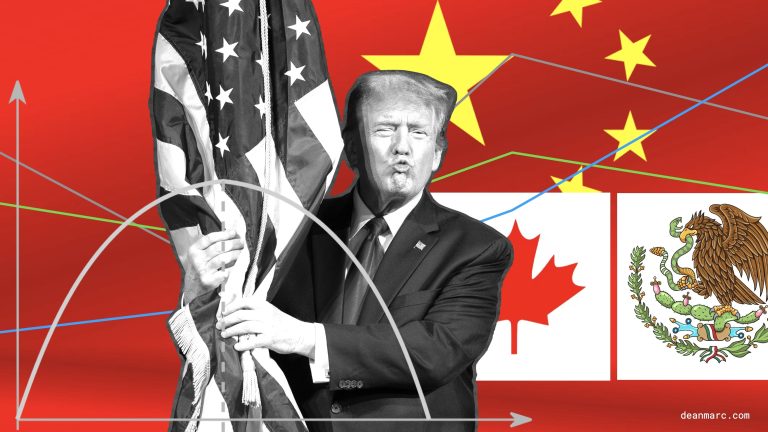
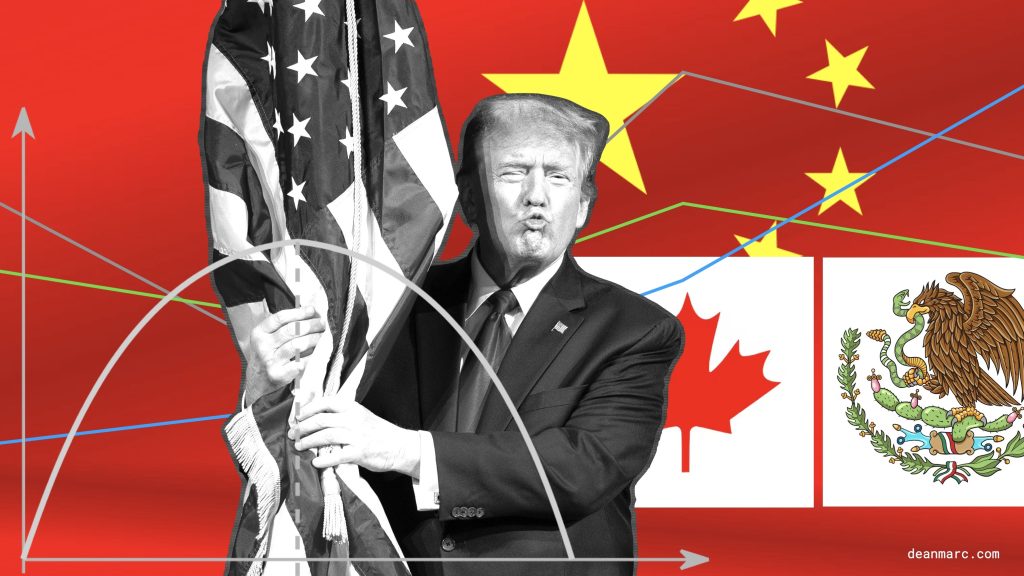
The real issue isn’t the tariff itself – it’s who’s wielding it. When Trump slaps tariffs around, he comes across like that guy at a party who keeps challenging everyone to arm-wrestling matches. Suddenly, what could be a boring economic tool becomes international drama worthy of Netflix.

Follow the Money (Or Lack Thereof)

At its core, the American economy has a cash flow problem, not unlike that friend who’s always “just about to” pay you back. The US is swimming in debt while China sits on a dragon’s hoard of American dollars. Tariffs provide an immediate injection of cash – like financial espresso for a hungover economy.

But there’s a bigger strategy at play: forcing companies to rethink their supply chains. When your CFO realizes that manufacturing in China now costs more than doing it in Michigan, suddenly that abandoned factory in Detroit starts looking attractive again. Reshoring manufacturing isn’t just about jobs – it’s about reducing dependency on countries whose values increasingly diverge from our own.

The Laffer Curve: Not Just a Funny Name

Economists have a concept called the Laffer Curve, which sounds like a ride at an economist’s theme park but is actually about how taxation and tariffs works. It illustrates how taxation generates more revenue – but only up to a point. Push too far, and it’s like squeezing an empty toothpaste tube: you look increasingly desperate and get diminishing returns.

The same applies to tariffs. A 10% tariff might achieve your goals, but a 50% tariff could destroy global supply chains, spark retaliation, and make everything from iPhones to underpants unaffordable. There’s a sweet spot somewhere in between – the challenge is finding it without breaking everything first.

It’s Not About Canada, It’s About China

When Trump started tariff wars with Canada and Mexico, it was like picking a fight with your roommates when you’re actually mad at your boss. These weren’t the real targets – they were collateral damage in a strategy aimed squarely at China.

The China-Russia axis represents the actual concern for American policymakers. As these autocracies cozy up to each other, the U.S. is desperately trying to reduce its dependence on their economies while pressuring allies to do the same. Tariffs are just one tool in what’s becoming a full-scale economic cold war.

The Distribution Problem No One Wants to Talk About

Here’s the dirty secret about American capitalism that both parties avoid addressing: if you keep consolidating wealth at the top while gutting the middle class, eventually you run out of customers who can afford your products. Henry Ford understood this when he paid his workers enough to buy the cars they built. Today’s corporations seem to have forgotten this lesson.

If tariff-induced price increases hit consumers already stretched thin by inflation, housing costs, and stagnant wages, we risk accelerating a downward economic spiral. There’s no AI economy coming to save us – AI doesn’t buy products, people do. And people need money to buy things.

Where Do We Go From Here?

Honestly? I have no idea. I’m not an economist – I just play one in op-eds. But maybe the answer isn’t “tariffs bad” or “tariffs good” but “can we please stop implementing major economic policies the way a toddler decorates a birthday cake?” The tariff debate needs nuance, not absolutism. We should be asking:

  1. What specific industries genuinely need protection for national security?
  2. How can we implement tariffs with clear metrics, sunset provisions, and adjustment periods?
  3. What complementary policies might offset consumer price increases?
  4. How do we coordinate with allies to prevent easy circumvention?

Instead of treating tariffs as either economic salvation or the apocalypse, we should see them as tools in a complicated economic toolkit – useful in specific circumstances, dangerous when misapplied, and always requiring precision.

The Bottom Line

Trump isn’t wrong that America needs to reconsider its trade relationships, especially with authoritarian regimes. But slapping tariffs around like a drunk person with a fly swatter isn’t strategy – it’s tantrum-as-policy.

Effective tariff policy requires planning, coordination, and clear objectives. It means balancing short-term pain against long-term gain. Most importantly, it demands recognizing that in a global economy, there are no simple solutions – just complicated trade-offs.

Maybe instead of asking whether tariffs are good or bad, we should be asking a different question: How do we build an economy that works for everyone, not just those at the top? Until we answer that, we’re just rearranging deck chairs on the Titanic – with or without tariffs.

Welcome Home! NASA’s SpaceX Crew-9 Back on Earth After Science Mission

0

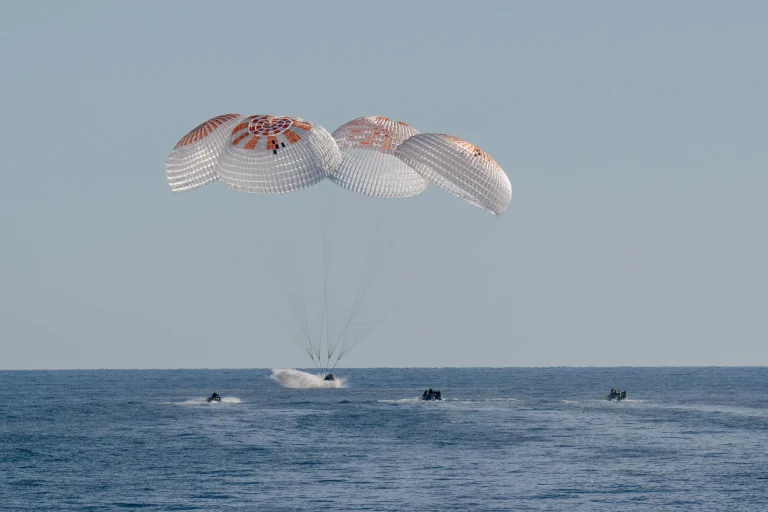
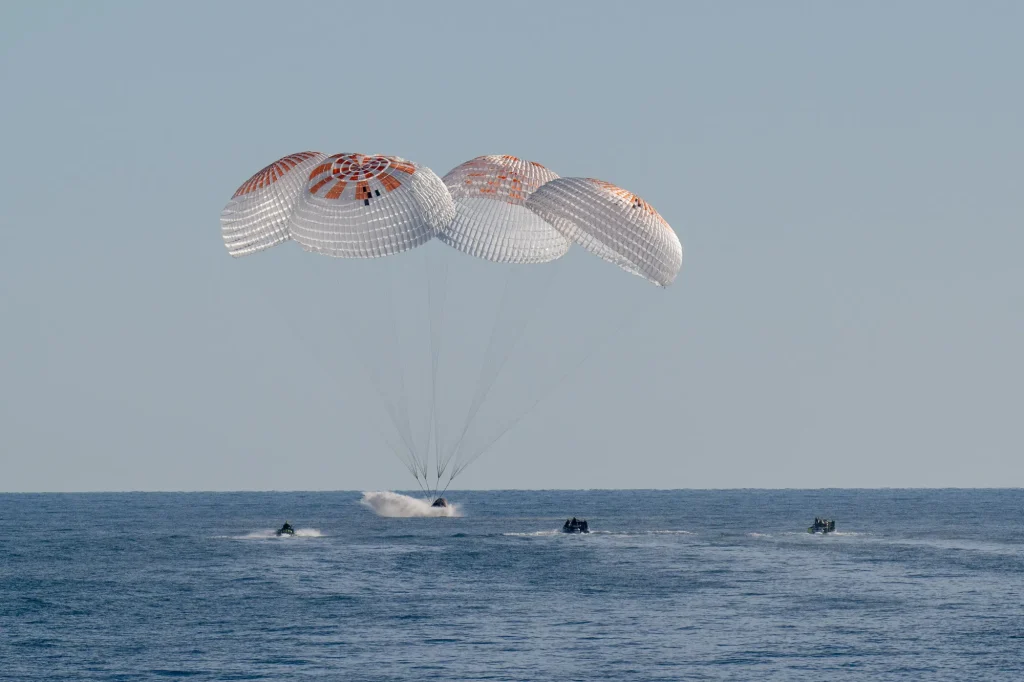
NASA’s SpaceX Crew-9 completed the agency’s ninth commercial crew rotation mission to the International Space Station on Tuesday, splashing down safely in a SpaceX Dragon spacecraft off the coast of Tallahassee, Florida, in the Gulf of America.

NASA astronauts Nick Hague, Suni Williams, and Butch Wilmore, and Roscosmos cosmonaut Aleksandr Gorbunov, returned to Earth at 5:57 p.m. EDT. Teams aboard SpaceX recovery vessels retrieved the spacecraft and its crew. After returning to shore, the crew will fly to NASA’s Johnson Space Center in Houston and reunite with their families.

“We are thrilled to have Suni, Butch, Nick, and Aleksandr home after their months-long mission conducting vital science, technology demonstrations, and maintenance aboard the International Space Station,” said NASA acting Administrator Janet Petro. “Per President Trump’s direction, NASA and SpaceX worked diligently to pull the schedule a month earlier. This international crew and our teams on the ground embraced the Trump Administration’s challenge of an updated, and somewhat unique, mission plan, to bring our crew home. Through preparation, ingenuity, and dedication, we achieve great things together for the benefit of humanity, pushing the boundaries of what is possible from low Earth orbit to the Moon and Mars.”

Hague and Gorbunov lifted off at 1:17 p.m. Sept. 28, 2024, on a SpaceX Falcon 9 rocket from Space Launch Complex 40 at Cape Canaveral Space Force Station in Florida. The next day, they docked to the forward-facing port of the station’s Harmony module. Williams and Wilmore launched aboard Boeing’s Starliner spacecraft and United Launch Alliance Atlas V rocket on June 5, 2024, from Space Launch Complex 41 as part of the agency’s Boeing Crew Flight Test. The duo arrived at the space station on June 6. In August, NASA announced the uncrewed return of Starliner to Earth and integrated Wilmore and Williams as part of the space station’s Expedition 71/72 for a return on Crew-9. The crew of four undocked at 1:05 a.m. Tuesday to begin the trip home.

Williams and Wilmore traveled 121,347,491 miles during their mission, spent 286 days in space, and completed 4,576 orbits around Earth. Hague and Gorbunov traveled 72,553,920 miles during their mission, spent 171 days in space, and completed 2,736 orbits around Earth. The Crew-9 mission was the first spaceflight for Gorbunov. Hague has logged 374 days in space over his two missions, Williams has logged 608 days in space over her three flights, and Wilmore has logged 464 days in space over his three flights.

Throughout its mission, Crew-9 contributed to a host of science and maintenance activities and technology demonstrations. Williams conducted two spacewalks, joined by Wilmore for one and Hague for another, removing a radio frequency group antenna assembly from the station’s truss, collecting samples from the station’s external surface for analysis, installing patches to cover damaged areas of light filters on an X-ray telescope, and more. Williams now holds the record for total spacewalking time by a female astronaut, with 62 hours and 6 minutes outside of station, and is fourth on the all-time spacewalk duration list.

The American crew members conducted more than 150 unique scientific experiments and technology demonstrations between them, with over 900 hours of research. This research included investigations on plant growth and quality, as well as the potential of stem cell technology to address blood diseases, autoimmune disorders, and cancers. They also tested lighting systems to help astronauts maintain circadian rhythms, loaded the first wooden satellite for deployment, and took samples from the space station’s exterior to study whether microorganisms can survive in space.

The Crew-9 mission was the fourth flight of the Dragon spacecraft named Freedom. It also previously supported NASA’s SpaceX Crew-4, Axiom Mission 2, and Axiom Mission 3. The spacecraft will return to Florida for inspection and processing at SpaceX’s refurbishing facility at Cape Canaveral Space Force Station, where teams will inspect the Dragon, analyze data on its performance, and begin processing for its next flight.

The Crew-9 flight is part of NASA’s Commercial Crew Program, and its return to Earth follows on the heels of NASA’s SpaceX Crew-10 launch, which docked to the station on March 16, beginning another long-duration science expedition.

The goal of NASA’s Commercial Crew Program is safe, reliable, and cost-effective transportation to and from the space station and low Earth orbit. The program provides additional research time and has increased opportunities for discovery aboard humanity’s microgravity testbed for exploration, including helping NASA prepare for human exploration of the Moon and Mars.

Learn more about NASA’s Commercial Crew Program at:

https://www.nasa.gov/commercialcrew

-end-

Amber Jacobson / Joshua Finch
Headquarters, Washington
202-358-1100
[email protected] / [email protected]

Kenna Pell / Sandra Jones
Johnson Space Center, Houston
281-483-5111
[email protected] / [email protected]

Steve Siceloff / Stephanie Plucinsky
Kennedy Space Center, Florida
321-867-2468
[email protected] / [email protected]

By:Jessica Taveau
Originally published at: NASA

NASA Invites Media to Annual FIRST Robotics Rocket City Competition

0

The Rocket City Regional – Alabama’s annual For Inspiration and Recognition of Science and Technology (FIRST) Robotics Regional Competition – is scheduled for Friday, March 14, through Saturday, March 15, at the Von Braun Center South Hall in Huntsville, Alabama. 

FIRST Robotics is a global robotics competition for students in grades 9-12. Teams are challenged to raise funds, design a team brand, hone teamwork skills, and build and program industrial-sized robots to play a difficult field game against competitors. 

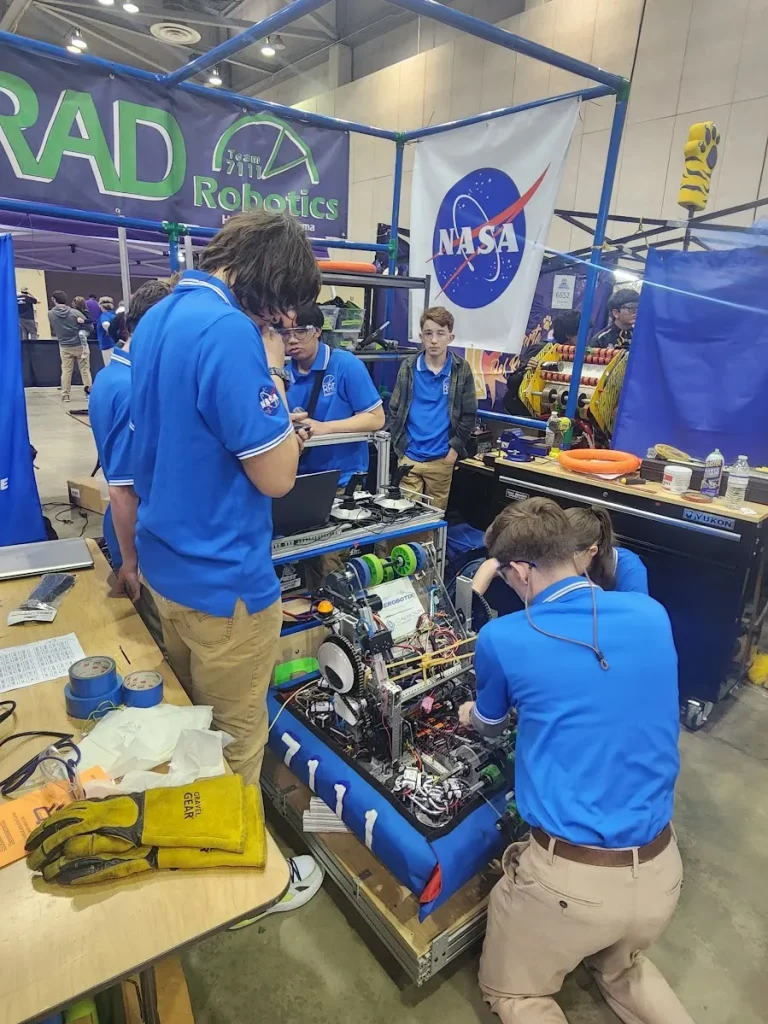
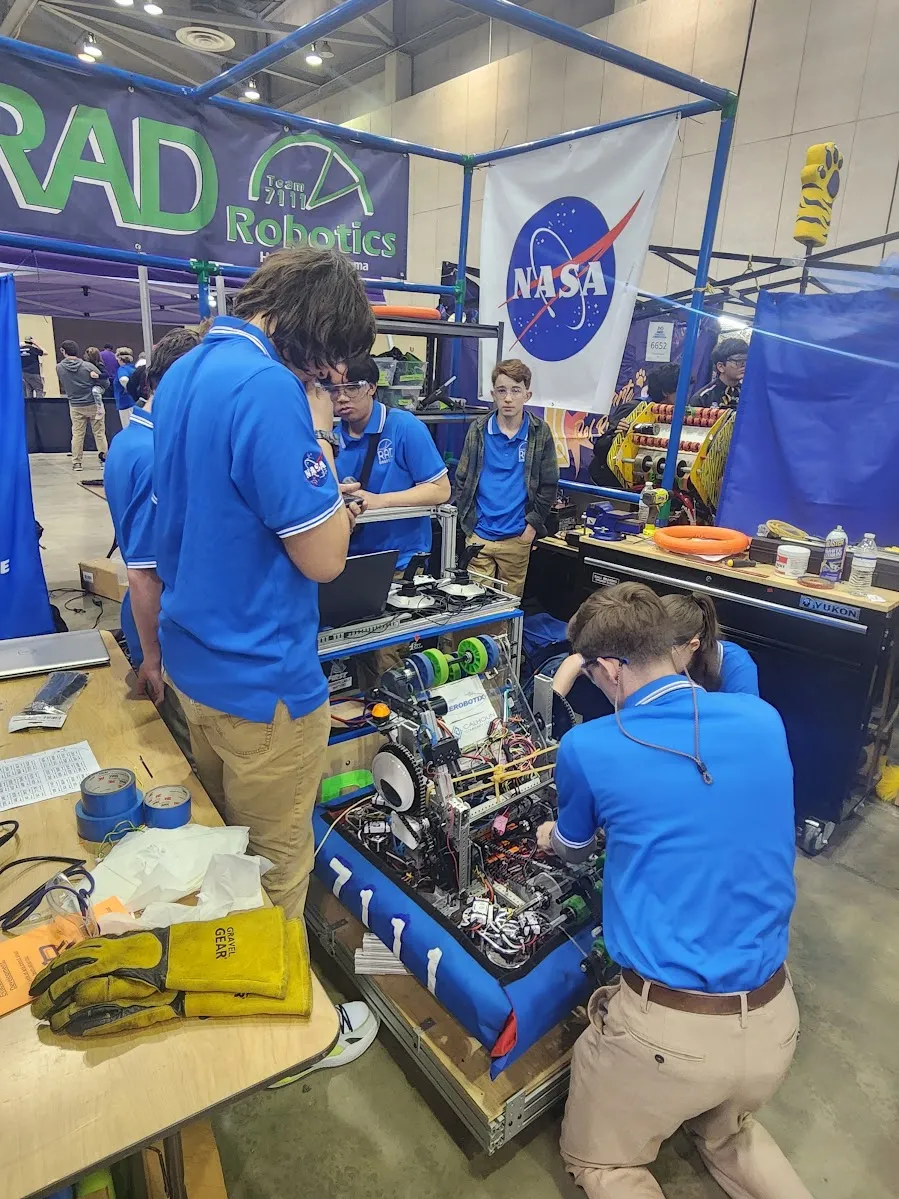
Students from RAD Robotics Team 7111 – a FIRST Robotics team from Huntsville, Alabama, and sponsored by NASA’s Marshall Space Flight Center – make adjustments to their robot during the 2024 Rocket City Regional FIRST Robotics Competition in Huntsville.

District and regional competitions – such as the Rocket City Regional – are held across the country during March and April, providing teams a chance to qualify for the 2025 FIRST Robotics Competition Championship events held in mid-April in Houston.

Hundreds of high school students from 44 teams from 10 states and 2 countries will compete in a new robotics game called, “REEFSCAPE.” 

This event is free and open to the public. Opening ceremonies begin at 8:30 a.m. CDT followed by qualification matches on March 14 and March 15. The Friday awards ceremony will begin at 5:45 p.m., while the Saturday awards ceremony will begin at 1:30 p.m.

NASA and its Robotics Alliance Project provide grants for high school teams and support for FIRST Robotics competitions to address the critical national shortage of students pursuing STEM (Science, Technology, Engineering, and Mathematics) careers. The Rocket City Regional Competition is supported by NASA’s Marshall Space Flight Center in Huntsville, Alabama, and NASA’s Office of STEM Engagement. 

News media interested in covering this event should respond no later than 4 p.m. on Thursday, March 13 by contacting Taylor Goodwin at 256-544-0034 or [email protected]

Learn more about the Rocket City Regional event: 

https://www.firstinspires.org/team-event-search/event?id=72593

Find more information about Marshall’s support for education programs:

https://www.nasa.gov/marshall/marshall-stem-engagement

Taylor Goodwin 
256-544-0034
Marshall Space Flight Center, Huntsville, Alabama
[email protected]

By: Beth Ridgeway
Originally published at: NASA

Source: zedreviews.com

Study: Climate change will reduce the number of satellites that can safely orbit in space

0

Increasing greenhouse gas emissions will reduce the atmosphere’s ability to burn up old space junk, MIT scientists report.

Jennifer Chu | MIT News
https://news.mit.edu/2025/study-climate-change-will-reduce-number-satellites-safely-orbit-space-0310

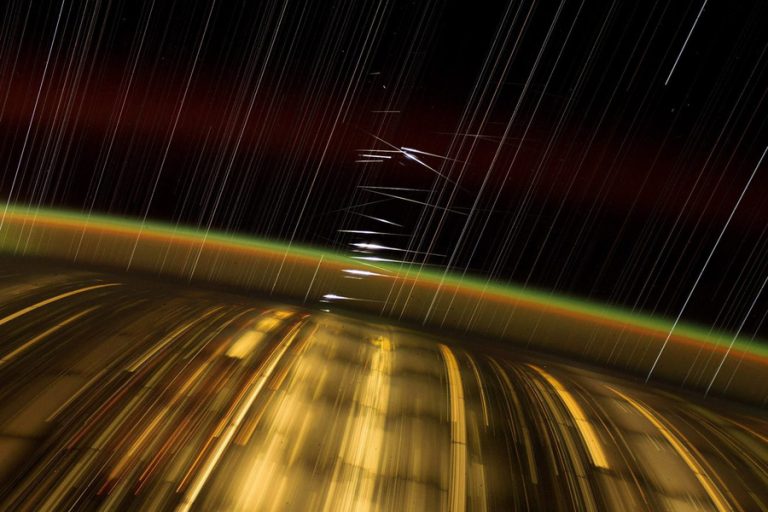
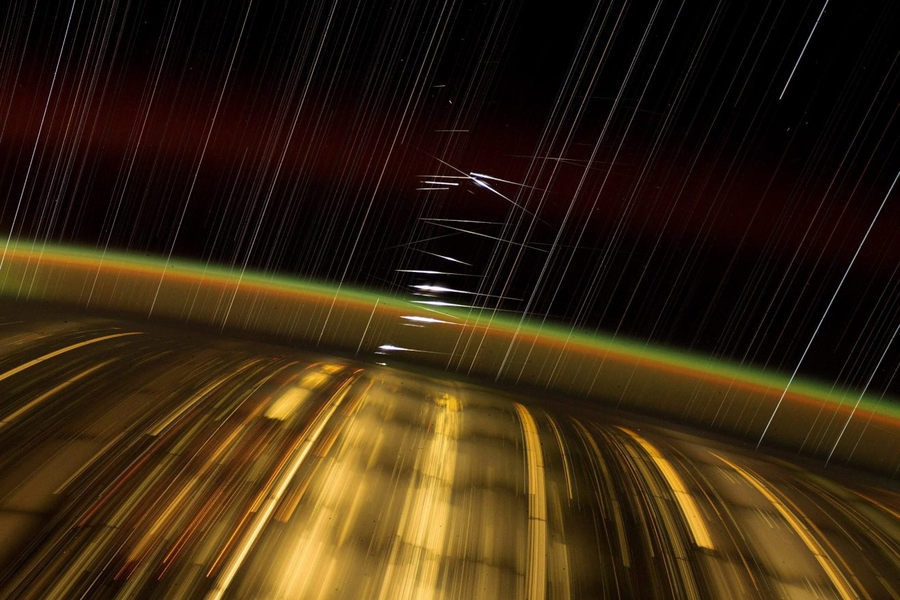
Caption:Captured by astronaut Don Pettit aboard the International Space Station (ISS), this long-exposure photograph showcases Earth’s city lights, the upper atmosphere’s airglow, and streaked stars. The bright flashes at the center are reflections of sunlight from SpaceX’s Starlink satellites in low-Earth orbit. Credits:Credit: NASA

MIT aerospace engineers have found that greenhouse gas emissions are changing the environment of near-Earth space in ways that, over time, will reduce the number of satellites that can sustainably operate there.

In a study appearing today in Nature Sustainability, the researchers report that carbon dioxide and other greenhouse gases can cause the upper atmosphere to shrink. An atmospheric layer of special interest is the thermosphere, where the International Space Station and most satellites orbit today. When the thermosphere contracts, the decreasing density reduces atmospheric drag — a force that pulls old satellites and other debris down to altitudes where they will encounter air molecules and burn up.

Less drag therefore means extended lifetimes for space junk, which will litter sought-after regions for decades and increase the potential for collisions in orbit.

The team carried out simulations of how carbon emissions affect the upper atmosphere and orbital dynamics, in order to estimate the “satellite carrying capacity” of low Earth orbit. These simulations predict that by the year 2100, the carrying capacity of the most popular regions could be reduced by 50-66 percent due to the effects of greenhouse gases.

“Our behavior with greenhouse gases here on Earth over the past 100 years is having an effect on how we operate satellites over the next 100 years,” says study author Richard Linares, associate professor in MIT’s Department of Aeronautics and Astronautics (AeroAstro).

“The upper atmosphere is in a fragile state as climate change disrupts the status quo,” adds lead author William Parker, a graduate student in AeroAstro. “At the same time, there’s been a massive increase in the number of satellites launched, especially for delivering broadband internet from space. If we don’t manage this activity carefully and work to reduce our emissions, space could become too crowded, leading to more collisions and debris.”

The study includes co-author Matthew Brown of the University of Birmingham.

Sky fall

The thermosphere naturally contracts and expands every 11 years in response to the sun’s regular activity cycle. When the sun’s activity is low, the Earth receives less radiation, and its outermost atmosphere temporarily cools and contracts before expanding again during solar maximum.

In the 1990s, scientists wondered what response the thermosphere might have to greenhouse gases. Their preliminary modeling showed that, while the gases trap heat in the lower atmosphere, where we experience global warming and weather, the same gases radiate heat at much higher altitudes, effectively cooling the thermosphere. With this cooling, the researchers predicted that the thermosphere should shrink, reducing atmospheric density at high altitudes.

In the last decade, scientists have been able to measure changes in drag on satellites, which has provided some evidence that the thermosphere is contracting in response to something more than the sun’s natural, 11-year cycle.

“The sky is quite literally falling — just at a rate that’s on the scale of decades,” Parker says. “And we can see this by how the drag on our satellites is changing.”

The MIT team wondered how that response will affect the number of satellites that can safely operate in Earth’s orbit. Today, there are over 10,000 satellites drifting through low Earth orbit, which describes the region of space up to 1,200 miles (2,000 kilometers), from Earth’s surface. These satellites deliver essential services, including internet, communications, navigation, weather forecasting, and banking. The satellite population has ballooned in recent years, requiring operators to perform regular collision-avoidance maneuvers to keep safe. Any collisions that do occur can generate debris that remains in orbit for decades or centuries, increasing the chance for follow-on collisions with satellites, both old and new.

“More satellites have been launched in the last five years than in the preceding 60 years combined,” Parker says. “One of key things we’re trying to understand is whether the path we’re on today is sustainable.”

Crowded shells

In their new study, the researchers simulated different greenhouse gas emissions scenarios over the next century to investigate impacts on atmospheric density and drag. For each “shell,” or altitude range of interest, they then modeled the orbital dynamics and the risk of satellite collisions based on the number of objects within the shell. They used this approach to identify each shell’s “carrying capacity” — a term that is typically used in studies of ecology to describe the number of individuals that an ecosystem can support.

“We’re taking that carrying capacity idea and translating it to this space sustainability problem, to understand how many satellites low Earth orbit can sustain,” Parker explains.

The team compared several scenarios: one in which greenhouse gas concentrations remain at their level from the year 2000 and others where emissions change according to the Intergovernmental Panel on Climate Change (IPCC) Shared Socioeconomic Pathways (SSPs). They found that scenarios with continuing increases in emissions would lead to a significantly reduced carrying capacity throughout low Earth orbit.

In particular, the team estimates that by the end of this century, the number of satellites safely accommodated within the altitudes of 200 and 1,000 kilometers could be reduced by 50 to 66 percent compared with a scenario in which emissions remain at year-2000 levels. If satellite capacity is exceeded, even in a local region, the researchers predict that the region will experience a “runaway instability,” or a cascade of collisions that would create so much debris that satellites could no longer safely operate there.

Their predictions forecast out to the year 2100, but the team says that certain shells in the atmosphere today are already crowding up with satellites, particularly from recent “megaconstellations” such as SpaceX’s Starlink, which comprises fleets of thousands of small internet satellites.

“The megaconstellation is a new trend, and we’re showing that because of climate change, we’re going to have a reduced capacity in orbit,” Linares says. “And in local regions, we’re close to approaching this capacity value today.”

“We rely on the atmosphere to clean up our debris. If the atmosphere is changing, then the debris environment will change too,” Parker adds. “We show the long-term outlook on orbital debris is critically dependent on curbing our greenhouse gas emissions.”

This research is supported, in part, by the U.S. National Science Foundation, the U.S. Air Force, and the U.K. Natural Environment Research Council.

Reprinted with permission of MIT News
http://news.mit.edu/

The Unexpected Pi-Fect Deals This March 14

0

If you love pie, you might be lost and found this by mistake. But, if you love the mathematical constant number Pi (3.14) and looking for deals, then stay a while and check out these bargains.

Laptop

Everybody needs a laptop. Whether it’s for yourself or a gift to others.

Backpack Bag

Now if you purchased a laptop, it would be only proper to match it with a bag for safety.

Smart Watch

Cherish your daily activities and act like you are raising a character in a game by watching your own stats with a smart watch.

Electric Fan

It’s summer time! Too cold and expensive for an ACU? Hassle to use a manual hand fan? An electric fan is just the right middle ground for you then.


Get the most out of your shopping with an Amazon Prime membership! Sign up now to enjoy free one-day delivery, unlimited streaming, exclusive deals, membership perks and more. Sign up today to enjoy a 30-day free trial and if you’re a student enjoy up to 6 months free trial. Click here to signup now!

Source: zedreviews.com

Five Facts About NASA’s Moon Bound Technology

0

NASA is sending revolutionary technologies to the Moon aboard Intuitive Machines’ second lunar delivery as part of the agency’s CLPS (Commercial Lunar Payload Services) initiative and Artemis campaign to establish a long-term presence on the lunar surface. 

As part of this CLPS flight to the Moon, NASA’s Space Technology Mission Directorate will test novel technologies to learn more about what lies beneath the lunar surface, explore its challenging terrain, and improve in-space communication.  

The launch window for Intuitive Machines’ second CLPS delivery, IM-2, opens no earlier than Wednesday, Feb. 26 from Launch Complex 39A at NASA’s Kennedy Space Center in Florida. After the Intuitive Machines’ Nova-C class lunar lander reaches Mons Mouton, a lunar plateau near the Moon’s South Pole region, it will deploy several NASA and commercial technologies including a drill and mass spectrometer, a new cellular communication network, and a small drone that will survey difficult terrain before returning valuable data to Earth.

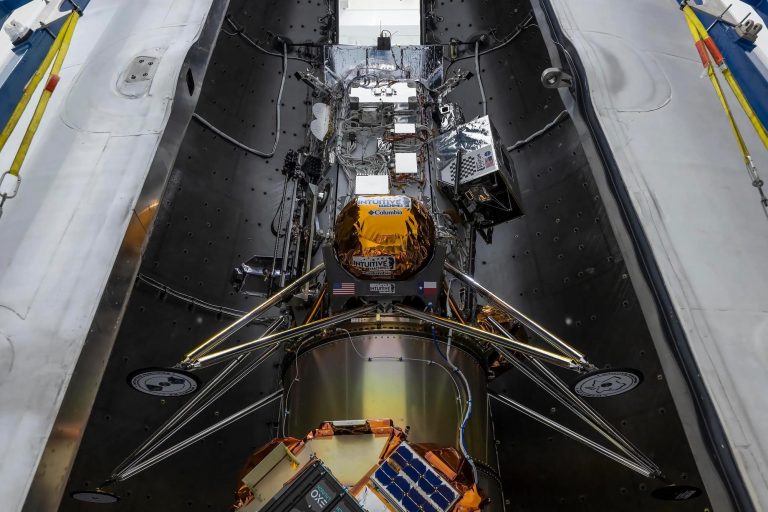
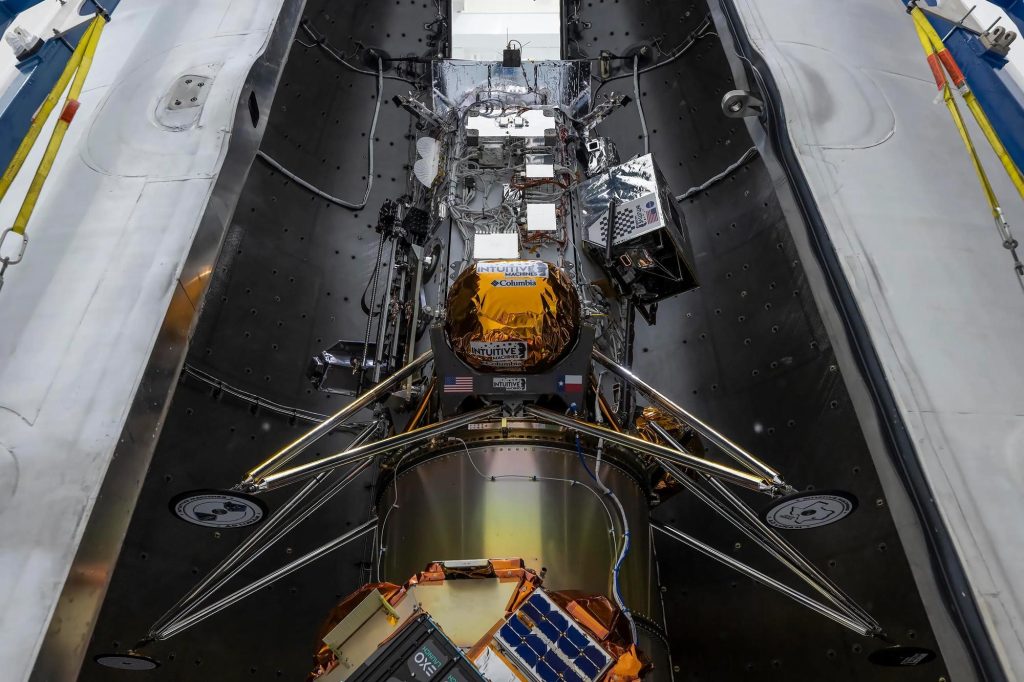
Caption: The Intuitive Machines lunar lander that will deliver NASA science and technology to the Moon as part of the agency’s CLPS (Commercial Lunar Payload Services) initiative and Artemis campaign is encapsulated in the fairing of the SpaceX Falcon 9 rocket. Credit: SpaceX

Here are five things to know about this unique mission to the Moon, the technologies we are sending, and the teams making it happen!  

1. Lunar South Pole Exploration 

IM-2’s landing site is known as one of the flatter regions in the South Pole region, suitable to meet Intuitive Machines’ requirement for a lit landing corridor and acceptable terrain slope. The landing location was selected by Intuitive Machines using data acquired by NASA’s Lunar Reconnaissance Orbiter.  

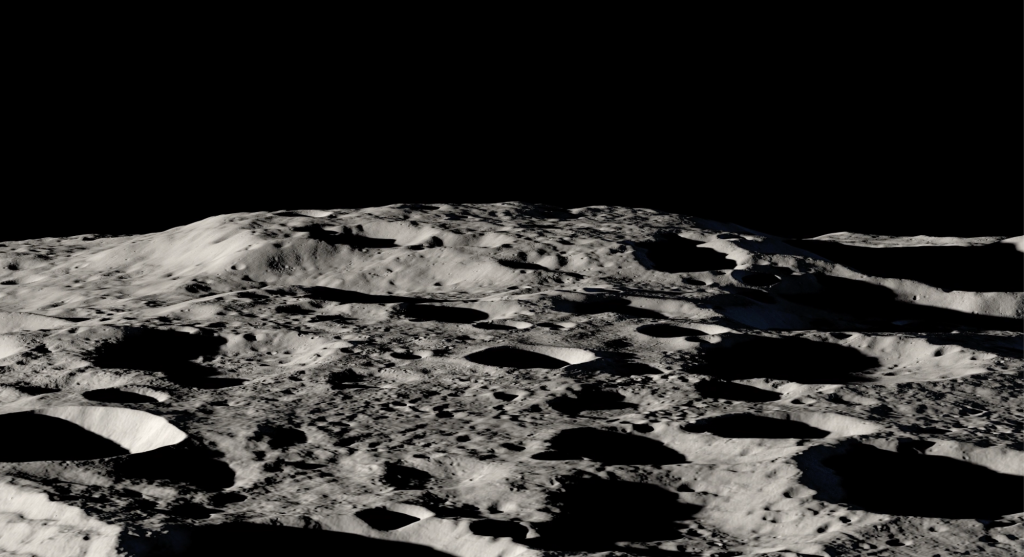
An illustration of Mons Mouton, a mesa-like lunar mountain that towers above the landscape carved by craters near the Moon’s South Pole. Credit: NASA/Scientific Visualization Studio

2. New Technology Demonstrations 

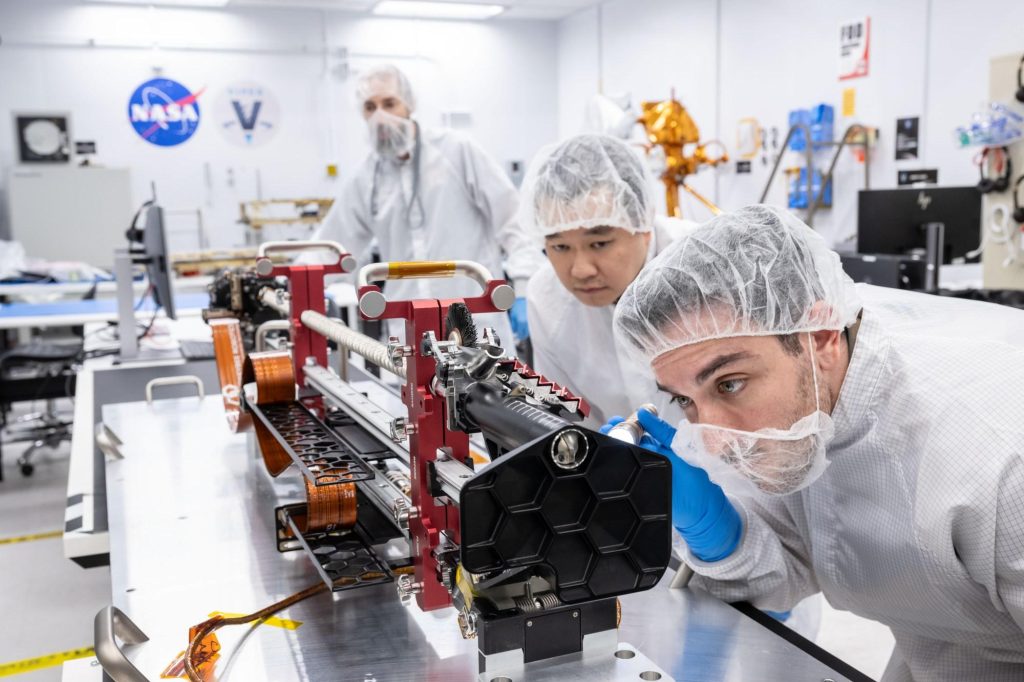
NASA’s Polar Resources Ice Mining Experiment, known as PRIME-1, is a suite of two instruments – a drill and mass spectrometer – designed to demonstrate our capability to look for ice and other resources that could be extracted and used to produce propellant and breathable oxygen for future explorers. The PRIME-1 technology will dig up to about three feet below the surface into the lunar soil where it lands, gaining key insight into the soil’s characteristics and temperature while detecting other resources that may lie beneath the surface.  

Data from the PRIME-1 technology demonstration will be made available to the public following the mission, enabling partners to accelerate the development of new missions and innovative technologies.   

The Polar Resources Ice Mining Experiment-1 (PRIME-1) will help scientists search for water at the lunar South Pole. Credit: NASA/Advanced Concepts Lab

3. Mobile Robots

Upon landing on the lunar surface, two commercial Tipping Point technology demonstrations will be deployed near Intuitive Machines’ lander, Tipping Points are collaborations between NASA’s Space Technology Mission Directorate and industry that foster the development of commercial space capabilities and benefit future NASA missions. 

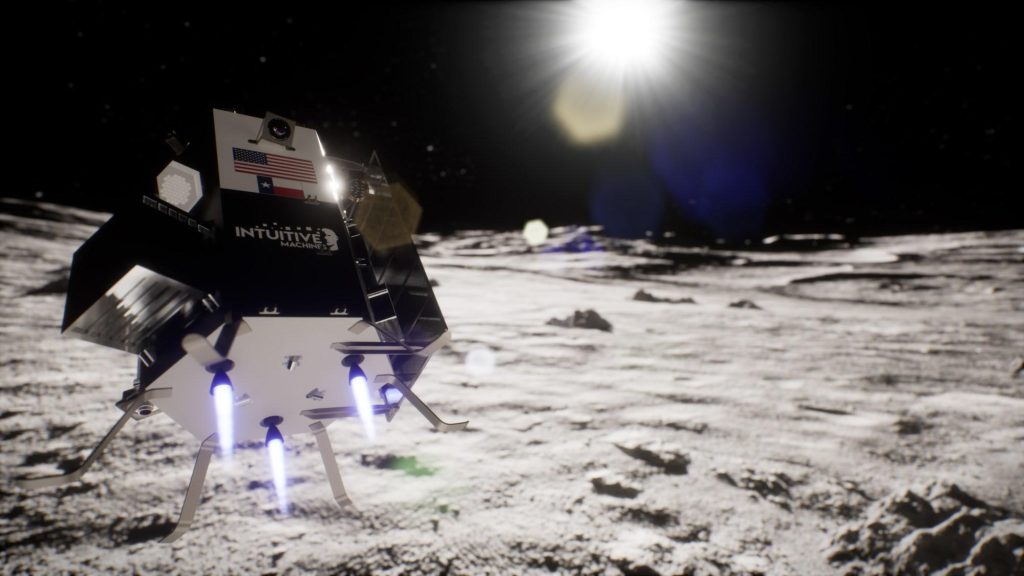
The first is a small hopping drone developed by Intuitive Machines. The hopper, named Grace, will deploy as a secondary payload from the lander and enable high-resolution surveying of the lunar surface, including permanently shadowed craters around the landing site. Grace is designed to bypass obstacles such as steep inclines, boulders, and craters to cover a lot of terrain while moving quickly, which is a valuable capability to support future missions on the Moon and other planets, including Mars. 

Artist rendering of the Intuitive Machines Micro Nova Hopper. Credit: Intuitive Machines

4. Lunar Surface Communication

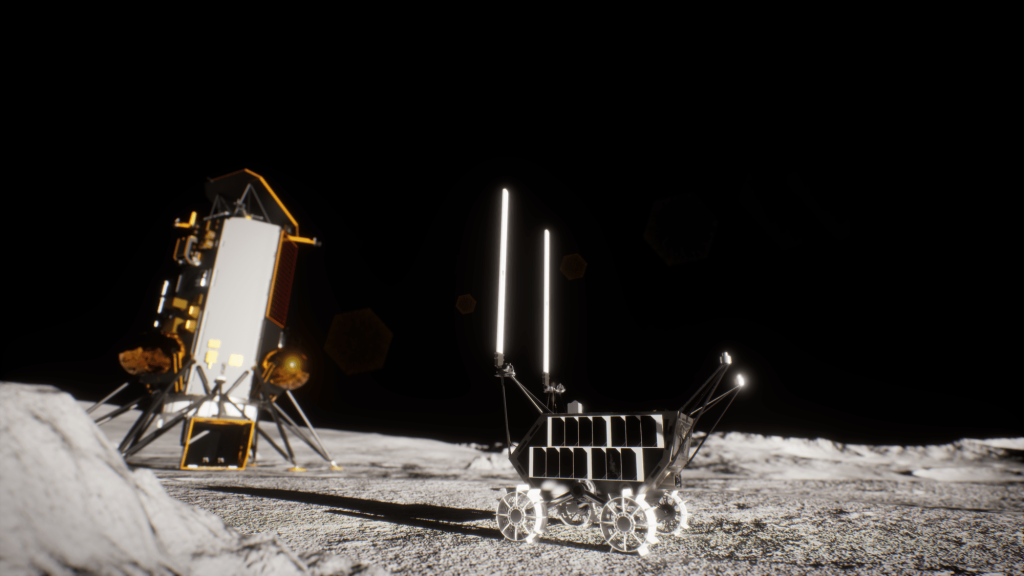
The next Tipping Point technology will test a Lunar Surface Communications System developed by Nokia. This system employs the same cellular technology used here on Earth, reconceptualized by Nokia Bell Labs to meet the unique requirements of a lunar mission. The Lunar Surface Communications System will demonstrate proximity communications between the lander, a Lunar Outpost rover, and the hopper. 

Artist rendering of Nokia’s Lunar Surface Communication System (LSCS), which aims to demonstrate cellular-based communications on the lunar surface. Credit: Intuitive Machines

5. Working Together

NASA is working with several U.S. companies to deliver technology and science to the lunar surface through the agency’s CLPS initiative.  

NASA’s Space Technology Mission Directorate plays a unique role in the IM-2 mission by strategically combining CLPS with NASA’s Tipping Point mechanism to maximize the potential benefit of this mission to NASA, industry, and the nation.  
NASA’s Lunar Surface Innovation Initiative and Game Changing Development program within the agency’s Space Technology Mission Directorate led the maturation, development, and implementation of pivotal in-situ resource utilization, communication, and mobility technologies flying on IM-2.  

Join NASA to watch full mission updates, from launch to landing on NASA+, and share your experience on social media. Mission updates will be made available on NASA’s Artemis blog.  

A team of engineers from NASA’s Johnson Space Center in Houston and Honeybee Robotics in Altadena, California inspect TRIDENT – short for The Regolith Ice Drill for Exploring New Terrain – shortly after its arrival at the integration and test facility. Credit: NASA/Robert Markowitz
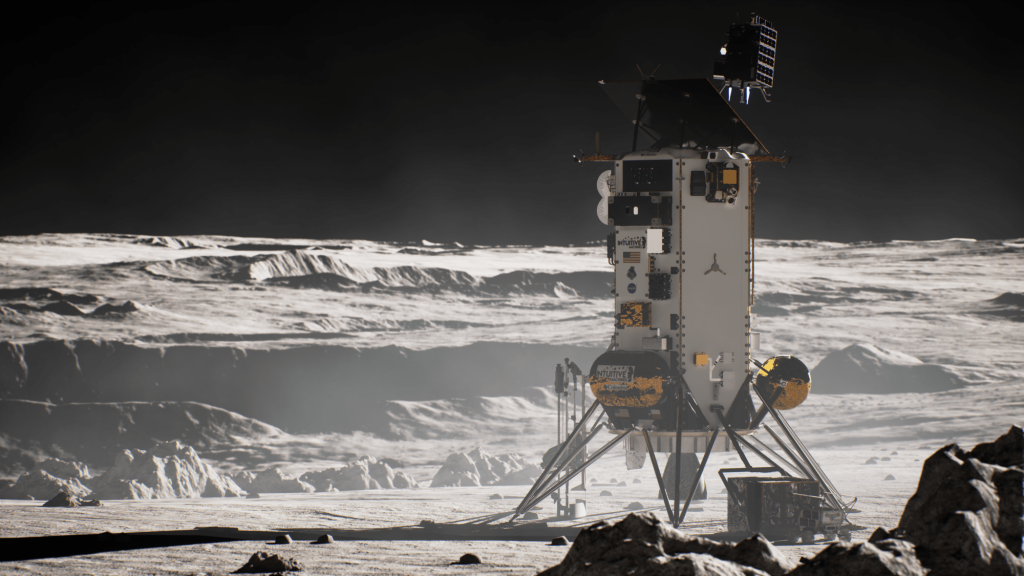
Artist’s rendering of Intuitive Machines’ Athena lunar lander on the Moon. Credit: Intuitive Machines
Artist conception: Earth emerges from behind Mons Mouton on the horizon. Credit: NASA/Scientific Visualization Studio

By: Stefanie Payne
Originally published at: NASA