Home Blog Page 40

More Than Math – The Must-Have Non-Technical Skills for Data Pros

0

There are a lot of skills that will help to become a data scientist. These includes technical skills such as machine learning, deep learning, mathematics, programming and others. But in all these, there are also some non-technical skills or principles that data pros should learn.

Talking to subject matter experts

As a data scientist or one aspiring to become a decent one, you should have the courage to talk to people. Information is king. And in different lines of work, there will be various people who specialise or experts in their own fields. Make it a point to talk to these individuals, they are valuable resource persons.

Cognitive empathy

You will not have access to experts all the time, during these periods you should try and put yourself in the shoes of others. With cognitive empathy, we are not trying to put ourselves directly in their situation but understand the thought process on how certain decisions and data came to be. 

If you are a fan of detective literally works like Sherlock Holmes, you would be familiar with this process. Where the detective will try to trace the steps on how crimes happened.

Skeptical attitude

Do not trust the data. Doubt the data. Even if you try to trace how the decision came to be and arrived at the same result, you might want to question it. There is a saying that “Sometimes the data lies to you”. While this is not always the case, in some instance it could just be incomplete. Or you are looking at a different time frame that is outdated. You must nurture a skeptical mindset. A bit of knowledge in statistics will help. 

Curios mind

There is a saying that curiousity killed the cat. But remember that the cat has 9 lives. We are not saying you commit 8 mistakes and leave it at that. Try to have a creative thinking when you don’t have access to data. That is to check what variables or missing information could be missing. Ask why the data is like that. There might be a missing attribute that is actually there but was not given to you thinking it might be irrelevant.

Management skills

Your job is not only the data aspect of the project. Remember that you would need to communicate not just with the members that are part of the data science team, but also to upper management. You would need to be able to explain without using technical jargon. If it is unavoidable to use these terms, explain it further by giving examples or something to relate to.

Communication skills

Another common phrase is “Communication is the key”. They are not wrong, and this applicable to the line of work of being a data scientist. Communicating with the management, team mates and those that are of subject experts are crucial. A misstep that conveys the wrong information to everyone could derail the project in levels you could not imagine. 

Having a scheduled discussion will help consolidate ideas and information. Schedule it regularly but not too frequent that it might disrupt everyone. This will provide clarity and understanding on what the status and direction of the project is. Before these meetings, think of possible questions that could be asked, and prepare for answers and possible solutions that you are considering. The most common question is the data integrity. Back these up with data and be honest with everyone.

Thank you for Z/O Digital

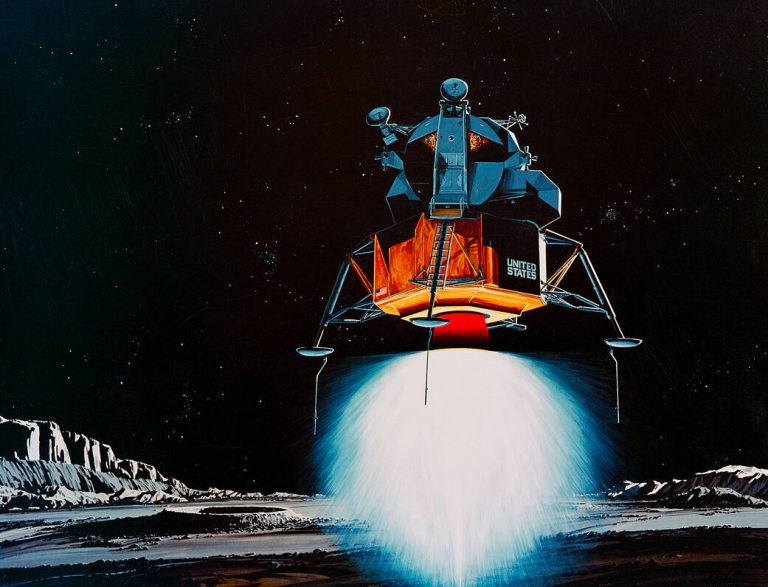
An Artist’s Concept Of The Apollo 11 Lunar Module Landing

0

This artist’s concept from July 11, 1969, depicts the Apollo 11 lunar module Eagle landing on the surface of the Moon.

Apollo 11 launched from Cape Kennedy on July 16, 1969, carrying commander Neil Armstrong, command module pilot Michael Collins, and lunar module pilot Edwin “Buzz” Aldrin. On July 20, the Eagle landed in the Sea of Tranquility with Aldrin and Armstrong inside, about four miles downrange from the predicted touchdown point and almost one-and-a-half minutes earlier than scheduled. Four hours later, Armstrong emerged from the Eagle and deployed the TV camera for the transmission of the event to Earth.

Image Credit: TRW Incorporated

By: Monika Luabeya
Originally published at NASA

Coverage Set For NASA’s SpaceX Crew-7 Events, Broadcast, Launch

0

Editor’s Note: This media advisory was updated on Aug. 26, 2023, to reflect a change in the post-launch news conference participant from SpaceX. 

Editor’s Note: This media advisory was updated on Aug. 25, 2023, to reflect new times for crew arrival and docking, as well as a change in the post-launch news conference participant from SpaceX. 

Editor’s note: This media advisory was updated on Aug. 24, 2023, to reflect new dates for launch and docking, as well as NASA TV coverage.

Editor’s Note: This media advisory was updated on Aug. 23, 2023, to reflect a new target launch time of 3:50 a.m. EDT on Friday, Aug. 25.

Editor’s Note: This media advisory was updated on Aug. 20, 2023, to reflect the NASA administrator joining the crew arrival event on Sunday, Aug. 20, 5 p.m. EDT start time for the Monday, Aug. 21 media teleconference, and an updated title for Kristin Fabre in the NASA Social Panel.

NASA will provide coverage of the upcoming prelaunch and launch activities for the agency’s SpaceX Crew-7 mission with astronauts to the International Space Station.

The launch now is targeted for 3:27 a.m. EDT Saturday, Aug. 26, from Launch Complex 39A at NASA’s Kennedy Space Center in Florida. The Dragon spacecraft, named Endurance, is scheduled to dock to the space station at 8:50 a.m. Sunday, Aug. 27.

Crew arrival, launch, the postlaunch news conference, and mission coverage through docking will air live on NASA Television, the NASA app, and the agency’s website. NASA also will host an audio-only post-Flight Readiness Review news teleconference. Follow all live events at:

https://www.nasa.gov/live

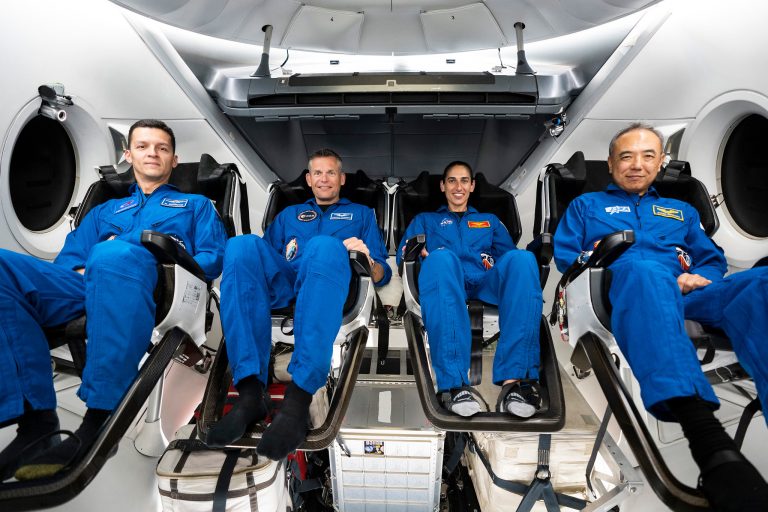
The Crew-7 launch will carry NASA astronaut Jasmin Moghbeli, ESA (European Space Agency) astronaut Andreas Mogensen, JAXA (Japan Aerospace Exploration Agency) astronaut Satoshi Furukawa, and Roscosmos cosmonaut Konstantin Borisov.

As part of the agency’s Commercial Crew Program, Crew-7 marks the eighth human spaceflight mission supported by a SpaceX Dragon spacecraft and the seventh crew rotation mission to the space station since 2020 for NASA.

The deadline for media accreditation for in-person coverage of this launch has passed. The agency’s media credentialing policy is available online. For questions about media accreditation, please email: [email protected].

All media participation in the following news conferences will be remote except where specifically listed below.

NASA’s SpaceX Crew-7 mission coverage is: (all times Eastern and subject to change based on real-time operations)

Sunday, Aug. 20

12:15 p.m.  – Crew arrival media event at Kennedy on NASA TV

  • Bill Nelson, NASA administrator 
  • Bob Cabana, associate administrator, NASA
  • Janet Petro, director, NASA Kennedy
  • Dana Hutcherson, deputy manager, Commercial Crew Program, NASA Kennedy
  • Eric van der Wal, lead, International Space Station Program Houston Office, ESA
  • Junichi Sakai, program manager, International Space Station, JAXA
  • NASA astronaut Jasmin Moghbeli
  • ESA astronaut Andreas Mogensen
  • JAXA astronaut Satoshi Furukawa
  • Roscosmos cosmonaut Konstantin Borisov

The event is limited to in-person media only. Follow Commercial Crew and Kennedy Space Center for the latest arrival updates.

Monday, Aug. 21

5 p.m. (approximately) – Flight Readiness Review media teleconference (no earlier than one hour after completion of the Flight Readiness Review) with the following participants:

  • Ken Bowersox, associate administrator, Space Operations Mission Directorate, NASA Headquarters
  • Steve Stich, manager, Commercial Crew Program, Kennedy
  • Joel Montalbano, manager, International Space Station Program, Johnson
  • William Gerstenmaier, vice president, Build and Flight Reliability, SpaceX
  • Frank De Winne, program manager, International Space Station, ESA
  • Junichi Sakai, program manager, International Space Station, JAXA
  • Amer AlSayegh AlGhaferi, assistant director general, Aerospace Engineering Sector, Mohammed Bin Rashid Space Center

Media may ask questions via phone only. For the dial-in number and passcode, please contact the Kennedy newsroom no later than 3 p.m. Monday, Aug. 21, at: [email protected].

Wednesday, Aug. 23

9:30 a.m. – NASA Social Panel Live Stream event at Kennedy with the following participants:

  • Tom Engler, Center Planning and Development Director, NASA Kennedy
  • Samantha Testa, recovery director, Commercial Crew Program, Kennedy
  • Kristin Fabre, deputy chief scientist, NASA’s Human Research Program 
  • Luca Parmitano, ESA astronaut

Members of the public may ask questions online by posting questions to the YouTube, Facebook, and X livestreams using #AskNASA.

11:30 a.m. –  One-on-one media interviews at Kennedy with various mission subject matter experts. Sign-up information will be emailed to media accredited to attend this launch in-person.

Friday, Aug. 25

11:30 p.m. – NASA TV launch coverage begins

Saturday, Aug. 26

3:27 a.m. – Launch

Following conclusion of launch and ascent coverage on NASA TV, coverage of the Crew-7 flight to the space station will continue audio only on mission audio circuits and on YouTube until coverage of rendezvous, docking, hatch opening, and welcoming remarks resumes on NASA TV.

For NASA TV downlink information, schedules, and links to streaming video, visit: http://www.nasa.gov/live.

5 a.m. (approximately) – Postlaunch News Conference on NASA TV

  • Ken Bowersox, associate administrator, Space Operations Mission Directorate, NASA Headquarters
  • Steve Stich, manager, Commercial Crew Program, Kennedy
  • Joel Montalbano, manager, International Space Station Program, Johnson
  • Benji Reed, senior director, Human Spaceflight Program, SpaceX
  • Hiroshi Sasaki, vice president, JAXA
  • Josef Aschbacher, director general, ESA

Media may ask questions in-person and via phone. Limited auditorium space will be available for in-person participation. For the dial-in number and passcode, please contact the Kennedy newsroom no later than 2:30 a.m. Saturday, Aug. 26, at [email protected].

Sunday, Aug. 27

6:45 a.m. – NASA TV arrival coverage begins

8:39 a.m. – Docking to the space-facing port of the station’s Harmony module

10:33 a.m. – Hatch opening

11:30 a.m. – Welcome ceremony

Audio Only Coverage

Audio only of the news conferences and launch coverage will be carried on the NASA “V” circuits, which may be accessed by dialing 321-867-1220, -1240 or -7135. On launch day, “mission audio,” countdown activities without NASA TV launch commentary, will be carried on 321-867-7135.

Launch audio also will be available on Launch Information Service And Amateur Television System’s VHF radio frequency 146.940 MHz and KSC Amateur Radio Club’s UHF radio frequency 444.925 MHz, FM mode, heard within Brevard County on the Space Coast.

Live Video Coverage Prior to Launch

NASA will provide a live video feed of Launch Complex 39A approximately 48 hours prior to the planned liftoff of the Crew-7 mission. Pending unlikely technical issues, the feed will be uninterrupted until the prelaunch broadcast begins on NASA TV, approximately four hours prior to launch. Once live, the video is available on NASA Kennedy’s Newsroom YouTube.

NASA Website Launch Coverage

Launch day coverage of NASA’s SpaceX Crew-7 mission will be available on the agency’s website. Coverage will include live streaming and blog updates beginning no earlier than 11:30 p.m. Friday, Aug. 25, as the countdown milestones occur. On-demand streaming video and photos of the launch will be available shortly after liftoff.

For questions about countdown coverage, contact the Kennedy newsroom at 321-867-2468. Follow countdown coverage on the commercial crew or Crew-7 blog.

Attend the Launch Virtually

Members of the public can register to attend this launch virtually. NASA’s virtual guest program for this mission also includes curated launch resources, notifications about related opportunities or changes, and a stamp for the NASA virtual guest passport following a successful launch.

Watch and Engage on Social Media

Let people know you’re following the mission on X, Facebook, and Instagram by using the hashtags #Crew7 and #NASASocial. You can also stay connected by following and tagging these accounts:

Facebook: NASANASAKennedyISSISS National Lab

Instagram: @NASA@NASAKennedy@ISS@ISSNationalLab@SpaceX

X: @NASA@NASAKennedy@NASASocial@Space_Station@ISS_Research@ISS National Lab@SpaceX@Commercial_Crew

Coverage en Espanol

Did you know NASA has a Spanish section called NASA en Espanol? Make sure to check out NASA en Espanol on X, Instagram, Facebook and YouTube for more coverage on Crew-7.

Para obtener información sobre cobertura en español en el Centro Espacial Kennedy o si desea solicitar entrevistas en español, comuníquese con Antonia Jaramillo: 321-501-8425; [email protected]; o Messod Bendayan: 256-930-1371; [email protected].

NASA’s Commercial Crew Program has delivered on its goal of safe, reliable, and cost-effective transportation to and from the International Space Station from the United States through a partnership with American private industry. This partnership is changing the arc of human spaceflight history by opening access to low Earth orbit and the International Space Station to more people, science, and commercial opportunities. The space station remains the springboard to NASA’s next great leap in space exploration, including future missions to the Moon and, eventually, to Mars.

For NASA’s launch blog and more information about the mission, visit:

https://www.nasa.gov/commercialcrew

-end-​

Joshua Finch / Lora Bleacher
Headquarters, Washington
202-358-1100
[email protected] / [email protected]

Steven Siceloff / Heather Scott
Kennedy Space Center, Florida
321-867-2468
[email protected] / [email protected]

Leah Cheshier
Johnson Space Center, Houston
281-483-5111
[email protected]

An Engineer’s Starter Pack – Must Have Supplies For The Trade

0

Engineering students need to have the best supply there is. Most of these should last you until you graduate from the course. Choosing the highest quality will save you a lot in the long run.

01. Mechanical Pencil from Bic

Mechanical pencil

It has a 0.7mm point size and provides smooth writing.

02. Erasers from Staedtler

Eraser

Premium quality vinyl eraser.

03. Graph Notebook from Oxford

Graph notebook

A grid notebook which can be used for mathematics and engineering subjects. Some also prefer this notebook for taking notes, if you don’t mind writing in small sizes. Or just use multiple rows when writing larger texts.

04. Scientific Calculator from Casio

Scientific calculator

If there is one piece of equipment any Engineer will have in their bag, it’s a Scientific Calculator. While there are already a variety of mobile applications that replicate the functions on a smart phone, those are not allowed on exams.

05. T-Square from Mr. Pen

T-Square ruler

The mighty T-Square, while primarily being required for drawing horizontal lines. It’s also used in tandem with the triangles.

06. Storage Tube from US Art Supply

Storage tube

I cannot stress how important this is. It not only protects your work from being crumpled, but it also prevents accidents that involves liquids like water and coffee.

07. Geometry Set from Maped

Geometry set

Complete set of geometry tools. This includes a small ruler, triangles, protractor, eraser, lead pencil, and compass. The 2 compass included has the versatility of allowing you to use your own pencil or the included lead.

08. Surface Pro Go Laptop from Microsoft

Surface pro

Dual use betwen a laptop and tablet. Portable and powerful. It comes with Windows 10 S operating system. Has a sufficient memory of 4 GB, 64GB of hard disk and Intel HD Graphics. 

09. Backpack Bag from JanSport

JanSport bag

Can fit laptops or tablets up to 15 inches. It has a padded sleeve, perfect for protecting your electronic device like laptop or tablet. It has spacious main compartment for your other tools.

Artemis II Crew, Meet Orion

0

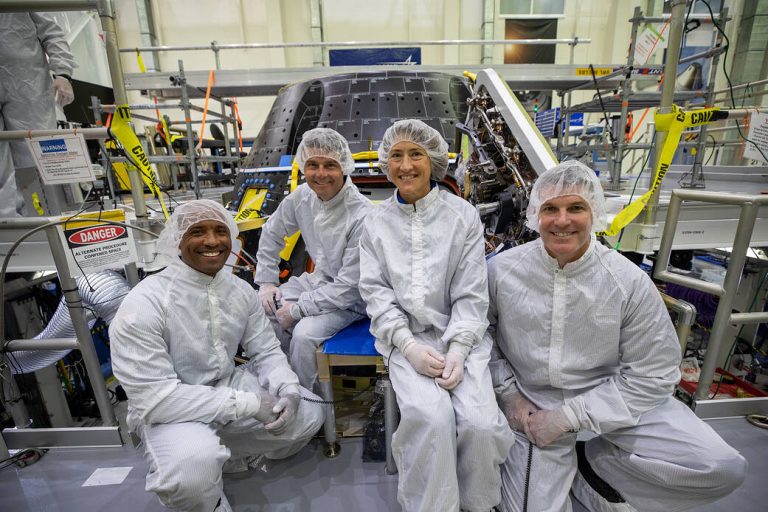
While wearing clean room suits, the Artemis II crew members (from left: NASA astronauts Victor Glover, Reid Wiseman, and Christina Koch, and Canadian Space Agency astronaut Jeremy Hansen) check out their Orion crew module inside the Neil Armstrong Operations and Checkout Building at NASA’s Kennedy Space Center in Florida on Aug. 7, 2023. The crew module is undergoing acoustic testing ahead of integration with the European Service Module. Orion will carry the crew around the Moon in the first crewed mission on NASA’s path to establishing a long-term lunar presence for science and exploration under Artemis.

Image Credit: NASA/Kim Shiflett

By: Monika Luabeya
Originally published at NASA

NASA and IBM Openly Release Geospatial AI Foundation Model for NASA Earth Observation Data

0

Based on NASA’s Harmonized Landsat Sentinel-2 (HLS) data, the artificial intelligence (AI) foundation model is a milestone in the application of AI for Earth science.

Foundation models were applied to HLS imagery, such as this true color composite image of irrigated agricultural fields near Sadat City, about 80 km northwest of Cairo, Egypt. Credit: HLS/NASA IMPACT.

A public/private partnership involving NASA and IBM Research has led to the release of NASA’s first open-source geospatial artificial intelligence (AI) foundation model for Earth observation data. Built using NASA’s Harmonized Landsat Sentinel-2 (HLS) dataset, the release of the HLS Geospatial Foundation Model (HLS Geospatial FM) is a milestone in the application of AI for Earth science. The model has a wide range of potential applications, including tracking changes in land use, monitoring natural disasters, and predicting crop yields. The HLS Geospatial FM is available at Hugging Face, a public repository for open-source machine learning models.

NASA’s Interagency Implementation and Advanced Concepts Team (IMPACT) played a major role in this work. Located at NASA’s Marshall Space Flight Center in Huntsville, Alabama, IMPACT is a component of NASA’s Earth Science Data Systems (ESDS) Program and is charged with expanding the use of NASA Earth observation data through innovation, partnerships, and technology, including the application of AI to these data. 

“AI foundation models for Earth observations present enormous potential to address intricate scientific problems and expedite the broader deployment of AI across diverse applications,” says Dr. Rahul Ramachandran, IMPACT manager and a senior research scientist at Marshall. “We call on the Earth science and applications communities to evaluate this initial HLS foundation model for a variety of uses and share feedback on its merits and drawbacks.” 

Along with NASA and IBM Research, this collaborative effort included Clark University’s Center for Geospatial Analytics, ESA (European Space Agency), USGS, and the U.S. Department of Energy’s Oak Ridge National Laboratory. This work is part of NASA’s Open-Source Science Initiative (OSSI), a commitment to building an inclusive, transparent, and collaborative open science community over the next decade. Development of the HLS Geospatial FM began in January 2023, and the FM was released in July 2023.

The Significance of Foundation Models

Foundation models (FMs) are types of AI models trained on a broad set of unlabeled data. They can be used for different tasks and can apply information about one situation to another. The goal of the NASA/IBM work is to provide an easier way for researchers to analyze and draw insights from large NASA datasets related to Earth processes.

“We believe that foundation models have the potential to change the way observational data are analyzed and help us to better understand our planet,” says NASA Chief Science Data Officer Kevin Murphy. “And by open-sourcing such models and making them available to the world, we hope to multiply their impact.”

AI FMs have the potential to play a pivotal role in understanding our planet’s interconnected processes and the climate effects of ongoing natural and human-caused changes. FMs that are pretrained on Earth observation data can accelerate the analysis of tremendous amounts of data in two primary ways.

First, FMs do not need large training datasets, which can be laborious and resource-intensive to create. The ability to train FMs on much smaller datasets can save time and money. Second, FMs can reduce redundant efforts to build downstream applications, which use FM output to perform a specific task, such as tracking changes in land use or monitoring natural disasters.

The Harmonized Landsat Sentinel-2 Data Collection

True-color HLS image of northwest Iceland acquired on July 11, 2023. NASA IMPACT developed the processing stream to expand HLS coverage from 28% of Earth to near-global. Interactively explore this image in NASA Worldview. Credit: HLS/NASA IMPACT; NASA Worldview.

HLS is a logical dataset on which to base the FM work. The HLS project provides consistent surface reflectance data from the Operational Land Imager (OLI) aboard the joint NASA/USGS Landsat 8 and 9 satellites and the Multi-Spectral Instrument (MSI) aboard the European Union’s Copernicus Sentinel-2A and Sentinel-2B satellites. The combined sensor measurements enable global land observations every 2 to 3 days at 30-meter spatial resolution.

NASA IMPACT was instrumental in developing the HLS processing architecture to achieve near-global coverage. HLS imagery can be interactively explored using the NASA Worldview Earth science data visualization tool and can be downloaded through NASA Earthdata Search.

The Road to the HLS Geospatial FM

The infrastructure needed for AI FMs is constantly evolving as the neural network architectures used to train these models become more complex. FMs are typically trained on massive datasets, which requires a significant amount of computing power.

As part of the NASA/IBM collaboration, IBM Research trained the HLS Geospatial FM on the IBM Cloud Vela supercomputer using the IBM watsonx FM stack, which is a cloud-based platform for training and deploying FMs. The IBM watsonx FM stack is currently running in NASA’s Science Managed Cloud Environment (SMCE). Located at NASA’s Goddard Space Flight Center in Greenbelt, Maryland, the SMCE is designed to accelerate NASA science research by enabling quick access to cloud resources for rapid prototyping and open collaboration. 

Evaluating the Model

NASA, IBM Research, and Clark University teams are in the process of assessing the HLS Geospatial FM for a wide range of downstream applications, including classification, object detection, time-series segmentation, and similarity search. The FM already has been applied to flood mapping, where it achieved state-of-the-art performance using smaller samples. Along with flood mapping, the FM also has been applied to burn scar identification, a critical component for active fire management and post-fire recovery. Additionally, using time-series data, the teams have shown the benefits of using the FM model for land cover and crop type mapping in diverse geographies across the contiguous United States. 

Fine-Tuning the Model

A recent workshop demonstrated the potential of AI FMs for Earth science applications. Organized by IMPACT in collaboration with the Institute of Electrical and Electronics Engineers Geoscience and Remote Sensing Society (IEEE GRSS) Earth Science Informatics Technical Committee (ESI TC), the workshop covered the development of FMs using HLS data and included a hands-on exercise in fine-tuning the FM using IBM’s watsonx.ai. Participants also applied the model to new HLS data and successfully fine-tuned the FM for flood water detection and burn scar identification.

The workshop demonstrated that with the right tutorials, platform, and infrastructure, it is possible to quickly train geoscientists to effectively use FMs for downstream applications. This is a significant step forward in the development of AI for Earth science, as it opens up the possibility of using FMs to solve a wide range of problems.

Next Steps

Along with the work on the HLS Geospatial FM, NASA and IBM are developing other applications to extract insights from Earth observations, including a large language model based on Earth science literature. In keeping with NASA’s open science guidelines and principles, models and products resulting from this collaborative work will be open and available to the entire science community.

Explore the Data

Hugging Face calls the HLS Geospatial FM family pipelines Prithvi. Prithvi is a first-of-its-kind temporal Vision transformer pre-trained by the NASA and IBM team on contiguous U.S. HLS data.

Prithvi 100M:

Prithvi 100M Burn Scars:

Prithvi 100M Flooding:

Prithvi 100M Multitemporal Crop Detection:

By: Josh Blumenfeld
Originally published at Earth Data

Source: cyberpogo.com

Art And Artist Essentials. A Back-To-School List.

0

As an artist, you need to prime your creative mind. This require an intensive focus that you’d have to avoid distractions. What better way to help focus on your objective, than to have the supplies and equipment ready. Here are some the items that will help you.

01. Graphite Sketch Pencil Set from Faber-Castell

Includes 6 artist quality pencils in various degrees of lead hardness: 2H, HB, B, 2B, 4B, 6B. 

Graphite Pencils

02. Color Pencil from Prismacolor

72 premium colored pencils. Artist quality colored pencils for every level of expertise

Color Pencils

03. Artist Pen from Faber-Castell

Pitt Artist Pens are perfect for any style of art. It is filled with India Ink, which is specially used for inking combic books and comic strips.

Artist Pen

04. Highlighter Pen from Zebra

Versatile creative tool! With a broad chisel tip at one end and fine bullet point at the other, these creative markers are great for highlighting, hand lettering and creative expression

Highlighter Pen

05. Sketch Pad from Canson

It has 5.5 x 8.5 inches (14 x 21.6 cm) paper size. It is also has a durable surface that allows erasing without damaging surface. 

Sketch Pad

06. Scissor from Westcott

This full-size safety cutter is designed to cut through the largest of boxes and allows you to open boxes with ease. It also has an ergonomic handle, which you should look for every scissor that you want to buy. 

Scissor

07. Masking Tape from TSSART

Masking tapes are widely used for fixing paper and other objects to the working environment. This one has residue-free feature which doesn’t leave any sticky residue which ensures that your work will be in spotless condition.

Masking tape

08. Sharpener from CARL

This mechanical sharpener has been well-trusted for a long time. Capable of producing a sharp point for any pencil you have. While there are automatic sharpeners available, this one you can enjoy the movement of sharpening.

Pencil sharpener

09. Painting Set from ESRICH

The set has 12 pieces brushes, 24 color tubes (12ml, 0.4 oz) acrylic paint, a palette, an easel, 6 pieces blank drawing boards (round and rectangle) ,10 Page Pad(A4), a paint knife, a brush cup, an art sponge and a gift box.

Painting set

10. Drawing Tablet Apple iPad Pro 11-inch (4th Generation)

This is an excellent tool for drawing without the use of pencil and colors. While it has that advantage, there are also the disadvantage of not having the feel of carefully cleaning and erasing the pencil drafts before inking. But this disadvantage might only come from those who started with using pencils and similar tools. 

Note that the Apple Pencil is not included in this package.

Tablet device

11. Backpack Bag from JanSport

Can fit laptops or table up to 15 inches. It has a padded sleeve, perfect for protecting your electronic device like laptop or tablet, or even your drawing pad. It has spacious main compartment for your other tools.

Backpack bag


Student life is busy enough without hassles like paying for shipping. That’s why Amazon Prime Student is a must-have for you. For just $14.99 $7.49/month, Prime Student gets you free two-day shipping on over 100 million items, unlimited photo storage, exclusive deals, and more. Better still, it comes with a six-month free trial so you can make sure Prime Student fits your lifestyle. Join today to take advantage of membership benefits and perks tailored specifically for students! Click here to sign up now: https://amzn.to/47wkx6f

Testing New Wheels For The Moon

0

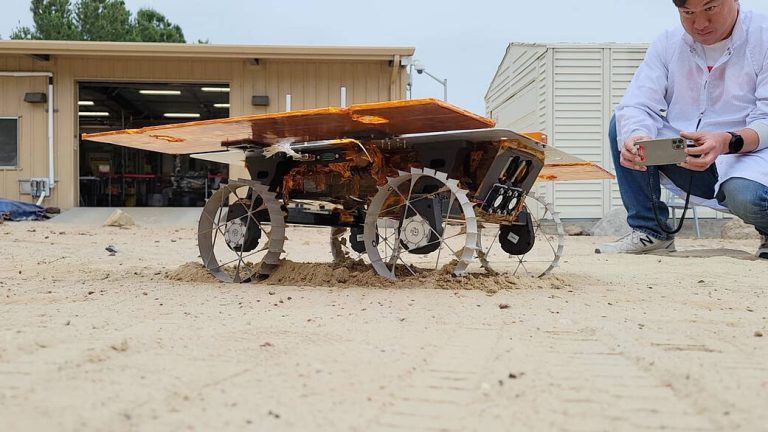
In this image from June 2023, an engineer watches a development model rover during a test for NASA’s Cooperative Autonomous Distributed Robotic Exploration (CADRE) technology demonstration in the Mars Yard at NASA’s Jet Propulsion Laboratory in Southern California. The team tested a new wheel design, surface navigation software, and mobility capabilities, among other aspects of the project.

NASA is sending a trio of these miniature rovers to the Moon to see how well they can cooperate with one another without direct input from mission controllers back on Earth. About the size of a carry-on suitcase, each of the four-wheeled rovers will drive to find a sunbathing spot, where they’ll open their solar panels and charge up. Then they’ll spend the lunar daytime conducting experiments designed to test their capabilities.

Learn more about CADRE (https://www.nasa.gov/feature/jpl/nasa-s-trio-of-mini-rovers-will-team-up-to-explore-the-moon).

Image Credit: NASA/JPL-Caltech

By: Monika Luabeya
Originally published at NASA

Back-To-School and Back-To-Class. The Professor Essentials.

0

The school year is about to start, and it’s about to get busy. In order to save some time we have listed some of supplies you might need restocking. Also included are some equipment professors will need to ease the workload.

01. Pencil from Paper Mate

Still one of the best and simplest writing tool there is. Just remember to bring a sharpener and eraser.

Pencil

02. Black Ballpen from Bic

An ingenious invention, widely used to this day. Invented by László Bíró, and together with the pencil are the most common used writing tool 

Ballpen

03. Whiteboard Maker from EXPO

With four available colors, highlighting lectures will become much easier and effective.

Whiteboard marker

04. Ruled Notebook from Amazon Basics

A ruled notebook with an elastic closure to keep the contents safe.

Notebook

05. A Field Guide To AI by Dean Marc Co and Mary Rose Oh

Artificial Intelligence whether we like it or not. For the better of it, we should try to learn what are all the terms and meanings are. Better be knowledgeable to avoid being swayed by the buzz words.

A Field Guide to A.I.

06. Laser Pointer / Presentation Clicker from Zoxkoy

A good equipment for teaching. Specially when teaching in a large classroom. It is universally compatible with laptops. 

Laser pointer

07. Microsoft Surface Pro Go Laptop from Microsoft

Dual use between a laptop and tablet. Versatility at it’s finest. It comes with Windows 10 S operating system. Has a sufficient memory of 4 GB, 64GB of hard disk and Intel HD Graphics. Good for lessons, planning and presentation.

Laptop

08. Laptop Bag from Osprey

Will fit the Microsoft Surface Go and other items you might need for teaching. It has side pockets for water bottle and other essential items.

Backpack bag


Student life is busy enough without hassles like paying for shipping. That’s why Amazon Prime Student is a must-have for you. For just $14.99 $7.49/month, Prime Student gets you free two-day shipping on over 100 million items, unlimited photo storage, exclusive deals, and more. Better still, it comes with a six-month free trial so you can make sure Prime Student fits your lifestyle. Join today to take advantage of membership benefits and perks tailored specifically for students! Click here to sign up now: https://amzn.to/47wkx6f

Lahaina Wildfires – Here’s How You Can Help

0

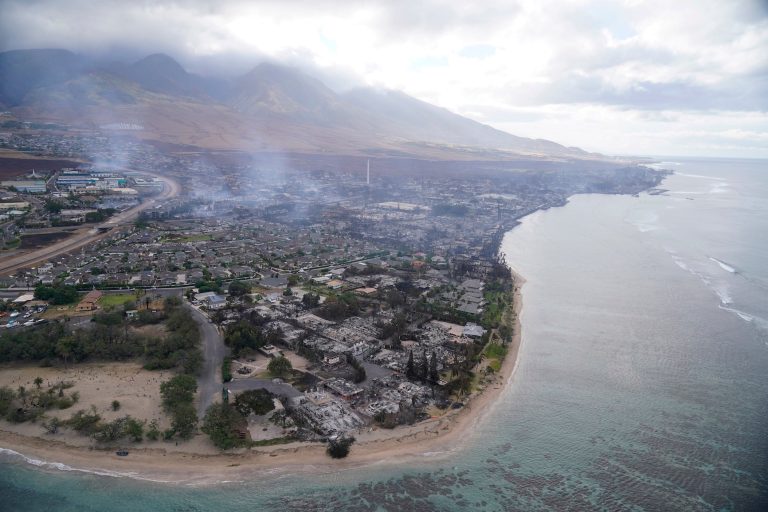
Devastating wildfires raged across Maui, Hawaii, burning out of control amid strong winds from Hurricane Dora. The fast-spreading flames have destroyed homes and landmarks, including the historic Lahaina town on Maui, a top tourist destination.

Hospitals are inundated treating burn and smoke inhalation victims as thousands have fled or been displaced by the inferno. With communication networks down, search and rescue efforts continue even as officials warn the death toll may climb higher.

Hawaii desperately needs assistance combating these unrelenting wildfires and supporting displaced residents. Here are some ways you can help:

  • Donate to relief organisations supplying emergency shelter, food, and medical care. Consider funds for long-term recovery efforts.
  • Give to Hawaii-based nonprofits mobilising response teams and resources on the ground.
  • Support volunteer fire crews travelling to reinforce exhausted local teams.
  • Check with local Hawaii community foundations supporting affected families with immediate needs.
  • Reach out to elected officials and urge robust federal disaster aid to Hawaii.

Every contribution, large or small, can make a difference for Hawaii residents impacted by these devastating wildfires. Please consider acting now to provide critical relief during these difficult times. Here are some organisations you can reach out to:

American Red Cross of Hawaii

https://www.redcross.org/local/hawaii.html

Hawaii Salvation Army

https://hawaii.salvationarmy.org/

Hawaii Community Foundation

https://www.hawaiicommunityfoundation.org/maui-strong

Maui United Way

https://mauiunitedway.org/disasterrelief

Kako’o Maui fund

https://www.memberplanet.com/campaign/cnhamembers/kakoomaui

Maui Humane Society

https://www.facebook.com/MauiHumaneSociety

Maui Food Bank

Mahalo…