
Home Blog Page 118

Hubble Finds A Black Hole Igniting Star Formation In A Dwarf Galaxy

0

Dwarf galaxy Henize 2-10 continues to make a big impact, defying astronomers’ expectations

Black holes are often described as the monsters of the universe—tearing apart stars, consuming anything that comes too close, and holding light captive. Detailed evidence from NASA’s Hubble Space Telescope, however, shows a black hole in a new light: fostering, rather than suppressing, star formation. Hubble imaging and spectroscopy of the dwarf starburst galaxy Henize 2-10 clearly show a gas outflow stretching from the black hole to a bright star birth region like an umbilical cord, triggering the already dense cloud into forming clusters of stars. Astronomers have previously debated that a dwarf galaxy could have a black hole analogous to the supermassive black holes in larger galaxies. Further study of dwarf galaxies, which have remained small over cosmic time, may shed light on the question of how the first seeds of supermassive black holes formed and evolved over the history of the universe.


Often portrayed as destructive monsters that hold light captive, black holes take on a less villainous role in the latest research from NASA’s Hubble Space Telescope. A black hole at the heart of the dwarf galaxy Henize 2-10 is creating stars rather than gobbling them up. The black hole is apparently contributing to the firestorm of new star formation taking place in the galaxy. The dwarf galaxy lies 30 million light-years away, in the southern constellation Pyxis.

A decade ago this small galaxy set off debate among astronomers as to whether dwarf galaxies were home to black holes proportional to the supermassive behemoths found in the hearts of larger galaxies. This new discovery has little Henize 2-10, containing only one-tenth the number of stars found in our Milky Way, poised to play a big part in solving the mystery of where supermassive black holes came from in the first place.
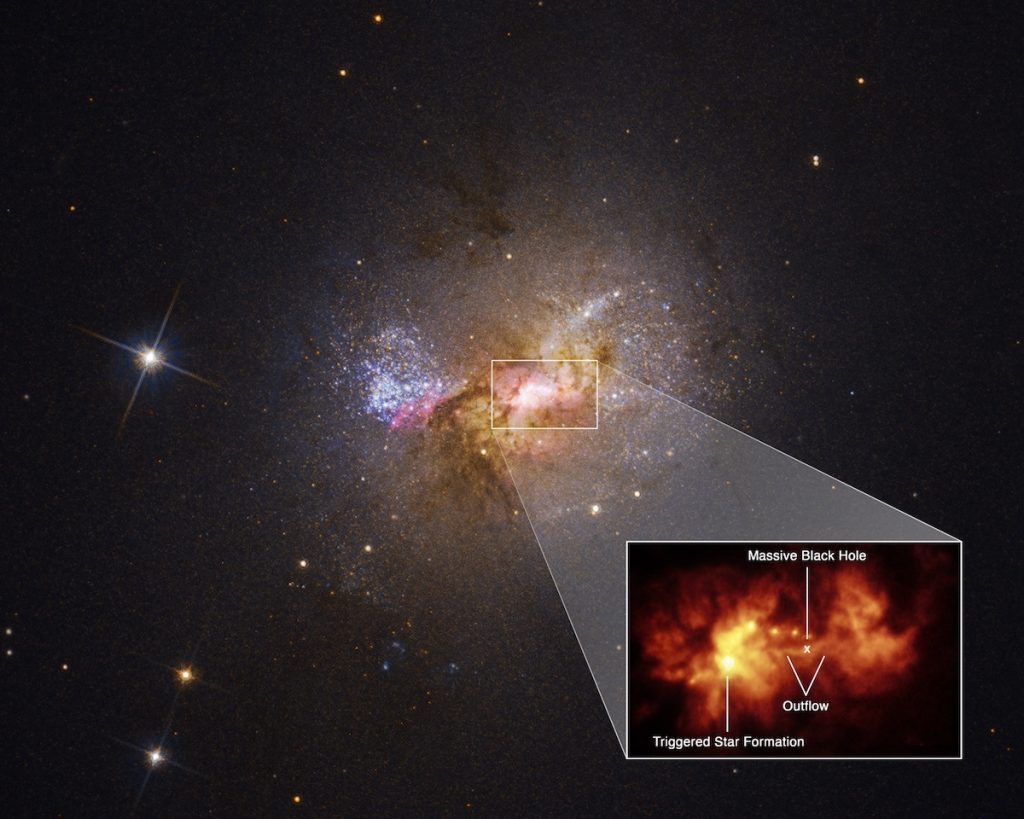
A pullout of the central region dwarf starburst galaxy Henize 2-10 traces an outflow, or bridge of hot gas 230 light-years long, connecting the galaxy’s massive black hole and a star-forming region. Hubble data on the velocity of the outflow from the black hole, as well as the age of the young stars, indicates a causal relationship between the two. A few million years ago, the outflow of hot gas slammed into the dense cloud of a stellar nursery and spread out, like water from a hose impacting a mound of dirt. Now clusters of young stars are aligned perpendicular to the outflow, revealing the path of its spread. Image credits: CREDITS: SCIENCE: NASA, ESA, Zachary Schutte (XGI), Amy Reines (XGI), Alyssa Pagan (STScI)
A pullout of the central region dwarf starburst galaxy Henize 2-10 traces an outflow, or bridge of hot gas 230 light-years long, connecting the galaxy’s massive black hole and a star-forming region. Hubble data on the velocity of the outflow from the black hole, as well as the age of the young stars, indicates a causal relationship between the two. A few million years ago, the outflow of hot gas slammed into the dense cloud of a stellar nursery and spread out, like water from a hose impacting a mound of dirt. Now clusters of young stars are aligned perpendicular to the outflow, revealing the path of its spread. Image credits: NASA, ESA, Zachary Schutte (XGI), Amy Reines (XGI), Alyssa Pagan (STScI)

“Ten years ago, as a graduate student thinking I would spend my career on star formation, I looked at the data from Henize 2-10 and everything changed,” said Amy Reines, who published the first evidence for a black hole in the galaxy in 2011 and is the principal investigator on the new Hubble observations, published in the January 19 issue of Nature

“From the beginning I knew something unusual and special was happening in Henize 2-10, and now Hubble has provided a very clear picture of the connection between the black hole and a neighboring star forming region located 230 light-years from the black hole,” Reines said.

That connection is an outflow of gas stretching across space like an umbilical cord to a bright stellar nursery. The region was already home to a dense cocoon of gas when the low-velocity outflow arrived. Hubble spectroscopy shows the outflow was moving about 1 million miles per hour, slamming into the dense gas like a garden hose hitting a pile of dirt and spreading out. Newborn star clusters dot the path of the outflow’s spread, their ages also calculated by Hubble.

This is the opposite effect of what’s seen in larger galaxies, where material falling toward the black hole is whisked away by surrounding magnetic fields, forming blazing jets of plasma moving at close to the speed of light. Gas clouds caught in the jets’ path would be heated far beyond their ability to cool back down and form stars. But with the less-massive black hole in Henize 2-10, and its gentler outflow, gas was compressed just enough to precipitate new star formation.
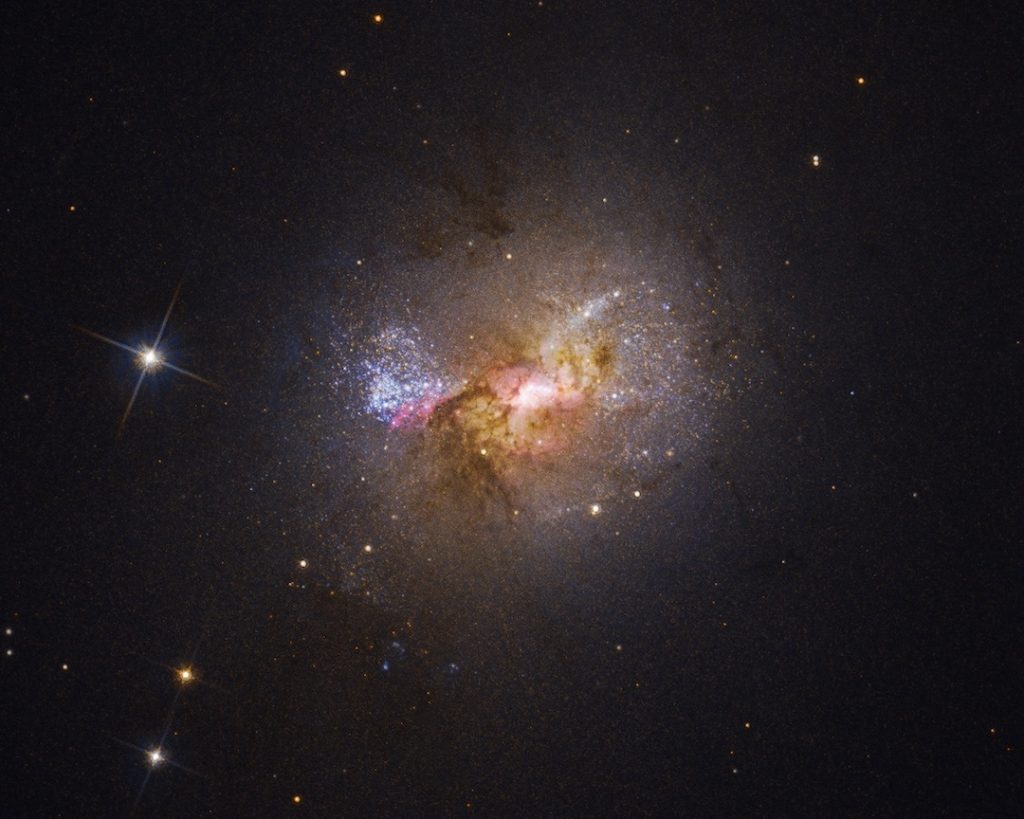
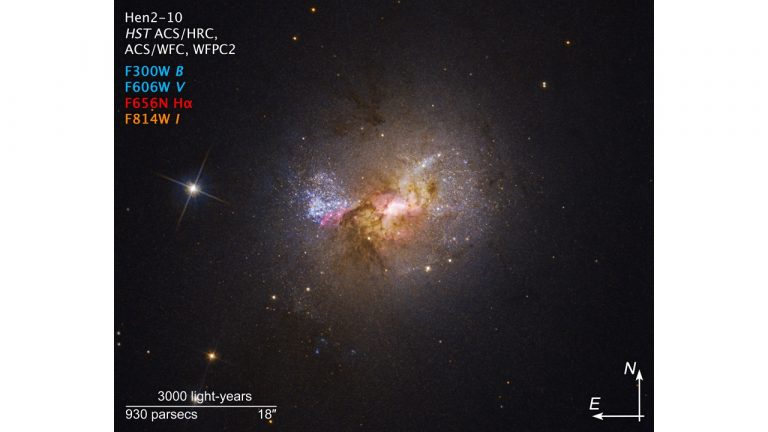
Dwarf starburst galaxy Henize 2-10 sparkles with young stars in this Hubble visible-light image. The bright region at the center, surrounded by pink clouds and dark dust lanes, indicates the location of the galaxy’s massive black hole and active stellar nurseries. Image credit: NASA, ESA, Zachary Schutte (XGI), Amy Reines (XGI), Alyssa Pagan (STScI)

“At only 30 million light-years away, Henize 2-10 is close enough that Hubble was able to capture both images and spectroscopic evidence of a black hole outflow very clearly. The additional surprise was that, rather than suppressing star formation, the outflow was triggering the birth of new stars,” said Zachary Schutte, Reines’ graduate student and lead author of the new study.

Ever since her first discovery of distinctive radio and X-ray emissions in Henize 2-10, Reines has thought they likely came from a massive black hole, but not as supermassive as those seen in larger galaxies. Other astronomers, however, thought that the radiation was more likely being emitted by a supernova remnant, which would be a familiar occurrence in a galaxy that is rapidly pumping out massive stars that quickly explode.

“Hubble’s amazing resolution clearly shows a corkscrew-like pattern in the velocities of the gas, which we can fit to the model of a precessing, or wobbling, outflow from a black hole. A supernova remnant would not have that pattern, and so it is effectively our smoking-gun proof that this is a black hole,” Reines said.

Reines expects that even more research will be directed at dwarf galaxy black holes in the future, with the aim of using them as clues to the mystery of how supermassive black holes came to be in the early universe. It’s a persistent puzzle for astronomers. The relationship between the mass of the galaxy and its black hole can provide clues. The black hole in Henize 2-10 is around 1 million solar masses. In larger galaxies, black holes can be more than 1 billion times our Sun’s mass. The more massive the host galaxy, the more massive the central black hole.

Current theories on the origin of supermassive black holes break down into three categories: 1) they formed just like smaller stellar-mass black holes, from the implosion of stars, and somehow gathered enough material to grow supermassive, 2) special conditions in the early universe allowed for the formation of supermassive stars, which collapsed to form massive black hole “seeds” right off the bat, or 3) the seeds of future supermassive black holes were born in dense star clusters, where the cluster’s overall mass would have been enough to somehow create them from gravitational collapse.

So far, none of these black hole seeding theories has taken the lead. Dwarf galaxies like Henize 2-10 offer promising potential clues, because they have remained small over cosmic time, rather than undergoing the growth and mergers of large galaxies like the Milky Way. Astronomers think that dwarf galaxy black holes could serve as an analog for black holes in the early universe, when they were just beginning to form and grow.

“The era of the first black holes is not something that we have been able to see, so it really has become the big question: where did they come from? Dwarf galaxies may retain some memory of the black hole seeding scenario that has otherwise been lost to time and space,” Reines said.

The Hubble Space Telescope is a project of international cooperation between NASA and ESA (European Space Agency). NASA’s Goddard Space Flight Center in Greenbelt, Maryland, manages the telescope. The Space Telescope Science Institute (STScI) in Baltimore, Maryland, conducts Hubble science operations. STScI is operated for NASA by the Association of Universities for Research in Astronomy in Washington, D.C.
Our Universe is too vast for even the most imaginative sci-fi

0

As an astrophysicist, I am always struck by the fact that even the wildest science-fiction stories tend to be distinctly human in character. No matter how exotic the locale or how unusual the scientific concepts, most science fiction ends up being about quintessentially human (or human-like) interactions, problems, foibles and challenges. This is what we respond to; it is what we can best understand. In practice, this means that most science fiction takes place in relatively relatable settings, on a planet or spacecraft. The real challenge is to tie the story to human emotions, and human sizes and timescales, while still capturing the enormous scales of the Universe itself.

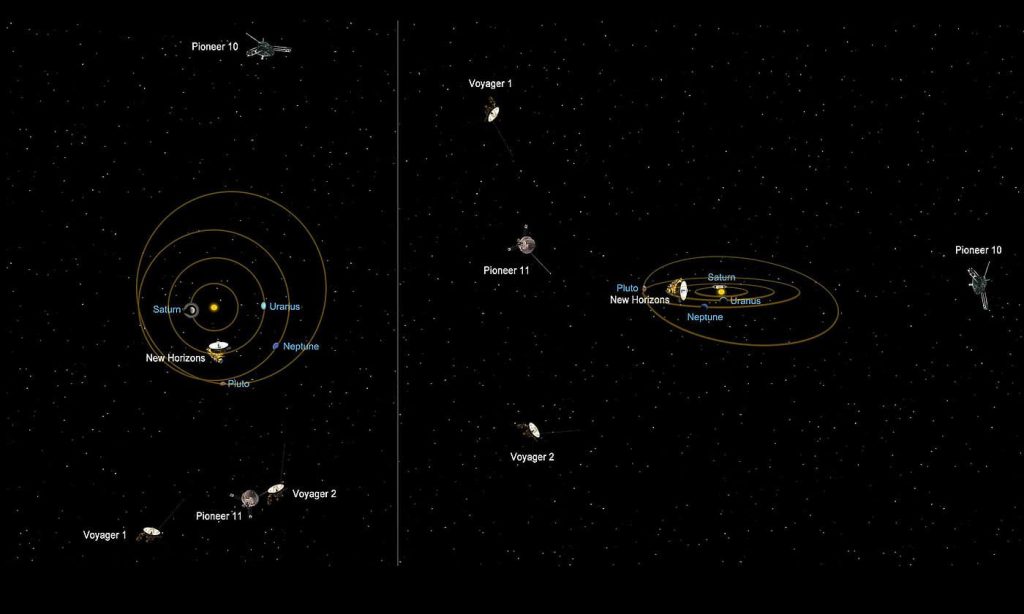
Relative positions of distant spacecraft. Courtesy NASA/JPL-Caltech

Just how large the Universe actually is never fails to boggle the mind. We say that the observable Universe extends for tens of billions of light years, but the only way to really comprehend this, as humans, is to break matters down into a series of steps, starting with our visceral understanding of the size of the Earth. A non-stop flight from Dubai to San Francisco covers a distance of about 8,000 miles – roughly equal to the diameter of the Earth. The Sun is much bigger; its diameter is just over 100 times Earth’s. And the distance between the Earth and the Sun is about 100 times larger than that, close to 100 million miles. This distance, the radius of the Earth’s orbit around the Sun, is a fundamental measure in astronomy; the Astronomical Unit, or AU. The spacecraft Voyager 1, for example, launched in 1977 and, travelling at 11 miles per second, is now 137 AU from the Sun.

But the stars are far more distant than this. The nearest, Proxima Centauri, is about 270,000 AU, or 4.25 light years away. You would have to line up 30 million Suns to span the gap between the Sun and Proxima Centauri. The Vogons in Douglas Adams’s The Hitchhiker’s Guide to the Galaxy (1979) are shocked that humans have not travelled to the Proxima Centauri system to see the Earth’s demolition notice; the joke is just how impossibly large the distance is.

Four light years turns out to be about the average distance between stars in the Milky Way Galaxy, of which the Sun is a member. That is a lot of empty space! The Milky Way contains about 300 billion stars, in a vast structure roughly 100,000 light years in diameter. One of the truly exciting discoveries of the past two decades is that our Sun is far from unique in hosting a retinue of planets: evidence shows that the majority of Sun-like stars in the Milky Way have planets orbiting them, many with a size and distance from their parent star allowing them to host life as we know it.

Yet getting to these planets is another matter entirely: Voyager 1 would arrive at Proxima Centauri in 75,000 years if it were travelling in the right direction – which it isn’t. Science-fiction writers use a variety of tricks to span these interstellar distances: putting their passengers into states of suspended animation during the long voyages, or travelling close to the speed of light (to take advantage of the time dilation predicted in Albert Einstein’s theory of special relativity). Or they invoke warp drives, wormholes or other as-yet undiscovered phenomena.

When astronomers made the first definitive measurements of the scale of our Galaxy a century ago, they were overwhelmed by the size of the Universe they had mapped. Initially, there was great skepticism that the so-called ‘spiral nebulae’ seen in deep photographs of the sky were in fact ‘island universes’ – structures as large as the Milky Way, but at much larger distances still. While the vast majority of science-fiction stories stay within our Milky Way, much of the story of the past 100 years of astronomy has been the discovery of just how much larger than that the Universe is. Our nearest galactic neighbour is about 2 million light years away, while the light from the most distant galaxies our telescopes can see has been travelling to us for most of the age of the Universe, about 13 billion years.

We discovered in the 1920s that the Universe has been expanding since the Big Bang. But about 20 years ago, astronomers found that this expansion was speeding up, driven by a force whose physical nature we do not understand, but to which we give the stop-gap name of ‘dark energy’. Dark energy operates on length- and time-scales of the Universe as a whole: how could we capture such a concept in a piece of fiction?

The story doesn’t stop there. We can’t see galaxies from those parts of the Universe for which there hasn’t been enough time since the Big Bang for the light to reach us. What lies beyond the observable bounds of the Universe? Our simplest cosmological models suggest that the Universe is uniform in its properties on the largest scales, and extends forever. A variant idea says that the Big Bang that birthed our Universe is only one of a (possibly infinite) number of such explosions, and that the resulting ‘multiverse’ has an extent utterly beyond our comprehension.

The US astronomer Neil deGrasse Tyson once said: ‘The Universe is under no obligation to make sense to you.’ Similarly, the wonders of the Universe are under no obligation to make it easy for science-fiction writers to tell stories about them. The Universe is mostly empty space, and the distances between stars in galaxies, and between galaxies in the Universe, are incomprehensibly vast on human scales. Capturing the true scale of the Universe, while somehow tying it to human endeavours and emotions, is a daunting challenge for any science-fiction writer. Olaf Stapledon took up that challenge in his novel Star Maker (1937), in which the stars and nebulae, and cosmos as a whole, are conscious. While we are humbled by our tiny size relative to the cosmos, our brains can none the less comprehend, to some extent, just how large the Universe we inhabit is. This is hopeful, since, as the astrobiologist Caleb Scharf of Columbia University has said: ‘In a finite world, a cosmic perspective isn’t a luxury, it is a necessity.’ Conveying this to the public is the real challenge faced by astronomers and science-fiction writers alike.

Welcome to the Universe: An Astrophysical Tour by Michael Strauss, Neil deGrasse Tyson and J Richard Gott is out now through Princeton University Press.

This article was originally published at Aeon and has been republished under Creative Commons.

Leading space innovator ClearSpace opens for business in the UK

0

ClearSpace, the innovative Swiss start-up with mission to make the booming commercial space economy more sustainable, affordable and resilient, has announced the formation of a UK subsidiary, its first significant engineering presence outside of Switzerland. The new ClearSpace facility has the potential to create more than 20 high-skill jobs as part of the company’s drive to deliver a wide range of in-orbit services, including orbital debris removal, in-orbit transport, and satellite life extension.

Since its formation in 2018, ClearSpace has innovated rapidly and has recently signed an €86.2M in-orbit service contract with the European Space Agency to remove orbital debris, the first step in cleaning up Space for future generations. The formation of ClearSpace Today Ltd will allow critical parts of that ClearSpace-1 Mission, and other future commercial missions, to be developed in the UK.

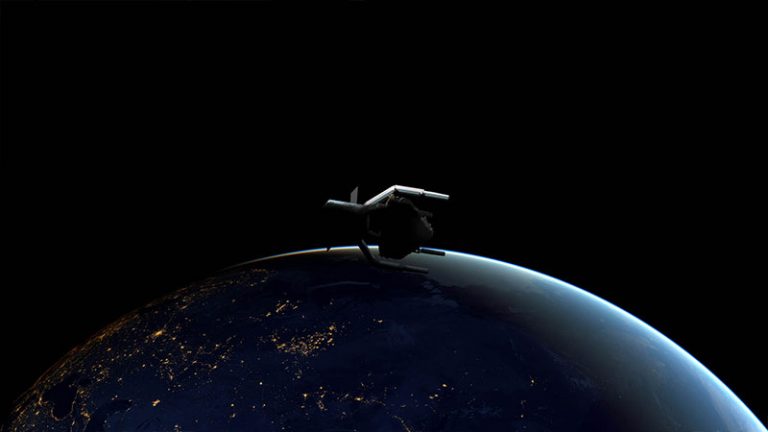
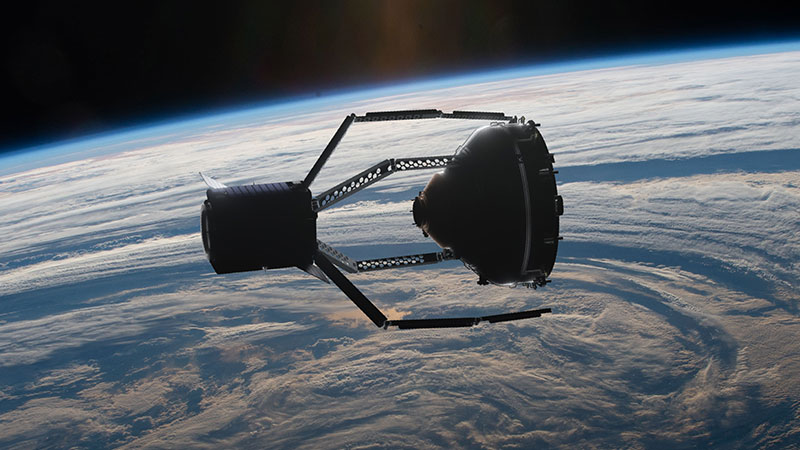
The ClearSpace-1 satellite (left) docking with a piece of space debris (right), before safely removing it from orbit. Image credit: ClearSpace SA.

ClearSpace’s UK lead Rory Holmes said:
“We are thrilled to be part of the thriving UK space ecosystem and are excited to build our engineering presence here, tapping into the highly-relevant experience that exists within the high-tech talent pool and the local industry.
“We are very grateful for the invaluable support provided by the UK Space Agency and the Department for International Trade throughout the setup of our UK subsidiary.”

The UK is Europe’s largest contributor to ESA projects to remove debris from Space. Science Minister Amanda Solloway said:
“I want the UK to be the destination of choice for the world’s most enterprising space companies, and it is brilliant news that ClearSpace has chosen to carry out its world-leading work here.
“This ambitious project to clean up space will help create highly skilled jobs for the UK’s thriving space sector while ensuring that the scientific and commercial exploration of space remains sustainable for generations to come.”

Minister for Investment Gerry Grimstone said:
“I welcome Clearspace to the UK’s dynamic and cutting-edge space industry where they will be able to carry out their important work to remove orbital debris.”
“Space will increasingly play a role in growing UK prosperity through high skilled jobs and investment in R&D, providing solutions to some of our shared global problems. I am excited to see how Clearspace, through developing their UK capability, will be a key part of addressing these.”

ClearSpace CEO and co-founder Luc Piguet said:
“Space sustainability and resilient operations is a challenge at the global scale – now is the time to build capabilities that will make our space operations more sustainable and affordable. We need to ambitiously grow space activities while safeguarding this precious environment for future generations.”
“We are enthusiastic to expand our team in the UK to develop key enabling technologies and to foster robust partnerships with other forward-thinking companies and organizations.”

ClearSpace-1 will be the first space mission to remove an item of debris from orbit, planned for launch in 2025. UK Space Agency International Director Alice Bunn said:
“Space represents the future of our economy, but we must make use of it sustainably. With thousands of pieces of space debris, including defunct satellites, rocket bodies and launch adapters remaining in orbit, the need for new techniques and technologies to remove them could not be greater.
“We want UK to be the best place for space and are committed to delivering access to skills, investment, and regulatory reform to make that happen.”


About ClearSpace

ClearSpace SA, a Swiss start-up founded in Lausanne in 2018, brings together space experts including astronauts, engineers and researchers from all over the world at EPFL (Ecole Polytechnique Fédérale Lausanne). They aim to harness their respective talents to clean up space debris and build the future of in-orbit services. The team of experts were originally hired for an academic mission to bring down SwissCube, a cubesat launched in 2009 by EPFL, but they left the University in 2012 to focus on ClearSpace-1, their mission for the European Space Agency (ESA). On 13 November 2020, ClearSpace signed a contract worth 86 million euros with ESA to send their first robot cleaner into space in 2025.

What high-speed astronomy can tell us about the galactic zoo

0

For most of human history, the distant ‘celestial sphere’ was regarded as perfect and unchanging. Stars remained in place, planets moved predictably, and the few rogue comets were viewed as atmospheric phenomena. This began to change with the Danish astronomer Tycho Brahe’s observation of the supernova of 1572 – apparently, a new star – and his studies of the Great Comet of 1577, which he proved was actually a distant object. Nonetheless, the impression of permanence is strong. There are very few astronomical objects that noticeably vary to the naked eye: only the brightest comets, novae and supernovae. For observers in the northern hemisphere, the last naked-eye supernova was in 1604.

Modern telescopic studies tell a quite different story. Today, we know of roughly a half-million variable stars in our galaxy, and identify thousands of transient objects each year. Although many stars vary in predictable ways, the Universe is also full of unpredictable violence. When two stars orbit close to each other, mass can flow from one to the other. If one of the stars is an old, collapsed white dwarf, the gas it pulls from its companion can accumulate until the dwarf undergoes a sudden thermonuclear explosion – a supernova like the one seen by Tycho. There is also another, more common type of supernova produced by the deaths of solitary stars more than about 10 times the mass of the Sun.

Supernovae show a broad range of behaviours that depend on the detailed properties of the system at the time of the final, fatal cataclysm. The atoms that emerge from supernova explosions have provided the raw material for all planets, including our own. Astronomers are understandably eager to learn more about them, but the two classes of supernovae combined happen only about once per century in our galaxy.

Obviously, for events occurring on time scales of a century, searching for them in our galaxy alone is not terribly profitable. Fortunately, our galaxy is only one of about a trillion galaxies in the visible Universe. If you monitor millions of galaxies all the time, it is possible to find many supernovae each and every day. This is one of the most exciting challenges of modern high-speed astronomy.

Other than supernovae, there are only a few variable sources luminous enough to be seen at the great distances to other galaxies, even using powerful telescopes. By far the most common is the random variability of quasars. Quasars consist of a supermassive black hole, millions to billions of times the mass of our Sun, which shine as material falls towards the black hole, heats up and radiates energy.

Today we think that essentially every galaxy contains a supermassive black hole at its centre, and something like 1 per cent of them are accreting mass fast enough to be seen as luminous quasars. The supermassive black hole at the centre of our own galaxy is essentially ‘off’. On rare occasions, though, such a black hole rapidly turns itself ‘on’. The most fascinating cause is a so-called ‘tidal disruption event’ in which a star like the Sun passes too close to the black hole and is ripped apart by the black hole’s tides. Some of the debris then falls into the black hole to power a transient flare. These tidal disruption events are far rarer than supernovae, occurring only about once every 10,000 years in any particular galaxy. In the distant Universe, the study of variability is essentially the study of black holes and supernovae.

This gives you some sense of the remarkable astronomical zoo of variable and transient objects. The challenge for the professional astronomer is to find and characterise all these different sources not only for how they work individually, but also to determine their overall demographics and statistics. To find large numbers of them, you need a big telescope that can detect the much more numerous distant, faint objects. In general, however, bigger telescopes see only smaller pieces of the sky. This frustrating rule can be bent only by spending large sums of money.

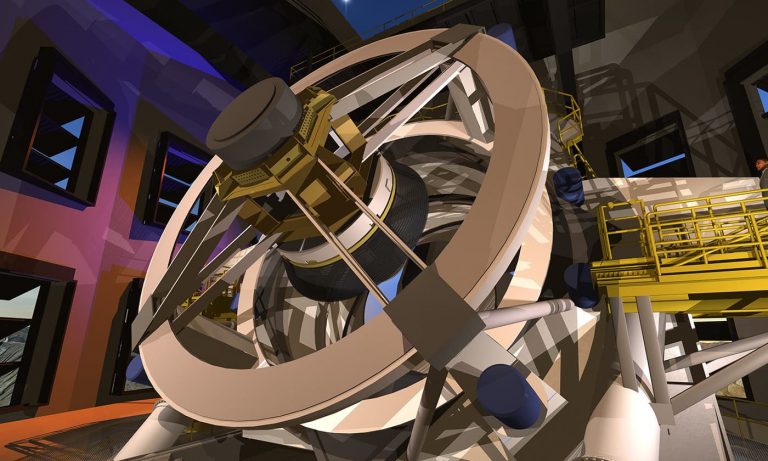
If your scientific goal is to find the largest possible number of transients, and to study their evolution across the cosmic history of the Universe, then you want to use a big telescope that covers as much of the sky as you can afford. This is fundamentally the goal of the Large Synoptic Survey Telescope (LSST). Located in Chile, LSST is (effectively) a 6.7-metre diameter telescope, scheduled to start full science operations in 2022.

LSST will be the closest astronomers have ever come to creating a movie camera to watch the whole universe. It will survey approximately half the sky using a camera that spans more than 40 times the area of the full Moon. But LSST can obtain a new image of each patch of that sky only once every three nights. LSST can detect transients 30 million times fainter than visible to the naked eye, making it a phenomenal project for finding huge numbers of faint transient sources across the visible Universe – LSST should find some 1,000 supernovae per day! But this capability comes at a cost: roughly $600 million just for construction, plus a significant operation cost as well.

At the other limit from LSST is a project I am working on: the All-Sky Automated Survey for Supernovae (ASAS-SN). By the end of this year, ASAS-SN will consist of 20 14-cm aperture telescopes spread across the globe, and costing roughly $3.5 million for both construction and operation through to 2022. With such small telescopes – big telephoto camera lenses, really – ASAS-SN can find only bright transients, roughly 25,000 times fainter than are visible to the human eye. Even so, it should still find about one supernova a day. And because ASAS-SN is comprised of small telescopes, it can image the sky far faster than LSST. The combined ‘image’ from all the ASAS-SN telescopes spans 1,600 times the area of the Moon. This allows them to survey the entire visible sky every night.

The two projects are highly complementary, essentially balancing a trade-off between ‘quantity’ and ‘quality’. LSST provides ‘quantity’: the large numbers of faint sources needed for statistical studies of distant sources, and for studying the evolution of transient sources across cosmic time. However, the typical LSST transient is faint and hard to study in detail for long periods of time, even with the world’s largest telescopes. ASAS-SN provides ‘quality’. The bright sources found by ASAS-SN are the ones that best survey the nearby Universe, and that can be studied in the greatest detail and for the longest periods of time using larger telescopes.

One of the most important tools for astronomers is the spectrum of an object: how much light is emitted as a function of its colour. A spectrum is the best way to classify the velocities, temperatures, elemental composition and type of an object (eg, which type of supernova? What were its unique properties?). Because you must chop up the light into narrow bins of colour, you need far more light to make a spectrum of an object than to get an image of it. LSST is already a large telescope, so it will be difficult or impossible to get a spectrum of the typical, faint LSST transient.

Even for the minority of LSST sources bright enough to obtain one spectrum, the source will quickly fade and become too faint to get another spectrum to study how it evolves with time. Therefore, a negligible fraction of LSST discoveries will be studied by this fundamentally important astronomical tool. The ASAS-SN transients are far fewer in number but are far brighter, so a very large fraction of ASAS-SN transients can be studied spectroscopically, and they can be studied for long periods of time even as they fade away.

Projects like LSST and ASAS-SN are continuing the revolution begun by Tycho, revealing the variable and sometimes violent events that light up the highly imperfect, ever-changing celestial sphere.

This article was originally published at Aeon and has been republished under Creative Commons.

Gravitational waves will bring the extreme universe into view

0

The first direct detection of gravitational waves on 14 September 2015 proved that massive objects can ripple the structure of space, verifying a key prediction of Albert Einstein’s general theory of relativity. The second detection, made on 26 December 2015 and announced this June, firmly established gravitational waves as a new window to the Universe. But even more exciting are the detections yet to come: the thousands of signals that should soon be observed by the Laser Interferometer Gravitational-Wave Observatory (LIGO) and Virgo experiments. They will transform our understanding of black holes, neutron stars, supernova explosions, and perhaps even the origin and fate of the cosmos itself.

gravitational-waves-idea_sized-ns_gw_art
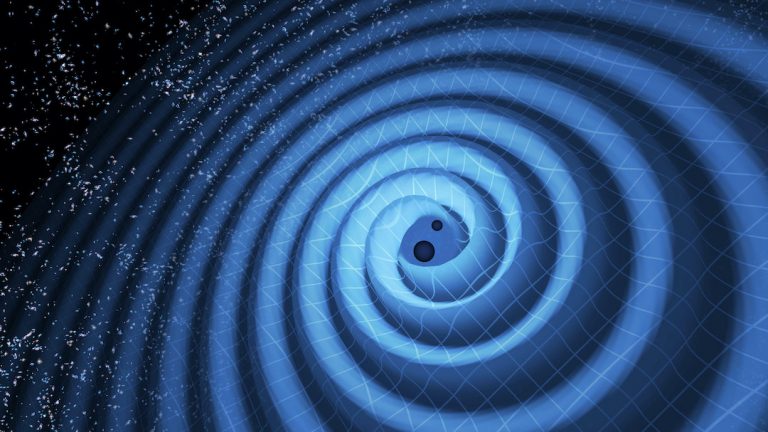
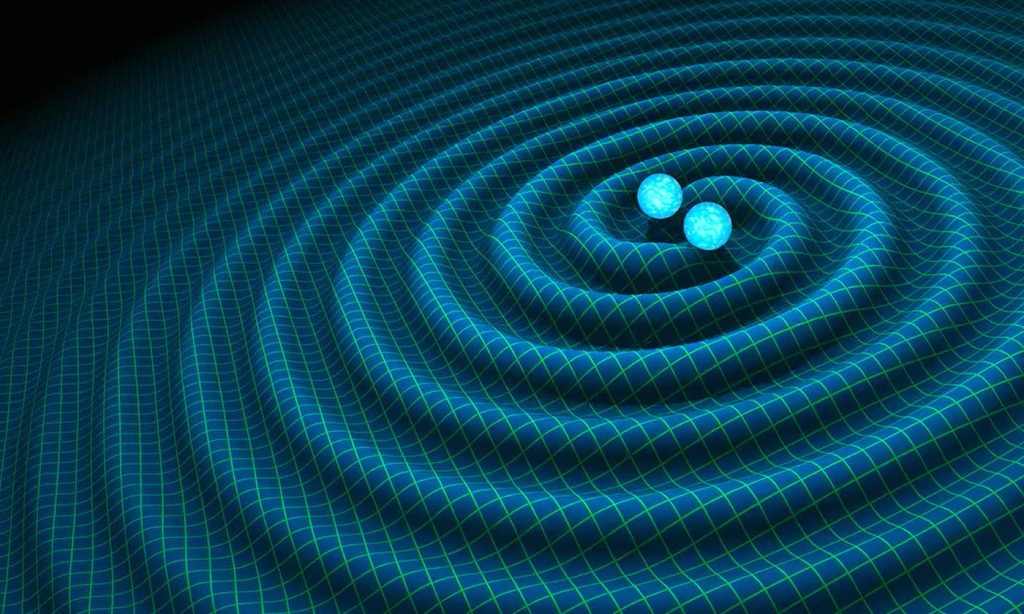
An artist’s impression of gravitational waves generated by binary neutron stars. R. Hurt/Caltech-JPL

Changes to the fields of physics and astronomy are already being felt. The two events reported so far have significantly increased the number of known stellar-mass black holes, and have demonstrated that black holes can form tight pairs and merge violently within the lifetime of the Universe; such mergers are the inferred cause of the September 14 and December 26 signals. Drawing on data from those two events, my colleagues in the LIGO and Virgo collaborations have tested general relativity in novel ways, far outside our terrestrial experience. And we have shown that black holes collide more often than expected, which has lead some researchers to speculate that black holes might be abundant enough to qualify as a variety of dark matter.

As with any new observational tool, the most important discoveries from the new detectors will surely be the ones that are unexpected. But we also have a good sense of the amazing things that the gravitational universe will tell us, even in the absence of surprises.

First, we can be certain that we will detect many more merging pairs of black holes comparable to the two already detected. The current instruments are about three times less sensitive than their full potential. At their ultimate sensitivity, the two LIGO detectors (in Louisiana and Washington state) and the Virgo experiment (near Pisa in Italy) will register dozens to hundreds of black-hole events per year. This large sample will yield a detailed census of black holes, and will allow astronomers to characterise their population all across the Universe, evaluating theories of how they form.

We also expect to observe mergers of neutron stars, the ultradense remains of stars that were too small to form black holes. Whereas black holes are so extreme that they are breathtakingly simple (completely described by their mass, spin and charge), neutron stars show the Universe at its most bizarre and complex. They contain more mass than our Sun packed into a sphere the size of Manhattan, with magnetic fields that can be more than a billion times as powerful as Earth’s. We do not understand how matter this dense behaves, nor do we know how their magnetic fields are sustained. What we do know is that pairs of neutron stars sometimes spiral into each other. The resulting gravitational waves will give us, for the first time, an unobstructed picture of neutron stars as they interact.

Unlike black holes, naked neutron stars emit light and other forms of radiation. Neutron-star mergers can produce a rapid flash of gamma rays or X-rays, along with a faint optical afterglow that can linger for days or weeks. With LIGO and Virgo operating in concert, we can localise the position of colliding neutron stars to within a few degrees in the sky. Optical telescopes can then search this patch of sky for a fading signal emitted by radioactive material ejected during the merger. This simultaneous observation of gravitational and electromagnetic signals could solve many long-standing mysteries in astronomy, such as the nature of energetic flashes known as short gamma-ray bursts, and the origin of heavy elements, including much of the gold found on Earth.

Gravitational waves can also show what happens in a ‘core-collapse’ supernova explosion, which occurs when the core of a massive star exhausts its nuclear fuel and is crushed under the star’s immense mass. This is an open question in astrophysics, because the mechanism that drives the explosion is hidden deep inside the star. Gravitational waves from supernovae will travel directly from the star’s centre to our detectors. Core-collapse supernovae are exceptionally rare, however; the last such one near our galaxy was in 1987, and the last known event in our galaxy proper was 400 years ago. Gravitational-wave scientists will have to be lucky and patient.

Looking out on an even grander scale, gravitational waves from neutron star mergers will give us a fresh way to study the expansion of the Universe. Our current picture of cosmology­ – in which the Universe is expanding following the Big Bang, and is accelerating due to an unseen ‘dark energy’ – relies heavily on observations of supernovae in distant galaxies. Gravitational waves will provide complementary information: the intensity (amplitude) of the gravitational signal tells us the distance to the event, while the optical appearance of the merger reveals how much its light has been stretched, or redshifted, on its way to Earth. These two pieces of information define the rate at which the Universe is expanding. Measuring this rate independently will provide an important check of our cosmological models.

Finally, LIGO and Virgo might detect a faint background hum of gravitational waves that pervades the entire Universe, constantly vibrating all of empty space. Many theories predict an omnipresent gravitational energy produced either from the accumulation of astrophysical events such as black hole mergers or from an early, extremely rapid episode of cosmic inflation immediately after the Big Bang. If the hum is loud enough, it will show up as a correlated signal between widely separated detectors such as LIGO and Virgo. Measuring the gravitational-wave background would be a dramatic achievement.

For the next few years, progress in gravitational-wave science will be limited by the sensitivity of the detectors. With each boost to their performance, it’s likely that we will uncover events from new types of sources. Eventually, perhaps after a large international investment in new facilities, progress in the field will be limited only by the willingness of the Universe to provide rare, exotic signals to observe.

LIGO and Virgo have already performed a staggering feat. Consider the properties of the September 14 event: the signal was generated by two objects, each roughly 35 times the mass of our Sun, locked in a decaying orbit the size of Switzerland, circling each other 50 times a second. The energy involved was staggering, briefly exceeding that of all the starlight in the Universe, but the signal that reached Earth was among the most imperceptible things that humans have ever measured. As gravitational-wave detections make the transition from sensational discoveries to routine tools for astrophysics and cosmology, the invisible shaking of space will, paradoxically, illuminate parts of the Universe that were entirely dark until now.

This article was originally published at Aeon and has been republished under Creative Commons.

How pigeon droppings nearly derailed a massive discovery in cosmology

0

The pigeon, the antenna and me

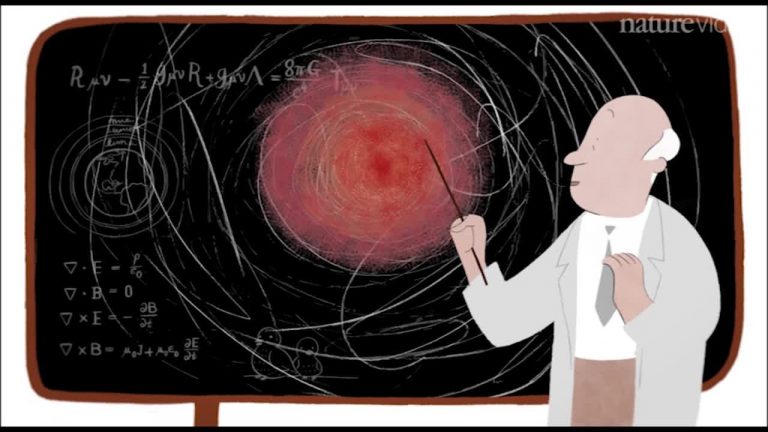
Great cosmology research requires accounting for an enormous number of variables, everything from nuclear detonations to bird droppings. In this animation from Nature, the American radio astronomer Robert Wilson discusses how a pair of pigeons living in a large antenna frustrated attempts to measure the minimum brightness of the sky. Even once the pigeons were removed, the measurements still weren’t right. The issue, it turned out, was cosmic microwave background radiation left behind by the Big Bang – a discovery that would eventually earn Wilson part of the 1978 Nobel Prize in physics.

Video by Dog & Rabbit

Blue Origin Completes Third Human Spaceflight

0

The NS-19 mission marks the sixth flight of the year for the program

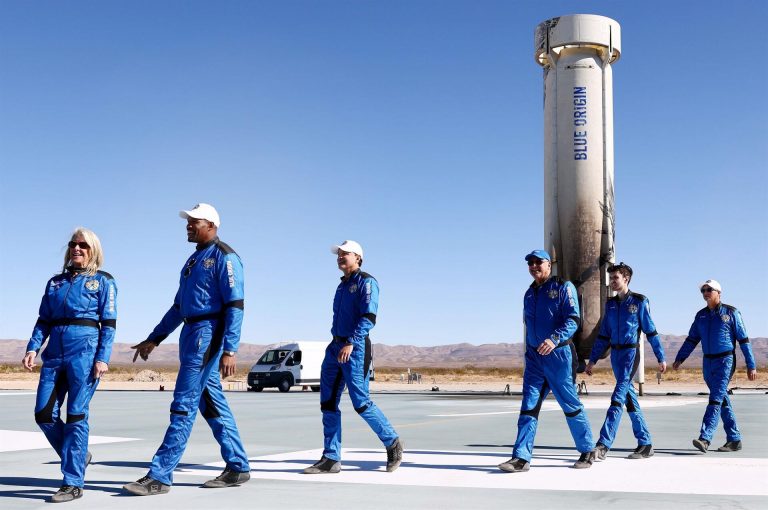
Blue Origin today successfully completed the third human spaceflight – the first with six astronauts on board. The astronaut manifest included, Laura Shepard Churchley, Michael Strahan, Evan Dick, Dylan Taylor, Cameron Bess, and Lane Bess.

blue-origin-2021-12-11
The crew of New Shepard NS-19. Pictured from left to right: Dylan Taylor, Lane Bess, Cameron Bess, Laura Shepard Churchley, Michael Strahan, and Evan Dick.

“We had a great flight today. This was our sixth flight in what has been a great year for the New Shepard program. We flew 14 astronauts to space, flew a NASA payload flight that tested lunar landing sensors and completed our certification test flights,” said Bob Smith, CEO Blue Origin. “I want to thank our payload customers, our astronauts and, of course, Team Blue for these many important accomplishments. I am so proud to be part of this dedicated and hard-working team that ensures that each and every flight of New Shepard is safe and reliable. And, it’s fun to say that this is just the beginning.”

Blue Origin is planning several crewed and payload flights in 2022. If you are interested in flying on New Shepard, visit our website.

Also available for purchase on the Blue Origin Shop is the commemorative patch from today’s mission and other merchandise, including the signature Michael Strahan Brand Blue Origin hoodie. 

In case you missed it you can view a full replay of today’s flight below.

What is the shape of space?

0

Why the apparent flatness of space is an enduring cosmological mystery

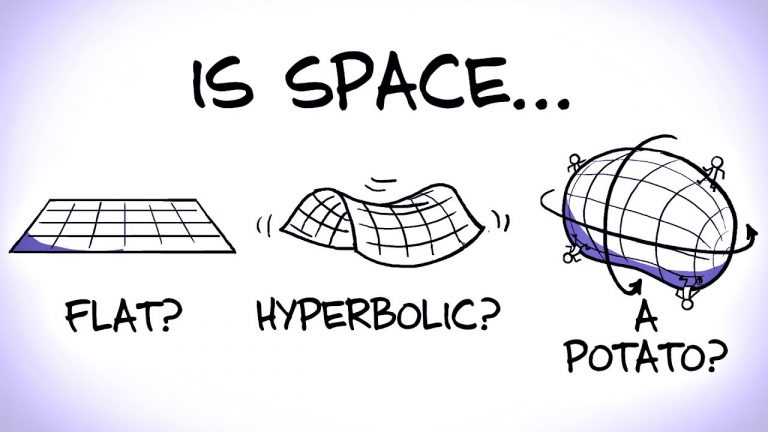
Empty space isn’t ‘nothing’. Since Albert Einstein, scientists have known that space has distinct physical properties, giving it the ability to bend, ripple and expand. One of its most mysterious characteristics, however, is its apparent flatness, allowing objects travelling on parallel paths to continue on parallel paths unless acted upon by the gravitational force of another object – a feature of the Universe that appears to be ‘a gigantic, cosmic-level coincidence’. This brief animation probes our evolving understanding of space, brushing up against the edges of current human understanding.

Video by MinutePhysics and PHD Comics

Republished from Aeon

Roger Penrose: Why did the Universe begin?

0

A cyclical, forgetful Universe – Roger Penrose details an astonishing origin hypothesis

Since the discovery of cosmic microwave background radiation in 1965, the Big Bang theory has been the dominant model of our Universe’s origin. In the ensuing decades, an obvious and yet still deeply unsettled question has emerged at the core of cosmology: what happened before it? While many scientists hold firm that there’s no decent evidence to support the notion that anything existed before the Big Bang, new hypotheses have cracked open the door for the possibility.

The UK mathematical physicist Roger Penrose, a professor emeritus at Oxford University and co-recipient of the 2020 Nobel Prize in Physics, is a convert to the camp of thinkers entertaining the notion of a pre-Big Bang state. In this interview with Robert Lawrence Kuhn for the PBS series Closer to Truth, Penrose details a somewhat mind-boggling idea he’s advanced known as the ‘conformal cyclic cosmology’ hypothesis, which proposes that our Universe is just one in an infinite series.

For more on the prospect of a before, before the Big Bang, watch Aeon Video’s interview with Tim Maudlin, a professor of philosophy at New York University.

Video by Closer to Truth

Republished from Aeon

NASA Seeks Next Flight Directors for Human Spaceflight Missions

0

NASA is looking for leaders for one of the best jobs on Earth for human spaceflight – including missions to the Moon – the position of flight director in mission control at the agency’s Johnson Space Center in Houston.

Applications for new flight directors is open now through Thursday, Dec. 16. U.S. citizens can apply at:

https://go.nasa.gov/3ltYoPO

Those chosen as NASA flight directors will lead human spaceflight missions to the International Space Station and upcoming Artemis missions to the Moon, and, eventually, the first human missions to Mars.

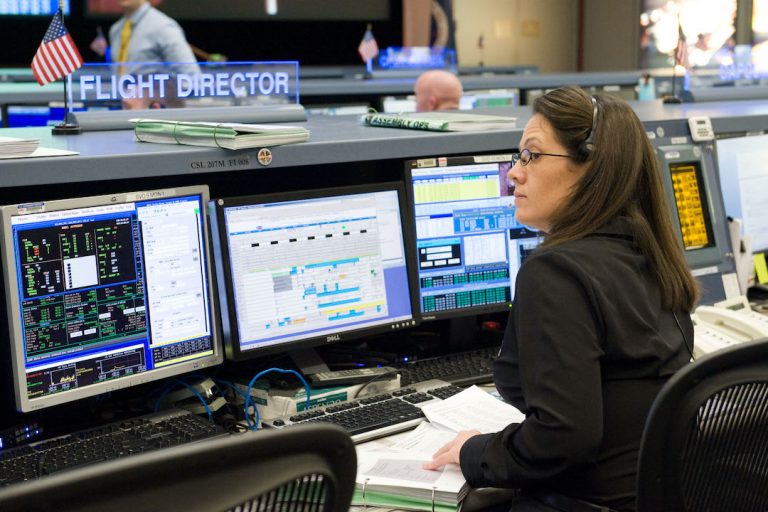
Expedition 65 flight controllers on console during U.S. EVA # 76 to complete the second IROSA solar array installation for the 4B channel on the P6 truss with astronauts Thomas Pesquet and Shane Kimbrough.  Photo Date: June 25, 2021.  Location:  Bldg. 30 FCR-1.  Photographer: Robert Markowitz
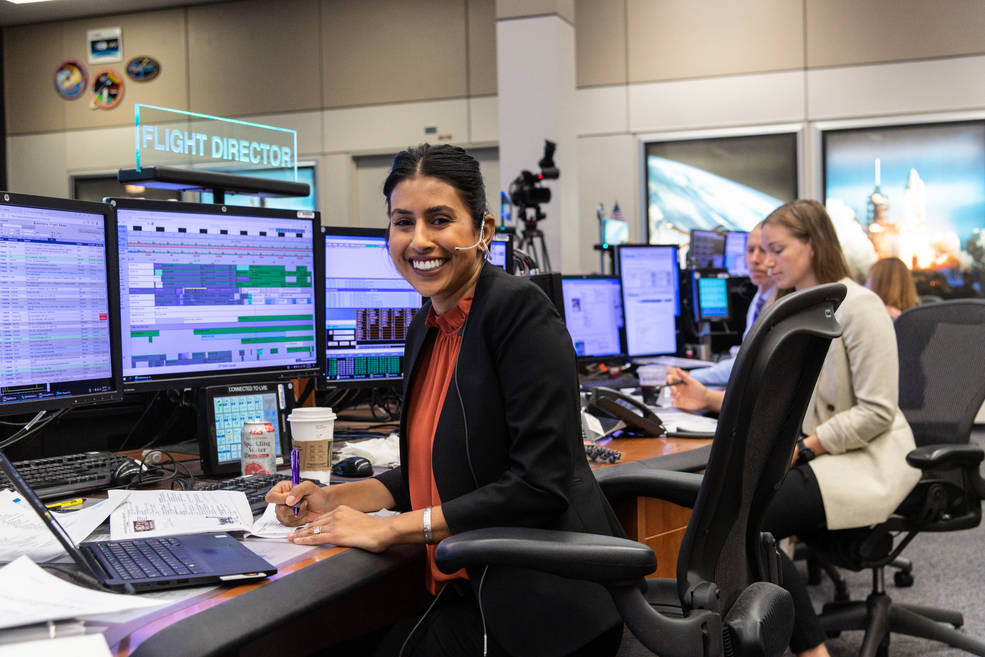
Flight Director Pooja Jesrani on console during a spacewalk to complete the second International Space Station roll-out solar array installation on June 25. Credits: NASA

Flight directors are responsible for leading teams of flight controllers, astronauts, research and engineering experts, and commercial and international partners around the world, and for making the real-time decisions critical to keeping NASA astronauts safe in space.

“Human spaceflight is rapidly evolving as we enhance missions in low-Earth orbit and prepare to explore the Moon with Artemis, and eventually, Mars,” said Holly Ridings, chief flight director at Johnson. “We need NASA flight directors who are technically excellent, humble, and creative to lead historic missions for humanity. This critical responsibility requires confidence and teamwork and we are excited to begin the selection of our next class.”

To be considered, flight director candidates must be U.S. citizens with a bachelor’s degree from an accredited institution in engineering, biological science, physical science, computer science, or mathematics. They also will need substantial related, progressively responsible professional experience, including time-critical decision-making experience in high-stress, high-risk environments. Although many flight directors have previously been NASA flight controllers, it is not a prerequisite to apply.

NASA plans to announce selections in spring 2022. The new flight directors then will receive extensive training on flight control and spacecraft systems, as well as operational leadership and risk management.

Learn more about NASA careers at: https://www.nasa.gov/careers