Home Blog Page 117

The Origin Of Chaos In The Solar System Through Computer Algebra

0

Shedding new light on planetary chaos

Are the orbits of the solar system planets stable? This question has arisen several times in history, especially when Henri Poincaré, at the end of the 19th century, highlights chaotic zones. Until recently the origin of this chaos has given rise to controversy. A publication in press in Astronomy & Astrophysics Letters, by Mogavero and Laskar, develops a systematic study of all the resonances present in the inner solar system. It is indeed the entanglement of resonances which is the source of the chaotic behavior of these orbits.

The question of the stability of the solar system arose since the enunciation of the law of universal gravitation by Newton. Newton’s law allows to recover Kepler’s fixed ellipses for a single planet around the sun, Jupiter, for example. But as soon as we consider a second planet, Saturn, the law also announces that Saturn disturbs the orbit of Jupiter. The big question, which Newton already poses in the preface to his optical volume (1706), is then whether these disturbances between the planets will destabilize the system. This problem will be solved in a first approximation by Laplace and Lagrange at the end of the 18th century. Laplace shows that the size of planetary orbits is invariant on average. Lagrange introduces the formalism that allows him to calculate their long-term evolution. Planetary ellipses rotate slowly in their plane and in space, with notable variations in their eccentricity and inclination, but which do not allow planetary collisions. The system is stable and predictable over an infinite time. This triumph was of short duration, because at the end of the XIXth century, Henri Poincaré shows that the problem of the three bodies is not integrable. He highlighted the zones that are now called chaotic, in which the orbits can show a very high sensitivity to their initial conditions. After Poincaré, mathematicians and astronomers continued their quest for stability for the solar system. The famous KAM theorem (Kolmogorov, Arnold, Moser) shows that despite the areas of instability highlighted by Poincaré, there remains a large number of regular solutions provided that the planetary masses are small enough. The application of this result to the motion of the planets by Vladimir Arnold in 1963 will again be considered as a proof of the stability of the solar system, even if Michel Hénon then pointed out that its application requires planetary masses much lower than the mass of the electron.

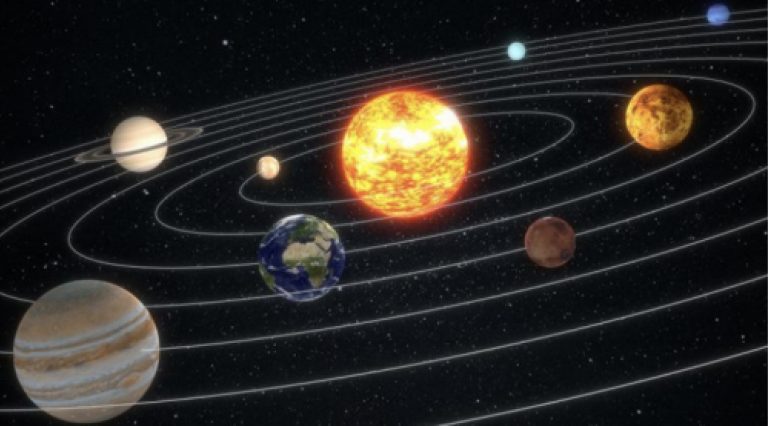
Due to the gravitational perturbations between the planets, the orbits of these planets deform over time. These variations are chaotic, limiting the predictions to 60 million years. Credits Y. Gominet/IMCCE (NASA textures)

More than thirty years ago, using computer algebra methods coupled with numerical integrations, Jacques Laskar (Institut de Mécanique Céleste et de Calcul des Éphémérides (IMCCE), CNRS, Observatoire de Paris, Université Paris Sciences et Lettres) showed that the motion of the planets in the solar system is chaotic and not regular, as had been widely assumed until then. One of the first outcomes of this result is the impossibility of predicting the movement of the planets in the solar system over a period of more than 60 million years (Ma). The uncertainty on the trajectories of the planetary orbits diverge exponentially with a characteristic time of 5 Ma. In other words, this uncertainty is multiplied by 10 every 10 Ma. This limits the possibilities of calculating variations in insolation on the Earth’s surface resulting from variations in the Earth’s orbit, themselves due to disturbances from other planets. This then also limits the possibility of establishing geological time scales based on the correlation between the sedimentary series which testify of the climatic variations of the past and the insolation computations of celestial mechanics. Over longer periods of the order of the age of the solar system, the planets can even collide, among themselves or with the sun, with, for Mercury, a probability of collision of the order of 1%.

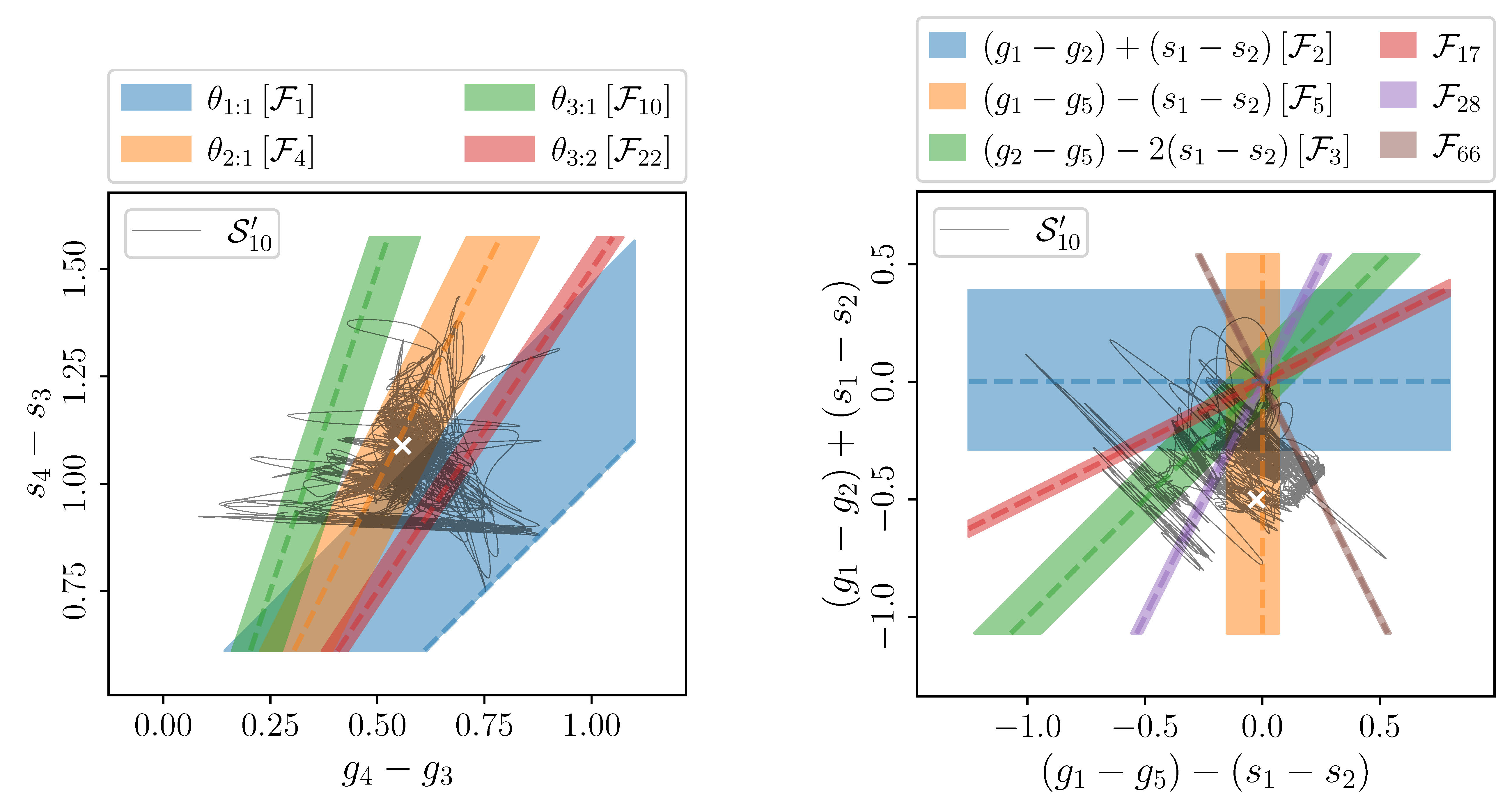
These results are now well accepted, but the origin of this chaotic motion remained a source of controversy. J. Laskar had highlighted a major role played by two resonances between the precessional movements of the planetary orbits. One involving the modes associated with the planets Mercury, Venus, Jupiter ((g1-g5)-(s1-s2)), and another linked to Earth and Mars (2(g4-g3)-(s4-s3)). The latter had been challenged by American researchers when they had reproduced the results of J. Laskar through numerical calculations on computers. Since then, these doubts have been taken up in the scientific literature until very recently. On the other hand, no one has so far reproduced the analytical calculations that led to the discovery of the chaotic motion of the planets.

To put an end to this controversy, Federico Mogavero and J. Laskar used the computer algebra software TRIP developed over thirty years within the IMCCE team, to conduct a systematic study of all the resonances present in the inner solar system. These calculations, which have just been published as a Letter in the journal Astronomy and Astrophysics, involve developments of several million analytical terms. After analysis, these terms are classified by decreasing amplitude. Among the very first, we find the resonances discovered thirty years ago by J. Laskar. At the same time, a multidimensional network of new resonances, strongly coupling the inner planets, is revealed. The researchers show that taking into account the most important resonances of this network makes it possible to account for the characteristic time of 5 Ma for the exponential divergence of the planetary orbits. The application of computer algebra at the basis of this study has therefore made it possible to overcome the great complexity of the dynamics of the planets, by revealing the entanglement of resonances which is the source of the chaotic behavior of their orbits.

In a joint study of more than 100,000 solutions, the IMCCE team also confirms that the probability of collision of Mercury over 5 billion years (Ga) is indeed of the order of 1%. This probability reaches more than 90% if these calculations are extended over 100 Ga, forgetting that the life expectancy of the sun is probably only 5 Ga.

Figure: The solar system (white cross) is in a tangle of resonances represented here by dotted lines associated with a band whose width represents the amplitude of the resonance. The superposition of these resonant zones is at the origin of the chaotic motion of the solar system. The dynamics of this multidimensional system is complex and these figures must be considered as cuts in the most unstable directions (Mogavero & Laskar, 2022).

5 Big Questions About The Science Of ‘Star Wars’

0

As Star Wars: The Force Awakens cleaned up at the box office, researchers from Georgia Tech took a closer look at the science of the films. They answered five big questions about the worlds depicted in the movies and what’s possible in reality. We’re revisiting their responses to celebrate the release of the 2018 installment in the series, Solo: A Star Wars Story.

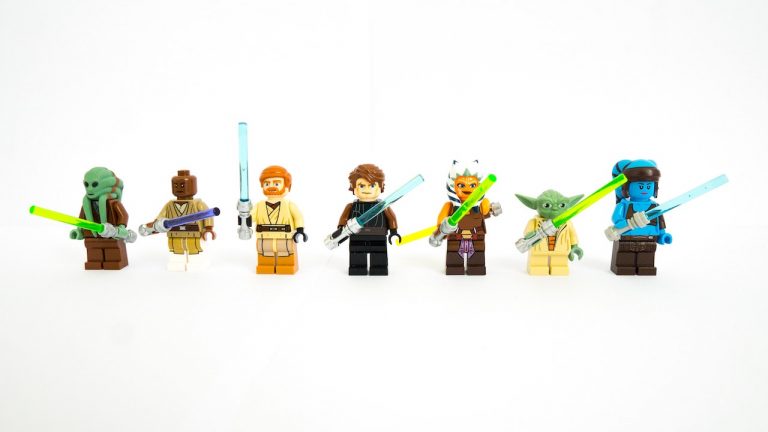
"Didn't we learn from physics classes about Newton's third law? For every action, there is an equal and opposite reaction," says Nepomuk Otte. "If true, it would mean that when Yoda exerts a force on the X-wing, Luke Skywalker's spaceship should also exert the same amount of force on Yoda. So why doesn't the little fella get squished like a mosquito?" (Credit: Thomas Hawk/Flickr)
“Didn’t we learn from physics classes about Newton’s third law? For every action, there is an equal and opposite reaction,” says Nepomuk Otte. “If true, it would mean that when Yoda exerts a force on the X-wing, Luke Skywalker’s spaceship should also exert the same amount of force on Yoda. So why doesn’t the little fella get squished like a mosquito?” (Credit: Thomas Hawk/Flickr)

1. IS LIGHT SPEED EVEN POSSIBLE?

Han Solo isn’t a bashful hero. So it’s no surprise that it took him only a few moments after we first met him to brag that his Millennium Falcon was the “fastest ship in the galaxy.” But how fast is fast? Solo said his ship can go .5 past light speed.

Deirdre Shoemaker, associate professor in the Georgia Tech School of Physics, explains in this video how fast light speed really is, why it’s not fast enough, and what needs to happen for something to actually travel 186,000 miles per second:

2. COULD THESE NEW WORLDS EXIST IN OUR UNIVERSE?

The Star Wars universe depicts a diverse set of worlds containing a variety of inhabitants. John Wise, assistant professor in the School of Physics, studies early galaxies and distant objects in the universe. He wonders if there are planets somewhere out there that resemble the ones imagined by George Lucas:

“Until 1991, the only planets known to humans were in our Solar System. In that same year, astronomers discovered the first extrasolar planet, now dubbed as exoplanets, by measuring the Doppler shift of stellar spectral lines, effectively witnessing the planet play gravitational tug-of-war with its parent star as it orbits. Over the next decade or so, astronomers refined their planet hunting skills and found more than 30 exoplanets.

“IMAGINE HOW MANY PLANETS ARE LITTERED AMONG THE 100 BILLION GALAXIES IN THE OBSERVABLE UNIVERSE. PERHAPS PLANETS FROM A LONG TIME AGO IN A GALAXY FAR, FAR AWAY?”

“This all changed with the launch of NASA’s Kepler Mission, which continually monitored a patch of sky for brightness variations in 150,000 stars. Any dip in brightness can be caused by a planet passing in front of its star, blocking a small fraction of its light. In its four-year run, Kepler detected and confirmed nearly 2,000 planetary systems, ranging from “Hot Jupiters” to frozen, rocky worlds. Intriguingly, a select few lie within the Goldilocks zone where liquid water could exist because the planet isn’t too hot or too cold.

“This planetary diversity is also seen in Star Wars—Endor, the home of the Ewoks, that orbits a gaseous giant planet; Hoth, where Luke Skywalker almost froze to death; Alderaan, a blue-green orb not unlike our Earth until it was destroyed by the Death Star; and Tatooine, Luke and Anakin Skywalker’s home planet. One of the most vivid scenes of Episode IV happens when Luke gazes toward the horizon at a binary sunset. When the original was released in 1977, such a scene was restricted to the sci-fi realm, but this is no longer the case. Kepler has now discovered 10 planets that orbit binary star systems, whose possible inhabitants see a similar sight every day.

“The Kepler Mission was just the first step in humankind’s discovery of planetary systems in the Milky Way. It only observed 1/400th of the sky. It could only detect planets out to 3,000 light years, which is tiny compared to the Milky Way’s size of 100,000 light years. Using Kepler’s detections, astronomers have estimated that there could be as many as 40 billion planets in our galaxy. But that is only one galaxy! Imagine how many planets are littered among the 100 billion galaxies in the observable universe. Perhaps planets from a long time ago in a galaxy far, far away?”

r2-d2 and c3po watch sunset
(Credit: Michael Li/Flickr)

3. ARE C-3PO AND R2-D2 COMING SOON?

Even though C-3PO and R2-D2 lived (in a galaxy) a long time ago, today’s roboticists still haven’t found a way to create their current-day cousins. The College of Computing’s Sonia Chernova is one of many on campus trying to bring robots out of the lab and into the world so that people can have their own droids. She says:

“Robots tend to be on one extreme or the other these days. One kind is found on Mars, battlefields, and in operating rooms. These robots are extensions of humans—they’re rarely autonomous because a human is always in the loop.

“AS FOR R2-D2 AND HIS FRIENDS, WE’RE NOT THAT FAR FROM PERSONAL ROBOTS.”

“Others are autonomous. We see this mostly on manufacturing floors, where machines are programmed to do the same repetitive task with extreme precision. Not only are they limited by what they can do, but they’re also often separated from people for safety reasons.

“I’m focused on something in the middle. Full autonomy for personal robots would be great, but it’s not yet practical given today’s technology. Humans are too unpredictable and environments are ever changing. Rather than setting 100 percent autonomy as the goal for getting robots into our lives, we should deploy them when they’re simply “good enough.” Once they’re with us, they can learn the rest.

“Here’s an example: in hospitals, a delivery robot could pass out towels and medication. If it were to get stuck leaving a room, the machine could call a command center where a human technician would figure out the problem and free the robot. Here’s the key: every time a person made a fix, the robot would keep that new information and use it to perform differently the next time it leaves the room. With humans in the mix, this robot could learn from its mistakes and continually push toward 100 percent autonomy.

“As for R2-D2 and his friends, we’re not that far from personal robots. I don’t think we’ll have to clean our houses in 20 years because we’ll have robot helpers. I’m not sure what they’ll cost or if people will psychologically be ready to give up that part of their lives, but we’ll have the software and hardware in place to make it happen.

4. WHAT WOULD IT BE LIKE TO MASTER THE FORCE?

Imagine lifting a spaceship with the tip of your finger like Yoda in The Empire Strikes Back. Nepomuk Otte of the School of Physics says there are a few things you might want to consider: 

“Didn’t we learn from physics classes about Newton’s third law? For every action, there is an equal and opposite reaction. If true, it would mean that when Yoda exerts a force on the X-wing, Luke Skywalker’s spaceship should also exert the same amount of force on Yoda. So why doesn’t the little fella get squished like a mosquito?

“Violating action and reaction would shatter one of the most sacred laws in physics—momentum conservation. But Yoda moves the spacecraft with ease and shuffles away unscathed. The Jedi Master must be surrounded by some sort of shield that absorbs the reaction part of the force. When you attempt to use the Force, make sure you have one of those shields, too, or you might suffer the consequences.”

5. CAN THE FORCE BE A NEW INTERACTION THAT WE HAVEN’T DISCOVERED YET?

Flavio Fenton of the School of Physics responds—and offers a few questions of his own:

“When the Death Star’s superlaser destroyed Princess Leia’s home planet of Alderaan, Obi-Wan Kenobi delivered one of the saga’s most famous quotes: ‘I felt a great disturbance in the Force, as if millions of voices suddenly cried out in terror and were suddenly silenced. I fear something terrible has happened.’

“…IF WE WERE TO STUDY THE FORCE FROM A SUBATOMIC LEVEL, WE SHOULD CONSIDER THAT, LIKE ANY OTHER INTERACTION WE KNOW IN NATURE, THERE EXIST FORCE CARRIERS.”

“The death of the entire planet sent shock waves through the Force, weakening those who were able to feel them. That included Obi-Wan, who briefly became faint. This action at a distance is explained in physics by what is called a field. For example, we are well aware of gravitational and electromagnetic fields. Objects that are affected by a field carry “something” that allows them to interact. For gravity, it is mass. For electricity, it is charge.

“Because there is a Light and a Dark Side of the Force, a field would require that we assume two types of charges, similar to positive and negative charges in the electromagnetic force. Here’s an example: Darth Vader can strangle people by using the Force without physical contact. That means his victims would have to carry both types of charges in equal amounts, and the effects of the two types cancel each other. How does it happen?

“One explanation is that the dark force Vader unleashes attracts the light charge of his victim, leaving the person unbalanced with an excess of dark charge. In this case, all the dark charges then try to come together along the neck, squeezing and nearly choking the person to death. This means that unlike electric charge, particles with equal force charges attract and repel when they have different charges. This could explain why a neutral force charge is common to all objects. It could also explain why the Dark Side has an addictive aspect: when a Jedi turns to the Dark Side, it’s a slippery slope filled with continuous evil.

“Going just a bit deeper for my fellow physics fanatics—if we were to study the Force from a subatomic level, we should consider that, like any other interaction we know in nature, there exist force carriers. These are particles that give rise to forces between other particles. For example, the electromagnetic force between two electrons can be explained by the exchange of virtual photons and gravitation by the exchange of virtual gravitons. Therefore the two Force charges should have a carrier. Should we call them Jedi-nos? Should the Large Hadron Collider search for these new particles now that it has found the Higgs particle?”

Source: Georgia Tech (Originally published December 30, 2015)

Republished from Futurity

How Plausible Are The Planets In Star Wars?

0

Could Star Wars really happen? Experts on planetary formation, processes, and habitability discuss the science behind the saga.

Space discoveries are in the news almost every week—but they may not make as big an impression as the legend of Star Wars. December 20 marks the release of the final installment of the Skywalker saga, The Rise of Skywalker. The film raises questions about the fate of the inhabitants of that faraway galaxy. And beyond the plot, there are plenty of questions we can ask about the science: How did those planets form? Could they exist in our universe? Is any of this possible?

At the Stanford University School of Earth, Energy & Environmental Sciences, researchers use geological and geophysical techniques to both investigate Earth and explore other planetary bodies:

  • Dustin Schroeder, an assistant professor of geophysics, works on the use of ice-penetrating radar in observing and understanding the interaction of ice and water in the solar system.
  • Laura Schaefer, an assistant professor of geological sciences, studies planetary atmospheres and their formation.
  • Mathieu Lapôtre, assistant professor of geological sciences, focuses on the physics behind sedimentary and geomorphic processes that shape planetary surfaces.
  • Sonia Tikoo-Schantz, an assistant professor of geophysics, uses paleomagnetism and fundamental rock magnetism as tools to investigate problems in the planetary sciences.

Here, the four experts answer questions about the plausibility of Star Wars:

Q

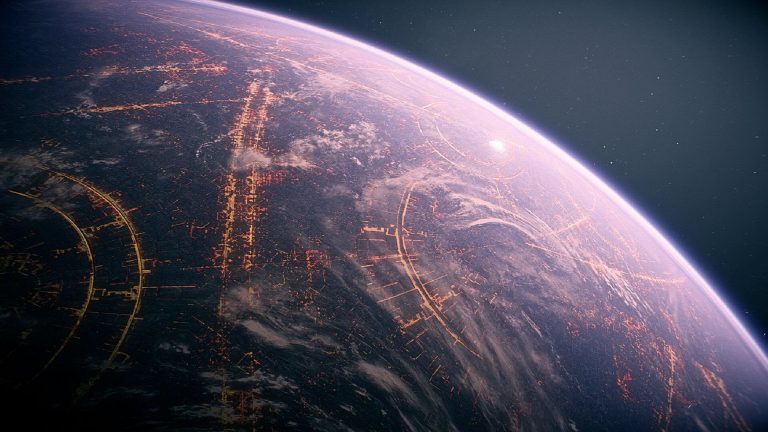
On the volcanic planet Mustafar, Anakin duels with Jedi Master Obi-Wan Kenobi, ends up nearly submerged in lava, and must turn into a cyborg to survive. What kinds of forces would cause a planet to form like that? What would we need to survive?

A

Tikoo-Schantz: Such a volcanic planet can exist from tidal heating. A comparable world would be Jupiter’s moon Io, which gets flexed on the inside by the gravitational pull of Jupiter and other Jovian moons. The resulting stress releases a lot of heat. However, the gases in the atmosphere of such a volcanic world would be noxious and surface temperatures would likely be too hot for anything to survive, much less get in a fight.

Schaefer: We have also found some exoplanets that orbit their stars so closely that they have permanent dayside magma oceans. But as Sonia said, the temperatures are so hot that you’d burn to a crisp before you got to have your Jedi duel.


Q

The icy planet Hoth hosts a temporary Rebel base where the heroes have to defeat Imperial walkers in order to escape. How would you explore the snow-covered orb? What subsurface processes form a rocky vs. icy planet?

A

Schroeder: Ice-penetrating radar would be the ideal geophysical technique for exploring Hoth. It would allow Rebel Alliance scientists and engineers to determine the thickness and properties of Hothian ice and snow. This would be useful for creating icy infrastructure like fortifications and ice-roads that avoid or exploit crevasses as well as for investigating the climate and history of the planet itself.

In terms of platforms, you could do a global survey from space if you had enough power (probably not a problem for a spacecraft with the power to approach light speed), unless snow-processes on Hoth produce problematic clutter reflections for the radar. Rebel airspeeders travel too fast to be an ideal airborne platform for ice-penetrating radar, so you’d probably go orbital for large-scale surveys and then tauntaun-pulled sleds for very local fine-scale studies.

Lapôtre: Because icy worlds form far from their host star(s) where temperature is low, ice essentially behaves like rock. At depth, viscous ice may convect like Earth’s mantle, leading to some kind of tectonics and even forming reservoirs of “magma” which create volcanoes when the magma finds its way to the surface. At the surface of planets without giant atmospheres, the ice is really cold and behaves like granite on Earth. On Titan, for example, rivers of methane and ethane erode a crust of water-ice rock.

Hoth, in contrast with the icy worlds of our solar system, is not technically an icy planet—it is a rocky planet covered in snow and ice. In that sense, it is more analogous to Snowball Earth, when our own planet was entirely frozen. This happened a few times in Earth’s history, through a runaway process in which an increasing snow cover led to more and more of the sunlight being reflected back to space, leading to further cooling. The last Snowball Earth episode is thought to have happened just before the explosive diversification of life in the oceans.


Q

After escaping Hoth, Han Solo attempts to navigate an asteroid field that surrounds the planet, eventually landing on one of the rocks, which they discover is home to a giant space slug. Is this what asteroid fields are really like? What happens when they hit the surface of Hoth? Could an asteroid support life?

A

Tikoo-Schantz: This scene is totally unrealistic. Asteroids are not even remotely close enough to each other for a spacecraft like the Millennium Falcon to have to dodge around them. The average distance between two asteroids in our asteroid belt is 600,000 miles! If you flew in a random straight line through the asteroid belt, you are almost certain to NOT hit anything at all.

I looked up the “canon” description for this asteroid field and it says that it was formed by the collision of two rocky planets. In reality, these types of planetary collisions primarily happen at the beginning of a solar system’s lifetime, and the resulting debris would have either come together to re-form a new planet or be gravitationally perturbed and ejected to other parts of the solar system.

Our asteroid belt is made up of many, many planetesimals that were gravitationally “herded” into their current position—mostly by the gravitational forcing of giant planets like Jupiter—and is not related to the breakup of a single planetary body. But if the Star Wars asteroid field was real, the objects hitting Hoth would vaporize upon impact. If these impacts are large enough or occur frequently enough, they could pose a serious threat to life forms living on Hoth.

Schaefer: An asteroid would be an unlikely place to find life, especially giant space slugs. The largest object in our own asteroid belt (Ceres, now classified as a dwarf planet) is only 7% the size of Earth and about the size of Texas. Its gravity is much too low to allow it to hold onto an atmosphere, which is vital to make liquid water stable at the surface.

Tiny bacteria could possibly survive in the subsurface brines of Ceres (if they somehow managed the space journey to get there), but it’s unlikely they would thrive and evolve into a large organism because the environment is so inhospitable and energy-limited.

Microscopic tardigrades (also known as waterbears) on Earth are possibly the only multicellular animal that could survive such conditions (again, if they somehow got delivered there), but they would be in a dormant hibernation state, and also not likely to evolve into a giant space slug.


Q

The heroes in Star Wars embark on many solo missions to other planets, as well as large-scale efforts to move the entire Rebel fleet to new operation bases. What goes into space missions from Earth? How have you been involved?

A

Schroeder: Space missions that we organize from Earth include hundreds of people. They play a wide range of roles from science and engineering to management and leadership. Planetary missions take years to decades to develop and operate. As a science team member on the REASON instrument (Radar for Europa Assessment and Sounding: Ocean to Near Surface) on NASA’s upcoming Europa Clipper Mission, I’ve had an opportunity to help with the requirements, design, and scientific planning for the instrument. Once the mission arrives at Europa, we’ll use the radar data to investigate the geophysical processes and potential habitability of the moon’s ice shell.

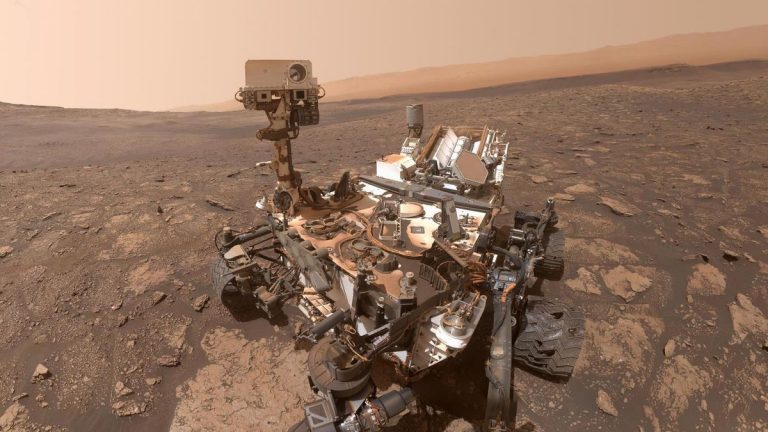
Lapôtre: I was a science team member for the Curiosity rover that is currently investigating an ancient lake environment on Mars. I participated in daily operations with hundreds of other scientists and engineers, and had the opportunity to lead the rover’s investigation of a modern dune field. On a daily basis, we would all convene by teleconference to discuss the latest data sent back to Earth, and decide where to go next before the engineers implement our plan and send instructions to Mars. With so many scientists on the team, it can be very difficult to get the rover to go where you want it to—you have to make a pretty compelling case to convince others your idea has more merit than theirs!


Q

In one of the most iconic scenes from the original Star Wars movie, Luke Skywalker walks outside his uncle’s moisture farm to gaze at two suns on the horizon of his home planet of Tatooine. What makes it possible for a planet to orbit two stars? What do we know about binary systems in the universe?

A

Schaefer: About half of all stars like the sun are actually in binary systems. We have currently found 143 planets in 97 binary systems. In 22 of these systems, the planets orbit both stars, but in the remaining systems, the planets orbit only one of the stars in the system. In most of these binary systems, one of the stars is often much bigger than the other, so having two stars that are about the same size is a little unusual.

Most of these systems also seem to be coplanar: The planets and the stars all orbit in the same plane, indicating that they formed from the same protoplanetary disk. To make two stars, the disk would have had to be much more massive than the protoplanetary disk for a single-star system, but otherwise the process of planet formation would work much the same way as it does for other systems, except that planets that formed too close to the binary pair might end up being ejected from the system. Planets far enough away from the binary pair have stable orbits and may be habitable.


Q

What has been the most exciting discovery you’ve witnessed since you started your research in planetary sciences?

A

Lapôtre: To name just a few of my favorites, I’d say (1) the diverse landscapes of Pluto, with mountains, glaciers, plains, and even possibly dunes; (2) the active migration of ripples at the surface of the 67P/Churyumov Gerasimenko comet; a comet has no atmosphere, and as such, the formation of ripples, let alone the detection of their motion during a short-lived mission, was very surprising and exciting; (3) the discovery of a type of Martian ripples that does not exist on Earth; (4) the possible detection of a subglacial lake beneath Mars’ polar cap.

Tikoo-Schantz: One thing that really excites me is that new developments in technology have enabled us to study the physical and chemical properties of extremely small samples of extraterrestrial materials (even things that are less than a tenth of a millimeter across) and learn about large-scale processes that were going on in the early solar system. For example, we can retrieve paleomagnetic records from individual chondrules (tiny spherules that are some of the first solid materials in the solar system) and learn about magnetic fields that were present in the disk of gas and dust that orbited the protosun before the planets formed. But perhaps the thing that most excites me is the discoveries we are making in other solar systems.

Schaefer: The variety of exoplanets discovered around other stars continues to astonish me. We don’t have examples of the most common types of planets (super-Earths and sub-Neptunes) in our own solar system, suggesting that our home system is unusual—not just for hosting life. There have also been amazing new observations of proto-planetary disks around other stars showing gaps in the disks where we think large planets like Jupiter are forming: This level of detail had never been seen before until the last 7-10 years with the ALMA telescope and is really starting to change the way we think about planet formation.


Q

How has Star Wars influenced your ideas, aspirations, or career choices?

A

Tikoo-Schantz: I am a lifelong science fiction nerd. As a kid, all of the “Stars” (Star WarsStar TrekStargate) presented me with this vision of a universe filled with innumerable worlds waiting to be explored and a sense that we are not alone on our little blue dot in space. A great motivator for me as a planetary scientist is the idea that perhaps someday I will be able to fact-check some of these fantastical planets I read about via my research and see whether or not aspects of these worlds could exist in reality.

Schroeder: In academic science, as in any career, you encounter people, processes, and cultures doing things out of “anger, fear, or aggression” (which, as Yoda explains, belong to the “Dark Side” of the force). Star Wars is a good reminder to do our best to keep things like this out of science; to appreciate rather than tear down the work of our colleagues, to work on projects because of intrinsic interest instead of a fear that others may do them first, and to reject the temptation to keep a record of real or perceived scholarly slights. Star Wars challenges us to be Science Jedi not Science Sith.

Source: Stanford University

Republished from Futurity

NASA’s Mega Moon Rocket, Spacecraft Complete First Roll to Launch Pad

0

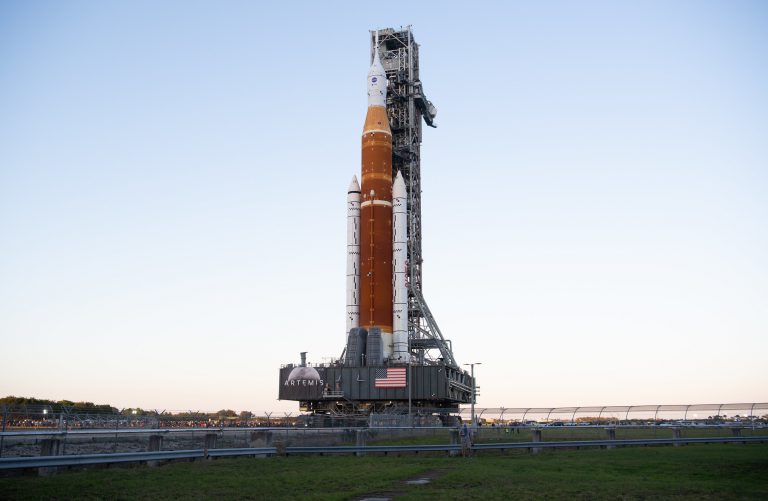
NASA’s Space Launch System (SLS) rocket with the Orion spacecraft atop arrived at Launch Pad 39B at the agency’s Kennedy Space Center in Florida Friday in preparation for a final test before its Artemis I Moon mission.

The Moon rises behind NASA's Space Launch System rocket and Orion spacecraft.

The Moon is seen rising behind NASA’s Space Launch System (SLS) rocket with the Orion spacecraft aboard atop a mobile launcher as it rolls out to Launch Complex 39B for the first time, Thursday, March 17, 2022, at NASA’s Kennedy Space Center in Florida. Ahead of NASA’s Artemis I flight test, the fully stacked and integrated SLS rocket and Orion spacecraft will undergo a wet dress rehearsal at Launch Complex 39B to verify systems and practice countdown procedures for the first launch.Credits: NASA

The uncrewed flight test will pave the way for missions to land the first woman and first person of color on the Moon under Artemis, and the rocket rolled to the pad for a final test before launch.

“From this sacred and historical place, humanity will soon embark on a new era of exploration,” said NASA administrator Bill Nelson. “Artemis I will demonstrate NASA’s commitment and capacity to extend humanity’s presence on the Moon – and beyond.”

Stacked on the mobile launcher and mounted on the crawler-transporter for a journey from the Vehicle Assembly Building to Launch Pad 39B, it took 10-hours and 28 minutes for SLS and Orion to reach the launch pad four miles away. The trip began at 5:47 p.m. Thursday, March 17, and the 322-foot tall, 3.5-million-pound rocket and spacecraft arrived at the pad at 4:15 a.m. on March 18.

The upcoming final test, known as the wet dress rehearsal, will run the Artemis I launch team through operations to load propellant into the rocket’s tanks, conduct a full launch countdown, demonstrate the ability to recycle the countdown clock, and also drain the tanks to practice the timelines and procedures the team will use for launch.

“Rolling out of the Vehicle Assembly Building is an iconic moment for this rocket and spacecraft, and this is a key milestone for NASA,” said Tom Whitmeyer, deputy associate administrator for Common Exploration Systems Development at NASA Headquarters in Washington. “Now at the pad for the first time, we will use the integrated systems to practice the launch countdown and load the rocket with the propellants it needs to send Orion on a lunar journey in preparation for launch.”

Before the test, SLS, Orion, and the associated ground systems will undergo checkouts at the pad. After the rehearsal, NASA will review data from the test before setting a specific target launch date for the upcoming Artemis I launch. The integrated rocket and spacecraft will roll back to the Vehicle Assembly Building several days after the test to remove sensors used during the rehearsal, charge system batteries, stow late-load cargo, and run final checkouts. Orion and SLS will then roll to the launch pad for a final time about a week before launch.

With Artemis, NASA will establish long-term exploration at the Moon in preparation for human missions to Mars. SLS and NASA’s Orion spacecraft, along with the human landing system and the Gateway in orbit around the Moon, are NASA’s foundation for deep space exploration.

Artemis I Moon Rocket Arrives at Launch Pad for First Time

0

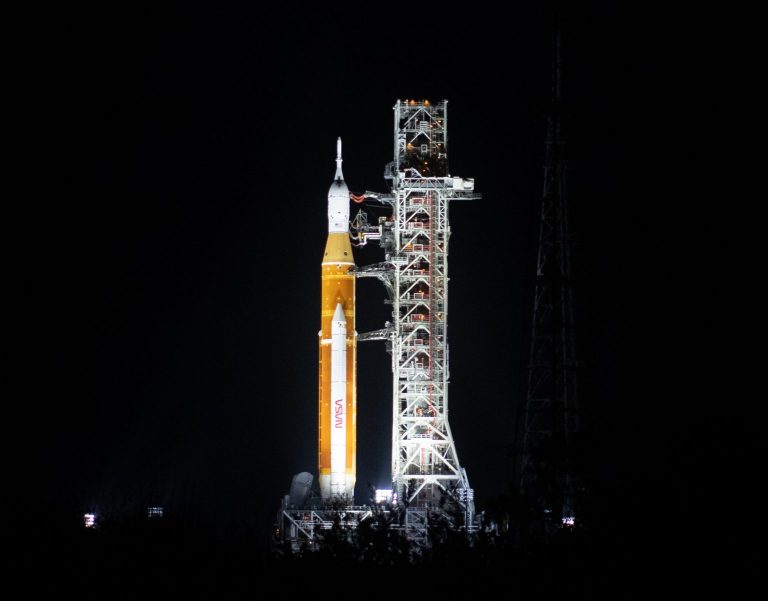
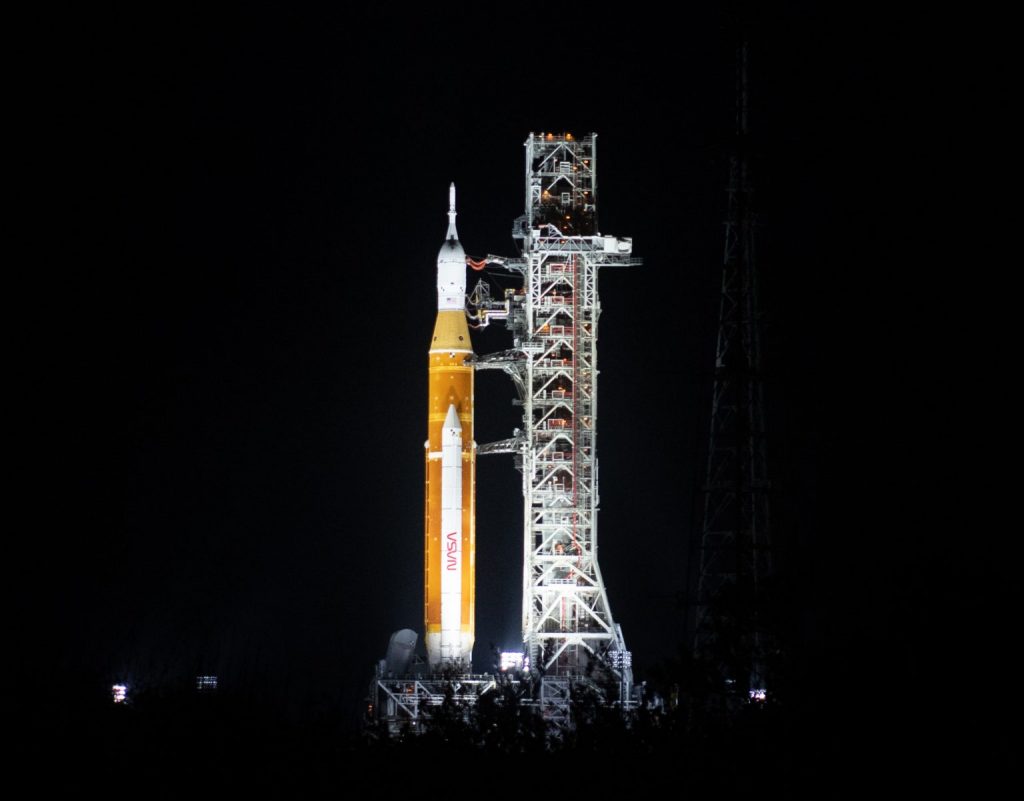
Around 4:15 a.m. ET the Space Launch System rocket and Orion Spacecraft for the Artemis I mission arrived atop Launch Complex 39B after a nearly 11-hour journey from the Vehicle Assembly Building at NASA’s Kennedy Space Center in Florida.

NASA’s Space Launch System (SLS) rocket with the Orion spacecraft aboard is seen illuminated by spotlights atop a mobile launcher at Launch Complex 39B, Friday, March 18, 2022, after being rollout out to the launch pad for the first time at NASA’s Kennedy Space Center in Florida. Photo Credit: (NASA/Joel Kowsky)

In the coming days, engineers and technicians will prepare the Artemis I rocket for its final major test – the wet dress rehearsal. The approximately two-day test will demonstrate the team’s ability to load cryogenic, or super-cold, propellants into the rocket, conduct a launch countdown, and practice safely removing propellants at the launch pad.  After wet dress rehearsal, engineers will roll the rocket and spacecraft back to the Vehicle Assembly Building for final checkouts before launch.

We can begin an interstellar mission today – and we should

0

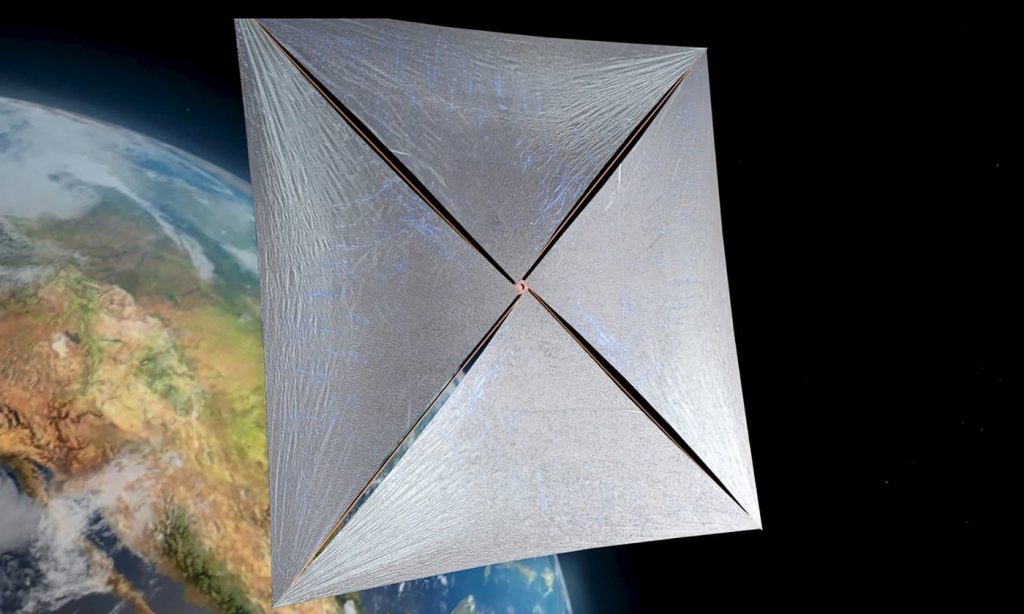
Fifty-five years ago, Yuri Gagarin rocketed into orbit and began to break our bonds to our planet. To mark the occasion, the nonprofit Breakthrough Institute just announced plans to free us from an even more formidable set of bonds and send a fleet of small spacecraft beyond our solar system, off to the stars. News of the ‘Breakthrough Starshot’ plan was met with great enthusiasm, but also with more than a little skepticism. The distance between stars is vast. Our closest neighbour, the Alpha Centauri system, is 4.4 light years away – roughly 25 trillion miles. The Voyager 1 spacecraft, the fastest object ever created by humans, would take 70,000 years to travel that far. Many reporters greeted the Breakthrough Starshot as an idea grounded more in fantasy than in reality.

breakthrough-initiatives-idea_SIZED-2016-04-12t180659z_835429780_gf10000380251_rtrmadp_3_space-milner1

The reaction was understandable. All previous plans for interstellar flight relied on non-existent or impractical technologies such as antimatter, wormholes and warp drives. But now we have a concrete path forward, which I have published in detail. It is possible to begin the journey to the stars today.

Drawing on recent advances in photonics and electronics, we could use arrays of lasers to accelerate miniature probes (the size and mass of a semiconductor wafer, weighing less than one ounce) to unprecedented velocities. Particles of light, or photons, have no rest mass but they carry energy and momentum. Just as a sailboat can be propelled by the wind, light sails can ride the momentum of photons by reflecting a wind of intense laser light. We call such focused beams of light ‘directed energy’.

On modest scales, directed-energy systems are already becoming available with continuous power levels around 100 kilowatts. A greatly scaled-up version could propel a small spacecraft to velocities exceeding 20 per cent the speed of light, nearly 4,000 times what Voyager 1 achieved. Doing so would require kilometre-size arrays of synchronised, or ‘phased’, photonic amplifiers, each similar to but far more powerful than the signal boosters used today to drive internet data through fibre-optic cables. Although it would be extremely challenging, building such an array should be feasible within 30 years, judging from the current rate of technological development. Directed-energy propulsion could send a probe to Alpha Centauri in about 20 years, with another four years required for data to return, or could reach Tau Ceti (which has a system of five known planets) in about 60 years with a 12-year return message.

Better yet, we will send a whole fleet of probes. Almost all the development costs will go into building the directed-energy launch system. The probes themselves would be small devices tethered to reflective sails, cheap to build. The total cost of launching 100 probes would be scarcely any greater than launching one. Potentially, we could build millions of probes of many different masses, from ‘wafer’ spacecraft the size of an iPhone (but much thinner) to much larger probes, all carrying sophisticated cameras, sensors and a laser-communication system powered by a compact (RTG), similar to the one aboard the New Horizons probe that flew past Pluto last summer. The probes would store up energy between communication bursts, and draw additional power from solar cells when they near their destination stars.

The smallest and most challenging of these are the wafer-scale spacecraft, which would require miniaturised accelerometers and gyros, star trackers, photon thrusters for attitude control, computers and memory, magnetic-field and radiation sensors, dust-impact sensors, spectrometers, and the critical laser communications system. The communications system would use a chip-level laser diode and data-encoding system with a burst power of a few watts; it would direct data to Earth by bouncing a laser beam off the same sail that propels the probe. Back home, the laser-phased array used to propel the wafer probe would run in reverse as a phased-array telescope, acting as a square-kilometre receiving system to receive the weak laser signal from our interstellar traveller. After the directed-energy propulsion array, the data-communication system probably poses the greatest technological challenge.

Once we master directed-energy propulsion, a breathtaking range of possibilities open before us. Laser-array technology is modular and scalable, allowing us to send ever-larger and more capable systems to nearby stars. It would enable rapid travel to any destination in the solar system, linked back to Earth via high data-rate laser communications. Focused beams of laser energy could protect our planet by deflecting any hazardous near-Earth objects such as asteroids and comets. Used as a remote-sensing probe, the laser array could determine the composition of distant bodies in the solar system. The same basic tech could be configured as extremely large, high-precision, phased-array telescopes for specialised studies in astronomy and cosmology. If we so desired, we could even beam messages to potential alien civilisations that would be detectable across the entire visible Universe. More important, other intelligent life presumably could do the same thing, and thus we should be able to detect them. I recently published a paper on this possibility.

No longer are we limited by chemical rocket technology that has changed little since its invention centuries ago. With directed-energy photonic propulsion, we face no speed limits except that of light itself, and spacecraft can be radically miniaturised since their main propulsion system stays at home. And a single photonic driver could power an essentially unlimited number of probes, so the cost for each launch could drop sharply. No longer would we need to wait years or decades between major space missions.

Right now, directed-energy technology is poorly appreciated outside a small community, but it is progressing rapidly. The power output of laser systems and the ability to synchronise and ‘parallel-process’ with them are doubling approximately every 18 months, similar in pace to ‘Moore’s Law’, which transformed the semiconductor industry. At that rate, we can expect greatly expanded capabilities to emerge over the coming decades. In the current concept, the fastest interstellar probes are designed to be flyby missions; farther in the future, an interplanetary transport network might use a second, decelerating laser array at the destination – Mars, for example – to shuttle a steady flow of passengers and cargo back and forth between the two stops.

Inconceivable as it might seem, people alive today could some day see direct pictures of planets around nearby stars, perhaps glimpsing lands that will be colonised by later generations. There is a lot of work ahead. We need to build larger and more powerful laser arrays; understand the associated problems; and fold this knowledge into next-generation systems until we reach our goal. At the same time, we need to develop wafer-scale spacecraft, low-mass sails and laser communication systems. Doing all this will cost billions of dollars, but we already spend billions of dollars on space exploration every year (not to mention the hundreds of billions on defence and technology development).

Our published ‘roadmap’ to interstellar flight shows the way. The Breakthrough Starshot programme allows us to start developing the key technology. We can achieve this future, and we can begin now.

This article was originally published at Aeon and has been republished under Creative Commons.

Landing on alien worlds is our highest form of exploration

0

The expression ‘We’ve landed!’ connects to something deep and instinctive in the human psyche. Those words mean that we have crossed an inhospitable expanse and staked our place on the other side. At first, the expression referred only to voyages across the ocean, then also across the sky, and now across space as well. Through all those leaps, the essential elements have remained the same: a specially built craft, a long and daunting journey, a burst of fresh danger on arrival – and a pause to celebrate merely surviving. Then comes the magical moment when we look up and cast our eyes over an unfamiliar horizon. We become a species of explorers all over again.

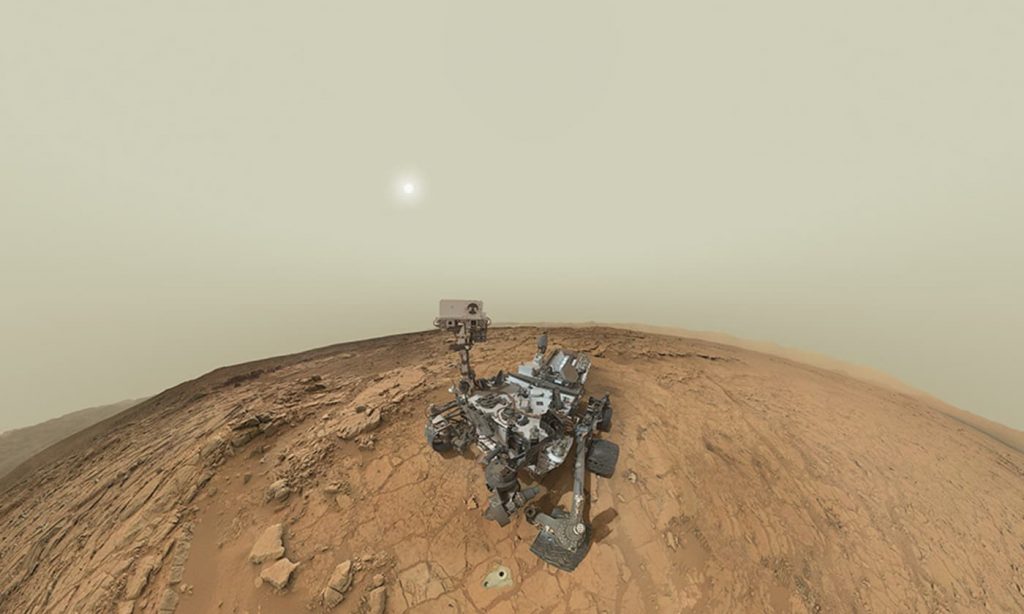
idea_SIZED-curiosity_sol-177bodrov600-NASA/JPL/CalTech/MSSS
NASA/JPL/CalTech/MSSS

Forty-seven years after the fact, Neil Armstrong’s message ‘Houston… the Eagle has landed’ remains one of the defining moments of the space age. Landings don’t even have to involve humans to be emotionally stirring. A robotic landing was what first drew me into planetary science and astrobiology. In 1976, while I was starting my first year of graduate school, the twin Viking probes touched down on Mars. They inspired me, far more than the earlier Mariner spacecraft that had flown past or orbited the planet. The images were both tangible and shocking: a salmon-coloured sky hanging over a rusty desert, its rocks scoured by thin, persistent winds. We were on the surface of Mars! My general interest in astronomy quickly narrowed into a specific fascination with Mars that persists to this day.

Despite their emotional power, space landings are few and far between. There are good, practical reasons for that. Landings are complex and expensive. Flybys and even orbiters are cheaper, easier and in many ways more sensible from a pure-science point of view. But NASA and the other space agencies are missing a huge opportunity here to make space exploration more evocative, and more personal. There simply is no other space vista that compares with seeing an alien horizon, capturing the perspective of an astronaut standing on another world.

After Viking, a full two decades passed before the next Mars touchdown. When the Pathfinder probe landed on Mars in the late afternoon of 4 July 1997, I was standing before a packed audience in the Stanford Theatre in Palo Alto, California. All of us were held spellbound by the first images from the lander and its little rover arriving back to Earth. Those pictures were processed in a specialty shop and projected by 35mm slides hand-carried to the theatre. Technology has changed since then, but the thrill has not. In 2012, when the two-ton Curiosity rover landed on Mars, rappelling down dramatically from a rocket-powered platform, the public response was once again immediate and intense. Thousands waited at science museums around the country to hear Curiosity’s heartbeat signal and to see the first views from the ground.

Most recently, the European Space Agency’s Philae probe made the first-ever soft landing on a comet on 12 November 2014, sending back provocative images of craggy, dust-coated cliffs. As a scientist focused on astrobiology, I have a keen interest in the organic chemistry of comets. Comets could have bought the building blocks of life to the early Earth, and might have jump-started the prebiotic reactions. But on that November day, the landing is what captured my imagination. A spindly robot bounced, tripped, tumbled and still managed to peer out on the utterly unknown surface of a comet. The science could, and did, come later.

There is an important lesson from these experiences: space missions to other worlds are not just about the science. They are about the human instinct to explore. The fascination with landing is part of that instinct. Even if the science is best served by merely orbiting or flying by, we should land whenever we can. They don’t have to be conflicting choices; often they can (and have been) done together. As for where we should land, the options are staggering. It’s been three decades since the last Venus landing; humans have only ever landed on one moon other than our own. There are many, many vistas waiting for us.

Jupiter’s large, ice-covered moon Europa is the next major target for a landing, but there has been a reluctance to commit. NASA scientists worry that the challenge is too hard, and that we have not surveyed Europa’s surface enough to find the ideal, safe landing site. Yes, there would be risks in landing there. Europa has no atmosphere in which to use parachutes. Then again, its surface gravity is similar to that of Earth’s moon, so we could use some of the technologies already developed for landing earlier robotic Moon landings. The risks of landing are similar to those of putting Pathfinder on Mars and Philae on the comet. The risks of not trying to land on Europa are more severe: we could lose the momentum for exploring this fascinating moon and searching for life in the global ocean beneath its frozen surface.

A Europa lander could be the beginning of a whole new era of space exploration. Landers don’t all have to be complex, costly machines like Curiosity. A stationary, battery-powered robot on Europa could still last long enough to survey an alien horizon unlike any seen before – our first view from the surface of an ice world. It could inspire follow-up missions to put eyes on the ground all across the solar system, so people hear the words ‘We’ve landed’ more often. There will be a rich scientific payoff but, even better, it would allow people around the world to experience other worlds from a distinctly human perspective.

I would like to volunteer as lookout with the crew that makes the first (robotic) landing on Europa. Hurray for distant lands, and for the humans and machines that land on them.

This article was originally published at Aeon and has been republished under Creative Commons.

Northrop Grumman-Built Space Sensor Satellites Launch in Support of US Space Force-8 Mission

0

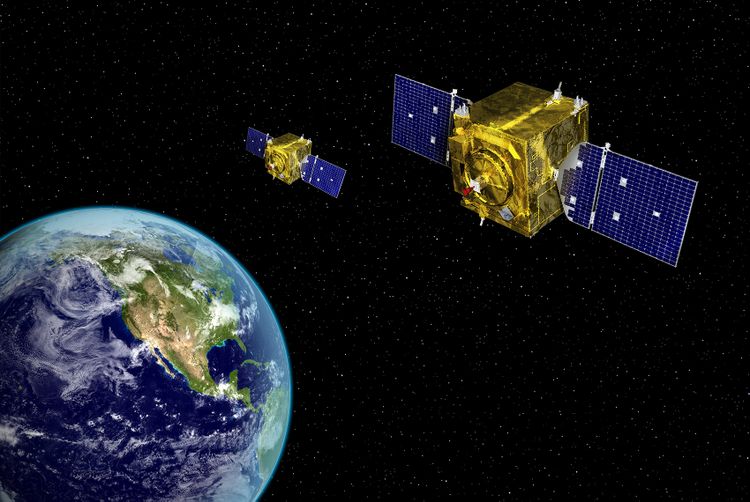
Two Northrop Grumman Corporation (NYSE: NOC) Geosynchronous Space Situational Awareness Program (GSSAP) satellites were successfully launched into orbit on a United Launch Alliance (ULA) Atlas V rocket today from Cape Canaveral Space Force Station as part of the U.S. Space Force (USSF)-8 mission. The two satellites, GSSAP-5 and GSSAP-6, will enhance space situational awareness, a top priority for the U.S. Space Force. In addition to manufacturing and delivering both GSSAP payloads, Northrop Grumman also provided the sole strap-on solid rocket booster adding propulsion to the rocket launch, as well as essential aeronautical components in support of the USSF-8 launch.  

Northrop Grumman-built GSSAP satellites collect space situational awareness data allowing for more accurate tracking and characterization of man-made orbiting objects.

The GSSAP program delivers a space-based capability operating in a near-geosynchronous Earth orbit (GEO), in support of the U.S. Space Command space surveillance operations. GSSAP satellites allow for more accurate tracking and characterization of orbiting objects and uniquely contribute to timely and precise orbital predictions, enhancing knowledge of the GEO environment and improving spaceflight safety. Northrop Grumman has manufactured all GSSAP satellites since the program’s inception in 2011.

“For over a decade, Northrop Grumman has delivered products that improve U.S. Space Command’s ability to monitor human-made orbiting objects in the geosynchronous environment,” said Matt Verock, vice president, space security, Northrop Grumman. “As dedicated Space Surveillance Network (SSN) sensors, the capabilities our GSSAP satellites bring demonstrate our leadership in space domain awareness.”

The company’s facilities in Dulles, Virginia along with Goleta and San Diego, California, and Beltsville, Maryland provided numerous subsystems, including the satellite’s solar arrays, primary structure, thermal control, avionic boxes, flight computer, shunt regulator assembly, composite components and deployable structures.   

This was the third ULA Atlas V rocket launch supported by Northrop Grumman’s 63-inch-diameter Graphite Epoxy Motor (GEM 63). The GEM 63 solid rocket booster, manufactured at the company’s Magna, Utah facility, provided nearly a third of the total thrust at liftoff. The GEM family of solid rocket motors recently expanded with the development of the GEM 63XL variation to support ULA’s Vulcan Centaur launch vehicle, scheduled for its first flight later this year.

The company manufactured the Atlas V rocket’s reaction control system propellant tanks at its Commerce, California, facility, and eight retro motors at its Elkton, Maryland, facility that assist first and second stage separation. Using advanced fiber placement manufacturing and automated inspection techniques, Northrop Grumman produced the composite heat shield that provides essential protection to the Atlas V first-stage engine, the Centaur Interstage Adapter that houses the second-stage engine, and the broadtail that adapts from the core vehicle to the five-meter diameter fairing. Northrop Grumman fabricated these structures at its Iuka, Mississippi, facility.

Northrop Grumman is a technology company, focused on global security and human discovery. Our pioneering solutions equip our customers with capabilities they need to connect, advance and protect the U.S. and its allies. Driven by a shared purpose to solve our customers’ toughest problems, our 90,000 employees define possible every day.

NASA to Discuss Webb’s Arrival at Final Destination, Next Steps

0

Scientists and engineers operating NASA’s James Webb Space Telescope will answer questions about the mission’s latest milestones in a NASA Science Live broadcast at 3 p.m. EST Monday, Jan. 24, followed by a media teleconference at 4 p.m.

The broadcast will air live online on the NASA Science Live website, as well as YouTubeFacebook, and Twitter. Audio of the teleconference will stream live on the agency’s website.

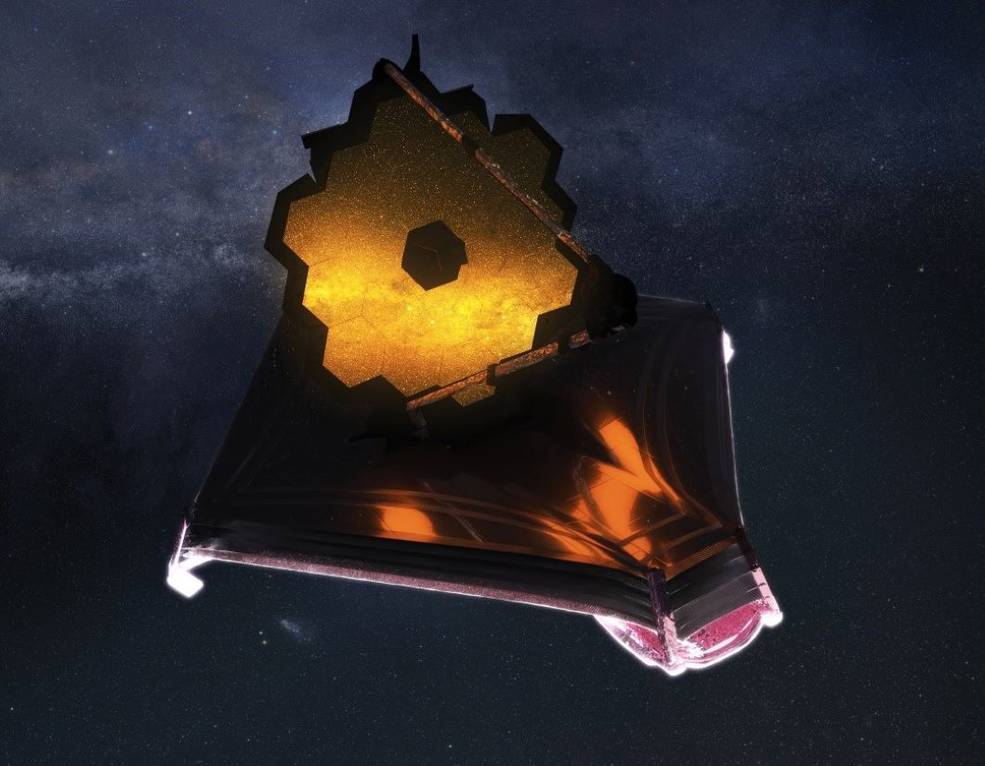
This artist’s conception shows the fully unfolded James Webb Space Telescope in space. Credits: Adriana Manrique Gutierrez, NASA Animator

Ground teams plan to fire Webb’s thrusters at 2 p.m. Monday, Jan. 24 to insert the space telescope into orbit around the Sun at the second Lagrange point, or L2, its intended destination, nearly 1 million miles from Earth. This mid-course correction burn has long been planned for approximately 29 days after launch. This week, the mission operations team selected the target date and time for the burn. Engineers also finished remotely moving Webb’s mirror segments out of their launch positions to begin the months-long process of aligning the telescope’s optics.

Viewers of this episode, “What’s Next for the James Webb Space Telescope?” can submit questions on social media using the hashtag #UnfoldtheUniverse or by leaving a comment in the chat section of the Facebook or YouTube stream. Questions from the public will be answered by:

  • Amber Straughn, deputy project scientist for Webb communications, NASA’s Goddard Space Flight Center in Greenbelt, Maryland
  • Scarlin Hernandez, flight systems engineer, Space Telescope Science Institute in Baltimore

Following the episode, NASA will host a media teleconference focused on the L2 insertion burn and mirror movements, as well as the next steps in preparing Webb to conduct science. The call will feature:

  • Lee Feinberg, Webb optical telescope element manager, Goddard
  • Amy Lo, Webb vehicle engineering lead, Northrop Grumman
  • Keith Parrish, Webb observatory commissioning manager, Goddard
  • Jane Rigby, Webb operations project scientist, Goddard

To participate in the teleconference, media must RSVP no later than two hours prior to the event to Laura Betz at: [email protected]. NASA’s media accreditation policy for virtual activities is available online.

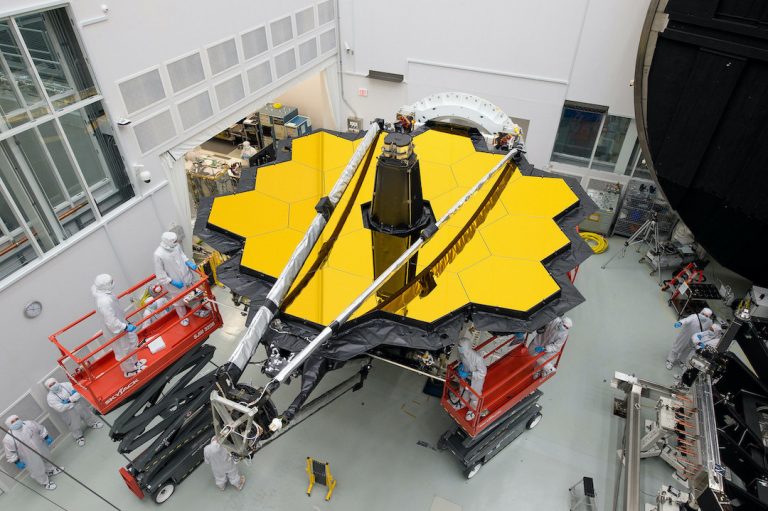
Webb, an international partnership with the ESA (European Space Agency) and the Canadian Space Agency, launched Dec. 25 from Europe’s Spaceport in Kourou, French Guiana. On Jan. 8, Webb finished unfolding in space after having been stowed inside the nose cone of an Arianespace Ariane 5 rocket for launch.

The observatory is now preparing for science operations, a human-controlled process called commissioning that provides the team with the flexibility to pause and adjust as needed. NASA provides regular updates about commissioning milestones on the Webb telescope blog. The public also can follow Webb’s progress online via a “Where is Webb?” interactive tracker.

Webb will explore every phase of cosmic history – from within the solar system to the most distant observable galaxies in the early universe, and everything in between. Webb will reveal new and unexpected discoveries and help humanity understand the origins of the universe and our place in it.

One Year into the Biden Administration, NASA Looks to Future

0

Over the past year, NASA has made valuable contributions to Biden-Harris Administration’s goals – leading on the global stage, addressing the urgent issue of climate change, creating high paying jobs, and inspiring future generations.

“Since President Biden and Vice President Harris were sworn in one year ago, their administration has made generational progress for Americans – and made NASA a priority. This spring, as Artemis I lifts off from Kennedy Space Center, the world will once again witness America’s unrivaled ingenuity and inspiration as NASA prepares the next generation to return to the Moon and on to Mars,” said NASA Administrator Bill Nelson. “I am proud of the work the agency has done to support this administration’s priorities on climate change, global leadership, diversity, equity, STEM education, and so much more. And we all should look forward to an even more robust future as NASA continues to explore the heavens and benefit life here on Earth.”

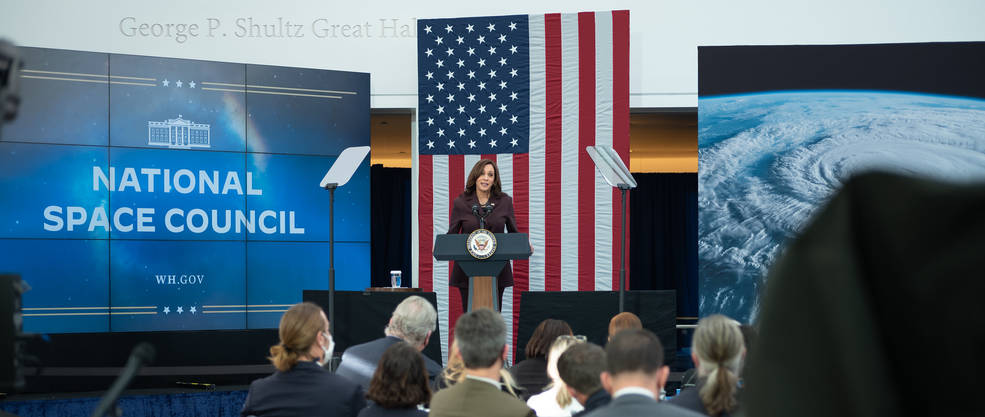
Vice President Kamala Harris delivers opening remarks at the first meeting of the National Space Council, Wednesday, Dec. 1, 2021, at the United States Institute of Peace in Washington. Credits: NASA/Joel Kowsky

Highlights of NASA’s efforts are below.

NASA Missions:

Since its inception, NASA has led the world in space, both in human spaceflight and science.

Mars: Perseverance and Ingenuity

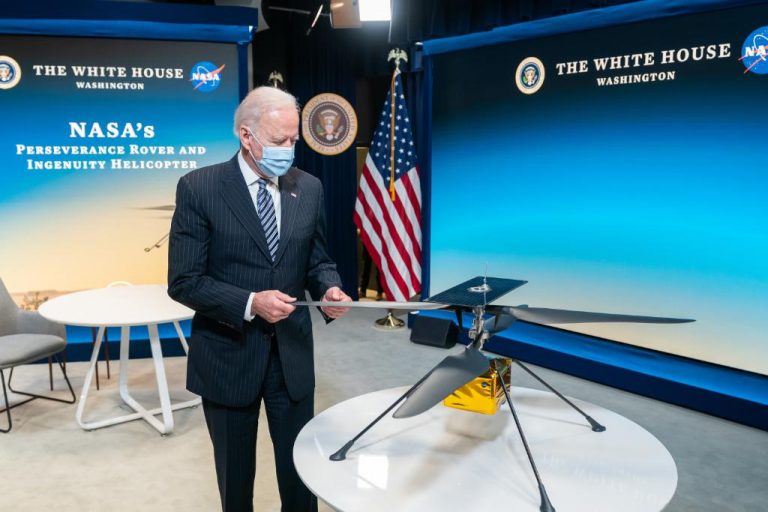
  • The Perseverance Mars rover landed on the Red Planet in February 2021 where it is studying the rock and sediment in Mars’ Jezero Crater and aiding in the search for signs of ancient microbial life.
  • Perseverance collected its first rock core into its sampling tube. The core is enclosed in a sample tube, and available for retrieval on a future Mars Sample Return mission.
  • Ingenuity became the first aircraft to make a powered, controlled flight on another planet, successfully logging 18 flights and completing more than 30 minutes of cumulative flight time.
  • Perseverance, first funded and approved under the Obama-Biden Administration, is made possible by thousands of scientists and engineers from countries and organizations around the world.

James Webb Space Telescope

  • Webb launched from Kourou, French Guiana Dec. 25th, in partnership with the European and Canadian space agencies.
  • In an incredible feat of engineering, the team has successfully completed the most critical and complex deployments, and the spacecraft now is on its way to its future home, nearly a million miles from Earth.
    • Webb will explore a wide range of science questions to help us understand the origins of the universe and our place within it. It will peer back to reveal the first stars and galaxies that formed about 13.5 billion years ago in the aftermath of the Big Bang.

International Space Station Extension

  • The Biden-Harris Administration has announced its commitment to extend International Space Station operations through 2030, and to work with our international partners in Europe (European Space Agency), Japan (Japan Aerospace Exploration Agency), Canada (Canadian Space Agency), and Russia (State Space Corporation Roscosmos) to enable continuation of the groundbreaking research being conducted in this unique orbiting laboratory through the rest of this decade.
  • Over the past two decades, the United States has maintained a continuous human presence in orbit around the Earth to test technologies, conduct scientific research, and develop skills needed to explore farther than ever before. The unique microgravity laboratory has hosted more than 3,000 research investigations from over 4,200 researchers across the world and is returning enormous scientific, educational, and technological developments to benefit people on Earth.

Humans in Space: NASA’s Commercial Crew Program, Astronaut Candidate Announcement

  • NASA and SpaceX successfully launched eight astronauts to the International Space Station in 2021. NASA’s Commercial Crew Program, a cornerstone of private-public partnership passed into law under the Obama-Biden administration, has brought value to the American taxpayer and enabled incredible growth in the commercial space sector, all while providing safe, reliable transportation to the space station on American rockets from American soil.
  • Nelson introduced the members of the 2021 astronaut class, the first new class in four years Dec. 6 at  NASA’s Johnson Space Center in Houston. Ten new astronaut candidates were selected from more than 12,000 applicants. The astronaut candidates recently began two years of training at Johnson and have the potential to walk on the Moon as part of Artemis.

Double Asteroid Redirection Test (DART)

  • DART, the world’s first full-scale mission to test technology for defending Earth against potential asteroid or comet hazards, launched in November.
  • DART will test whether a spacecraft can autonomously navigate to a target asteroid and intentionally collide with it in a method of deflection called kinetic impact.
    • The test in the fall of 2022 will provide important data to help better prepare for an asteroid that might pose an impact hazard to Earth, should one ever be discovered.

Moon to Mars

  • NASA took critical steps in 2021 to prepare for the historic launch of Artemis I, an uncrewed flight test of NASA’s powerful Space Launch System (SLS) rocket and Orion spacecraft in spring 2022, including the green run engine test and completing assembly of SLS and Orion for the first time.
    • NASA will land the first woman and person of color on the Moon as part of the Artemis program – missions that will help the agency in preparation for human exploration of Mars.
    • SLS is the most powerful rocket in the world – and the only rocket that can send Orion, astronauts, and supplies 239,000 miles to the Moon in a single mission.

Addressing Climate Change and Natural Disasters:

NASA unequivocally provides the most comprehensive data in the world on the Earth’s systems and is the only space agency in the world providing end-to-end research on our home planet to analyze and understand the processes involved.  

National Climate Task Force

  • NASA joined the National Climate Task Force established by President Biden and released a climate action plan aimed at averting mission impacts due to climate change, ensuring the resiliency of facilities and assets, and providing the nation and world unique climate observations, analysis, and modeling through scientific research.

Senior Climate Advisor

  • NASA established the new position of senior climate advisor to the administrator to ensure effective fulfillment of the Biden Administration’s climate science objectives for NASA. In January, NASA hired Dr. Katherine Calvin to serve a dual role as both the climate advisor and agency’s chief scientist.

Earth System Observatory

  • NASA announced a new Earth System Observatory, five integrated satellites that will provide key information to help mitigate and guide efforts related to climate change, disaster mitigation, fighting forest fires, and improve real-time agricultural processes.

Landsat 9

  • In September, NASA and United States Geological Survey launched Landsat 9, an Earth-observing satellite that will build on the most advanced measurements made in the program’s history.
  • The Landsat Program represents the longest, continuous, global satellite record of the Earth’s surface, allowing us to track the impacts of climate change.
  • These satellites have documented Earth’s changing landscape, helping farmers and scientists understand and manage land resources needed to sustain human life, like food, water, and forests.

INCUS

  • NASA selected a new Earth science mission that will study the behavior of tropical storms and thunderstorms, including their impacts on weather and climate models.
  • The mission will be a collection of three SmallSats, flying in tight coordination, called Investigation of Convective Updrafts (INCUS), and is expected to launch in 2027 as part of NASA’s Earth Venture Program.
  • INCUS fills an important niche to help understand extreme weather and its impact on climate models – all of which serves to provide crucial information needed to mitigate weather and climate effects on our communities.

TROPICS

  • To bring more data to forecasters and have a more consistent watch over Earth’s tropical belt where these storms form, NASA launched a test satellite, or pathfinder, ahead of a constellation of six weather satellites called TROPICS (Time-Resolved Observations of Precipitation structure and storm Intensity with a Constellation of Smallsats).
  • Planned for launch in 2022, the TROPICS satellites will work together to provide near-hourly microwave observations of a storm’s precipitation, temperature, and humidity – a revisit time for these measurements not currently possible with other satellites.

National Space Council:

Vice President Kamala Harris Chairs First National Space Council Meeting

  • The vice president leads the National Space Council, and she announced a new, whole-of-government framework to ensuring that space activities create opportunities that benefit the American people and the world, and enhances our ability to maintain a vibrant space sector across civilian, commercial, and national security.
  • The Vice President charged the Council with an initial focus on the rules and norms governing space, leveraging space to tackle the climate crisis, and building a diverse space and STEM workforce.
  • In conjunction with the Vice President leading her first National Space Council meeting, President Biden also signed a new Executive Order that addresses the membership, duties, and responsibilities of the Council. The Order added five new members to the Council: The Secretaries of Education, Labor, Agriculture, and the Interior, as well as the National Climate Advisor. These new members demonstrate the Administration’s emphasis on ensuring the benefits of American space activities are applied broadly throughout society and employed to solve the toughest challenges, including addressing the climate crisis and building a vibrant workforce for the future.
  • At the meeting, Nelson highlighted the breadth of NASA’s STEM engagement, from the more than 6,400 internships, fellowships, and other direct student higher education awards, to the $35 million in direct financial support to students enrolled in higher education programs.

Vice President Harris Tours NASA’s Goddard Space Flight Center

  • During the visit, the Vice President got a first-hand look at NASA’s Earth science missions and presented the first images from the Landsat 9 satellite.
  • While chairing her first National Space Council meeting, she highlighted the opportunities that the aerospace sector offers – for science, the economy, national competitiveness, STEM education, and more.

International Collaboration:

NASA is a global leader in space and here on Earth. International partnerships play a key role in achieving mission success – from collaboration on climate, to planetary science, and human exploration.

Ukrainian President Visits with NASA Administrator

  • Ukrainian President Volodymyr Zelenskyy met with NASA Administrator Bill Nelson at the Mary W. Jackson NASA Headquarters in Washington.
  • They two discussed a renewed commitment to partnership in space, shared interest in exploration and discovery, and the importance of international cooperation for achieving mutual ambitions in space.

Artemis Accords

  • Several nations joined a growing list of countries in signing the Artemis Accords, principles that will help establish a safe, peaceful, and prosperous future in space.

COP26

  • NASA expanded its presence at COP26, a global summit brings parties together to accelerate action towards the goals of the Paris Agreement and the U.N. Framework Convention on Climate Change. The NASA Hyperwall served as the main attraction at the U.S. Center.

Partnered with ESA on Climate

  • Formed a strategic, first-of-its-kind partnership with ESA to observe Earth and its changing environment.
  • The partnership was formalized through a joint statement of intent, signed Tuesday, which outlines how the agencies will collaborate to ensure continuity of Earth observations; advance understanding of the Earth System, climate change and application of that knowledge; and collaborate on an open data policy that promotes open sharing of data, information, and knowledge within the scientific community and the wider public.

Lead Multilateral Meeting with Nearly 30 Space Agencies

  • Hosted a multilateral event with nearly 30 space agencies around the world at the International Aeronautical Congress to discuss the future of space exploration and underscore the importance of the safe, sustainable use of outer space.

Diversity, Equity, Inclusion and Accessibility:

NASA is entirely committed to the full participation and empowerment of a wide variety of people, organizations, capabilities, and assets because we know this best enables the workforce to accomplish our missions.

Mission Equity

  • In response to Executive Order 13985 (Advancing Racial Equity and Support for Underserved Communities Through the Federal Government), NASA rolled out “Mission Equity,” held a public meeting to solicit feedback, and is reviewing public comments to a request for information.
  • Mission Equity is a comprehensive effort to assess agency programs, procurements, grants, and policies, and examine what potential barriers and challenges may exist for communities that are historically underrepresented and underserved.

NASA Headquarters Officially Named for Mary W. Jackson

  • NASA celebrated the agency’s first African American female engineer, Mary W. Jackson, with a ceremony to formally name the agency’s headquarters building in Washington in her honor.

Dual Anonymous Science Grant Proposal System

  • NASA is experimenting with changing its science grant proposal system to a dual anonymous system – one where names of reviewers and proposers are both kept hidden – which has been proven to increase fairness and reduce hidden biases for research awards. 
  • NASA has pilot programs underway and used this method to choose the recently announced set of first research projects for the James Webb Space Telescope.

STEM Education:

NASA STEM education and engagement is critical to our nation’s goal of building a diverse future STEM workforce and engages students in authentic learning experiences that spark interest and provide connections to NASA’s missions.

NASA 2021 STEM-a-Thon

  • NASA hosted STEM-a-Thon with a series of activities and engagements for students with more than 6,600 registrants from across the globe. NASA’s STEM-a-Thon is aimed at sparking interest in careers and broadening student participation in STEM. This year’s event highlighted paths to careers at NASA and encouraged students to pursue their interests in STEM.

NASA’s Minority University Research and Education Project (MUREP)

  • NASA awarded grants to MSIs to support Artemis Space Technology. $3.5 million will be distributed to selected universities over two years. NASA’s MUREP called upon Minority Serving Institutions to develop proposals for how they could use NASA funding to strengthen their support for underrepresented communities.
  • NASA chose six MSIs to receive the MUREP INCLUDES award. Each award provides up to $1.2 million for a three-year period to implement the institution’s proposal.

EPSCoR

  • In fiscal year 2021, NASA’s Established Program to Stimulate Competitive Research (EPSCoR) conducted five competitive awards processes aimed toward increasing research and development capacity and improvement, while enabling valuable contributions to NASA mission needs and challenges. These five competitive solicitations yielded 94 selected proposals for a total of over $45 million in awards to institutions. 

Space Grant

  • In fiscal year 2021, Space Grant awarded $42 million in cooperative agreements to institutions in all 50 states, Washington DC & Puerto Rico, resulting in over 3,700 Significant Student awards.  FY21 also saw the expansion of the Space Grant Consortia to include over 1,100 partner institutions throughout Academia, Industry, State/Local Government, and non-profit organizations. 
  • In addition to direct awards made to Higher Education students, the program had over 193,000 student participants, 16,700 faculty participants, and over 400 peer-reviewed manuscripts with another 180 pending.

Next Gen STEM

  • In FY21, Next Gen STEM, OSTEM’s K-12 project, reached 467,805 students and 35,562 educators through various events, activities and STEM learning.

Million Girls Moonshot

  • NASA partnered with Million Girls Moonshot’s Reach for the Stars Downlink Event, part of the Million Girls Moonshot, a five-year partnership designed to cultivate an engineering mindset within one million girls by 2025. Over 24,000 students registered for the event.

Internships

  • NASA nearly doubled the number of participants in its internship program over the fiscal year, and both the fall and spring intern cohorts were NASA’s largest to date for those sessions.

Statistics:

  • NASA activities supported more than $60 billion in total economic output and supported more than 300,000 jobs nationwide.
  • NASA grew the agency’s social media following to 277 million in 2021 – up 14% from 240 million in 2020.
  • 4.2 million viewers watched live as Perseverance landed on Mars. Currently, the landing broadcast is the most-watched video of all time on NASA’s YouTube channel with almost 24 million views.
  • NASA also conducted its first live Spanish language broadcast for the Mars Perseverance landing, which received more than 2.6 million views.
  • More than 1 million students participated in NASA’s Mission to Mars Student Challenge.
  • More than 7.7 million viewers tuned into the launch of the James Webb Space Telescope. The launch broadcast is now among the top 20 videos of all time on NASA’s flagship channel. 
  • The YouTube NASA en español broadcast of the Webb Telescope launch, “Desplegando el universo,” reached 465,000 views.