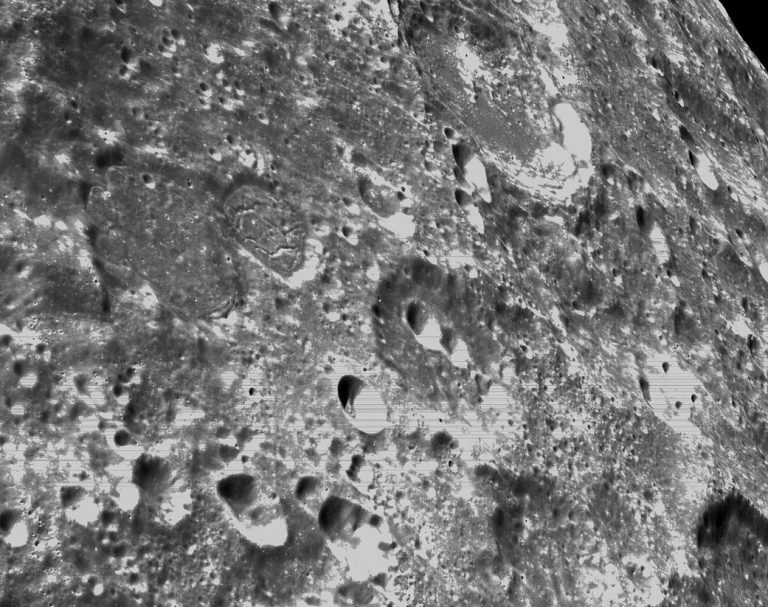
On Dec. 5, 2022, Orion completed the return powered flyby burn, committing the spacecraft to a Dec. 11 splashdown in the Pacific Ocean.
NASA’s Orion spacecraft is on course for its return to Earth on Sunday, Dec. 11. The spacecraft made its second and final close approach to the Moon at 10:43 a.m. CST Monday, Dec. 5, just before its return powered flyby burn, passing 80.6 miles above the lunar surface.
The burn, which used the spacecraft’s main engine on the European-built service module, lasted 3 minutes, 27 seconds, and changed the velocity of the spacecraft by about 655 mph (961 feet per second). It was the final major engine maneuver of the flight test.
“Orion is heading home! Today the team achieved another momentous accomplishment, flying Orion just 80 miles from the surface of the Moon. The lunar flyby enabled the spacecraft to harness the Moon’s gravity and slingshot it back toward Earth for splashdown,” said Administrator Bill Nelson. “When Orion re-enters Earth’s atmosphere in just a few days, it will come back hotter and faster than ever before – the ultimate test before we put astronauts on board. Next up, re-entry!”
Several hours before the lunar flyby, the spacecraft performed a trajectory correction burn at 4:43 a.m. CST using the reaction control system thrusters on the service module. The burn lasted 20.1 seconds and changed the velocity of the spacecraft by 1.39 mph (2.04 feet per second).
The mission management team convened and polled “go” to deploy recovery assets off the coast of California ahead of Orion’s splashdown on Dec. 11. As soon as Orion splashes down, a team of divers, engineers, and technicians will depart the ship on small boats and arrive at the capsule. Once there, they will secure it and prepare to tow it into the back of the ship, known as the well deck. The divers will attach a cable to pull the spacecraft into the ship, called the winch line, and up to four additional tending lines to attach points on the spacecraft. The winch will pull Orion into a specially designed cradle inside the ship’s well deck and the other lines will control the motion of the spacecraft. Once Orion is positioned above the cradle assembly, the well deck will be drained and Orion will be secured on the cradle.
“Last week, we completed our final rehearsal with the USS Portland, which will be our recovery ship for Artemis I,” said Melissa Jones, landing and recovery director, NASA’s Kennedy Space Center. “We had a great three days working with them to refine our procedures and integrate our teams so we can meet the objectives of recovering the Orion spacecraft.”
Orion has used approximately 8,050 pounds of propellant during Artemis I, which is 180 pounds less than expected prelaunch. There are 2,075 pounds of margin available over what was planned for the mission, a 165-pound increase.
As of 5:29 p.m. CST on Dec. 5, Orion was traveling 244,629 miles from Earth and 16,581 miles from the Moon, cruising at 668 mph.
NASA Television and the agency’s website will resume live coverage of Orion’s journey at 9 a.m. Tuesday.
As Orion leaves the lunar sphere of influence for the final time, watch NASA astronaut Thomas Marshburn read the children’s book Goodnight Moon from space during his expedition aboard the International Space Station as part of a collaboration with Crayola Education to bring stories and the unique teachings of space to life with art and creativity.
Images are sent down to Earth, and uploaded to NASA’s Johnson Space Center Flickr account and Image and Video Library. When bandwidth allows, views of the mission will be available in real-time via video stream.
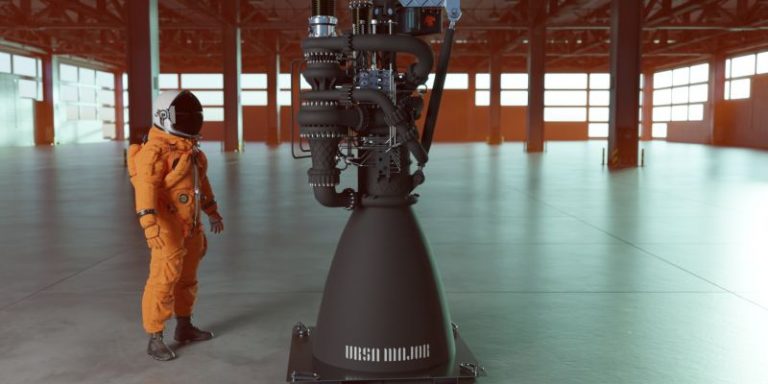
“Let’s build some engines!” That’s essentially what Ursa Major is doing. Based in Colorado, this space technology business is racing to improve humanity’s quest to explore the universe – several engines at a time. With its cutting-edge 3D printing techniques, copper-alloy materials, and a team of more than 250 aerospace and propulsion experts, Ursa Major thrives in an industry dominated by big players and traditional production methodologies. The key to its success is funneling a niche market in America solely focused on rocket propulsion.
Founded on the premise that propulsion is the backbone of the journey to space, Ursa Major realized from the outset that delivering affordable rocket engines is vital in the competitive space race environment. It has turned to additive manufacturing, which reduces lead time and cost against conventional production techniques. The complex shapes and geometries that are often challenging and expensive can be made with AM resulting in newer engine designs that are economically and technically achievable.
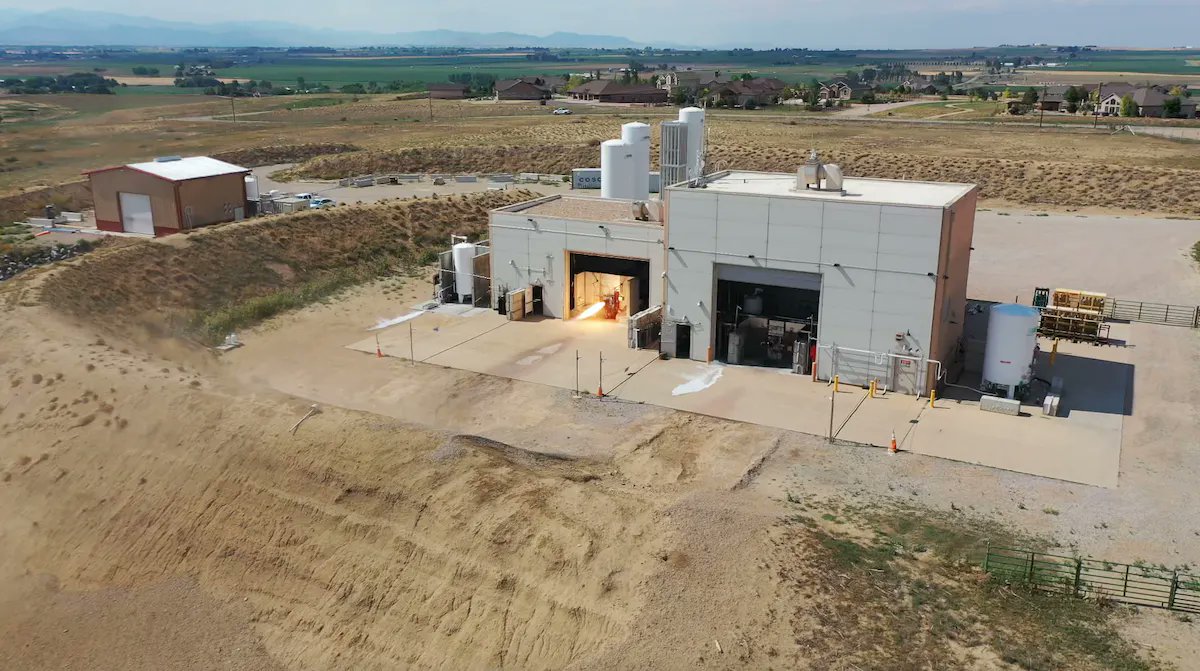
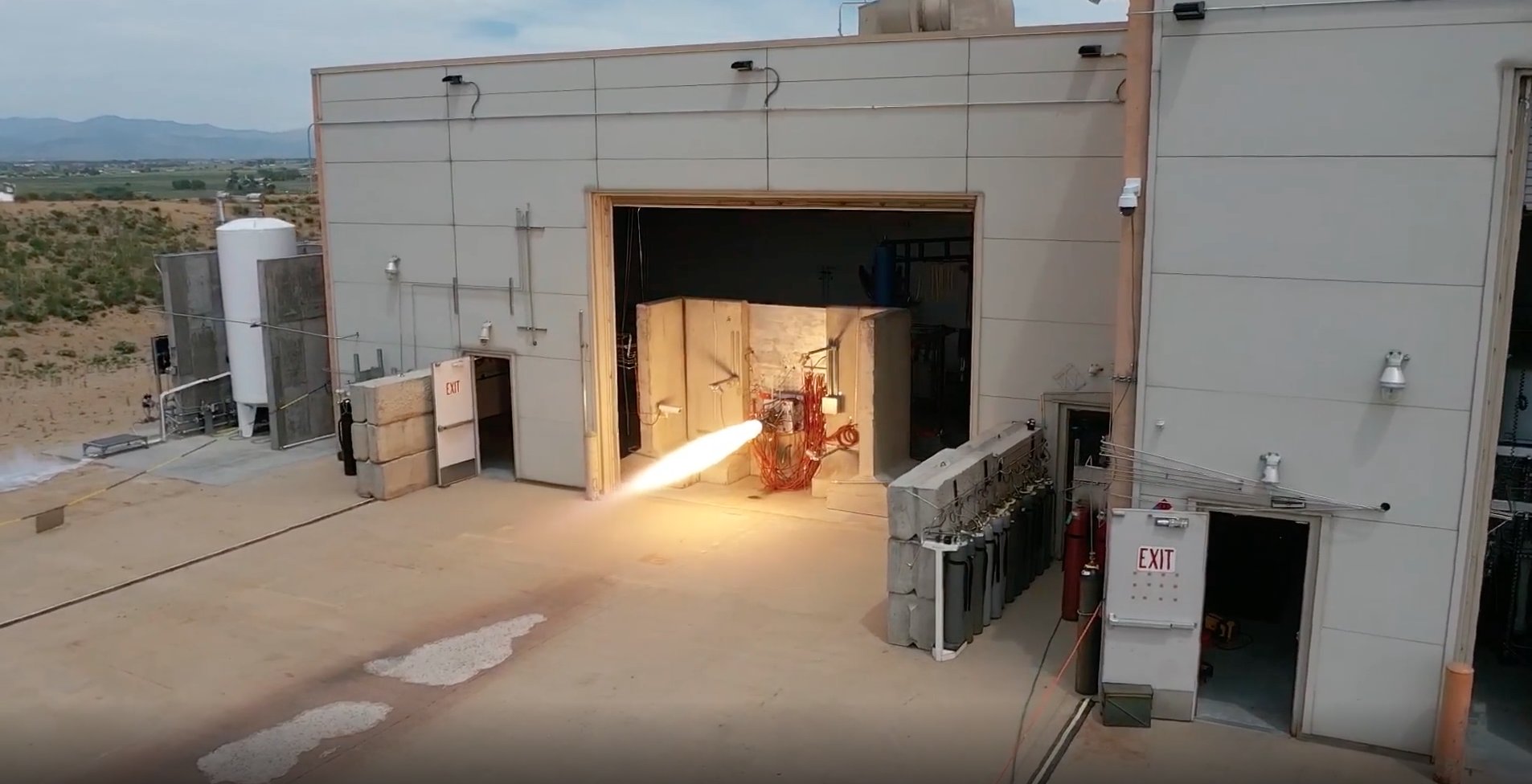
Ursa Major headquarters in Colorado. Image courtesy of Ursa Major.
In 2015, company founder and former Propulsion Engineer at SpaceX and Blue Origin, Joe Laurienti, turned to AM technology, simulation, and 3D design software to modernize the development of staged combustion engines. The company successfully designed and built two liquid oxygen and kerosene combustion engine models, Hadley and Ripley, and is currently working on a third engine called Arroway. Through internally developed materials and processes, Ursa Major additively manufactures 80% of its engines.
Passionate about propulsion
Key to its success is the ongoing collaboration with AM veteran EOS. Together they have sped up engine production and improved performance and reliability. But how is this possible, given the persisting supply chain issues for engine manufacturers?
To learn more about Ursa Major’s propulsion solutions, 3DPrint.com talked to the company’s Director of Advanced Manufacturing & Materials, Jacob Bowles, and EOS Senior VP of Applied Technologies, Greg Hayes.
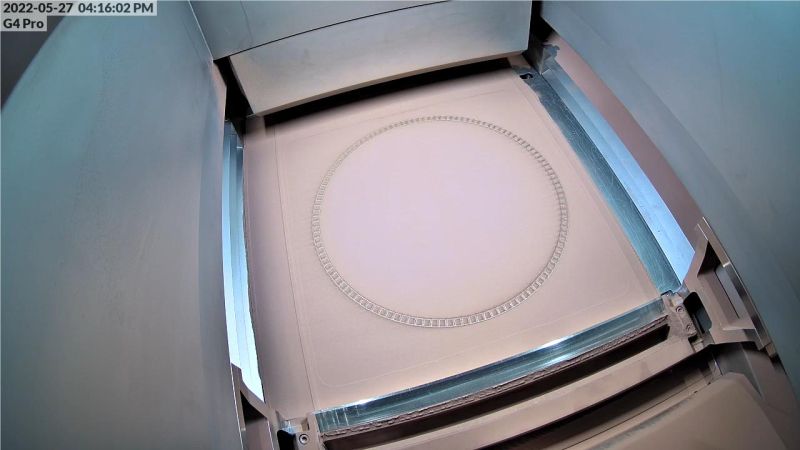
A look inside EOS M400 which is printing a rocket engine part. Image courtesy of Ursa Major.
Copper is at the cusp of transforming the manufacturing space, explain the experts, and with the help of EOS 3D printing technology, Ursa Major delivered its first copper-based 3D-printed rocket engine components. As a manufacturer of turnkey propulsion solutions for a wide range of vehicles servicing the orbital launch community, Ursa Major is aiding humanity’s endeavor to explore the universe. To do this, the company has an EOS laser powder bed fusion 3D printer, the M400, in-house specifically used for creating copper alloy parts.
So far, it’s a small but tactical operation, explains Bowles. “Our efforts have been focused on developing the process and parameters for our copper alloy engine program, including combustion chambers and liners.”
Design, build and test hardware to run the engines
From the start, Ursa Major wanted to reduce the production and delivery cycles compared to traditional manufacturing and turned to 3D printing.
“It enabled access to a quicker timeline of sourcing parts to test on the stand reducing that cycle time, which is incredibly important in development, and also allowing Ursa designers to have flexibility with their conceptual design,” describes Bowles. “We’re excited about improving the status quo on manufacturing lead times, and additive specifically is one of the biggest opportunities for us to do so.”
But disrupting the industry is not new to 3D printing veterans like EOS. Hayes says that with 3D printing, no matter how much better the technologies get, the production timeframes are still incredible compared to traditional manufacturing paths, where months of manufacturing are the norm.
“3D printing has greatly impacted how fast industries can innovate and really how fast they’ve been able to drive their application technologies further,” commented Hayes.
EOS Senior VP of Applied Technologies Greg Hayes. Image courtesy of EOS.
At Ursa Major’s Advanced Manufacturing Lab in Youngstown, Ohio, which is overseen by Bowles and began operating in October of 2021, the EOS printer produces rocket engine components on demand. Last July, it delivered the first copper-based 3D-printed rocket engine combustion chambers, compressing the production and delivery cycle to one month, compared to the six-month minimum it takes using traditional manufacturing processes.
For Bowles, seeing the output from that lab and the impact that it’s had on the development program for the Hadley, a 5,000-pound thrust and oxygen-rich staged combustion engine capable of launching orbital and suborbital vehicles, is incredible.
The Youngstown 3D printing lab was critical to rapidly redesigning Ursa Major’s Ripley from a 35,000 to 50,000-pound thrust engine to meet market demand. At the moment, Ursa Major has seen a lot of traction. Aside from a massive 200-engine order plus from recurring client Phantom Space, a new space transportation provider developing micro-satellite, small satellites, and propulsion systems launch services, it has almost a dozen government contracts and roughly eight other commercial customers.
At Phantom headquarters, there is an ever-growing inventory of Ursa Major Hadley engines ready for installation on Phantom’s Daytona launch vehicle. Image courtesy of Phantom Space.
“It’s a compelling time to go from installing a machine and developing processes to affecting engine testing in real life,” suggests Bowles.
According to the engineer, 80% of the engine mass is 3D printed, and the rest comes from commercial off-the-shelf hardware. Bowles said that engineers constantly evaluate new technology as the company moves forward with its new engines.
“Our focus is getting testing done on the new engines,” commented Bowles. “We are churning about one Hadley engine per week. So really, what we’re looking at is our rate capabilities. As we get into early development and qualification on our next-gen engines [like the recently announced 200,000-pound thrust Arroway designed for medium and heavy launch], those numbers will also tick up.”
Ursa Major Director of Advanced Manufacturing & Materials Jacob Bowles at the company’s testing site in Colorado. Image courtesy of Ursa Major.
Thanks to its in-house expertise for successful engine system production, space companies could turn to Ursa Major for its propulsion. In addition, by leveraging EOS’ machine with copper alloys, Ursa Major is also unlocking other applications that could take advantage of this technology and material combination. Hayes says that in the world of copper alloys, plenty of applications could benefit from its advantages, like heat exchangers for the semiconductor industry and the electric vehicle industry.
“We need to make sure that our machines can process these coppers, that the lasers in our advanced systems have the correct power to print the material, and make sure that we are not at the rate-limiting step in getting this technology into the hands of people like Ursa Major,” indicated Hayes. “Because as users hit this material with one, two, four, or more lasers, the temperatures are increasing a lot, and copper is a soft alloy and very reflective, so there are still many challenges. Overall, our experience with Ursa Major has been an exciting way to push the printer machines to the next level to enable pushing the propulsion systems further.”
To keep the reliability and longevity of its systems, EOS makes sure its additive engineers work closely with Ursa Major rocket specialists to ensure the manufacturing ecosystem is aligned. That also means EOS has to guarantee that its future technologies are improving, making it easier, faster, and more reliable for companies like Ursa Major to use the systems in their production chain. Considering that Ursa Major is creating engines for long-term supply contracts with rocket makers, EOS software updates and reverse compatibility are critical when placing new technology into a manufacturing ecosystem, explained Hayes.
In 2022, Ursa Major ran 29,606 seconds of hotfire tests. Image courtesy of Ursa Major.
The journey to space is powered by engines
Ursa Major’s Hadley engine is in early production, while the 50,000-pound thrust Ripley engine and 200,000-pound thrust Arroway are in early development. The company has built and tested over 50 staged-combustion rocket engines. To date, Ursa Major engines have accumulated more than 50,000 seconds of run-time, far more than a typical engine is tested prior to first flight.
From early concepts to physical hardware, 3D printing accelerates production times for Ursa Major. Backed by renowned investors like XN and Explorer 1, the startup has already raised more than $130 million in investments and has watched its workforce expand to incorporate over 250 employees. With its flexible rocket engines spearheading the union between 3D printing and propulsion, Ursa Major can help spark even more interest in the rocket engines market.
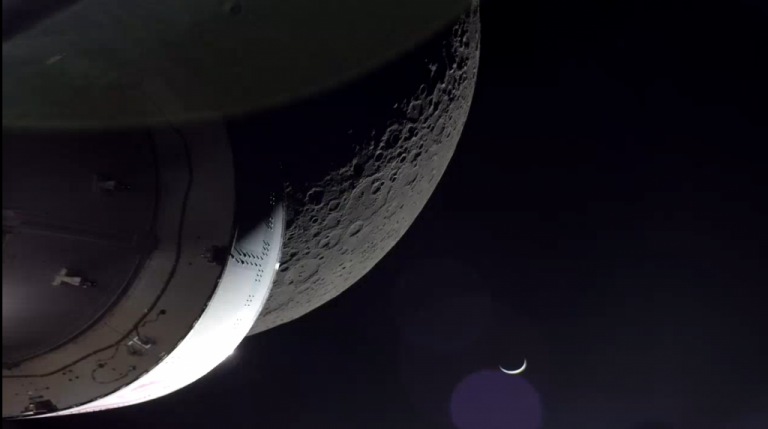
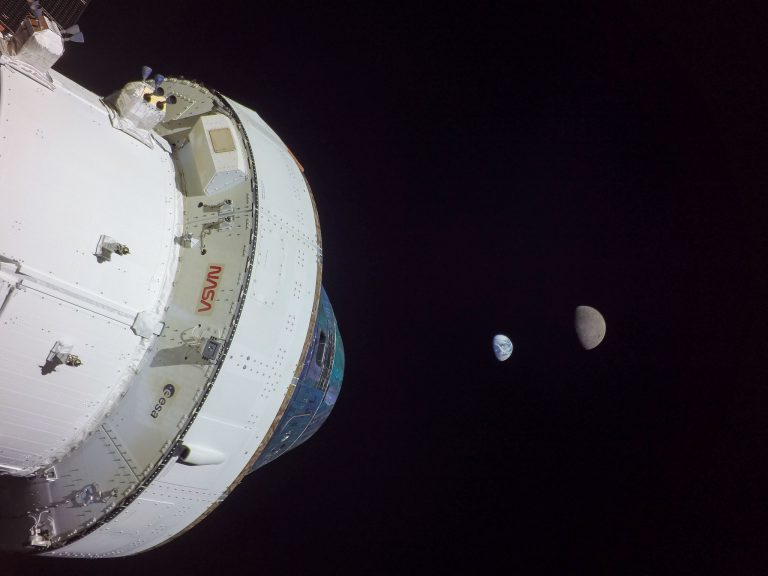
NASA’s uncrewed Orion spacecraft reached a maximum distance of nearly 270,000 miles from Earth during the Artemis I flight test before beginning its journey back toward Earth. Orion captured imagery of the Earth and Moon together from its distant lunar orbit, including this image on Nov. 28, 2022, taken from camera on one of the spacecraft’s solar array wings. Credits: NASA
NASA will provide live coverage of the Artemis I uncrewed Orion spacecraft’s return flyby of the Moon on Monday, Dec. 5, as well as its return to Earth on Sunday, Dec. 11.
The agency also will host several briefings to discuss the upcoming activities from Johnson Space Center in Houston. NASA will provide live coverage on NASA Television, the agency’s website, and the NASA app.
Orion has begun its return trek toward Earth, completing a burn Dec. 1, to exit a lunar orbit thousands of miles beyond the Moon, where engineers have been testing systems to improve understanding of the spacecraft before future missions with astronauts.
Return lunar flyby coverage will begin at 9 a.m. EST Monday, Dec. 5. The return powered flyby burn, in which the spacecraft will harness the Moon’s gravity and accelerate back toward Earth, is expected at 11:43 a.m. The spacecraft is expected to fly about 79 miles above the lunar surface at 11:42 a.m., just before the burn.
U.S. media wishing to join in the news conferences in person must request credentials from the Johnson newsroom no later than 1 p.m. on the day of each briefing at 281-483-5111 or [email protected]. Media interested in participating by phone must also contact the Johnson newsroom no later than one hour before the start of the briefings.
Live coverage as Mission Control, Houston, monitors the spacecraft’s entry, descent, and splashdown off the coast of San Diego will begin at 11 a.m. Sunday, Dec. 11. Splashdown is expected at 12:40 p.m., after which the exploration ground systems recovery team from NASA’s Kennedy Space Center in Florida, working with the U.S. Navy, will recover the spacecraft.
NASA also is hosting a STEM event in collaboration with the San Diego Air and Space Museum at 9 a.m. PST Sunday, Dec. 11, for students and families to learn about Orion and the science, technology, engineering, and math that ensures the success of the agency’s missions. Participants will be able to watch a live stream of the splashdown, participate in STEM hands on activities, and hear from NASA experts and Department of Education Deputy Secretary Cindy Marten.
Following the lunar flyby Dec. 5, NASA will host a 5 p.m. news conference at Johnson.
Participants will include:
Mike Sarafin, Artemis mission manager, NASA Headquarters
Judd Frieling, flight director, NASA Johnson
Debbie Korth, Orion Program deputy manager, NASA Johnson
Melissa Jones, landing and recovery director, NASA Kennedy Space Center
The agency also will hold a 5 p.m. Thursday, Dec. 8, news conference to preview Orion’s entry through Earth’s atmosphere, descent, and splashdown in the Pacific Ocean off the coast of San Diego.
Participants will include:
Mike Sarafin, Artemis mission manager, NASA Headquarters
Judd Frieling, flight director, Johnson
Howard Hu, manager, Orion Program, NASA Johnson
Melissa Jones, landing and recovery director, NASA Kennedy
A news conference also will be held after splashdown, about 3:30 p.m. Dec. 11.
Participants will include:
Bill Nelson, NASA administrator
Jim Free, NASA associate administrator for the Exploration System Development Mission Directorate, NASA Headquarters
Howard Hu, Orion Program manager, Johnson
Emily Nelson, chief flight director, Johnson
Melissa Jones, recovery director, Kennedy
Following a successful launch on NASA’s Space Launch System rocket, Artemis I is testing the Orion spacecraft on a rigorous mission in the extreme environment of deep space around the Moon before flying astronauts on Artemis II in 2024. Artemis includes a series of increasingly complex missions that will enable human exploration at the Moon where the agency will prepare for future missions with crew to Mars.
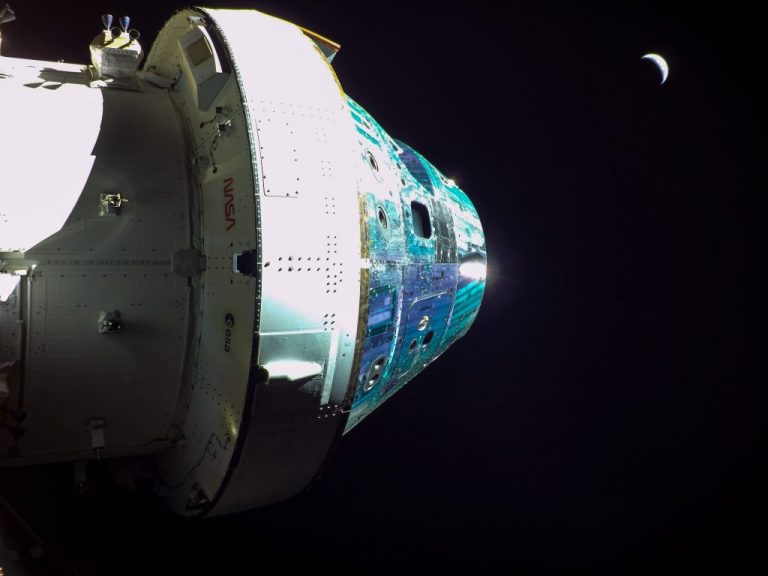
art001e002003 (Dec. 4, 2022) On the 19th day of the Artemis I mission, Orion captures Earth from a camera mounted on one of its solar arrays as the spacecraft prepares for the return powered flyby of the Moon on Dec. 5, when it will pass approximately 79 miles above the lunar surface.
Orion performed the second return trajectory correction burn on Sunday, Dec. 4, at 10:43 a.m. CST, using the auxiliary thrusters and increasing the spacecraft’s velocity by 1.16 mph (1.71 feet per second).
Shortly after acquiring signal with the Deep Space Network’s Canberra ground station at 12:41 a.m. CST, Orion experienced an issue with a power conditioning distribution unit (PCDU), in which four of the latching current limiters responsible for downstream power were switched off. These lower-level switches connect to the propulsion and heater subsystems. Teams confirmed the system was healthy and successfully repowered the downstream components. There was no interruption of power to any critical systems, and there were no adverse effects to Orion’s navigation or communication systems.
Teams are examining whether a potential contributor to this issue is related to a power configuration test implemented by the flight teams to investigate previous instances in which one of eight units opened without a command. The umbilical was successfully commanded closed each time and there was no loss of power flowing to avionics on the spacecraft.
The spacecraft obtained additional data using its optical navigation system, which is a sensitive camera to take images of the Moon and Earth to help orient the spacecraft by looking at the size and position of the celestial bodies in the images. Engineers also continue to work plans to accomplish several additional test objectives during Orion’s journey back to Earth. A host of test objectives provide information to engineers about how Orion operates in space, allowing them opportunities to validate performance models and learn as much as possible about the spacecraft.
In preparation for Orion’s return to Earth, the team from NASA’s Exploration Ground Systems Program and the U.S. Navy, who will recover Orion from the Pacific Ocean, completed its final training day at sea, using a mock capsule in the water for divers and small boats to practice open water recovery procedures.
On Monday, Dec. 5, Orion will make its closest approach to the Moon, flying 79.2 miles above the lunar surface. It will perform the return powered flyby burn at 10:43 a.m. CST, which will last about 3 minutes and 27 seconds, changing the velocity of the spacecraft by approximately 655 mph (961 feet per second). The return powered flyby is the last large maneuver of the mission, with only smaller trajectory corrections to target Earth remaining.
Live coverage of the close lunar flyby and burn will begin at 8 a.m. CST on NASA TV, the agency’s website, and the NASA app. During the coverage, lighting will be different than it was during Orion’s initial close lunar flyby on Nov. 21. The spacecraft will lose communications with Earth for approximately 31 minutes beginning at 10:40 a.m. CST, as it flies behind the far side of the Moon.
At 4 p.m. CST on Dec. 5, NASA leaders will discuss the results of the return powered flyby burn and the deployment of recovery assets to sea ahead of Orion’s splashdown on Dec. 11. Live coverage will be available on all NASA channels.
Just after 4:30 p.m. CST on Dec. 4, Orion was traveling 222,213 miles from Earth and 23,873 miles from the Moon, cruising at 3,076 mph.
Images from the mission are available on NASA’s Johnson Space Center Flickr account and Image and Video Library. When bandwidth allows, live views from Orion are available in real-time.
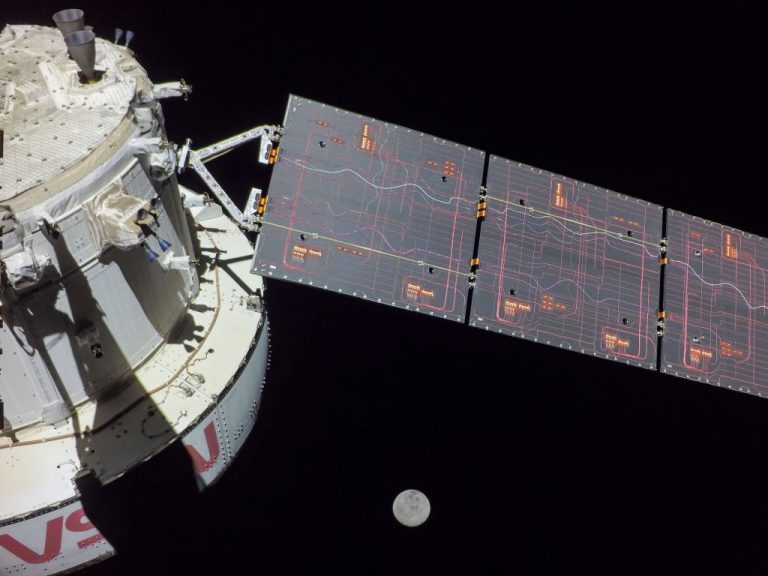
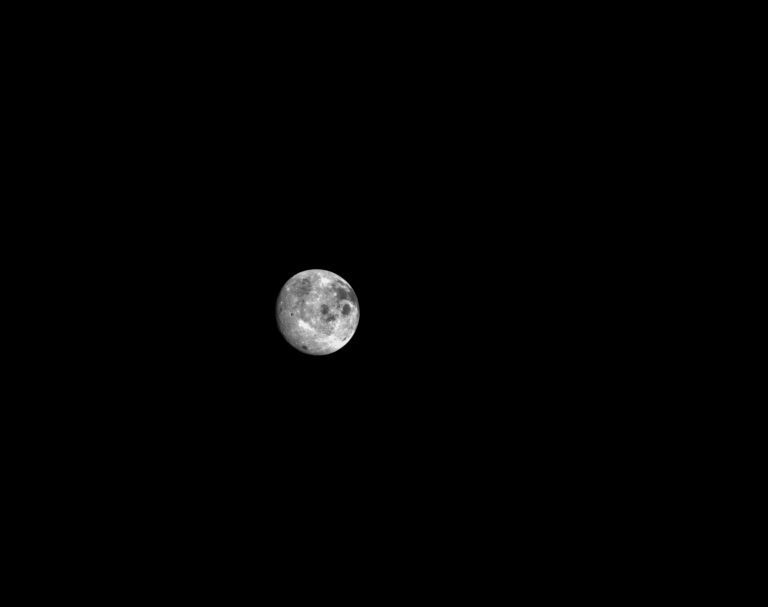
art001e001933 (Dec. 2, 2022) A camera mounted on one of Orion’s four solar arrays captured this image of the Moon on flight day 17 of the 25.5-day Artemis I mission from a distance of more than 222,000 miles from Earth. Orion has exited the distant lunar orbit and is heading for a Dec. 11 splashdown in the Pacific Ocean.
Orion re-entered the lunar sphere of influence at 4:45 p.m. CST Saturday, Dec. 3, making the Moon the main gravitational force acting on the spacecraft. Entry into the lunar sphere of entry occurred when the spacecraft was about 39,993 miles from the lunar surface. It will exit the lunar sphere of influence for a final time on Tuesday, Dec. 6, one day after the return powered flyby about 79 miles above the lunar surface.
On Flight Day 18, engineers also performed a development flight test objective that changed the minimum jet firing time for the reaction control thrusters over a period of 24 hours. This test objective is designed to exercise the reaction control system jets in a pre-planned sequence to model jet thruster firings that will be incorporated into the crewed Artemis II mission.
The test used the reaction control system (RCS) thrusters, built by ArianeGroup, on the European Service Module. All firings of RCS thrusters during the flight test to date have used those on the service module. Another set of 12 RCS thrusters, built by Aerojet Rocketdyne, are located on the crew module.
While the crew module thrusters will be tested a few days before Orion’s splashdown on Earth, their primary role takes place in the final hour before splashdown in the Pacific Ocean. After the crew module and service module separate the crew module’s RCS thrusters will be used to ensure the spacecraft is properly oriented for re-entry, with its heat shield pointed forward, and stable during descent under parachutes.
Orion will be out of communication with NASA’s Deep Space Network for about 4.5 hours from 7:40 p.m. to 12:00 a.m. while network teams reconfigure ground stations. The flight control team has adjusted the activity timeline, and there is no impact to the mission’s trajectory. Automated commands will guide the spacecraft during this period, and Orion will reacquire signal as it passes within range of the Canberra ground station.
Just after 4:30 p.m. on Dec. 3, Orion was traveling 221,630 miles from Earth and 40,086 miles from the Moon, cruising at 2,777 miles per hour.
Images from the mission are available on NASA’s Johnson Space Center Flickr account and Image and Video Library. When bandwidth allows, live views from Orion are available in real-time.
art001e001859 (Dec. 1, 2022) Orion’s optical navigation camera captured this image of the Moon on flight day 16 of the Artemis I mission. Orion uses the optical navigation camera to capture imagery of the Earth and the Moon at different phases and distances, providing an enhanced body of data to certify its effectiveness under different lighting conditions as a way to help orient the spacecraft on future missions with crew.
After departing distant retrograde orbit the afternoon of Thursday, Dec. 1, Orion completed a planned trajectory correction burn to fine-tune its course toward the Moon. The five-second burn occurred at 9:54 p.m. CST Thursday, and changed the spacecraft’s velocity by about 0.3 mph or less than half a foot per second.
Dec. 2, teams collected additional images with Orion’s optical navigation camera and downlinked a wide variety of data files to the ground, including data from the Hybrid Electronic Radiation Assessor, or HERA. The radiation detector measures charged particles that pass through its sensors. Measurements from HERA and several other radiation-related sensors and experiments aboard Artemis I will help NASA better understand the space radiation environment future crews will experience and develop effective protections. On crewed missions, HERA will be part of the spacecraft’s caution and warning system and will sound a warning in the case of a solar energetic particle event, notifying the crew to take shelter. NASA is also testing a similar HERA unit aboard the International Space Station.
Orion carries other experiments to gather data on radiation, including several radiation area monitors about the size of a matchbox that record the total radiation dose during the mission, dosimeters provided by ESA (European Space Agency) mounted inside the cabin to collect radiation data with time stamps to allow scientists to assess dose rates during various mission phases, and three “purposeful passengers” collecting additional information on what crews will experience during future missions. Four space biology investigations, collectively called Biology Experiement-1, are examining the impact of deep space radiation on seeds, fungi, yeast, and algae.
Orion will reenter the lunar sphere of influence on Saturday, Dec. 3, making the Moon the main gravitational force acting on the spacecraft. It will exit the lunar sphere of influence for a final time on Tuesday, Dec. 6, one day after its return powered flyby about 79 miles above the lunar surface.
A total of about 7,940 pounds of propellant has been used, which is about 150 pounds less that the amount expected before launch. Approximately 2,040 pounds of margin is available beyond what flight controllers plan to use for the remainder of the mission, which is nearly 130 pounds more than expected amounts before launch. About 97 gigabytes of data have been sent to the ground by the spacecraft.
Just after 1 p.m. CST on Dec. 2, Orion was traveling 229,812 miles from Earth and 50,516 miles from the Moon, cruising at 2,512 miles per hour.
Images from the mission are available on NASA’s Johnson Space Center Flickr account and Image and Video Library. When bandwidth allows, live views from Orion are available in real-time.
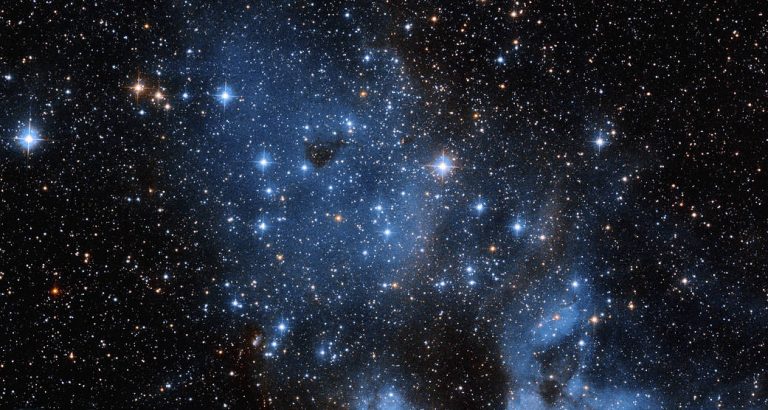
Against a backdrop littered with tiny pinpricks of light glint a few, brighter stars. This whole collection is NGC 1858, an open star cluster in the northwest region of the Large Magellanic Cloud, a satellite galaxy of our Milky Way that boasts an abundance of star-forming regions. NGC 1858 is estimated to be around 10 million years old.
Open clusters are a type of star cluster with loose gravitational attraction between the stars, which causes the cluster to be irregularly shaped and its stars to be spread out. NGC 1858 is also an emission nebula, which is a cloud of interstellar gas that has been ionized by ultraviolet wavelengths radiating off of nearby stars. The gas of the nebula emits its own light at visible wavelengths, seen here as a faint cloud that populates the middle and bottom right of the image.
The stars within this young cluster are at different phases of their evolution, making it a complex collection. Within NGC 1858, researchers have detected a protostar, a very young, emerging star, indicating that star formation within the cluster may still be active or has stopped very recently. The presence of an emission nebula also suggests that star formation recently occurred here, since the radiation required to ionize the gas of the nebula comes from stars that only live a short time.
NGC 1858 is located about 160,000 light-years away in the constellation Dorado and contains multiple massive stars, which can be seen shining brightly throughout the center of the image. The cluster is located in a crowded area of the sky, and the large number of stars around the cluster makes it difficult to study alone. To survey these distant stars, scientists relied on the Hubble Space Telescope’s unique resolution and sensitivity at visible and infrared wavelengths.
Image Credit: NASA, ESA and G. Gilmore (University of Cambridge); Processing: Gladys Kober (NASA/Catholic University of America)
In 1916, shortly after publishing his theory of general relativity, Albert Einstein predicted the existence of gravitational waves – warps in space time caused by accelerating matter that ripple outward at the speed of light. However, he believed these ripples would be so slight as to be undetectable, before eventually abandoning the concept altogether. But following decades of scientific developments suggesting their existence, as well as technological innovations making their detection possible, in 2015 a team of researchers at the Massachusetts Institute of Technology (MIT) and the California Institute of Technology recorded humanity’s first direct observation of the phenomena.
Created by the US filmmakers Sarah Klein and Tom Mason in collaboration with the MIT School of Science, this documentary tracks how the US physicist Rai Weiss, now professor emeritus at MIT, stood on the shoulders of his fields’ biggest giant to prove the existence of gravitational waves, a century after Einstein had predicted them. Relaying an inspiring story of imagination, ingenuity and dedication giving rise to a monumental breakthrough, the documentary reflects on how scientific ideas travel – often circuitously – across generations.
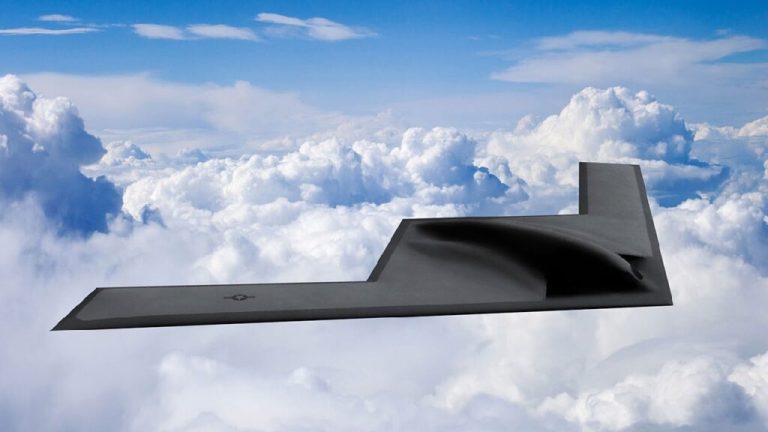
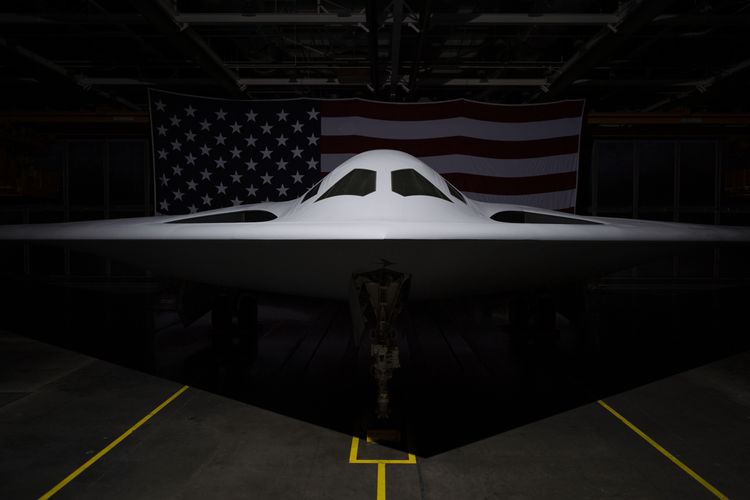
Northrop Grumman Corporation (NYSE: NOC) and the U.S. Air Force unveiled the B-21 Raider to the world today. The B-21 joins the nuclear triad as a visible and flexible deterrent designed for the U.S. Air Force to meet its most complex missions.
“The Northrop Grumman team develops and delivers technology that advances science, looks into the future and brings it to the here and now,” said Kathy Warden, chair, chief executive officer and president, Northrop Grumman. “The B-21 Raider defines a new era in technology and strengthens America’s role of delivering peace through deterrence.”
The B-21 Raider forms the backbone of the future for U.S. air power, leading a powerful family of systems that deliver a new era of capability and flexibility through advanced integration of data, sensors and weapons. Its sixth-generation capabilities include stealth, information advantage and open architecture.
Northrop Grumman and the U.S. Air Force introduce the B-21 Raider, the world’s first sixth-generation aircraft. Credit: Northrop Grumman
“The B-21 Raider is a testament to America’s enduring advantages in ingenuity and innovation. And it’s proof of the Department’s long-term commitment to building advanced capabilities that will fortify America’s ability to deter aggression, today and into the future. Now, strengthening and sustaining U.S. deterrence is at the heart of our National Defense Strategy,” said Secretary of Defense Lloyd J. Austin III. “This bomber was built on a foundation of strong, bipartisan support in Congress. And because of that support, we will soon fly this aircraft, test it and then move into production.”
The B-21 is capable of networking across the battlespace to multiple systems, and into all domains. Supported by a digital ecosystem throughout its lifecycle, the B-21 can quickly evolve through rapid technology upgrades that provide new capabilities to outpace future threats.
“With the B-21, the U.S. Air Force will be able to deter or defeat threats anywhere in the world,” said Tom Jones, corporate vice president and president, Northrop Grumman Aeronautics Systems. “The B-21 exemplifies how Northrop Grumman is leading the industry in digital transformation and digital engineering, ultimately delivering more value to our customers.”
The B-21 Raider is named in honor of the Doolittle Raids of World War II when 80 men, led by Lt. Col. James “Jimmy” Doolittle, and 16 B-25 Mitchell medium bombers set off on a mission that changed the course of World War II. The designation B-21 recognizes the Raider as the first bomber of the 21st century.
Northrop Grumman is a technology company, focused on global security and human discovery. Our pioneering solutions equip our customers with capabilities they need to connect, advance and protect the U.S. and its allies. Driven by a shared purpose to solve our customers’ toughest problems, our 90,000 employees define possible every day.
On the sixth day of the Artemis I mission, Nov. 21, 2022, the Orion spacecraft’s optical navigation camera captured black-and-white images of craters on the Moon below. This photo and others captured are the closest photos of the Moon from a human-rated vessel since Apollo. The optical navigation camera takes black-and-white imagery of the Earth and the Moon at different phases and distances; this technology demonstration will help prove its effectiveness for future missions with crew.