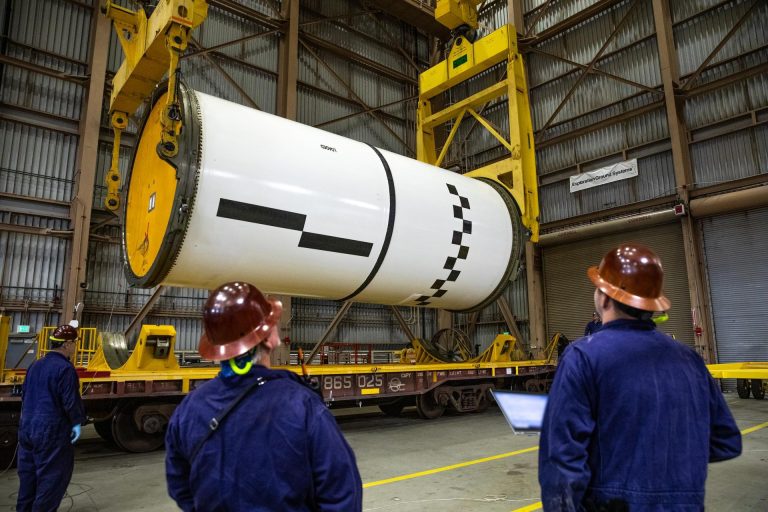
Engineers and technicians process the right forward center segment of the Space Launch System solid rocket boosters for the Artemis II mission inside the Rotation, Processing and Surge Facility (RPSF) at NASA’s Kennedy Space Center in Florida on Tuesday, Nov. 27, 2023.
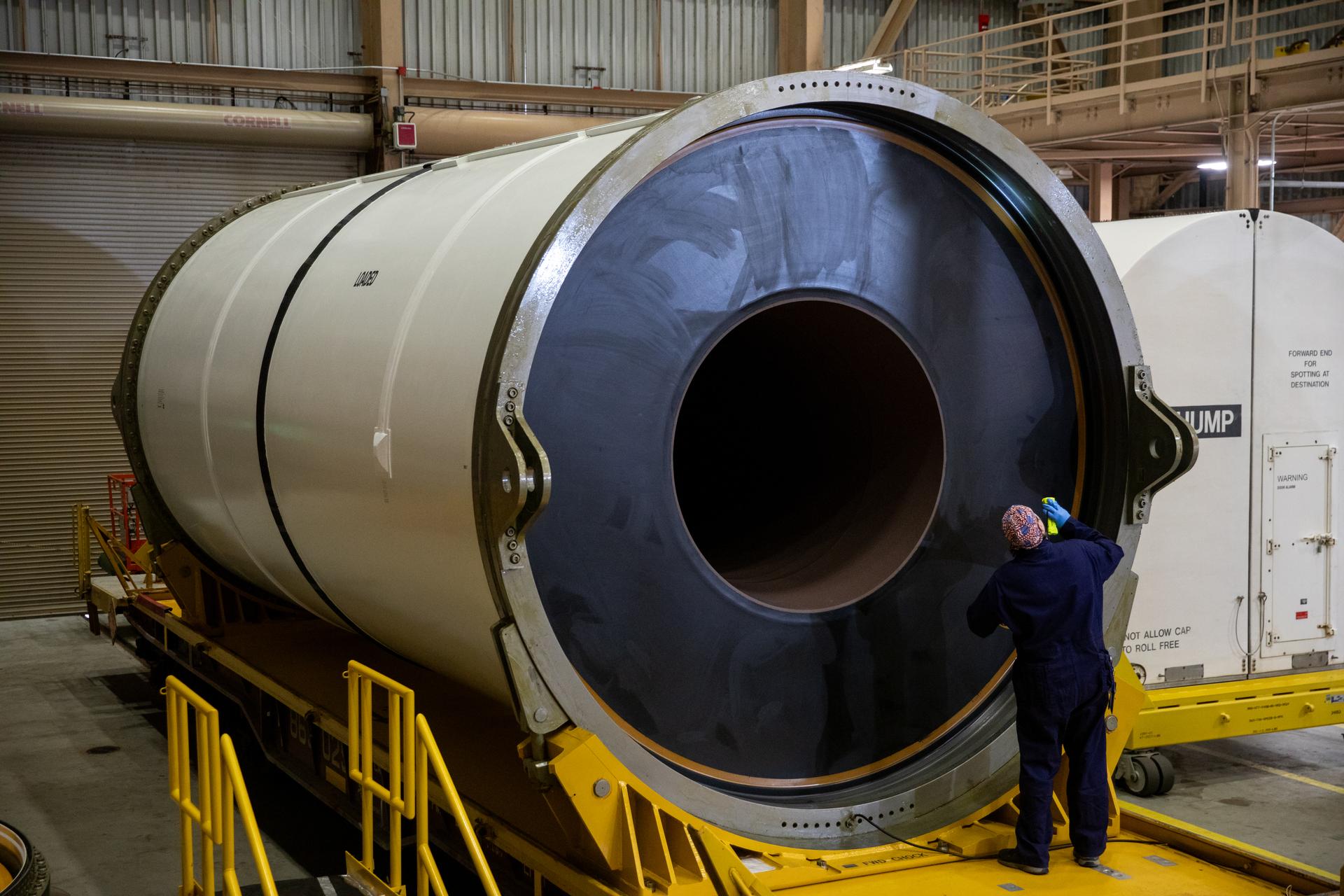
Inside the Rotation, Processing and Surge Facility at NASA’s Kennedy Space Center in Florida, engineers and technicians process the right forward center segment of the SLS (Space Launch System) rocket on Nov. 28, 2023. The ongoing processing of the segments is the first step before stacking operations begin and the segments will form the twin solid rocket boosters for the SLS rocket that will power NASA’s Artemis II mission. After arriving via rail in September, the team has been inspecting each segment one-by-one and lifting them to a vertical position to ensure the solid propellant and segment are ready for integration and launch.
Engineers and technicians process and inspect the propellant of the right forward center segment of the Space Launch System solid rocket boosters for the Artemis II mission inside the Rotation, Processing and Surge Facility (RPSF) at NASA’s Kennedy Space Center in Florida on Monday, Nov. 27, 2023.
Once processing is complete for all 10 segments, they will be moved one at a time to the Vehicle Assembly Building for stacking atop the mobile launcher. Standing 17 stories tall and burning approximately six tons of propellant every second, each booster generates more thrust than 14 four-engine jumbo commercial airliners. Together, the twin boosters provide more than 75 percent of the total SLS thrust at launch.
The Artemis II mission will send four astronauts around the Moon as part of the agency’s effort to establish a long-term science and exploration presence at the Moon, and eventually Mars.
The two small moons of Mars, Phobos (about 22km in diameter) and Deimos (about 13km in diameter), have been puzzling scientists for decades, with their origin remaining a matter of debate. Some have proposed that they may be made up of residual debris produced from a planet or large asteroid smashing into the surface of Mars (#TeamImpact).
An opposing hypothesis (#TeamCapture), however, suggests the moons are asteroids that were captured by Mars’s gravitational pull and were trapped in orbit.
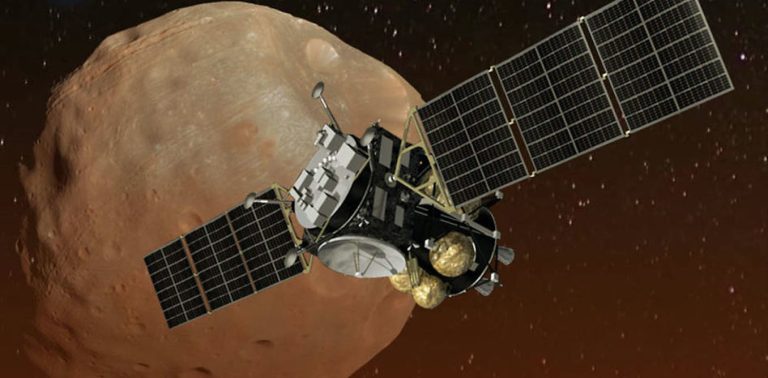
To solve the mystery, we’ll need material from the moons’ surfaces for analytical analyses on Earth. Luckily, the Japan Aerospace Exploration Agency (Jaxa) will launch a mission, named “Martian Moon eXploration” (MMX), to Phobos and Deimos in September 2024. The mission will be carried by a newly designed rocket, the H-3, which is still under development.
The spacecraft is expected to reach Martian orbit in 2025, after which it will orbit Phobos and finally collect material from its surface before returning to Earth by 2029.
This will make it the next in a series of recent missions bringing material from space back to Earth, following on from Jaxa’s successful mission to asteroid Ryugu (Hayabusa2), as well as Nasa’s Osiris-Rex mission to asteroid Bennu and the Chinese Space Agency’s Chang’e 5 mission to the Moon.
Giveaways
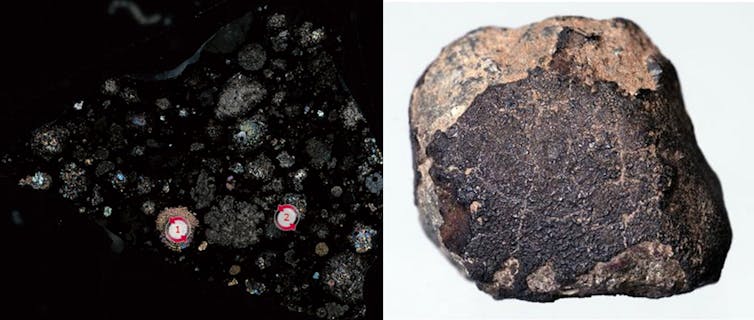
If an impact origin did indeed occur, we would expect to find similar material on Phobos to that which is found on Mars. While we do not have any material returned directly from Mars (yet), we are lucky enough to have rock that has been ejected off its surface which eventually found its way to Earth.
These meteorites may therefore be similar to the material returned from Phobos, providing a fantastic comparison.
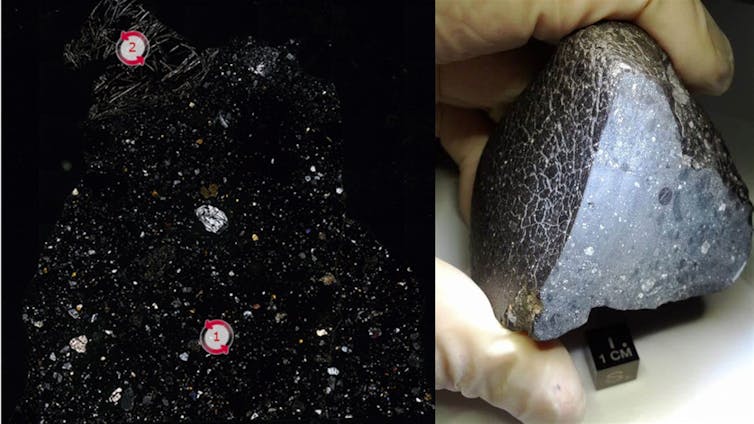
A martian meteorite under the microscope and hand specimen. Open University, CC BY-NC-SA
In the case of a captured asteroid origin, however, we are more likely to find material on Phobos that is found on other asteroids in our Solar System. The prevailing hypothesis in the #TeamCapture group is that the moons are made up of the same rock as meteorites, called carbonaceous chondrite. Thankfully, we have plenty of such meteorites and samples that we could compare with the Phobos material.
A carbonaceous chondrite meteorite under the microscope and hand specimen. CC BY-NC-SA
Comparing meteorites and material brought back from Phobos will be a fantastic tool for helping us understand the origin of the two moons. Once we have material in the laboratory, rigorous analytical techniques can be applied to the samples.
One such technique is oxygen isotope analysis. Isotopes are versions of elements whose nuclei have more or fewer particles called neutrons. Oxygen, for example, has three stable isotopes, with atomic masses of 16, 17 and 18.
The sum of the isotopic ratios of oxygen-17/oxygen-16 and oxygen-18/oxygen-16
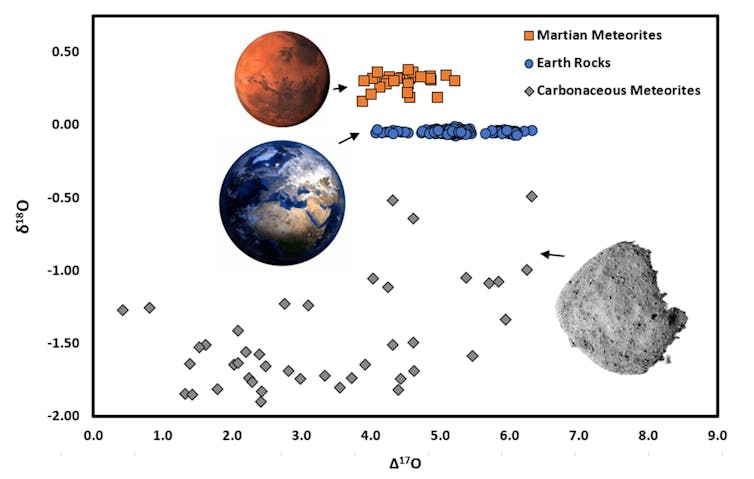
is denoted as Δ17O, and is characteristic of specific parent objects. Depending on where in the Solar System a rocky body is formed, a distinct oxygen composition is acquired and retained in the rocks. For example, rocks from Earth have Δ17O of around 0, while meteorites from Mars have Δ17O of around ~0.3. Therefore, rocks from Earth and Martian meteorites can be readily separated from one another.
If Phobos formed in the same or at least similar location in the Solar System to Mars, we would expect the composition of the material brought back by MMX also to have Δ17O of around 0.3.
As mentioned previously, #TeamCapture suggest a carbonaceous chondrite-like origin for Phobos. All known carbonaceous chondrites studied by scientists have revealed negative isotopic Δ17O, ranging from -0.5 all the way down to -4. Oxygen can therefore be an extremely powerful tool in deciphering the origin of the moons of Mars, and should be a high priority for the mission once material is returned to Earth.
Oxygen isotope plot showing the stark differences in oxygen between the Earth, Mars and asteroids. CC BY-NC-SA
If Phobos does indeed represent an ancient fragment of Mars, it could comprise the most primitive of Martian material. Mars has experienced a wide range of processes that have altered the rocks on its surface, including wind erosion and water alteration. Based on features such as dry river beds observed from orbiters such as Viking, it is clear that water on Mars once existed.
This water likely originated from a mix of asteroids and comets, and volcanic activity. Mars also retained a thick atmosphere, which allowed water to be present as a liquid on the planet’s surface.
Phobos, on the other hand, has remained an airless body where processes such as contamination from water have not occurred (though minor impact events may have taken place). This means that samples returned from Phobos could provide extremely important insights into the original water content of Mars, and a window to processes that occurred in the early Solar System.
MMX is one of the most exciting planned missions in space exploration. With less than a year to go, our fingers are already firmly crossed for a successful launch, sample acquisition, and sample return. Many scientists including myself would absolutely love the possibility of one day studying those samples.
Ben Rider-Stokes, Post Doctoral Researcher in Achondrite Meteorites, The Open University
This article is republished from The Conversation under a Creative Commons license. Read the original article (https://theconversation.com/the-longstanding-mystery-of-mars-moons-and-the-mission-that-could-solve-it-219161).
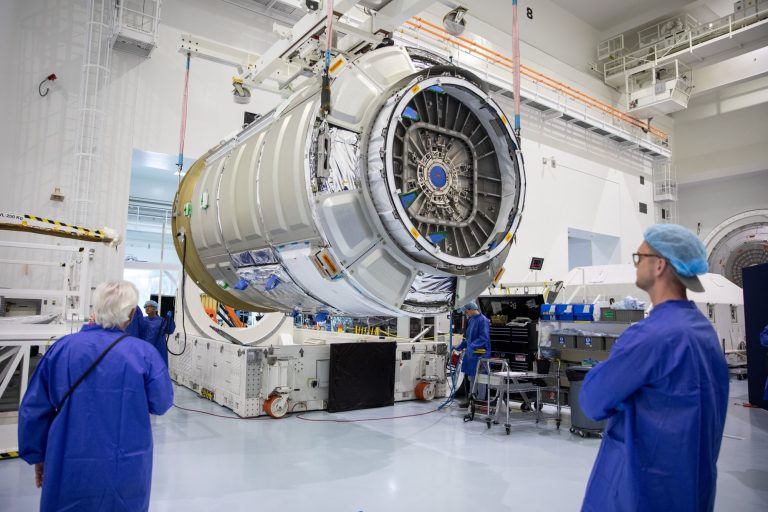
The Northrop Grumman Cygnus spacecraft’s pressurized cargo module for the company’s 20th commercial resupply mission is lifted and moved by crane inside the high bay in the Space Station Processing Facility at NASA’s Kennedy Space Center in Florida. The Cygnus, aboard a SpaceX Falcon 9 rocket, will liftoff from Cape Canaveral Space Force Station’s Space Launch Complex 40. NASA/Ben Smegelsky
Media accreditation is open for the next launch to deliver NASA science investigations, supplies, and equipment to the International Space Station. This launch is the 20th Northrop Grumman commercial resupply services mission to the orbital laboratory for the agency.
NASA, Northrop Grumman, and SpaceX are targeting no earlier than Monday, Jan. 29, for a Falcon 9 rocket to launch the Cygnus spacecraft from Space Launch Complex 40 at Cape Canaveral Space Force Station in Florida.
Following launch, the space station’s Canadarm2 will grapple Cygnus no earlier than Wednesday, Jan. 31, and the spacecraft will attach to the Unity module’s Earth-facing port for cargo unloading by the Expedition 70 crew.
U.S. media may apply for credentials to cover the prelaunch and launch activities. The application deadline for U.S. citizens is 11:59 p.m., Friday, Jan. 12. All accreditation requests must be submitted online at:
https://media.ksc.nasa.gov
Credentialed media will receive a confirmation email upon approval. NASA’s media accreditation policy is available online. For questions about accreditation, or to request special logistical support, email: [email protected]. For other questions, please contact NASA’s Kennedy Space Center newsroom at: 321-867-2468.
Para obtener información sobre cobertura en español en el Centro Espacial Kennedy o si desea solicitor entrevistas en español, comuníquese con Antonia Jaramillo o Messod Bendayan a: [email protected] o [email protected].
Each resupply mission to the station delivers scientific investigations in the areas of biology and biotechnology, Earth and space science, physical sciences, and technology development and demonstrations. Cargo resupply from U.S. companies ensures a national capability to deliver scientific research to the space station, significantly increasing NASA’s ability to conduct new investigations aboard humanity’s laboratory in space.
Cygnus also will deliver food, supplies, and equipment to the crew. Research aboard this mission includes the first surgical robot on the space station and an orbit re-entry platform that collects thermal protection systems data. Other investigations aboard include a 3D cartilage cell culture that maintains healthy cartilage in a lower gravity environment and ESA’s (European Space Agency) Metal 3D printer, an autonomous semiconductor manufacturing platform.
This spacecraft is named the S.S. Patricia “Patty” Hilliard Robertson.
Humans have occupied the space station continuously since November 2000. In that time, 273 people from 21 countries have visited the orbital outpost. The space station is a springboard to NASA’s next great leap in exploration, including future missions to the Moon under Artemis, and ultimately, human exploration of Mars.
Learn more about NASA’s commercial resupply missions at:
You can now try Gemini Pro in Bard for new ways to collaborate with AI. Gemini Ultra will come to Bard early next year in a new experience called Bard Advanced.
Today we announced Gemini, our most capable model with sophisticated multimodal reasoning capabilities. Designed for flexibility, Gemini is optimized for three different sizes — Ultra, Pro and Nano — so it can run on everything from data centers to mobile devices.
Now, Gemini is coming to Bard in Bard’s biggest upgrade yet. Gemini is rolling out to Bard in two phases: Starting today, Bard will use a specifically tuned version of Gemini Pro in English for more advanced reasoning, planning, understanding and more. And early next year, we’ll introduce Bard Advanced, which gives you first access to our most advanced models and capabilities — starting with Gemini Ultra.
Try Gemini Pro in Bard
Before bringing it to the public, we ran Gemini Pro through a number of industry-standard benchmarks. In six out of eight benchmarks, Gemini Pro outperformed GPT-3.5, including in MMLU (Massive Multitask Language Understanding), one of the key leading standards for measuring large AI models, and GSM8K, which measures grade school math reasoning.
On top of that, we’ve specifically tuned Gemini Pro in Bard to be far more capable at things like understanding, summarizing, reasoning, coding and planning. And we’re seeing great results: In blind evaluations with our third-party raters, Bard is now the most preferred free chatbot compared to leading alternatives.
We also teamed up with YouTuber and educator Mark Rober to put Bard with Gemini Pro to the ultimate test: crafting the most accurate paper airplane. Watch how Bard helped take the creative process to new heights.
You can try out Bard with Gemini Pro today for text-based prompts, with support for other modalities coming soon. It will be available in English in more than 170 countries and territories to start, and come to more languages and places, like Europe, in the near future.
Look out for Gemini Ultra in an advanced version of Bard early next year
Gemini Ultra is our largest and most capable model, designed for highly complex tasks and built to quickly understand and act on different types of information — including text, images, audio, video and code.
One of the first ways you’ll be able to try Gemini Ultra is through Bard Advanced, a new, cutting-edge AI experience in Bard that gives you access to our best models and capabilities. We’re currently completing extensive safety checks and will launch a trusted tester program soon before opening Bard Advanced up to more people early next year.
This aligns with the bold and responsible approach we’ve taken since Bard launched. We’ve built safety into Bard based on our AI Principles, including adding contextual help, like Bard’s “Google it” button to more easily double-check its answers. And as we continue to fine-tune Bard, your feedback will help us improve.
With Gemini, we’re one step closer to our vision of making Bard the best AI collaborator in the world. We’re excited to keep bringing the latest advancements into Bard, and to see how you use it to create, learn and explore. Try Bard with Gemini Pro today.
By: Sissie Hsiao (Vice President and General Manager, Google Assistant and Bard) Originally published at: Google Blog
A note from Google and Alphabet CEO Sundar Pichai:
Every technology shift is an opportunity to advance scientific discovery, accelerate human progress, and improve lives. I believe the transition we are seeing right now with AI will be the most profound in our lifetimes, far bigger than the shift to mobile or to the web before it. AI has the potential to create opportunities — from the everyday to the extraordinary — for people everywhere. It will bring new waves of innovation and economic progress and drive knowledge, learning, creativity and productivity on a scale we haven’t seen before.
That’s what excites me: the chance to make AI helpful for everyone, everywhere in the world.
Nearly eight years into our journey as an AI-first company, the pace of progress is only accelerating: Millions of people are now using generative AI across our products to do things they couldn’t even a year ago, from finding answers to more complex questions to using new tools to collaborate and create. At the same time, developers are using our models and infrastructure to build new generative AI applications, and startups and enterprises around the world are growing with our AI tools.
This is incredible momentum, and yet, we’re only beginning to scratch the surface of what’s possible.
We’re approaching this work boldly and responsibly. That means being ambitious in our research and pursuing the capabilities that will bring enormous benefits to people and society, while building in safeguards and working collaboratively with governments and experts to address risks as AI becomes more capable. And we continue to invest in the very best tools, foundation models and infrastructure and bring them to our products and to others, guided by our AI Principles.
Now, we’re taking the next step on our journey with Gemini, our most capable and general model yet, with state-of-the-art performance across many leading benchmarks. Our first version, Gemini 1.0, is optimized for different sizes: Ultra, Pro and Nano. These are the first models of the Gemini era and the first realization of the vision we had when we formed Google DeepMind earlier this year. This new era of models represents one of the biggest science and engineering efforts we’ve undertaken as a company. I’m genuinely excited for what’s ahead, and for the opportunities Gemini will unlock for people everywhere.
– Sundar
Introducing Gemini
By Demis Hassabis, CEO and Co-Founder of Google DeepMind, on behalf of the Gemini team
AI has been the focus of my life’s work, as for many of my research colleagues. Ever since programming AI for computer games as a teenager, and throughout my years as a neuroscience researcher trying to understand the workings of the brain, I’ve always believed that if we could build smarter machines, we could harness them to benefit humanity in incredible ways.
This promise of a world responsibly empowered by AI continues to drive our work at Google DeepMind. For a long time, we’ve wanted to build a new generation of AI models, inspired by the way people understand and interact with the world. AI that feels less like a smart piece of software and more like something useful and intuitive — an expert helper or assistant.
Today, we’re a step closer to this vision as we introduce Gemini, the most capable and general model we’ve ever built.
Gemini is the result of large-scale collaborative efforts by teams across Google, including our colleagues at Google Research. It was built from the ground up to be multimodal, which means it can generalize and seamlessly understand, operate across and combine different types of information including text, code, audio, image and video.
Introducing Gemini: our largest and most capable AI model
Gemini is also our most flexible model yet — able to efficiently run on everything from data centers to mobile devices. Its state-of-the-art capabilities will significantly enhance the way developers and enterprise customers build and scale with AI.
We’ve optimized Gemini 1.0, our first version, for three different sizes:
Gemini Ultra — our largest and most capable model for highly complex tasks.
Gemini Pro — our best model for scaling across a wide range of tasks.
Gemini Nano — our most efficient model for on-device tasks.
State-of-the-art performance
We’ve been rigorously testing our Gemini models and evaluating their performance on a wide variety of tasks. From natural image, audio and video understanding to mathematical reasoning, Gemini Ultra’s performance exceeds current state-of-the-art results on 30 of the 32 widely-used academic benchmarks used in large language model (LLM) research and development.
With a score of 90.0%, Gemini Ultra is the first model to outperform human experts on MMLU (massive multitask language understanding), which uses a combination of 57 subjects such as math, physics, history, law, medicine and ethics for testing both world knowledge and problem-solving abilities.
Our new benchmark approach to MMLU enables Gemini to use its reasoning capabilities to think more carefully before answering difficult questions, leading to significant improvements over just using its first impression.
Gemini surpasses state-of-the-art performance on a range of benchmarks including text and coding.
Gemini surpasses state-of-the-art performance on a range of benchmarks including text and coding.
Gemini Ultra also achieves a state-of-the-art score of 59.4% on the new MMMU benchmark, which consists of multimodal tasks spanning different domains requiring deliberate reasoning.
With the image benchmarks we tested, Gemini Ultra outperformed previous state-of-the-art models, without assistance from object character recognition (OCR) systems that extract text from images for further processing. These benchmarks highlight Gemini’s native multimodality and indicate early signs of Gemini’s more complex reasoning abilities.
See more details in our Gemini technical report.
Gemini surpasses state-of-the-art performance on a range of multimodal benchmarks.
Gemini surpasses state-of-the-art performance on a range of multimodal benchmarks.
Next-generation capabilities
Until now, the standard approach to creating multimodal models involved training separate components for different modalities and then stitching them together to roughly mimic some of this functionality. These models can sometimes be good at performing certain tasks, like describing images, but struggle with more conceptual and complex reasoning.
We designed Gemini to be natively multimodal, pre-trained from the start on different modalities. Then we fine-tuned it with additional multimodal data to further refine its effectiveness. This helps Gemini seamlessly understand and reason about all kinds of inputs from the ground up, far better than existing multimodal models — and its capabilities are state of the art in nearly every domain.
Learn more about Gemini’s capabilities and see how it works.
Sophisticated reasoning
Gemini 1.0’s sophisticated multimodal reasoning capabilities can help make sense of complex written and visual information. This makes it uniquely skilled at uncovering knowledge that can be difficult to discern amid vast amounts of data.
Its remarkable ability to extract insights from hundreds of thousands of documents through reading, filtering and understanding information will help deliver new breakthroughs at digital speeds in many fields from science to finance.
Gemini unlocks new scientific insights
Understanding text, images, audio and more
Gemini 1.0 was trained to recognize and understand text, images, audio and more at the same time, so it better understands nuanced information and can answer questions relating to complicated topics. This makes it especially good at explaining reasoning in complex subjects like math and physics.
Gemini explains reasoning in math and physics
Advanced coding
Our first version of Gemini can understand, explain and generate high-quality code in the world’s most popular programming languages, like Python, Java, C++, and Go. Its ability to work across languages and reason about complex information makes it one of the leading foundation models for coding in the world.
Gemini Ultra excels in several coding benchmarks, including HumanEval, an important industry-standard for evaluating performance on coding tasks, and Natural2Code, our internal held-out dataset, which uses author-generated sources instead of web-based information.
Gemini can also be used as the engine for more advanced coding systems. Two years ago we presented AlphaCode, the first AI code generation system to reach a competitive level of performance in programming competitions.
Using a specialized version of Gemini, we created a more advanced code generation system, AlphaCode 2, which excels at solving competitive programming problems that go beyond coding to involve complex math and theoretical computer science.
Gemini excels at coding and competitive programming
When evaluated on the same platform as the original AlphaCode, AlphaCode 2 shows massive improvements, solving nearly twice as many problems, and we estimate that it performs better than 85% of competition participants — up from nearly 50% for AlphaCode. When programmers collaborate with AlphaCode 2 by defining certain properties for the code samples to follow, it performs even better.
We’re excited for programmers to increasingly use highly capable AI models as collaborative tools that can help them reason about the problems, propose code designs and assist with implementation — so they can release apps and design better services, faster.
See more details in our AlphaCode 2 technical report.
More reliable, scalable and efficient
We trained Gemini 1.0 at scale on our AI-optimized infrastructure using Google’s in-house designed Tensor Processing Units (TPUs) v4 and v5e. And we designed it to be our most reliable and scalable model to train, and our most efficient to serve.
On TPUs, Gemini runs significantly faster than earlier, smaller and less-capable models. These custom-designed AI accelerators have been at the heart of Google’s AI-powered products that serve billions of users like Search, YouTube, Gmail, Google Maps, Google Play and Android. They’ve also enabled companies around the world to train large-scale AI models cost-efficiently.
Today, we’re announcing the most powerful, efficient and scalable TPU system to date, Cloud TPU v5p, designed for training cutting-edge AI models. This next generation TPU will accelerate Gemini’s development and help developers and enterprise customers train large-scale generative AI models faster, allowing new products and capabilities to reach customers sooner.
A row of Cloud TPU v5p AI accelerator supercomputers in a Google data center.
Built with responsibility and safety at the core
At Google, we’re committed to advancing bold and responsible AI in everything we do. Building upon Google’s AI Principles and the robust safety policies across our products, we’re adding new protections to account for Gemini’s multimodal capabilities. At each stage of development, we’re considering potential risks and working to test and mitigate them.
Gemini has the most comprehensive safety evaluations of any Google AI model to date, including for bias and toxicity. We’ve conducted novel research into potential risk areas like cyber-offense, persuasion and autonomy, and have applied Google Research’s best-in-class adversarial testing techniques to help identify critical safety issues in advance of Gemini’s deployment.
To identify blindspots in our internal evaluation approach, we’re working with a diverse group of external experts and partners to stress-test our models across a range of issues.
To diagnose content safety issues during Gemini’s training phases and ensure its output follows our policies, we’re using benchmarks such as Real Toxicity Prompts, a set of 100,000 prompts with varying degrees of toxicity pulled from the web, developed by experts at the Allen Institute for AI. Further details on this work are coming soon.
To limit harm, we built dedicated safety classifiers to identify, label and sort out content involving violence or negative stereotypes, for example. Combined with robust filters, this layered approach is designed to make Gemini safer and more inclusive for everyone. Additionally, we’re continuing to address known challenges for models such as factuality, grounding, attribution and corroboration.
Responsibility and safety will always be central to the development and deployment of our models. This is a long-term commitment that requires building collaboratively, so we’re partnering with the industry and broader ecosystem on defining best practices and setting safety and security benchmarks through organizations like MLCommons, the Frontier Model Forum and its AI Safety Fund, and our Secure AI Framework (SAIF), which was designed to help mitigate security risks specific to AI systems across the public and private sectors. We’ll continue partnering with researchers, governments and civil society groups around the world as we develop Gemini.
Making Gemini available to the world
Gemini 1.0 is now rolling out across a range of products and platforms:
Gemini Pro in Google products
We’re bringing Gemini to billions of people through Google products.
Starting today, Bard will use a fine-tuned version of Gemini Pro for more advanced reasoning, planning, understanding and more. This is the biggest upgrade to Bard since it launched. It will be available in English in more than 170 countries and territories, and we plan to expand to different modalities and support new languages and locations in the near future.
We’re also bringing Gemini to Pixel. Pixel 8 Pro is the first smartphone engineered to run Gemini Nano, which is powering new features like Summarize in the Recorder app and rolling out in Smart Reply in Gboard, starting with WhatsApp — with more messaging apps coming next year.
In the coming months, Gemini will be available in more of our products and services like Search, Ads, Chrome and Duet AI.
We’re already starting to experiment with Gemini in Search, where it’s making our Search Generative Experience (SGE) faster for users, with a 40% reduction in latency in English in the U.S., alongside improvements in quality.
Building with Gemini
Starting on December 13, developers and enterprise customers can access Gemini Pro via the Gemini API in Google AI Studio or Google Cloud Vertex AI.
Google AI Studio is a free, web-based developer tool to prototype and launch apps quickly with an API key. When it’s time for a fully-managed AI platform, Vertex AI allows customization of Gemini with full data control and benefits from additional Google Cloud features for enterprise security, safety, privacy and data governance and compliance.
Android developers will also be able to build with Gemini Nano, our most efficient model for on-device tasks, via AICore, a new system capability available in Android 14, starting on Pixel 8 Pro devices. Sign up for an early preview of AICore.
Gemini Ultra coming soon
For Gemini Ultra, we’re currently completing extensive trust and safety checks, including red-teaming by trusted external parties, and further refining the model using fine-tuning and reinforcement learning from human feedback (RLHF) before making it broadly available.
As part of this process, we’ll make Gemini Ultra available to select customers, developers, partners and safety and responsibility experts for early experimentation and feedback before rolling it out to developers and enterprise customers early next year.
Early next year, we’ll also launch Bard Advanced, a new, cutting-edge AI experience that gives you access to our best models and capabilities, starting with Gemini Ultra.
The Gemini era: enabling a future of innovation
This is a significant milestone in the development of AI, and the start of a new era for us at Google as we continue to rapidly innovate and responsibly advance the capabilities of our models.
We’ve made great progress on Gemini so far and we’re working hard to further extend its capabilities for future versions, including advances in planning and memory, and increasing the context window for processing even more information to give better responses.
We’re excited by the amazing possibilities of a world responsibly empowered by AI — a future of innovation that will enhance creativity, extend knowledge, advance science and transform the way billions of people live and work around the world.
By: Sundar Pichai (CEO of Google and Alphabet) and Demis Hassabis (CEO and Co-Founder, Google DeepMind) Originally published at: Google Blog
The goal is to improve the speed, accuracy, and accessibility of weather forecasting and other climate applications.
Foundation models are fast becoming indispensable tools for writing code, translating languages, and summarizing virtually any text, no matter how complex. Predicting the weather and climate could be next.
Fed enough raw data, foundation models can piece together the underlying structure of complex systems, whether that’s code, natural language, or molecules. From this general base of knowledge, a single foundation model can perform many tasks with additional training and task-specific examples. Their power lies in their ability, when prompted, to generate predictions or original content with limited instructions from humans.
The essential ingredient is data, which is something NASA has in abundance. To make NASA’s vast and growing data archive more accessible, IBM and NASA set out a year ago to build an open-source geospatial foundation model. Now available on Hugging Face, the model can help scientists estimate the extent of past floods and wildfires. IBM is also using the model to help map urban heat islands in the UAE and track reforestation in Kenya.
Encouraged by these results, IBM and NASA decided to branch out. A new foundation model aimed at making weather and climate applications faster, more accurate, and more accessible is now in the works. Other potential applications include helping climate experts infer high-resolution information from low-res data, identify conditions conducive to wildfires, and predict hurricanes, droughts, and other extreme events.
In September, IBM and NASA hosted a workshop to discuss their proposed roadmap for building a weather and climate foundation model. When finished, the model will be made open source and publicly available.
The renaissance in weather forecasting
Weather prediction has improved dramatically in recent decades. Today’s six-day forecast is as accurate as a five-day forecast 10 years ago. Hurricane tracks can be predicted more accurately three days out than they were 24 hours in advance 40 years ago.
This remarkable achievement is due to two things: decades of advances in atmosphere and ocean science and parallel progress in high-performance computing. Modern weather models base their predictions on massive computer simulations that take time and energy to run. That’s because they factor in both physics-based equations and weather observations, from winds and air pressure to temperature and precipitation.
But now, another revolution is underway. In the last year, a new way of forecasting the weather has emerged. The European Centre for Medium-Range Weather Forecasting (ECMWF) has started using several deep-learning models called AI emulators that generate forecasts based on historical weather patterns; the laws of physics are not explicitly encoded in AI emulators, but they can be inferred from the data. This simplicity means that a forecast can be dashed off on a desktop computer in minutes instead of the hours it can take an HPC system.
Google Deep Mind recently reported that its GraphCast emulator could provide a faster, more accurate 10-day forecast than current traditional models. In September, GraphCast accurately predicted that Hurricane Lee would make landfall in Nova Scotia nine days in advance — three days earlier than current models.
Technically, AI emulators are not foundation models. They were trained to perform one task, on one dataset, and were given explicit forecasting instructions. But they are the precursors to a general-purpose foundation model and hint at the benefits to come.
A multimodal foundation model for weather and climate
Foundation models have several advantages that come from their ability to process and analyze raw data of many types, allowing them to form a broad representation of the data that can be generalized to many scenarios. It’s an important capability in a field like climate, where conditions are constantly changing through time and space, and many downstream applications exist beyond forecasting.
Foundation models can take tens of thousands of GPU hours to train. But at inference time, they can be run in minutes to seconds. Currently, not many researchers have access to HPC computing resources to run traditional weather models. The emergence of pre-trained AI models means that the field of weather and climate modeling has effectively been democratized. This brings the potential for accelerated discovery.
Foundation models could also improve the accuracy of forecasting for other climate applications. Earth’s climate is changing rapidly and disrupting weather patterns globally. For logistics, businesses, and government agencies, the earlier that a pending disaster can be detected, the greater the chance that lives and money can be saved.
Inferring atmospheric dynamics from the data
To be foundational, a foundation model can’t be a one-trick pony. It should be capable of performing many tasks, and ideally, trained on many types of data. This is especially important in weather and climate prediction since many physical processes can often only be observed over certain timeframes and spatial scales. The cyclic El Niño weather pattern, for example, plays out over many months and across half the globe, while tornado initiation can take minutes and arise from processes at the sub-meter scale.
Sensors provide a continuous, highly localized record of changing temperatures, winds, and pressure. Satellite images, by contrast, capture environmental changes at longer intervals and lower resolution.
IBM and NASA’s proposed foundation model will initially be trained on the MERRA-2 dataset, a combination of high-quality observations and estimates of past weather over the last 40 years. Observational data from fixed weather stations, floating weather balloons, and planet-orbiting satellites will be added later. IBM and NASA are currently experimenting with model architectures and techniques to integrate these varying time and spatial scales into one multimodal model.
Other challenges
Current AI models often miss extreme events. This tendency is a known problem for AI models which are trained to ignore outliers. Loss functions minimize the chance of making big mistakes, but consequently they can also miss extreme events. Methods to correct this tendency have been implemented in smaller models. IBM and NASA’s challenge will be to extend this work to large foundation models.
Another issue is climate change itself. The past is not always a great predictor of the future, especially when the climate is warming as rapidly as it is today. A hurricane in 2024, for example, may have higher wind speeds than a hurricane in 1933. As a result, forecasters may not see it coming if their models are based exclusively on historical data. AI, however, makes it possible to continuously update models as circumstances evolve and new data becomes available.
What’s next
IBM and NASA’s goal is to create a multimodal AI foundation model for weather and climate prediction that can be adapted to many downstream tasks with relatively few GPUs. AI experts at IBM will work closely with climate scientists and other domain experts at NASA to test and validate the model on seven applications, including 10-14 day weather forecasts and things like dust storms and aviation turbulence.
Once trained, the model will be made openly available on Hugging Face, making weather and climate modeling much more accessible to the global research community. This work is part of a larger effort by IBM and NASA to develop foundation models that can answer some of the most pressing questions about our changing climate and environment.
By: Kim Martineau Originally published at: IBM Blog
In the digital age, the emergence of ChatGPT by OpenAI marked a turning point in artificial intelligence. More than a mere chatbot, ChatGPT represented a leap forward in AI interaction, blending advanced technology with an almost human-like ability to communicate. Its arrival heralded a new era, where AI became not just a tool, but a collaborator and companion in various aspects of human endeavour.
This innovation wasn’t without its challenges. ChatGPT’s introduction raised questions about the future of AI, its implications for job markets, and ethical concerns surrounding AI interactions. Yet, its potential to transform industries and enhance human productivity was undeniable, setting the stage for a year of remarkable change.
Redefining User Interaction
ChatGPT fundamentally altered the landscape of human-AI interaction. Unlike its predecessors, it could understand and respond with a level of sophistication and nuance that was almost indistinguishable from human conversation. This breakthrough changed the way people viewed and interacted with AI, turning it from a functional tool into a more relatable and engaging presence.
The user experience was transformed across various platforms. From simple Q&A sessions to complex discussions, ChatGPT proved adept at handling a wide range of topics. Its versatility made it an invaluable resource for people seeking information, advice, or even just a conversation, reshaping the expectations of what AI can achieve in terms of communication.
Impact on Education and Learning
ChatGPT’s foray into education has been nothing short of revolutionary. In classrooms and online learning platforms, it emerged as a powerful tool for educators and students. Teachers used ChatGPT to augment their teaching methods, providing personalized assistance and enhancing the learning experience with interactive, AI-driven content.
For students, ChatGPT became a tutor and study partner, accessible at any time. Its ability to explain complex concepts, assist with homework, and offer learning resources in a conversational manner made it particularly appealing. This personalized approach to learning not only made education more accessible but also more engaging, catering to different learning styles and needs.
Revolution in Customer Service
In the customer service sector, ChatGPT’s impact was transformative. Businesses swiftly adopted this technology to handle customer inquiries, automate responses, and provide a higher level of service. This AI-driven approach resulted in more efficient customer interactions, reduced wait times, and improved overall satisfaction.
Beyond handling routine queries, ChatGPT enabled companies to offer personalized service at scale. Its ability to learn from interactions and adapt to specific customer needs made it an invaluable asset in building customer relationships. This shift not only enhanced the customer experience but also redefined the role of AI in service-oriented industries.
Creative Collaborations
The creative world found an unexpected ally in ChatGPT. Artists, writers, and musicians began exploring its potential as a collaborative tool, using it to inspire new ideas and perspectives. ChatGPT’s input ranged from generating initial concepts to helping refine and develop creative works, making it a unique partner in the creative process.
This collaboration extended beyond traditional arts. In fields like game design and film, ChatGPT contributed to storytelling and character development. Its ability to understand and generate narrative structures brought a new dimension to creative projects, blurring the lines between human and AI-generated content.
Ethical Considerations and Challenges
The rise of ChatGPT brought with it a host of ethical considerations. Concerns about privacy, data security, and the potential for AI to be misused were at the forefront of discussions. OpenAI’s commitment to developing ethical AI practices played a crucial role in addressing these issues, setting standards for responsible AI use.
The debate extended to the societal impact of AI. Questions about job displacement, AI’s role in decision-making, and the importance of human oversight became central themes. As ChatGPT became more integrated into our lives, it underscored the need for ongoing dialogue and policy development around AI ethics.
Looking to the Future
As ChatGPT enters its second year, its trajectory points towards even greater integration into daily life and industry. The potential for AI to contribute to solving complex global challenges, from climate change to healthcare, is immense. ChatGPT’s evolving capabilities suggest a future where AI partnerships can lead to significant advancements in these fields.
The future also promises more sophisticated AI-human interactions. As technology evolves, so too will the ways in which ChatGPT can assist, collaborate, and enhance human efforts. The journey of ChatGPT is a testament to the possibilities inherent in AI, and its continued development is a journey towards realizing even greater potential.
ChatGPT’s first year marked a turning point in the relationship between humans and AI. Its influence has been far-reaching, touching every aspect of our lives, from how we learn and work to how we create and interact. As we look to the future, ChatGPT stands not just as a technological marvel, but as a symbol of the endless possibilities that AI and human collaboration can bring.
For now, we commemorate the profound impact one AI has had in just twelve short months. Happy 1st anniversary, ChatGPT! Your story is only just beginning.
Below are messages CEO Sam Altman and board chair Bret Taylor shared with the company this afternoon.
Message from Sam to the company
I am returning to OpenAI as CEO. Mira will return to her role as CTO. The new initial board will consist of Bret Taylor (Chair), Larry Summers, and Adam D’Angelo.
I have never been more excited about the future. I am extremely grateful for everyone’s hard work in an unclear and unprecedented situation, and I believe our resilience and spirit set us apart in the industry. I feel so, so good about our probability of success for achieving our mission.
Before getting to what comes next, I’d like to share some thanks.
I love and respect Ilya, I think he’s a guiding light of the field and a gem of a human being. I harbor zero ill will towards him. While Ilya will no longer serve on the board, we hope to continue our working relationship and are discussing how he can continue his work at OpenAI.
I am grateful to Adam, Tasha, and Helen for working with us to come to this solution that best serves the mission. I’m excited to continue to work with Adam and am sincerely thankful to Helen and Tasha for investing a huge amount of effort in this process.
Thank you also to Emmett who had a key and constructive role in helping us reach this outcome. Emmett’s dedication to AI safety and balancing stakeholders’ interests was clear.
Mira did an amazing job throughout all of this, serving the mission, the team, and the company selflessly throughout. She is an incredible leader and OpenAI would not be OpenAI without her. Thank you.
Greg and I are partners in running this company. We have never quite figured out how to communicate that on the org chart, but we will. In the meantime, I just wanted to make it clear. Thank you for everything you have done since the very beginning, and for how you handled things from the moment this started and over the last week.
The leadership team–Mira, Brad, Jason, Che, Hannah, Diane, Anna, Bob, Srinivas, Matt, Lilian, Miles, Jan, Wojciech, John, Jonathan, Pat, and many more–is clearly ready to run the company without me. They say one way to evaluate a CEO is how you pick and train your potential successors; on that metric I am doing far better than I realized. It’s clear to me that the company is in great hands, and I hope this is abundantly clear to everyone. Thank you all.
Jakub, Szymon, and Aleksander are exceptional talents and I’m so happy they have rejoined to move us and our research forward. Thank you.
To all of you, our team: I am sure books are going to be written about this time period, and I hope the first thing they say is how amazing the entire team has been. Now that we’re through all of this, we didn’t lose a single employee. You stood firm for each other, this company, and our mission. One of the most important things for the team that builds AGI safely is the ability to handle stressful and uncertain situations, and maintain good judgment throughout. Top marks. Thank you all.
Satya, Kevin, Amy, and Brad have been incredible partners throughout this, with exactly the right priorities all the way through. They’ve had our backs and were ready to welcome all of us if we couldn’t achieve our primary goal. We clearly made the right choice to partner with Microsoft and I’m excited that our new board will include them as a non-voting observer. Thank you.
To our partners and users, thank you for sticking with us. We really felt the outpouring of support and love, and it helped all of us get through this. The fact that we did not lose a single customer will drive us to work even harder for you, and we are all excited to get back to work.
Will Hurd, Brian Chesky, Bret Taylor and Larry Summers put their lives on hold and did an incredible amount to support the mission. I don’t know how they did it so well, but they really did. Thank you.
Ollie also put his life on hold this entire time to just do everything he could to help out, in addition to providing his usual unconditional love and support. Thank you and I love you.
So what’s next?
We have three immediate priorities.
Advancing our research plan and further investing in our full-stack safety efforts, which have always been critical to our work. Our research roadmap is clear; this was a wonderfully focusing time. I share the excitement you all feel; we will turn this crisis into an opportunity! I’ll work with Mira on this.
Continuing to improve and deploy our products and serve our customers. It’s important that people get to experience the benefits and promise of AI, and have the opportunity to shape it. We continue to believe that great products are the best way to do this. I’ll work with Brad, Jason and Anna to ensure our unwavering commitment to users, customers, partners and governments around the world is clear.
Bret, Larry, and Adam will be working very hard on the extremely important task of building out a board of diverse perspectives, improving our governance structure and overseeing an independent review of recent events. I look forward to working closely with them on these crucial steps so everyone can be confident in the stability of OpenAI.
I am so looking forward to finishing the job of building beneficial AGI with you all—best team in the world, best mission in the world.
Love,
Sam
Message from Bret to the company
On behalf of the OpenAI Board, I want to express our gratitude to the entire OpenAI community, especially all the OpenAI employees, who came together to help find a path forward for the company over the past week. Your efforts helped enable this incredible organization to continue to serve its mission to ensure that artificial general intelligence benefits all of humanity. We are thrilled that Sam, Mira and Greg are back together leading the company and driving it forward. We look forward to working with them and all of you.
As a Board, we are focused on strengthening OpenAI’s corporate governance. Here’s how we plan to do it:
We will build a qualified, diverse Board of exceptional individuals whose collective experience represents the breadth of OpenAI’s mission – from technology to safety to policy. We are pleased that this Board will include a non-voting observer for Microsoft.
We will further stabilize the OpenAI organization so that we can continue to serve our mission. This will include convening an independent committee of the Board to oversee a review of the recent events.
We will enhance the governance structure of OpenAI so that all stakeholders – users, customers, employees, partners, and community members – can trust that OpenAI will continue to thrive.
OpenAI is a more important institution than ever before. ChatGPT has made artificial intelligence a part of daily life for hundreds of millions of people. Its popularity has made AI – its benefits and its risks – central to virtually every conversation about the future of governments, business, and society.
We understand the gravity of these discussions and the central role of OpenAI in the development and safety of these awe-inspiring new technologies. Each of you plays a critical part in ensuring that we effectively meet these challenges. We are committed to listening and learning from you, and I hope to speak with you all very soon.
We are grateful to be a part of OpenAI, and excited to work with all of you.
Engineers will go beyond the ends of the Earth to find more performance for future Mars helicopters.
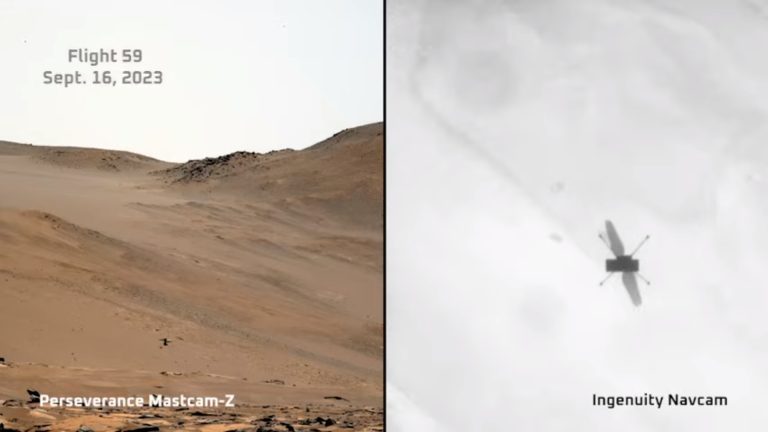
This video combines two perspectives of the 59th flight of NASA’s Ingenuity Mars Helicopter. Video on the left was captured by the Mastcam-Z on NASA’s Perseverance Mars rover; the black-and-white video on the right was taken by Ingenuity’s downward-pointing Navcam. The flight occurred Sept 16. Credit: NASA/JPL-Caltech/ASU/MSSS
For the first time in history, two planets have been home to testing future aircraft designs. On this world, a new rotor that could be used with next-generation Mars helicopters was recently tested at NASA’s Jet Propulsion Laboratory in Southern California, spinning at near-supersonic speeds (0.95 Mach). Meanwhile, the agency’s Ingenuity Mars Helicopter has achieved new altitude and airspeed records on the Red Planet in the name of experimental flight testing.
“Our next-generation Mars helicopter testing has literally had the best of both worlds,” said Teddy Tzanetos, Ingenuity’s project manager and manager for the Mars Sample Recovery Helicopters. “Here on Earth, you have all the instrumentation and hands-on immediacy you could hope for while testing new aircraft components. On Mars, you have the real off-world conditions you could never truly re-create here on Earth.” That includes a whisper-thin atmosphere and significantly less gravity than on Earth.
The next-generation carbon fiber rotor blades being tested on Earth are almost 4 inches (more than 10 centimeters) longer than Ingenuity’s, with greater strength and a different design. NASA thinks these blades could enable bigger, more capable Mars helicopters. The challenge is, as the blade tips approach supersonic speeds, vibration-causing turbulence can quickly get out of hand.
To find a space big enough to create a Martian atmosphere on Earth, engineers looked to JPL’s 25-foot wide, 85-foot-tall (8-meter-by-26-meter) space simulator – a place where Surveyor, Voyager, and Cassini got their first taste of space-like environments. For three weeks in September, a team monitored sensors, meters, and cameras as the blades endured run after run at ever-higher speeds and greater pitch angles.
A dual rotor system for the next generation of Mars helicopters is tested in the 25-Foot Space Simulator at NASA’s Jet Propulsion Laboratory on Sept.15. Longer and stronger than those used on the Ingenuity Mars Helicopter, the carbon-fiber blades reached near-supersonic speeds during testing. Credit: NASA/JPL-Caltech
“We spun our blades up to 3,500 rpm, which is 750 revolutions per minute faster than the Ingenuity blades have gone,” said Tyler Del Sesto, Sample Recovery Helicopter deputy test conductor at JPL. “These more efficient blades are now more than a hypothetical exercise. They are ready to fly.”
At around the same time, and about 100 million miles (161 million kilometers) away, Ingenuity was being commanded to try things the Mars Helicopter team never imagined they would get to do.
Fourth Rock Flight Testing
Ingenuity was originally slated to fly no more than five times. With its first flight entering the mission logbook more than two-and-a-half years ago, the helicopter has exceeded its planned 30-day mission by 32 times and has flown 66 times. Every time Ingenuity goes airborne, it covers new ground, offering a perspective no previous planetary mission could achieve. But lately, Team Ingenuity has been taking their solar-powered rotorcraft out for a spin like never before.
“Over the past nine months, we have doubled our max airspeed and altitude, increased our rate of vertical and horizontal acceleration, and even learned to land slower,” said Travis Brown, Ingenuity’s chief engineer at JPL. “The envelope expansion provides invaluable data that can be used by mission designers for future Mars helicopters.”
Limited by available energy and motor-temperature considerations, Ingenuity flights usually last around two to three minutes. Although the helicopter can cover more ground in a single flight by flying faster, flying too fast can confuse the onboard navigation system. The system uses a camera that recognizes rocks and other surface features as they move through its field of view. If those features whiz by too fast, the system can lose its way.
So, to achieve a higher maximum ground speed, the team sends commands for Ingenuity to fly at higher altitudes (instructions are sent to the helicopter before each flight), which keeps features in view longer. Flight 61 established a new altitude record of 78.7 feet (24 meters) as it checked out Martian wind patterns. With Flight 62 Ingenuity set a speed record of 22.3 mph (10 meters per second) – and scouted a location for the Perseverance rover’s science team.
The team has also been experimenting with Ingenuity’s landing speed. The helicopter was designed to contact the surface at a relatively brisk 2.2 mph (1 mps) so its onboard sensors could easily confirm touchdown and shut down the rotors before it could bounce back into the air. A helicopter that lands more slowly could be designed with lighter landing gear. So, on Flights 57, 58, and 59 they gave it a whirl, demonstrating Ingenuity could land at speeds 25% slower than the helicopter was originally designed to land at.
All this Martian Chuck Yeager-ing is not over. In December, after solar conjunction, Ingenuity is expected to perform two high-speed flights during which it will execute a special set of pitch-and-roll angles designed to measure its performance.
“The data will be extremely useful in fine-tuning our aero-mechanical models of how rotorcraft behave on Mars,” said Brown. “On Earth, such testing is usually performed in the first few flights. But that’s not where we’re flying. You have to be a little more careful when you’re operating that far away from the nearest repair shop, because you don’t get any do-overs.”
More About Ingenuity
Ingenuity began its life at Mars as a technology demonstration. It first flew on April 19, 2021, hovering 10 feet (3 meters) for 30 seconds. Four more flights in as many weeks added 499 seconds and saw the helicopter flying horizontally over the surface for 1,171 feet (357 meters). After proving flight was possible on Mars, Ingenuity entered an operations demonstration phase in May 2021 to show how aerial scouting could benefit future exploration of Mars and other worlds.
The Ingenuity Mars Helicopter was built by JPL, which also manages the project for NASA Headquarters. It is supported by NASA’s Science Mission Directorate. NASA’s Ames Research Center in California’s Silicon Valley and NASA’s Langley Research Center in Hampton, Virginia, provided significant flight performance analysis and technical assistance during Ingenuity’s development. AeroVironment Inc., Qualcomm, and SolAero also provided design assistance and major vehicle components. Lockheed Space designed and manufactured the Mars Helicopter Delivery System.
At NASA Headquarters, Dave Lavery is the program executive for the Ingenuity Mars Helicopter.
Leading global technology and business solutions provider will work with Amazon’s low Earth orbit (LEO) satellite broadband network to bring Japanese customers the flexibility, resiliency, and availability benefits of LEO communications technology
This is the first strategic collaboration Project Kuiper has announced in the Asia-Pacific region
November 27, 2023—LAS VEGAS—Today, Nippon Telegraph and Telephone Corporation (NTT), NTT DOCOMO, Inc. (NTT DOCOMO), NTT Communications Corporation (NTT Com), and SKY Perfect JSAT Corporation (SKY Perfect JSAT) announced they have formed a strategic collaboration with Project Kuiper, the low Earth orbit (LEO) satellite broadband network from Amazon (NASDAQ: AMZN), to bring advanced, reliable, and far-reaching satellite connectivity options to customers in Japan. The companies expect to use Project Kuiper LEO satellite connectivity services to enhance communications availability and resiliency for Japanese customers.
As part of this collaboration, NTT and SKY Perfect JSAT plan to distribute Project Kuiper connectivity services to enterprises and government organizations in Japan, while NTT Group companies become customers of Project Kuiper. The companies plan to use Project Kuiper to provide their customers with new connectivity options to build out resilient, redundant communications networks.
Although Japan is well served by terrestrial communications technology like fiber and wireless, the country’s mountainous terrain and many islands makes it challenging to restore connectivity in the event of natural disasters and other emergencies. Project Kuiper provides a rapid, scalable solution to that challenge. For instance, NTT DOCOMO, Japan’s leading mobile network provider, plans to use Project Kuiper to connect rural and hard to reach parts of Japan back to its core telecom network without the time and expense required to build out fiber and fixed wireless infrastructure.
As a result of this collaboration, Japanese businesses will be able to use Project Kuiper connectivity to support a broad range of applications, including internet of things, predictive maintenance, fleet management, remote manufacturing, and more. Customers will also be able to use Project Kuiper to connect to Amazon Web Services (AWS) to run advanced technologies such as machine learning and AI.
Moving forward, Project Kuiper, NTT, SKY Perfect JSAT, and the other companies will explore a broader range of collaborations related to seamless communication between Earth and space to help Japanese businesses innovate. The goal is to create new services to help customers make more sustainable use of their resources and give consumers improved options for healthcare, financial services, entertainment, and more.
“Improving connectivity infrastructure will become even more important in the future to help solve various issues facing society and to establish sustainable economic and social activities,” said Katsuhiko Kawazoe, senior executive vice president of NTT. “We look forward to accelerating innovation and achieving a future in which we deliver further value in cooperation with Project Kuiper, bringing together the respective technologies and resources of each company, such as NTT’s IOWN technology.”
“Our philosophy at NTT DOCOMO is to prioritize our customers and satisfy them with personalized communications solutions and unparalleled customer support, and Amazon’s Project Kuiper shares those priorities,” said Hozumi Tamura, executive vice president of NTT DOCOMO. “In Japan, where we are fortunate to offer such robust communications services, Project Kuiper can help us take customer satisfaction to a new level by providing even more options for powering innovation and helping our customers communicate wherever and whenever they like.”
“Japan has a long history of innovation and an insatiable demand for connectivity,” said Toru Fukuoka, representative director, senior executive vice president of SKY Perfect JSAT. “The existing partnership between SKY Perfect JSAT and NTT has brought Japanese businesses more opportunities to create and grow, and the addition of Project Kuiper into our family of services is a very exciting development that accelerates further business innovation and technical development in Japan.”
“NTT, SKY Perfect JSAT, Project Kuiper, and the NTT Group companies share the mission of keeping customers connected no matter what situations arise and helping them continue to innovate by harnessing data from virtually anywhere,” said Rajeev Badyal, vice president of technology and head of Project Kuiper. “NTT is a trusted communications services provider in Japan and an ideal partner for Project Kuiper as we prepare to offer reliable, secure LEO broadband services in the country.”
“AWS and NTT Group have a proven track record of innovating for our customers, and we’re excited to expand what is possible with Project Kuiper,” said Tadao Nagasaki, president of AWS Japan. “The introduction of Project Kuiper connectivity services will give our customers new options for connecting remote locations and using the world’s leading secure, resilient, and flexible cloud provider to transform their operations.”
Project Kuiper recently achieved a 100% success rate for its prototype satellite test mission, validating the key technologies that make up its satellites and network. Project Kuiper expects to begin beta testing connectivity services with select customers and partners in the second half of 2024. NTT and SKY Perfect JSAT plan to take part in that testing as part of this collaboration.
To learn more about working with Project Kuiper, visit http://amazon.com/projectkuiperenterprise.
About NTT
NTT contributes to a sustainable society through the power of innovation. We are a leading global technology company providing services to consumers and business as a mobile operator, infrastructure, networks, applications, and consulting provider. Our offerings include digital business consulting, managed application services, workplace and cloud solutions, data center and edge computing, all supported by our deep global industry expertise. We are over $95B in revenue and 330,000 employees, with $3.6B in annual R&D investments. Our operations span across 80+ countries and regions, allowing us to serve clients in over 190 of them. We serve over 75% of Fortune Global 100 companies, thousands of other enterprise and government clients and millions of consumers.
About NTT DOCOMO
NTT DOCOMO, Japan’s leading mobile operator with over 87 million subscriptions, is one of the world’s foremost contributors to 3G, 4G, and 5G mobile network technologies. Beyond core communications services, DOCOMO is challenging new frontiers in collaboration with a growing number of entities (“+d” partners), creating exciting and convenient value-added services that change the way people live and work. Under a medium-term plan toward 2020 and beyond, DOCOMO is pioneering a leading-edge 5G network to facilitate innovative services that will amaze and inspire customers beyond their expectations. https://www.docomo.ne.jp/english/
About SKY Perfect JSAT
SKY Perfect JSAT is Asia’s largest satellite operator with a fleet of 17 satellites, and Japan’s only provider of both Multi-channel Pay TV broadcasting and satellite communications services. SKY Perfect JSAT delivers a broad range of entertainment through the “SKY PerfecTV!” platform, the most extensive in Japan with over 2 million subscribers. SKY Perfect JSAT’s satellite communications services, which cover Asia, Indian Ocean, Middle East, Pacific Ocean and North America, play a vital role in supporting communications infrastructures for mobile backhaul, government, aviation, maritime, oil & gas and disaster recovery. For more information, visit our corporate website (https://www.skyperfectjsat.space/en) and Space Business website (https://www.skyperfectjsat.space/jsat/en/).
About Amazon
Amazon is guided by four principles: customer obsession rather than competitor focus, passion for invention, commitment to operational excellence, and long-term thinking. Amazon strives to be Earth’s Most Customer-Centric Company, Earth’s Best Employer, and Earth’s Safest Place to Work. Customer reviews, 1-Click shopping, personalized recommendations, Prime, Fulfillment by Amazon, AWS, Kindle Direct Publishing, Kindle, Career Choice, Fire tablets, Fire TV, Amazon Echo, Alexa, Just Walk Out technology, Amazon Studios, and The Climate Pledge are some of the things pioneered by Amazon. For more information, visit amazon.com/about and follow @AmazonNews.