As the Technology and Digital Director for an international concert tour, your role is pivotal in ensuring the seamless integration of technology and digital operations both on and off stage. Your responsibilities span across ensuring reliability, fostering innovation, and managing operations effectively while catering to the needs of the main celebrity, other performers, support crews, and fans.
1. Technological Framework And Adaptability.
1.1. Dynamic Tech Infrastructure.
1.1.1. Construct a flexible and robust technological framework capable of adapting to varying venue sites and technical capabilities across different countries.
1.1.2. Prioritise redundancy systems to mitigate technical failures.
1.2. Advanced Tech Solutions.
1.2.1. Incorporate advanced technology in audio, visual, and special effects to elevate performance impact.
1.2.2. Regularly update equipment to stay at the forefront of technological innovation.
1.3. Local Compatibility And Integration.
1.3.1. Ensure your tech stack is versatile enough to integrate seamlessly with local systems and standards.
2. Digital Strategy And Security.
2.1. Integrated Digital Experiences.
2.1.1. Create a unified digital platform for fans, offering engaging content, interactive features, and virtual participation.
2.1.2. Experiment with emerging technologies like AR/VR to provide unique fan experiences.
2.2. Digital Content Management.
2.2.1. Strategise for expansive digital reach through live streaming, social media engagement, and content marketing.
2.2.2. Uphold stringent cybersecurity measures to safeguard digital assets and user privacy.
3. Team Dynamics And Local Collaboration.
3.1. Unified Team Approach.
3.1.1. Efficiently manage a diverse team, balancing the core team's expertise with local tech crews' local knowledge.
3.1.2. Conduct thorough training sessions to align everyone with the tour's technological standards and goals.
3.2. Synergy With Local Authorities.
3.2.1. Liaise with local authorities for technological assistance and ensure adherence to regional tech-related laws.
4. Innovation And Custom Solutions.
4.1. Customised Tech Approaches.
4.1.1. Tailor tech and digital solutions to fit the specific requirements of each performance, considering factors like audience demographics and venue size.
4.1.2. Stay informed about tech trends and integrate novel solutions that enhance the concert experience.
5. Operational Excellence And Consistency.
5.1. Efficient Tech Operations.
5.1.1. Develop streamlined procedures for the assembly and disassembly of tech setups, ensuring swift transitions between tour locations.
5.1.2. Focus on consistent operational excellence to reduce setup times and enhance performance reliability.
5.2. Systematic Reliability Checks.
5.2.1. Conduct routine checks and simulations to ensure all technological systems function optimally in diverse environments.
6. Safety Standards And Regulatory Adherence.
6.1. Rigorous Safety Measures.
6.1.1. Implement and enforce strict safety protocols for all technological equipment to protect the crew, performers, and audience.
6.1.2. Regularly inspect equipment for compliance with safety standards.
6.2. Compliance With Global Standards.
6.2.1. Keep abreast of and comply with international technology regulations and standards, particularly in data and digital operations.
7. Audience Engagement And Accessibility.
7.1. Maximising Audience Interaction.
7.1.1. Use technology as a bridge to intensify audience interaction, both onsite and online.
7.1.2. Explore features like live social media feeds, interactive kiosks, or audience-driven show elements.
7.2. Inclusive Digital Access.
7.2.1. Ensure that digital platforms are accessible to all audience segments, including those with disabilities.
8. Performance Analysis And Adaptation.
8.1. Continuous Tech Monitoring.
8.1.1. Employ analytics and feedback mechanisms to gauge the effectiveness of your technological strategies.
8.1.2. Adapt and evolve strategies based on real-time audience and performance data.
8.2. Post-Tour Technological Assessment.
8.2.1. Conduct a detailed post-tour analysis to identify successes and areas for improvement in the tour's technological and digital execution.
9. Performance-Centric Technology And Systems Integration.
9.1. Stage And Performance Technology.
9.1.1. Implement advanced, programmable lighting systems and audio engineering software to create dynamic, immersive stage experiences. This includes LED screens, intelligent lighting, and high-fidelity sound systems.
9.1.2. Utilise automated systems for special effects, such as pyrotechnics and fireworks, ensuring they are synchronised with the performance for maximum impact.
9.2. Integration Of Operational Systems.
9.2.1. Oversee the integration of logistics and financial management systems across the tour. This includes supply chain management software, budgeting and accounting platforms, and inventory tracking systems.
9.2.2. Ensure these systems are interconnected for real-time data flow and decision-making, facilitating smooth operational transitions between tour locations.
9.3. Ticketing And Audience Management Systems.
9.3.1. Manage advanced ticketing platforms, incorporating features like digital ticketing, seat selection, and mobile entry. These systems should be capable of handling high traffic volumes and providing a seamless user experience.
9.3.2. Implement crowd management software to enhance audience safety and experience, including ingress and egress flow management, and emergency evacuation planning.
9.4. Facilities And Venue Management Technology.
9.4.1. Utilise facilities management software for venue operations, including maintenance scheduling, venue readiness tracking, and utilities management.
9.4.2. Ensure that the technology is adaptable to different venues and compliant with local regulations and infrastructure capabilities.
9.5. IT Infrastructure And Support.
9.5.1. Develop and maintain a robust IT infrastructure that supports all technology and digital operations. This includes server management, data storage solutions, and network systems ensuring high availability and security.
9.5.2. Provide ongoing IT support to address technical issues swiftly, minimising downtime and ensuring the continuous operation of all systems.
9.6. Collaborative Technology Environment.
9.6.1. Foster a collaborative environment where the technology team, production crew, and other stakeholders can work together seamlessly. Utilise collaborative tools and platforms for communication, project management, and information sharing.
9.6.2. Ensure that all team members are trained and familiar with the technology and systems in use, promoting efficient operation and quick problem resolution.
9.7. Innovation And Future-Proofing.
9.7.1. Keep abreast of emerging technologies and trends in stage production, logistics, and audience engagement. Explore opportunities to incorporate these innovations into the tour to stay ahead of the curve.
9.7.2. Plan for future scalability and upgrades of systems and technology, ensuring the tour remains at the forefront of technological advancement.
Incorporating these elements under the vast umbrella of the technology team underscores the critical role of technology in every aspect of an international concert tour. From enhancing the performance itself to ensuring smooth operational workflows and audience satisfaction, technology stands as the backbone of modern touring. As the Technology and Digital Director, orchestrating this complex interplay of systems and software, you're not just managing technology; you're crafting an unforgettable experience for everyone involved.
In this role, your strategic vision and ability to harness technology's power will be key in delivering a seamless and immersive concert experience that resonates with audiences worldwide. Emphasising innovation, adaptability, and meticulous planning will ensure the tour's technological aspects are not just functional but also groundbreaking.
Daniel Andrews, project manager for NASA’s Volatiles Investigating Polar Exploration Rover (VIPER) (left), stands next to a full-scale model of the rover alongside visitors from the Japan Aerospace Exploration Agency (JAXA): Dr. Hitoshi Kuninaka, Vice President of JAXA and Director General of JAXA’s Institute of Space and Astronautical Science (ISAS); Nobuhiro Takahashi of the ISAS Management and Integration Department; and Shintaro Chofuku, a JAXA engineer on detail to NASA’s Ames Research Center in California’s Silicon Valley (right), during a visit to Ames on Feb. 1, 2024.
Following briefings about both agencies’ space science and spaceflight missions, Kuninaka toured several Ames facilities supporting NASA and JAXA’s exploration of the solar system. The heat shield for JAXA’s Hayabusa2 mission, which delivered a sample of an asteroid to Earth in 2020, was tested in the center’s arc jet facility, and a portion of that sample is now being studied by Ames researchers. An upcoming JAXA mission to study the two moons of Mars, called Martian Moons eXploration (MMX), was also tested in the arc jet.
Present and future exploration of the Moon was a focus of the day, including a stop at Ames’ Lunar Imaging Lab following the VIPER briefing.
VIPER will be delivered to Mons Mouton near the Moon’s South Pole in late 2024 to map water and other potential resources and explore the characteristics of the lunar environment where NASA plans to send future astronauts as part of the Artemis campaign.
Last month, JAXA’s Smart Lander for Investigating Moon (SLIM) arrived on the lunar surface, after reaching its targeted landing site with great accuracy. The mission aimed to demonstrate accurate lunar landing techniques by a small explorer, to help accelerate study of the Moon and planets using lighter exploration systems.
Japan is a significant partner for NASA and for Ames, specifically,” said Center Director Eugene Tu. “From testing with our teams the X-59 quiet supersonic aircraft design to JAXA’s contributions to Artemis and Gateway, where astronauts on future lunar missions will stay, our work together runs broad and deep. We look forward to many more fruitful collaborations.”
Nobuhiro Takahashi of the Japan Aerospace Exploration Agency’s (JAXA) Institute of Space and Astronautical Science (ISAS) Management and Integration Department (left), Dr. Eugene Tu, center director at NASA’s Ames Research Center in California’s Silicon Valley, and Dr. Hitoshi Kuninaka, vice president of JAXA and director general of ISAS gather for a photo during the JAXA representatives’ visit to Ames on Feb. 1, 2024.
NASA/Don Richey
NASA astronaut and Artemis II commander Reid Wiseman exits the side of a mockup of the Orion spacecraft during a training exercise in the Neutral Buoyancy Lab at NASA’s Johnson Space Center in Houston Jan. 23, 2024. As part of training for their mission around the Moon next year the crew of four astronauts practiced the recovery procedures they will use when the splash down in the Pacific Ocean. Artemis II is the first crewed mission on NASA’s path to establishing a long-term presence at the Moon for scientific discovery and exploration through the Artemis campaign. The approximately 10-day flight will test NASA’s foundational human deep space exploration capabilities, the SLS (Space Launch System) rocket and Orion spacecraft, for the first time with astronauts.
More than 1 million apps will be available on Apple Vision Pro beginning Friday, February 2.
February 1, 2024
UPDATE
Apple announces more than 600 new apps built for Apple Vision Pro
All-new spatial apps built for Apple Vision Pro join more than 1 million compatible apps available on the App Store to deliver a wide array of breakthrough experiences
More than 600 apps and games designed to take advantage of the unique and powerful capabilities of Apple Vision Pro will be available this Friday, February 2. Vision Pro has an infinite canvas where apps can scale beyond the boundaries of a traditional display, and introduces an intuitive and powerful three-dimensional user interface that users navigate with their eyes, hands, and voice. Spatial experiences on Vision Pro can transform any room into a personal theater for sports, TV shows, and films; unlock new ways to collaborate, create, and view digital content; and transport users to stunning gameplay environments and exciting new places.
“Apple Vision Pro is unlocking the imaginations of our worldwide developer community, and we’re inspired by the range of spatial experiences they’ve created for this exciting new platform,” said Susan Prescott, Apple’s vice president of Worldwide Developer Relations. “With more than 600 new spatial experiences to explore in the all-new App Store, alongside more than 1 million compatible apps across iOS and iPadOS, users can discover a wide array of apps that expand the boundaries of what’s possible. These incredible apps will change how we experience entertainment, music, and games; spark our imaginations with new ways to learn and explore; unlock productivity like never before; and so much more. Developers are already capturing the promise of spatial computing, and we can’t wait to see what they create next.”
Enjoy the Best Seat in the House
Apple Vision Pro features ultra-high-resolution displays that deliver more pixels than a 4K TV for each eye, so users can watch their favorite content on a 100-foot screen. Sports fans will love the viewing experience on Vision Pro, with apps like PGA TOUR Vision, which uses real-time shot tracking layered on top of 3D models of real golf courses alongside key stats — including leaderboards, scorecards, schedules, course information, and other tournament details — to bring the tour to life in a user’s space.
“With Apple Vision Pro and the power of spatial computing, Apple is teeing us up to deliver an innovative and immersive way of experiencing professional golf,” said Scott Gutterman, PGA TOUR’s senior vice president of Digital Operations. “PGA TOUR Vision, the first golf app developed for Apple Vision Pro, takes fans inside the ropes and directly onto the greens of the world’s most iconic courses, from Pebble Beach to TPC Sawgrass, no matter where they are.”
With the NBA app on Apple Vision Pro, basketball fans can stream up to five broadcasts live or on demand with Multiview, keep an eye on real-time player and team stats, and effortlessly glance at other games and scores. MLB immerses users in a ballpark with a view from home plate and stats from each pitch. Red Bull TV displays 3D maps of races paired with high-quality video and immersive environments. And soccer fans can access MLS Season Pass on the Apple TV app,home of Major League Soccer. With compatible apps from top cable services — including Charter Spectrum, Comcast Xfinity, Cox Contour, Sling TV, and Verizon Fios — and sports broadcasters — including ESPN, CBS, Paramount+, NBC, NBC Sports, Peacock, FOX Sports, and the UFC — Vision Pro users always have the best seat in the house.
With the NBA app on Apple Vision Pro, basketball fans can stream up to five games live or on demand simultaneously, and easily rearrange games within their space.Fans can also access real-time team and player stats, see the status of other games, and toggle between broadcast and language options for every game — live or on demand.
View Extraordinary Immersive Entertainment
Alongside Disney+, top entertainment apps have taken advantage of the unique capabilities of Apple Vision Pro to offer all-new ways for viewers to view their favorite movies, shows, and more.1 IMAX delivers an awe-inspiring viewing experience for 2D and 3D content, featuring popular documentaries such as Deep Sky in IMAX’s expanded aspect ratio.
Warner Bros. Discovery’s Max features hit movies and series, fresh originals, family favorites, breaking news, and live sports, with select titles available in 4K and Spatial Audio with Dolby Atmos.2
“With the Max app for Apple Vision Pro, fans can transform their space using the Iron Throne Room environment for an immersive experience that brings viewers into the iconic Red Keep,” said Casey Bloys, Chairman and CEO of HBO and Max Content. “The intricate Targaryen-era adornments will make fans feel like they’re watching the programming available on Max in Westeros during the height of their reign.”
With the Max app on Apple Vision Pro, fans can transform their space into the Iron Throne Room while enjoying the HBO Original Series House of the Dragon and their favorite titles from the Max library.Max subscribers will enjoy more than 37,000 hours of iconic programming from the expansive Warner Bros. Discovery library on Vision Pro, including Barbie, True Detective: Night Country, and the upcoming final season of the HBO Original Series Curb Your Enthusiasm.
With the Apple TV app, users can also experience all Apple Originals from Apple TV+, more than 200 3D movies, and Apple Immersive Video, which puts viewers right inside the action with 180-degree, 8K 3D recordings captured with Spatial Audio. On Apple Music, listeners can download and stream more than 100 million songs ad-free with Spatial Audio featuring Dolby Atmos and Lossless Audio with ultra-low latency using AirPods Pro (2nd generation) with USB-C. While native apps deliver experiences that take full advantage of the capabilities of spatial computing, Apple Vision Pro users can also enjoy their favorite video and music streaming services in Safari, including the ability to open multiple windows, go full screen, listen with Spatial Audio, and launch an Environment for an entertainment experience unlike any other.
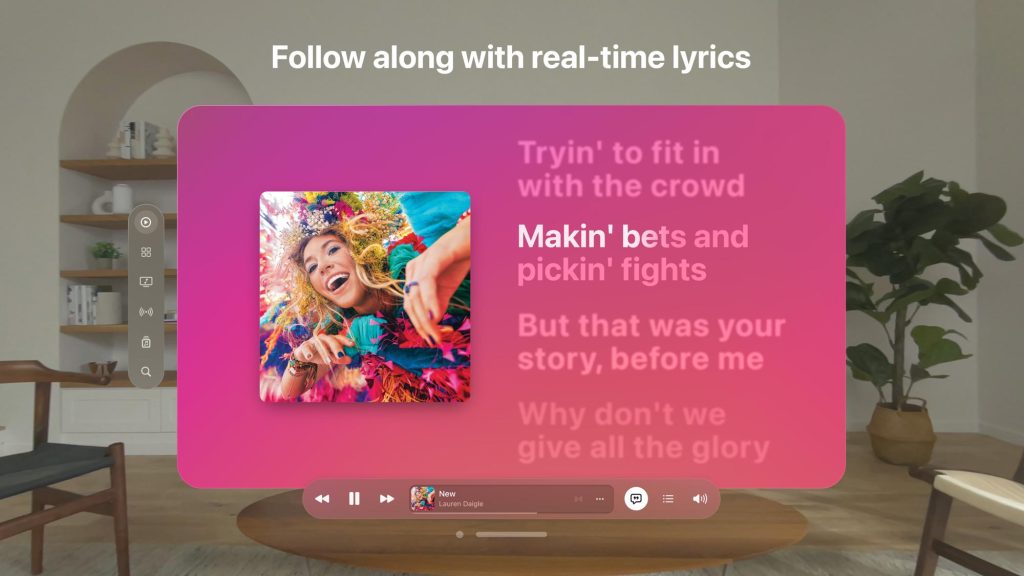
Vision Pro users can experience a curated selection of Apple Immersive Video series and films — including Adventure, Alicia Keys: Rehearsal Room, Prehistoric Planet Immersive, and Wild Life — on the Apple TV app at no additional cost.Using the Apple Music app, listeners can follow along to their favorite songs with real-time lyrics and place a small jukebox anywhere in their space with the MiniPlayer.
Work with Apps on an Infinite Canvas
Apple Vision Pro is an ideal productivity tool for everyday tasks. The three-dimensional user interface frees apps from the boundaries of a display so they can appear side by side at any scale, providing an infinite canvas for multitasking and collaboration. Vision Pro users can pair a Magic Keyboard and Magic Trackpad, or bring the powerful capabilities of Mac into Vision Pro with Mac Virtual Display to create the ultimate workspace.
Apps built specifically for visionOS, like Box, make it easy to collaborate and securely manage files and content, including 3D objects, while the MindNode app helps users brainstorm with thought bubbles that float around a user’s space. OmniFocus and OmniPlan use beautiful data and project management visualization in large windows to view a complete project plan. Microsoft 365 productivity apps, Fantastical, and Numerics make full use of the infinite canvas and sharp text rendering of Apple Vision Pro to make daily tasks effortless. JigSpace combines 3D content, audio, video, and text in interactive, step-by-step spatial presentations, and Navi translates conversations in real time, creating live captions so users can see exactly what people around them are saying.
Numerics helps enterprises keep tabs on their business with live widgets that support more than 4,000 KPIs and can be placed anywhere in a user’s space.
“Apple Vision Pro is a massive step change in technology, akin to iPhone and iPad,” said Aaron Levie, Box’s cofounder and CEO. “This breakthrough technology introduces immersive experiences that fundamentally redefine the way we work by delivering visually stunning interactions without physical limitations. From developing the next breakthrough product to reimagining customer experiences, the possibilities are endless.”
When collaborating with colleagues, users can join Webex, Zoom, and Microsoft Teams from Apple Vision Pro, creating the ultimate meeting experience with multiple windows and shared content that can fill the space around the user. Thousands of popular productivity apps are also compatible with Vision Pro at launch, like Slack, Notion, Todoist, and others that are an important part of everyday workflows.
Play Fun Games in All-New Ways
Apple Vision Pro delivers fun and rewarding gameplay for players of all skill levels. Players can dive into games on the App Store that transform the space around them, use an Environment for a more immersive experience, or play compatible games on a screen as large as they want. To support a wide variety of games and spatial experiences, Vision Pro works seamlessly with popular game controllers, including PlayStation DualSense and the Xbox Wireless Controller.
With Apple Arcade, players can access a catalog of more than 250 games on Apple Vision Pro, with no in-app purchases or ads, including hit titles like NBA 2K24 Arcade Edition, Sonic Dream Team,and TMNT Splintered Fate. Arcade players will also experience the world of spatial gaming with a fantastic selection of immersive titles created specifically for Vision Pro. These experiences take on a whole new dimension as players are transported to stunning gameplay environments in Synth Riders, twirl LEGO bricks with their fingers inLEGO Builder’s Journey, slice apples with their hands in Super Fruit Ninja, and so much more. Additional spatial games available with Apple Arcade at launch include Game Room,WHAT THE GOLF?, Cut the Rope 3,Jetpack Joyride 2, Bloons TD 6+, stitch., Patterned, Illustrated, and Wylde Flowers.
Numerics helps enterprises keep tabs on their business with live widgets that support more than 4,000 KPIs and can be placed anywhere in a user’s space.
“Innovation is in our DNA, so we were super excited to dive into this new technology and take the core gameplay of Jetpack Joyride and Fruit Ninja into new, immersive, and truly captivating experiences, leveraging the incredible technology of the Apple Vision Pro,” said Shainiel Deo, Halfbrick’s CEO. “We hope that players will be blown away by the world of Barry Steakfries in Jetpack Joyride 2, and by being able to transform their living room into their very own Dojo with Super Fruit Ninja.”
In addition to Apple Arcade, players can access spatial titles on the App Store that offer a variety of gameplay experiences. Loóna brings relaxing 3D dioramas to life, Blackbox spatial puzzles float in the physical world, and Void-X reinvigorates the fast-paced retro arcade shooter in a dark, pixel art-style cityscape, boasting immersive 3D effects and intuitive eye and hand gameplay. Skatrix Pro combines physics-driven skateboarding and a unique 3D hand gesture joystick for a competitive and immersive skating experience.
Players can access more games from the Mac App Store and apps like Steam using Mac Virtual Display — including popular titles like Lies of P and Baldur’s Gate 3 — and enjoy smooth and responsive gameplay with Game Mode enabled on Mac.
Explore New Places
Entirely new experiences designed for spatial computing help Apple Vision Pro users discover places in incredible ways. Hold the World transports users to London’s Natural History Museum with Sir David Attenborough to explore rare specimens from its world-famous collection, and The Archive takes users to a different place to explore immersive locations, artifacts, and spatial media from the beloved mythology of Star Trek’s Gene Roddenberry and other legendary creators. Apps like Voyager by ForeFlight give spatial context to the coordinated nature of air traffic control, creating the ultimate playground for aviation enthusiasts, and CARROT Weather uses 3D weather maps to deliver hilariously twisted forecasts.
Learn with Apps in Fun New Ways
Apple Vision Pro offers users an immersive, three-dimensional learning environment with apps like solAR, which brings the wonders of the solar system right to a user’s doorstep, or Sky Guide and Night Sky, which transport users into their own personal planetarium. Users can even explore the red planet through the eyes of one of the three NASA rovers currently on the surface with Exploring Mars. Insight Heart lets users understand the human heart like never before, while CellWalk takes users on a tour of life’s molecular machines to explore a whole bacteria cell, down to individual atoms. Complete HeartX demonstrates a fresh approach to connecting tailored 3D anatomy and physiology with diagnoses and treatments to better prepare students for the real-world pressures of treating patients.
Create New Music Experiences
Many popular apps have created unique experiences designed just for Apple Vision Pro, like djay, which allows users to mix their favorite music on two hyperrealistic 3D turntables. NowPlaying explores hidden stories behind music and enhances the listening experience, and video and audio streaming service STAGE+ allows users to get up close to the world’s greatest classical musicians like never before. Apps like Spool create amazing music videos with studio-quality visual effects and unique and immersive editing tools, while Animoog Galaxy lives alongside users in a physical space, infusing it with constantly evolving sounds and colors. AmazeVR Concerts brings users into the front row of high-quality concerts featuring live action footage of their favorite artists in stunningly rendered 3D VR environments. And with tappr.tv, users can discover new music, create choreography, and more.
Discover, Visualize, and Shop in All-New Ways
The powerful capabilities of Apple Vision Pro unlock highly immersive and dynamic shopping experiences like never before. J.CrewVirtual Closet andMytheresa: Luxury Experience arereimagining shopping with live consultations and new ways to share looks with friends on FaceTime. Decathlon helps shoppers view, choose, and buy products, and see them in 3D in their personal environment. Home improvement apps like Lowe’s Style Studio take advantage of spatial computing to let users design the perfect kitchen right before their eyes, and Wayfair Decorify helps them quickly and easily redesign their spaces. House hunters can use Zillow Immerse to get an up-close look inside select listings with virtual home tours and interactive 3D floor plans.
Stay in the Present Moment
With Apple Vision Pro, users can immerse themselves in private and calm spaces with apps that help them reflect, breathe, and focus. Mindfulness apps like Healium bring beautifully designed experiences to Vision Pro users, helping them relax and build resilience by creating stress-reducing memories of nature-based escapes. Lungy: Spaces guides users through interactive breathing exercises and sound-based, active meditation, while wellness app Odio brings users into their own personal sonic cocoon with spatial soundscapes that transport them to a realm of calm and tranquility. Endel creates a new audiovisual experience with immersive light and sound, perfect for Vision Pro.
With new apps launching all the time on the App Store, Apple Vision Pro users will be able to explore new spatial experiences that continue to excite.
With access to Hulu content for eligible Disney Bundle subscribers. A Disney+ subscription is required.
Max Ultimate Ad-Free plan required for 4K viewing and support for Spatial Audio with Dolby Atmos.
The benefits of clean air extend well beyond the environment; it is also key to human health.
Dirty skies continue to dominate headlines, with the annual death toll due to outdoor air pollution now at 8 million people worldwide.
Air pollution has well-documented adverse effects on health, but the issue of clean air often falls through the cracks of global negotiations.
The newly-launched Our Common Air global commission outlines four steps that will be key to to accelerate collective action for clean air.
There is no dearth of headlines on air pollution from Dubai to Delhi to DC. And every year they get starker. At COP28, the first ‘Health Day’ was ironically marked by the Dubai skyline being covered by smog, and the publication of the latest report giving us the annual death toll from outdoor air pollution which now stands at more than 8 million people worldwide each year.
There is mounting scientific evidence about the impact of pollution. According to the World Health Organization, there are more than 70,000 scientific papers which show that air pollution adversely affects our health.
For people who face these health implications – from persistent coughs to lung cancer to strokes to dementia – the crisis is clear. We urgently need clean air. But for the rest of us, when we can’t visibly see the pollution, it’s easy to forget these headlines, and it’s easy to let these big numbers wash over us.
Despite COP28 Health Day, this critical issue falls through the ‘cracks’ of international negotiations. Most of the sources of both the climate crisis and air pollution are similar – emissions. Yet dirty air does not get the concerted international efforts it needs for the issue to be addressed.
This is why at COP28 we launched Our Common Air, a global commission to accelerate collective action for clean air. We believe progress is contingent on four important steps, all underpinned by one key fact – that clean air is key to human development and economic growth.
1. Make the economic case for clean air
Cleaner air improves economic outcomes: it reduces health system costs, vastly improves productivity and has a disproportionate impact on certain sectors. To be specific, the global cost of health damages associated with exposure to air pollution costs an estimated $8.1 trillion, according to a World Bank report.
Further, we will lose 3.8 billion working days annually to air pollution by 2060 if solutions are not found or known actions are not taken. Not surprisingly, the effects of air pollution are disproportionately felt by low- and middle-income countries.
A report by Dalberg Advisors, in partnership with the Clean Air Fund, Blue Sky Analytics, and the Confederation of Indian Industry, showed that air pollution costs Indian businesses $95 billion annually.
Improvements in air quality ensure fewer working days are lost due to sickness, and mitigate the cognitive impairments that otherwise lead to poor performance in schools. It also increases crop yields and, hence, food security. Other benefits include higher efficiency from solar power infrastructure and increase in tourism revenues.
2. Reform and scale finance available for cleaning the air
The evidence is clear — financing clean air is an investment in development. But the recent State of Global Air Quality Funding report finds that only 1% of international development funding and 2% of international public climate finance tackle outdoor air pollution.
The funding that exists is not evenly distributed. African countries received only 5% of the funding available, despite having five of the top 10 most polluted countries in the world per head of population; 86% of the funding went to just five Asian countries.
Development funding on outdoor air quality only surpassed that for fossil fuel prolonging funding in 2021. Image: Poojil Tiwari/CEEW
Moreover, most of that support (92%) came as loans in already debt-ridden countries. Developing economies especially need accessible, de-risked, concessional funding to mitigate pollution at its source, but few receive it. And never at the scale needed. Investing in clean air is investing in climate action — it reduces emissions and improves economic outcomes, for both businesses and people.
Five Asian countries received 86% of the total outdoor air quality funding between 2017 and 2021. Image: Poojil Tiwari/CEEW
3. Create a network of institutions to arrive at solutions
The Our Common Air initiative aims to create a network of institutions, especially in the Global South, to develop the capacity for locally relevant micro- and macroeconomic analysis of air pollution and context-specific ways to tackle it. It will be designed as a solutions network for the benefit of policy-makers, businesses, citizens and civil society.
4. Monitor progress in a standardized manner
Behind the headlines and big numbers on air pollution, there is a need to ensure regular tracking and review in a manner that is standardized and comparable across geographies. Timely actions need accountability and monitoring.
For instance, a study by the Council on Energy, Environment and Water (CEEW) shows the importance of accurate forecasting of sources contributing to air pollution in New Delhi, so that responses are measured and timely. When policies rely on regular data collection, regulators and administrators can follow a science-driven plan to mitigate pollution rather than have to respond with patchwork reactions when smog descends across city skylines.
Clean air key to sustainable human development
Countries and negotiators finally understand the need to champion health at the same time as climate action, but the world needs a credible architecture to monitor responses, measure impacts, and accordingly design further solutions and additional resources to support geographies and jurisdictions seeking to combat air pollution.
In the face of soaring statistics and overlooked urgency, the reality of air pollution becomes strikingly personal. The crisis is undeniably present in every cough, especially in poorer communities.
It’s a stark reminder that clean air isn’t just a matter of well-being; it’s a linchpin for sustainable human development. The stakes are high, the toll is personal, the benefits are economy-wide and beyond borders — and the time to clear the air is now.
Dr Arunabha Ghosh is Founder-CEO of Council on Energy, Environment and Water (CEEW), and Ms Jane Burston is Founder and CEO of Clean Air Fund (CAF). They are co-convenors and Commissioners of Our Common Air, a global commission on air quality. They are also members of the Global Future Council on Clean Air. Views are personal.
Image: Unsplash/Chandan Chaurasia
By: Arunabha Ghosh (Chief Executive Officer, Council on Energy, Environment and Water (CEEW)) and Jane Burston (Chief Executive Officer, Clean Air Fund) Originally published at: World Economic Forum
While the industry is ready to assimilate DLT and digital assets into the financial ecosystem, it first needs help overcoming roadblocks to moving assets across blockchains and integrations to traditional systems.
The fever-pitch hype around distributed ledger technology is being replaced by more concrete efforts to integrate this technology into our financial systems.
Standards and controls will be essential in ensuring this technology’s integration is managed effectively.
Industry leaders DTCC, Clearstream and Euroclear have partnered to publish a white paper on the financial industry’s continued evolution in digital assets.
For a moment back in the mid-2010s, blockchain was being hailed as the future of financial markets. It was labeled generational and transformative due to its decentralized nature and potential applications across various industries, with the ability to solve an ever-growing list of operational challenges.
That level of hype was never realistic or sustainable. While there is no doubt that distributed ledger technology (DLT) still holds great promise to reimagine business models and processes, the blockchain journey has reached an inflection point after years of experimentation. Many companies have begun increasing rigor around investment and want to see a pay-off. They’re demanding a real strategy and strong business cases before approving funding for existing and new proofs of concept.
The good news is that, according to a recent study, nearly 40% of financial market participants are currently using some form of DLT or digital assets. These initiatives have begun to show that the technology can improve certain functions, such as securities issuance, trade settlement and data transparency. They have also demonstrated new investment opportunities and operating models as well as ways to enhance efficiencies and liquidity across trade flows and asset classes.
Fragmented innovation is stymying progress
However, too many financial institutions and service providers are exploring how to leverage the technologies individually or as islands of digital innovation. Across the capital markets involved, 74% of DLT projects involved fewer than six participants in 2023. It’s clear that what’s lacking is widespread, industry-wide collaboration. The siloed nature of these initiatives, implemented on different networks with different protocols for connectivity, communication and function, pose challenges to broad adoption and limits the ability to scale any DLT solution.
All of these obstacles can lead to inefficiencies, risks, high transaction costs and limited gains from trading. They also could lead to a new but disconnected puzzle of DLT silos that use multiple technologies and standards. In an ideal world, uniform standards would create an even playing field for new entrants into the financial system, maintain privacy and security and ensuring new systems are compatible with existing ones. Consistent standards would also help bridge the digital divide across jurisdictions that are excluded or have more costly access to cross-border systems.
While the industry is ready to assimilate DLT and digital assets into the financial ecosystem, it first needs help overcoming roadblocks to moving assets across blockchains and integrations to traditional systems. The financial markets work well today because we have developed standards for their design and operation. DTCC has been exploring DLT and digitization for many years, and has successfully tested DLT’s capabilities in several use cases. There is continued momentum in the sector, and DTCC itself has taken a number of steps to advance a robust infrastructure, standards, governance and the right architecture to ensure the safety and soundness of digital markets.
Recognizing the value of principles and standards to the efficient operation of markets, DTCC has developed an initial set of control principles to help ensure the emerging tokenized securities market is as efficient, incorporates customer protections and is as safe and sound as today’s securities marketplace. These principles aim to reduce risk through defining roles, responsibilities, risks and offsetting controls.
How the financial industry is partnering to move forward
This past September, DTCC partnered with Clearstream and Euroclear to publish a white paper on the industry’s continued evolution in digital assets. The report called out the need for greater industry collaboration to overcome the roadblocks impeding the progress of digital assets and counteracting the efficiencies achieved through DLT. The three firms have pledged to collaborate with the industry to drive scale and harmonize standards across processes, platforms and jurisdictions.
An example of such industry-wide collaboration is a recent experiment conducted by SWIFT in which banks and market infrastructures participated to test the transfer of simulated tokenized assets. The results showed that SWIFT’s existing infrastructure can provide a secure, scalable way for financial institutions to connect to multiple types of blockchains. The industry must continue to work together like this to build the optimal architecture and market structure to incorporate DLT and digital assets into the ecosystem and best meet participants’ needs.
Fostering industry-wide collaboration
DTCC has taken further steps to advance digital assets. Most notable is its recent acquisition of Securrency, a developer of institutional-grade, digital asset infrastructure. This will enable DTCC to continue driving institutional adoption of blockchain technology, enabling real time processing and post-trade settlement, and will position DTCC to connect global liquidity pools.
These new capabilities will also be a key enabler to fostering industry-wide collaboration to promote acceptance and adoption of digital assets. By acting as a DLT-agnostic harmonization layer, the platform will connect disparate blockchains and promote liquidity, transparency and security. Financial firms will be able to use it to transform and evolve their operating models and create new digital asset services alone or in collaboration with other market participants. DTCC’s investment in Fnality, a provider of DLT-based wholesale payment systems, will help foster the development of new rails that will be essential for the emergence of a robust digital infrastructure.
As the worlds of TradFi and DeFi converge, DTCC is committed to continuing to partner with the industry through efforts such as these to help introduce the standards and governance needed to drive ecosystem growth while ensuring the highest levels of market safety and stability. The collective impact of these initiatives will help establish a robust digital infrastructure for the industry in a responsible manner to deliver on the compelling opportunities presented by digital assets.
By: Frank La Salla (President, CEO & Director, DTCC) Originally published at: World Economic Forum
The findings suggest our galaxy’s core may contain less dark matter than previously estimated.
Jennifer Chu | MIT News (https://news.mit.edu/2024/study-stars-travel-more-slowly-milky-ways-edge-0126)
A study by MIT physicists suggest the Milky Way’s gravitational core may be lighter in mass, and contain less dark matter, than previously thought.
Credits:Credit: ESA/Gaia/DPAC, Edited by MIT News
By clocking the speed of stars throughout the Milky Way galaxy, MIT physicists have found that stars further out in the galactic disk are traveling more slowly than expected compared to stars that are closer to the galaxy’s center. The findings raise a surprising possibility: The Milky Way’s gravitational core may be lighter in mass, and contain less dark matter, than previously thought.
The new results are based on the team’s analysis of data taken by the Gaia and APOGEE instruments. Gaia is an orbiting space telescope that tracks the precise location, distance, and motion of more than 1 billion stars throughout the Milky Way galaxy, while APOGEE is a ground-based survey. The physicists analyzed Gaia’s measurements of more than 33,000 stars, including some of the farthest stars in the galaxy, and determined each star’s “circular velocity,” or how fast a star is circling in the galactic disk, given the star’s distance from the galaxy’s center.
The scientists plotted each star’s velocity against its distance to generate a rotation curve — a standard graph in astronomy that represents how fast matter rotates at a given distance from the center of a galaxy. The shape of this curve can give scientists an idea of how much visible and dark matter is distributed throughout a galaxy.
“What we were really surprised to see was that this curve remained flat, flat, flat out to a certain distance, and then it started tanking,” says Lina Necib, assistant professor of physics at MIT. “This means the outer stars are rotating a little slower than expected, which is a very surprising result.”
The team translated the new rotation curve into a distribution of dark matter that could explain the outer stars’ slow-down, and found the resulting map produced a lighter galactic core than expected. That is, the center of the Milky Way may be less dense, with less dark matter, than scientists have thought.
“This puts this result in tension with other measurements,” Necib says. “There is something fishy going on somewhere, and it’s really exciting to figure out where that is, to really have a coherent picture of the Milky Way.”
The team reports its results this month in the Monthly Notices of the Royal Society Journal. The study’s MIT co-authors, including Necib, are first author Xiaowei Ou, Anna-Christina Eilers, and Anna Frebel.
“In the nothingness”
Like most galaxies in the universe, the Milky Way spins like water in a whirlpool, and its rotation is driven, in part, by all the matter that swirls within its disk. In the 1970s, astronomer Vera Rubin was the first to observe that galaxies rotate in ways that cannot be driven purely by visible matter. She and her colleagues measured the circular velocity of stars and found that the resulting rotation curves were surprisingly flat. That is, the velocity of stars remained the same throughout a galaxy, rather than dropping off with distance. They concluded that some other type of invisible matter must be acting on distant stars to give them an added push.
Rubin’s work in rotation curves was one of the first strong pieces of evidence for the existence of dark matter — an invisible, unknown entity that is estimated to outweigh all the stars and other visible matter in the universe.
Since then, astronomers have observed similar flat curves in far-off galaxies, further supporting dark matter’s presence. Only recently have astronomers attempted to chart the rotation curve in our own galaxy with stars.
“It turns out it’s harder to measure a rotation curve when you’re sitting inside a galaxy,” Ou notes.
In 2019, Anna-Christina Eilers, assistant professor of physics at MIT, worked to chart the Milky Way’s rotation curve, using an earlier batch of data released by the Gaia satellite. That data release included stars as far out as 25 kiloparsecs, or about 81,000 light years, from the galaxy’s center.
Based on these data, Eilers observed that the Milky Way’s rotation curve appeared to be flat, albeit with mild decline, similar to other far-off galaxies, and by inference, the galaxy likely bore a high density of dark matter at its core. But this view now shifted, as the telescope released a new batch of data, this time including stars as far out as 30 kiloparsecs — almost 100,000 light years from the galaxy’s core.
“At these distances, we’re right at the edge of the galaxy where stars start to peter out,” Frebel says. “No one had explored how matter moves around in this outer galaxy, where we’re really in the nothingness.”
Weird tension
Frebel, Necib, Ou, and Eilers jumped on Gaia’s new data, looking to expand on Eilers’ initial rotation curve. To refine their analysis, the team complemented Gaia’s data with measurements by APOGEE — the Apache Point Observatory Galactic Evolution Experiment, which measures extremely detailed properties of more than 700,000 stars in the Milky Way, such as their brightness, temperature, and elemental composition.
“We feed all this information into an algorithm to try to learn connections that can then give us better estimates of a star’s distance,” Ou explains. “That’s how we can push out to farther distances.”
The team established the precise distances for more than 33,000 stars and used these measurements to generate a three-dimensional map of the stars scattered across the Milky Way out to about 30 kiloparsecs. They then incorporated this map into a model of circular velocity, to simulate how fast any one star must be traveling, given the distribution of all the other stars in the galaxy. They then plotted each star’s velocity and distance on a chart to produce an updated rotation curve of the Milky Way.
“That’s where the weirdness came in,” Necib says.
Instead of seeing a mild decline like previous rotation curves, the team observed that the new curve dipped more strongly than expected at the outer end. This unexpected downturn suggests that while stars may travel just as fast out to a certain distance, they suddenly slow down at the farthest distances. Stars at the outskirts appear to travel more slowly than expected.
When the team translated this rotation curve to the amount of dark matter that must exist throughout the galaxy, they found that the Milky Way’s core may contain less dark matter than previously estimated.
“This result is in tension with other measurements,” Necib says. “Really understanding this result will have deep repercussions. This might lead to more hidden masses just beyond the edge of the galactic disk, or a reconsideration of the state of equilibrium of our galaxy. We seek to find these answers in upcoming work, using high resolution simulations of Milky Way-like galaxies.”
This research was funded, in part, by the National Science Foundation.
Reprinted with permission of MIT News (http://news.mit.edu/)
Managing AI quality enables industrial organizations to increase their productivity and sustainability.
Image: iStockphoto.
AI is expected to transform manufacturing and supply chains, making it critical for businesses to stay competitive.
Concerns about security, data protection, and regulatory uncertainties present serious challenges to AI adoption.
Managing the quality of AI systems offers a systematic approach to evaluating risks and determining whether an AI system satisfies key requirements throughout its life cycle.
Artificial intelligence (AI) has emerged as the cornerstone of a reimagined manufacturing landscape, with 89% of executives across industries regarding AI as essential to achieve their growth objectives and aiming to implement it in their operations. Yet, concerns about security, data protection, regulatory compliance or performance issues present serious challenges to AI adoption in manufacturing and supply chains. AI also comes with intrinsic risks that may be exacerbated if not carefully considered. The lack of standardised processes to qualify AI products and assess risks when integrating and operating AI solutions results in a complex and often unclear path.
Effectively managing the quality of AI systems enables industrial organizations to overcome these challenges and harness the full potential of AI for greater productivity, flexibility, sustainability and workforce engagement while mitigating the associated risks.
What is AI quality and why is it important?
Quality has always been a key aspect of industrial operations. Quality assurance, essential in every stage of a manufactured product’s life cycle, parallels AI quality, which is a systematic approach to evaluating the degree to which an AI system meets specific requirements throughout its life cycle.
In assessing the quality of an AI system, six critical pillars are considered:
Safety: focusing on potential harm to people or property.
Security: evaluating cybersecurity risks and AI-specific threats.
Legal: ensuring compliance with regulations and contractual obligations.
Ethics: aligning the system with the company’s values and ethical principles affecting stakeholders.
Performance: confirming the system’s effectiveness and accuracy.
Sustainability: examining whether its development and operations have been conducted with environmental considerations.
Collectively, these elements determine the AI system’s overall suitability and impact.
Six AI quality pillars to be considered throughout the AI system life cycle and data life cycle, taking sector specific requirements, industry best practices, and all applicable standards and regulations into account. Image: TÜV SÜD
AI quality in manufacturing: where do we currently stand?
To understand the most common quality gaps when implementing AI in manufacturing, and collectively identifying solutions to address them for long-term successful, responsible, and sustainable outcomes, the World Economic Forum, in collaboration with TÜV SÜD, conducted an in-depth analysis of AI quality as part of the AI-Powered Industrial Operations Initiative. TÜV SÜD’s AI quality framework was leveraged to conduct an “AI Quality Readiness Analysis” – consisting of a risk analysis and a maturity profiling – for five manufacturing use cases. After identifying the relevant quality pillars, 60 risk characteristics were analysed, out of which 21 were highlighted based on their frequency of occurrence and maximum level of risk observed.
Over 60 risk characteristics were analysed for each of the 5 use cases. 21 points of interest were highlighted based on frequency of occurrence and maximum level of risk. Image: TÜV SÜD
The assessments revealed that the highest percentage of risks were in the performance and security pillars. Risk criteria such as functional suitability, maintainability, and confidentiality were highlighted. Each risk characteristic represents a quality consideration that – if not met – introduces risk in the application of the AI system. For instance, ensuring functional suitability is paramount to guaranteeing that AI systems meet their intended objectives and perform effectively within their designated contexts. This is not only key for achieving reliable and accurate outcomes, but also for avoiding unintended consequences and maintaining user trust.
The security pillar reported comparatively higher levels of risk due to the sensitivity of the data processed by some of the assessed use cases. However, residual risks across all pillars were found to be generally well-managed, with effective risk mitigation strategies – such as robust security measures, proactive monitoring, and a culture of security awareness – bringing the maximum risk down to an acceptable level.
18 maturity dimensions were assessed, revealing gaps in 12 dimensions. Image: TÜV SÜD
The aggregated results of the maturity profiling indicate well-managed organizational maturity across the assessed use cases. High maturity levels were reported in dimensions such as compliance and strategy, as well as in cybersecurity, with organizations implementing robust policies and processes for managing AI-related cybersecurity threats.
Some maturity gaps were identified in the oversight and process management dimensions. Organizations displayed a tendency to overlook certain aspects of the AI life cycle, particularly in outlining a robust decommissioning plan. Testing approaches did not always account for AI-specific risks, such as adversarial attacks. While several testing tools were adopted across the assessed use cases, these tools were not always systematically employed. Adopting a structured approach towards testing and controls is necessary for ensuring the overall reliability and robustness of AI applications and minimising the impact of any AI failures.
Consultation with our broader community of industry and technology experts led to the elicitation of best practice solutions to address the identified maturity gaps. Key considerations include upskilling talent through training and development programmes, aligning business strategy with technical products, and implementing a robust failure management system.
The community also highlighted the importance of viewing AI quality as a continuous process rather than a one-off assessment. Routine evaluations of AI systems, their associated risks and risk mitigation strategies, as well as ongoing documentation and updates, are essential to ensuring the quality of AI systems and are to be operationalised as part of a robust quality management system.
The way forward
To successfully capture the full potential from AI in manufacturing in driving productivity, agility, sustainability and workforce augmentation, and achieve long-lasting results, it is essential for organizations to recognise that AI solutions, distinct from conventional automation systems, come with their own set of inherent risks that require systematic management.
A robust approach for identifying and evaluating these risks in the development and deployment of AI systems enables manufacturers to effectively integrate AI into their industrial processes, for a smooth and efficient implementation and operation. This not only facilitates AI adoption and compliance with regulations but also cultivates trust in AI technology. Furthermore, ongoing assessment and adaptation helps organizations remain agile and responsive to new opportunities and challenges in this rapidly evolving field.
With a holistic AI quality strategy, AI’s transformative potential can be responsibly and effectively leveraged, unlocking the next wave of value for businesses, workers, society, and the environment.
By: Kyriakos Triantafyllidis (Head of Growth and Strategy, Centre for Advanced Manufacturing and Supply Chains, World Economic Forum) and Andreas Hauser (CEO Digital Service, TÜV SÜD) Originally published at: World Economic Forum
Artificial intelligence (AI) can help healthcare systems worldwide cope with increasing stress and avoid waste in healthcare spending due to diminishing capacity.
AI in healthcare still faces challenges, particularly in low- and middle-income countries, such as unreliable results and inappropriate application in the local context.
Consistency in approach is key to the effective use of AI in healthcare, including robust data protection, guiding principles, accountability, open-source software and an accessible testing space.
Our populations’ future health will dramatically change in high-, middle- and low-income countries.
Impacts on healthcare from a rapidly changing climate, declining quality of air and water, conflicts and population displacement will coincide with longer-running trends in ageing populations and a shift in the burden of disease from infectious diseases to non-communicable, mostly chronic diseases in lower and middle-income countries where healthcare provision is least developed and most fragile.
These powerful drivers increase the pressure on already stressed healthcare systems, where, on average, 61% of healthcare professionals in the United States and Europe reported understaffing due to resignation and burnout at the beginning of 2023. Likewise, the workforce shortage in low- and middle-income countries is exacerbated by the lack of resources to train and retain medical professionals.
This capacity problem has led to many preventable lapses in spend and care. In the United States alone, avoidable waste in healthcare is estimated to cost around $850 billion or 25% of healthcare spending.
Better disease monitoring, procurement, compliance, diagnosis and fewer errors or negligence could all yield savings – and that is where technology can make a difference.
Sources of avoidable costs due to a lack of healthcare capacity. Image: IQVIA
Prescribing AI to mend healthcare
To date, healthcare’s use of artificial intelligence (AI) has proven transformative in narrow domains, such as digital pathology with recognizing lesions, for instance, on medical images, and research and development, mainly when modelling protein folds. However, embracing system-wide adoption of AI has, up to this point, been elusive.
Nonetheless, with the right leadership, careful future-focused regulation and strategic investment, advancements in AI may significantly increase care capacity in the medium term. These tools will not replace doctors in the foreseeable future but will support and augment decisions made by healthcare professionals. By reducing the potential for human mistakes, AI can help avoid medical errors, reduce inefficiency, and save lives. Put simply, AI-enhanced systems can potentially increase productivity and availability of healthcare.
A future patient journey might use AI through various stages – from accessing a health app to diagnostics, treatment and remote patient monitoring – automatic monitoring and triage have demonstrated potential at the beginning of a patient’s journey, which could follow through treatment and post-discharge care.
An AI-enabled patient journey. Image: IQVIA
Strategic, bold adoption of AI could expand access to healthcare in low- and middle-income countries and simultaneously directly address the technology gap between them and high-income countries. The combination of fewer legacy systems and the high availability of mobile devices in low- and middle-income countries brings opportunities to leapfrog to mobile AI platforms for improved and effective population engagement. There are still barriers to address, however.
Some reported challenges that have stopped more AI in healthcare in low- and middle-income countries are low reliability, mixed impacts on workflows, poor usability and a lack of understanding of local context.
In a global setting, the promise of rapid change alone will be insufficient to drive systematic adoption of AI in healthcare without a combination of trust, privacy and regulatory guardrails with education that healthcare providers and policymakers can understand to apply AI appropriately.
Current generative AI models are prone to unpredictability, with little understanding of how to produce reliable outputs. Future development of AI algorithms will train on and handle vast amounts of sensitive patient data, an enormous responsibility given the potential risks if data is mismanaged.
Do no harm
Global pharmaceutical and healthcare regulation has resulted from decades of painstaking evolution and optimization. However, even the best-funded regulatory systems have historically struggled to keep up with the innovation they regulate, as shown by the lag in introducing biosimilars in the United States or regulations on medicine promotion on social media. The pace and scope of AI development are much faster and larger than regulators have had to address. To prevent misuse, guiding principles for building safe AI tools must be agreed upon – a Hippocratic Oath for AI.
During Davos 24, this year’s Annual Meeting in Davos, Switzerland, world leaders must find rapid consensus and focus on building on the 30 points in their 2023 report, The Presidio Recommendations on Responsible Generative AI, to provide healthcare-specific recommendations. Flexible and adaptive guiding principles should foster innovation while ensuring safety, enable human governance at every step of the AI solution’s lifecycle and even account for a future where AI is given increasing independence.
First steps are being taken to codify regulations: the EU AI Act, the US Executive Order on Safe, Trustworthy AI, and the world’s first AI Safety Summit in Bletchley Park, but more should be done to extend these safeguards to low- and middle-income countries and encourage innovation in these countries where the need for care is already beyond capacity.
A unified regulatory landscape, adopted across multiple low- and middle-income countries, for example, through a Pan-African approach, will allow AI-enhanced healthcare to be built from the ground up, ensuring developers can follow a framework inducing a culture of safety, transparency and accountability.
With caution and consensus across stakeholders, AI can realize its significant potential in alleviating capacity constraints. However, the urgency to agree on a shared path cannot be overstated with five steps leaders in the field should follow:
Build rapid consensus on guiding principles that can be applied faster than formal regulations. High-profile organizations like the World Economic Forum are ideal places for leaders to form agreements.
Comply with the highest data protection regulations. Healthcare data is being used in new ways, so rigour in protecting patient data will minimize risks and build trust.
Promote the value of safety, transparency and accountability. Ensure that accelerators, innovation hubs and venture capitalists follow these principles, as they are likely to lay these foundations from the ground up for startups that show the ability to scale.
Bridge new technologies to low- and middle-income countries. Use open-source software where possible and build offerings with scale and affordability in mind so developing economies can take advantage of emerging technologies.
Run programmes to introduce AI into clinical practice. Create safe environments in hospitals to test AI tools that have a clear link to increasing capacity.
These steps will begin to foster a culture where the safe development of AI can occur without comprehensive regulations. With the right approach, trust can be built to test these tools in a clinical sandbox and ultimately reduce healthcare providers’ workload in high, low and middle-income countries to begin laying the foundations to bridge the healthcare capacity gap.
Image credits: IQVIA
By: Aurelio Arias (Director, Thought Leadership, IQVIA) and Sarah Rickwood (Vice President, Thought Leadership, IQVIA) Originally published at: World Economic Forum
The Netherlands is working to protect its climate-vulnerable neighbourhoods
The Netherlands is one of the most vulnerable countries in the world to flood risk, with around 60% of its population and its economy located below sea level.
A granular neighbourhood-level assessment of climate risks for households is crucial to find out where risks are most urgent.
ABN AMRO proposes multiple solutions to identify and deal with climate risks to households.
It is not the disaster of large floods, but the stacking of smaller damage from climate change that will likely become too much for homeowners in climate-vulnerable neighbourhoods.
With climate change threatening our long-term existence, news stories on the implications of dramatic flooding get a lot of attention. Our ABN AMRO study finds, however, that it is not high-impact events that are likely to hurt people and communities but rather the co-occurrence of small-impact, high-probability events, especially if they happen in neighbourhoods that are also financially less resilient.
Global flood risk maps are often based on the height of land relative to sea level. On such maps, the Netherlands is typically portrayed as the most vulnerable country in the world to flood risk; around 60% of the population and its economy are located below (or far below) sea level.
Image: CBS, Klimaateffectatlas, LIWO, ABN AMRO Group Economics
Instead, a troubling issue is the combination of heavy rainfall, rotting foundations and the cost of refurbishing homes to achieve energy neutrality. We have identified 900 neighbourhoods (of a total of 3,000 neighbourhoods in the Netherlands) where households face one of these three costly climate and/or policy risks and are unlikely to be able to cover these costs. In 90 of these neighbourhoods, homeowners face multiple costly climate risks. We have identified these neighbourhoods and proposed concrete solutions for governments, banks and other stakeholders to prevent unaffordable damage for homeowners in these areas.
Percentage of buy-to-own properties per neighbourhood for 1. Minimum of two risks, 2. Transition risk, 3. Foundation risk, 4. Flooding risk Image: CBS, Klimaateffectatlas, LIWO, ABN AMRO Group Economics
As the map shows, climate-vulnerable neighbourhoods are mainly located in the country’s periphery. Here, subsidence and/or the high costs of refurbishing to energy neutrality create the most urgency, while properties are of below-average value and homeowners have below-average income. The repair costs are high for both risks. Repairing foundations costs around €60,000 to €100,000 per household, and refurbishing a low energy efficiency home to be energy efficient costs around €35,000 per homeowner.
For low-value properties (up to €300,000), these costs may not be worth the investment and homeowners with below-average income (less than €30,000) may not be able to get a loan for the repairs. While these costly measures for climate adaptation and mitigation can be disastrous for an individual homeowner, the likelihood of a macroeconomic shock arising from these phenomena is small. We estimate that between 2 and 25% of financially vulnerable homeowners face at least one of these climate and/or policy hurdles. However, regions where these issues concentrate are at risk of economic shocks, as second-round effects may spill over to citizens who were not directly affected. Here, the government and other stakeholders need to provide liquidity aid. We propose the following solutions to identify and deal with climate risks to households:
1. Identify climate-vulnerable neighbourhoods
As policymakers need to prioritize their attention, the first thing to do is identify where households are most vulnerable. Stacking climate risk maps with economic risk maps makes the neighbourhoods that require the most attention visible.
2. Adjust values to ‘climate risk corrected’ values
The first painful measure that needs to be taken ensures homes are priced at their actual – climate risk corrected – value. Currently, this is not the case for physical climate risks, implying that the burden of future adaptation costs will be borne solely by home buyers and not sellers. Clear communication between buyers and sellers on the risks will create a price deduction that enables buyers to finance recovery. Communication based on granular risk maps will also prevent unjustified risk premiums on properties that are in non-risky areas.
“We have invested a lot in this research and we are already seeing that many municipalities and homeowners are requesting the details of their neighbourhood from us,” says ABN AMRO CEO Robert Swaak. “With that, we start the process of making the risks part of the knowledge of the buyer and seller. And by doing this, we are also contributing to economic and societal stability, in line with our purpose.”
3. Prevent vulnerable households from moving to risk-prone neighbourhoods
Once prices have adjusted to reflect climate risks, there will be neighbourhoods where houses become more affordable than before. Home buyers may perceive this price deduction as an opportunity to move to these regions, not realizing the potentially high adaptation costs in the near future. Here, mortgage providers have a duty of care to prevent financially vulnerable households from moving to climate-risky neighbourhoods by taking the financing of future adaptation costs into account.
4. Prevent financial lock-in when multiple risks occur
In neighbourhoods where both foundation repairs and energy investments are needed, homeowners could end up locked in financially if they invest their savings in energy efficiency but are not able to restore their foundations. In this case, low-value properties, in particular, may end up as stranded assets as homeowners go bankrupt. In neighbourhoods where these multiple issues are at play, solutions that simultaneously take care of both issues should be considered. New foundations that include geothermal heating could be a solution, as this single investment both increases energy efficiency and protects against value loss from subsidence.
5. Provide public funds for most vulnerable neighbourhoods
Our study found 19 neighbourhoods where multiple risks occur, homeowners are financially vulnerable, and more than 60% of properties are owner-occupied. In these neighbourhoods, regional impacts may spill over to non-impacted homeowners and the government, therefore, needs to step in with a social repair fund to tackle these issues holistically.
By: Sandra Phlippen (Chief Economist, ABN AMRO) and Bram Vendel (Economist and data scientist, ABN AMRO) Originally publshed at: World Economic Forum