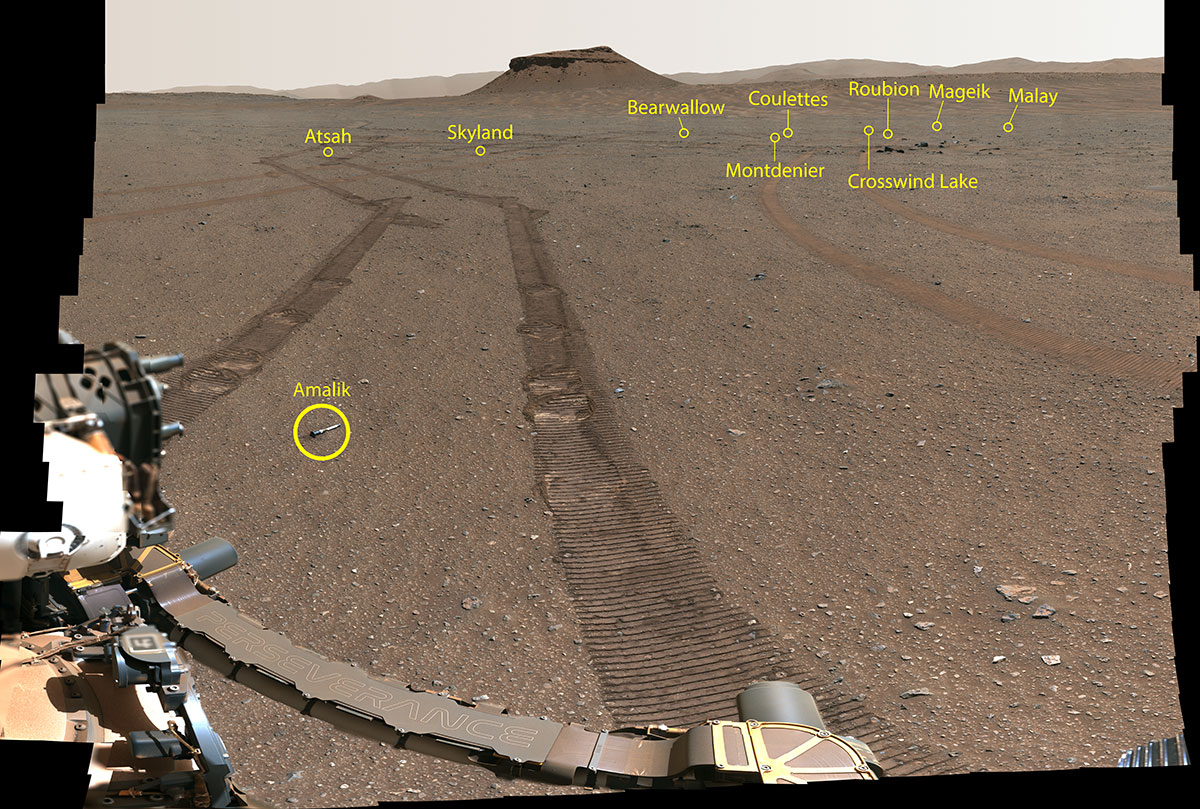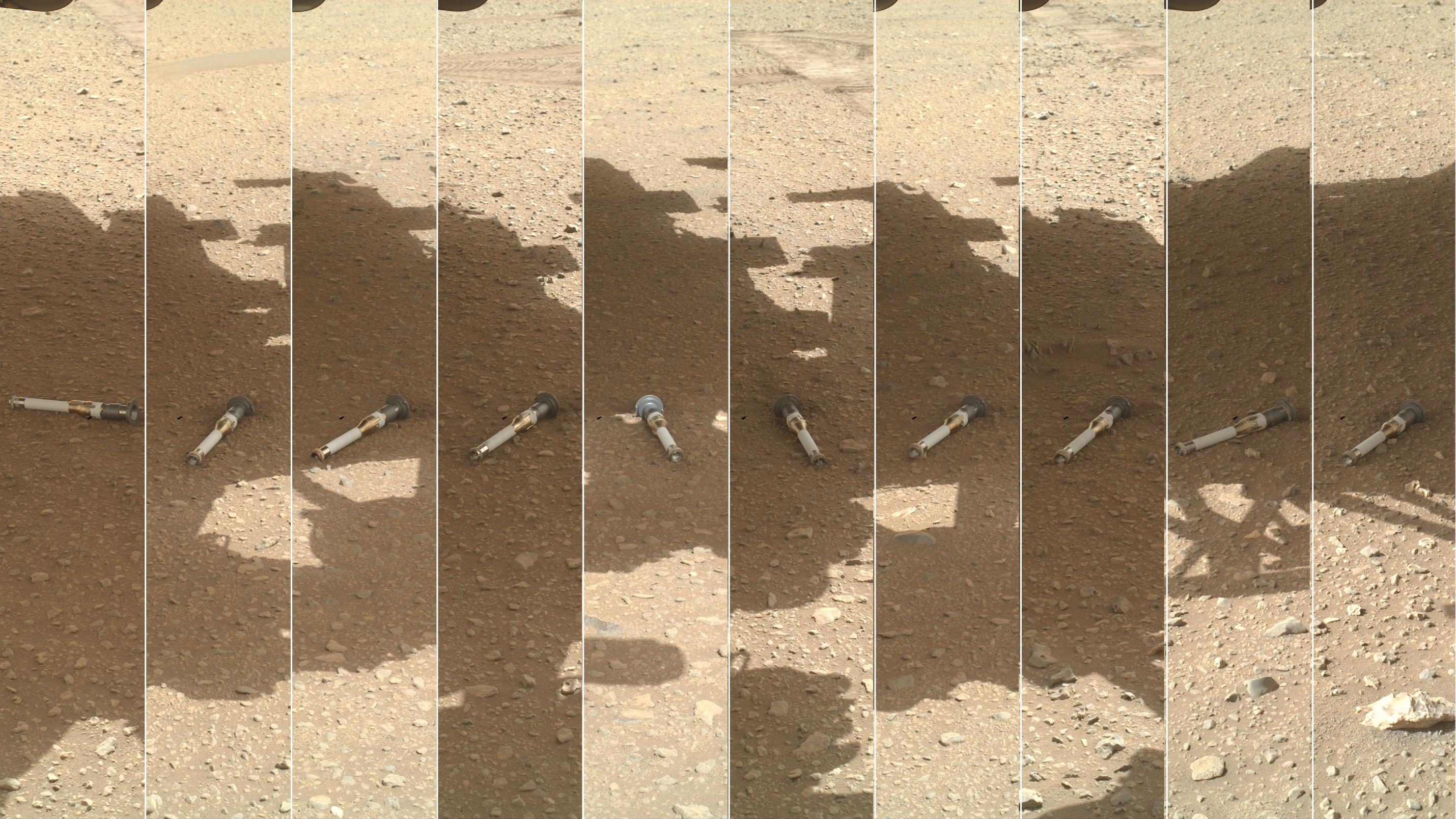


NASA’s Perseverance rover captured this portrait of its recently completed sample depot using its Mastcam-Z camera on Jan. 31, 2023, the 693rd Martian day, or sol, of the mission. Containing 10 samples, the depot is a crucial milestone in the NASA-ESA Mars Sample Return campaign. Credit: NASA/JPL-Caltech/ASU/MSSS Full Image Details
The Red Planet rover snapped a portrait of the sample depot it has assembled with 10 backup sample tubes that could be returned to Earth by a future mission.
Even space robots know what “pics or it didn’t happen” means: NASA’s Perseverance Mars rover provided a panorama of its recently completed sample depot – a big milestone for the mission and humanity’s first collection of samples on another planet. The panorama, stitched together from 368 images that were sent to Earth, captures more than a month of careful placement and mapping of 10 titanium tubes.
Eight of those tubes are filled with rock and regolith (broken rock and dust), while one is an atmospheric sample and one is a “witness” tube. The rover photographed the depot using the Mastcam-Z camera on the top of its mast, or “head,” on Jan. 31, 2023. The color has been adjusted to show the Martian surface approximately as it would look to the human eye.
The depot represents a backup collection of samples that could be recovered in the future by the Mars Sample Return campaign, a joint effort between NASA and ESA (European Space Agency) that aims to bring Mars samples to Earth for closer study. The rover began building the depot on Dec. 21, 2022, precisely spacing the tubes in case they need to be retrieved at a future date.

Perseverance built the depot at “Three Forks,” a location within Jezero Crater. Billions of years ago, a river flowed into the crater, carrying sediment that formed a steep, fan-shaped delta that the rover will drive up in the months ahead.
While the Martian surface is now cold, dry, and generally inhospitable to life, ancient Mars was likely similar to Earth – and could have supported microbial life, if any ever formed on the Red Planet. The samples Perseverance is collecting could help scientists determine whether life ever left its mark in a place like Jezero Crater.

More About the Mission
A key objective for Perseverance’s mission on Mars is astrobiology, including the search for signs of ancient microbial life. The rover will characterize the planet’s geology and past climate, pave the way for human exploration of the Red Planet, and be the first mission to collect and cache Martian rock and regolith (broken rock and dust).
Subsequent NASA missions, in cooperation with ESA (European Space Agency), would send spacecraft to Mars to collect these sealed samples from the surface and return them to Earth for in-depth analysis.
The Mars 2020 Perseverance mission is part of NASA’s Moon to Mars exploration approach, which includes Artemis missions to the Moon that will help prepare for human exploration of the Red Planet.
JPL, which is managed for NASA by Caltech in Pasadena, California, built and manages operations of the Perseverance rover. Arizona State University leads the operations of the Mastcam-Z instrument, working in collaboration with Malin Space Science Systems in San Diego, on the design, fabrication, testing, and operation of the cameras, and in collaboration with the Neils Bohr Institute of the University of Copenhagen on the design, fabrication, and testing of the calibration targets.
For more about Perseverance:
News Media Contact
Andrew Good
Jet Propulsion Laboratory, Pasadena, Calif.
818-393-2433
[email protected]
Karen Fox / Alana Johnson
NASA Headquarters, Washington
301-286-6284 / 202-358-1501
[email protected] / [email protected]
Our humans need coffee too! Your support is highly appreciated, thank you!