


Astronomers from the Geneva Observatory and the National Centre of Competence in Research PlanetS have discovered an unusual planetary system orbiting a small star – a red dwarf called TOI-756, located not far from our solar system.
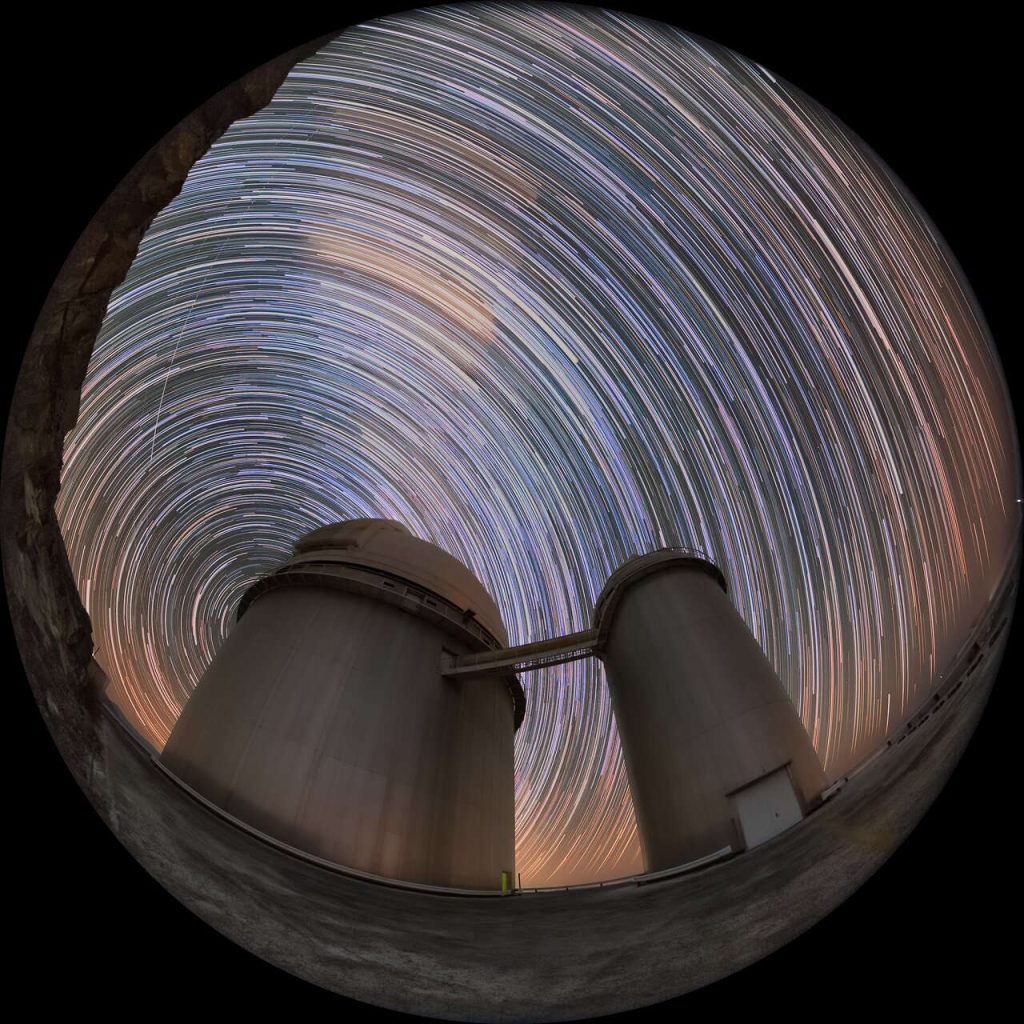
ESO’s 3.6-metre telescope is located in the large dome to the left of the photo above, and today astronomers use it to search for exoplanets. Since 2008, the telescope has housed the High Accuracy Radial Velocity Planet Searcher (HARPS) instrument, which was joined by the Near InfraRed Planet Searcher (NIRPS) in June 2022. Credit: ESO/M. Zamani
By combining two spectrographs developed by the Geneva Observatory, NIRPS and HARPS, with the TESS space telescope, the researchers discovered two very different planets orbiting the same star.
The inner planet, TOI-756 b, is a “sub-Neptune”—larger than Earth but smaller than Neptune, and enveloped in thick layers of gas- or water-rich material. It orbits its star in just 1.24 days, meaning its “year” lasts just under a weekend. Meanwhile, far away, the team discovered a massive, icy giant planet in an elongated, eccentric orbit, taking nearly 150 days to complete one orbit. This strange duo—a small, hot world right next to the star and a massive, cold planet much further away—is the first confirmed example of such planetary architecture around a red dwarf.
Red dwarfs are the most common stars in our galaxy, and understanding how planets form around them is therefore essential. Yet, until now, we had never observed this arrangement around this type of star. This suggests that planetary systems around red dwarfs could be far more diverse and complex than previously thought.
More interestingly, TOI-756 b lies at the edge of the “Hot Neptune Desert,” a region in the planet distribution where no planets exist. TOI-756 b could therefore be an ideal target for the James Webb Space Telescope to probe its atmosphere and help scientists better understand the mechanisms responsible for this peculiarity.
This is just the beginning: NIRPS is now revealing planetary systems that previous instruments could not detect—and TOI-756 could be one of the first surprises to come.
Publication : https://www.aanda.org/10.1051/0004-6361/202555684
Originally published at: University of Geneva
Our humans need coffee too! Your support is highly appreciated, thank you!

